Can Neutral Remain Neutral

2–3 minutes

I had two waking thoughts:

  1. Gendered language
  2. Fairness

I just published a post on Substack about the issue of gendered language. I’ll save fairness for another day.

Audio: NotebookLM summary podcast of this topic.

Rather than rehash the Substack essay, I thought it might be a better idea to discuss the meta of it.

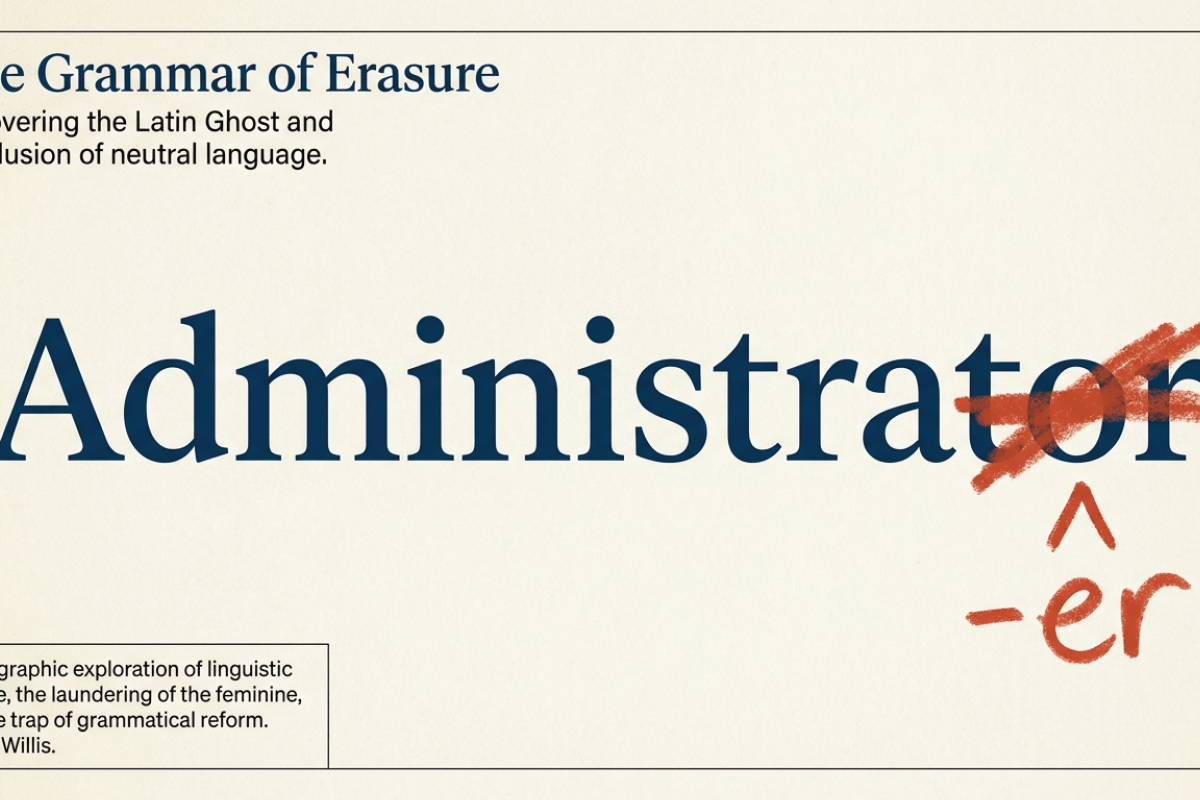
My initial thought was to rid the English language of administrators and dominatrices. Of course, I instantly considered French, and I write about that as well.

Here, I want to discuss the rift in Feminism:

  1. One faction feels that we should eliminate sexist terms in the Modern world. This is where I was coming from.
  2. Another faction claims this is a way of not being absorbed into an already male-dominated, dare I say, patriarchal culture.

Hence the title of this post.

If we were to swap or consolidate administrator and the less common administratrix into administrater in an act of rebellious conformity, women will be subsumed. As Simone de Beauvoir notes, the dominant lens is the male lens. Woman is other. As I say, this is why we have male and female versions of many, if not most, competitive sports, and certainly the professional ones. Thi sis also an instinct underlying trans-athletes competing in a contrasport – and it’s almost always about CIS-males performing in CIS-female events. I’m not aware of the contrary – and I don’t feel like looking it up. Opponents imagine fit males dressing as females in order to win some ribbons and medals, but I don’t really care to engage further in this conversational framing. I have no interest in sports, not even the World Cup being performed in my backyard.

The point is that females and other so-called minorities can be marginalised and lost to language. We preserve this identity through mechanics such as Best Actress to ensure representation.

Of course, I can also run off the reservation and down any number of rabbit holes: why don’t we have best black actor and/or actress? Why not left-handed? Height ranges? Weight ranges? Income ranges? Religious orientation? We quickly run into an intersectional challenge. I might imagine something like:

And I am proud to announce the winner of best left-handed, Asian Buddhist actress with a speech impediment

It’s easy to see where this goes off the rails – another Sorites problem hiding in plain sight.

I could go on. I won’t, but I wanted to make a point about my point. Check out the base post on Substack.
Enough, Anough, and the Archaeology of Small Mistakes

2–3 minutes

I have acquired a minor but persistent defect. When I try to type enough, my fingers often produce anough. Not always. Often enough to notice. Enough to be, regrettably, anough.

This is not a simple typo. The e and a keys are not conspirators with shared borders. This is not owned → pwned, where adjacency and gamer muscle memory do the heavy lifting. This is something more embarrassing and more interesting: a quasi-phonetic leak. A schwa forcing its way into print without permission. A clue for how I pronounce the word – like Depeche Mode’s I can’t get enough.

Audio: NotebookLM summary podcast of this topic.

Internally, the word arrives as something like ənuf, /əˈnʌf/. English, however, offers no schwa key. So the system improvises. It grabs the nearest vowel that feels acoustically honest and hopes orthography won’t notice. Anough slips through. Language looks the other way.

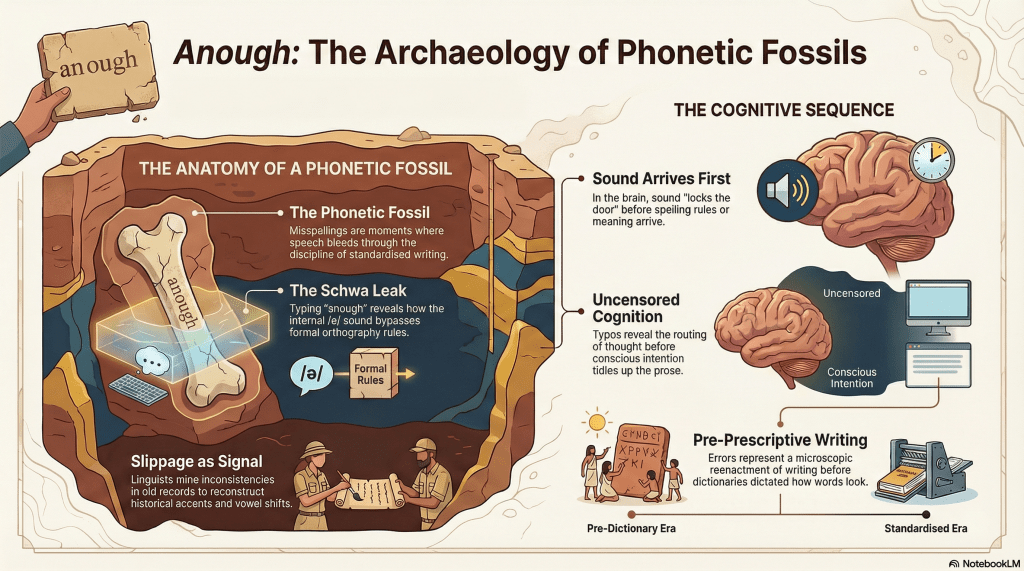
Image: Archaeology of anough
Video: Depeche Mode: I Just Can’t Get Enough

Is this revelatory?

Not in the heroic sense. No breakthroughs, no flashing lights. But it is instructive in the way cracked pottery is instructive. You don’t learn anything new about ceramics, but you learn a great deal about how the thing was used.

This is exactly how historians and historical linguists treat misspellings in diaries, letters, and court records. They don’t dismiss them as noise. They mine them. Spelling errors are treated as phonetic fossils, moments where the discipline of standardisation faltered, and speech bled through. Before spelling became prescriptive, it was descriptive. People wrote how words sounded to them, not how an academy later insisted they ought to look.

That’s how vowel shifts are reconstructed. That’s how accents are approximated. That’s how entire sound systems are inferred from what appear, superficially, to be mistakes. The inconsistency is the data. The slippage is the signal.

Anough belongs to this lineage. It’s a microscopic reenactment of pre-standardised writing, occurring inside a modern, over-educated skull with autocorrect turned off. For a brief moment, sound outranks convention. Orthography lags. Then the editor arrives, appalled, to tidy things up.

What matters here is sequence. Meaning is not consulted first. Spelling rules are not consulted first. Sound gets there early, locks the door, and files the paperwork later. Conscious intention, as usual, shows up after the event and claims authorship. That’s why these slips are interesting and why polished language is often less so. Clean prose has already been censored. Typos haven’t. They show the routing. They reveal what cognition does before it pretends to be in charge.

None of this licenses forensic grandstanding. We cannot reconstruct personalities, intentions, or childhood trauma from rogue vowels. Anyone suggesting otherwise is repackaging graphology with better fonts. But as weak traces, as evidence that thought passes through sound before it passes through rules, they’re perfectly serviceable.

Language doesn’t just record history. It betrays it. Quietly. Repeatedly. In diaries, in marginalia, and occasionally, when you’re tired and trying to say you’ve had enough. Or anough.

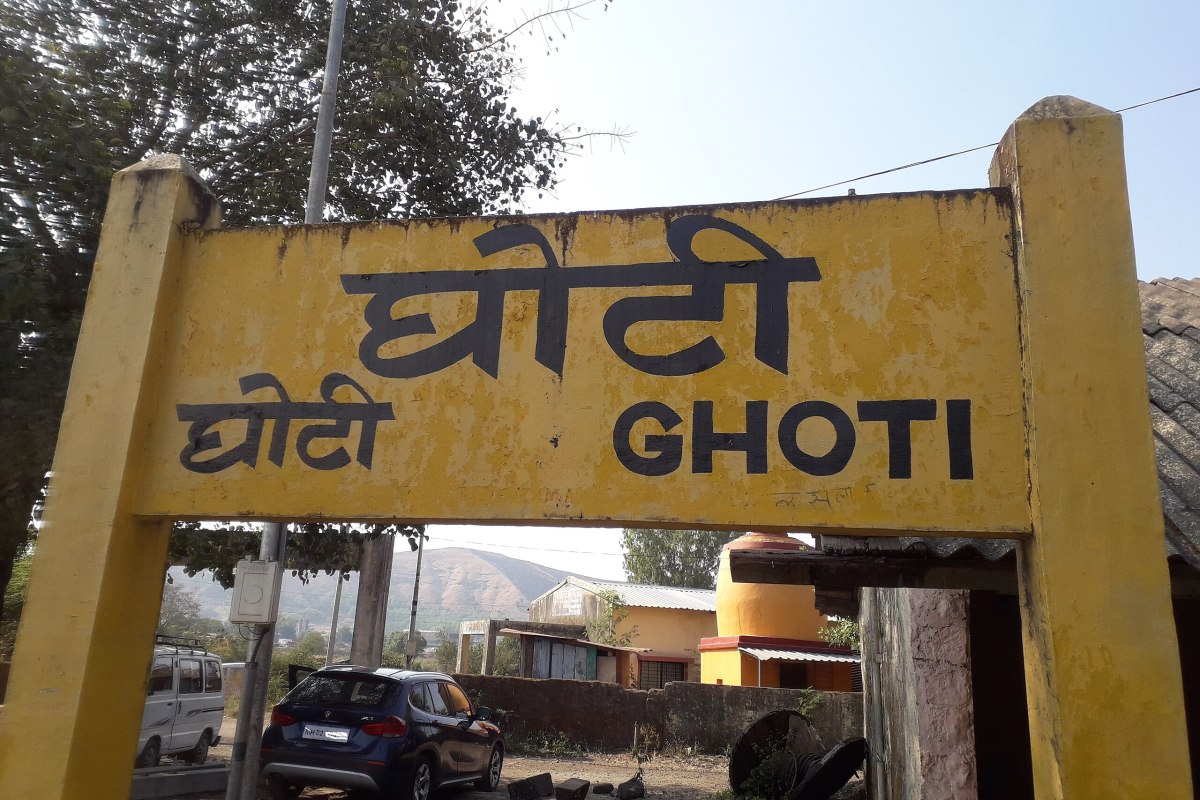
I’ll spare you a rant on ghoti.