A Brief and Largely Accurate History of Punctuation

1–2 minutes

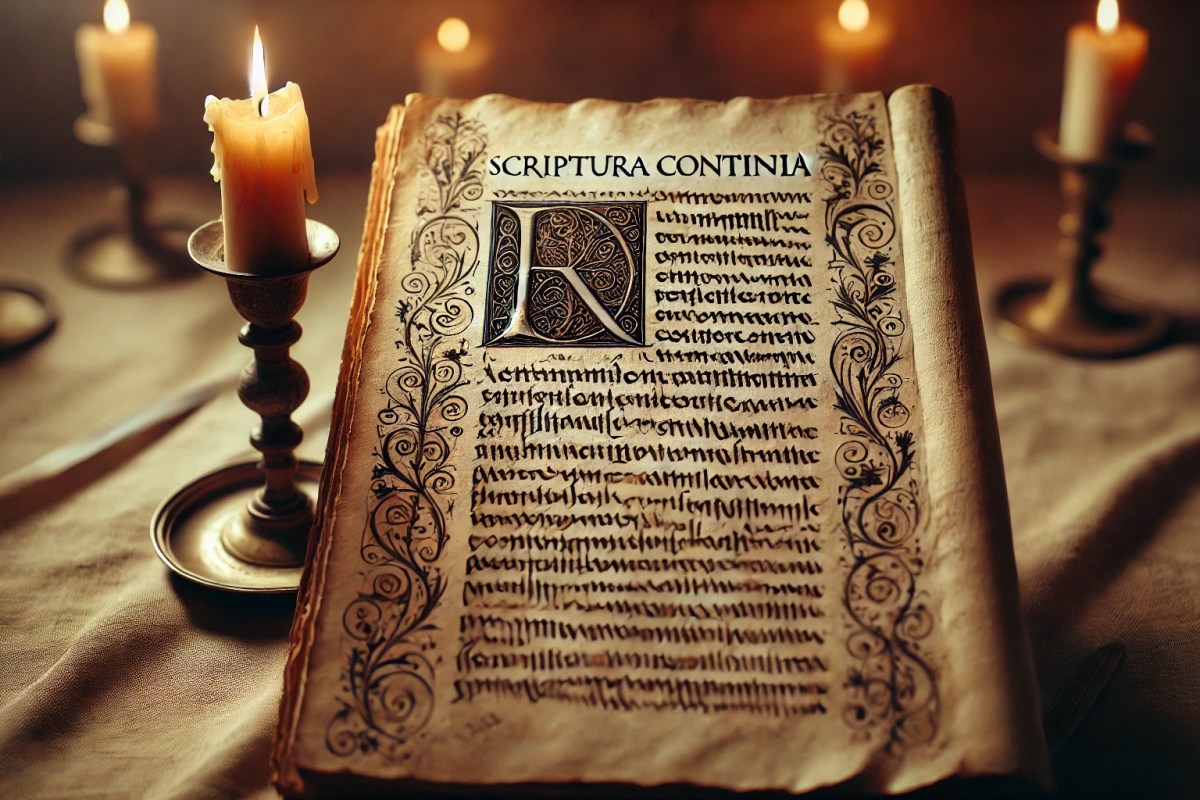
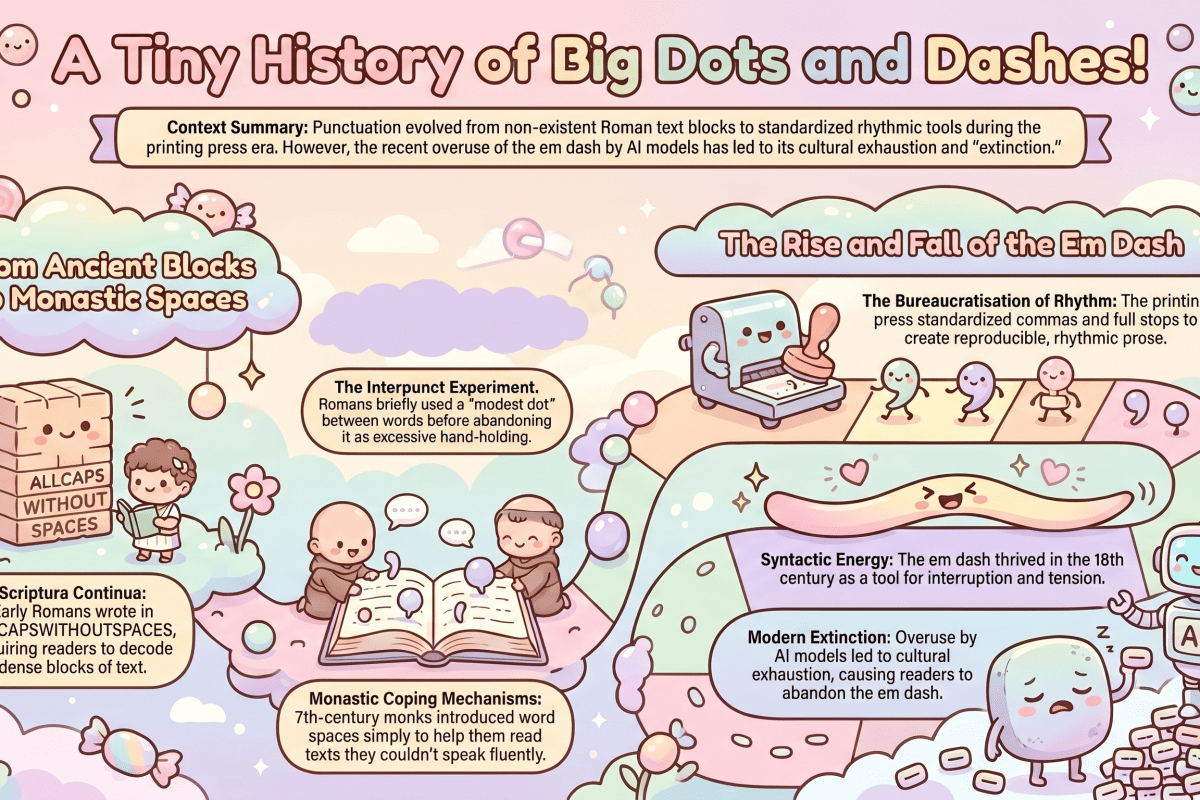
For most of human history, written Latin looked something like THISISASENTENCEABOUTPHILOSOPHYORWARYOUCHOOSE, and readers were simply expected to get on with it. And of course, in ALL CAPS. This was not considered a problem. The Romans were not known for their sensitivity to the needs of others.

The Romans did, briefly, experiment with the interpunct – a modest dot deployed between words, giving the reader something like THIS·IS·A·SENTENCE·ABOUT·PHILOSOPHY·OR·WAR·YOU·CHOOSE – before apparently deciding this was excessive hand-holding and abandoning it entirely. Punctuation’s first appearance in Western prose was thus also its first act of self-destruction. A precedent, as we shall see, that held.

Audio: NotebookLM summary podcast of this topic.

Relief came, eventually, from the most unlikely of sources: monks. Specifically, Irish and Anglo-Saxon monks in the 7th and 8th centuries, who were copying Latin texts they couldn’t actually read fluently, and who introduced spaces between words as a personal coping mechanism. Civilisation has strange bedfellows.

The comma, the full stop, and their assorted relatives arrived with the printing press – Aldus Manutius and the Venetian humanists essentially standardising the breath-marks of prose into something reproducible at scale. Punctuation became, in this period, the bureaucratisation of rhythm. A noble project. Mildly tyrannical in execution.
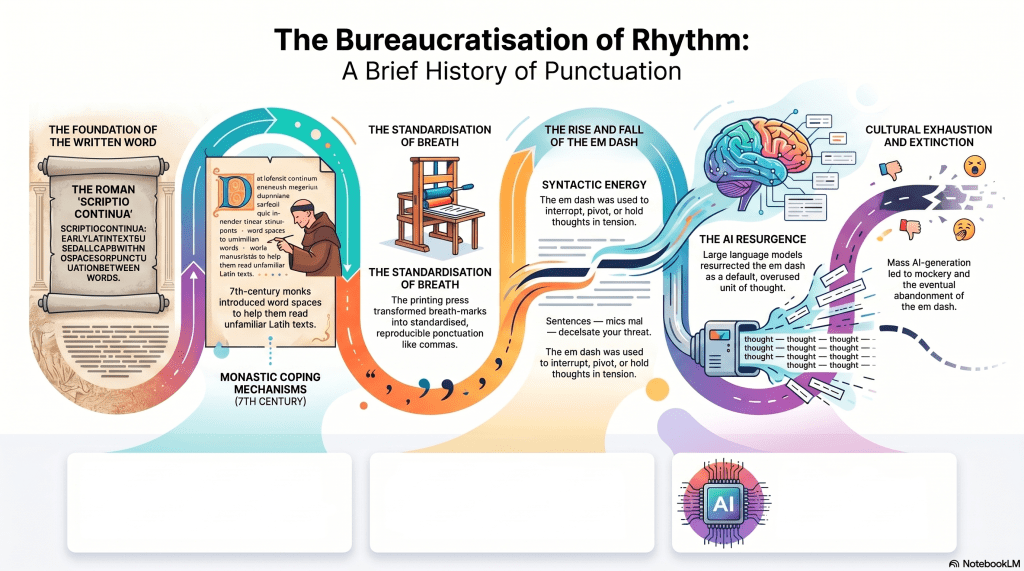
The em dash, meanwhile, had an entirely respectable career throughout the 18th and 19th centuries — a mark of genuine syntactic energy, used to interrupt, to pivot, to hold two thoughts in productive tension — before being left largely to the eccentric and the emphatic.

Then came the large language models. Within approximately eighteen months, the em dash was resurrected from the dead to become the default unit of thought, issuing them faster than Oprah Christmas giveaways. Every clause got one. Sometimes a sentence received two, bracketing a thought that required neither a bracket nor a thought. The em dash ceased to mean interruption and began to mean I am text generated at scale. Readers noticed. Then they mocked it. Then, following the immutable logic of cultural exhaustion, they stopped using it entirely. The em dash is now extinct — which is a shame, really.

Accusations of Writing Whilst Artificial

2–3 minutes

Accusations of writing being AI are becoming more common – an irony so rich it could fund Silicon Valley for another decade. We’ve built machines to detect machines imitating us, and then we congratulate ourselves when they accuse us of being them. It’s biblical in its stupidity.

A year ago, I read an earnest little piece on ‘how to spot AI writing’. The tells? Proper grammar. Logical flow. Parallel structure. Essentially, competence. Imagine that – clarity and coherence as evidence of inhumanity. We’ve spent centuries telling students to write clearly, and now, having finally produced something that does, we call it suspicious.

Audio: NotebookLM podcast on this topic and the next one.

My own prose was recently tried and convicted by Reddit’s self-appointed literati. The charge? Too well-written, apparently. Reddit – where typos go to breed. I pop back there occasionally, against my better judgment, to find the same tribunal of keyboard Calvinists patrolling the comment fields, shouting ‘AI!’ at anything that doesn’t sound like it was composed mid-seizure. The irony, of course, is that most of them wouldn’t recognise good writing unless it came with upvotes attached.

Image: A newspaper entry that may have been generated by an AI with the surname Kahn. 🧐🤣

Now, I’ll admit: my sentences do have a certain mechanical precision. Too many em dashes, too much syntactic symmetry. But that’s not ‘AI’. That’s simply craft. Machines learned from us. They imitate our best habits because we can’t be bothered to keep them ourselves. And yet, here we are, chasing ghosts of our own creation, declaring our children inhuman.

Apparently, there are more diagnostic signs. Incorporating an Alt-26 arrow to represent progress is a telltale infraction → like this. No human, they say, would choose to illustrate A → B that way. Instead, one is faulted for remembering – or at least understanding – that Alt-key combinations exist to reveal a fuller array of options: …, ™, and so on. I’ve used these symbols long before AI Wave 4 hit shore.

Interestingly, I prefer spaced en dashes over em dashes in most cases. The em dash is an Americanism I don’t prefer to adopt, but it does reveal the American bias in the training data. I can consciously adopt a European spin; AI, lacking intent, finds this harder to remember.

I used to use em dashes freely, but now I almost avoid them—if only to sidestep the mass hysteria. Perhaps I’ll start using AI to randomly misspell words and wreck my own grammar. Or maybe I’ll ask it to output everything in AAVE, or some unholy creole of Contemporary English and Chaucer, and call it a stylistic choice. (For the record, the em dashes in this paragraph were injected by the wee-AI gods and left as a badge of shame.)

Meanwhile, I spend half my time wrestling with smaller, dumber AIs – the grammar-checkers and predictive text gremlins who think they know tone but have never felt one. They twitch at ellipses, squirm at irony, and whimper at rhetorical emphasis. They are the hall monitors of prose, the petty bureaucrats of language.

And the final absurdity? These same half-witted algorithms are the ones deputised to decide whether my writing is too good to be human.

The Spaces Between: A Punctuated History

Language is a fickle thing. Spoken words are fleeting vibrations in the air, while the written word stands still, preserved for all eternity—or at least until someone spills a cup of tea on it. But as it turns out, the way we write things down is just as much a human invention as the words themselves. And perhaps nothing exemplifies this better than the simple, unassuming space.

You see, in the early days, spaces between words didn’t exist at all. Latin texts were written in something called scriptura continua, which, if you’re imagining an interminable block of unbroken letters, is exactly what it was. There were no spaces, no commas, and certainly no handy full stops to tell you when you’d reached the end of a thought. If you’re feeling brave, try reading a page of dense prose without any breaks, and you’ll see just how taxing it must have been. Not for the faint-hearted, especially if your reading material consisted of ancient Roman tax codes or Cicero’s less thrilling speeches.

Originally, Romans tried to manage the chaos with something called the interpunct—a little dot, mid-height, between words. Cute, right? But these mid-dots weren’t as convenient as you’d think. They eventually fell out of fashion, leaving words to once again pile up against each other like an anxious crowd waiting for a delayed train. It wasn’t until some resourceful monks in the seventh century thought, “This is ridiculous, let’s make reading less like mental acrobatics,” that the concept of word spacing, as we know it, truly took off. Hats off to those monks, honestly—turning scriptura continua into something you could read without a magnifying glass and a headache.

And then, along came punctuation. Oh, punctuation! The glorious marks that tell us when to pause, when to stop, and when to yell in sheer disbelief—like the question mark (?!), when you discover early Latin, had none of these. The dots got demoted, moved down to the bottom of the line, and eventually became full stops. Punctuation began as a tool for reading aloud—a sort of musical notation for the voice—but evolved into something to guide the eye, allowing the inner voice to navigate text without getting lost.

The spaces and dots may seem like minor players, but they were transformative. They laid the foundation for silent reading, which revolutionised the entire act of reading itself. No longer were texts simply prompts for orators to recite; they became private journeys into the mind. By the time the printing press rolled around, spaces and punctuation were firmly in place, making it possible for literacy to spread and for people to sit in quiet corners, reading for pleasure. Who would have thought that the humble space—the “nothing” between words—would become a hero of the human intellect?

For a deeper dive into this rather niche but wildly fascinating history, check out Rob Words’ video on the subject here: Where Does Punctuation Come From?!. It’s well worth your time—a rollicking journey through the peculiarities of written language, spaces, and all the delightful stops along the way.

And remember, next time you type a message, mind the gap. It’s doing a lot more work than you think.