Me: I got an admission: I never enjoyed musical ear training – trying to name a pitch, interval, or chord.
You: That’s nice. So what?
Me: Well, let me tell you…
I’ve been doing a similar exercise… also involving ears. I’ve decided to engage in IPA phonetic ear training as part of my language curriculum, as it were.
I’ve created an Anki flashcard pack, of – as well as other things –phonetic symbols to match to the sound and vice versa. It’s harder than it sounds. Like pitch, if I play an A (Do) I can tell what an E (Sol) sounds like, a perfect fifth; but I can’t produce an E from vapour: If I hear it absent of musical information, I can’t name it; neither can I produce it without a reference. This is a limitation of relative pitch.
On a guitar, I can play an E relative to other strings, but I can’t tell you whether the A is pitched to 440 (top) or 432 (bottom).
440 Hz432 Hz
Of course, if you tell me the top sound is pitched to A-440 and ask if the second one is higher or lower, I can tell you that. Hooray for me. But if the A-432 was actually A-431, you’d have had me tricked.
You: Where’s this going?
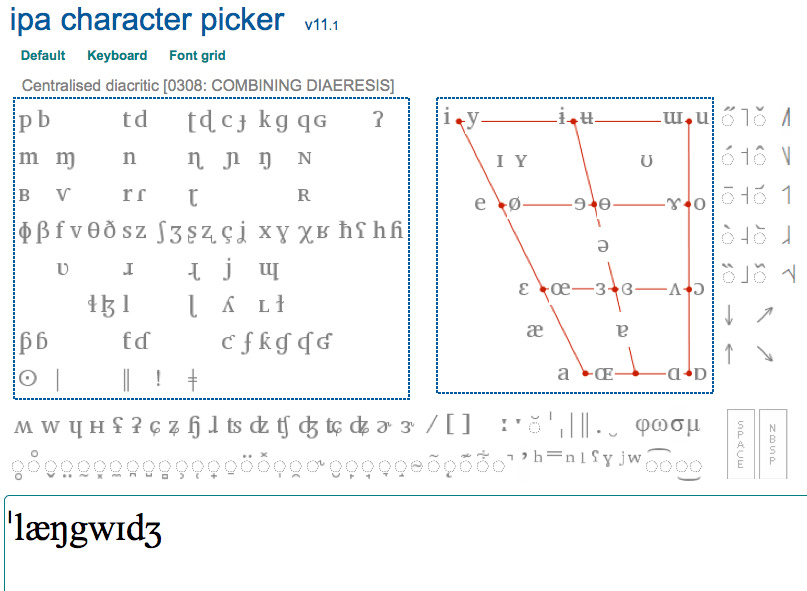
I experience the same challenge in my IPA studies. In context, if I hear an open and closed O sound – ɔ and o – I can tell you which is which, but I haven’t yet mastered the ability to utter these in the wild. I might be able to manage a nasal O – ɔ̃ – but we still haven’t arrived at the neighbours – ɵ, ɞ, ɤ, and so on. Source. Here’s a random or at least arbitrary IPA site.
I wonder if you people have perfect pitch in this regard.
I have acquired a minor but persistent defect. When I try to type enough, my fingers often produce anough. Not always. Often enough to notice. Enough to be, regrettably, anough.
This is not a simple typo. The e and a keys are not conspirators with shared borders. This is not owned → pwned, where adjacency and gamer muscle memory do the heavy lifting. This is something more embarrassing and more interesting: a quasi-phonetic leak. A schwa forcing its way into print without permission. A clue for how I pronounce the word – like Depeche Mode’s I can’t get enough.
Audio: NotebookLM summary podcast of this topic.
Internally, the word arrives as something like ənuf, /əˈnʌf/. English, however, offers no schwa key. So the system improvises. It grabs the nearest vowel that feels acoustically honest and hopes orthography won’t notice. Anough slips through. Language looks the other way.
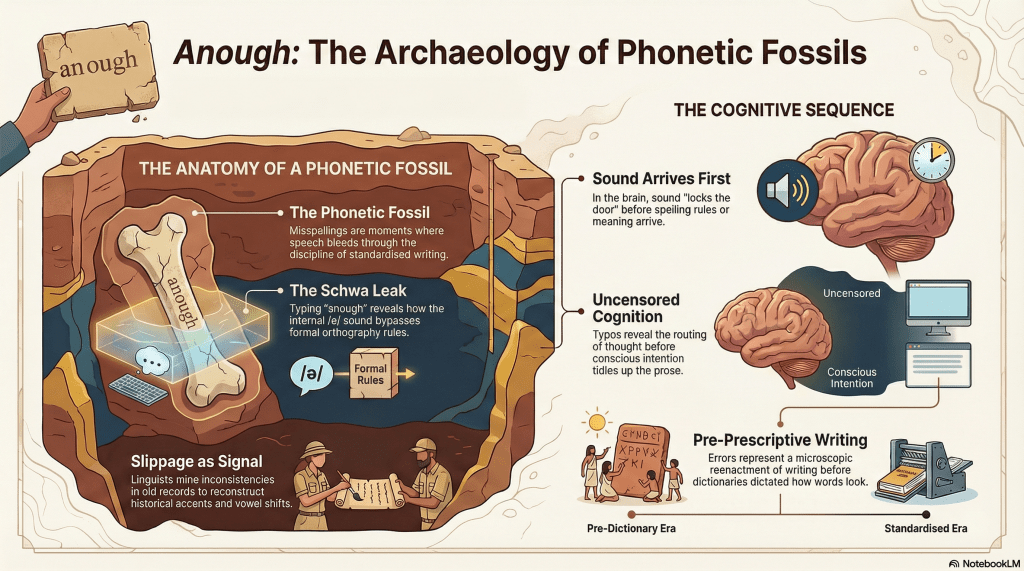
Image: Archaeology of anough
Video: Depeche Mode: I Just Can’t Get Enough
Is this revelatory?
Not in the heroic sense. No breakthroughs, no flashing lights. But it is instructive in the way cracked pottery is instructive. You don’t learn anything new about ceramics, but you learn a great deal about how the thing was used.
This is exactly how historians and historical linguists treat misspellings in diaries, letters, and court records. They don’t dismiss them as noise. They mine them. Spelling errors are treated as phonetic fossils, moments where the discipline of standardisation faltered, and speech bled through. Before spelling became prescriptive, it was descriptive. People wrote how words sounded to them, not how an academy later insisted they ought to look.
That’s how vowel shifts are reconstructed. That’s how accents are approximated. That’s how entire sound systems are inferred from what appear, superficially, to be mistakes. The inconsistency is the data. The slippage is the signal.
Anough belongs to this lineage. It’s a microscopic reenactment of pre-standardised writing, occurring inside a modern, over-educated skull with autocorrect turned off. For a brief moment, sound outranks convention. Orthography lags. Then the editor arrives, appalled, to tidy things up.
What matters here is sequence. Meaning is not consulted first. Spelling rules are not consulted first. Sound gets there early, locks the door, and files the paperwork later. Conscious intention, as usual, shows up after the event and claims authorship. That’s why these slips are interesting and why polished language is often less so. Clean prose has already been censored. Typos haven’t. They show the routing. They reveal what cognition does before it pretends to be in charge.
None of this licenses forensic grandstanding. We cannot reconstruct personalities, intentions, or childhood trauma from rogue vowels. Anyone suggesting otherwise is repackaging graphology with better fonts. But as weak traces, as evidence that thought passes through sound before it passes through rules, they’re perfectly serviceable.
Language doesn’t just record history. It betrays it. Quietly. Repeatedly. In diaries, in marginalia, and occasionally, when you’re tired and trying to say you’ve had enough. Or anough.
This video on accents was nice –a welcome diversion. In truth, it devoured the time I’d planned to spend writing something original, so I’m sharing it instead.
It’s by Dr Geoff Lindsey, a linguist whose work I rate highly. Using Gary Stevenson and Jimmy the Giant as case studies, he explores how accents quietly gatekeep credibility and upward mobility in Britain. The experiment is clever, the cultural archaeology even better.
Watching it as an American raised in New England, I found the whole exercise oddly revealing. I can distinguish the accents, but I don’t carry the surrounding freight, so I was pulled more by persuasion than by prejudice. The Eliza Doolittle caricature feels distant enough to resist belief; Gary and Jimmy’s ‘poshified’ voices do not.
And of course, we have our own mess. In the US, Southern accents are coded as low-status, no matter the speaker’s education, yet many outsiders find them charming. Each side of the Atlantic has its class machinery; the gears are simply cut differently.


 Philosophics