
Anki Meets ChatGPT for Snacks in Paris for Lunch

5–7 minutes

I have been developing my French, so I rely on several primary resources.

Myself

This includes grammar books, novels and the rest of the traditional fare, some of which I have listed below. Books remain useful, despite their regrettable inability to generate notifications, harvest engagement or insist that one more chapter will transform your life.
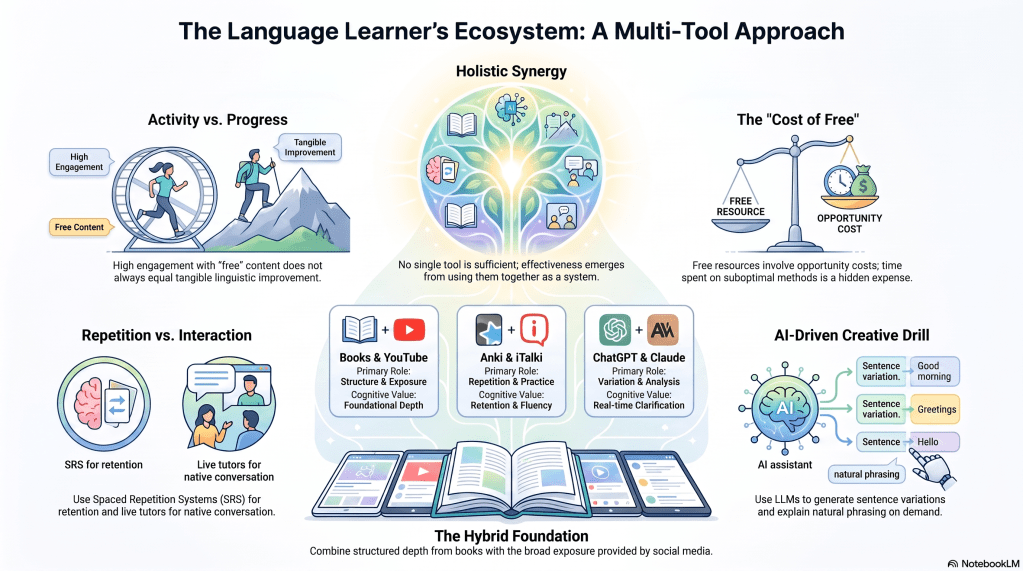
Audio: NotebookLM summary podcast of this topic.
NotebookLM Infographic on this topic.

YouTube and Such

Social media is a time sink, and YouTube is no exception. This is not to argue that I derive no value from either. I do. It is merely to observe that the cost-benefit calculation may not always be in my favour.

That said, I encounter many useful tips, ideas and sources of general exposure to French. These help with learning, relearning and noticing gaps in what I thought I already knew.

There is, however, a risk. People teach and learn differently. Some teachers also believe they understand how they themselves learned and construct a method around that retrospective account. Memory being the immaculate scientific instrument that it is, this can create difficulties.

The first is obvious. A teacher may misattribute the cause of their own success and teach what is merely a covariant feature of the process. The method may have accompanied their learning without producing it. Remove the principal variable and the supposed method may accomplish very little.

A related problem arises when learners do not yet understand how they themselves learn. They may spend hours following a method that is suboptimal or even counterproductive. On the other hand, the method might happen to suit them perfectly. It can be difficult to know in advance.

A teacher may also be ideal for a learner at A1 or A2, but less appropriate at B1, B2 or beyond. By then, however, familiarity has become comfort, and comfort can masquerade as progress. This seems worth bearing in mind.

Even so, YouTube contains an enormous amount of material at nearly every level. The problem is not scarcity but selection.

Anki

Anki is excellent for repetitive learning tasks. It is essentially a flashcard system on steroids, although with fewer alarming side effects.

Many decks have already been constructed and made available online. I happen to use Anki for language learning, but it would be useful for almost any flashcard-oriented task, including academic study or memorising recipes, should that be your peculiar ambition.

This post is little more than a reference to Anki for context, but I recommend exploring it. There are also plenty of YouTube resources explaining how to use it for different purposes.

Anki supports text, images, audio and video, so it is genuinely multimedia rather than merely a digital imitation of index cards.

I have been using it to retain and expand my French vocabulary and grammar because I live somewhere French is not especially available. I would be better situated if I wanted to learn Spanish or Portuguese, and perhaps several other languages. For now, I shall pass.

Many of the cards I have imported come from decks with names such as “Top 1,000 Common Words”, “100 Conjugated Verbs” and “50 Useful Travel Phrases”. After enough examples involving “She has an apple”, “She gave him an apple” and “He would like her to give an apple to his father”, my mind wandered towards Snow White and poisoned apples.

In English, one may speak of a poison apple, treating poison as an attributive noun, or of a poisoned apple, in which poisoned describes what has happened to it. French does not ordinarily preserve the first construction unless one is deliberately inventing a literary compound. The natural French expression is:

Elle a mangé une pomme empoisonnée.
She ate a poisoned apple.

I asked ChatGPT about this. I shall spare you the full forensic inquiry into the apple. What interested me more was its suggestion that I diversify the examples in my deck.

iTalki

I use iTalki for live conversation with native speakers. Although I am not formally endorsing the platform, I recommend investigating it and have found it useful.

I have interacted with only two teachers, but I enjoyed working with each of them for different reasons. Lessons are relatively inexpensive, although rates vary considerably between teachers. They are not as cheap as YouTube or Anki because they are not free, but, as an economist, I also take opportunity costs into account.

Spending hours on a free platform without acquiring any durable knowledge still entails a cost. Free is not synonymous with costless, despite what several business models would prefer us to believe.

I am not trying to sell anyone on iTalki or a similar service, but one can sample it fairly cheaply. A lesson might cost about the same as a cup or two of aggressively marketed coffee. Since I do not drink coffee, I already have the necessary budgetary fiction in place.

ChatGPT and Claude

I also use ChatGPT and Claude frequently. In this case, ChatGPT suggested several variations that retained the grammatical structure while making the sentences slightly less lifeless:

Elle a mangé une pomme empoisonnée.
She ate a poisoned apple.

Elle a mangé une pomme pourrie.
She ate a rotten apple.

Elle a mangé une pomme volée.
She ate a stolen apple.

Elle a mangé une pomme interdite.
She ate a forbidden apple.

Elle a mangé une pomme étrange.
She ate a strange apple.

This is a minor use of a large language model, but a useful one. It can produce controlled variations, introduce vocabulary I have not encountered often and help prevent repetitive exercises from collapsing into grammatical wallpaper.

It can also explain why one construction sounds natural and another does not, generate examples at a particular level and create drills around a specific weakness. Naturally, its answers still require scrutiny. Confidently delivered nonsense remains nonsense, even when it arrives with immaculate formatting.

Taken together, these resources serve different functions. Books provide structure and depth. YouTube supplies exposure and ideas. Anki makes repetition tolerable. iTalki provides live interaction. Language models generate variations and explanations on demand.

None is sufficient by itself. Used together, however, they form a reasonably effective learning environment, provided one continues to distinguish activity from progress. The first is easy to measure. The second is what all the activity was supposedly for.


NB: I wrote this by hand and passed it through ChatGPT to clean it up. Let’s call it 95% human authored and call it a day.

Image: Gemini Nano Banana Pro’s first mis-render. This and the cover image are intentionally stereotypically satirical.

Operant Chickens

As with chickens, humans can learn through reinforcement AKA operant conditioning.

In this video clip, we see a chicken learning that pecking a red circle yields a payload of food. Yet there is a problem with this algorithm. I don’t expect this study was meant to elucidate this point, but I’ll continue.

Except for one instance where the blue circle was pecked to yield nothing, the chicken learned that packing the red yielded a treat and so became fixed on seeking the red. What the chicken did not explore where the other colours—beige, green, and yellow. Perhaps these might have had a larger payout or a ‘better’ reward. Perhaps even a penalty or punishment, but I’ll ignore that eventuality.

The point is that through operant conditioning, the chicken is habituated. I feel that this is a metaphor for many such habituations in humans. People are indoctrinated (habituated) into all sorts of beliefs and behaviours, from the organisation of social and political systems to economic systems.

When I see people defending Democracy as Churchill did as “the worst form of government, but the best so far,” I can’t help but consider the parallels: Democracy is the red dot; capitalism is the red dot.

This not being a self-help blog, I’ll mention is passing the routines we get ourselves into that are analogous to this chicken—wandering through the world as if with blinders. The difference between a rut and a grave is the depth or dimensions. Are you in a rut on your way to the grave?

This is all I wanted to say. No chickens were harmed during the production of this blog entry.

Houston, we have a problem

EDIT: Since I first posted this, I’ve discovered that computer algorithms and maths are not playing well together in the sandbox. Those naughty computer geeks are running rogue from the maths geeks.

In grade school, we typically learn a form of PEMDAS as a mnemonic heuristic for mathematical order of operations. It’s a stand-in for Parentheses, Exponents, Multiplication, Division, Addition, and Subtraction. This may be interpreted in different ways, but I’ve got bigger fish to fry. It turns out that many (if not most) programming languages don’t implement around a PEMDAS schema. Instead, they opt for BODMAS, where the B and O represent Brackets and Orders—analogous to Parentheses and Exponents. The important thing to note is the inversion of MD to DM, as this creates discrepancies.

And it doesn’t end here. HP calculators interject a new factor, multiplication by juxtaposition, that mathematician and YouTuber, Jenni Gorham, notates as J resulting in PEJMDAS. This juxtaposition represents the implied multiplication as exemplified by another challenge;

1 ÷ 2✓3 =

In this instance, multiplication by juxtaposition instructs us to resolve 2✓3 before performing the division. Absent the J, the calculation results in ½✓3 rather than the intended 1/(2✓3). As with this next example, simply adding parentheses fixes the problem. Here’s a link to her video:

And now we return to our originally scheduled programming…

Simplifying concepts has its place. The question is where and when. This social media war brings this back to my attention.

As depicted in the meme, there is a difference of opinion as to what the answer is to this maths problem.

6 ÷ 2 ( 1 + 2 ) =

In grade school, children are taught some variation of PEMDAS, BOMDAS, BEDMAS, BIDMAS, or whatever. What they are not taught is that this is a regimented shortcut, but it doesn’t necessarily apply to real-world applications. The ones defending PEMDAS are those who have not taken maths beyond primary school and don’t use maths beyond some basic addition and subtraction. Luckily, the engineers and physicists who need to understand the difference, generally, do.

Mathematicians, scientists, and engineers have learned to transform the equation into the form on the left, yielding an answer of 1. If your answer is 9, you’ve been left behind.

Why is this such a big deal?

When I taught undergraduate economics, I, too, had to present simplifications of models. In practice, the approach was to tell the students that the simplification was like that in physics. At first, you assume factors like gravity and friction don’t exist—fewer variables, fewer complexities. The problem, as I discovered in my advanced studies, is that in economics you can’t actually relax the assumptions. And when you do, the models fail to function. So they only work under assumptions that cannot exist in the real world—things like infinite suppliers and demanders. Even moving from infinite to a lot, breaks the model. Economists know this, and yet they teach it anyway.

When I transitioned from undergrad to grad school, I was taken aback by the number of stated assumptions that were flat out wrong.

When I transitioned from undergrad to grad school, I was taken aback by the number of stated assumptions that were flat out wrong. Not only were these simplifications flat out wrong, but they also led to the wrong conclusion—the conclusion that aligned with the prevailing narratives.

This led me to wonder about a couple of things

Firstly, if I had graduated with an English degree and then became a PhD candidate in English, would I have also learnt it had mostly been a lie for the purpose of indoctrination?

Secondly, what other disciplines would have taught so much disinformation?

Thirdly, how many executives with degrees and finance and management only got the fake version?

Fourthly, how many executives hadn’t even gotten that? Perhaps they’d have had taken a class or two in each of finance and economics and nothing more. How many finance and economics courses does one need to take to get an MBA? This worries me greatly.

To be honest, I wonder how many other disciplines have this challenge. I’d almost expect it from so-called soft sciences, but from maths? Get outta here.

Half-life of knowledge

This also reminds me of the notion of the half-life of knowledge. What you knew as true may eventually no longer be. In this case, you were just taught a lie because it was easier to digest than the truth. In other cases, an Einstein comes along to change Newtonian physics into Oldtonian physics, or some wisenheimer like Copernicus determines that the cosmic model is heliocentric and not geocentric.

If you’ve been keeping up with my latest endeavour, you may be surprised that free will, human agency, identity, and the self are all human social constructs in need of remediation. Get ready to get out of your comfort zone or to entrench yourself in a fortress of escalating commitment.