
I have been developing my French, so I rely on several primary resources.
Myself
This includes grammar books, novels and the rest of the traditional fare, some of which I have listed below. Books remain useful, despite their regrettable inability to generate notifications, harvest engagement or insist that one more chapter will transform your life.
YouTube and Such
Social media is a time sink, and YouTube is no exception. This is not to argue that I derive no value from either. I do. It is merely to observe that the cost-benefit calculation may not always be in my favour.
That said, I encounter many useful tips, ideas and sources of general exposure to French. These help with learning, relearning and noticing gaps in what I thought I already knew.
There is, however, a risk. People teach and learn differently. Some teachers also believe they understand how they themselves learned and construct a method around that retrospective account. Memory being the immaculate scientific instrument that it is, this can create difficulties.
The first is obvious. A teacher may misattribute the cause of their own success and teach what is merely a covariant feature of the process. The method may have accompanied their learning without producing it. Remove the principal variable and the supposed method may accomplish very little.
A related problem arises when learners do not yet understand how they themselves learn. They may spend hours following a method that is suboptimal or even counterproductive. On the other hand, the method might happen to suit them perfectly. It can be difficult to know in advance.
A teacher may also be ideal for a learner at A1 or A2, but less appropriate at B1, B2 or beyond. By then, however, familiarity has become comfort, and comfort can masquerade as progress. This seems worth bearing in mind.
Even so, YouTube contains an enormous amount of material at nearly every level. The problem is not scarcity but selection.
Anki
Anki is excellent for repetitive learning tasks. It is essentially a flashcard system on steroids, although with fewer alarming side effects.
Many decks have already been constructed and made available online. I happen to use Anki for language learning, but it would be useful for almost any flashcard-oriented task, including academic study or memorising recipes, should that be your peculiar ambition.
This post is little more than a reference to Anki for context, but I recommend exploring it. There are also plenty of YouTube resources explaining how to use it for different purposes.
Anki supports text, images, audio and video, so it is genuinely multimedia rather than merely a digital imitation of index cards.
I have been using it to retain and expand my French vocabulary and grammar because I live somewhere French is not especially available. I would be better situated if I wanted to learn Spanish or Portuguese, and perhaps several other languages. For now, I shall pass.
Many of the cards I have imported come from decks with names such as “Top 1,000 Common Words”, “100 Conjugated Verbs” and “50 Useful Travel Phrases”. After enough examples involving “She has an apple”, “She gave him an apple” and “He would like her to give an apple to his father”, my mind wandered towards Snow White and poisoned apples.
In English, one may speak of a poison apple, treating poison as an attributive noun, or of a poisoned apple, in which poisoned describes what has happened to it. French does not ordinarily preserve the first construction unless one is deliberately inventing a literary compound. The natural French expression is:
Elle a mangé une pomme empoisonnée.
She ate a poisoned apple.
I asked ChatGPT about this. I shall spare you the full forensic inquiry into the apple. What interested me more was its suggestion that I diversify the examples in my deck.
iTalki
I use iTalki for live conversation with native speakers. Although I am not formally endorsing the platform, I recommend investigating it and have found it useful.
I have interacted with only two teachers, but I enjoyed working with each of them for different reasons. Lessons are relatively inexpensive, although rates vary considerably between teachers. They are not as cheap as YouTube or Anki because they are not free, but, as an economist, I also take opportunity costs into account.
Spending hours on a free platform without acquiring any durable knowledge still entails a cost. Free is not synonymous with costless, despite what several business models would prefer us to believe.
I am not trying to sell anyone on iTalki or a similar service, but one can sample it fairly cheaply. A lesson might cost about the same as a cup or two of aggressively marketed coffee. Since I do not drink coffee, I already have the necessary budgetary fiction in place.
ChatGPT and Claude
I also use ChatGPT and Claude frequently. In this case, ChatGPT suggested several variations that retained the grammatical structure while making the sentences slightly less lifeless:
Elle a mangé une pomme empoisonnée.
She ate a poisoned apple.
Elle a mangé une pomme pourrie.
She ate a rotten apple.
Elle a mangé une pomme volée.
She ate a stolen apple.
Elle a mangé une pomme interdite.
She ate a forbidden apple.
Elle a mangé une pomme étrange.
She ate a strange apple.
This is a minor use of a large language model, but a useful one. It can produce controlled variations, introduce vocabulary I have not encountered often and help prevent repetitive exercises from collapsing into grammatical wallpaper.
It can also explain why one construction sounds natural and another does not, generate examples at a particular level and create drills around a specific weakness. Naturally, its answers still require scrutiny. Confidently delivered nonsense remains nonsense, even when it arrives with immaculate formatting.
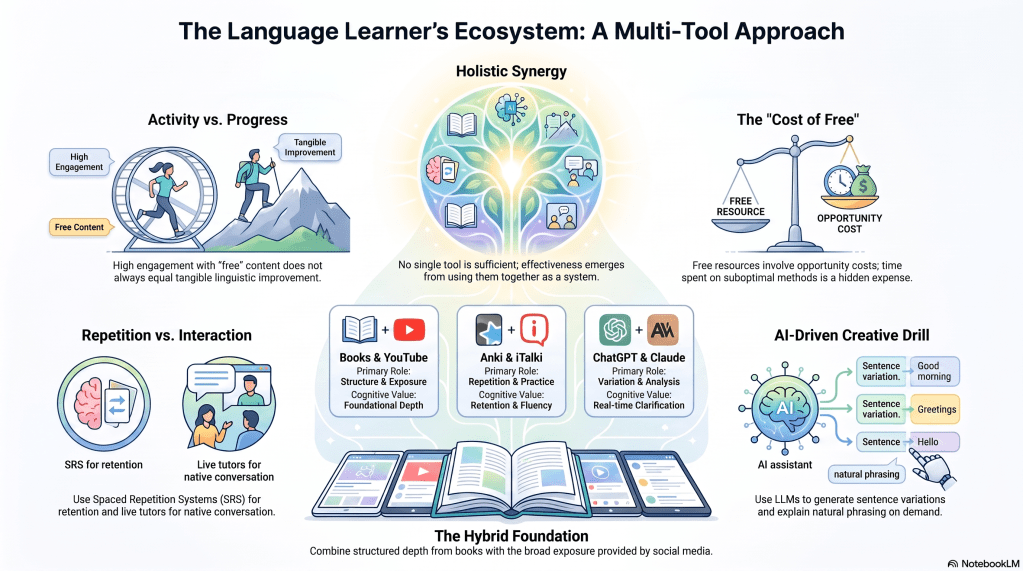
Taken together, these resources serve different functions. Books provide structure and depth. YouTube supplies exposure and ideas. Anki makes repetition tolerable. iTalki provides live interaction. Language models generate variations and explanations on demand.
None is sufficient by itself. Used together, however, they form a reasonably effective learning environment, provided one continues to distinguish activity from progress. The first is easy to measure. The second is what all the activity was supposedly for.
NB: I wrote this by hand and passed it through ChatGPT to clean it up. Let’s call it 95% human authored and call it a day.