Although I am not a linguist, I am a philosopher of language, so occasionally I cross into that territory through sheer love of the thing. I chat with a French interlocutor a couple of times a week, and today we discussed the French infinitive demander – a false friend (faux ami) in English, though a closer one than most.
Demander means to ask, not to demand, though an English speaker might notice that demanding is simply an elevated asking. Which raises the question: is there an elevated version of demander in French? It turns out there is – a whole ladder of them.
In English: to ask → to demand → to order → to command → to enjoin.
In French: demander → exiger → ordonner → commander → enjoindre.
(Enjoin, for those who’ve only met it in legal documents, is the formal instrument of judicial compulsion – to enjoin someone is to prohibit or require by court order. It earns its place at the top of the ladder.)
I won’t get into the full nuances of each term. I’ll leave that to a linguist. But the false friend problem is worth pursuing, because it’s more interesting than a simple mismatch.
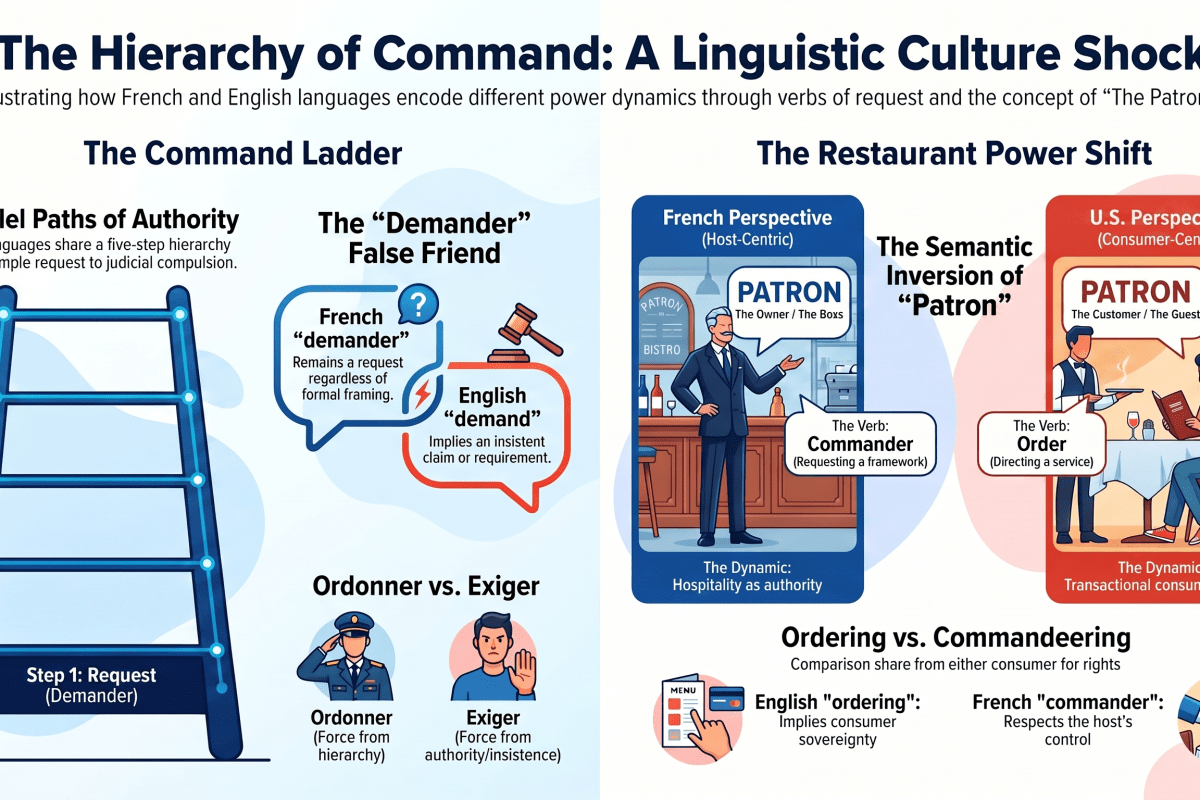
The trouble isn’t just that demander ≠ ‘demand’ etymologically. It’s that the English word ‘demand’ smuggles in a force condition that French distributes across different verbs depending on the source of that force. Exiger implies force from authority, entitlement, or insistence. Ordonner implies force from hierarchy – a command structure in which compliance is not optional. Demander, however formally framed, remains a request. English ‘demand’ collapses all of this into one word and leaves the source of force unspecified.
This becomes vivid with examples. A judge doesn’t demander; the authority relationship forecloses the mere-request reading entirely. Exiger captures the illocutionary force; this demand is backed by institutional power, and non-compliance has consequences. But a judicial order in English sits closer to ordonner than exiger; the court doesn’t merely insist, it commands with legal effect. And a military general? Ordonner again – unilateral, hierarchical, non-negotiable.
This brings us to restaurants, where things get strange. In English, customers order. The same verb a general uses. What gives?
Polysemy is the easy answer, but the cultural one is more interesting. The French model is closer to hospitality in the older sense – the restaurateur is the host, the diner is a guest, and the dynamic carries an implicit asymmetry in which the host has authority over the experience. One eats what is offered, at the pace the kitchen sets; complaining loudly is a breach of the guest’s role rather than an exercise of consumer rights. Commander fits this – one places a request within a framework that the host controls.
The American model inverts this. The customer is sovereign, the staff are in service to the customer’s preferences, and the transactional frame licenses a kind of authority that would read as rudeness in France. ‘Order’ in the American restaurant sense carries just enough of the command register to be revealing; you’re not asking, you’re directing.
This makes the English verb choice quietly ideological in a way the French isn’t. Commander is neutral about the power dynamic. English ‘order’ encodes the American consumer-as-patron assumption right into the lexicon.
And the word, patron, is almost too good to leave alone. In French, le patron is the boss, the owner, the one with authority. In American English, the patron is the customer. The semantic inversion is almost too neat to be coincidental. It maps the entire cultural difference onto a single word: in France, the restaurateur is the patron; in America, the diner is. When the two meet – a tête-à-tête between rival patrons – culture shock is the predictable result.

