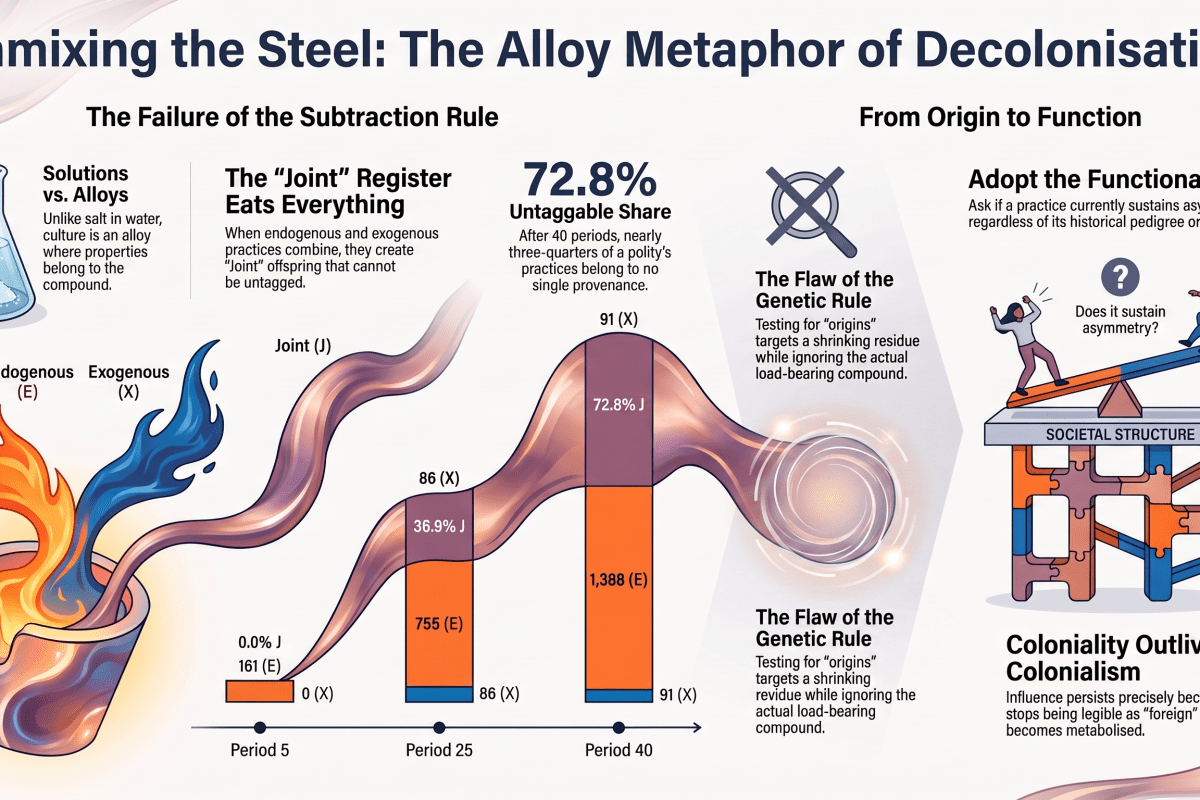
A toy model of why purification is the wrong verb – offered for dissent.
Addendum: Please note that I have added an endnote to this post to explain the maths a bit better.
Preamble
I continue to press on colonialism, but this time I look at possibilities and probabilities of extricating colonial influences. I suggest that this is easier said than done. I am no expert in colonialism, post-colonialism, or decolonialism, but I have an interest in philosophical claims and maths, so here I am. Here, I attack a particular model using the metaphor of reconstituting from an alloy. This may be the wrong practical argument, but I address it all the same.
Decolonising decolonisation
There is a picture of decolonisation so intuitive that it barely announces itself as a picture. Something foreign was introduced. The task is to get it out. Sift the flour, strain the tea, remove the intruder, and what remains is ours again. The picture is tidy, it is emotionally satisfying, and it licenses a rule: identify the imports by provenance, discard them, keep the rest.
Let me say at the outset what this essay is not, because the register invites misreading. It is not a defence of the Enlightenment’s colonial rationale, which I regard as indefensible. It is not a claim that nothing should be dismantled. I hold no brief for borders, nations, or the machinery that enforces them, and I am not about to acquire one in the space of fifteen hundred words. The argument is narrower and, I think, more awkward: the subtraction rule cannot be applied, not because it is politically inconvenient but because it is arithmetically malformed. If you want to dismantle something, you need a rule that can actually be run. Provenance is not one.
Wrong metaphor, slightly better metaphor
The usual image is a solution – salt in water. Evaporate the water, and you get your salt back. The image quietly promises that separation is a matter of energy and patience.
Alloys are less accommodating. Steel is not iron with carbon loitering nearby; the hardness belongs to the compound, not to either constituent. Better still, steel’s properties depend on its thermal path as much as its composition. Identical carbon content, quenched rather than annealed, gives you a different material. The map from ingredients to properties is many-to-one and runs in one direction only. You cannot read the recipe off the blade.
That is the metaphor I want, and I want it because it makes a specific claim rather than a mood: the question which properties are the coloniser’s? is not hard to answer. It is malformed. The properties in dispute are compound properties. They have no constituent-level owner to be returned to.
So I built a small arithmetic model to see whether that claim survives being made precise, or whether it evaporates like most metaphors do when you make them count.
What the model is for
Not evidence. Let me be blunt about this, since it is the first objection and it is correct. The model demonstrates nothing about actual history. The numbers are invented. There is no dataset, no measurement, no claim about any real polity.
Its use is different and, I’d argue, more honest than a model pretending to measure. It converts a rhetorical position into a set of rules, so that anyone who wants to disagree has to say which rule they reject rather than merely disliking the conclusion. That is a better argument than either of us shouting about purity. It also has the pleasant property of being able to embarrass its author, since a model can fail to produce the result you wanted, which is more than can be said for an essay.
The rules
Take a polity’s stock of practices – institutions, techniques, concepts, forms of life, whatever you like. Sort every element into three registers:
- E : endogenous-tagged. Arose from the inherited repertoire.
- X : exogenous-tagged. Imposed or imported from outside.
- J : joint. Generated by combining the two, and therefore tagged to neither.
Two rules govern the dynamics.
Recombination. Each period, new practice is generated by combining two elements drawn at random from the existing stock. The offspring is E only if both parents are E. It is X only if both are X. Otherwise – mixed parentage, or a parent that is itself already joint – it is J.
Injection. During the colonial window, a fixed quantity is added to X each period from outside. This is the imposition proper: it does not arise from the stock, it is put there.
Then run two timelines. B receives the injection. A does not – except that A receives a fraction of it anyway, because no polity in the relevant centuries was sitting outside the world colonialism was busy making. Meiji Japan was not a control group. It was adapting to a treated world. In the causal-inference idiom this is an interference violation; I have simply written it in as a leakage parameter rather than confessing it in a footnote.
Finally, a property index sits on top of composition: P = E + 0.6·X + 1.8·J. The large coefficient on J is the whole point of the alloy metaphor. The compound has properties neither constituent had.
Sample output
Forty periods, injection running from period 5 to 25, recombination at 10% of stock per period:
| period | E | X | J | J-share |
|---|---|---|---|---|
| 5 | 161 | 0 | 0 | 0.0% |
| 10 | 254 | 20 | 9 | 3.2% |
| 15 | 384 | 41 | 56 | 11.7% |
| 20 | 552 | 63 | 184 | 23.0% |
| 25 | 755 | 86 | 472 | 35.9% |
| 30 | 977 | 89 | 1048 | 49.6% |
| 40 | 1398 | 91 | 3994 | 72.8% |
Three things fall out, and the first is not a parameter trick.
One: the joint register is absorbing, so it eats everything. Any element with a J parent produces J. J therefore never shrinks and its share rises monotonically toward unity. This is a theorem about the rules, not an artefact of my invented numbers – any contact at all, given recombination and sufficient time, drives the untaggable share to dominance. By period 40, roughly three-quarters of the stock belongs to no one’s provenance.
Watch the X column, which is where the model earned its keep. X stalls at 91 while the total stock climbs past five thousand. The provenance-visible residue shrinks to 1.7% – not because the imposition faded, but because it was metabolised. What persists of the imposition is precisely the part that has stopped being taggable. I find this the most interesting output, since it says something the metaphor alone did not: coloniality outlives colonialism because it stops being legible as colonial.
Two: subtraction barely moves anything. Strip out every X-tagged element – perfect execution of the purificatory programme, no enforcement problems, no disputes about the list. The property index falls from 8,642 to 8,587. Six-tenths of one per cent. The property lives in J, which the provenance rule cannot see, let alone reach. The purist gets to burn the 1.7% that remains legible and call it a restoration.
Three: the control timeline identifies nothing. Over two hundred stochastic runs, the uncolonised timeline A returns a mean of 8,336 with a standard deviation of 1,249 – a 5th-to-95th percentile band running from 6,276 to 10,173. Colonised timeline B returns 8,571. That is 0.19 standard deviations from A’s mean: sitting comfortably inside the distribution, indistinguishable from an ordinary draw. The decolonising intervention shifts things by about 0.04 sd. Even if you grant a counterfactual – which the previous essay in this sequence argued you cannot, there being no determinate nearest world and no transworld-identical bearer – the counterfactual’s own variance swallows the effect whole.
The rule that survives
If provenance cannot be run, something else has to be. The model points at the alternative rather than merely clearing the ground.
A genetic rule asks: where did this come from? It is an origin test. It requires a counterfactual to answer, has no truth-value when the counterfactual is undefined, and – as the X column shows – targets a shrinking sliver of legible residue whilst the compound does the actual work. Applied in practice, an inoperable rule gets applied by proxy, which means provenance is assigned by whoever holds the pen. The purity test cannot be corrected, because it has already assumed its own criterion.
A functional rule asks: is this presently load-bearing in the reproduction of the asymmetry? It is answerable from what is in front of you, revisable when the answer changes, and indifferent to pedigree. Railways and germ theory arrived with the apparatus and do not sustain it. A racialised labour hierarchy sustains it, whatever its vintage. The question is not what a thing’s parents were but what it is currently holding up.
This is not a concession wrung out of anyone. The better decolonial work got here first and by a different route – Mignolo’s delinking is explicitly not restoration, and Táíwò’s objection to purity-by-provenance is that it insults the appropriative agency it claims to restore. Fanon, whose practice was cheerfully larcenous with Hegel, Marx and Sartre, would have had little patience for a rule that condemned an idea by its passport. The purificatory picture I am attacking is the popular one, not the serious one, and I would rather say so than enjoy an easy win.
What I want dissent on
Three specific places, since general disagreement is no use to anyone.
The absorbing rule. Is it right that mixed parentage yields an untaggable offspring? A critic might say that provenance is heritable – that a practice built from a colonial institution and a local one remains colonial in the relevant sense, and my rule assumes away the answer. I think that reply reintroduces the genetic test by the back door, but it is the strongest objection and I would like it pressed properly.
The coefficient on J. Nothing forces the compound to have emergent properties, and if the property index were merely additive the whole result collapses. Is emergence the right assumption, or have I built the conclusion into the arithmetic?
Whether the generalisation holds. I take this to be one instance of a wider pattern: there is no un-enframed baseline against which to audit a technology, no pre-wage self whose unalienated labour the wage-form displaced, no pre-Norman England to compare the settlement against. Every member of the family runs the same undefined counterfactual, and every purificatory programme in the set is malformed the same way. That is either an elegant result or an overreach dressed as one, and I am genuinely unsure which.
Endnote: On the constants
Several readers have asked where the coefficients in the property index came from. The answer is that I chose them, and since a toy model’s only real virtue is that its assumptions are visible, it is worth saying exactly what they do, what other values would mean, and – the more useful question – which results depend on them. The short version: almost none do.
What the index is
The index sits on top of the composition and reads:
P = E + κX·X + κJ·J
where each coefficient is a weight declaring how much a unit of stock in that register contributes to whatever the index tracks. The reader may fill in ‘functional capacity’, ‘productive capability’, or simply ‘the thing about the arrangement anyone would care about’; the argument does not depend on the interpretation. What matters is that the index is a stipulated relation between composition and property, not a measurement of one.
The coefficient on E is fixed at 1 by normalisation. It sets the unit and carries no claim. The other two do carry claims.
κX : how imported practice performs in situ. An imported practice was selected somewhere else, under other conditions. κX asks whether that provenance costs it anything, or gains it anything, once it is running here.
κJ : whether the compound exceeds its parts. This is the emergence parameter, and it is what makes the model an alloy rather than a mixture. Steel is harder than iron or carbon; if the joint register merely inherited the average of its parents, the metaphor would be idle.
What different ranges mean
| κX | reading |
|---|---|
| < 0 | imports subtract: a harm model, coherent but a different argument from this one |
| 0 – 1 | mismatch: practices adapted elsewhere underperform in a setting that did not select them |
| = 1 | neutral; provenance carries no functional consequence |
| > 1 | selection: things get imported because they work, so imports outperform the average |
| κJ | reading |
|---|---|
| < 1 | degradation: hybrids are incoherent, syncretism costs something |
| = 1 | mixture, no emergence; the alloy metaphor abandoned |
| > 1 | alloy proper; the compound has properties neither constituent had |
On restricting the ranges
I was asked whether κX ≤ 1 and κJ > 1 can be justified as constraints. My answers differ.
κJ > 1 is defensible, but only as interpretation. It is what the alloy metaphor asserts, so imposing it is less an empirical claim than a declaration of which model one is running. There is suggestive support in accounts of recombinant innovation – new capability arising from combination rather than from either parent – but suggestive is the correct word, and a critic who holds that hybrids typically underperform is making a coherent rival claim, not an error. The honest form of the constraint is therefore the inequality itself, κJ > κE, stated as the model’s premise rather than as a finding. And, as below, nothing turns on it.
κX ≤ 1 I would not impose, and I no longer use it. There is an argument for it: a practice selected in another environment has no particular reason to fit this one, so friction should be expected on average. But there is an equally good argument against, since the practices that travel are often the ones that travel because they work, which biases the other way. Neither argument is decisive, and the tie-break is not epistemic but rhetorical. This essay’s conclusion is that removing the exogenous register barely changes anything. Setting κJ low makes that conclusion cheaper to reach. Conservative practice runs the other way: choose the value that makes your own result harder to obtain, and report what happens across the range. The original draft used κX = 0.6, which quietly asserted that imported practice underperforms – an unargued substantive claim with an unfortunate resonance, and a thumb on my own scale. I have replaced it with 1.0.
What the constants actually carry
Very little, which is the point of saying so.
Across κX from 0.2 to 5.0 and κJ from 0.5 to 3.0, the effect of stripping every exogenous-tagged element at period 40 ranges from 0.14% to 11.8%, and stays under 3% everywhere except the corner where imports are stipulated to be worth five times native practice. At the neutral setting (κX = 1, κJ = 1 – no penalty on imports and no emergence at all, the metaphor entirely surrendered) the effect is 1.66%. Granting the purist’s own premise instead, that mixture degrades (κJ = 0.5), it is 2.61%. The identification result is similarly indifferent: the colonised timeline sits between 0.16 and 0.41 standard deviations from the uncolonised distribution’s mean across every pairing tested. There is no setting of these constants at which subtraction works or the control group identifies anything.
What does carry the argument is the absorbing rule – the stipulation that mixed parentage yields untaggable offspring – and, downstream of it, elapsed time. Holding the coefficients neutral, the effect of stripping X depends almost entirely on when you strip:
| strip at | X-share | ΔP |
|---|---|---|
| t=8 | 5.3% | 5.3% |
| t=15 | 8.6% | 8.6% |
| t=25 | 6.6% | 6.6% |
| t=40 | 1.7% | 1.7% |
| t=60 | 0.3% | 0.3% |
The curve rises while the injection continues and X accumulates faster than recombination metabolises it, peaks near the close of the colonial window, and decays thereafter toward nothing. This is the model’s substantive claim, and it needs no invented constant to make it: purificatory subtraction has a window, and the window closes on its own. Attempted immediately it is partially coherent. Attempted at generational distance it addresses a fraction of a per cent, not because the imposition faded but because it stopped being taggable.
Why they cannot simply be estimated
One might reasonably ask why I do not calibrate the coefficients against something rather than stipulating them. The reason is not laziness, and it is not incidental to the argument. To estimate κX and κJ empirically, one would have to measure the separate contributions of endogenous, exogenous, and joint practice to some outcome – which requires precisely the provenance attribution the essay argues is inoperable, assessed against precisely the counterfactual baseline it argues is undefined. The model cannot be calibrated for the same reason the programme it examines cannot be run.
I would rather state that plainly than have it discovered. It also means the appropriate dissent is not about the numbers. Anyone wishing to defeat the argument should attack the absorbing rule, where the whole weight rests; quarrelling with the constants defeats nothing, as the grid above concedes in advance.

