Foxtail Palms on Cape Cod

3–5 minutes

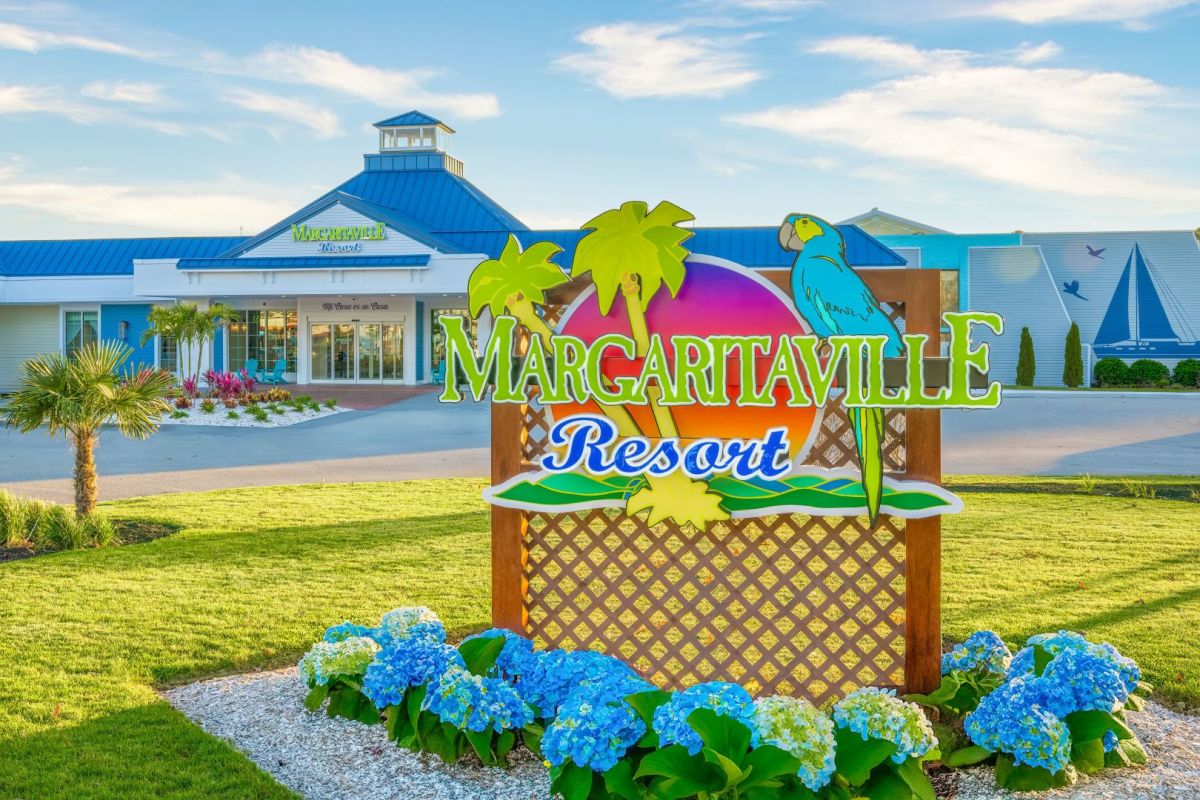
I drove to Hyannis this afternoon and saw these trees lining the roadside in front of Margaritaville. I shared this photo with ChatGPT for identification.

NB: Cover image rights reserved by copyright holder.
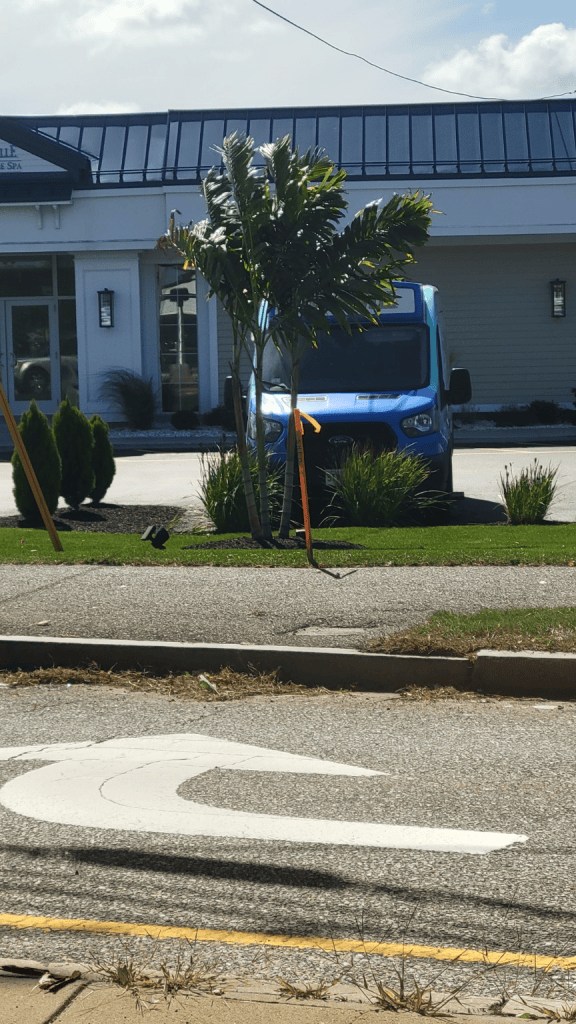
A blue van parked in front of a modern building with a black roof, surrounded by small shrubs and palm trees. A curved white line is painted on the road in the foreground.

That looks very much like a foxtail palm (Wodyetia bifurcata).

The giveaway is the foliage: instead of the leaflets lying in a relatively flat plane, they emerge at different angles around the central stem, giving each frond that dense, bushy, almost bottle-brush appearance. Hence “foxtail”, because apparently even botanists occasionally succumb to the irresistible human urge to name plants after whatever furry object they resemble.

The several trunks are probably multiple palms planted together, rather than a naturally clustering individual. Foxtail palms normally develop a single smooth, grey trunk.

One slightly comical detail, given the apparent Massachusetts setting: this is emphatically not a New England-hardy palm. Foxtails are tropical, roughly USDA zones 10–11. If this is on Cape Cod, it has almost certainly been installed seasonally and will need to be removed or protected indoors before serious frost.

The rest of the story

Having lived in Los Angeles for so many years, I recognised these as tropical plants. In fact before last winter, this establishment had planted pygmy date palms (Phoenix roebelenii) that didn’t make it through winter. I shared this photo with ChatGPT with a note about the last arboreal residents.
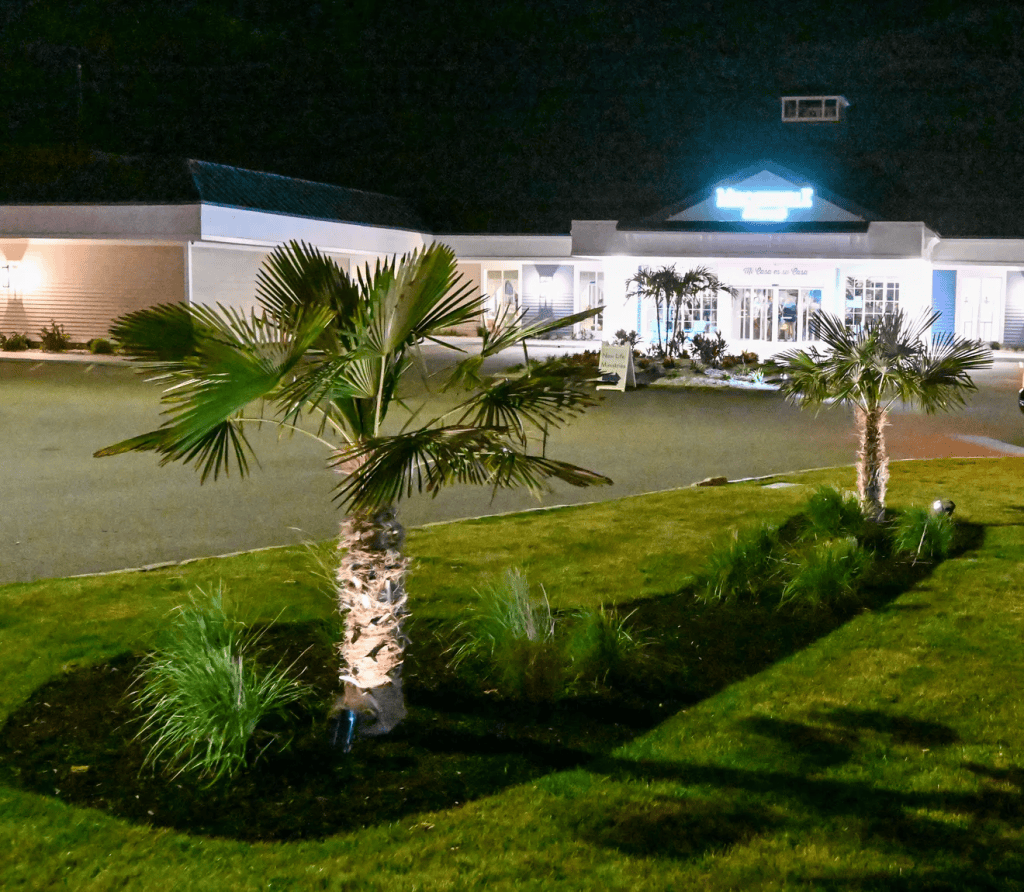
A well-lit hotel entrance at night, featuring palm trees and manicured grass in the foreground.
Image: Ron Schloerb/Cape Cod Times

Taken together, that strongly suggests the previous planting was treated as seasonal landscaping rather than genuinely hardy landscape stock.

The clues are the single relatively slender trunk, the compact crown, and the arching, feather-like fronds. It does not have the thick, bushy, three-dimensional foliage of the foxtail in your first photograph.

And in Hyannis, its demise is not especially mysterious. Phoenix roebelenii is a genuinely tropical/subtropical palm, generally suited to roughly USDA zones 9b–11. A Cape Cod winter is rather beyond its contractual obligations. Even a comparatively mild Hyannis winter can bring temperatures low enough to kill it outright, especially if it was planted permanently rather than brought in.

For those pygmy date palms, the outcome is exactly what one would expect in Hyannis. They can tolerate a brief flirtation with cold, but Cape Cod winter is not a flirtation. It is a prolonged bureaucratic proceeding involving frost, wind, wet soil, and repeated freezing. The fact that several died and were all replaced after winter makes cold injury vastly more plausible than some isolated disease or irrigation problem.

The replacement with foxtail palms is interesting because it is not really a move towards winter hardiness. Wodyetia bifurcata is, if anything, even less appropriate for overwintering outdoors in Massachusetts. So unless the landscaper plans to remove, wrap, heat, or otherwise cosset them, I would regard these new palms as living on borrowed time.

There are a few palms that can survive much colder climates, notably needle palm (Rhapidophyllum hystrix) and windmill palm (Trachycarpus fortunei), with protection and a favourable microclimate. But the specimens in these photographs are plainly being selected for that conspicuous Florida-resort aesthetic, not because anyone consulted the inconvenient little matter of January.

So this winter should provide a fairly decisive experiment. If they remain planted and unprotected, I would be surprised if the foxtails emerge unscathed.

Clarification

Finally, I provided more context and got the subsequent response.

Margaritaville Resort Cape Cod is located at 1225 Iyannough Road (Route 132) in Hyannis, Massachusetts 02601.

That makes the landscaping choice make much more sense. The resort’s own site explicitly sells the property as an “island-inspired” and “tropical” Cape Cod escape, and confirms the address.

So the palms are almost certainly branding before horticulture. They are there to manufacture a visual shorthand for Margaritaville: Florida, cocktails, Jimmy Buffett, vague latitude-related irresponsibility. Whether the plants regard Hyannis as paradise is another matter.

The interesting bit is that the previous palms apparently died after winter and were then replaced with another tropical species rather than something genuinely hardy. That suggests one of three things: they are intended as effectively disposable seasonal specimens; the landscaper underestimated the winter problem; or the resort is willing to accept periodic replacement as part of maintaining the tropical aesthetic.

Given the photographs and the resort’s stated theme, the first and third possibilities now strike me as much more likely than simple horticultural ignorance.

Reflections

Honestly, the AI was more horrified and emotional than at least the managers of this place. Not much to add. Gotta love humans, capitalism, and consumerism.

Sandwich Beach

1–2 minutes

I don’t get out much. I find it interferes with my writing, as indeed, so does posting on social media. What’s one got to do? Opportunity costs abound. I don’t tend to share many personal pics on this blog, but as it happens, sometimes I do – make it feel lived in.

This place is the Sandwich Boardwalk (Google Map). I visited on 8 May 2026. The boardwalk runs over a marshland, but it was experiencing a seasonally low tide, so there was little water coverage. These shots were taken on my mobile, a Samsung S21. Enjoy.

Boardwalk, Sandwich Beach - Oceanview, East
Panoramic shot from the top of the boardwalk, ending on a beach and the Atlantic Ocean.

Mimetic Desire

People influence one another and, when they’re together, they have a tendency to desire the same things, primarily not because those things are rare but because, contrary to what most philosophers think, imitation also bears on desire. Humans essentially try to base their being, their profound nature and essence, on the desire of their peers.

“Mimetic Desire: Shakespeare Rather than Plato.” When These Things Begin: Conversations with Michel Treguer, by René Girard and Trevor Cribben Merrill

Although I have some reservations—or at least reserve some latitude—, I tend to agree with Girard. Desire is a social construct. Desire is separate to needs. Desires are wants. As accomodated in Economics, we don’t need what we want, but we want what we need. We desire what we need.

we don’t need what we want, but we want what we need

What Girard is essentially saying is that I want what I want because you want it. This is independent of value in an economic sense. Memetically, the value of an object increases relative to the perceiver simply because another person wants it. In my reckoning, I’d separate want from desire or at least elevate desire to a higher degree of wanting.

Girard termed this triangular relationship between subject (you), object (the thing), and the mediator (the influencer) mimetic, to mimic. I suppose some of this might be considered to be memetic, but I also suppose that memes serve to simplify rather than serve as a distinct transmission vector.

circa 2016

My question is—exacerbated during this pandemic—how does this operate in isolation? I consider myself. I am not an ascetic by most definitions, but I am somewhat of a minimalist. My only ‘vices’ are my computer and my guitars. I used to be a professional musician—though most of that was spent on the other side of the console—and I was a Gibson snob. From the perspective of emotional desire, I still am. There is a certain nostalgia, but I don’t play out anymore, and I’m not seriously recording, so I don’t need the same perceived quality of an old Gibson.

Guitarists know that different guitars give different sounds. I’ve owned as many as 10 guitars at a time, and each had its purpose. Some was feel. This guitar was for Blues, this was other for Grunge, and that was for Jazz…and that for Fusion and that for a retro sound. This one had a fast neck, and this one sustained for days. This one was tuned à la Keith Richards, sans a string, to an Open G, and the was set up for Drop C, and of course there was the Standard-tuned one for good measure

Jason & Me circa 2012

Did I need 10 guitars? No. Did I need 1? Not really—not unless I wanted to be a musician, desired to be a musician, so the degree of freedom was l, given this other desire. Having 1 guitar for a guitar player is not the same as a painter with only one colour of paint, but it almost feels like it. It’s certainly a convenience, and it allows players to express themselves artistically.

The question isn’t why I desired a guitar, but why I wanted to be a musician, and of all the instruments, why the guitar—and why did I prefer this genre over that. I’ll admit that my tastes are rather eclectic, but all that says is that I mimic eclecticism or eccentrism. My parents are not eclectic. Most of my friends are mainstream whitebread people—none I’d deem eclectic.

I’m rambling. Just because I don’t remember the source of my desire doesn’t mean there is no source. Perhaps it’s a composite source. I can’t say. Perhaps the outcome I’m naming, say eclecticism, is incorrect, so I am seeking the wrong source.

circa 2004

My point was that I don’t need a Gibson to be satisfied. First, I’ve already owed them, and I don’t have the same performative needs. But I still want to play, and I still want to exercise some artistic freedom, so I still have a few guitars.

To wrap this up, I’ll leave with an unpaid mimitec endorsement of Harley Benton guitars. The last guitar I purchased was this Harley Benton Black Paisley TE70. It’s very fit, and I picked it up for about €200, which included shipping and handling. They are German-built. When I was a kid, a guitar at this price range would have be borderline unplayable and won’t sound shite-like. These aren’t €1,000 instruments, but you’d be hard pressed to find a 5x value differential. They are build solid and have been given extra care not previously seen in down-market instruments. If I wanted to spend another €200, I could upgrade the pickups and for a bit more swap out the electronics to bigger potentiometers—but I won’t. I was planning to splurge and spend €50 on locking machine heads. Nope. Good enough. At €200 a pop, I could afford all sorts of configurations, but even that desire has waned—at least a bit, at least for a while.

circa 1984