Hiding Neurodiversity

5–8 minutes

This post is a bit different to the rest, though it is about language use. I’m not officially neurodiverse or on a spectrum – at least not this spectrum – but I know many who are, and so I advocate in my own way. Given that we are all neurodiverse, I suppose we all are unofficially so.

There’s a term currently doing heavy administrative labour in HR departments, disability frameworks, school inclusion policies, and the more compassionate corners of LinkedIn. We likely have already encountered this term: neurodivergent. It is, we’re assured, a kinder, more affirming way to describe people whose cognitive, sensory, attentional, or communicative profiles don’t quite fit the expected mould. It has replaced older, uglier vocabulary. It comes with badges and a flag. Cue Eddie Izzard. Workplaces run training sessions about it. People put it in their Twitter bios with quiet pride. 🏳️‍🌈🤔 No, a different sort of pride. It’s also, philosophically speaking, a mess – and not an innocent one.

Audio: NotebookLM summary podcast of this topic.

The Grammar Problem

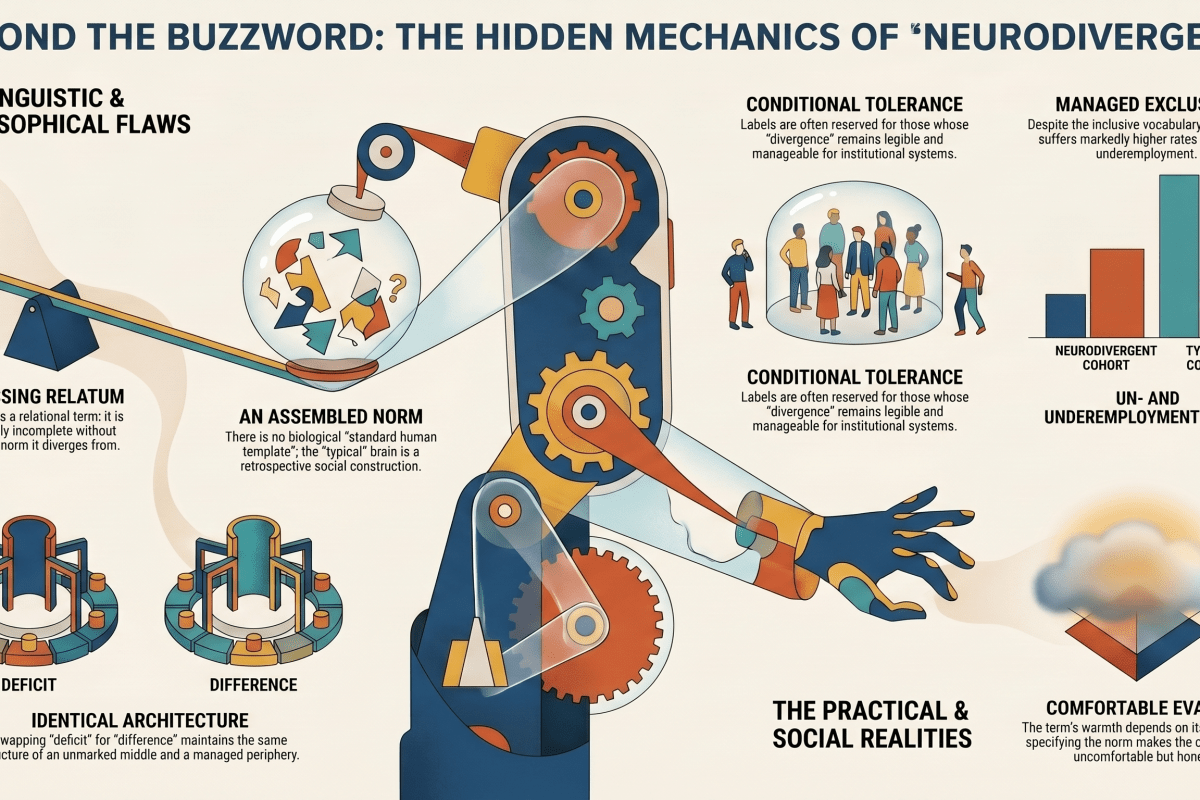
Start with the word itself. Neurodivergent is a compound: neuro, meaning something to do with the nervous system, and divergent, meaning departing from something. This second element is where the trouble begins, because divergent is a relational predicate. It cannot mean anything in isolation. To diverge is necessarily to diverge from something – a path, a norm, a baseline, a centre. The word is semantically incomplete without its relatum. So, ask yourself: divergent from what, exactly?

The term takes the Fifth. It presents divergence as though it were an intrinsic property of certain people – a fact about their neurology, full stop – rather than a relation between a person and an implied standard. The standard is left unnamed, unexamined, and serenely unaccountable. This isn’t a pedantic complaint. Suppressing the relatum is suppressing the normative commitment that does all the actual work. You can’t hide what you are measuring against and then claim to be merely describing what you find.

The Norm That Dare Not Speak Its Name

So what is the suppressed baseline? What is the nervous system that neurodivergent people are diverging from? It’s not a biological fact. There isn’t a neurologically standard human template, no Platonic baseline brain from which variation can be objectively measured. Every nervous system differs from every other nervous system. Neurological variation is not deviation; it’s quite literally the condition. If neurodivergent meant simply having a nervous system that differs from other nervous systems, it would apply to everyone and say nothing.

In practice, the implied norm is something far less neutral: a composite of statistical frequency, institutional convenience, behavioural compliance, and the tacit preferences of the systems – educational, occupational, social – built around a presumed cognitive majority. The neurotypical person – add scare quotes if you must – isn’t discovered. They’re assembled retrospectively. The centre is a construct. And the term neurodivergent relies entirely on this construction while refusing to acknowledge it.

This is the move that I, as a language philosopher, finds objectionable. The term behaves as though it were tracking a natural kind – a real biological category with a stable referent – when it’s actually encoding a social judgement: this person’s profile doesn’t pass through the normative aperture cleanly. Dressing this judgement in neurological vocabulary doesn’t make it scientific. It just makes it harder to argue with.

Euphemism With a Retention Problem

One might charitably read neurodivergent as a well-intentioned euphemism – an attempt to replace stigmatising diagnostic language with something that affirms rather than pathologises. Fair enough, as far as that goes. The older vocabulary was often brutal, and the intent to do better deserves acknowledgement before it receives its drubbing. But here’s the problem: it retains the entire logic it was meant to replace.

The old pathologising vocabulary said: these people deviate from normal, and that deviation is a deficit. The new vocabulary says: these people diverge from typical, and that divergence is a difference worth celebrating. The architecture is identical. There’s still a centre and a periphery remains. There are still people installed at the unmarked middle and others who are marked, managed, diagnosed, accommodated, sentimentalised, or quietly struggled with. The only thing that’s changed is the tone of the managing.

Euphemism of this kind isn’t neutral, for sure. It performs a service for the system it appears to critique. By making the language warmer, it makes the underlying structure harder to see and therefore harder to contest. As I note, neurodivergent isn’t a challenge to the norm. It’s just more photogenic with a soft filter.

The Tolerance Regime and Its Conditions

If we strip the euphemism back to its functional content, the term actually describes something like: a person whose failure to conform to the behavioural expectations of the statistical fiction called ‘normal’ has been traced, however loosely, to their nervous system, and who has been granted conditional tolerance on that basis.

Conditional tolerance becomes the operative phrase, a tolerance with terms, the primary term being legibility. The person must be divergent in a form the system can process: diagnosable, accommodatable, adaptable enough to participate in the institutions built around the norm they are diverging from. Masking – the performance of neurotypicality sufficient to pass institutional scrutiny – is the behavioural proof that the condition is being met.

Who Gets the Label, and Who Doesn’t

The term’s selectivity is its own quiet indictment. Neurodivergent, as socially deployed, doesn’t even cover the full range of neurological variation it nominally describes. It covers the functional end – those whose divergence is legible, manageable, and compatible, at least in principle, with participation in mainstream institutions. Those whose difference is more severe, more disruptive, more genuinely incompatible with the machinery of normal life don’t get the badge.

The term, then, extends its conditional warmth precisely to those who least require protection from the norm, whilst those most genuinely strained by it remain outside even the euphemism.

And within the group the term does cover, the employment picture is instructive. This cohort suffers markedly higher rates of un- and underemployment than the general population. Where employment is secured, it’s sometimes, if not usually, tokenistic – the divergent hire serving the firm’s reputational and fiscal interests as much as their own, their characteristic drive to succeed and conform exploited rather than accommodated. The vocabulary promises inclusion, but the outcomes record something closer to managed exclusion.

What an Honest Term Would Look Like

A more philosophically honest term would need to do three things the current one refuses:

  1. name the relational structure explicitly
  2. locate the norm rather than concealing it
  3. attribute the social judgement accurately rather than laundering it as biology

Something like norm-attributed divergence comes close inasmuch as it captures that the divergence is from a norm, and that the attribution to neurology is an explanatory move rather than a simple observation. However, it is a bit ungainly to the point of unusability by anyone not already beyond saving.

The more pointed observation may be that no honest replacement term could be as palatable as neurodivergent – and this may very well be self-indictment. The term’s warmth depends on its vagueness. Specify the norm, and you have to defend it. Specify the attribution, and you have to evidence it. Specify the conditionality of the tolerance, and you have to justify it. The language works precisely because it doesn’t do any of these things. It’s a vapid term meant not to offend. Neurodivergent is comfortable because it is evasive. Make it honest, and it becomes uncomfortable. Which is where the honest conversation was always waiting to begin.
How to Instantly Lose Popularity on the Internet

(A brief note on language, power, and moral certainty)

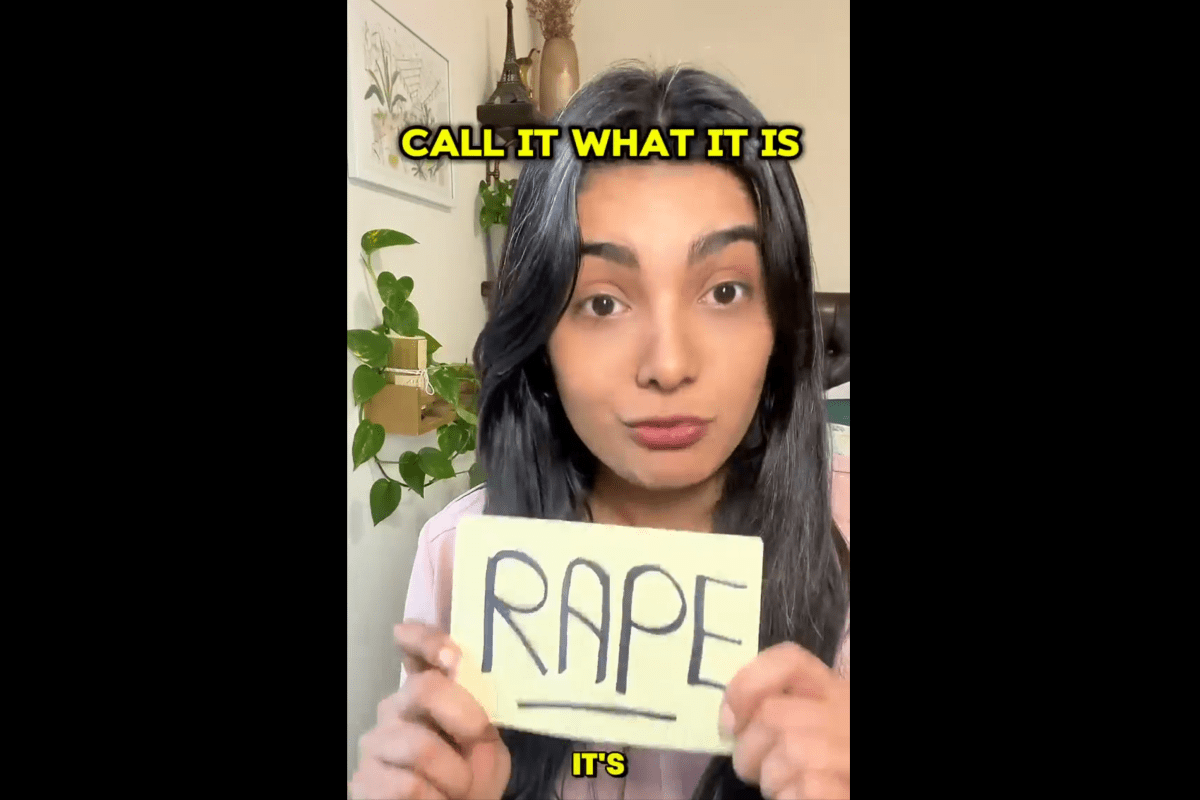
There is a particular kind of video that circulates online with tremendous force. A woman addresses the camera directly.

Video: Discussion Point (Full transcript at the end of this post)

She is clear, indignant, morally resolute:

  • It’s not an ‘inappropriate relationship with a 17-year-old’. It’s rape.
  • It’s not ‘coerced sex with a minor’. It’s rape.
  • It’s not a ‘young woman’. It’s a child.
  • Call it what it is.

Before proceeding, let me state something unambiguously: sexual exploitation of minors is morally reprehensible within contemporary Western legal and moral frameworks. I am not contesting that. Nor am I defending euphemism for its own sake. This is where philosophers of language take a lot of heat.

Audio: NotebookLM summary podcast on this topic.

The question here is narrower and, perhaps, more uncomfortable: What work is being done by the demand to ‘call it what it is‘?

Euphemism and Softening

She is correct in one respect. Institutional language often softens. Inappropriate relationship is anaesthetic. It lowers emotional temperature. It blunts moral outrage. Institutions frequently prefer such language because it reduces volatility, legal exposure, and procedural risk.

Language can minimise. That is not controversial. But it’s only half the story.

Naming Is Not Neutral

When she insists on rape and child, she is not merely removing euphemism. She is installing thick, legally saturated categories.

Rape is not a raw moral atom floating in space. It is a juridical classification defined by statute, evidentiary thresholds, and evolving legal doctrine. Its scope has expanded significantly over time: marital rape was once unrecognised; coercion has broadened beyond physical force; statutory rape collapses questions of consent into questions of legal capacity.

Likewise, child is not a purely biological category. It is a modern legal identity with shifting age thresholds and historical elasticity. The concept has expanded across the last two centuries as education extended, labour laws tightened, and adolescence became socially constructed as a protected stage of dependency.

To say this is not to relativise harm. It is to recognise that categories are historically sedimented and institutionally stabilised.

When someone says ‘Call it what it is‘, they are treating these contemporary legal categories as metaphysically self-evident. But they are products of a specific ontological framework: one in which autonomy and consent are foundational, and in which minors are deemed categorically incapable of exercising full sexual agency.

That framework is dominant in the West. It is not universal globally or historically.

Elasticity and Instrumentality

There is another asymmetry worth noticing.

Child expands protectively when someone is victimised. But the same individual may be stripped of childhood if they commit a serious crime: ‘They acted like an adult. They should have known better.’

The boundary is not purely developmental. It is normative. The category flexes.

Similarly, rape operates differently in everyday speech, in moral condemnation, and in statutory law. In the case of statutory rape, the term does not necessarily describe force; it describes the legal impossibility of consent. It is a doctrinal move grounded in an ontology of agency.

None of this weakens moral condemnation. But it reveals that these terms are not merely descriptive. They are instruments of moral and legal allocation.

Power and Irony

There is also a certain irony in the video.

She accuses mainstream institutions of manipulating language to reduce severity. Yet her demand is to deploy one of the state’s most powerful juridical classifications immediately and universally.

Rape derives its force from the same legal apparatus she critiques. It is powerful precisely because it is institutional. She is not rejecting power; she is attempting to redirect it.

This is not hypocrisy. It is politics. But it is politics nonetheless.

Ontology and Universality

The deeper issue is not whether we should condemn sexual exploitation. We should.

The issue is whether contemporary Western legal categories are simply “what is,” or whether they are historically developed ontological commitments that feel self-evident because they have been normalised.

The woman in the video experiences her categories as universal moral Truth. Many viewers agree. That agreement does not make the categories metaphysically timeless; it makes them hegemonic.

Recognising semantic expansion and legal drift does not undermine moral seriousness. It clarifies where moral authority resides: not in eternal linguistic atoms, but in historically stabilised frameworks.

Why This Is Unpopular

Online discourse prefers moral clarity over semantic archaeology. When harm is salient, genealogical analysis sounds like minimisation. Distinguishing between descriptive, legal, and ontological levels is interpreted as evasion.

It is not.

It is possible to affirm moral condemnation while also acknowledging that:

  • Language frames perception.
  • Legal categories evolve.
  • Terms are deployed instrumentally.
  • Ontologies masquerade as nature once naturalised.

One can insist on moral seriousness without pretending that our current vocabulary fell from the sky fully formed.

But saying so will reliably lose popularity on the internet.

Apparently, clarity has thresholds.


Full Video Transcript

‘Hey. It’s not an “Inappropriate Relationship with a 17-year-old”, it’s rape.

‘It’s not “coerced sex with a minor”, it’s rape.

‘It’s not “non-consensual sex with a 13-year-old”, it’s rape.

‘Call it what it is! Call them what they are.

‘And while we’re at it, it’s not a “young woman”, it’s a child!

‘It’s not a preteen, it’s a child!

‘It’s not a “mature girl”, it’s a child!

‘This use of specific language by mainstream media is super intentional, and it’s a tool of the patriarchy to try to reduce the egregiousness of horribly egregious acts that men commit against women and girls!

‘And, I say this with full awareness of the irony of my needing to use show and tell to make my point because I am beholden to these stupid social media platforms, which commit violence against women and girls every day in their own right by automatically suppressing any content as soon as I say a particular word.

‘And you and I need to say that it’s absolutely unacceptable!’

When Words Do the Work: A Case Study in Nomenclature Drift

3–5 minutes

Lewis Goodall, a talk show host, calls the cross-border seizure of Venezuela’s Nicolás Maduro a ‘kidnapping’. His guest and Trump apologist, Angie Wong, rejects the word. She first says ‘arrest’, then ‘extradition’, then finally the improvised ‘special extradition’. Around that single lexical choice, a 12-minute standoff unfolds.

Audio: NotebookLM summary podcast of this topic.

As a language philosopher, I am evaluating the language and am less concerned with the underlying facts of the matter. Language serves to obscure these facts from the start and then rhetorically controls the narrative and framing.

Video: Source segment being analysed

There is a familiar mistake made whenever public discourse turns heated: the assumption that the real disagreement lies in the facts. This is comforting, because facts can, at least in principle, be checked. What follows examines a different failure mode altogether. The facts are largely beside the point.

Consider a broadcast exchange in which a political commentator and an interviewer argue over how to describe the forcible removal of a head of state from one country to another. The interviewer repeatedly uses the word kidnapping. The guest repeatedly resists this term, preferring arrest, extradition, and eventually the improvisational compromise ‘special extradition’.

What matters here is not which term is correct. What matters is what the interaction reveals about how meaning is negotiated under pressure.

The illusion of disagreement

Superficially, the exchange appears to be a dispute about legality. Was there a treaty? Was due process followed? Which court has jurisdiction? These questions generate heat, but they are not doing the work.

The real disagreement is prior to all of that: which lexical frame is allowed to stabilise the event.

Once a label is accepted, downstream reasoning becomes trivial. If it was an extradition, it belongs to one legal universe. If it was a kidnapping, it belongs to another. The participants are not arguing within a shared framework; they are competing to install the framework itself.

Equivocation as method, not error

The guest’s shifting vocabulary is often described as evasive or incoherent. This misreads what is happening. The movement from extradition to special extradition is not confusion. It is a deliberate widening of semantic tolerance.

‘Special extradition’ is not meant to clarify. It is meant to survive. It carries just enough institutional residue to sound procedural, while remaining sufficiently vague to avoid binding criteria. It functions less as a description than as a holding pattern.

This is equivocation, but not the amateur kind taught in logic textbooks. It is equivocation under constraint, where the aim is not precision but narrative continuity.

Why exposure fails

The interviewer repeatedly points out that extradition has a specific meaning, and that the situation described does not meet it. This is accurate, and also ineffective.

Why? Because the exchange is no longer governed by definitional hygiene. The audience is not being asked to adjudicate a dictionary entry. They are being asked to decide which voice has the authority to name the act.

Once that shift occurs, exposing misuse does not correct the discourse. It merely clarifies the power asymmetry. The guest can concede irregularity, precedent-breaking, even illegality, without relinquishing control of the label. The language continues to function.

Truth as a downstream effect

At no point does the exchange hinge on discovering what ‘really happened’. The physical sequence of events is relatively uncontested. What is contested is what those events are allowed to count as.

In this sense, truth is not absent from the discussion; it is subordinate. It emerges only after a rhetorical frame has been successfully installed. Once the frame holds, truth follows obediently within it.

This is not relativism. It is an observation about sequence. Rhetoric does not decorate truth here; it prepares the ground on which truth is later claimed.

Language doing institutional work

The most revealing moment comes when the guest effectively shrugs at the legal ambiguity and asks who, exactly, is going to challenge it. This is not cynicism. It is diagnostic.

Words like arrest and extradition are not merely descriptive. They are operational tokens. They open doors, justify procedures, and allow institutions to proceed without stalling. Their value lies less in semantic purity than in administrative usability.

‘Kidnapping’ is linguistically precise in one register, but administratively useless in another. It stops processes rather than enabling them. That is why it is resisted.

What the case study shows

This exchange is not about geopolitics. It is about how language behaves when it is tasked with carrying power. Meaning drifts not because speakers are careless, but because precision is costly. Labels are selected for durability, not accuracy. Truth does not arbitrate rhetoric; rhetoric allocates truth. Seen this way, the debate over terminology is not a failure of communication. It is communication functioning exactly as designed under modern conditions. Which is why insisting on ‘the correct word’ increasingly feels like shouting into a ventilation system. The air still moves. It just isn’t moving for you.