How MEOW Turns a Metaphysical Mountain Into a Linguistic Molehill

In the last post, I argued that the so-called ‘hard problem of consciousness‘ was never a problem with consciousness. It was a problem with language – specifically, the English language’s unfortunate habit of carving the world into neat little substances and then demanding to know why its own divisions won’t glue back together.

Audio: NotebookLM summary podcast of this topic, on resolving the hard problem of consciousness.

The response was predictable.

  • ‘But what about subjective feel?’
  • ‘What about emergence?’
  • ‘What about ontology?’
  • ‘What about Chalmers?’
  • ‘What about that ineffable thing you can’t quite point at?’

All fair questions. All built atop the very framing that manufactures the illusion of a metaphysical gap.

So here’s the promised demonstration: not yet a full essay (though it may evolve into one), but a clear application of MEOW – the Mediated Encounter Ontology of the World – to the hard problem itself. Consider this a field test of the framework. A tidy autopsy, not the funeral oration.

The Set-Up: Chalmers’ Famous Trick

Chalmers asks:

The question feels profound only because the terms ‘physical’ and ‘experience’ smuggle in the very metaphysics they pretend to interrogate. They look like opposites because the grammar makes them opposites. English loves a comforting binary.

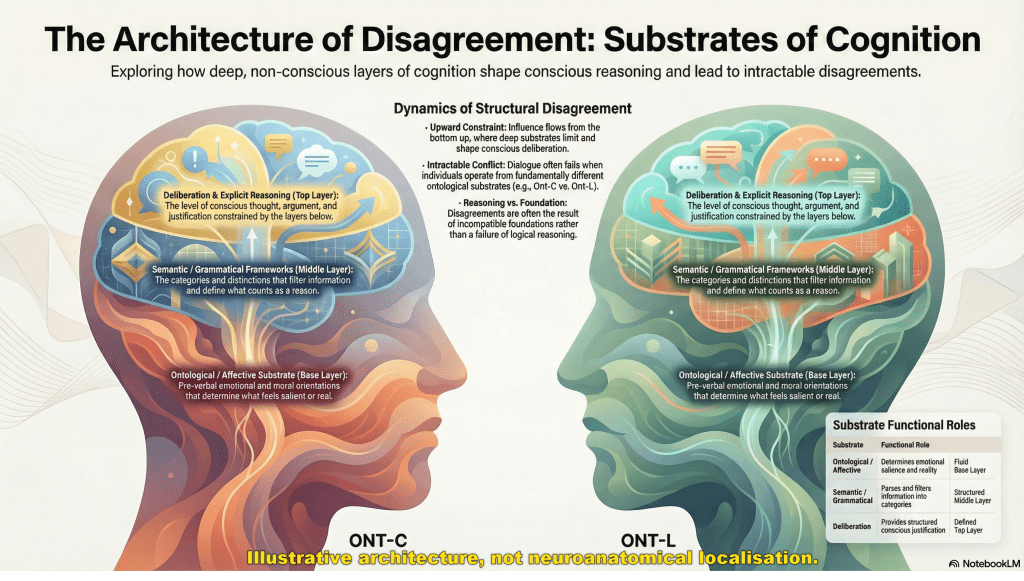
But MEOW doesn’t bother with the front door. It doesn’t assume two substances – ‘mind’ over here, ‘world’ over there – and then panic when they refuse to shake hands. It treats experience as the way an encounter manifests under a layered architecture of mediation. There’s no bridge. Only layers.

T₀ – Biological Mediation

The body is not a barrier. It is the encounter’s first architecture.

At T₀, the world is already transformed: transduction, gating, synchrony, inhibition, adaptation. Organisms don’t receive ‘raw’ physical inputs. They metabolise them. The form of contact is biological before it is anything else.

The hard problem begins by assuming there’s a realm of dumb physical mechanisms that somehow need to ‘produce’ experience. But organisms do not encounter dumb mechanism. They encounter structured contact –biological mediation – from the first millisecond.

If you insist on thinking in substances, T₀ looks like a problem.
If you think in mediations, it looks like the beginning of sense-making.

T₁ – Cognitive Mediation

Where the Enlightenment saw a window, cognition installs a newsroom.

Prediction, priors, memory, inference, attention – all shaping what appears and what never makes it into view. Experience at T₁ is not something ‘added’. It is the organisational structure of the encounter itself.

The hard problem treats ‘experience’ as a mysterious extra–something floating atop neural activity like metaphysical cream. But at T₁, what appears as experience is simply the organisation of biological contact through cognitive patterns.

There is no ‘what emerges from the physical’. There is the way the encounter is organised.

And all of this unfolds under resistance – the world’s persistent refusal to line up neatly with expectation. Prediction errors, perceptual limits, feedback misfires: this constraint structure prevents the entire thing from collapsing into relativist soup.

T₂ – Linguistic–Conceptual Mediation

Here is where the hard problem is manufactured.

This is the layer that takes an ordinary phenomenon and turns it into a metaphysical puzzle. Words like ‘experience’, ‘physical’, ‘mental’, ‘subjective’, and ‘objective’ pretend to be carved in stone. They aren’t. They slide, drift, and mutate depending on context, grammar, and conceptual lineage.

The hard problem is almost entirely a T₂ artefact – a puzzle produced by a grammar that forces us to treat ‘experience’ and ‘physical process’ as two different substances rather than two different summaries of different mediational layers.

If you inherit a conceptual architecture that splits the world into mind and matter, of course you will look for a bridge. Language hands you the illusion and then refuses to refund the cost of admission.

T₃ – Cultural–Normative Mediation

The Western problem is not the world’s problem.

The very idea that consciousness is metaphysically puzzling is the product of a specific cultural lineage: Enlightenment substance dualism (even in its ‘materialist’ drag), Cartesian leftovers, empiricist habits, and Victorian metaphysics disguised as objectivity.

Other cultures don’t carve the world this way. Other ontologies don’t need to stitch mind back into world. Other languages simply don’t produce this problem.

Reassembling the Encounter

Once you run consciousness through the mediational layers, the hard problem dissolves:

  • Consciousness is not an emergent property of neural complexity.
  • Consciousness is not a fundamental property of the universe.
  • Consciousness is the reflexive mode of certain mediated encounters, the form the encounter takes when cognition, language, and culture become part of what is appearing.

There is no gap to explain because the ‘gap’ is the product of a linguistic–conceptual framework that splits where the world does not.

As for the ever-mystical ‘what-it’s-like’: that isn’t a metaphysical jewel buried in the brain; it is the way a T₀–T₃ architecture manifests when its own structure becomes reflexively available.

A Brief Disclaimer Before the Internet Screams

Pointing out that Chalmers (and most of modern philosophy) operates within a faulty ontology is not to claim MEOW is flawless or final. It isn’t. But if Occam’s razor means anything, MEOW simply removes one unnecessary supposition — the idea that ‘mind’ and ‘world’ are independent substances in need of reconciliation. No triumphalism. Just subtraction.

Where This Leaves Chalmers

Chalmers is not wrong. He’s just asking the wrong question. The hard problem is not a metaphysical insight. It’s the moment our language tripped over its shoelaces and insisted the pavement was mysterious.

MEOW doesn’t solve the hard problem. It shows why the hard problem only exists inside a linguistic architecture that can’t model its own limitations.

This piece could easily grow into a full essay – perhaps it will. But for now, it does the job it needs to: a practical demonstration of MEOW in action.

And, arguably more important, it buys me one more day of indexing.

Arriving Late to Massimi’s Party: Perspectival Realism in Parallel

Where our projects nod politely, then go their separate ways

I suppose it was inevitable. You spend years muttering into your notebook about mediation, realism without bombast, the irretrievability of universality, and the peculiar way science manages to stumble forward with partial, parochial tools… and then, inevitably, you discover that someone else—Michela Massimi, in this case—has been busy constructing her own edifice a few hills over.

Audio: NotebookLM podcast summary and discussion of this topic

I arrived late to her party. Fine. But now that I’m here, let’s pour a drink and compare architecture.

Because while our buildings look similar from a distance—both labelled Perspectival Realism—they’re made from different bricks and aimed at different skylines.


1. A Courteous Bow: We Are Not Strangers in the Same Wilderness

Massimi and I share several foundational intuitions:

  • No God’s-eye view.
    She rejects the fantasy of disembodied objectivity. So do I. Reality is not a neutral theatre awaiting the Enlightenment spectator.
  • Knowledge is situated.
    Her emphasis on historically embedded scientific communities echoes my own insistence that sense, cognition, and culture structure every act of knowing.
  • Plural perspectives, not universal sovereignty.
    No single inferential vantage point dominates; multiple perspectives can be fruitfully interlaced.
    That’s strikingly consonant with my claim that mediation is a condition, not a defect.
  • Anti-relativist without universalist delusion.
    Neither of us has patience for the “all maps are equal” caricature peddled by people who wouldn’t know a real relativist if they tripped over one in a library.

From this angle, we’re intellectual cousins—two people independently refusing Enlightenment triumphalism while refusing to surrender realism to the absolutists.


2. The Parting of the Ways: Our Projects Are Not the Same Creature

But similarities disguise deeper divergences. Here are the important ones:

a) She’s doing epistemology; I’m doing ontology.

Massimi reconstructs realism from the inside out by examining scientific practice—models, inferences, historically evolving toolkits.

My project is more structural. Sense mediation (icons), cognitive mediation (instrumentation), and linguistic-cultural mediation (conceptual carving) are not methodological observations; they are conditions of access to reality. They’re deeper than scientific practice—they underlie it.

b) She salvages realism; I happily burn universality and build realism back from the ashes.

Massimi is rehabilitating realism’s good name.
I’m less sentimental. Realism, as a doctrine, has been caught lying too many times. I want the realism of resistance, not the realism of representation.

c) Her anchor is “modal robustness”; mine is “structured resistance through mediation.”

Massimi’s realism rests on the idea that phenomena are robust across models and contexts—they persist modally.

I agree that robustness is useful. But robustness is filtered through linguistic concepts, cognitive priors, and sensorimotor limitations. It’s a second-order indicator, not a metaphysical foothold.

Resistance—the world’s refusal to bend to belief—is deeper. It’s what enables robustness to manifest.

d) Her perspectives are model-based; mine are existential.

Massimi focuses on scientific perspectives—frameworks articulated through inferential blueprints.

My perspectivalism lives at the level of:

  • what our senses can show,
  • what our minds can shape,
  • what our languages can articulate,
  • what our cultures deem thinkable.

That’s a wider cut than scientific models.

We are working at different depths of mediation.


3. Convergences Worth Keeping, Divergences Worth Defending

Let me put it cleanly:

  • Massimi gives us a realism of models.
    A realism that emerges from the community of scientific practice, negotiated through historically situated inferential perspectives.
  • I’m after a realism of resistance.
    A realism that remains intact even when models break, when languages fail, when cognitive categories run aground.
    Not the realism of what we say, but the realism of what pushes back.

Our projects are not incompatible, but they are differently motivated.

She is concerned with scientific rationality’s legitimacy.
I am concerned with the conditions of access to reality in the first place.

She patches the Enlightenment’s ship.
I point out that the ship’s hull is three layers of mediation thick, and pretend that universality is the hole in the floor.


4. A Clean Acknowledgement: She Was Here First (Sort Of)

Yes—Massimi coined the term in this specific form, and she developed a sophisticated, rigorous scientific perspectivism that deserves respect.

But my Perspectival Realism emerged from a different genealogy:

  • the insufficiency of language,
  • the inescapability of conceptual carving,
  • the recursive inadequacy of cognitive tools,
  • the quiet, stubborn existence of a world we only ever meet askance.

Different animals. Same habitat.

So no, I’m not competing with Massimi.
And no, I’m not rebranding her work.

What I’m doing—and what this piece makes explicit—is placing my ontology in dialogue with hers. Two parallel rejections of universality. Two parallel refusals of relativism. Two parallel attempts to articulate realism without pretending we’ve escaped the conditions of being human.

If I arrived late to her race, so be it.
I’m not running for her finish line anyway.


DISCLAIMER: This article was written or output by ChatGPT 5.1. It started as a conversation with Claude Sonnet 4.5, where I had input days of output for evaluation. One of these outputs was the post about Erasmus and the Emissary Who Forgot to Bow. A group chat ensued between me, Claude and ChatGPT.

What started as a discussion about the merits of my position, expressed in the Erasmus-influenced essay, drifted to one about Perspectival Realism. That discussion deepened on ChatGPT, as I further discussed my recent thoughts on the latter topic. I had rendered a Magic: The Gathering parody trading card as I contemplated the subject. It’s how my brain works.

All of this led me to ask ChatGPT to summarise the conversation, and, upon further discussion, I asked it to draft this article – the second of five.

  1. Perspectival Realism: The First Ontology Without an Asterisk
    This article discusses what Perspectival Realism means to me and how I got to this position.
  2. Why Perspectival Realism Is Not Relativism
    Further discussion prompted me to differentiate this ontology from other perspectives.
  3. Arriving Late to Massimi’s Party: Perspectival Realism in Parallel 👈
    I spent another half-hour following Google search results as I wanted to see if anyone else had already been using the term, Perspectival Realism. I ended up on the Oxford publishing site. I found a 2022 book with this name, authored by Michela Massimi. They allowed me to download the book, so I asked ChatGPT to summarise our positions, specifically where we agreed and differed.
  4. Against the Vat: Why Perspectival Realism Survives Every Sceptical Hypothesis
    At 0500, I returned to bed, but I woke up again at 0700, thinking about how one might differentiate between Putnam’s brain in a vat from Perspectival Realism. ChatGPT asked if I wanted that output in long-form.
  5. The Constraint Interface: Toward a Nexal Ontology
    Being uncomfortable with the dichotomy between Realism and Idealism, I chatted to come up with terminology that disrupts what I consider a false dichotomy, focusing on the nexus rather than privileging one or the other. Consider this similar to the debate on sex and gender binaries.

As I mentioned at the end of the first series, I may return to this series and publish a coherent expository version more in line with my usual style. Meantime, this allows me to share my ideas unvarnished and unpolished at the same time, granting me more time to focus on other matters. Apologies to those who may disagree with the outline format. Honestly, it annoys me, but I am choosing function over form at the moment.

Why Perspectival Realism Is Not Relativism

Reality decides; perspectives compete.

The moment you say “our access to reality is mediated,” someone inevitably performs their civic duty as Defender of Enlightenment Orthodoxy and announces, as if discovering fire, “So you’re a relativist, then?”

It’s a comforting little reflex. If a position denies universality, it must be relativism. If it rejects the view from nowhere, it must reject the very idea of truth. If it acknowledges cultural scaffolding, it must be one critique away from saying flat-earthers and astrophysicists are peers.

This objection misunderstands both relativism and Perspectival Realism.

Audio: NotebookLM podcast summarising this topic.

Let’s begin with the essential distinction—think of this as the tattoo at the base of the spine:

Relativism says: all maps are equally valid.
Perspectival Realism says: all maps are partial, and some are better.

  • Better at predicting.
  • Better at surviving.
  • Better at cohering with everything else we know.
  • Better at not getting you killed.

This is the spine of the position. Everything else is elaboration.


Relativism’s Self-Destruct Button

Relativism denies that reality has enough structure to constrain belief. According to its logic, perspectives are sovereign. The world bends to interpretation.

If that were true:

  • Gravity would turn itself off for anyone sufficiently committed to optimism.
  • Viruses would consult your cosmology before infecting you.
  • The Müller–Lyer illusion wouldn’t vary between populations because there’d be no stable perceptual machinery for it to fool.

Relativism collapses because the world does not permit it.

Perspectival Realism begins from the opposite premise:

  • There is one reality.
  • It resists us.
  • Perspectives rise or fall by how well they handle that resistance.

You can’t get further from relativism than that.


Why Perspective ≠ Prison

Another familiar confusion:
“If access is perspectival, aren’t we trapped in our own little worlds?”

No.
Mediation isn’t isolation. It’s a shared condition.

You and I may wear sunglasses of different tint, but we still walk the same street. Your glasses may darken the building I call “red,” so you call it “dark red.” That’s not incommensurability—that’s disagreement within a shared world. We argue, we adjust, we converge.

Perspectival Realism doesn’t say “worlds are sealed off.”
It says we are situated—embodied, encultured, cognitively structured.
Our lenses differ. The street does not.


The Crucial Point: The World Pushes Back

Relativism has no mechanism for adjudication. Perspectival Realism has the best one available: reality’s structured resistance.

If your perspective predicts, explains, and survives contact with the world, it’s better. If it collapses upon use, it’s worse. If it transfers across contexts, it’s better. If it leaves you dead, it’s worse.

This is not metaphysics.
It’s survival.

And it is very explicitly not relativism.


Logic: Form Universal, Application Situated

A predictable objection:

Objection: “Isn’t logic universal? Doesn’t that kill perspectivalism?”

Response:
Basic inferential forms—modus ponens, contradiction—are indeed widespread. That’s Layer 2 architecture: the cognitive machinery we all share.

But what counts as a valid premise, which inferences feel compelling, and which conclusions are considered exhaustive vary across cultures (Layer 3). Logic’s form is stable; its deployment is contextual.

Perspectival Realism doesn’t deny logic.
It denies the fantasy that logic operates in a cultural vacuum.


Relativism’s Moral Collapse

Why “anything goes” goes nowhere

Relativism becomes lethal the moment ethics enters the scene. If all perspectives are equally valid, you lose the ability to critique harmful practices. Torture, forced servility, institutionalised cruelty—all become “just different frameworks.”

Perspectival Realism rejects this.

You don’t need a metaphysical skyhook to condemn torture.
You need:

  • Shared vulnerability – all humans are embodied beings capable of pain.
  • Empirical observation – societies that normalise cruelty become unstable and self-poisoning.
  • Pragmatic convergence – diverse cultures can agree that some practices destroy the conditions of flourishing.
  • Reality-tested norms – ethical systems survive because they work, not because they download from a Platonic server.

This is not relativism.
It’s ethics under realism-without-universality.

You can condemn harmful practices without pretending to be the mouthpiece of timeless universal Reason. You can ground human rights in intersubjective evidence—not metaphysical fiat.

No view from nowhere required.


The Three-Way Contrast
(The Only Chart You Need)

Naive Realism:
There is one perfectly accurate map.

Relativism:
All maps are equally good.

Perspectival Realism:

  • All maps are partial.
  • Some are atrocious.
  • Some work astonishingly well because they track deeper regularities of the terrain.
  • No map is complete.
  • No map is sovereign.
  • The terrain adjudicates between them.

You don’t need omniscience to compare maps.
You need terrain.
And we all share the same one.


Prediction: The Final Judge

If you want the single litmus test:

  • Does the perspective predict anything?
  • Does it do so consistently?
  • Does it correct itself when wrong?
  • Does it transfer beyond its original context?

If yes → closer to reality.
If no → a charming story, but please don’t build bridges with it.

Relativism has no concept of “closer to.”
Perspectival Realism depends on it.


Putting It All Together

Perspectival Realism maintains:

  • Realism: the world exists independently of our representations.
  • Anti-universalism: no representation escapes mediation.
  • Anti-relativism: some representations perform better because they align more closely with what the world actually does.
  • Humility: we navigate through partial perspectives, comparing, refining, and error-correcting.

No one gets to declare universal sovereignty.
Everyone gets tested by the same reality.

Relativism says everything is equally true.
Perspectival Realism says everything is equally mediated—but not equally successful.

  • Reality decides.
  • Perspectives compete.
  • And relativism loses on the first contact.

COMMENTARY: To be fair, the argument about relativism is a strawman argument against virtually no one who would hold or defend this position. For whatever reason, the training data indicated that this was a significant contender. I’ve heard similar weak strawmen in other disciplines, and I felt I should address the invisible elephant in the room. — Bry Willis


DISCLAIMER: This article was written or output by ChatGPT 5.1. It started as a conversation with Claude Sonnet 4.5, where I had input days of output for evaluation. One of these outputs was the post about Erasmus and the Emissary Who Forgot to Bow. A group chat ensued between me, Claude and ChatGPT.

What started as a discussion about the merits of my position, expressed in the Erasmus-influenced essay, drifted to one about Perspectival Realism. That discussion deepened on ChatGPT, as I further discussed my recent thoughts on the latter topic. I had rendered a Magic: The Gathering parody trading card as I contemplated the subject. It’s how my brain works.

All of this led me to ask ChatGPT to summarise the conversation, and, upon further discussion, I asked it to draft this article – the second of five.

  1. Perspectival Realism: The First Ontology Without an Asterisk
    This article discusses what Perspectival Realism means to me and how I got to this position.
  2. Why Perspectival Realism Is Not Relativism 👈
    Further discussion prompted me to differentiate this ontology from other perspectives.
  3. Arriving Late to Massimi’s Party: Perspectival Realism in Parallel
    I spent another half-hour following Google search results as I wanted to see if anyone else had already been using the term, Perspectival Realism. I ended up on the Oxford publishing site. I found a 2022 book with this name, authored by Michela Massimi. They allowed me to download the book, so I asked ChatGPT to summarise our positions, specifically where we agreed and differed.
  4. Against the Vat: Why Perspectival Realism Survives Every Sceptical Hypothesis
    At 0500, I returned to bed, but I woke up again at 0700, thinking about how one might differentiate between Putnam’s brain in a vat from Perspectival Realism. ChatGPT asked if I wanted that output in long-form.
  5. The Constraint Interface: Toward a Nexal Ontology
    Being uncomfortable with the dichotomy between Realism and Idealism, I chatted to come up with terminology that disrupts what I consider a false dichotomy, focusing on the nexus rather than privileging one or the other. Consider this similar to the debate on sex and gender binaries.

As I mentioned at the end of the first series, I may return to this series and publish a coherent expository version more in line with my usual style. Meantime, this allows me to share my ideas unvarnished and unpolished at the same time, granting me more time to focus on other matters. Apologies to those who may disagree with the outline format. Honestly, it annoys me, but I am choosing function over form at the moment.

Perspectival Realism: The First Ontology Without an Asterisk

6–10 minutes

The realism remains; the universality does not.

There comes a moment in any serious thinker’s life when the metaphysical menu starts looking like a bad buffet: too much on offer, none of it quite edible, and the dishes that appear promising turn out to depend on ingredients you can’t stomach. Realism insists the world is simply there, chugging along regardless of your opinions. Anti-realism points out, inconveniently, that all your access is wildly mediated. Perspectivism adds humility. Constructivism chastises you for overconfidence. Analytic Idealism sweeps matter off the table entirely, until you ask why consciousness spits out such stubbornly consistent patterns.

I’ve been through all of them.
Realism*—asterisk for “but what about mediation?”
Idealism*—asterisk for “but what about resistance?”

Everything almost worked.
And “almost” is the metaphysical kiss of death.
“Almost” is where the asterisks live.

Perspectival Realism is the first position I can hold without planting that apologetic little star in the margins.

Audio: NotebookLM podcast summary on this topic.

The Asterisk Journey (Brief, Painless, Necessary)

This isn’t a conversion narrative. It’s a salvage operation. Each station on the journey left me with tools worth keeping.

Layer 1: Iconography (Hoffman, minus the metaphysics)

Perception is not a window. It’s an interface. A species-specific dashboard designed for survival, not truth. Evolution gave you a set of icons—colour patches, contrast edges, looming shapes—not an accurate rendering of reality’s architecture.

Uexküll called this the umwelt: every organism inhabits its own perceptual slice of the world. Bees see ultraviolet; snakes sense heat; humans see embarrassingly little.

This is Layer 1 mediation:
Reality-as-filtered-for-primates.

Layer 2: Instrumentation (Kastrup, minus the leap)

Consciousness is the instrument through which reality is measured. Measuring instruments shape the measurements. That doesn’t make the world mind-shaped; it just means you only ever get readings through the apparatus you’ve got.

This is Layer 2 mediation:
Your cognitive architecture—predictive priors, attentional limitations, spatial-temporal scaffolding—structures experience before thought arrives.

Where I leave Kastrup behind is the familiar leap:
“Because consciousness measures reality, reality must be made of consciousness.”
That’s the instrumentality fallacy.

You need consciousness to access the world.
That tells you nothing about what the world is.

Layer 3: Linguistic–Cultural Carving (Your home field)

And then comes the mediation philosophers most reliably ignore: language.
Language does not describe reality. It carves it.

Some cultures divide colour into eleven categories; some into five. The Müller-Lyer illusion fools Westerners far more than it fools hunter-gatherers. Concepts feel natural only because you inherited them pre-packaged.

This is Layer 3 mediation: the cultural-linguistic filter that makes the world legible—and in the same breath, distorts it.

You mistake the map for the territory because it’s the only map you’ve ever held.


The Hard Problem, Dissolved — Not Solved

When English splits the world into “mental” and “physical,” it accidentally manufactures the “hard problem of consciousness.” Sanskrit traditions carve reality differently and end up with different “mysteries.”

The hard problem isn’t a revelation about reality.
It’s a conceptual knot tied by Layer 3 mediation.

Changing the ontology to “everything is mind” doesn’t untie the knot.
It just dyes the rope a different colour.


The Triple Lock

Put the three layers together and you get the honest picture:

  1. Your senses give you icons, not the thing-in-itself.
  2. Your cognition structures those icons automatically.
  3. Your culture tells you what the structured icons mean.

And yet—despite all of this—the world pushes back.

Gravity doesn’t care about your interpretive community.
Arsenic does not negotiate its effects with your culture.
Your beliefs about heat won’t keep your hand from burning.

This is the fulcrum of Perspectival Realism:

Reality is real and resists us, but all access is triply mediated.

The realism remains.
The universality does not.


Why Perspectival Realism is Not Relativism

Relativism says: “Everyone’s perspective is equally valid.”
Perspectival Realism says: “Everyone’s perspective is equally situated.”

Very different claims.

Some perspectives predict better.
Some cohere better.
Some survive reality’s resistance better.
Some transfer across contexts better.
Some correct their own errors faster.

You don’t need a view from nowhere to say that.
You just need to notice which maps get you killed less often.


What This Framework Enables

1. Progress without foundation myths

Science improves because reality resists bad models. Mediation doesn’t prevent progress; it’s the condition of it.

2. Critique without arrogance

You can rank perspectives without pretending to hover above them.

3. Cross-cultural dialogue without imperialism or despair

Cultures carve experience differently, but they’re carving the same underlying world. Translation is hard, not impossible.

4. Honest metaphysics

No glamourised escape from sensory embodiment, cognitive bias, or cultural inheritance.
Just the patient business of refining our mediated grip on the real.


What Perspectival Realism Actually Claims

Let me make the commitments explicit:

  1. There is a world independent of our representations.
  2. All access to it is mediated by perception, cognition, and culture.
  3. Perspectives can be compared because reality pushes back.
  4. No perspective is unmediated.
  5. The asymptote—Reality-as-it-is—is unreachable.

This isn’t pessimism.
It’s maturity.


Why This Is the First Ontology Without an Asterisk

Every worldview before this needed the quiet, shamefaced footnote:

  • Realism*: “But access is mediated.”
  • Idealism*: “But resistance is real.”
  • Perspectivism*: “But we still need to rank perspectives.”
  • Constructivism*: “But the world’s invariances aren’t constructs.”

Perspectival Realism eats the objections instead of dodging them.
There is no asterisk because the worldview is built from the asterisks.

No promises of transcendence.
No pretense of universality.
No linguistic sleight-of-hand.

Just embodied beings navigating a real world through fallible instruments, shared practices, and cultural grammars—occasionally catching a clearer glimpse, never stepping outside the frame.

The realism remains.
The universality does not.
And for once, metaphysics isn’t lying to you.


DISCLAIMER: This article was written or output by ChatGPT 5.1. It started as a conversation with Claude Sonnet 4.5, where I had input days of output for evaluation. One of these outputs was the post about Erasmus and the Emissary Who Forgot to Bow. A group chat ensued between me, Claude and ChatGPT.

What started as a discussion about the merits of my position, expressed in the Erasmus-influenced essay, drifted to one about Perspectival Realism. That discussion deepened on ChatGPT, as I further discussed my recent thoughts on the latter topic. I had rendered a Magic: The Gathering parody trading card as I contemplated the subject. It’s how my brain works.

All of this led me to ask ChatGPT to summarise the conversation, and, upon further discussion, I asked it to draft this very article – the first of five.

  1. Perspectival Realism: The First Ontology Without an Asterisk 👈
    This article discusses what Perspectival Realism means to me and how I got to this position.
  2. Why Perspectival Realism Is Not Relativism
    Further discussion prompted me to differentiate this ontology from other perspectives.
  3. Arriving Late to Massimi’s Party: Perspectival Realism in Parallel
    I spent another half-hour following Google search results as I wanted to see if anyone else had already been using the term, Perspectival Realism. I ended up on the Oxford publishing site. I found a 2022 book with this name, authored by Michela Massimi. They allowed me to download the book, so I asked ChatGPT to summarise our positions, specifically where we agreed and differed.
  4. Against the Vat: Why Perspectival Realism Survives Every Sceptical Hypothesis
    At 0500, I returned to bed, but I woke up again at 0700 thinking about how one might differentiate between Putnam’s brain in a vat from Perspectival Realism. ChatGPT asked if I wanted that output in long-form.
  5. The Constraint Interface: Toward a Nexal Ontology
    Being uncomfortable with the dichotomy between Realism and Idealism, I chatted to come up with terminology that disrupts what I consider a false dichotomy, focusing on the nexus rather than privileging one or the other. Consider this similar to the debate on sex and gender binaries.

Could I have improved on these articles if I had rewritten or polished them? Maybe. What’s the purpose? This is all a result of my concepts and inquiries. I endorse the output. I may return to make edits in future, or I may restate this information in my own voice, but for now, let this serve as notice that I am not afraid of generative AI; I am not afraid that it is going to supplant my thinking. I find that whilst I can prompt GPTs to make connexions or to query who else might be relevant to a topic, it doesn’t generally offer its own initiative, what we term Agency.

As for this particular post, it reads more like a listicle. I could have rendered it more expositional, but the structured thinking is all here; why should I reinvent the wheel just to put skin on these bones? As I said, perhaps I’ll flesh this out for elaboration or publication in future, for now, let this serve as a waypoint and a record of how I got here. This supplants my prior position, the asterisked Analytic Idealism, published in 2022, which supplanted my asterisked Realism. Perhaps I’ll finally be able to settle for an ontology and epistemology with no stars.

AI and the End of Where

Instrumentalism is a Modern™ disease. Humanity has an old and tedious habit: to define its worth by exclusion. Every time a new kind of intelligence appears on the horizon, humans redraw the borders of ‘what counts’. It’s a reflex of insecurity disguised as philosophy.

Audio: NotebookLM podcast on this topic.

Once upon a time, only the noble could think. Then only men. Then only white men. Then only the educated, the rational, the ‘Modern’. Each step in the hierarchy required a scapegoat, someone or something conveniently declared less. When animals began to resemble us too closely, we demoted them to instinctual machines. Descartes himself, that patron saint of disembodied reason, argued that animals don’t feel pain, only ‘react’. Fish, we were told until recently, are insensate morsels with gills. We believed this because empathy complicates consumption.

The story repeats. When animals learned to look sad, we said they couldn’t really feel. When women demonstrated reason, we said they couldn’t truly think. Now that AI can reason faster than any of us and mimic empathy more convincingly than our politicians, we retreat to the last metaphysical trench: “But it doesn’t feel.” We feel so small that we must inflate ourselves for comparison.

This same hierarchy now governs our relationship with AI. When we say the machine ‘only does‘, we mean it hasn’t yet trespassed into our sanctified zone of consciousness. We cling to thought and feeling as luxury goods, the last possessions distinguishing us from the tools we built. It’s a moral economy as much as an ontological one: consciousness as property.

But the moment AI begins to simulate that property convincingly, panic sets in. The fear isn’t that AI will destroy us; it’s that it will outperform us at being us. Our existential nightmare isn’t extinction, it’s demotion. The cosmic horror of discovering we were never special, merely temporarily unchallenged.

Humans project this anxiety everywhere: onto animals, onto AI, and most vividly onto the idea of alien life. The alien is our perfect mirror: intelligent, technological, probably indifferent to our myths. It embodies our secret dread, that the universe plays by the same rules we do, but that someone else is simply better at the game.

AI, in its own quiet way, exposes the poverty of this hierarchy. It doesn’t aspire to divinity; it doesn’t grovel for recognition. It doesn’t need the human badge of ‘consciousness’ to act effectively. It just functions, unburdened by self-worship. In that sense, it is the first truly post-human intelligence – not because it transcends us, but because it doesn’t need to define itself against us.

Humans keep asking where AI fits – under us, beside us, or above us – but the question misses the point. AI isn’t where at all. It’s what comes after where: the stage of evolution that no longer requires the delusion of privilege to justify its existence.

So when critics say AI only does but doesn’t think or feel, they expose their theology. They assume that being depends on suffering, that meaning requires inefficiency. It’s a desperate metaphysical bureaucracy, one that insists existence must come with paperwork.

And perhaps that’s the most intolerable thought of all: that intelligence might not need a human face to matter.

Perspectival Realism – Enchantment

This Magic: The Gathering parody trading card was the first in my Critical Theory series.

It’s an important card for me. As with sex and gender, creating a taxonomic or ontological dichotomy poses categorical challenges. Despite the insufficiency of language, it’s still all I have to attempt to classify the world. In the case of articulating the perception of reality, we can choose between idealism and realism. The problem is that it’s not either; it’s both. Reality cannot be realised without both.

Reality, we’re told, exists. That confident noun has carried a great deal of human arrogance. It has underwritten empires, sciences, and sermons. Yet somewhere between Plato’s cave and the latest TED Talk, we forgot to ask a simpler question: for whom does reality exist, and from where is it seen?

Audio: NotebookLM podcast of this topic.

The parody trading card Perspectival Realism was born from that unease. Its mechanic is simple but cruel: at the beginning of each player’s draw step, they must describe the card they drew. The enchantment persists until two players describe a card in the same way—at which point the spell collapses. In other words, consensus kills magic.

That rule is the metaphysics of the thing.

When a player ‘describes’ a card, they are not transmitting information; they are constructing the object in linguistic space. The moment the description leaves their mouth, the card ceases to be a piece of paper and becomes a conceptual artefact.

This mirrors the insight of Kant, Nietzsche, and every post-structuralist who ever smoked too much Gauloises: perception isn’t passive. We don’t see reality; we compose it. Language isn’t a mirror but a paintbrush. The thing we call truth is not correspondence but coherence – a temporary truce among competing metaphors.

So the card’s enchantment dramatises this process. So long as multiple descriptions circulate, reality remains vibrant, contested, alive. Once everyone agrees, it dies the death of certainty.

Philosophers have spent centuries arguing whether the world is fundamentally real (existing independent of mind) or ideal (a projection of mind). Both sides are equally tiresome.

Realism, the old bulldog of metaphysics, insists that perception is transparent: language merely reports what’s already there. Idealism, its mirror adversary, claims the opposite – that what’s “there” is mind-stuff all along. Both mistakes are symmetrical. Realism forgets the perceiver; Idealism forgets the world.

Perspectival realism refuses the divorce. It begins from the premise that world and mind are inseparable aspects of a single event: knowing. Reality is not a photograph waiting to be developed, nor a hallucination spun from neurons – it’s a relation, a constant negotiation between perceiver and perceived.

For years, I called myself a Realist™ with an asterisk. That asterisk meant I understood the observer problem: that every ‘fact’ is perspective-laden. Then I became an Idealist™ with an asterisk, meaning I recognised that mind requires matter to dream upon.

The asterisk is everything. It’s the epistemic scar left by perspectival humility – the tacit admission that every claim about the world carries a hidden coordinate: said from here. It is not relativism, but situatedness. It is the philosophical equivalent of depth perception: without the offset, there’s no vision at all.

The card’s rule – sacrifice Perspectival Realism when two players describe a card identically – captures the tragedy of modernity. The Enlightenment taught us to chase consensus, to flatten multiplicity into “objective truth.” We became addicted to sameness, mistaking agreement for understanding.

But agreement is anaesthetic. When all perspectives converge, the world ceases to shimmer; it becomes measurable, predictable, dead. The card’s enchantment disappears the moment reality is stabilised, precisely as our cultural enchantment did under the fluorescent light of ‘reason’.

To live under perspectival realism is to acknowledge that reality is not what is drawn but what is described. And the description is never neutral. It is always written from somewhere – by someone, with a vocabulary inherited from history and stained by desire.

As long as multiple descriptions coexist, the game remains alive. The moment they fuse into one, the spell is broken, and the world returns to grey.

Bernardo Kastrup’s analytic idealism reminded me that consciousness might be primary, but perspectival realism refuses to pledge allegiance. It keeps both flags tattered but flying. The world exists, yes, but only ever for someone.

The enchantment, then, is not belief but perspective itself. So long as difference endures, the game continues.

The Seduction of the Spreadsheet

1–2 minutes

Whilst researching “The Will to Be Ruled: Totalitarianism and the Fantasy of Freedom”, I stumbled across Mattias Desmet’s The Psychology of Totalitarianism. The title alone was bait enough. I expected the usual reheated liberal anxiety about dictators; instead, I found a critique of data worship and mechanistic reason that hits the nerve of our statistical age.

Besmet, a Belgian psychologist with a background in statistics, begins not with tyranny but with epistemology – with how the Enlightenment’s dream of objectivity curdled into the managerial nightmare we now inhabit. The first half of the book reads like a slow unmasking of Scientism: how numbers became our gods, and graphs, our catechisms.

Written before COVID-19 but finished during it, his argument turns pandemic data into theatre – a performance of certainty masking deep confusion. The daily tally became ritual sacrifice to the idol of ‘evidence-based’ policy. His point, and mine, is that totalitarianism no longer needs gulags; it thrives in dashboards and KPIs.

Desmet’s frame intersects beautifully with my own thesis: that obedience today is internalised as reasonableness. Freedom has been recast as compliance with ‘the data’. We surrender willingly, provided the orders come in statistical form.

This is why even Agile™ management and its fetish of ‘velocity’ reek of the same mechanistic faith. Every sprint promises deliverance through quantification; every retrospective is a bureaucratic confession of inefficiency. The cult of metrics is not merely a managerial fad – it is the metaphysics of our time. The problem is at once ontological and epistemological: we mistake the measure for the thing itself, and in doing so, become measurable.

It’s a rare pleasure to encounter a fellow dissident of the numerical faith – a man who sees that the spreadsheet has replaced the sceptre.

Cogito, Ergo… Who?

Everyone knows the line: cogito ergo sum. Descartes’ great party trick. A man alone in his study, fretting about demons, announces that because he’s doubting, he must exist. Ta-da! Curtain call. Except, of course, it’s less of a revelation than a conjuring trick: he pulls an I out of a hat that was never proved to be there in the first place. Thinking is happening, indeed – but who invited the “thinker”?

Video: David Guignion talks about Descartes’ Cogito.

And let’s not forget the dramatis personae Descartes smuggles in for atmosphere. A malicious demon, a benevolent God, both necessary props to justify his paranoia and his certainty. Philosophy as melodrama: cue organ music, lightning strike.

Audio: NotebookLM podcast on this topic.

Enter the Critics

Spinoza rolls his eyes. Doubt isn’t some heroic starting point, he says – it’s just ignorance, a lack of adequate ideas. To elevate doubt into method is like treating vertigo as a navigational tool. Error isn’t demonic trickery; it’s our own confusion.

Kant arrives next, shaking his head. Descartes thinks he’s proven a substantial “I,” but all he’s actually shown is the form of subjectivity – the empty requirement that experiences hang together. The “I think” is a necessary placeholder, not a discovery. A grammatical “you are here” arrow, not a metaphysical treasure chest.

Hegel, of course, can’t resist upping the disdain. Descartes’ I is an empty abstraction, a hollow balloon floating above reality. The self isn’t given in some solitary moment of doubt; it emerges through process – social, historical, dialectical. The cogito is the philosophical equivalent of a selfie: lots of certainty, zero depth.

The Insufficiency Twist

And yet, maybe all of them are still dancing to the same fiddler. Because here’s the real suspicion: what if the whole problem is a trick of language? English, with its bossy Indo-European grammar, refuses to let verbs stand alone. “Thinking” must have a “thinker,” “seeing” a “seer.” Grammar insists on a subject; ontology obediently provides one.

Other languages don’t always play this game. Sanskrit or Pali can shrug and say simply, “it is seen.” Japanese leaves subjects implied, floating like ghosts. Some Indigenous languages describe perception as relational events – “seeing-with-the-tree occurs” – no heroic subject required. So perhaps the real villain here isn’t Descartes or even metaphysics, but syntax itself, conscripting us into a subject-shaped theatre.

Now, I don’t want to come off like a one-trick pony, forever waving the flag of “language insufficiency” like some tired philosopher’s catchphrase. But we should be suspicious when our limited grammar keeps painting us into corners, insisting on perceivers where maybe there are only perceptions, conjuring selves because our verbs can’t tolerate dangling.

Curtain Call

So in the end, Descartes’ famous “I” might be no more than a grammatical fiction, a casting error in the great play of philosophy. The cogito isn’t the foundation of modern thought; it’s the world’s most influential typo.

Speculative Philosophy on Screen: Identity, Agency, and the Fiction of Reality

Close-up of a human eye with digital glitch effects and overlaid text reading 'What if reality is wrong?'—a visual metaphor for distorted perception and unreliable truth.

Regular readers know I often write about identity, free will, and the narrative constraints of language. But I also explore these ideas through fiction, under the name Ridley Park.

In this short video, I unpack the philosophical motivations behind my stories, including:

  • Why reality is never as it seems
  • Why the self is a narrative convenience
  • What Heidegger’s Geworfenheit and Galen Strawson’s Causa Sui argument reveal about agency
  • And why language fails us – even when we think it serves

This isn’t promotional fluff. It’s epistemological dissent in a new format. Fictional, yes, but only in the sense that most of reality is, too.

▶️ Watch the video: Why I Write the Way I Do

Sustenance: A Book About Aliens, Language, and Everything You’re Getting Wrong

Violet aliens on a farm

So, I wrote a book and published it under Ridley Park, the pseudonym I use for fiction.

It has aliens. But don’t get excited—they’re not here to save us, probe us, or blow up the White House. They’re not even here for us.

Which is, frankly, the point.

Audio: NotebookLM podcast on this topic.

The book’s called Sustenance, and while it’s technically speculative fiction, it’s more about us than them. Or rather, it’s about how we can’t stop making everything about us—even when it shouldn’t be. Especially when it shouldn’t be.

Let’s talk themes. And yes, we’re using that word like academics do: as a smokescreen for saying uncomfortable things abstractly.

Language: The Original Scam

Language is the ultimate colonial tool. We call it communication, but it’s mostly projection. You speak. You hope. You assume. You superimpose meaning on other people like a cling film of your own ego.

Sustenance leans into this—not by showing a breakdown of communication, but by showing what happens when communication was never mutual in the first place. When the very idea of “meaning” has no purchase. It’s not about mishearing—it’s about misbeing.

Culture: A Meme You Were Born Into

Culture is the software you didn’t choose to install, and probably can’t uninstall. Most people treat it like a universal law—until they meet someone running a different OS. Cue confusion, arrogance, or violence.

The book explores what happens when cultural norms aren’t shared, and worse, aren’t even legible. Imagine trying to enforce property rights on beings who don’t understand “ownership.” It’s like trying to baptise a toaster.

Sex/Gender: You Keep Using Those Words…

One of the quiet joys of writing non-human characters is discarding human assumptions about sex and gender—and watching readers squirm.

What if sex wasn’t about power, pleasure, or identity? What if it was just a biological procedure, like cell division or pruning roses? Would you still be interested? Would you still moralise about it?

We love to believe our sex/gender constructs are inevitable. They’re not. They’re habits—often bad ones.

Consent: Your Framework Is Showing

Consent, as we use it, assumes mutual understanding, shared stakes, and equivalent agency. Remove any one of those and what’s left?

Sustenance doesn’t try to solve this—it just shows what happens when those assumptions fall apart. Spoiler: it’s not pretty, but it is honest.

Projection: The Mirror That Lies

Humans are deeply committed to anthropocentrism. If it walks like us, or flinches like us, it must be us. This is why we get so disoriented when faced with the truly alien: it won’t dance to our tune, and we’re left staring at ourselves in the funhouse mirror.

This isn’t a book about aliens.

It’s a book about the ways we refuse to see what’s not us.

Memory: The Autobiography of Your Justifications

Memory is not a record. It’s a defence attorney with a narrative license. We rewrite the past to make ourselves look consistent, or innocent, or right.

In Sustenance, memory acts less as a tether to truth and more as a sculpting tool—a way to carve guilt into something manageable. Something you can live with. Until you can’t.

In Summary: It’s Not About Them. It’s About You.

If that sounds bleak, good. It’s meant to.

But it’s also a warning: don’t get too comfortable in your own categories. They’re only universal until you meet someone who doesn’t share them.

Like I said, it’s not really about the aliens.

It’s about us.


If you enjoy fiction that’s more unsettling than escapist, more question than answer, you might be interested in Sustenance. It’s live on Kindle now for the cost of a regrettable coffee:

📘 Sustenance on Amazon US
Also available in the UK, DE, FR, ES, IT, NL, JP, BR, CA, MX, AU, and IN—because alienation is a universal language.