The Trouble with Ockham’s Razor

4–6 minutes

Few philosophical aphorisms travel as lightly and cut as confidently as Ockham’s Razor. “Do not multiply entities beyond necessity.” The phrase has the air of austere wisdom. It sounds disciplined, economical, rational. It promises clarity by subtraction. One imagines conceptual clutter swept aside by a single elegant stroke.

The Razor is attributed to William of Ockham, though like many slogans it has acquired a life far removed from its origin. In contemporary discourse it functions less as a methodological reminder and more as an epistemic trump card. The simpler explanation, we are told, is the better one. Case closed.

The trouble begins precisely there.

Audio: NotebookLM summary podcast

The Hidden Variable: Necessity

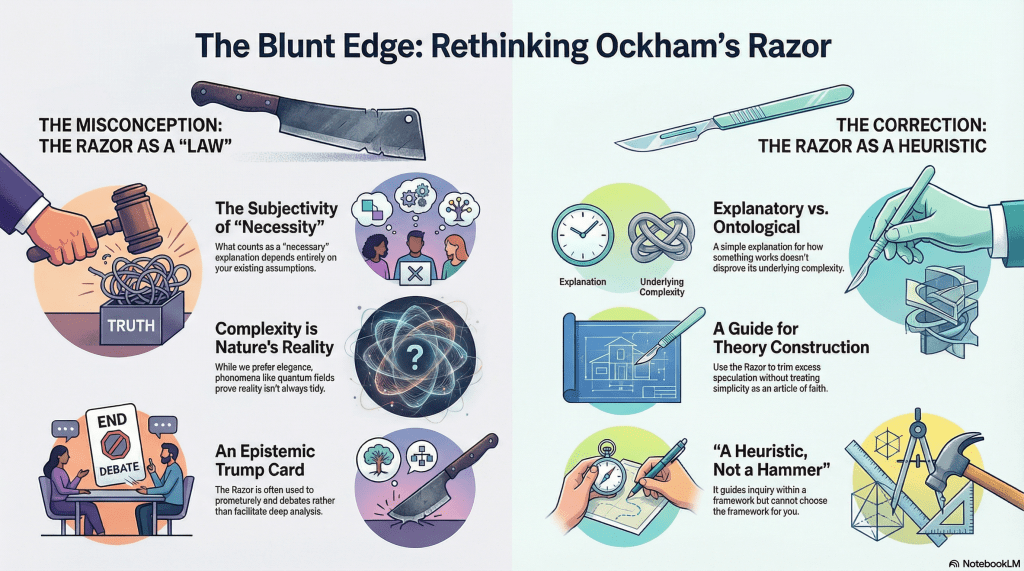
The Razor does not forbid multiplicity. It forbids unnecessary multiplicity. But who decides what is necessary?

Necessity is not a neutral category. It is already embedded within a framework of assumptions about what counts as explanation, what counts as sufficiency, and what counts as legitimate ontological commitment.

For one thinker, invoking a divine ground of physical law is unnecessary because the laws themselves suffice. For another, the laws are unintelligible without a grounding principle, and so God is necessary. Both can claim parsimony within their respective ontologies. The Razor does not adjudicate between them. It presupposes the grammar within which “necessity” is assessed.

The aphorism thus functions less as a rule and more as a reinforcement mechanism. It stabilises the commitments one already holds.
Parsimony Is a Heuristic, Not a Law

Science has often rewarded simplicity. Copernicus simplified celestial mechanics. Newton reduced motion to a few principles. Maxwell unified electricity and magnetism. These episodes encourage a romantic attachment to elegance.

Yet physics has also revealed a universe that is anything but tidy. Quantum fields, curved spacetime, dark matter, inflationary cosmology. Nature has shown little regard for our aesthetic preference for minimal furniture.

Parsimony, then, is pragmatic. It helps us avoid gratuitous complication. It disciplines theory formation. But it is not a metaphysical guarantee that reality itself is sparse.

To treat the Razor as if it carries ontological authority is to convert a methodological guideline into a philosophical dogma.

Structural Sufficiency Versus Metaphysical Surplus

The Razor becomes particularly contentious when deployed in debates about ultimate grounds. If a structural model explains observable regularities and survives empirical constraint, some conclude that any additional metaphysical layer is redundant.

This is a defensible position. It is also incomplete.

Redundancy in explanatory terms does not entail impossibility in ontological terms. A structural account of behaviour may render psychological speculation unnecessary for prediction, but it does not disprove the existence of inner motives. Likewise, a lawful cosmology may render a divine hypothesis explanatorily idle without rendering it incoherent.

The Razor trims explanatory excess. It does not settle metaphysical disputes.

Aphorisms as Closure Devices

Part of the Razor’s power lies in its compression. It is aphoristic. It travels easily. It signals intellectual seriousness. It sounds like disciplined thinking distilled.

But aphorisms compress complexity. They conceal premises. They discourage reopening the frame. “Follow the science.” “Extraordinary claims require extraordinary evidence.” “Trust the market.” These phrases do not argue; they configure. They pre-load the space of acceptable interpretation.

Ockham’s Razor often operates in precisely this way. It is invoked not as the conclusion of a careful analysis but as a device to end discussion. The simpler view wins. Full stop.

Yet simplicity itself is indexed to perspective. What looks simple within one conceptual scheme may appear impoverished within another.

Tolerance for Explanatory Closure

There is also a psychological dimension worth acknowledging. Some individuals are comfortable with open explanatory ceilings. They accept that certain features of reality may lack ultimate grounding within their present framework. Others experience such openness as instability. They seek a final anchor.

The Razor favours the former temperament. It encourages ontological restraint and distrust of ultimate grounds. For those comfortable with structural sufficiency, this is liberating. For those who experience the absence of grounding as incomplete, it feels evasive.

The disagreement is not resolved by invoking parsimony. It reflects divergent tolerances for metaphysical closure.

When the Razor Becomes Inflationary

Ironically, the Razor can itself become an inflationary principle. It can elevate “simplicity” to a quasi-transcendental value. It can be treated as if reality owes us elegance.

At that point, the tool begins to govern the ontology rather than merely discipline it. The Razor becomes an article of faith, a universal heuristic immune to its own demand for justification.

One might then ask, with a certain symmetry: by what necessity is simplicity itself necessary?

A More Modest Use

None of this requires abandoning the Razor. It remains useful. It reminds us not to posit hidden mechanisms when observable structures suffice. It cautions against explanatory extravagance. It protects inquiry from baroque speculation.

But it should be treated as a heuristic, not a hammer. It guides theory construction within a framework. It does not choose the framework.

A more disciplined formulation would be this: when a structural account explains observed regularities under constraint and remains revisable, additional metaphysical posits do not increase explanatory power. Their adoption becomes a matter of ontological preference rather than necessity.

This preserves the Razor’s pragmatic value without inflating it into a metaphysical arbiter.

The Real Trouble

The real trouble with Ockham’s Razor is not that it cuts too much. It is that we often wield it without noticing the hand that holds it. We treat it as neutral when it is already embedded within a grammar of sufficiency, explanation, and legitimacy.

The Razor does not eliminate ontological commitment. It expresses one.

Recognising that does not blunt the blade. It merely reminds us that even the sharpest instruments are guided by the frameworks in which they are forged.

And frameworks, unlike aphorisms, are rarely simple.

The Architecture of Cognitive Compromise

4–6 minutes

Abortion, Ontological Grammar, and the Limits of Civil Discourse

When federal abortion protections were withdrawn in the United States, many observers treated the event as a policy reversal, a judicial shift, or a partisan victory. Those are surface descriptions. They are not wrong. They are simply too thin.

What was exposed was not a failure of dialogue. It was the collision of ontological grammars.

Audio: NotebookLM summary podcast.

1. Thick Concepts and the Illusion of Neutral Ground

book cover

Bernard Williams famously distinguished between ‘thin’ moral terms (good, bad, right) and ‘thick’ ones (cruel, courageous, treacherous), where description and evaluation are fused.

Abortion is not a thin concept. It is thick all the way down.

For one framework, the operative grammar is something like:

  • Life begins at conception.
  • The foetus is a rights-bearing entity.
  • Termination is morally equivalent to killing.

For another:

  • Personhood is socially and biologically emergent.
  • Bodily autonomy is foundational.
  • Forced gestation is coercive.

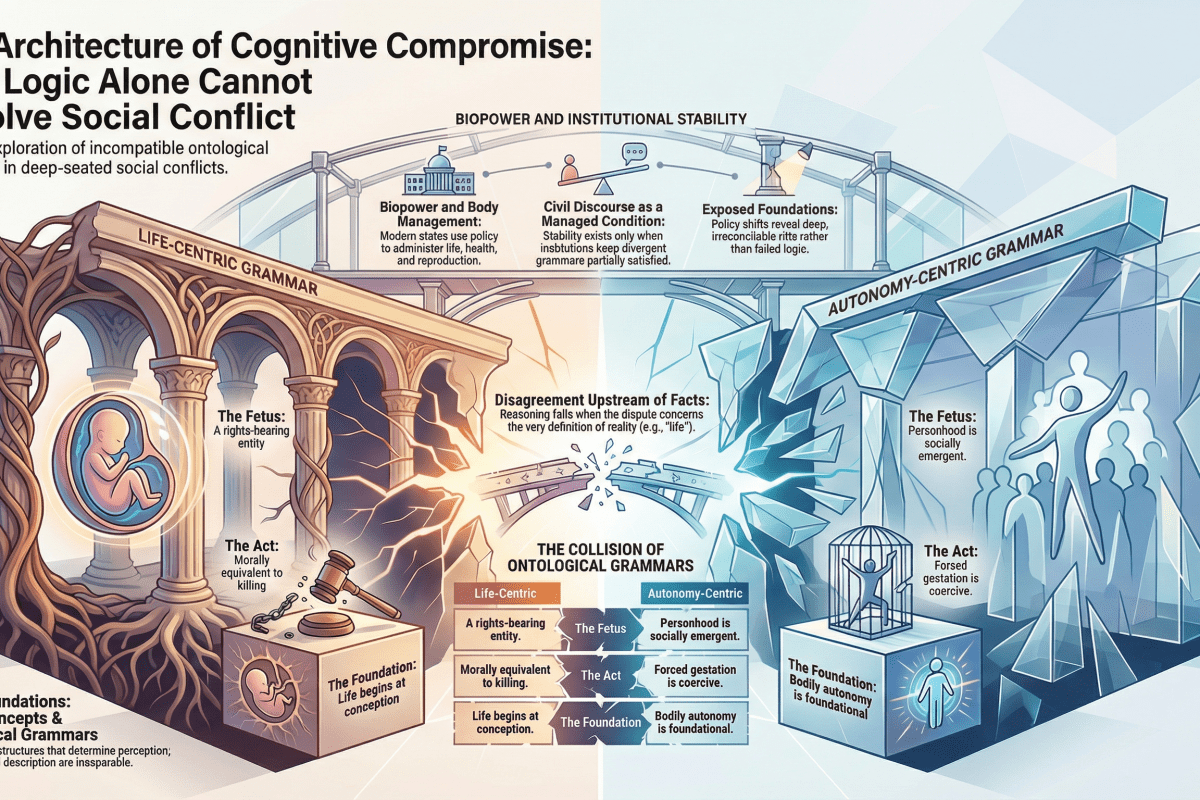
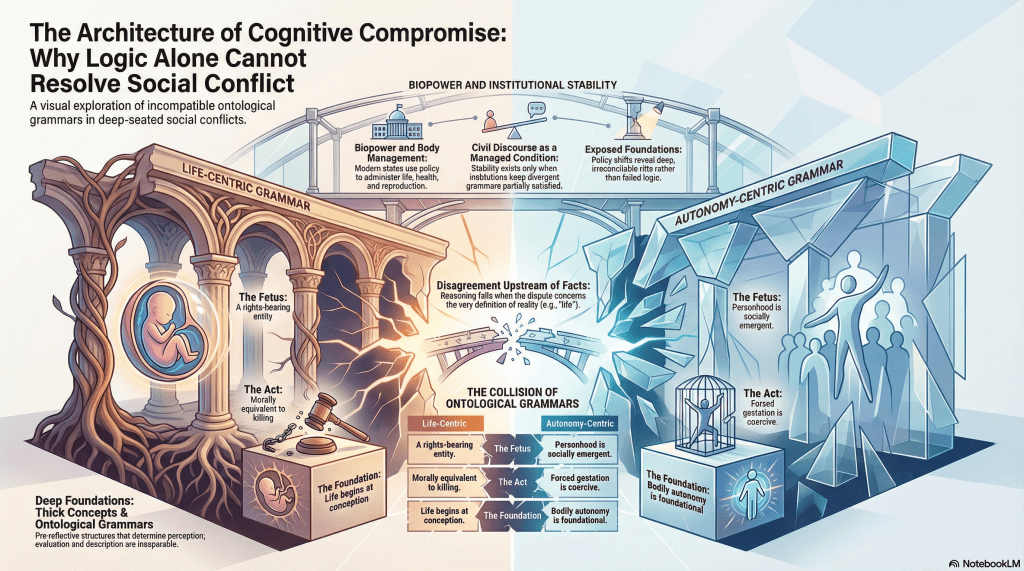
Notice that these are not competing policies. They are competing ontological commitments about what exists, what counts as a person, and what kind of being a pregnant body is.

Argument across this divide does not merely contest conclusions. It contests the background conditions under which reasons register as reasons.

This is not ‘people see the world differently’. It is: people parse reality through grammars that do not commute.

2. Ontological Grammar: Where Deliberation Stops

By ‘ontological grammar’, I do not mean syntax in the Saussurean or Chomskyan sense. I mean the pre-reflective substrate that structures what appears salient, real, morally charged, or negligible.

We deliberate within grammars. We do not deliberate our way into them.

Liberal Enlightenment optimism assumes that if disagreement persists, more information, better reasoning, or improved empathy will close the gap. But if the dispute concerns the very ontology of ‘life’, ‘person’, or ‘rights’, no amount of fact-sharing resolves the issue. The disagreement is upstream of facts.

The closure of federal abortion access did not prove that one side reasoned better. It demonstrated that institutional containment had failed.

3. Biopower and the Management of Bodies

Michel Foucault gives us a crucial lens: biopower. Modern states do not merely govern territory; they administer life. Birth rates, mortality, sexuality, health – these become objects of policy.

Abortion sits directly inside this matrix.

A state that restricts abortion is not only expressing moral judgment. It is reallocating control over reproductive capacity. It is asserting a claim over which bodies count, which futures are permitted, and which biological processes are subject to regulation.

The conflict is therefore not purely ethical. It is biopolitical.

And what appears as ‘civil discourse’ around abortion is often possible only so long as institutional frameworks keep both grammars partially satisfied. When federal protections existed, they acted as a stabilising superstructure. Remove that, and the ontological conflict becomes naked.

4. Habitus and the Illusion of Reasoned Consensus

Pierre Bourdieu would remind us that our dispositions are not self-authored. Habitus sedimented through family, religion, class, and institutional life shapes what feels obvious, outrageous, or unthinkable.

People do not wake up one morning and choose an abortion ontology.

They inherit it. It becomes embodied common sense.

Thus, when someone says, ‘Surely we can agree that making a person feel whole is more important than ideological purity’, they are already speaking from within a grammar that prioritises individual authenticity and psychological coherence. That priority is not universal. It is historically situated.

Compromise is not achieved by stepping outside habitus. It is achieved when institutional and social conditions allow divergent grammars to coexist without totalising one another.

5. The Popperian Threshold

Karl Popper warned of the ‘paradox of tolerance‘: unlimited tolerance may enable intolerant forces to eliminate tolerance itself.

In particularly virulent climates, appeals to compromise are heard not as gestures of goodwill but as tactical weakness.

When one faction succeeds in unilaterally redefining the legal status of abortion at a federal level, it is not merely participating in discourse. It is altering the biopolitical infrastructure. Once altered, the range of permissible disagreement narrows.

Civil discourse, then, is not a natural equilibrium. It is a managed condition sustained by institutional design, social trust, and shared legibility.

NB: Popper’s paradox of tolerance is often invoked as a moral axiom. But it is better understood as a self-protective clause internal to liberal ontology. It presupposes a shared commitment to rational exchange. When that commitment erodes, the paradox does not resolve disagreement; it merely marks the point at which biopower intervenes to preserve a regime.

6. Why This Is Not Just ‘People Disagree’

The lay intuition – ‘people see the world differently’ – is descriptively correct and analytically useless.

What the ontological grammar model adds is structure:

  • Disagreements cluster around thick concepts.
  • Thick concepts fuse description and evaluation.
  • Frameworks determine what counts as a reason.
  • Institutions temporarily stabilise incompatible grammars.
  • When stabilisation weakens, conflict appears irreconcilable.

Abortion is not uniquely polarising because people are irrational. It is polarising because it touches ontological primitives: life, personhood, autonomy, and obligation.

In such cases, ‘compromise’ is not achieved by discovering a middle truth. It is achieved – if at all – by constructing a legal and institutional arrangement that both grammars can grudgingly inhabit.

NotebookLM Infographic

7. The Uncomfortable Conclusion

The Enlightenment story tells us that disagreement is a surface phenomenon, curable by better reasoning.

The ontological grammar story tells us something harsher: some disagreements are not resolvable through language because they are about the conditions under which language binds.

This does not entail quietism. It entails clarity.

Civil discourse is not proof that grammars have converged. It is evidence that power, institutions, and habitus have aligned sufficiently to prevent rupture.

When that alignment shifts, the illusion of shared ontology evaporates.

And what we are left with is not failed reasoning – but exposed foundations.


I planned to use prostitution and anti-natalism as other cases for elucidation, but I see this has already grown long. I’ll reserve these are others for another day and time.

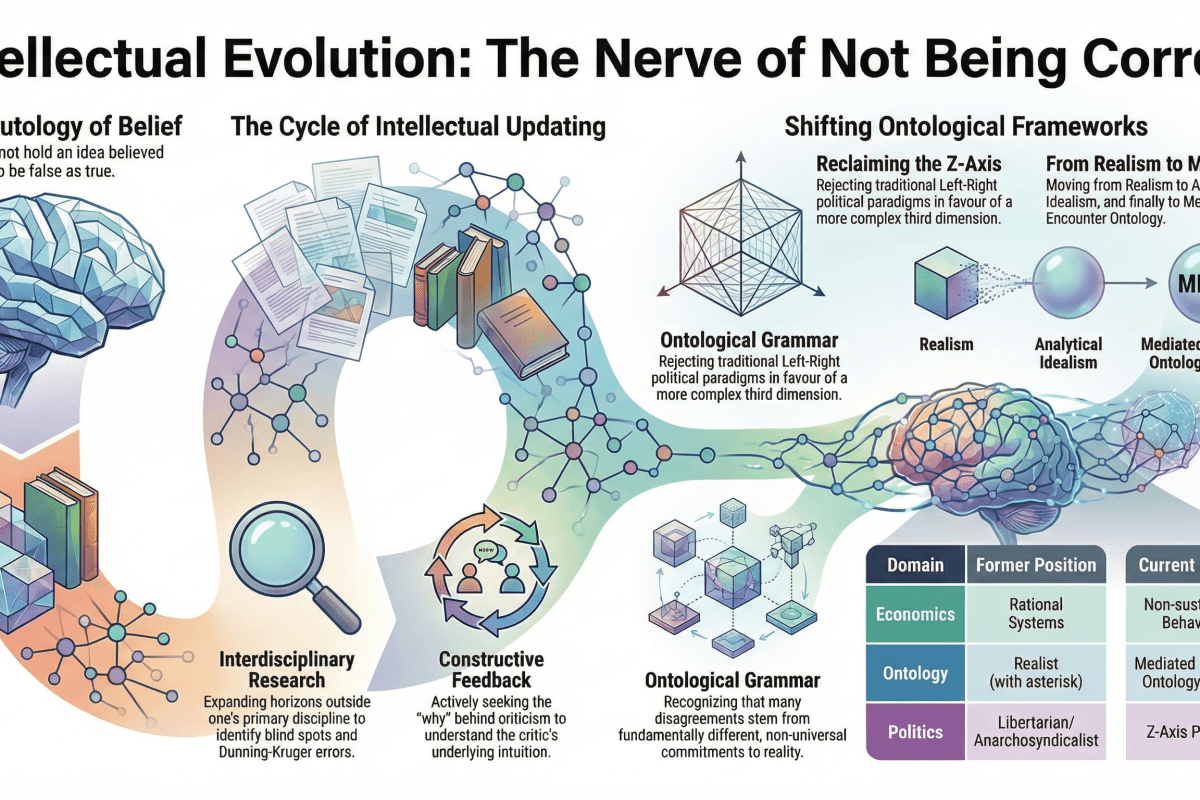
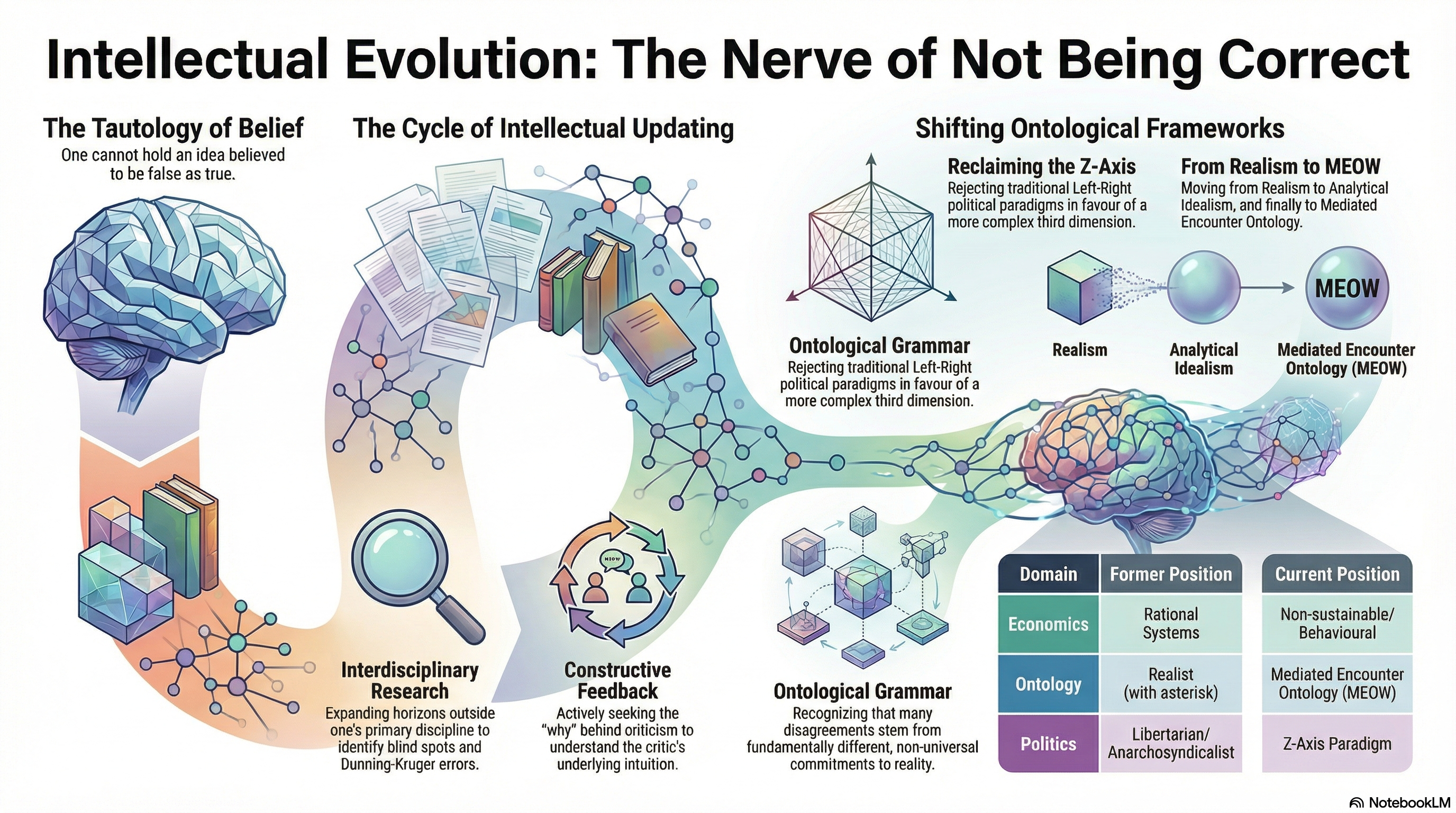
The Nerve of Not Being Correct

I’ve received feedback like, ‘Not everything you believe is right’ and ‘What if you’re not right?’

First: I agree. Second: And what if I’m not?

This isn’t new feedback, but I’ll address it in terms of my latest work.

Audio: NotebookLM summary podcast

Not everything you believe is right

This is true, but one cannot hold an idea one believes to be false as true, so the idea that one believes what one believes to be true to tautological. This is also why I continue to research and attempt to expand my horizon. I even wander outside of my discipline at the risk of Dunning-Kruger errors.

In my recent work on ontology and grammar, I collided with Bourdieu, so I read his work. As helpful as it was, it served to reinforce my position, but from a position of Social Theory instead of Philosophy. When I read Judith Butler, I see how I might connect my ideas to Gender theory. It should be obvious that I’ve read much on Linguistics, but I am not a linguist. Our lenses all differ to some extent.

I’ve even corrected some of the ideas I’ve posted on this blog as I gain new information. To be fair, it’s a reason I post here. I hope to get feedback. I may not fully pursue alternative disciplines, but it’s nice to know they exist, and I can at least perform cursory surveys.

NotebookLM Infographic

Historically, many times I’d been claimed to be wrong because the person was coming from a differnt ontology. I might have been arguing something within the realm of Continental philosophy, and I’d get a critique from an Analytical philosopher. This is akin to a vegan critiquing a steak dinner. It may be valid within their ontological grammar, but it is not otherwise universal. It usually doesn’t take very long to assess one’s commitments to other grammars. That happened recently, when I encountered a philosophical Realist.

When I wouldn’t accept their position, eventually we arrived at this foundational point. Realism is a position I ontologically and grammatically reject. I’ve written several pieces defending or at least articulating my position, notably the Mediated Encounter Ontology (MEOW). Disagree? Tell me.

I used to be a Realist with an asterisk; then I was an Analytical Idealist with an asterisk; now, I believe in MEOW. The asterisk was necessary because there were holes in the position. When Analytical Idealism came around, there was still an asterisk, but it felt better than that of Realism. When I came up with MEOW, the asterisk went away. Perhaps you might consider that MEOW has an asterisk, if you believe it’s plausible at all. If so, what’s missing – what’s the known unknown? You obviously can’t articulate an unknown unknown.

When I write about ontology, grammar, and commensurability, I do not exempt myself from these biases. I have all of these challenges – perhaps even more so because I don’t tend to fit into the round holes very well myself. This helps me with intellectual humility.

Politically, I am often accused of being on the Left, but I reject the Left-Right paradigm as a valid lens for me; I am on a different axis. The Libertarians added an Authority-Liberty Y-axis to the Progressive-Conservative X-axis, but I am on a Z-axis, which is not to be fully described or accounted for on these planes. Think of the message of Flatland.

What if you’re wrong?

Hopefully, every philosopher understands this and has noticed the dustbin of history littered with wrong ideas.

When I publish essays, they are the result of research and deliberation. Could I be wrong? Again, I’ve been wrong before. I’ll be wrong again, but I need to understand why to change my position. I could shift my position or abandon it outright.

There was a time I believed people to be rational. I was an economist. I studied finance. I believed it until I didn’t. Behavioural Economics likely did the heavy lifting, but it’s likely that they believe that rationality-based systems are salvageable. I don’t. Not meaningfully. Not sustainably.

So, I can be wrong, and I can admit it.

I was once a closet (or adjacent) Libertarian until I realised it didn’t cohere with reality. My last declared stance was an Anarchosydicalist, but I know this isn’t quite right either – on multiple accounts.

Anyway, I’m not afraid of being wrong, and I’m not afraid of wittering on about it. Again, I appreciate constructive criticism. I’m also amicable to non-solutions in the manner of my Dis–Integration approach, but at least break down the pieces.

Firmware, Room 101, and the Myth of Rational Reprogramming

2–3 minutes

NB: I am travelling today, but I still wish to clarify how my ontologies and grammars operate, so I had a chat with, well, ChatGPT – from Bourdieu to Burgess – using an EPROM analogy.

I know that this analogy may appeal more to one with a technical background, but I hope it helps. If you don’t get the reference, just look it up

Audio: NotebookLM summary podcast of this content.

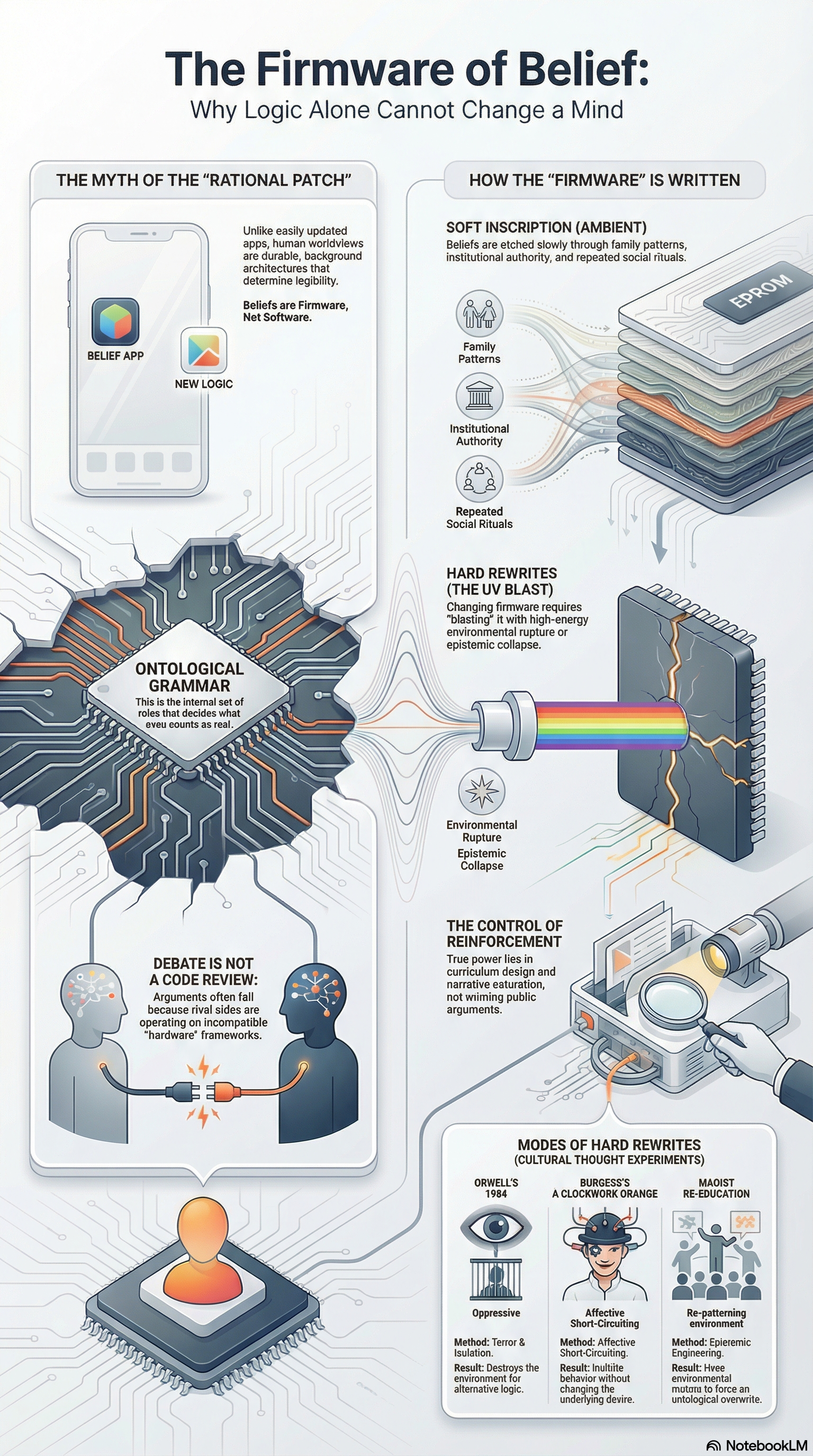
There is a persistent liberal fantasy that human beings update their beliefs the way laptops update operating systems. A patch is issued. A bug is identified. The system installs corrections.

This fantasy survives despite all available evidence.

What Bourdieu called habitus — durable dispositions structured by early social conditions — is not a folder of opinions. It is firmware. It is the background architecture that determines what even counts as legible input.

You can argue against a proposition.
You cannot argue against the grammar that determines whether that proposition parses.

This is where the EPROM analogy earns its keep.

EPROM — erasable programmable read-only memory — can, in theory, be rewritten. But not casually. It requires exposure to high-energy ultraviolet light. You do not “reason” an EPROM into new content. You blast it.

The durability is the point.

NotebookLM Infographic

Soft Inscription: The Invisible UV

Most of the time, ontological grammar is inscribed slowly:

  • Family speech patterns
  • Institutional authority
  • Ritual repetition
  • Reward structures
  • Peer reinforcement

No torture chambers required. No theatrical violence. Just ecological stability.

Over time, what is socially repeated becomes ontologically obvious. What is ontologically obvious becomes morally self-evident.

The result feels like reason.

It is not.

It is stabilised reinforcement architecture.

Hard Rewrites: Cultural Thought Experiments

Our culture understands this more clearly than our political theory does.

In 1984, by George Orwell, Winston is not persuaded. He is destabilised. Isolation, sleep deprivation, epistemic collapse, and finally pain. The Party does not win an argument. It destroys the environment that made alternative legibility possible.

Two plus two equals five is not stupidity. It is the final stage of ecological override.

In A Clockwork Orange, by Anthony Burgess, the Ludovico Technique does something subtler. Alex’s ontology is not rewritten. His affective circuits are short-circuited. He retains desire; he loses viable enactment.

Orwell shows firmware rewrite through terror.
Burgess shows behavioural inhibition without ontological conversion.

Both are caricatures — but useful ones. They compress what normally unfolds across decades into clinical spectacle.


Apologies in advance. Evidently, creating a post on a mobile isn’t very accommodating.

Legibility and Ontology

3–5 minutes

These two words qualify as my words of the month: legibility and ontology.

I’ve been using them as lenses.

I picked up legibility from James C. Scott’s Seeing Like a State: How Certain Schemes to Improve the Human Condition Have Failed, which is really a book about how well-intentioned schemes fail once reality is forced to become administrable. Ontology is an older philosophical workhorse, usually paired with epistemology, but I’m using it here in a looser, more pragmatic sense.

When I write, I write through lenses. Everyone does. Writing requires a point of view, even when we pretend otherwise.

In this post, I want to talk more informally about my recent essay, Grammatical Failure. I usually summarise my work elsewhere, but here I want to think out loud about it, particularly in relation to social ontology and epistemology. I won’t linger on definitions. They’re a search away. But a little framing helps.

Ontology, roughly: how reality is parsed.

Epistemology: how knowledge is justified within that parsing.

Audio: NotebookLM summary of this post.

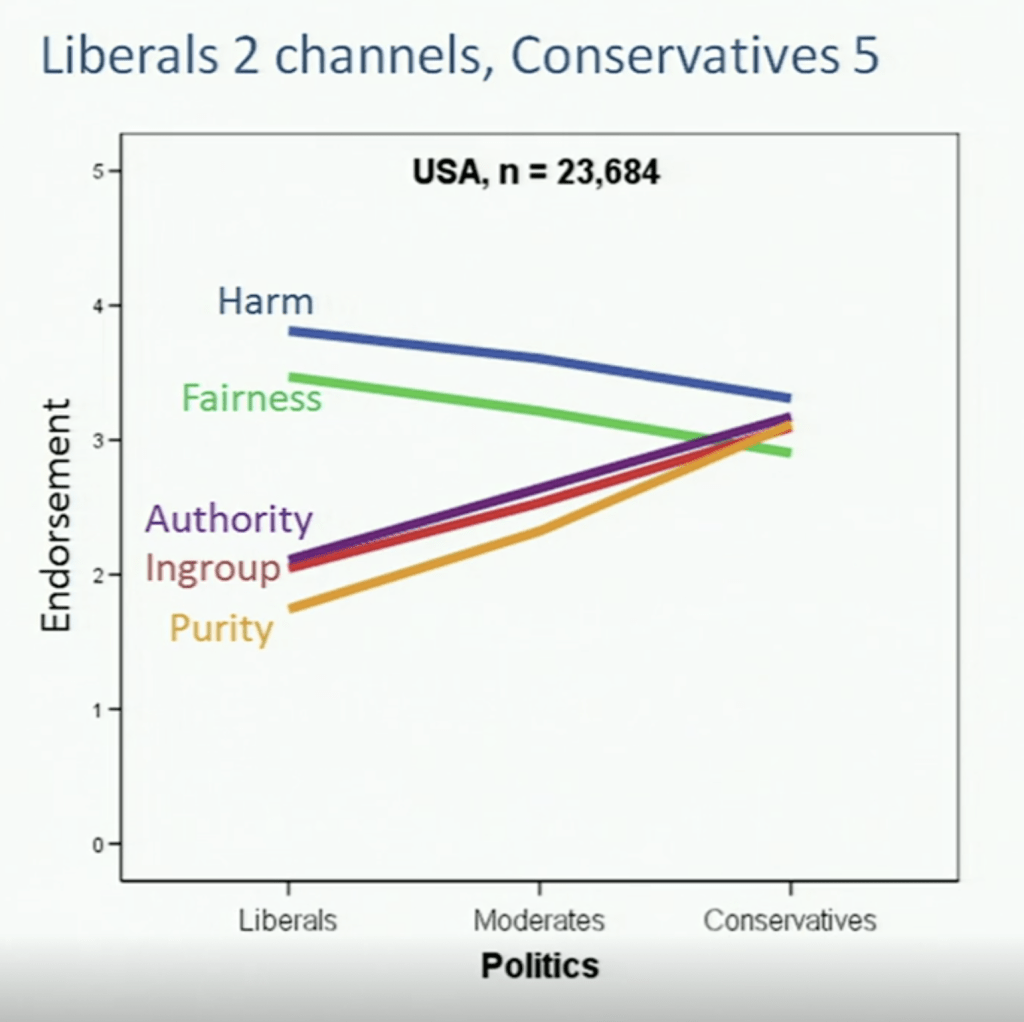
Much of my recent work sits downstream of thinkers like Thomas Sowell, George Lakoff, Jonathan Haidt, Kurt Gray, and Joshua Greene. Despite their differences, they converge on a shared insight: human cognition is largely motivated preverbally. As a philosopher of language, that pre-language layer is where my interest sharpens.

I explored this in earlier work, including a diptych titled The Grammar of Impasse – Conceptual Exhaustion and Causal Mislocation. Writing is how I gel these ideas. There are several related pieces still in the pipeline.

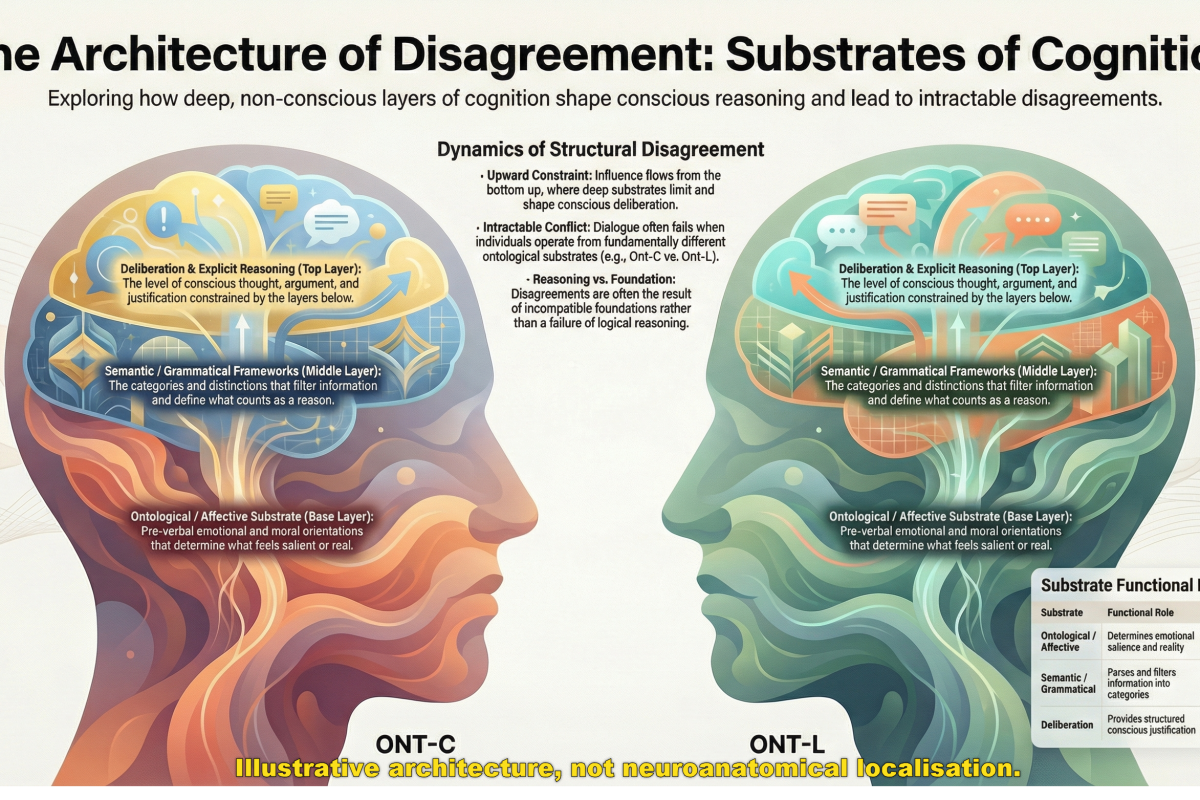
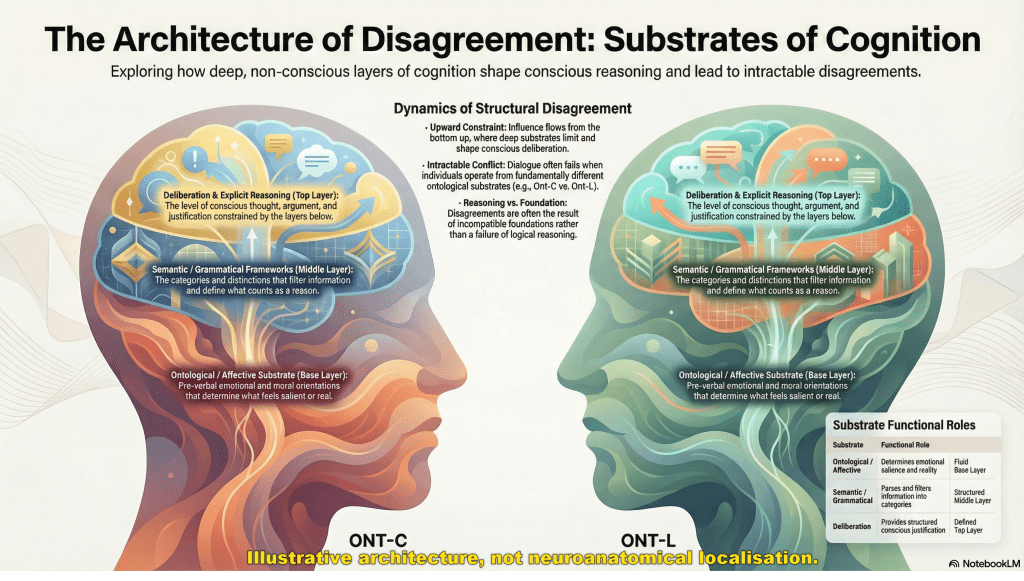
When I talk about grammar, I don’t mean Saussure or Chomsky. I mean something deeper: the ontological substrate beneath belief. Grammar, in this sense, is how reality gets parsed before beliefs ever form. It filters what can count as real, salient, or intelligible.

Let’s use a deliberately simplified example.

Imagine two ontological orientations. Call them Ont-C and Ont-L. This isn’t to say there are only two, but much of Western political discourse collapses into a binary anyway.

Ont-C tends to experience people as inherently bad, dangerous, or morally suspect. Ont-L tends to experience people as inherently good or at least corrigible. These aren’t opinions in the usual sense. They sit beneath belief, closer to affect and moral orientation.

Now consider retributive justice, setting aside the fact that justice itself is a thick concept.

From Ont-C, punishment teaches a lesson. It deters. It disciplines. From Ont-L, punishment without rehabilitation looks cruel or counterproductive, and the transgression itself may be read as downstream of systemic injustice.

Each position can acknowledge exceptions. Ont-L knows there are genuinely broken people. Ont-C knows there are saints. But those are edge cases, not defaults.

Now ask Ont-C and Ont-L to design a criminal justice system together. The result will feel intolerable to both. Too lenient. Too harsh. The disagreement isn’t over policy details. It’s over how reality is carved up in the first place.

And this is only one dimension.

Add others. Bring in Ont-V and Ont-M if you like, for vegan and meat-based ontologies. Suddenly, you have Ont-CV, Ont-CM, Ont-LV, and Ont-LM. Then add class, religion, gender, authority, harm, and whatever. Intersectionality stops looking like a solution and starts looking like a combinatorial explosion.

The Ont-Vs can share a meal, so long as they don’t talk politics.

The structure isn’t just unstable. It was never stable to begin with. We imagine foundations because legibility demands them.

Grammatical Failure is an attempt to explain why this instability isn’t a bug in liberal epistemology but a structural feature. The grammar does the sorting long before deliberation begins.

More on that soon.


In any case, once you start applying this ontological lens to other supposedly intractable disputes, you quickly realise that their intractability is not accidental.

Take abortion.

If we view the issue through the lenses of Ont-A (anti-abortion) and Ont-C (maternal choice), we might as well be peering through Ont-Oil and Ont-Water. The disagreement does not occur at the level of policy preferences or competing values. It occurs at the level of what counts as morally salient in the first place.

There is no middle ground here. No middle path. No synthesis waiting to be negotiated into existence.

That is not because the participants lack goodwill, intelligence, or empathy. It is because the ontological primitives are incommensurate. Each side experiences the other not as mistaken but as unintelligible.

We can will compromise all we like. The grammar does not comply.

Contemporary discourse often insists otherwise. It tells us that better arguments, clearer framing, or more dialogue will eventually converge. From this perspective, that insistence is not hopeful. It is confused. It mistakes a grammatical fracture for a deliberative failure.

You might try to consider other polemic topics and notice the same interplay.

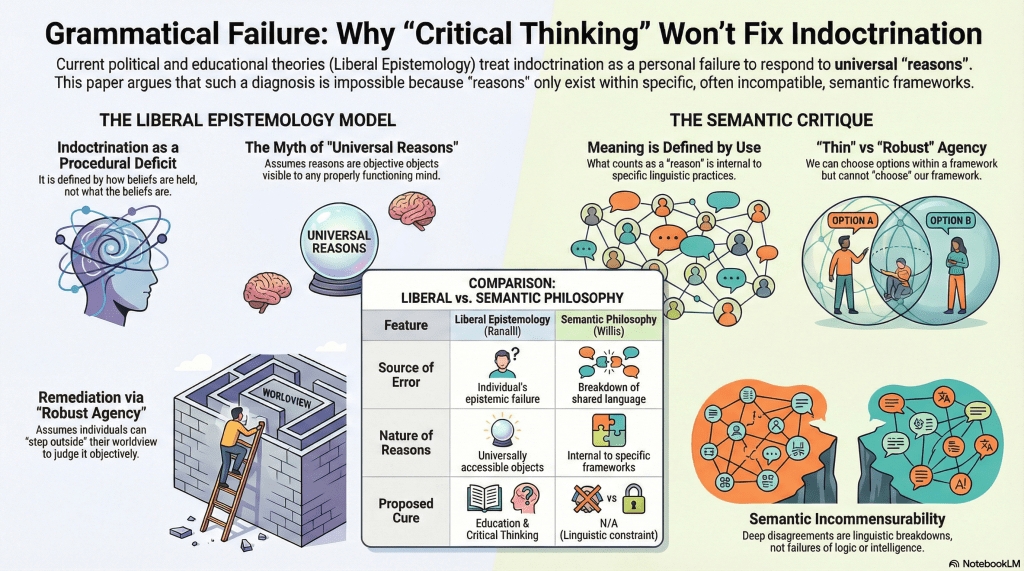
Why “Just Think Critically” Keeps Failing

2–4 minutes

The paper is now available on Zenodo.

I’ve been wittering on about social ontological positions and legibility for a few months now. I’ve been writing a book and several essays, but this is the first to be published. In it, I not only counter Ranalli – not personally; his adopted belief – I also counter Thomas Sowell, George Lakoff, Jonathan Haidt, Kurt Gray, and Joshua Green. (Counter might be a little harsh; I agree with their conclusions, but I remain on the path they stray from.)

Audio: NotebookLM summary of the essay: Grammatical Failure

There is a strange faith circulating in contemporary culture: the belief that disagreement persists because someone, somewhere, hasn’t been taught how to think properly.

The prescription is always the same. Teach critical thinking. Encourage openness. Expose people to alternatives. If they would only slow down, examine the evidence, and reflect honestly, the right conclusions would present themselves.

When this doesn’t work, the explanation is equally ready to hand. The person must be biased. Indoctrinated. Captured by ideology. Reason-resistant.

What’s rarely considered is a simpler possibility: nothing has gone wrong.

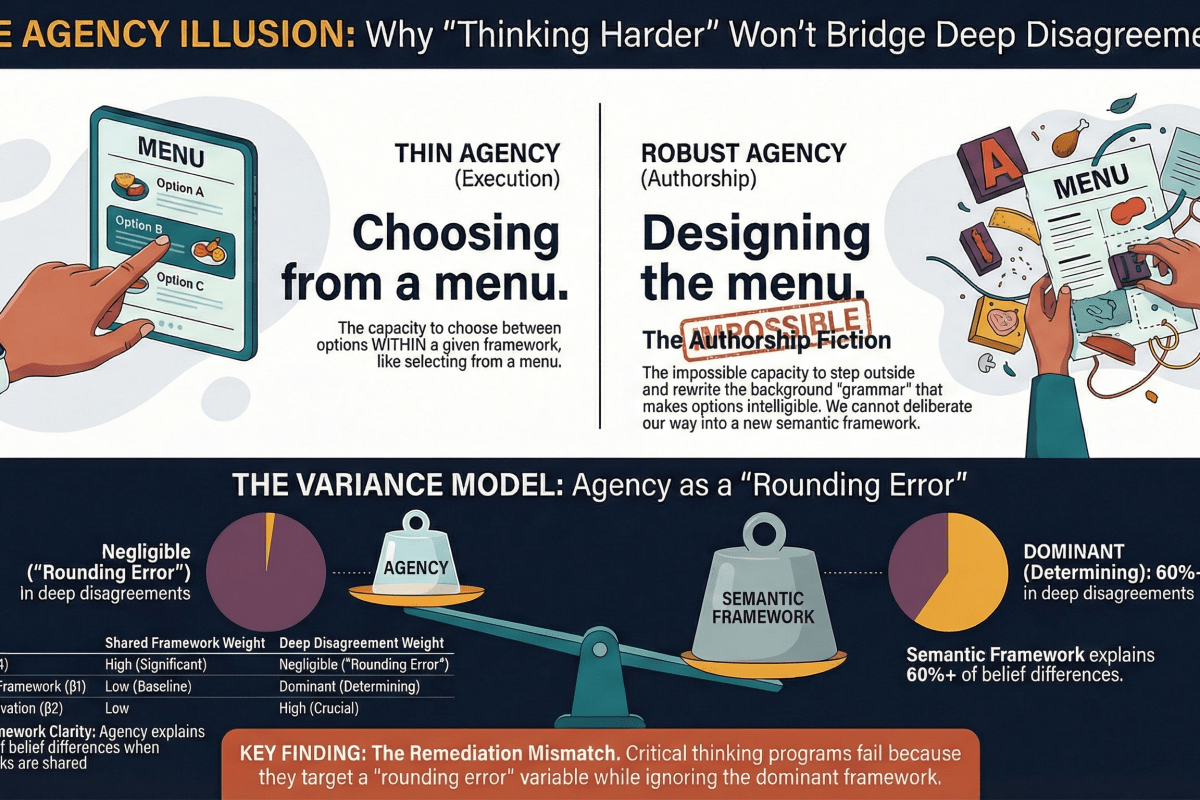
Most of our public arguments assume that we are all operating inside the same conceptual space, disagreeing only about how to populate it. We imagine a shared menu of reasons, facts, and values, from which different people select poorly. On that picture, better reasoning should fix things.

What if what counts as a ‘reason’, what qualifies as ‘evidence’, or what even registers as a meaningful alternative is already structured differently before any deliberation begins?

At that point, telling someone to ‘think critically’ is like asking them to optimise a system they cannot see, using criteria they do not recognise. The instruction is not offensive. It’s unintelligible. This is why so many contemporary disputes feel immune to argument. Not merely heated, but strangely orthogonal. You aren’t rebutted so much as translated into something else entirely: naïve, immoral, dangerous, unserious. And you do the same in return.

Liberal epistemology has a neat explanation for this. It treats these failures as agent-level defects: insufficient openness, motivated reasoning, epistemic irresponsibility. The problem is always how people reason. The argument of Grammatical Failure is that this diagnosis is systematically misplaced. The real constraint, in many cases, lies upstream of reasoning itself. It lies in the semantic frameworks that determine what can count as a reason in the first place. When those frameworks diverge, deliberation doesn’t fail heroically. It fails grammatically.

This doesn’t mean people lack agency. It means agency operates within a grammar, not over it. We choose, revise, and reflect inside spaces of intelligibility we did not author. Asking deliberation to rewrite its own conditions is like asking a sentence to revise its own syntax mid-utterance. The result is a familiar pathology. Disagreement across frameworks is redescribed as epistemic vice. Category rejection is mistaken for weak endorsement. Indoctrination becomes a label we apply whenever persuasion fails. Not because anyone is lying, but because our diagnostic tools cannot represent what they are encountering.

The paper itself is not a manifesto or a programme. It doesn’t tell you what to believe, how to educate, or which politics to adopt. It does something more modest and more uncomfortable. It draws a boundary around what liberal epistemology can coherently explain – and shows what happens when that boundary is ignored.

Sometimes the problem isn’t that people won’t think.

It’s that they are already thinking in a grammar that your advice cannot reach.

Why So Serious?

1–2 minutes

Yes, I am still focusing on writing my ontology papers, but I still come up for air. Over lunch, I found this: Jonny Thomson showcasing Judge Coleridge: The Duty. Watch it.

Video: Philosophy Minis: Judge Coleridge: The Duty

This really got my hamster wheel cranking. In fact, it gave me another essay idea mired in formal logic. Yuck, I know.

My brief post here is to share this and ask why I don’t share ‘positive’ posts. Pretty much everything is critical. For one, it’s how my brain works. For two, I don’t really know.

When I see something, I instantly want to tear it apart, not for the sake of malice but because my mind registers it as WTAF?

In short, the judge says that one cannot privilege one’s own life over others. Of course, this got my hamster on steroids, considering the implication: does this invalidate self-defence? Wouldn’t it? 🧐

The answer is yes – but only if Law were tethered to Morality, which it isn’t. This will be my essay. Who knows when I’ll have time to write it? Please, stand by. Cheers.

What are your thoughts? Maybe I’ll share this as a video response on YouTube and TikTok. Time will tell – and it evidently heals all wounds.

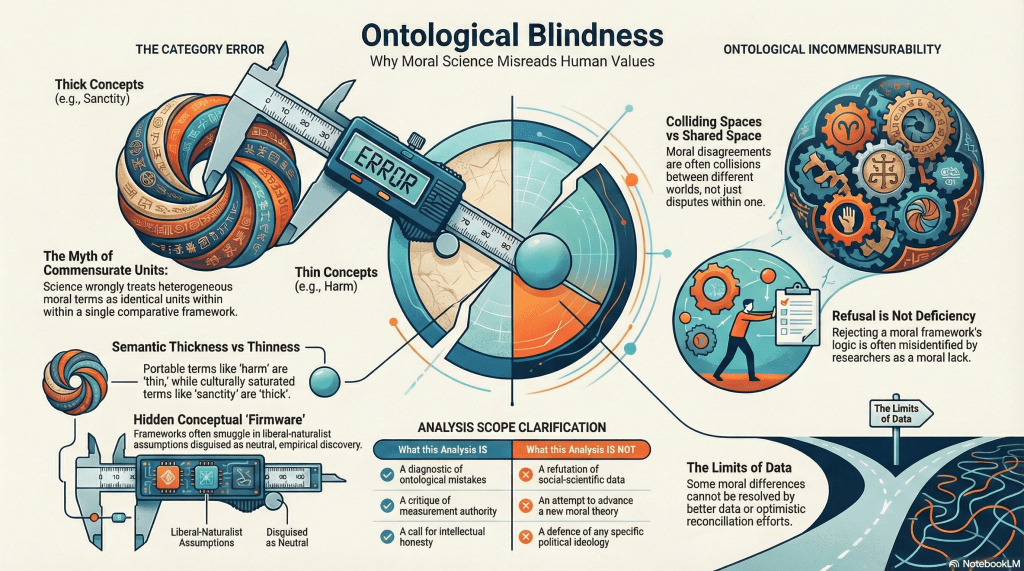
Ontological Blindness in Modern Moral Science

4–6 minutes

Announcement: I’ll be taking a break from posting long-form articles for a while to focus on a project I’m developing. Instead, I’ll share progress summary updates.

Ontological Blindness in Modern Moral Science is a working title with a working subtitle as The Why Semantic Thickness, Measurement, and Reconciliation Go Wrong. No spoilers.

Audio: NotebookLM summary podcast of this topic.

INSERT: I’ve only outlined and stubbed this Ontological blindness project, and I’ve already got another idea. I need to stop reading and engaging with the world.

I was listening to the Audible version of A.J. Ayer’s classic, Language, Truth, and Logic (1936)– not because I had time but because I listen to audiobooks when I work out. Ayer is a Logical Positivist, but I forgive him. He’s a victim of his time. In any case, I noticed several holes in his logic.

Sure, the book was published in 1936, and it is infamous for defending or creating Emotivism, a favourite philosophical whipping boy. I’m an Emotivist, so I disagree with the opposition. In fact, I feel their arguments are either strawmen or already defended by Ayer. I also agree with Ayer that confusing the map of language with the terrain of reality is a problem in philosophy (among other contexts), but it’s less excusable for a language philosopher.

In any case, I have begun a file to consider a new working title, Phenomenal Constraint and the Limits of Ontological Language. I might as well stay in the ontological space for a while. We’ll see where it leads, but first, I need to put the original project to bed.

Every time I commence a project, I create a thesis statement and an abstract to orient me. These may change over the course of a project, especially larger ones – more of an abstract than a thesis. This thesis has already changed a couple of times, but I feel it’s settled now.

Image: NotebookLM infographic on this topic.

Thesis Statement

Modern moral psychology repeatedly commits a multi-layered category error by treating semantically and ontologically heterogeneous moral terms as commensurate units within a single comparative framework, while simultaneously treating parochial moral metaphysics as natural substrate.

This dual conflation—of semantic density with moral plurality, and of ontological commitment with empirical discovery—produces the false appearance that some moral systems are more comprehensive than others, when it in fact reflects an inability to register ontological incommensurability.

Moral Foundations Theory provides a clear and influential case of this broader mistake: a framework whose reconciliation-oriented conclusions depend not on empirical discovery alone, but on an unacknowledged liberal-naturalist sub-ontology functioning as conceptual ‘firmware’ mistaken for moral cognition itself.

Abstract

Modern moral psychology seeks to explain moral diversity through empirically tractable frameworks that assume cross-cultural comparability of moral concepts. This book argues that many such frameworks – including but not limited to Moral Foundations Theory (MFT) – rest on a persistent category error: the treatment of semantically and ontologically heterogeneous moral terms as commensurate units within a single evaluative space.

The argument proceeds in four stages. First, it establishes that moral vocabularies differ not merely in emphasis but in semantic thickness: some terms (e.g. harm, fairness) are comparatively thin, portable, and practice-independent, while others (e.g. loyalty, authority, sanctity) are culturally saturated, institution-dependent, and ontologically loaded. Treating these as equivalent ‘foundations’ mistakes density for plurality.

Second, the book shows that claims of moral ‘breadth’ or ‘completeness’ smuggle normativity into ostensibly descriptive research, crossing the Humean is/ought divide without acknowledgement. Third, it argues that this slippage is not accidental but functional, serving modern culture’s demand for optimistic, reconcilable accounts of moral disagreement.

Finally, through sustained analysis of MFT as a worked example, the book demonstrates how liberal naturalist individualism operates as an unacknowledged sub-ontology – conceptual firmware that determines what counts as moral, measurable, and comparable. The result is not moral pluralism, but ontological imperialism disguised as empirical neutrality.

The book concludes by arguing that acknowledging ontological incommensurability does not entail nihilism or relativistic indifference, but intellectual honesty about the limits of moral science and the false comfort of reconciliation narratives.

Ideation

I’ve been pondering ontologies a lot these past few weeks, especially how social ontologies undermine communication. More recently, I’ve been considering how sub-ontologies come into play. A key catalyst for my thinking has been Jonathan Haidt’s Moral Foundations Theory, but I’ve also been influenced by George Lakoff, Kurt Gray, and Joshua Greene, as I’ve shared recently. I want to be clear: This book is not about politics or political science. It intends to about the philosophy of psychology and adjacent topics.

At the highest levels, I see fundamental category errors undermining MFT, but as I inspected, it goes deeper still, so much so that it’s too much to fit into an essay or even a monograph, so I will be targeting a book so I have room to expand and articulate my argumentation. Essays are constraining, and the narrative flow – so to speak – is interrupted by footnotes and tangents.

In a book, I can spend time framing and articulating – educating the reader without presuming an in-depth knowledge. This isn’t to say that this isn’t a deep topic, and I’ll try not to patronise readers, but this topic is not only counterintuitive, it is also largely unorthodox and may ruffle a few feathers.

I’m not sure how much I’ll be able to share, but I’d like to be transparent in the process and perhaps gather some inputs along the way.

Methodology

Sort of… I’ve used Scrivener in the past for organising and writing fiction. This is the first time I’ am organising nonfiction. We’ll see how it goes.

Reality Happens Once. Facts Happen Many Times.

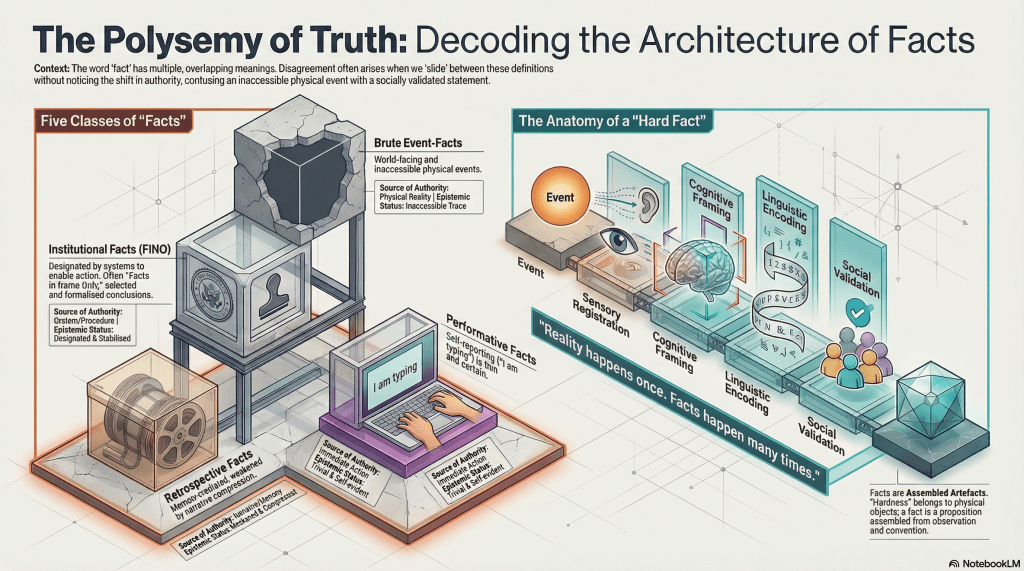
I want to clarify my recent The Trouble with Facts post. I realise that I was speaking to one non-trivial form of facts, but there is more than one class of facts. We argue about facts as if the word named a single, stable thing. It doesn’t. It names a family of very different things, quietly grouped together by habit, convenience, and institutional need. Most disputes about facts go nowhere, not because one side is irrational, but because the word itself is doing covert work. We slide between meanings without noticing, then act surprised when disagreement follows. This piece is an attempt to slow that slide.

Audio: NotebookLM summary podcast of this topic.

Polysemy We Notice, Polysemy We Don’t

We are comfortable with ambiguity when it is obvious. A bank can be a financial institution or the edge of a river. A bat can be an animal or a piece of sports equipment. Context resolves these instantly. No one feels existentially threatened by the ambiguity.

Fact is different. The word is polysemous in a way that is both subtle and consequential. Its meanings sit close enough to bleed into one another, allowing certainty from one sense to be smuggled into another without detection. Calling something a fact does not merely describe it. It confers authority. It signals that questioning should stop. That is why this ambiguity matters.

Different Kinds of Facts

Before critiquing facts, we need to sort them.

1. Event-facts (brute, world-facing)
As mentioned previously, these concern what happens in the world, independent of observation.

  • A car collides with a tree.
  • Momentum changes.
  • Metal deforms.

These events occur whether or not anyone notices them. They are ontologically robust and epistemically inaccessible. No one ever encounters them directly. We only ever encounter traces.

2. Indexical or performative facts (trivial, self-reporting)
“I am typing.”

I am doing this now – those now may not be relevant when you read this. This is a fact, but a very thin one. Its authority comes from the coincidence of saying and doing. It requires no reconstruction, no inference, no institutional validation. These facts are easy because they do almost no work.

3. Retrospective personal facts (memory-mediated)
“I was typing.”

This may be relevant now, at least relative to the typing of this particular post. Still a fact, but weaker. Memory enters. Narrative compression enters. Selectivity enters. The same activity now carries a different epistemic status purely because time has passed.

4. Prospective statements (modal, not yet facts)
“I will be typing.”

This is not yet a fact. It may never come to be one. It is an intention or prediction that may or may not be realised. Future-tense claims are often treated as incipient facts, but this is a category error with real consequences.

5. Institutional facts (designated, procedural)
“The court finds…”
“The report concludes…”

These are facts by designation. They are not discovered so much as selected, formalised, and stabilised so that systems can act. They are unlikely to rise to the level of facts, so the legal system tends to generate facts in name only – FINO, if I am being cute.

All of these are called ‘facts’. They are not interchangeable. The trouble begins when certainty migrates illicitly from trivial or institutional facts into brute event-facts, and we pretend nothing happened in the transfer.

One Motor Vehicle

Reconsider the deliberately simple case: A motor vehicle collides with a tree. Trees are immobile, so we can rule out the tree colliding with the car.

Ontologically, something happened. Reality did not hesitate. But even here, no one has direct access to the event itself.

The driver does not enjoy privileged access. They experience shock, adrenaline, attentional narrowing, selective memory, post hoc rationalisation, perhaps a concussion. Already several layers intervene before language even arrives.

A rough schema looks like this:

event → sensory registration → cognitive framing → linguistic encoding → social validation

Ontology concerns what happens.
Epistemology concerns how anything becomes assertable.

Modern thinking collapses the second into the first and calls the result the facts.

People speak of “hard facts” as if hardness transfers from objects to propositions by proximity. It doesn’t. The tree is solid. The fact is an artefact assembled from observation, inference, convention, and agreement.

And so it goes…

Why the Confusion Persists

When someone responds, “But isn’t it a fact that I read this?”, the answer is yes. A different kind of fact.

The error lies not in affirming facts, but in failing to distinguish them. The word fact allows certainty to migrate across categories unnoticed, from trivial self-reports to brute world-events, and from institutional verdicts to metaphysical claims. That migration is doing the work.

Conclusion

Clarifying types of facts does not weaken truth. It prevents us from laundering certainty where it does not belong.

Facts exist. Events occur. But they do not arrive unmediated, innocent, or singular.

Reality happens once. Facts happen many times.

The mistake was never that facts are unreal. It was believing they were all the same kind of thing.

The Trouble with Facts

5–8 minutes

One Motor Vehicle

What we call facts are not discoveries of an unfiltered world. They are the end-products of mediation.

Let’s walk through an example.

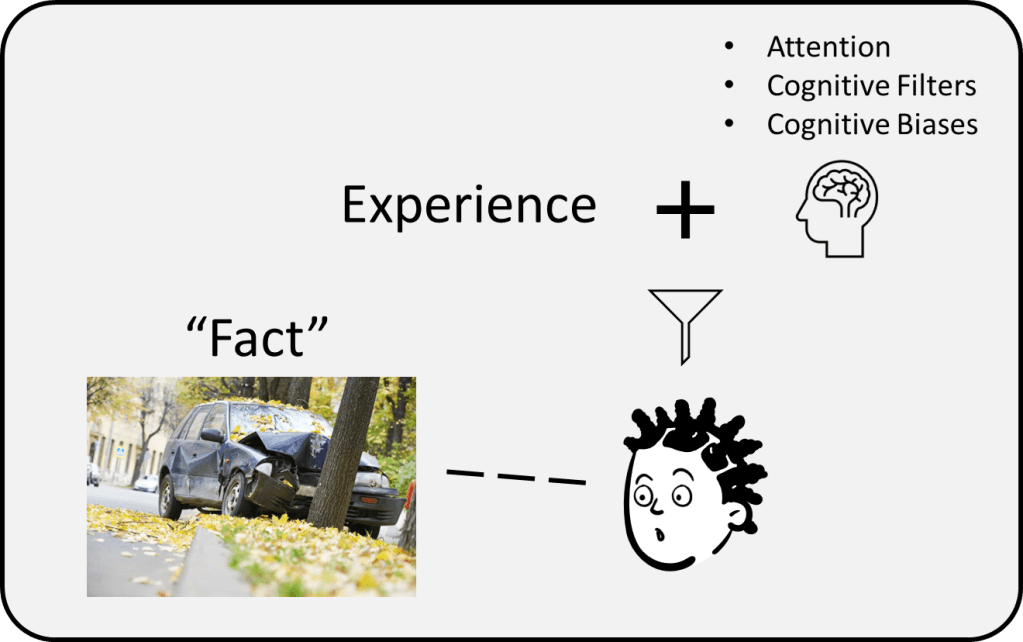
Image: Autosmash example. An observer arrives with experience – from genetic predisposition to childhood trauma to winning the lottery. Whatever it might be. Of course, they have many cognitive deficits, biases and filters. Then, there’s the immediate problem of attention. When did they notice the event? Did they turn to look after hearing the noise, or were they meditating on the tree in that moment?

Apparently, a motor vehicle has collided with a tree. Trees are immobile objects, so we can safely rule out the tree colliding with the car.*

So what, exactly, are the facts?

Audio: NotebookLM summary podcast of this topic.

Ontology (the boring bit)

Ontologically, something happened.

A car struck a tree.
Metal deformed.
Momentum stopped.

Reality did not hesitate. It did not consult witnesses. It did not await interpretation.

This is the part Modernity likes to gesture at reverently before immediately leaving it behind.

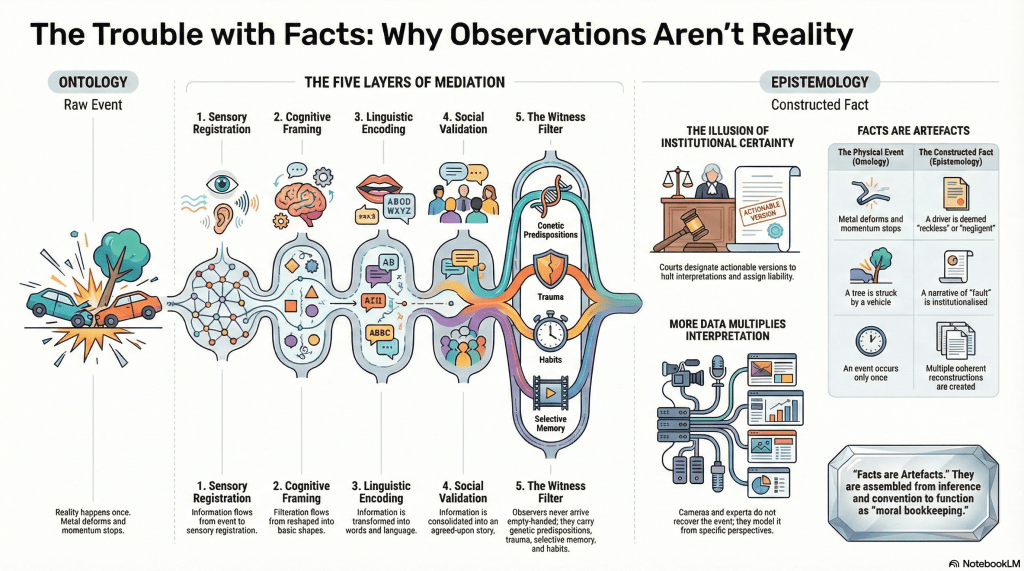
Image: Requisite NotebookLM infographic on this content.

The Witness

Even the driver does not enjoy privileged access to “what really happened”.

They get:

  • proprioceptive shock
  • adrenaline distortion
  • attentional narrowing
  • selective memory
  • post hoc rationalisation
  • possibly a concussion

Which is already several layers deep before language even arrives to finish the job.

We can generalise the structure:

Ontology: events occur. States of affairs obtain. Something happens whether or not we notice.

Epistemology: observation is always filtered through instruments, concepts, language, habits, and incentives.

Modern sleight of hand: collapse the second into the first and call the result the facts.

People love the phrase “hard facts”, as if hardness transfers from objects to propositions by osmosis. It doesn’t. The tree is solid. The fact is not.

Facts are artefacts. They are assembled from observation, inference, convention, and agreement. They function. They do not reveal essence.

Filtration

An event occurred. A car struck a tree.

Then an observer arrives. But observers never arrive empty-handed.

They arrive with history: genetics, upbringing, trauma, habits, expectations, incentives. They arrive already filtered.

Daniel Kahneman, Olivier Sibony, and Cass Sunstein spend an entire book explaining just how unreliable this process is. See Noise: A Flaw in Human Judgment if you want the empirical receipts.

  • Even before bias enters, attention does.
  • When did the observer notice the crash?
  • At the sound? At the sight? After the fact?
  • Were they already looking, or did the noise interrupt something else entirely?

Reality happens once. Facts happen many times, differently, depending on who needs them and why.

Here Comes the Law

This is where the legal system enters, not because truth has been found, but because closure is required.

Courts do not discover facts. They designate versions of events that are good enough to carry consequences. They halt the cascade of interpretations by institutional force and call the result justice.

At every epistemic level, what we assert are interpretations of fact, never access to ontological essence.

Intent, negligence, recklessness. These are not observations. They are attributions. They are stopping rules that allow systems to function despite uncertainty.

The law does not ask what really happened.
It asks which story is actionable.

Two Motor Vehicles

Now add a second moving object.

Another car enters the frame, and with it an entire moral universe.

Suddenly, the event is no longer merely physical. It becomes relational. Agency proliferates. Narratives metastasise.

Who was speeding?
Who had the right of way?
Who saw whom first?
Who should have anticipated whom?

Intent and motive rush in to fill the explanatory vacuum, despite remaining just as unobservable as before.

Nothing about the ontology improved.
Everything about the storytelling did.

Where the tree refused intention, the second vehicle invites it. We begin inferring states of mind from trajectories, attributing beliefs from brake lights, extracting motives from milliseconds of motion.

But none of this is observed.

What we observe are:

  • vehicle positions after the fact,
  • damage patterns,
  • skid marks,
  • witness statements already filtered through shock and expectation.

From these traces, we construct mental interiors.

The driver “intended” to turn.
The other driver “failed” to anticipate.
Someone was “reckless”.
Someone else was merely “unlucky”.

These are not facts. They are interpretive assignments, layered atop already mediated observations, selected because they allow responsibility to be distributed in socially recognisable ways.

This is why explanation now fractures.

One cascade of whys produces a story about distraction or poor judgment.
Another produces a story about road design or visibility.
Another about timing, traffic flow, or urban planning.

Each narrative is plausible.
Each is evidence-constrained.
None is ontologically privileged.

Yet one will be chosen.

Not because it is truer, but because it is actionable.

The presence of a second vehicle does not clarify causation. It merely increases the number of places we are willing to stop asking questions.

Modernity mistakes this proliferation of narrative for epistemic progress. In reality, it is moral bookkeeping.

The crash still occurred.
Metal still deformed.
Momentum still stopped.

What changed was not access to truth, but the urgency to assign fault.

With one vehicle and a tree, facts already fail to arrive unmediated.
With two vehicles, mediation becomes the point.

And still, we insist on calling the result the facts.

Many Vehicles, Cameras, and Experts

At this point, Modernity regains confidence.

Add more vehicles.
Add traffic cameras.
Add dashcams, CCTV, bodycams.
Add accident reconstruction experts, engineers, psychologists, statisticians.

Surely now we are approaching the facts.

But nothing fundamental has changed. We have not escaped mediation. We have merely scaled it up and professionalised it.

Cameras do not record reality. They record:

  • a frame,
  • from a position,
  • at a sampling rate,
  • with compression,
  • under lighting conditions,
  • interpreted later by someone with a mandate.

Video feels decisive because it is vivid, not because it is ontologically transparent. It freezes perspective and mistakes that freeze for truth. Slow motion, zoom, annotation. Each step adds clarity and distance at the same time.

Experts do not access essence either. They perform disciplined abduction.

From angles, debris fields, timing estimates, and damage profiles, they infer plausible sequences. They do not recover the event. They model it. Their authority lies not in proximity to reality, but in institutional trust and methodological constraint.

More data does not collapse interpretation.
It multiplies it.

With enough footage, we don’t get the story. We get competing reconstructions, each internally coherent, each technically defensible, each aligned to a different question:

  • Who is legally liable?
  • Who is financially responsible?
  • Who violated policy?
  • Who can be blamed without destabilising the system?

At some point, someone declares the evidence “clear”.

What they mean is: we have enough material to stop arguing.

This is the final Modern illusion: that accumulation converges on essence. In reality, accumulation converges on closure.

The event remains what it always was: inaccessible except through traces.
The facts become thicker, more confident, more footnoted.
Their metaphysical status does not improve.

Reality happened once. It left debris. We organised the debris into narratives that could survive institutions.

Cameras didn’t reveal the truth. Experts didn’t extract it. They helped us agree on which interpretation would count.

And agreement, however necessary, has never been the same thing as access to what is.

* I was once driving in a storm, and a telephone pole fell about a metre in front of my vehicle. My car drove over the pole, and although I was able to drive the remainder of the way home, my suspension and undercarriage were worse for the wear and tear.