I recently made a teaser for this post. Here is a video summary before you visit.
Bonus
I often get asked what my deal is with activist topics. It’s not that I don’t care about the issues, per se, but my interest is more in the way they are framed and positioned. I feel that many issues are such because of rhetorical tricks and language insufficiencies. That’s my bag.
I loathe patriarchy as much as the next bloke, but I need to ask what it is in the first place. Does anyone actually defend patriarchy? Is defending the patriarchy the same as the notion of it? If y=one is against it, what exactly is one against.
Nickdruryfad commented recently on another post that I need to get out of my left hemisphere. Point taken, but this is – at least metaphorically speaking – where speech and categories live. The right hemisphere is only interested in attention and capturing re-presentation. The left is about language, syntax, and semantics. To be honest, I don’t believe the right hemisphere is about anything. It’s rather Zen, methinks. It may be creative, but it’s not so much communicative.
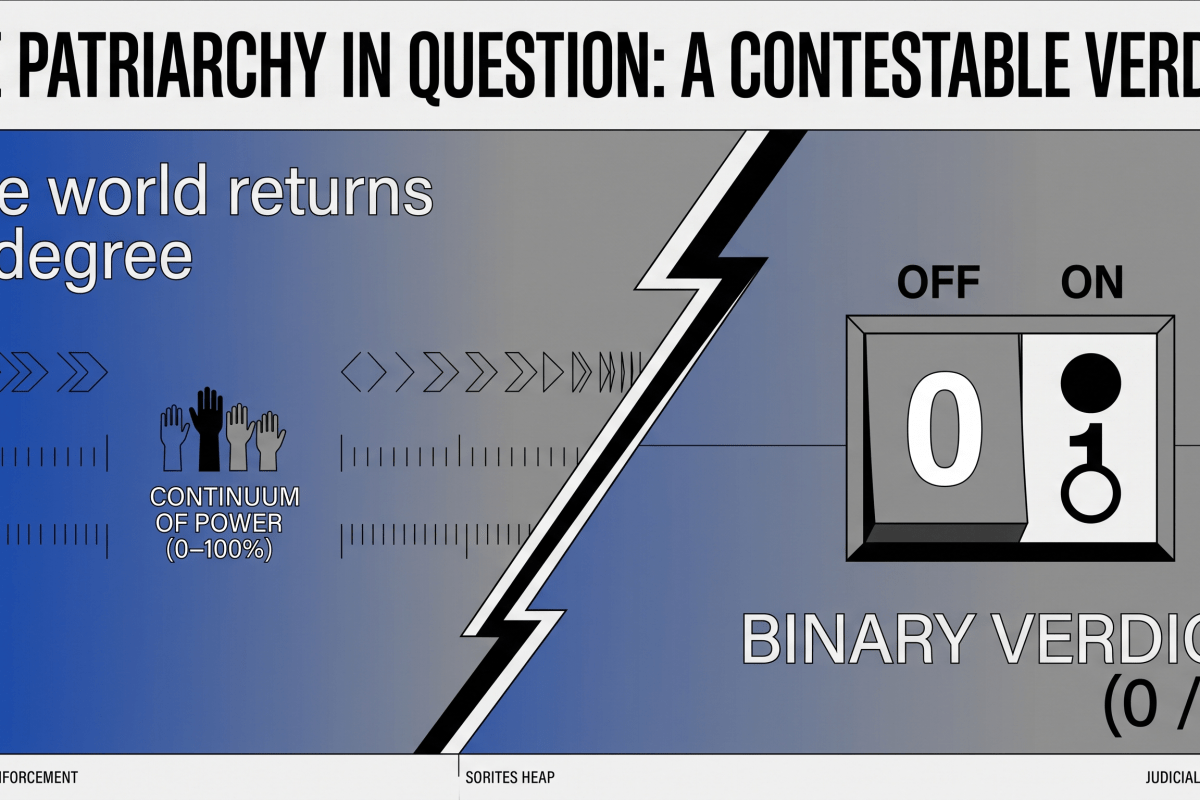
Man, this IaI piece asking about The Patriarchy in Question has got my knickers properly twisted. As I gather the scattered crockery of my thoughts, the first issue is the Sorites problem of patriarchy.
Audio:NotebookLM summary podcast of this topic.
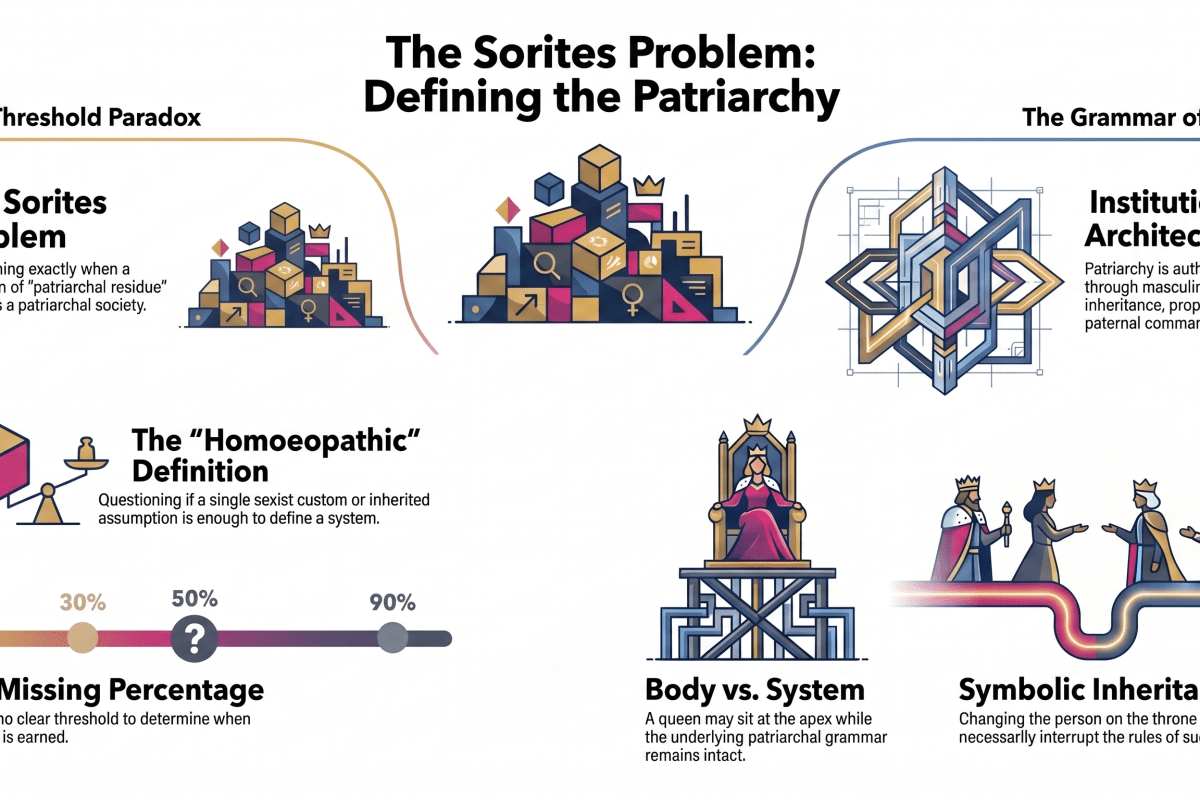
Mirroring the old question of when a collection of grains becomes a heap: when, exactly, does a society become a patriarchy? How much concentration of patriarchal residue is required before the noun is earned? Is one bad apple enough to spoil the whole lot, or does that give us only the faint homoeopathic aftertaste of patriarchy?
I doubt many people would openly defend this homoeopathic definition. One sexist custom, one male-coded institution, one inherited assumption, and behold: The Patriarchy. But if not that, where’s the threshold? Fifty per cent? Ninety? Thirty? Or is the question itself badly formed?
The issue isn’t only composition but degree, location, and power. One king over a kingdom gives us monarchy; it becomes patriarchal when rule is authorised through masculine-coded inheritance, legitimacy, property, office, or paternal command. But what of a queen operating under the same institutional grammar? Has the patriarchy been interrupted, or merely furnished with a woman at the apex? If she inherits the language, offices, succession rules, and symbolic architecture of patriarchal power, then the body on the throne may change while the grammar of rule remains intact.
Male flatworms, those primordial swordsmen of the slime, have invented what can only be described as penetration politics. They don’t seduce; they don’t serenade; they don’t even swipe right. They duel. Penises out, sabres up, they jab at one another in a tiny, biological cockfight until one is stabbed into submission. The “winner” ejaculates his way to freedom, while the “loser” becomes a mother by default. Gender, in flatworm society, is not destiny; it’s a duel with dicks for sabres.
Errata: Upon further research, I share additional information on my author site.
Beauvoir once reminded us: “One is not born, but rather becomes, a woman.” The flatworm demonstrates this principle with obscene literalness. You are not born female. You become female when you lose the fight and get stabbed full of sperm. Congratulations: you’ve been penis-fenced into maternity.
And here we can smuggle in that old feminist provocation – every man is a rapist. Not in the polite, bourgeois sense of candlelight coercion, but in the bare biological logic of the worm. To inseminate is to penetrate; to penetrate is to conquer; to conquer is to outsource the cost of life onto someone else’s body. The duel is just foreplay for the inevitable violation. Consent, in worm-world, is as fictional as a unicorn with a diaphragm. The “winner” is celebrated precisely because he doesn’t have to consent to anything afterwards – he stabs, struts, and slips away, leaving the loser’s body to incubate the consequences.
Now, humanity likes to pretend it has outgrown this. We have laws, customs, and etiquette. We invented flowers, chocolates, and marriage vows. But scratch the surface, and what do you find? Penetration politics. Who gets to wield the dick, who gets saddled with the debt. The radical feminists weren’t entirely wrong: structurally, culturally, biologically, the male role has been defined as penetration – and penetration, whether dressed in lace or latex, is always a form of conquest.
The worm is honest. We are hypocrites. They fence with their penises and accept the consequences. We fence with our laws, our armies, our religions, our institutions – and still manage to convince ourselves we’re civilised.
So yes, The Left Hand of Darkness can keep its glacial androgynes. For a metaphor that actually explains our sorry state, look no further than penis-fencing flatworms: every thrust a power play, every victory a rape in miniature, every loss a womb conscripted. Humanity in a nutshell – or rather, in a stab wound.

 Philosophics