What if the biggest trick language played on you is convincing you that the world is made of things?
Every sentence you speak installs a hidden assumption. ‘The rock falls.’ ‘The mind thinks.’ ‘The electron orbits.’ Each one presupposes a thing – a noun – that exists before anything happens to it. Your grammar tells you: first, there are objects, then they do stuff. But what if that’s backwards?
The Mediated Encounter Ontology – MEOW – proposes that it is. Reality isn’t made of things. It’s made of structured interactions. Encounter-events – relational, patterned, constrained – are what’s ontologically basic. Objects, subjects, minds, worlds: these are all downstream. They’re what you get when structured interaction stabilises within a given scale of encounter.
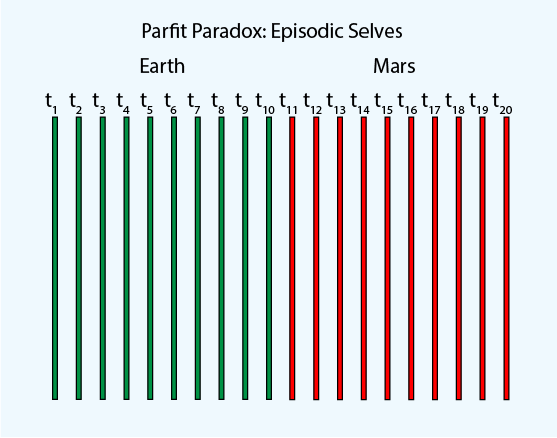
A thought experiment by Derek Parfit, here’s the setup: ostensibly, a human is cloned, but they aren’t so much cloned as teleported to Mars, à la Star Trek – there, not here, particle by particle.
The question and seeming paradox is whether the reconstructed person and the original are the same, identical.
In deference to my upcoming book, The Architecture of Encounter, I want to revisit this problem and show how there is no paradox. Let’s take a look.
Audio: NotebookLM summary podcast of this topic.
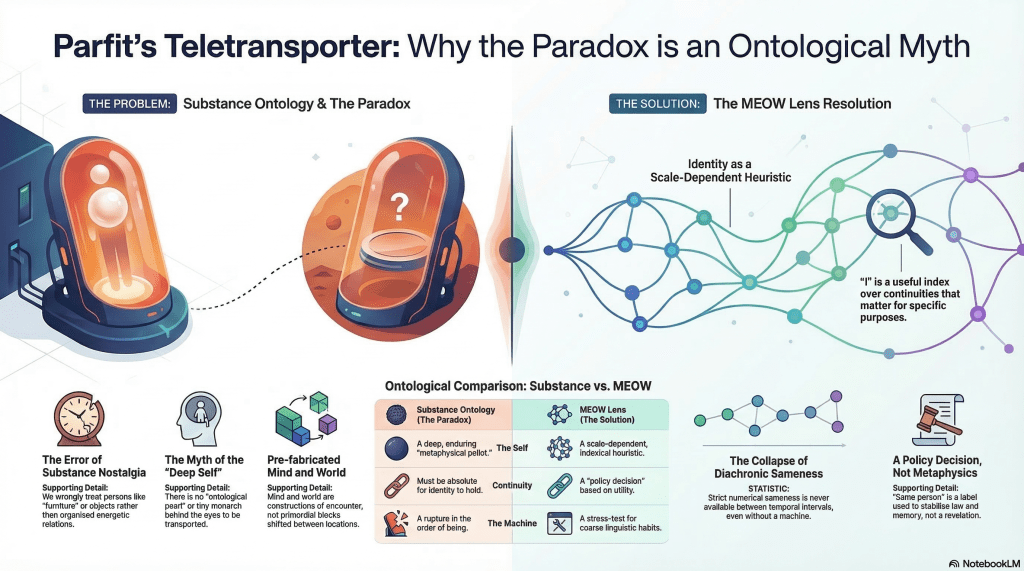
Parfit’s Teletransporter Is Not a Paradox. It Is a Hangover.
Derek Parfit’s teletransporter thought experiment has become one of philosophy’s favourite parlour tricks. A person steps into a machine on Earth. The machine records their physical structure in total detail, destroys the original body, and reconstructs an exact counterpart on Mars from local matter. The person on Mars wakes with the same memories, the same character, the same projects, and the same unearned confidence that philosophers are asking sensible questions. Parfit uses such cases to press the thought that personal identity may not be what matters; psychological continuity may matter more.
The supposed paradox is familiar enough: is the person on Mars the same person, or has the original died and been replaced by a copy?
My answer is that there is no paradox here, unless one insists on dragging in precisely the assumptions that ought to be under suspicion.
This is where my forthcoming book, The Architecture of Encounter, becomes relevant. The teletransporter puzzle only looks deep if one begins with a poor ontology and a clumsy model of selfhood. Once those are withdrawn, the mystery evaporates.
The first mistake: substance nostalgia
The teletransporter story is framed as though a human being were fundamentally a thing made of parts, a self-identical object that might either persist through rearrangement or fail to do so. We are invited to imagine a body atomised here and recomposed there, then asked whether the ‘same person’ has survived. But this framing already cheats.
If substance ontology is not basic, then there is no hidden metaphysical pellet of selfhood waiting to be shepherded from Earth to Mars. On a relational picture, what is fundamental is not a stockpile of little self-identical things but organised relation, structured energetic differentiation, constraint, response, and persistence-pattern. The old metaphysics of enduring stuff survives mostly because grammar flatters it.
So the first reason the teletransporter is not paradoxical is that it begins by treating persons as though they were furniture.
The second mistake: reifying the self
The second assumption is just as dubious. The problem presumes that there must be a deep self, some enduring owner of experience, whose fate the machine must settle. I don’t grant that either.
I am much closer here to Galen Strawson’s episodic flavour than to the pious diachronic picture in which one’s life forms a single, extended inner possession. Strawson’s distinction is useful because it reminds us that not everyone experiences themselves as a long, narratively unified entity stretching robustly across time. An episodic self need not deny practical continuity, memory, or biography; it simply refuses to inflate them into a metaphysical core.
That is also how I think identity should be understood more generally: as a scale-dependent heuristic.
The self is not nothing. But neither is it an ontological pearl. It is a compression. A convenience. A useful index over continuities that matter for some purposes and not others. At one grain, sameness appears stable enough. At another, it dissolves into drift, revision, replacement, and selective narrative smoothing.
The “I” is not a tiny monarch enthroned behind the eyes. It is an indexical function within organised experience.
The third mistake: treating mind and world as pre-fabricated blocks
The teletransporter story also inherits a bad picture of mind and world. It imagines a ready-made mind confronting a ready-made external world, then asks whether one of those ready-made minds has been shifted from one location in the world to another. I reject that framing, too.
Mind and world, on my view, are post hoc constructions of mediated interface. Encounter comes first. Organisation comes first. Constraint comes first. Only later do we abstract “mind” on one side and “world” on the other as though these were primordial blocks of reality instead of conceptual products of a deeper relation.
Once one starts there, the question changes. We are no longer asking whether some occult owner-substance has been preserved. We are asking what kind of continuity, if any, is being tracked across interruption, re-instantiation, and resumed encounter. That is a very different matter.
Under episodic time, the paradox collapses immediately
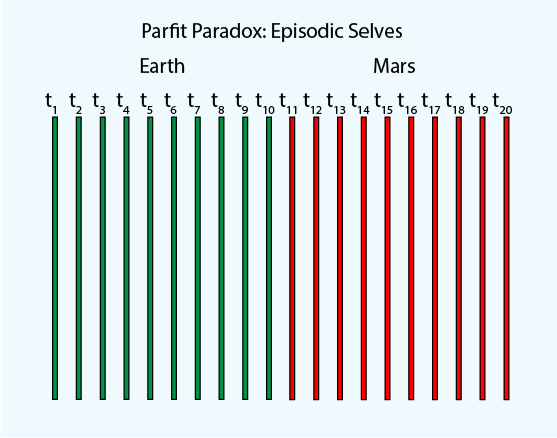
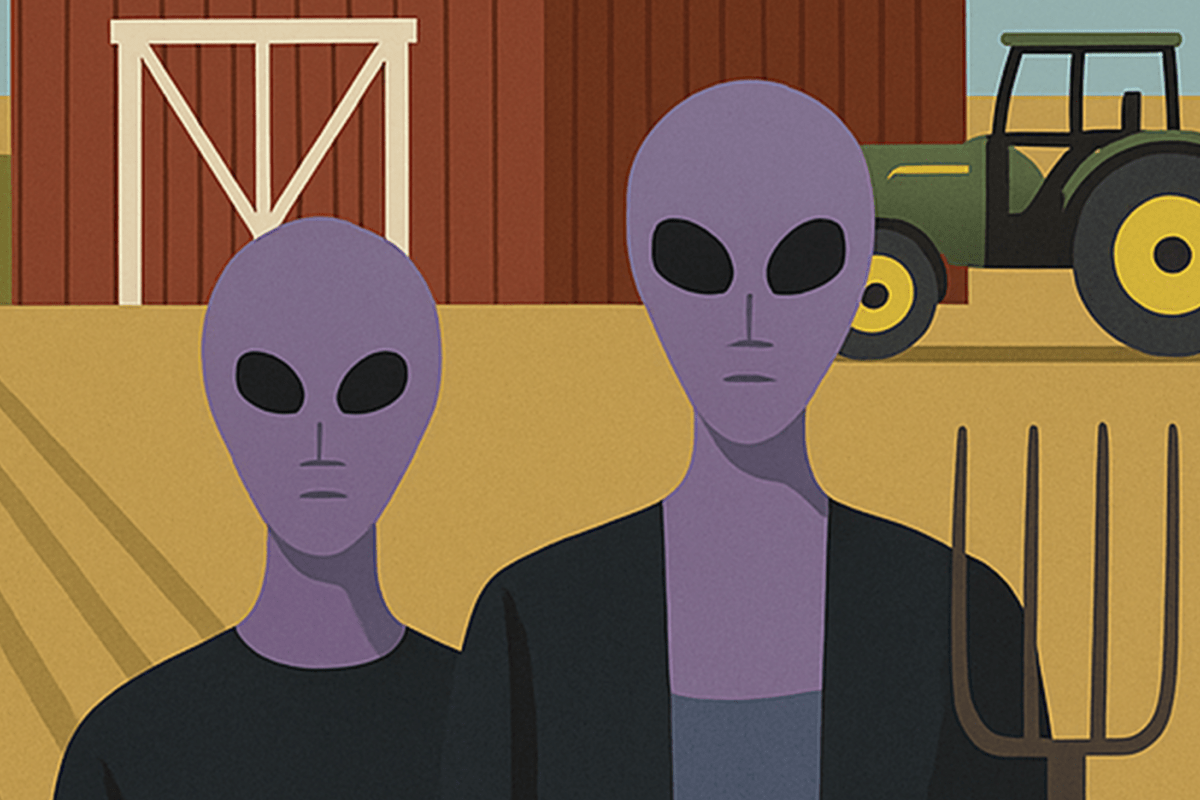
Image: Notice that if we reject the diachronic self in favour of an episodic self, when the ‘self’ migrates from Earth to Mars, it just carries on indexing, so the paradox vaporates.
If one takes the episodic view seriously, Parfit’s machine is mostly theatre.
Why? Because strict numerical sameness was never available between temporal intervals in the first place. The self at one interval and the self at the next are not joined by a metaphysical thread hidden beneath change. They are linked, where linked, by organised continuity, practical function, memory inheritance, bodily persistence, and narrative convenience.
The teletransporter does not introduce some unprecedented rupture into an otherwise pristine metaphysical order. It merely exaggerates what was true all along: selfhood is not an invariant core but a heuristic over organised succession.
That means the Mars person is not paradoxical. They are simply a case in which our ordinary identity-compression is being stress-tested.
Call them the same person if your explanatory threshold is coarse enough. Refuse the label if your threshold is stricter. There is no further hidden fact trembling in the wings.
Even under diachronic time, the issue is still heuristic
Suppose, however, that one relaxes the episodic commitment and grants a diachronic self. Even then, the machine does not resurrect a deep identity problem. It only relocates the issue to threshold-setting.
How much continuity is enough?
Enough for legal identity? Enough for moral responsibility? Enough for marriage? Enough for debt? Enough for grief? Enough for survival?
These are not one question. They never were one question. Philosophy often gets itself into trouble by pretending that practical, phenomenological, ethical, and metaphysical criteria must all cash out in the same currency. They do not.
Parfit himself is famous precisely for pressing the thought that what matters may be psychological continuity and connectedness rather than some further fact of identity. My complaint is that one can go further still. Once identity is treated as a heuristic rather than a metaphysical absolute, the need for a single all-purpose answer begins to look like a bad demand rather than an unsolved mystery.
Why the duplicate case makes the illusion obvious
The variant with duplication makes the point even more brutally. If one person enters on Earth and two successors emerge elsewhere, both inheriting the same memories and both insisting “I am the original,” then the problem is no longer whether identity has become spooky. The problem is that our ordinary identity-talk has finally been pushed beyond its comfort zone.
Once there are two successors, the inherited continuity-profile has branched. That does not produce metaphysical magic. It produces two loci of encounter with the same initial macro-organisation.
At time-nought, perhaps we may stipulate identical configuration for the sake of the thought experiment. Fine. Humans adore their stipulations. At the first non-zero interval thereafter, they are already different. Different position, different sensory input, different salience, different bodily relation, different thermal and spatial microconditions, different affordances. Their trajectories begin to separate immediately. So even there, no paradox. Only the collapse of a coarse heuristic under finer scrutiny.
The real lesson
Parfit’s teletransporter is often presented as though it reveals some terrible instability in personal identity. I think it reveals something duller and more devastating. It reveals that our language of identity was never as deep as we pretended.
We say “same person” because it is useful. We use it to stabilise law, memory, blame, love, property, and biography. Fair enough. But utility should not be mistaken for metaphysical revelation. The thought experiment merely embarrasses that confusion.
So when asked whether the reconstructed person on Mars is really the same person, my answer is:
Under an episodic model, strict sameness was never on offer across temporal intervals anyway. Under a diachronic model, sameness is still a heuristic judgement about acceptable continuity. In neither case is there a paradox. There is only an old habit of substance-thinking refusing to die.
The shorter version
The teletransporter does not expose a contradiction in selfhood. It exposes the poverty of the ontology brought to the problem.
If selves are indexical, scale-dependent heuristics arising from organised encounter, then the machine does not pose a metaphysical puzzle about whether some hidden essence made it to Mars. It only asks how much continuity we are willing to treat as enough.
That is not a paradox. That is a policy decision disguised as metaphysics.
I risk sharing this prematurely. Pushing the Transductive Subjectivity model toward more precision may lose some readers, but the original version still works as an introductory conversation.
Please note: There will be no NotebookLM summary of this page. I don’t even want to test how it might look out the other end.
Apologies in advance for donning my statistician cap, but for those familiar, I feel it will clarify the exposition. For the others, the simple model is good enough. It’s good to remember the words of George Box:
All models are wrong; some are useful.
The Simple Model
I’ve been thinking that my initial explanatory model works well enough for conversation. It lets people grasp the idea that a ‘self’ isn’t an enduring nugget but a finite sequence of indexed states:
The transitions are driven by relative forces, , which act as catalysts nudging the system from one episode to the next.
The Markov Model
That basic picture is serviceable, but it’s already very close to a dynamical system. More accurate, yes—though a bit more forbidding to the casual reader – and not everybody loves Markov chains:
Here:
is the episodic self at index i
is the configuration of relevant forces acting at that moment
is the update rule: given this self under these pressures, what comes next?
This already helps. It recognises that the self changes because of pressure from language, institutions, physiology, social context, and so on. But as I noted when chatting with Jason, something important is still missing:
isn’t the only thing in motion, and isn’t the same thing at every step.
And crucially, the update rule isn’t fixed either.
A person who has lived through trauma, education, and a cultural shift doesn’t just become a different state; they become different in how they update their states. Their very ‘logic of change’ evolves.
To capture that, I need one more refinement.
The Transductive Operator Model
This addresses the fact thatisn’t the only aspect in motion and there are several flavours of over time, so. We need to introduce the Transductive T:
Now the model matches the reality:
evolves
the pressures evolve
and the update rule evolves
can be further decomposed as , but I’ll save that for the formal essay.
The self is not simply ‘what comes next’, but a rule that keeps rewriting itself as it encounters the world.
That is why this is transductive rather than inductive or deductive: structure at one moment propagates new structure at the next.
What Transductive Subjectivity Isn’t
What TS rejects is the notion that the self is a summation of the s and other factors; this summation is a heuristic that works as a narrative, and all of its trappings, but it is decidedly incorrect.
Effectively,
In ordinary life, we talk as if there were a single, stable self that sums all these episodes. Transductive Subjectivity treats that as a convenient narrative, not an underlying fact. For example, someone raised in a rigid environment may initially update by avoiding conflict; after therapy and a cultural shift, they may update by seeking it out when something matters. This fiction is where we project agency and desert, and where we justify retribution.
Only teasing. It reads as pejorative unless you catch the self-inflicted mockery baked in. This chap Tom has for film what I seem to have for language: an alarming degree of enthusiasm paired with the creeping suspicion that most of civilisation is determined to ruin the very medium we love.
I don’t actually share his fondness for film, mind you. I merely recognise the feral passion. What pulled me into this clip wasn’t cinema but dissection. The language of his breakdown dropped me neatly into my natural habitat.
I seldom watch films, television, or whatever corporate imagination-by-committee is calling itself these days. Besides being an outrageous time-sink, Sturgeon’s Law doesn’t just hold; it’s juiced up as if someone ran it through a cheap VFX plug-in. The decline in visual quality Tom describes feels depressingly familiar.
A similar aesthetic rot crept in during the digital audio shift of the ’80s. Vast new possibilities, yes, but a certain grain, a certain breath, went missing. I remember an engineering mate in ’84 being asked to record a well-known jazz artist using Sony’s shiny new digital system. He refused on technical principle, writing a blistering hand-delivered letter explaining why the end result would sound worse. He was right, of course. The label didn’t care, of course. And he walked.
The problem then resembles the problem now. Most people aren’t experiencing media in the environment it was built for. We consume films on phones, tablets, monstrous living-room billboards, or, in my case, a knackered 32-inch monitor. Half the audience barely looks at the screen anyway. They want distraction, not discernment. Some, like Tom – and to a lesser degree, me – actually notice that something in the visual vocabulary has been quietly amputated.
Perhaps that’s why I avoid the form: the predictability, the shallow craft, the sense that the whole affair is engineered for attention-drifting multitudes rather than people who actually, well, look.
Anyway, the whole point was to share the video. Naturally, I ended up editorialising. I learnt something from it. You might too.
How might the indexicality of Charles Peirce relate to Galen Strawson’s notion of episodic self-identity?
Thought Process
This is an interesting philosophical question that connects two different thinkers and concepts. Let me think through this carefully.
Charles Peirce’s indexicality refers to his theory of indexical signs – signs that point to or indicate their objects through a direct, existential connection (like “this,” “here,” “now,” “I”). These are part of his broader semiotics, where he distinguished between icons, indexes, and symbols.
Galen Strawson’s notion of episodic self-identity relates to his work on the phenomenology of the self. Strawson distinguishes between “Diachronic” and “Episodic” self-experience. Diachronic individuals experience themselves as continuous over time, with a narrative extending into past and future. Episodic individuals (like Strawson claims to be) experience themselves more in terms of discrete, present-centered episodes, without a strong sense of narrative continuity.
How might these relate?
The indexical “I”: Peirce’s indexicality is crucial for how the “I” functions. The first-person pronoun is paradigmatically indexical – it picks out the speaker/thinker in the moment of utterance. For Strawson’s episodic self, each moment’s “I” might be more purely indexical, pointing to the present subject without necessarily carrying thick narrative continuity.
Temporal indexicals: “Now” is also indexical. Episodic self-experience emphasizes the “now” of experience over temporal extension. The indexical nature of present-tense self-reference might support episodic rather than diachronic self-conception.
Existential connection vs narrative construction: Indexical signs work through direct, causal-existential connection, not through resemblance or convention. Similarly, episodic self-experience might be more immediately indexical (this experience, now) rather than mediated through narrative construction.
This is a sophisticated question that deserves a nuanced response.
Disclaimer: I should be finishing my Language Insufficiency Hypothesis book, yet I am here writing about death and dying. Why? Because I was watching an interview with Neal Schon by Rick Beato. I should have been working on my book then, too. It seems I can write about death more easily than finish a book about the failure of language. Perhaps because death speaks fluently.
I haven’t produced music professionally since the mid-1980s, and I haven’t performed since 2012, yet I am still drawn to its intricacies. My fingers no longer allow me to play much of anything anymore. This is a sort of death. When the body forgets what the mind remembers, that’s a particular kind of death – one language dying while another can’t translate.
As Neal was walking Rick through his equipment and approach to music, I was taken back to a similar place. I wanted to plug into a Fender Twin or a Hi-Watt, a Lexicon 224 or a Cry Baby wah. I still have nightmares thinking of setting up a Floyd Rose.
Video: Rick Beato interviews Neal Schon
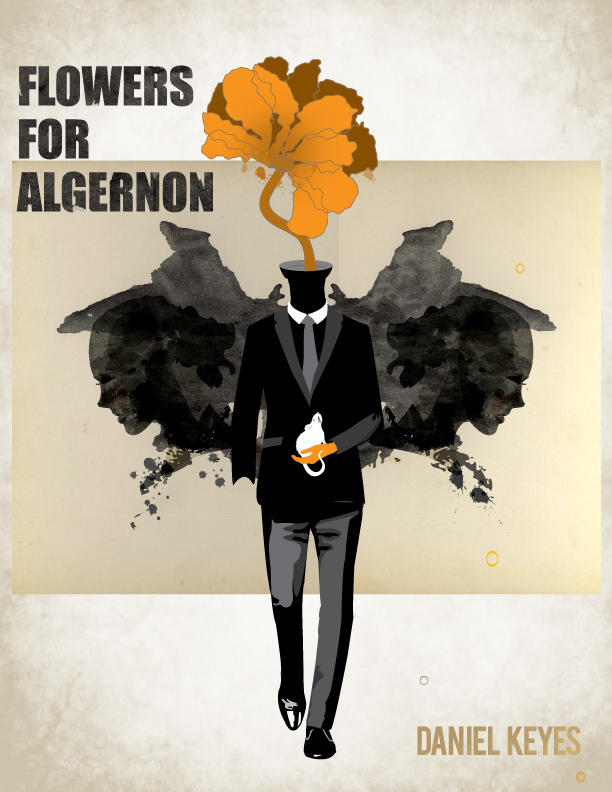
But I can’t go back. As for music, I can’t go forward either. I’m at a standstill, but in a regressed position. It’s uncomfortable. It feels a lot like Charlie in Flowers for Algernon. I used to be able to do that. Don’t get me wrong – I am not claiming to be on the level of Neal Schon, a man I remember from his days with Santana, but when you reach a level of proficiency and then lose it, it hurts; it can be devastating.
Audio: NotebookLM podcast on this topic.
I recall being in hospital in 2023 – a physical rehabilitation facility, really – and I found a piano in a vacant common room. Drawn to the instrument, I rolled over my wheelchair and played…nothing. My fingers wouldn’t work. The piano sat there like a relic of my former self. I rolled toward it as though approaching an altar. My fingers hovered, twitched, failed. The sound of nothing has never been so loud. I cried. I cried a lot those days. I was down to 58 kilos – at 182 cm, I weighed in at just over 9 stone. It wasn’t the best of times.
I still feel a certain nostalgia.
And then there are the people I’ve lost along the way – as another Neal reflected on – The Needle and the Damage Done.
Love and art are both acts of repetition. When one ends, the reflex remains – the impulse to reach, to share, to call out. Death doesn’t stop the motion, only the answer.
I’m lucky to have left Delaware. When a girlfriend died in 2020, I remained and connected with another until 2023, when she died, too. From 2020 to 2023, when I was out and about, something might have caught my eye, and I’d reflect on how Carrie might have liked that.
But it was different. It was more like, ‘I should let Carrie know about that,’ only to realise fractions of a second later that she wouldn’t see whatever it was; she couldn’t. And I’d carry on. I didn’t need to repeat this with Sierra. My relocation to Massachusetts solved this challenge – not so many triggers.
I’m not sure how the loss of ‘professional’ music relates to deceased partners, but it does – at least enough for me to make this connexion. Perhaps I’m just connecting arbitrary dots, but I’ll call it nostalgia.
I don’t play, but I still hear it. The song continues without me. Nostalgia is just rhythm without melody. Perhaps all nostalgia is epistemological error – the confusion of past fluency for present meaning.
I’ve been working through the opening chapters of Octavia Butler’s Dawn. At one point, the alien Jdahya tells Lilith, “We watched you commit mass suicide.”*
The line unsettles not because of the apocalypse itself, but because of what it presumes: that “humanity” acted as one, as if billions of disparate lives could be collapsed into a single decision. A few pulled triggers, a few applauded, some resisted despite the odds, and most simply endured. From the alien vantage, nuance vanishes. A species is judged by its outcome, not by the uneven distribution of responsibility that produced it.
This is hardly foreign to us. Nationalism thrives on the same flattening. We won the war. We lost the match. A handful act; the many claim the glory or swallow the shame by association. Sartre takes it further with his “no excuses” dictum, even to do nothing is to choose. Howard Zinn’s “You can’t remain neutral on a moving train” makes the same move, cloaked in the borrowed authority of physics. Yet relativity undermines it: on the train, you are still; on the ground, you are moving. Whether neutrality is possible depends entirely on your frame of reference.
What all these formulations share is a kind of metaphysical inflation. “Agency” is treated as a universal essence, something evenly spread across the human condition. But in practice, it is anything but. Most people are not shaping history; they are being dragged along by it.
One might sketch the orientations toward the collective “apple cart” like this:
Tippers with a vision: the revolutionaries, ideologues, or would-be prophets who claim to know how the cart should be overturned.
Sycophants: clinging to the side, riding the momentum of others’ power, hoping for crumbs.
Egoists: indifferent to the cart’s fate, focused on personal comfort, advantage, or escape.
Stabilisers: most people, clinging to the cart as it wobbles, preferring continuity to upheaval.
Survivors: those who endure, waiting out storms, not out of “agency” but necessity.
The Stabilisers and Survivors blur into the same crowd, the former still half-convinced their vote between arsenic and cyanide matters, the latter no longer believing the story at all. They resemble Seligman’s shocked dogs, conditioned to sit through pain because movement feels futile.
And so “humanity” never truly acts as one. Agency is uneven, fragile, and often absent. Yet whether in Sartre’s philosophy, Zinn’s slogans, or Jdahya’s extraterrestrial indictment, the temptation is always to collapse plurality into a single will; you chose this, all of you. It is neat, rhetorically satisfying, and yet wrong.
Perhaps Butler’s aliens, clinical in their judgment, are simply holding up a mirror to the fictions we already tell about ourselves.
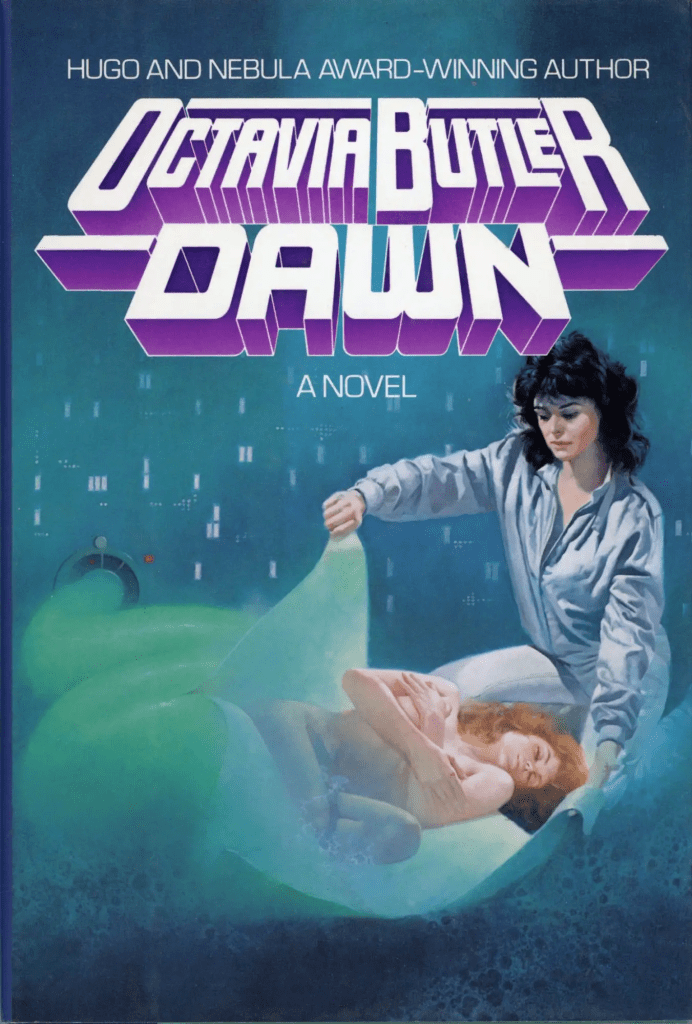
As an aside, this version of the book cover is risible. Not to devolve into identity politics, but Lilith is a dark-skinned woman, not a pale ginger. I can only assume that some target science fiction readers have a propensity to prefer white, sapphic adjacent characters.
I won’t even comment further on the faux 3D title treatment, relic of 1980s marketing.
* Spoiler Alert: As this statement about mass suicide is a Chapter 2 event, I am not inclined to consider it a spoiler. False alarm.
“Man is least himself when he talks in his own person. Give him a mask, and he will tell you the truth.” — Oscar Wilde
Identity is an illusion—but a necessary one. It’s a shortcut. A heuristic, evolved not for truth but for coherence. We reduce ourselves and others to fixed traits to preserve continuity—psychological, social, narrative.
Audio: NotebookLM podcast on this topic. (Spotify)
But what if continuity is a lie?
In the latest post on RidleyPark.blog, we meet Sarah—a woman who survives by splintering. She has three names, three selves, three economies of interaction. Each persona—Sarah, Stacey, and Pink—fulfils a role. Each protects her in a system that punishes complexity.
And yet, this isn’t fiction. It’s reality intensified.
Identity Is Compression
Cognitive science suggests that we don’t possess a self—we perform one. Our so-called identity is assembled post-hoc from memory, context, and social cues. It’s recursive. It’s inferred.
We are not indivisible atoms of identity. We are bundled routines, personae adapted to setting and audience.
This is not pathology. It’s strategy.
From Performance to Survival
In Needle’s Edge, Sarah doesn’t use aliases to deceive. She uses them to survive contradictions:
Stacey is desirable, stable, and profitable—so long as she appears clean and composed.
Pink is a consumer, invisible, stripped of glamour but allowed access to the block.
Sarah is the residue, the name used by those who once knew her—or still believe they do.
Each persona comes with scripts, limitations, and permissions. Sarah isn’t being dishonest. She’s practicing domain-specific identity. This is no different from how professionals code-switch at work, or how people self-edit on social media.
It’s just more raw. More urgent. Less optional.
The Literary Echo
In character development, we often demand “depth,” by which we mean contradiction. We want to see a character laugh and break. Love and lie. But Sarah shows us that contradiction isn’t depth—it’s baseline reality. Any singular identity would be a narrative failure.
Characters like Sarah expose the poverty of reduction. They resist archetype. They remind us that fiction succeeds when it reflects the multiple, the shifting, the incompatible—which is to say, the real.
What Else Might We Say?
That authenticity is a myth: “Just be yourself” presumes you know which self to be.
That moral judgment often stems from a failure to see multiple selves in others.
That trauma survivors often fracture not because they’re broken, but because fracturing is adaptive.
That in a capitalist framework, the ability to fragment and role-play becomes a survival advantage.
That fiction is one of the few spaces where we can explore multiple selves without collapse.
The Missing Link
For a concrete, narrative reflection of these ideas, this post on RidleyPark.blog explores how one woman carries three selves to survive three worlds—and what it costs her.
What if the real horror isn’t waking as a beetle, but as a man?
In Kafka’s Metamorphosis, Gregor Samsa wakes to find himself transformed into a giant beetle—a cockroach, a vermin, an intrusion of the inhuman into the domestic. The horror is obvious: loss of agency, social death, the grotesque made literal. It’s the nightmare of devolution, of becoming something other, something filthy.
But perhaps we’ve misunderstood the true absurdity.
Audio: NotebookLM podcast on this topic.
What if the real nightmare is the opposite? Not a man waking as an insect, but an insect waking in a human body—forced to contend with taxes, performance reviews, dinner parties, and the crushing weight of being legible to others. Imagine a beetle, content in its instinctual certainty, finding itself hurled into the howling contradiction of human subjectivity.
Suddenly, it must interpret signs, participate in rituals, conform to decorum, all while performing a pantomime of “meaning.” It’s not the exoskeleton that’s horrifying – it’s the endless internal monologue. The soul-searching. The unbearable tension of being expected to have purpose.
We call Gregor’s fate tragic because he can no longer function in a world built for humans. But isn’t that the human condition already? An endless, futile negotiation between the raw fact of existence and the stories we invent to make it bearable.
Gregor becomes insect. We were never anything but.
So, I wrote a book and published it under Ridley Park, the pseudonym I use for fiction.
It has aliens. But don’t get excited—they’re not here to save us, probe us, or blow up the White House. They’re not even here for us.
Which is, frankly, the point.
Audio: NotebookLM podcast on this topic.
The book’s called Sustenance, and while it’s technically speculative fiction, it’s more about us than them. Or rather, it’s about how we can’t stop making everything about us—even when it shouldn’t be. Especially when it shouldn’t be.
Let’s talk themes. And yes, we’re using that word like academics do: as a smokescreen for saying uncomfortable things abstractly.
Language: The Original Scam
Language is the ultimate colonial tool. We call it communication, but it’s mostly projection. You speak. You hope. You assume. You superimpose meaning on other people like a cling film of your own ego.
Sustenance leans into this—not by showing a breakdown of communication, but by showing what happens when communication was never mutual in the first place. When the very idea of “meaning” has no purchase. It’s not about mishearing—it’s about misbeing.
Culture: A Meme You Were Born Into
Culture is the software you didn’t choose to install, and probably can’t uninstall. Most people treat it like a universal law—until they meet someone running a different OS. Cue confusion, arrogance, or violence.
The book explores what happens when cultural norms aren’t shared, and worse, aren’t even legible. Imagine trying to enforce property rights on beings who don’t understand “ownership.” It’s like trying to baptise a toaster.
Sex/Gender: You Keep Using Those Words…
One of the quiet joys of writing non-human characters is discarding human assumptions about sex and gender—and watching readers squirm.
What if sex wasn’t about power, pleasure, or identity? What if it was just a biological procedure, like cell division or pruning roses? Would you still be interested? Would you still moralise about it?
We love to believe our sex/gender constructs are inevitable. They’re not. They’re habits—often bad ones.
Consent: Your Framework Is Showing
Consent, as we use it, assumes mutual understanding, shared stakes, and equivalent agency. Remove any one of those and what’s left?
Sustenance doesn’t try to solve this—it just shows what happens when those assumptions fall apart. Spoiler: it’s not pretty, but it is honest.
Projection: The Mirror That Lies
Humans are deeply committed to anthropocentrism. If it walks like us, or flinches like us, it must be us. This is why we get so disoriented when faced with the truly alien: it won’t dance to our tune, and we’re left staring at ourselves in the funhouse mirror.
This isn’t a book about aliens.
It’s a book about the ways we refuse to see what’s not us.
Memory: The Autobiography of Your Justifications
Memory is not a record. It’s a defence attorney with a narrative license. We rewrite the past to make ourselves look consistent, or innocent, or right.
In Sustenance, memory acts less as a tether to truth and more as a sculpting tool—a way to carve guilt into something manageable. Something you can live with. Until you can’t.
In Summary: It’s Not About Them. It’s About You.
If that sounds bleak, good. It’s meant to.
But it’s also a warning: don’t get too comfortable in your own categories. They’re only universal until you meet someone who doesn’t share them.
Like I said, it’s not really about the aliens.
It’s about us.
If you enjoy fiction that’s more unsettling than escapist, more question than answer, you might be interested inSustenance. It’s live on Kindle now for the cost of a regrettable coffee:
A five-part descent into the illusion of autonomy, where biology writes the script, reason provides the excuse, and the self is merely the echo of its own conditioning.This is a follow-up to a recent post on the implausibility of free will.
Audio: NotebookLM podcast discussing this topic.
Constraint Is Not Freedom
The ergonomic cage of compatibilist comfort
“You are not playing the piano. You are the piano, playing itself — then applauding.”
Compatibilists — those philosophical locksmiths determined to keep the myth of free will intact — love to say that constraint doesn’t contradict freedom. That a system can still be “free” so long as it is coherent, self-reflective, and capable of recursive evaluation.
In this view, freedom doesn’t require being uncaused — it only requires being causally integrated. You don’t need to be sovereign. You just need to be responsive.
“The pianist may not have built the piano — but she still plays it.”
It sounds lovely.
It’s also false.
You Are the Piano
This analogy fails for a simple reason: there is no pianist. No ghost in the gears. No homunculus seated behind the cortex, pulling levers and composing virtue. There is only the piano — complex, self-modulating, exquisitely tuned — but self-playing nonetheless.
The illusion of choice is merely the instrument responding to its state: to its internal wiring, environmental inputs, and the accumulated sediment of prior events. What feels like deliberation is often delay. What feels like freedom is often latency.
Recursive ≠ Free
Ah, but what about reflection? Don’t we revise ourselves over time?
We do. But that revision is itself conditioned. You didn’t choose the capacity to reflect. You didn’t choose your threshold for introspection. If you resist a bias, it’s because you were predisposed — by some cocktail of education, temperament, or trauma — to resist it.
A thermostat that updates its own algorithm is still a thermostat.
It doesn’t become “free” by being self-correcting. It becomes better adapted. Likewise, human introspection is just adaptive determinism wearing a philosophical hat.





 Philosophics