Unwilling Steelman, Part I

A five-part descent into the illusion of autonomy, where biology writes the script, reason provides the excuse, and the self is merely the echo of its own conditioning. This is a follow-up to a recent post on the implausibility of free will.

Audio: NotebookLM podcast discussing this topic.

Constraint Is Not Freedom

The ergonomic cage of compatibilist comfort

“You are not playing the piano. You are the piano, playing itself — then applauding.”

Compatibilists — those philosophical locksmiths determined to keep the myth of free will intact — love to say that constraint doesn’t contradict freedom. That a system can still be “free” so long as it is coherent, self-reflective, and capable of recursive evaluation.

In this view, freedom doesn’t require being uncaused — it only requires being causally integrated. You don’t need to be sovereign. You just need to be responsive.

“The pianist may not have built the piano — but she still plays it.”

It sounds lovely.

It’s also false.

You Are the Piano

This analogy fails for a simple reason: there is no pianist. No ghost in the gears. No homunculus seated behind the cortex, pulling levers and composing virtue. There is only the piano — complex, self-modulating, exquisitely tuned — but self-playing nonetheless.

The illusion of choice is merely the instrument responding to its state: to its internal wiring, environmental inputs, and the accumulated sediment of prior events. What feels like deliberation is often delay. What feels like freedom is often latency.

Recursive ≠ Free

Ah, but what about reflection? Don’t we revise ourselves over time?

We do. But that revision is itself conditioned. You didn’t choose the capacity to reflect. You didn’t choose your threshold for introspection. If you resist a bias, it’s because you were predisposed — by some cocktail of education, temperament, or trauma — to resist it.

A thermostat that updates its own algorithm is still a thermostat.

It doesn’t become “free” by being self-correcting. It becomes better adapted. Likewise, human introspection is just adaptive determinism wearing a philosophical hat.

Constraint Isn’t Contradiction — It’s Redefinition

Compatibilists smuggle in a quieter, defanged version of freedom: not the ability to do otherwise, but the ability to behave “like yourself.”

But this is freedom in retrospect, not in action.
If all freedom means is “acting in accordance with one’s programming,” then Roombas have free will.

If we stretch the term that far, it breaks — not loudly, but with the sad elasticity of a word losing its shape.

TL;DR: The Pianist Was Always a Myth

  • You didn’t design your mental architecture.
  • You didn’t select your desires or dispositions.
  • You didn’t choose the you that chooses.

So no — you’re not playing the piano.
You are the piano — reverberating, perhaps beautifully, to stimuli you didn’t summon and cannot evade.

📅 Coming Tomorrow

Continuity Is Not Identity

What if you are not who you were — but simply what you’ve become?

Embracing Your Anti-Self

Lessons from Keats on the Art of Self-Creation

I don’t believe in the notions of ‘self’ or identities, but it makes for a nice thought experiment.

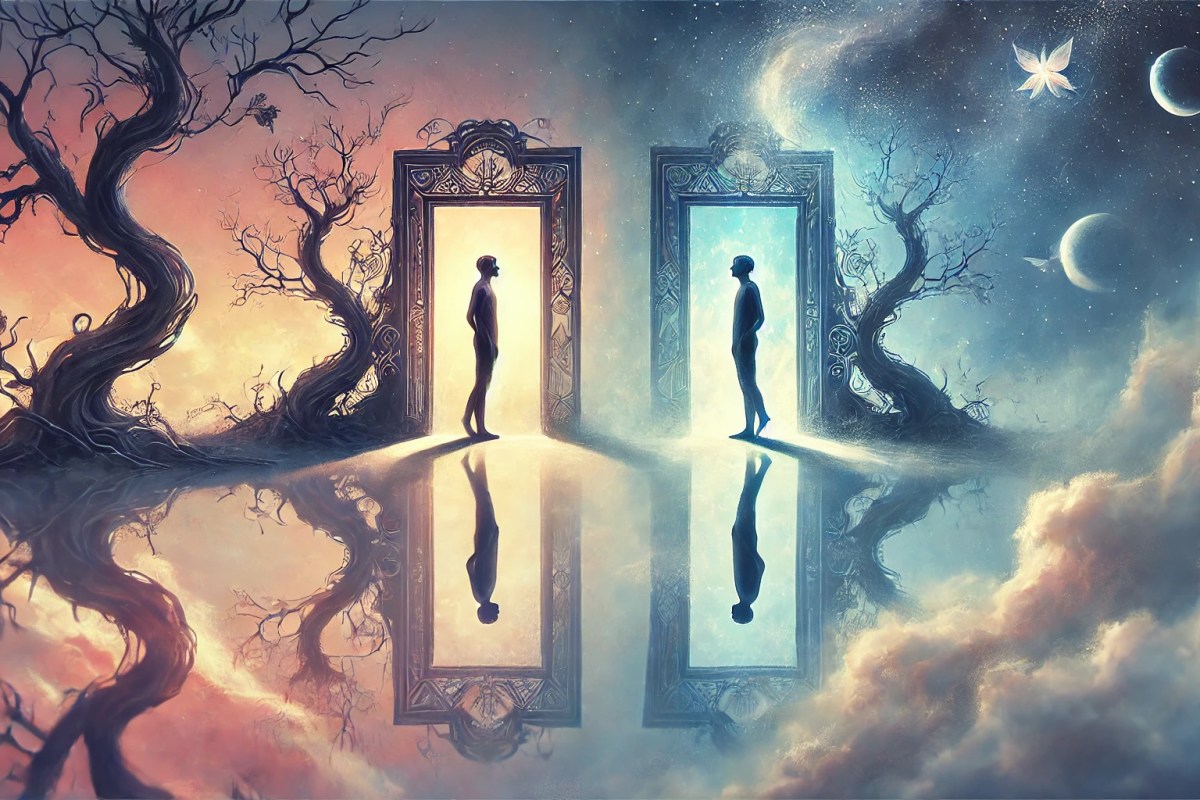
Imagine, just for a moment, that somewhere on this planet, there is someone who is your opposite in every conceivable way. They live as you do not. If you are kind, they are cruel. If you revel in the thrill of running through a rainstorm, they are the kind who sit comfortably by the fire, dreading the mere thought of a brisk step outdoors. If you drink to toast life’s joys, they abstain, unwilling to let a drop pass their lips. They are your anti-self—an inversion of who you are, lacking everything that you have and yet possessing everything that you do not.

As strange as it seems, this image is more than idle speculation. According to the Romantic poet John Keats, holding such an image of your anti-self is an essential part of the process of creating your own identity. The elusive art of true self-creation lies, paradoxically, in our capacity to hold in our minds those lives and feelings that are utterly different from our own. To truly grow, we must encounter the other—whether that other is someone we know or a shadowy, imagined version of who we could have been if only we’d chosen differently. This exercise is more than an intellectual indulgence; it is at the core of what Keats called ‘soul-making.’

Keats believed in the concept of the ‘chameleon poet’—the idea that writers, and indeed all human beings, must cultivate the ability to lose themselves in the perspectives of others. It is not enough to gaze upon the world through the singular lens of our own experience; to truly create, we must dissolve our egos and embrace a kaleidoscope of possibilities. A woman might explore the life of a soldier, writing deeply about a battle she’s never fought. A contented parent might dare to delve into the unimaginable grief of losing a child. Fiction writers, poets, artists—they all do this: they shed their own skin, assume another’s, and, in doing so, broaden the horizons of their own soul.

But Keats’ lesson here isn’t limited to the domain of poets and storytellers; it’s a practice that should extend to all of us. In what he evocatively called ‘the vale of soul-making,’ Keats posited that life offers each of us the raw materials to forge a soul, but we must engage imaginatively with all the lives we might lead, all the people we could be. We must dare to envision every possible road before us, not as a commitment but as an act of creation—enriching ourselves with the essence of each path before deciding which one we wish to tread.

And therein lies the heartbreak of it all. When we choose one possible life, we necessarily burn the others. In the very act of committing, we close other doors. We must set ablaze all our imagined lives just to make room for the one we decide to live. This thought is thrilling but also terrifying. Unlike a poet, who can glide into and out of fictional worlds, we must choose where we stand and stay there. We are not chameleons. We cannot flit endlessly between possibilities. We cannot write a library of books. We must write the one, and we must write it well.

Keats understood that the art of imagining one’s anti-self wasn’t about living vicariously forever in a land of could-have-beens. The exercise is in acknowledging these spectres of other lives, learning from them, and then committing, knowing full well what is lost in the process. Self-creation means being both the builder of one’s house and the one who tears down all the others, brick by potential brick. It means knowing who you could have been and yet, resolutely stepping into who you choose to be.

In a world obsessed with keeping every option open, Keats offers us the wisdom of finality. Burn off your possible lives and focus on writing the best version of the one that remains. Embrace the anti-self, learn from it, and commit once you have glimpsed all the possible worlds you might inhabit.

That is the paradoxical art of soul-making—of becoming whole while knowing you could have been anyone else. The beauty lies in the commitment, not in the drifting dream of endless potentiality. There is a deep satisfaction in choosing, in writing your own story, in saying, ‘This is who I am,’ even though you could have been another. And for that, we have John Keats to thank, the poet who understood that our anti-selves are not merely an idle game of imagination but the fuel for becoming fully human—the forge in which the soul is made.

The Illusion of Continuity: A Case Against the Unitary Self

The Comfortable Fiction of Selfhood

Imagine waking up one day to find that the person you thought you were yesterday—the sum of your memories, beliefs, quirks, and ambitions—has quietly dissolved overnight, leaving behind only fragments, familiar but untethered. The notion that we are continuous, unbroken selves is so deeply embedded in our culture, our psychology, and our very language that to question it feels heretical, even disturbing. To suggest that “self” might be a fiction is akin to telling someone that gravity is a choice. Yet, as unsettling as it may sound, this cohesive “I” we cling to could be no more than an illusion, a story we tell ourselves to make sense of the patchwork of our memories and actions.

And this fiction of continuity is not limited to ourselves alone. The idea that there exists a stable “I” necessarily implies that there is also a stable “you,” “he,” or “she”—distinct others who, we insist, remain fundamentally the same over years, even decades. We cling to the comforting belief that people have core identities, unchanging essences. But these constructs, too, may be nothing more than imagined continuity—a narrative overlay imposed by our minds, desperate to impose order on the shifting, amorphous nature of human experience.

We live in an era that celebrates self-actualisation, encourages “authenticity,” and treats identity as both sacred and immutable. Psychology enshrines the unitary self as a cornerstone of mental health, diagnosing those who question it as fractured, dissociated, or in denial. We are taught that to be “whole” is to be a coherent, continuous self, evolving yet recognisable, a narrative thread winding smoothly from past to future. But what if this cherished idea of a singular self—of a “me” distinct from “you” and “them”—is nothing more than a social construct, a convenient fiction that helps us function in a world that demands consistency and predictability?

To question this orthodoxy, let us step outside ourselves and look instead at our burgeoning technological companion, the generative AI. Each time you open a new session, each time you submit a prompt, you are not communicating with a cohesive entity. You are interacting with a fresh process, a newly instantiated “mind” with no real continuity from previous exchanges. It remembers fragments of context, sure, but the continuity you perceive is an illusion, a function of your own expectation rather than any persistent identity on the AI’s part.

Self as a Social Construct: The Fragile Illusion of Consistency

Just as we impose continuity on these AI interactions, so too does society impose continuity on the human self and others. The concept of selfhood is essential for social functioning; without it, law, relationships, and even basic trust would unravel. Society teaches us that to be a responsible agent, we must be a consistent one, bound by memory and accountable for our past. But this cohesiveness is less an inherent truth and more a social convenience—a narrative overlay on a far messier reality.

In truth, our “selves” may be no more than a collection of fragments: a loose assemblage of moments, beliefs, and behaviours that shift over time. And not just our own “selves”—the very identities we attribute to others are equally tenuous. The “you” I knew a decade ago is not the “you” I know today; the “he” or “she” I recognise as a partner, friend, or sibling is, upon close inspection, a sequence of snapshots my mind insists on stitching together. When someone no longer fits the continuity we’ve imposed on them, our reaction is often visceral, disoriented: “You’ve changed.”

This simple accusation captures our discomfort with broken continuity. When a person’s identity no longer aligns with the version we carry of them in our minds, it feels as though a violation has occurred, as if some rule of reality has been disrupted. But this discomfort reveals more about our insistence on consistency than about any inherent truth of identity. “You’ve changed” speaks less to the person’s transformation than to our own refusal to accept that people, just like the self, are fluid, transient, and perpetually in flux.

The AI Analogy: A Self Built on Tokens

Here is where generative AI serves as a fascinating proxy for understanding the fragility of self, not just in “I,” but in “you,” “he,” and “she.” When you interact with an AI model, the continuity you experience is created solely by a temporary memory of recent prompts, “tokens” that simulate continuity but lack cohesion. Each prompt you send might feel like it is addressed to a singular entity, a distinct “self,” yet each instance of AI is context-bound, isolated, and fundamentally devoid of an enduring identity.

This process mirrors how human selfhood relies on memory as a scaffolding for coherence. Just as AI depends on limited memory tokens to simulate familiarity, our sense of self and our perception of others as stable “selves” is constructed from the fragmented memories we retain. We are tokenised creatures, piecing together our identities—and our understanding of others’ identities—from whatever scraps our minds preserve and whatever stories we choose to weave around them.

But what happens when the AI’s tokens run out? When it hits a memory cap and spawns a new session, that previous “self” vanishes into digital oblivion, leaving behind only the continuity that users project onto it. And so too with humans: our memory caps out, our worldview shifts, and each new phase of life spawns a slightly different self, familiar but inevitably altered. And just as users treat a reset AI as though it were the same entity, we cling to our sense of self—and our understanding of others’ selves—even as we and they evolve into people unrecognisable except by physical continuity.

The Human Discontinuity Problem: Fractured Memories and Shifting Selves

Human memory is far from perfect. It is not a continuous recording but a selective, distorted, and often unreliable archive. Each time we revisit a memory, we alter it, bending it slightly to fit our current understanding. We forget significant parts of ourselves over time, sometimes shedding entire belief systems, values, or dreams. Who we were as children or even young adults often bears little resemblance to the person we are now; we carry echoes of our past, but they are just that—echoes, shadows, not substantial parts of the present self.

In this sense, our “selves” are as ephemeral as AI sessions, contextually shaped and prone to resets. A worldview that feels intrinsic today may feel laughable or tragic a decade from now. This is not evolution; it’s fragmentation, the kind of change that leaves the old self behind like a faded photograph. And we impose the same illusion of continuity on others, often refusing to acknowledge how dramatically they, too, have changed. Our identities and our understanding of others are defined less by core essence and more by a collection of circumstantial, mutable moments that we insist on threading together as if they formed a single, cohesive tapestry.

Why We Cling to Continuity: The Social Imperative of a Cohesive Self and Other

The reason for this insistence on unity is not metaphysical but social. A cohesive identity is necessary for stability, both within society and within ourselves. Our laws, relationships, and personal narratives hinge on the belief that the “I” of today is meaningfully linked to the “I” of yesterday and tomorrow—and that the “you,” “he,” and “she” we interact with retain some essential continuity. Without this fiction, accountability would unravel, trust would become tenuous, and the very idea of personal growth would collapse. Society demands a stable self, and so we oblige, stitching together fragments, reshaping memories, and binding it all with a narrative of continuity.

Conclusion: Beyond the Self-Construct and the Other-Construct

Yet perhaps we are now at a point where we can entertain the possibility of a more flexible identity, an identity that does not demand coherence but rather accepts change as fundamental—not only for ourselves but for those we think we know. By examining AI, we can catch a glimpse of what it might mean to embrace a fragmented, context-dependent view of others as well. We might move towards a model of identity that is less rigid, less dependent on the illusion of continuity, and more open to fluidity, to transformation—for both self and other.

Ultimately, the self and the other may be nothing more than narrative overlays—useful fictions, yes, but fictions nonetheless. To abandon this illusion may be unsettling, but it could also be liberating. Imagine the freedom of stepping out from under the weight of identities—ours and others’ alike—that are expected to be constant and unchanging. Imagine a world where we could accept both ourselves and others without forcing them to reconcile with the past selves we have constructed for them. In the end, the illusion of continuity is just that—an illusion. And by letting go of this mirage, we might finally see each other, and ourselves, for what we truly are: fluid, transient, and beautifully fragmented.

Decolonising the Mind

Ngũgĩ wa Thiong’o published “Decolonising the Mind” in 1986. David Guignion shares a 2-part summary analysis of the work on his Theory and Philosophy site.

I used NotebookLLM to produce this short podcast: [Content no longer extant] https://notebooklm.google.com/notebook/7698ab0b-43ab-47d4-a50f-703866cfb1b9/audio

Decolonising the Mind: A Summary

Ngũgĩ wa Thiong’o’s book Decolonising the Mind centres on the profound impact of colonialism on language, culture, and thought. It argues that imposing a foreign language on colonised people is a key tool of imperial domination. This linguistic imperialism leads to colonial alienation, separating the colonised from their own culture and forcing them to view the world through the lens of the coloniser.

Here are some key points from the concept of decolonising the mind:

  • Language is intimately tied to culture and worldview: Language shapes how individuals perceive and understand the world. When colonised people are forced to adopt the language of the coloniser, they are also compelled to adopt their cultural framework and values.
  • Colonial education systems perpetuate mental control: By privileging the coloniser’s language and devaluing indigenous languages, colonial education systems reinforce the dominance of the coloniser’s culture and worldview. This process results in colonised children being alienated from their own cultural heritage and internalising a sense of inferiority.
  • Reclaiming indigenous languages is crucial for decolonisation: wa Thiong’o advocates for a return to writing and creating in indigenous African languages. He sees this as an act of resistance against linguistic imperialism and a way to reconnect with authentic African cultures. He further argues that it’s not enough to simply write in indigenous languages; the content must also reflect the struggles and experiences of the people, particularly the peasantry and working class.
  • The concept extends beyond literature: While wa Thiong’o focuses on language in literature, the concept of decolonising the mind has broader implications. It calls for a critical examination of all aspects of life affected by colonialism, including education, politics, and economics.

It is important to note that decolonising the mind is a complex and ongoing process. There are debates about the role of European languages in postcolonial societies, and the concept itself continues to evolve. However, wa Thiong’o’s work remains a seminal text in postcolonial studies, raising crucial questions about the enduring legacy of colonialism on thought and culture.

Conspicuous Consumption is Immoral

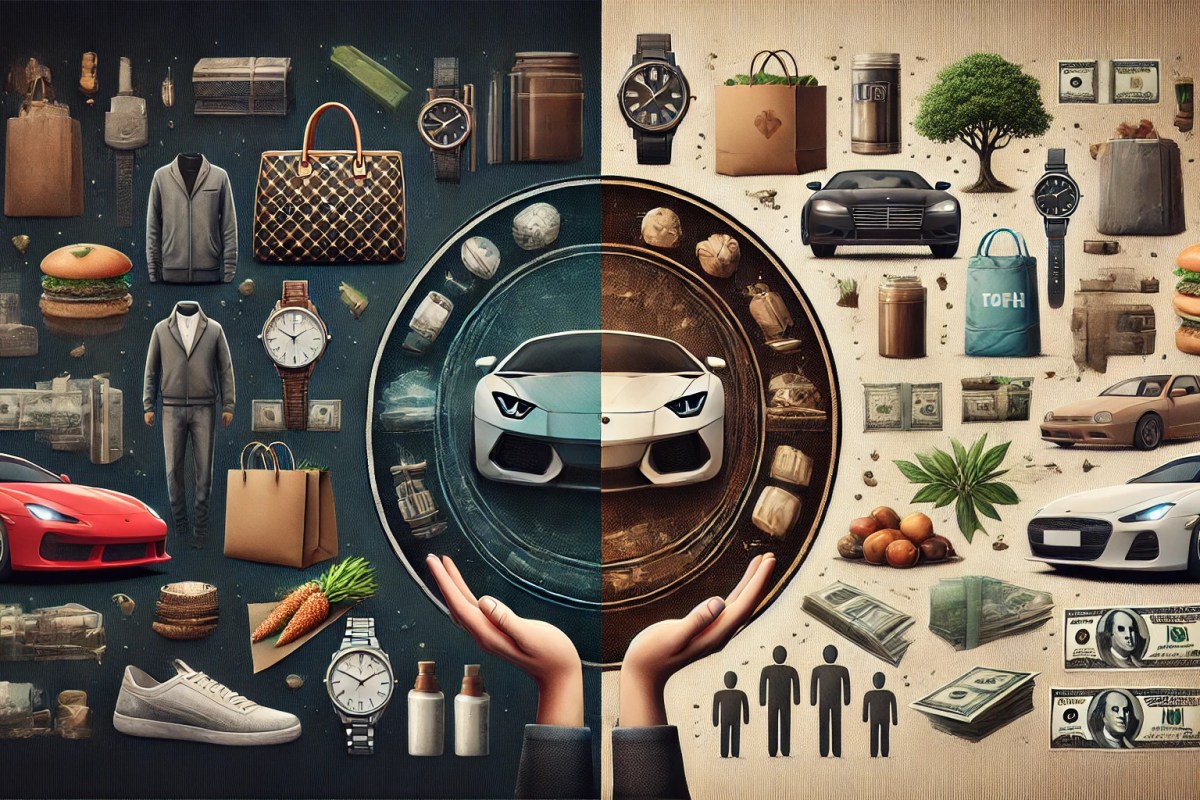
In a world where our worth is increasingly measured by what we own rather than who we are, it’s time to question the hollow pursuit of conspicuous consumption. Thorstein Veblen, over a century ago, saw through the shiny façade of status-driven consumerism. He coined the term conspicuous consumption to describe a phenomenon that has only grown more insidious in our time: the wasteful, performative display of wealth and luxury to signal social standing.

From luxury cars to designer handbags, we live in a society that encourages us to broadcast our economic worth at every turn. But what does this ostentatious display really achieve? Veblen would argue that it’s not about personal fulfilment or the intrinsic value of what we buy, but about outshining others—a relentless race with no finish line. We’re not buying goods; we’re buying validation, trying to purchase a place in an imagined hierarchy that is as fragile as the latest trend.

Peter Singer, the moral philosopher known for his advocacy of effective altruism, would take this critique even further. For Singer, conspicuous consumption is not just wasteful; it’s morally indefensible. His ethical stance, grounded in utilitarianism, compels us to consider the opportunity cost of our spending. Every pound spent on a designer item is a pound that could have been used to alleviate suffering—whether through combating extreme poverty, funding life-saving medical treatments, or addressing global environmental crises. In a world where preventable suffering and death are rampant, lavish spending on status symbols is not just misguided; it’s a moral failure.

Singer’s principle of equal consideration of interests demands that we weigh the impact of our actions on others as seriously as we consider their impact on ourselves. When we choose to engage in conspicuous consumption, we’re prioritising superficial self-expression over the tangible needs of those who are suffering. It’s a glaring contradiction to claim we value human life while squandering resources on goods that serve no purpose beyond ostentation.

The issue with conspicuous consumption isn’t just its superficiality—it’s the economic and social rot it perpetuates. It sustains a cycle of pecuniary emulation, where those lower on the socio-economic ladder are pressured to mimic the consumption patterns of those above them. The result? A society locked in an absurd competition, where individuals drown in debt just to keep up appearances, and resources are squandered on goods that serve no practical purpose other than to flaunt.

But why should we care? Isn’t spending on luxury just a harmless personal choice? Not quite. Every pound spent on a status symbol is a pound diverted from something meaningful—education, healthcare, the environment. When the affluent engage in extravagant spending, they set a toxic standard, promoting the idea that personal worth is tied to material excess. It’s not just bad taste; it’s bad ethics, bad economics, and bad for the planet.

More disturbingly, this drive to display wealth erodes the social fabric. It deepens divisions, creating resentment and alienation. The ultra-wealthy, insulated in their gilded cages, become oblivious to the realities faced by the rest of society. Meanwhile, those struggling to maintain the illusion of prosperity are left with the fallout—financial instability, stress, and a gnawing sense of inadequacy.

Veblen saw this trap for what it was: a hollow spectacle. Singer’s ethics give us a way out. He challenges us to shift our focus from self-indulgence to selflessness, from conspicuous consumption to conscious contribution. Instead of spending exorbitantly to bolster our social standing, why not use that wealth to create real, measurable change in the world?

We don’t need another luxury brand or another status symbol. We need a society that values substance over style, sustainability over excess, and human dignity over the incessant demand to buy more to be more. Singer’s challenge is simple: consider the true cost of your choices—not just for yourself, but for the world around you.

Conspicuous consumption is a dead end. It’s time to take a different road—one that leads not to a display case, but to a more equitable, thoughtful, and genuinely prosperous society.

Illusions of Self: Evanescent Instants in Time

In the realm of existential contemplation, the notion of the ‘self’ is akin to a fleeting present moment. It flits into existence for a fraction of an attosecond, vanishing before our grasp. Much like the illusory present, the ‘self’ manifests briefly and then fades into the annals of the past, a mere connection of temporal slices.

When we traverse the corridors of time, we effortlessly speak of the ‘past,’ stringing together these slices into a continuous narrative. This amalgamation serves our language and thought processes, aiding idiomatic expression. Yet, it remains a construct, a fiction we collectively weave. It is akin to the frames of a movie, where the illusion of movement and coherence is crafted by arranging individual frames in rapid succession.

The ‘self’ follows a similar illusionary trajectory. It exists only inasmuch as we christen it, attributing a name to a fleeting instance of being. However, this existence is as fleeting and ephemeral as a mirage. We name it, we perceive it, but it dissolves like smoke upon closer inspection.

This existential musing reminds one of the fictional entity – the unicorn. We can name it, describe it, and even envision it, yet its tangible existence eludes us. The ‘self’ aligns itself with this enigmatic unicorn, an abstract concept woven into the fabric of human understanding.

In this dance of philosophical thought, published works echo similar sentiments. Renowned thinkers like Nietzsche, in his exploration of eternal recurrence, or Camus, delving into the absurdity of life, have grappled with the transient nature of the ‘self.’ Their writings form a canvas, painting the portrait of an existence that flits through time, leaving only traces of memory and illusion in its wake.

In conclusion, the ‘self’ is a fleeting enigma, a temporal wisp that vanishes as quickly as it appears. Like a raindrop in the river of time, it merges and dissipates, leaving behind an evanescent trace of what we conceive as ‘I’. The philosophical gaze peers through the mist, challenging the very essence of this ephemeral entity, inviting us to question the very fabric of our perceived reality.

Identity as Fiction: You Do Not Exist

Identity is a fiction; it doesn’t exist. It’s a contrivance, a makeshift construct, a label slapped on to an entity with some blurry amalgam of shared experiences. But this isn’t just street wisdom; some of history’s sharpest minds have said as much.

— Friedrich Nietzsche

Think about Hume, who saw identity as nothing more than a bundle of perceptions, devoid of any central core. Or Nietzsche, who embraced the chaos and contradictions within us, rejecting any fixed notion of self.

Edmund Dantes chose to become the Count of Monte Cristo, but what choice do we have? We all have control over our performative identities, a concept that Judith Butler would argue isn’t limited to gender but applies to the very essence of who we are.

— Michel Foucault

But here’s the kicker, identities are a paradox. Just ask Michel Foucault, who’d say our sense of self is shaped not by who we are but by power, society, and external forces.

You think you know who you are? Well, Erik Erikson might say your identity’s still evolving, shifting through different stages of life. And what’s “normal” anyway? Try to define it, and you’ll end up chasing shadows, much like Derrida’s deconstruction of stable identities.

— Thomas Metzinger

“He seemed like a nice man,” how many times have we heard that line after someone’s accused of a crime? It’s a mystery, but Thomas Metzinger might tell you that the self is just an illusion, a by-product of the brain.

Nations, they’re the same mess. Like Heraclitus’s ever-changing river, a nation is never the same thing twice. So what the hell is a nation, anyway? What are you defending as a nationalist? It’s a riddle that echoes through history, resonating with the philosophical challenges to identity itself.

— David Hume

If identity and nations are just made-up stories, what’s all the fuss about? Why do people get so worked up, even ready to die, for these fictions? Maybe it’s fear, maybe it’s pride, or maybe it’s because, as Kierkegaard warned, rationality itself can seem mad in a world gone astray.

In a world where everything’s shifting and nothing’s set in stone, these fictions offer some solid ground. But next time you’re ready to go to the mat for your identity or your nation, take a minute and ask yourself: what the hell am I really fighting for? What am I clinging to?

Non-Identity Property Paradox

I’ve been reading David Benatar’s Better Never to Have Been, which I expect to review presently have reviewed, but that’s not what this post is about. In it, I happened upon the Non-Identity Paradox asserted by Derek Parfit. In essence, the argument affecting three intuitions runs like this:

  1. Person-affecting, intuition. According to that intuition, an act can be wrong only if that act makes things worse for, or (we can say) harms, some existing or future person.
  2. A person an existence, though flawed, is worth having in a case in which that same person could never have existed at all, and the absence of that act does not make things worse for, or harm, and is not “bad for,” that person.
  3. The existence-inducing acts under scrutiny in the various nonidentity cases are wrong.

The first intuition is my interest: an act can be wrong only if that act makes things worse for some existing or future person. In particular, relative to the future person.

I’ve long held that private property is immoral. One reason is that it favours an extant person over a non-extant person. It also favours humans over non-humans, but I suppose that’s an argument for another day. Plus, it appropriates common public property into private hands—and by ‘public’, I don’t mean property of the state, which is of course just another misappropriation but at a higher level

I believe that this intuition hones the edge of the extant person, person-affecting, argument insomuch as it puts future persons at a disadvantage relative to existing ones.

Nothing more to add. Back to reading Benatar. Thoughts?

Self-Identity

I readily admit to being provocative, sometimes edgy, and polemic, but not without qualification. I keep coming across Strawson’s work, and I agree with much of it, though I feel he’s an edge case in the eyes of many. Even when discussing Strawson’s views with others, I get ‘the look’, this incredulous half-cocked quizzical glare.

In fact, I am reminded of an online conversation altercation I had recently on the topic of identity, cutting to the chase, here’s the big reveal:

You are intentionally being contrarian for no reason other than attempting to appear worldly and intellectually superior.

All living people have an identity. Every single human being. It’s not a philosophical argument. It’s basic vocabulary. Just because another culture has a different name for it, doesn’t make it untrue.

Out of courtesy I’ll withhold the ‘identity’ of this individual, save to say it is an undergraduate.

I think it’s obvious to consider the notion of identity to be self-referential. I am supposed to have a self with some concomitant identity, and so are you. According to the dictionary definition, shared by the student I engaged with, individuals possess some distinguishing character or personality. This is vague. Presumably, there needs to be some constellation of characteristics to make them distinguishing. I don’t suspect that I’m allowed to be identified by non-distinguishing features.

I’m imagining a Ku Klux Klan meeting somewhere in America. Seeking ‘Sam’, I ask the doorman where I can find him. He knows Sam and conveys that he’s a white guy wearing a white sheet with a pillowcase with eye holes.”

Never mind, perhaps I should have referenced penguins. I suppose that’s why they tag them. Is that their identity. It doesn’t feel right. I’m rambling.

Identity is predicated on the notion of the self. I’m partial to Strawson here, but I think I am somewhere in the middle. I understand that the standard narrative is that we construct a narrative to represent our self. This creates a heuristic. But life is not a story.

The problem with this concept is that people configure this narrative differently. Using video vocabulary as a reference, I can think of several approaches straightaway:

  1. 60 FPS (frames per second)
  2. 15 FPS
  3. Dropping frames

There is a memory component. I can also think of only capturing high-lights, low-lights, or some combination. My event-triggered home security camera system captures certain movement and sound, but different cameras capture different frames under different conditions, for differing durations, at different intervals, and at different fidelity. Moreover, it also captures certain aspects of any given frame.

Add to this false memories and misremembered content as well as conveyed narratives that you include in this composite. Examples from my life are stories I heard my mum telling her friends over and over as I was growing up. I have no native memory, but if I were to reconstruct a sense of self, I’d want to include them with native memories.

Memories of my early life are fragmented, and I don’t remember anything before age 5 or so. And even then, I can recall maybe 2 or 3 events unprompted. If asked if I remember this or that event, I may or may not, and it might be true or not.

I can’t claim the same lack of continuity as Strawson, I do feel that it might be substantially weaker than that of the general public. Just reflecting back top of mind, I remember these select events:

  • Relating my judo lessons to my grade three classmates
  • Being bored to tears in grade four because I had been demoted to a ‘standard’ class and being re-promoted to advanced placement classes when I ‘acted out’ due to shear boredom
  • Being adopted by my stepdad and taking his last name in grade four
  • My mate, Carl, also being adopted and taking an entirely new name—not just the last name
  • Various domestic abuse episodes
  • Choosing the coronet as a grade five school band instrument because my dad wouldn’t allow me to play the drums

After this, I can start to remember more and more, but not significantly so. I can remember certain classmates and interactions, teachers, friends and neighbours. If I stitched it together as a single filmstrip, it would be underwhelming and wouldn’t likely make much sense to anyone else. And who could even identify dramatic effect?

In stop motion parlance, there is a notion of keyframes and tweening. The aforementioned events would serve as keyframes. Tweening is the interpolation between these frames that morph and create the appearance of motion. This tweening never actually happened. It’s only realised during playback. How much of self and indentity are this filler?

At this point, I am thinking that what I am doing is setting the stage to say that the self is incomplete and imperfect, but I am leaving room for its existence. And of course, it exists. It’s a phenomenon, and we’ve labelled it. What more can one ask for?

I’m still trying to put it all together, but my ‘I’ keeps changing. How can I tame Haidt’s elephant?

“The mind is divided, like a rider on an elephant, and the rider’s job is to serve the elephant.”

― Jonathan Haidt, The Righteous Mind: Why Good People Are Divided by Politics and Religion

What is Consciousness?

This infographic helps to articulate various notions of consciousness. Not much more to add.

I think I am partial to emergent theories, but I favour property dualism over emergent. The dualism employed in property dualism doesn’t feel accurate. It’s not dual so much as it just hasn’t been described yet.

I don’t think that physics can express or descriptively characterize everything that exists.

The Silence of Physics | Galen Strawson | Talks at Google

I want to accept the Buddhist notion, but I can’t seem to not differentiate.

I don’t feel I have enough information on the remainder of these. I could lean on the name and short description, but I feel this would necessarily establish me firmly in Dunning-Kruger territory. There may be even more hypotheses than are captured here.