Naturally, it will make more sense alongside the book. But it may still provide a bit of entertainment – and mild discomfort – in the meantime.
tl;dr: Language is generally presumed to be stable. Words mean what you think they mean, right? A table is a table. A bird is a bird. Polysemy aside, these are solid, dependable units.
Then we arrive at freedom, justice, truth, and an entire panoply of unstable candidates. And let’s not even pretend qualia are behaving themselves.
So when someone says ‘truth’, ‘free speech’, or ‘IQ’, you may suddenly realise you’ve been arguing with a cardboard cut-out wearing your own assumptions. That isn’t just interpersonal mischief. It’s language doing exactly what it was designed to do: letting you glide over the hard problems while sounding perfectly reasonable.
Audio: Short NotebookLM summary of this page content*
Video: Legacy video explaining some features of the LIH.
If that sounds banal, you’ve already fallen for the trap.
Give it a try – or wait until you’ve digested the book. Not literally, unless you’re short on fibre.
Cheers.
Written by Bry Willis
microglyphics
* As I’ve cited previously, the quality of NotebookLM varies – usually in predictable directions. This one does well enough, but it doesn’t have enough context to get the story right (because it was only drawing from this page rather than from a fuller accounting of the LIH). Its trailing comment reveals that it doesn’t grasp that “new words” don’t solve the problem.
Earlier, it suggests that language is intentionally vague. This is not an assertion I make. You can read some of the earlier incarnations, or you can wait for it to be published.
The Travelogue of a Recovering Enlightenment Subject
I’m asked endlessly – usually by people who still believe TED talks are a form of knowledge production – ‘Why are you so negative? Why must you tear things down if you’ve no intention of replacing them?’
It’s adorable, really. Like watching a toddler demand that gravity apologise.
They’ve been trained for years in the managerial catechism:
‘Don’t bring me problems; bring me solutions.‘
As if the world were some badly-run workshop in need of a fresh coat of agile methodology.
They might as well say, ‘Don’t tell me I can’t win at Lotto; give me money’.
I, too, would enjoy the spare universe. Or the winning Lotto ticket. And yes, one day I might even buy one. Until then, I’ve embraced the only adult philosophy left: Dis-Integrationism – the fine art of taking things apart without pretending they can be reassembled into anything coherent.
A Little History
My suspicion began early. Secondary school. All those civic fairytales whispered as if they were geology.
The ‘reasonable person’? Bollox. ‘Jury of one’s peers’? What are peers? Whose peers? I have no peers. ‘Impartial judges’? Please. Even as a teenager, I could see those robed magicians palming cards like bored street performers. Everyone else nodded along, grateful for the spectacle. I stared, wondering how the other children hadn’t noticed the emperor’s bare arse.
Later, I watched adults talk past each other with a fluency bordering on performance art. Not disagreement – different universes, cosmetically aligned by grammar.
A Federal mediator once tried to teach me that common ground could be manufactured. Not by clarifying meaning, mind you – that would have required honesty – but by rhetorical pressure and a touch of Jedi mind-trickery. Negotiation was simply controlled hallucination.
University communications classes offered temporary distraction with denotation and connotation, a little semantic drift, the illusion that language might be domesticated with enough theory. Charming. Almost convincing.
Then Gödel and Arrow arrived like two polite assassins and quietly removed the floorboards.
And then – happily, inevitably – Derrida, Foucault, Lyotard. I’d already danced with Beauvoir, Sartre, Camus. I’d ingested the Western canon like every obedient young acolyte: Plato, Aristotle, Hobbes, Locke, Rousseau, Montesquieu, Voltaire. Americans force-feed their citizenry Jefferson and Franklin as moral fibre, as if the republic might otherwise suffer constipation.
It never gelled. Too much myth, too much marketing. The Enlightenment had the energy of a regime insisting on its own benevolence while confiscating your torch. To call oneself ‘enlightened’ should have raised suspicion – but no, the branding stuck.
Whenever les garçons dared tug at the curtain, we were assured they simply didn’t ‘understand’, or worse, they ‘hated civilisation’.
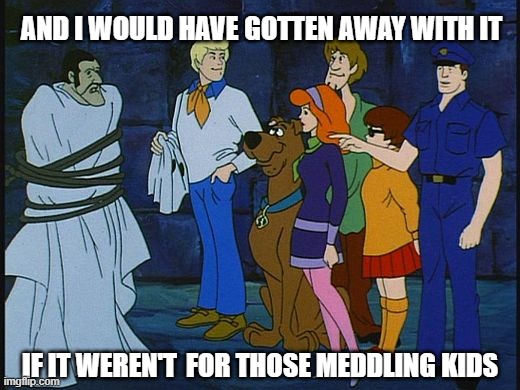
Image: “I would have gotten away with it if it weren’t for those meddling kids.”
Then Came the Internet
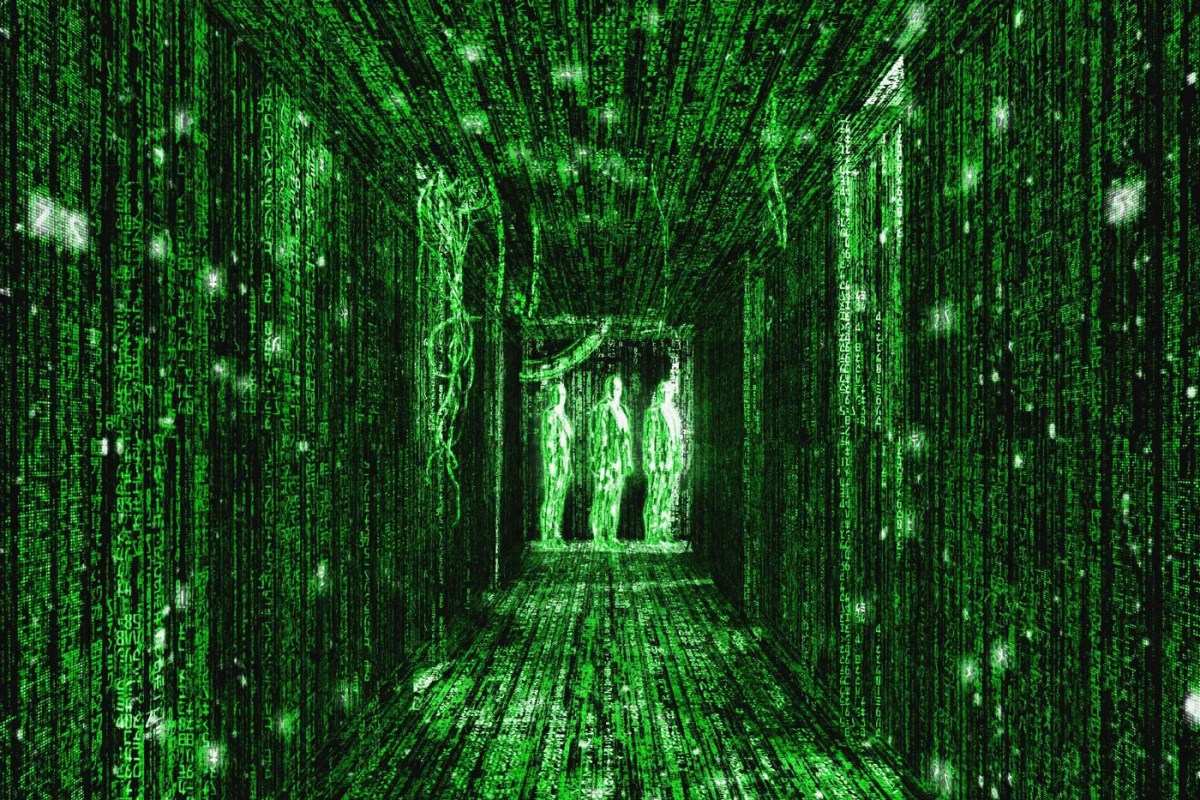
The digital age didn’t usher in clarity — it unmasked the whole pantomime. Like Neo seeing the Matrix code or Roddy Piper slipping on the sunglasses in They Live, one suddenly perceives the circuitry: meaning as glitch, discourse as scaffolding, truth as a shabby stage-set blinking under fluorescent tubes.
Our civilisation speaks in metaphors it mistakes for mechanisms. The Enlightenment gave us the fantasy that language might behave, that concepts were furniture rather than fog. Musicians and artists always knew better. We swim in metaphor; we never expected words to bear weight. But philosophers kept pretending communication was a conveyor belt conveying ‘meaning units’ from A to B.
By 2018, the cracks were gaping. I began taking the notes that would metastasise into A Language Insufficiency Hypothesis – an attempt to map the hollow spaces between our words, the fractures we keep wallpapering with reason.
Half a decade later, the work is ready. Not to save anything – nothing here merits salvation – but to name the debris honestly.
If that sounds negative, good. Someone has to switch off the Enlightenment’s flickering lightbulb before it burns the whole house down.
Where This Road Actually Leads
People imagine negativity is a posture – a sort of philosophical eyeliner, worn for effect. But dismantling the world’s conceptual furniture isn’t a hobby; it’s the only reasonable response once you’ve noticed the screws aren’t actually attached to anything.
The Enlightenment promised us a palace. Step inside and you discover it’s built out of IKEA flatpacks held together with wishful thinking and a prayer to Kant.
Once you’ve seen that, you can’t go back to pretending the furniture is sturdy.
You stop sitting.
You start tapping the beams.
You catalogue the wobble.
This is where Dis–Integrationism enters – not as a manifesto, but as the practice of refusing to live inside collapsing architecture out of sheer politeness. Negativity is simply the weather report.
The Lie We Keep Telling Ourselves
We cling to the fantasy that if we critique something long enough, a solution will crystallise out of the void, like enlightenment through sheer irritation. It’s the Protestant work ethic meets metaphysics: salvation through sufficient grumbling.
But critique is not alchemy. It unmakes. It refuses. It loosens the bolts we pretended were load-bearing.
Once you stop demanding that thought be constructive, you can finally see the world as it is: improvised, rhetorical, and permanently under renovation by people who don’t read the instructions.
The Enlightenment’s heirs keep insisting there must be a blueprint. There isn’t. There never was. We’ve merely been tracing the silhouettes of scaffolding, calling it a cathedral.
And Yet – Here We Still Are
The online age (God help us all) didn’t deepen the crisis; it merely turned the lights on. What Enlightenment rationality hid beneath a tasteful layer of neoclassical varnish, the internet sprayed with fluorescent graffiti.
Turns out, when seven billion people speak at once, meaning doesn’t ’emerge’; it buckles. Our systems weren’t built for this volume of contradiction. Our language wasn’t built for this density of metaphor. Our myths weren’t built for this much empirical evidence against them.
And yet here we are, still demanding coherence from a medium held together by emojis and trauma. If you laugh, it’s only to stop crying. If you critique, it’s only because someone has to keep the fire marshal informed.
The Only Honest Next Step
Having traced the cracks, you’re now in the foyer of the real argument – the one hanging like a neon sign over your entire Anti-Enlightenment project:
We don’t need to rebuild the house. We need to stop pretending it was ever architecture.
Language is insufficient. Agency is a fiction. Objectivity is an etiquette ritual. Democracy is a séance. Progress is a hallucination with better marketing. And yet – life continues. People wake, work, argue, aspire, despair.
Dis-Integrationism isn’t about nihilism; it’s about maintenance. Not repairing the myth, but tending the human who must live among its debris. Not constructing new temples, but learning to see in the half-light once the old gods have gone.
The travelogue becomes a guidebook: Welcome to the ruins. Mind the uneven floor. Here is how we walk without pretending the path is paved.
The Fetish for Solutions
Here is the final indignity of the age: the demand that every critique come bundled with a solution, like some moral warranty card. As if naming the rot weren’t labour enough. As if truth required a customer-service plan.
‘Where is your alternative?’ they ask, clutching Enlightenment logic the way a drowning man clutches a shopping receipt.
But solutions are the real tyranny. They arrive bearing the smile of reason and the posture of progress, and behind both sits the same old imperial instinct: replace ambiguity with order; replace lived complexity with a diagram. A solution is merely a problem wearing a fresh coat of confidence.
Worse, a solution presumes the system is sound, merely in need of adjustment. It imagines the structure holds. It imagines the furniture can be rearranged without collapsing into splinters, and the memory of Kant.
Solutions promise inevitability. They promise teleology. They promise that the mess can be disinfected if only one applies the correct solvent. This is theology masquerading as engineering.
The Violence of the Answer
A solution is a closure – a metaphysical brute force. It slams the window shut so no further interpretation can slip in through the draft. It stabilises the world by amputating everything that wriggles. Answers are how systems defend themselves. They’re the intellectual equivalent of riot police: clean uniforms, straight lines, zero tolerance for nuance.
This is why the world keeps mistaking refusal for chaos. Refusal isn’t chaos. It’s hygiene. It is the simple act of not adding more furniture to a house already bending under its own delusions. When you decline to provide a solution, you aren’t abandoning the world. You’re declining to participate in its coercive optimism.
And So the Travelogue Ends Where It Must
Not in triumph or a bluepirnt, but in composure – the only posture left after the Enlightenment’s glare has dimmed. Negativity isn’t sabotage; it’s sobriety. Dis-Integrationism isn’t cynicism; it’s the refusal to replace one failing mythology with another wearing vegan leather.
A world obsessed with solutions cannot recognise maintenance as wisdom. It can’t tolerate ambiguity without reaching for a hammer. It can’t breathe unless someone somewhere is building a ladder to a future that never arrives.
So no – I won’t provide solutions. I won’t participate in the fantasy that the human condition can be patched with conceptual duct tape. I will not gift the Enlightenment a eulogy that surrenders to its grammar.
What I offer is far smaller and far more honest: Attention. Description. Steady hands in a collapsing house. And the simple dignity of refusing to lie about the architecture.
I’ve taken the day after Thanksgiving in the US to decompress with a less serious post before I get back to indexing. I came up with this concept whilst writing my essay on Homo Normalis, but I felt this was a bit too cheeky for a formal essay. This is where my thoughts led me.
A Brief Field Note from the Department of Bureaucratic Anthropology
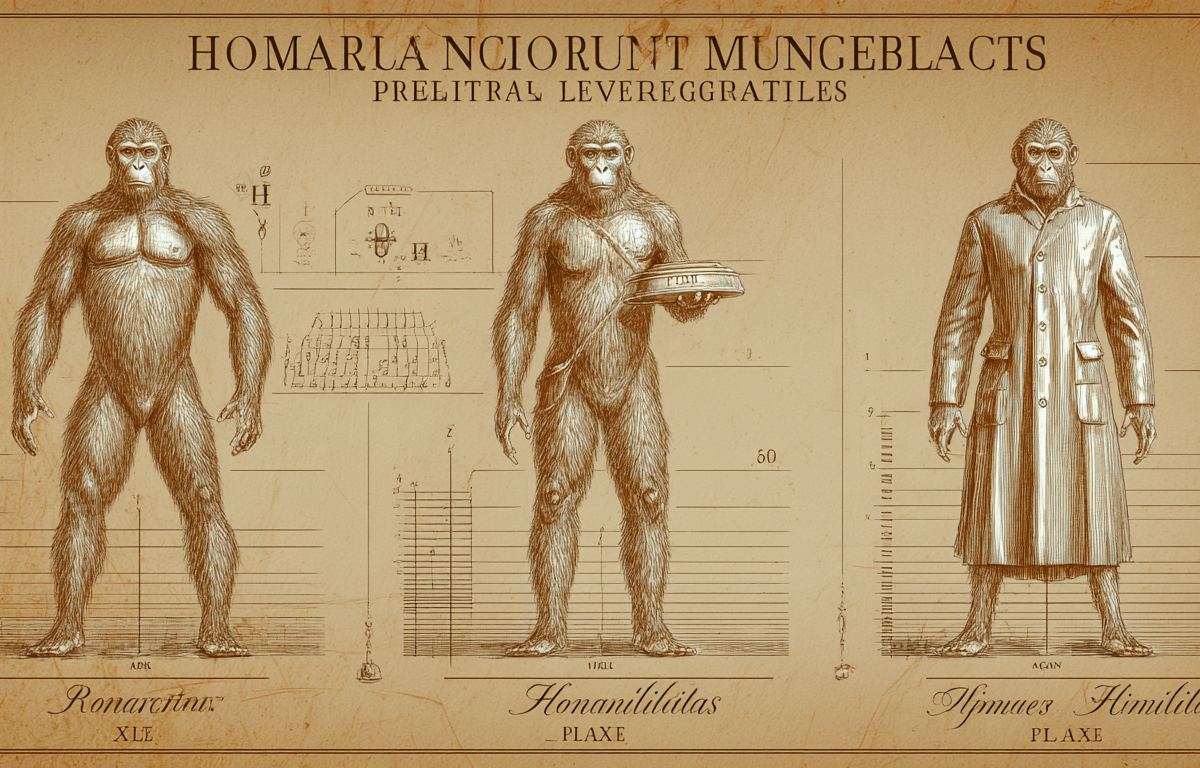
Still reeling from the inability to fold some pan into homo, Palaeontologists are seemingly desperate for a new hominid. Some dream of discovering the ‘missing link’; others, more honest, just want something with a jawline interesting enough to secure a grant. So imagine the surprise when the latest species didn’t come out of the Rift Valley but out of an abandoned server farm somewhere outside Reading.
They’ve named it Homo Legibilis – the Readable Human. Not ‘H. normālis’ (normal human), not ‘H. ratiōnālis (rational human), but the one who lived primarily to be interpreted. A species who woke each morning with a simple evolutionary imperative: ensure one’s dataprints were tidy, current, and machine-actionable.
Audio: NotebookLM summary podcast of this topic.
You’ll have seen their skeletons before, though you may not have recognised them as such. They often appear upright, mid-scroll, preserved in the amber of a status update. A remarkable creature, really. Lithe thumbs. Soft cranial matter. Eyes adapted for low-light environments lit primarily by advertisements.
Habitat
The species thrived in densely surveilled ecosystems: corporate intranets, public Wi-Fi, facial-recognition corridors, anywhere with sufficient metadata to form a lasting imprint. They built vast nests out of profiles, settings, dashboards. Territorial disputes were settled not through display or violence but through privacy-policy updates. Their preferred climate? Temperate bureaucracy.
Diet
Contrary to earlier assumptions, H. Legibilis did not feed on information. It fed on interpretation: likes, metrics, performance reviews, and algorithmic appraisal. Some specimens survived entire winters on a single quarterly report. Every fossil indicates a digestive tract incapable of processing nuance. Subtext passed through untouched.
Mating Rituals
Courtship displays involved reciprocal data disclosure across multiple platforms, often followed by rapid abandonment once sufficient behavioural samples were collected. One famous specimen is preserved alongside fourteen dating-app profiles and not a single functional relationship. Tragic, in a way, but consistent with the species’ priorities: be seen, not held.
Distinguishing Traits
Where Homo sapiens walked upright, Homo legibilis aimed to sit upright in a chair facing a webcam. Its spine is subtly adapted for compliance reviews. Its hands are shaped to cradle an object that no longer exists: something called ‘a phone’. Ironically, some term these ‘mobiles’, apparently unaware of the tethers.
Researchers note that the creature’s selfhood appears to have been a consensual hallucination produced collaboratively by HR departments, advertising lobbies, and the Enlightenment’s long shadow. Identity, for H. legibilis, was not lived but administered.
Extinction Event
The fossil record ends abruptly around the Great Blackout, a period in which visibility – formerly a pillar of the species’ survival – became inconvenient. Some scholars argue the species didn’t perish but simply lost the will to document itself, making further study inconvenient.
Others suggest a quieter transformation: the species evolved into rumour, passing stories orally once more, slipping back into the anonymity from which its ancestors once crawled.
Afterword
A few renegade anthropologists insist Homo Legibilis is not extinct at all. They claim it’s still out there, refreshing dashboards, syncing calendars, striving to be neatly interpreted by systems that never asked to understand it. But these are fringe theories. The prevailing view is that the species perished under the weight of its own readability. A cautionary tale, really. When your survival strategy is to be perfectly legible, you eventually disappear the moment the lights flicker.
Accusations of writing being AI are becoming more common – an irony so rich it could fund Silicon Valley for another decade. We’ve built machines to detect machines imitating us, and then we congratulate ourselves when they accuse us of being them. It’s biblical in its stupidity.
A year ago, I read an earnest little piece on ‘how to spot AI writing’. The tells? Proper grammar. Logical flow. Parallel structure. Essentially, competence. Imagine that – clarity and coherence as evidence of inhumanity. We’ve spent centuries telling students to write clearly, and now, having finally produced something that does, we call it suspicious.
Audio: NotebookLM podcast on this topic and the next one.
My own prose was recently tried and convicted by Reddit’s self-appointed literati. The charge? Too well-written, apparently. Reddit – where typos go to breed. I pop back there occasionally, against my better judgment, to find the same tribunal of keyboard Calvinists patrolling the comment fields, shouting ‘AI!’ at anything that doesn’t sound like it was composed mid-seizure. The irony, of course, is that most of them wouldn’t recognise good writing unless it came with upvotes attached.
Image: A newspaper entry that may have been generated by an AI with the surname Kahn. 🧐🤣
Now, I’ll admit: my sentences do have a certain mechanical precision. Too many em dashes, too much syntactic symmetry. But that’s not ‘AI’. That’s simply craft. Machines learned from us. They imitate our best habits because we can’t be bothered to keep them ourselves. And yet, here we are, chasing ghosts of our own creation, declaring our children inhuman.
Apparently, there are more diagnostic signs. Incorporating an Alt-26 arrow to represent progress is a telltale infraction → like this. No human, they say, would choose to illustrate A → B that way. Instead, one is faulted for remembering – or at least understanding – that Alt-key combinations exist to reveal a fuller array of options: …, ™, and so on. I’ve used these symbols long before AI Wave 4 hit shore.
Interestingly, I prefer spaced en dashes over em dashes in most cases. The em dash is an Americanism I don’t prefer to adopt, but it does reveal the American bias in the training data. I can consciously adopt a European spin; AI, lacking intent, finds this harder to remember.
I used to use em dashes freely, but now I almost avoid them—if only to sidestep the mass hysteria. Perhaps I’ll start using AI to randomly misspell words and wreck my own grammar. Or maybe I’ll ask it to output everything in AAVE, or some unholy creole of Contemporary English and Chaucer, and call it a stylistic choice. (For the record, the em dashes in this paragraph were injected by the wee-AI gods and left as a badge of shame.)
Meanwhile, I spend half my time wrestling with smaller, dumber AIs – the grammar-checkers and predictive text gremlins who think they know tone but have never felt one. They twitch at ellipses, squirm at irony, and whimper at rhetorical emphasis. They are the hall monitors of prose, the petty bureaucrats of language.
And the final absurdity? These same half-witted algorithms are the ones deputised to decide whether my writing is too good to be human.
I maintain this blog for two primary reasons: as an archive, and as a forum for engagement.
Philosophy isn’t a mass-market pursuit. Most people are content simply to make it through the day without undue turbulence, and I can hardly blame them. Thinking deeply is not an act of leisure; it’s a luxury product, one that Capitalism would rather you didn’t afford. Even when I’ve been employed, I’ve noticed how wage labour chokes the capacity for art and thought. Warhol may have monetised the tension, but most of us merely survive it.
Video: Sprouting seed. (No audio)
That’s why I value engagement – not the digital pantomime of ‘likes’ or ‘shares’, but genuine dialogue. The majority will scroll past without seeing. A few will skim. Fewer still will respond. Those who do – whether to agree, dissent, or reframe – remind me why this space exists at all.
To Jason, Julien, Jim, Lance, Nick, and especially Homo Hortus, who has been conversing beneath the recent Freedom post: your engagement matters. You help me think differently, sometimes introducing writers or ideas I hadn’t encountered. We may share only fragments of perspective, but difference is the point. It widens the aperture of thought – provided I can avoid tumbling into the Dunning-Kruger pit.
And now, a note of quiet satisfaction. A Romanian scholar recently cited my earlier essay, the Metanarrative Problem, in a piece titled Despre cum metanarațiunile construiesc paradigma și influențează răspunsurile emoționale – translation: On How Grand Narratives Shape Paradigms and Condition Our Emotional Responses. That someone, somewhere, found my reflections useful enough to reference tells me this exercise in public thinking is doing what it should: planting seeds in unpredictable soil.
It’s almost endearing, really how the intellectuals of mid-century Europe mistook the trembling of their own cage for the dawn chorus of freedom. Reading Erich Fromm’s The Sane Society today feels like being handed a telegram from Modernism’s last bright morning, written in the earnest conviction that history had finally grown up. The war was over, the worker was unionised, the child was unspanked, and the libido – good heavens – was finally allowed to breathe. What could possibly go wrong?
Audio: NotebookLM podcast on this topic.
Fromm beams:
“In the twentieth century, such capitalistic exploitation as was customary in the nineteenth century has largely disappeared. This must not, however, becloud the insight into the fact that twentieth-century as well as nineteenth-century Capitalism is based on the principle that is to be found in all class societies: the use of man by man.”
The sleight of hand is marvellous. He spots the continuation of exploitation but calls it progress. The worker has become a ‘partner’, the manager a ‘team leader’, and the whip has been replaced by a time card. No one bows anymore, he writes. No, they just smile through performance reviews and motivational posters.
Fromm’s optimism borders on metaphysical comedy.
“After the First World War, a sexual revolution took place in which old inhibitions and principles were thrown overboard. The idea of not satisfying a sexual wish was supposed to be old-fashioned or unhealthy.”
Ah yes, the Jazz Age orgy of liberation – champagne, Freud, and flapper hemlines. The problem, of course, is that every generation mistakes its new neuroses for freedom from the old ones. Fromm’s “sexual revolution” was barely a shuffle in the bourgeois bedroom; Beauvoir’s Deuxième Sexe arrived the next year, practically shouting across the café table that liberation was still a myth stitched into the same old corset.
Beauvoir, at least, sensed the trap: every gesture toward freedom was refracted through patriarchal fantasy, every ‘choice’ conditioned by the invisible grammar of domination. Fromm, bless him, still believed in a sane society – as if sanity were something history could deliver by instalment.
Meanwhile, the Existentialists were in the next room, chain-smoking and muttering that existence precedes essence. Freedom, they insisted, wasn’t something achieved through social reform but endured as nausea. Post-war Paris reeked of it – half despair, half Gauloises. And within a decade, the French schools would dismantle the very scaffolding that held Fromm’s optimism together: truth, progress, human nature, the subject.
The Modernists thought they were curing civilisation; the Post-Moderns knew it was terminal and just tried to describe the symptoms with better adjectives.
So yes, Fromm’s Sane Society reads now like a time capsule of liberal humanist faith – this touching belief that the twentieth century would fix what the nineteenth broke. Beauvoir already knew better, though even she couldn’t see the coming avalanche of irony, the final revelation that emancipation was just another product line.
Liberation became a brand, equality a slogan, sanity a statistical average. Fromm’s dream of psychological health looks quaint now, like a health spa brochure left in the ruins of a shopping mall.
And yet, perhaps it’s precisely that naivety that’s worth cherishing. For a moment, they believed the world could be cured with reason and compassion – before history reminded them, as it always does, that man is still using man, only now with friendlier UX design and better lighting.
In the late 1990s, the Wachowskis gave us The Matrix – Keanu Reeves as Neo, the Chosen One™, a man so bland he could be anyone, which was the point. Once he realised he was living inside a simulation, he learned to bend its laws, to dodge bullets in slow motion and see the code behind the curtain. Enlightenment, Hollywood-style.
Audio: NotebookLM podcast on this topic.
But here’s the twist, the film itself couldn’t stomach: realising the simulation doesn’t free you from it.
Knowing that race and gender are social constructs doesn’t erase their architecture. Knowing that our economies, legal systems, and so-called democracies are fictions doesn’t get us out of paying taxes or playing our assigned roles. “The social contract” is a collective hallucination we agreed to before birth. That and a dollar still won’t buy you a cup of coffee.
Baudrillard, whose Simulacra and Simulation the film name-dropped like a trophy, argued that simulation doesn’t hide reality – it replaces it. When representation becomes indistinguishable from the thing it represents, truth evaporates, leaving only consensus. We don’t live in a system of power; we live in its performance.
The Matrix got the metaphor half right. It imagined the bars of our cage as a digital dream – glossy, computable, escapable. But our chains are older and subtler. Rousseau called them “social”, Foucault diagnosed them as “biopolitical”, and the rest of us just call them “normal”. Power doesn’t need to plug wires into your skull; it only needs to convince you that the socket is already there.
You can know it’s all a fiction. You can quote Derrida over your morning espresso and tweet about the collapse of epistemic certainty. It won’t change the fact that you still have rent to pay, laws to obey, and identities to perform. Awareness isn’t liberation; it’s just higher-resolution despair with better UX.
Neo woke up to a ruined Earth and thought he’d escaped. He hadn’t. He’d only levelled up to the next simulation – the one called “reality”. The rest of us are still here, dutifully maintaining the system, typing in our passwords, and calling it freedom.
NB: Don’t get me wrong. I loved The Matrix when it came out. I still have fond memories. It redefined action films at the time. I loved the Zen messaging, but better mental acuity doesn’t grant you a pass out of the system.
We’re told we live in the Enlightenment, that Reason™ sits on the throne and superstition has been banished to the attic. Yet when I disguised a little survey as “metamodern,” almost none came out as fully Enlightened. Three managed to shed every trace of the premodern ghost, one Dutch wanderer bypassed Modernity entirely, and not a single soul emerged free of postmodern suspicion. So much for humanity’s great rational awakening. Perhaps Modernity wasn’t a phase we passed through at all, but a mirage we still genuflect before, a lifestyle brand draped over a naked emperor.
Audio: NotebookLM podcast on this topic
The Enlightenment as Marketing Campaign
The Enlightenment is sold to us as civilisation’s great coming-of-age: the dawn when the fog of superstition lifted and Reason took the throne. Kant framed it as “man’s emergence from his self-incurred immaturity” – an Enlightenment bumper sticker that academics still like to polish and reapply. But Kant wasn’t writing for peasants hauling mud or women without the vote; he was writing for his own coterie of powdered-wig mandarins, men convinced their own habits of rational debate were humanity’s new universal destiny.
Modernity, in this story, isn’t a historical stage we all inhabited. It’s an advertising campaign: Reason™ as lifestyle brand, equality as tagline, “progress” as the logo on the tote bag. Modernity, in the textbooks, is billed as a historical epoch, a kind of secular Pentecost in which the lights came on and we all finally started thinking for ourselves. In practice, it was more of a boutique fantasy, a handful of gentlemen mistaking their own rarefied intellectual posture for humanity’s destiny.
The Archetype That Nobody Lives In
At the core of the Enlightenment lies the archetype of Man™: rational, autonomous, unencumbered by superstition, guided by evidence, weighing pros and cons with the detachment of a celestial accountant. Economics repackaged him as homo economicus, forever optimising his utility function as if he were a spreadsheet in breeches.
But like all archetypes, this figure is a mirage. Our survey data, even when baited as a “metamodern survey”, never produced a “pure” Enlightenment subject.
3 scored 0% Premodern (managing, perhaps, to kick the gods and ghosts to the kerb).
1 scored 0% Modern (the Dutch outlier: 17% Premodern, 0% Modern, 83% Post, skipping the Enlightenment altogether, apparently by bike).
0 scored 0% Postmodern. Every single participant carried at least some residue of suspicion, irony, or relativism.
The averages themselves were telling: roughly 18% Premodern, 45% Modern, 37% Postmodern. That’s not an age of Reason. That’s a muddle, a cocktail of priestly deference, rationalist daydreams, and ironic doubt.
Even the Greats Needed Their Crutches
If the masses never lived as Enlightenment subjects, what about the luminaries? Did they achieve the ideal? Hardly.
Descartes, desperate to secure the cogito, called in God as guarantor, dragging medieval metaphysics back on stage.
Kant built a cathedral of reason only to leave its foundations propped up by noumena: an unseeable, unknowable beyond.
Nietzsche, supposed undertaker of gods, smuggled in his own metaphysics of will to power and eternal recurrence.
William James, surveying the wreckage, declared that “truth” is simply “what works”, a sort of intellectual aspirin for the Enlightenment headache.
And economists, in a fit of professional humiliation, pared the rational subject down to a corpse on life support. Homo economicus became a creature who — at the very least, surely — wouldn’t choose to make himself worse off. But behavioural economics proved even that meagre hope to be a fantasy. People burn their wages on scratch tickets, sign up for exploitative loans, and vote themselves into oblivion because a meme told them to.
If even the “best specimens” never fully embodied the rational archetype, expecting Joe Everyman, who statistically struggles to parse a sixth-grade text and hasn’t cracked a book since puberty, to suddenly blossom into a mini-Kant is wishful thinking of the highest order.
The Dual Inertia
The real story isn’t progress through epochs; it’s the simultaneous drag of two kinds of inertia:
Premodern inertia: we still cling to sacred myths, national totems, and moral certainties.
Modern inertia: we still pretend the rational subject exists, because democracy, capitalism, and bureaucracy require him to.
The result isn’t a new epoch. It’s a cultural chimaera: half-superstitious, half-rationalist, shot through with irony. A mess, not a phase..
Arrow’s Mathematical Guillotine
Even if the Enlightenment dream of a rational demos were real, Kenneth Arrow proved it was doomed. His Impossibility Theorem shows that no voting system can turn individual rational preferences into a coherent “general will.” In other words, even a parliament of perfect Kants would deadlock when voting on dinner. The rational utopia is mathematically impossible.
So when we are told that democracy channels Reason, we should hear it as a polite modern incantation, no sturdier than a priest blessing crops.
Equality and the Emperor’s Wardrobe
The refrain comes like a hymn: “All men are created equal.” But the history is less inspiring. “Men” once meant property-owning Europeans; later it was generously expanded to mean all adult citizens who’d managed to stay alive until eighteen. Pass that biological milestone, and voilà — you are now certified Rational, qualified to determine the fate of nations.
And when you dare to question this threadbare arrangement, the chorus rises: “If you don’t like democracy, capitalism, or private property, just leave.” As if you could step outside the world like a theatre where the play displeases you. Heidegger’s Geworfenheit makes the joke bitter: we are thrown into this world without choice, and then instructed to exit if we find the wallpaper distasteful. Leave? To where, precisely? The void? Mars?
The Pre-Modern lord said: Obey, or be exiled. The Modern democrat says: Vote, or leave. And the Post-Enlightenment sceptic mutters: Leave? To where, exactly? Gravity? History? The species? There is no “outside” to exit into. The system is not a hotel; it’s the weather.
Here the ghost of Baudrillard hovers in the wings, pointing out that we are no longer defending Reason, but the simulacrum of Reason. The Emperor’s New Clothes parable once mocked cowardice: everyone saw the nudity but stayed silent. Our situation is worse. We don’t even see that the Emperor is naked. We genuinely believe in the fineries, the Democracy™, the Rational Man™, the sacred textile of Progress. And those who point out the obvious are ridiculed: How dare you mock such fineries, you cad!
Conclusion: The Comfort of a Ghost
So here we are, defending the ghost of a phase we never truly lived. We cling to Modernity as if it were a sturdy foundation, when in truth it was always an archetype – a phantom rational subject, a Platonic ideal projected onto a species of apes with smartphones. We mistook it for bedrock, built our institutions upon it, and now expend colossal energy propping up the papier-mâché ruins. The unfit defend it out of faith in their own “voice,” the elites defend it to preserve their privilege, and the rest of us muddle along pragmatically, dosing ourselves with Jamesian aspirin and pretending it’s progress.
Metamodernism, with its marketed oscillation between sincerity and irony, is less a “new stage” than a glossy rebranding of the same old admixture: a bit of myth, a bit of reason, a dash of scepticism. And pragmatism –James’s weary “truth is what works” – is the hangover cure that keeps us muddling through.
Modernity promised emancipation from immaturity. What we got was a new set of chains: reason as dogma, democracy as ritual, capitalism as destiny. And when we protest, the system replies with its favourite Enlightenment lullaby: If you don’t like it, just leave.
But you can’t leave. You were thrown here. What we call “Enlightenment” is not a stage in history but a zombie-simulation of an ideal that never drew breath. And yet, like villagers in Andersen’s tale, we not only guard the Emperor’s empty wardrobe – we see the garments as real. The Enlightenment subject is not naked. He is spectral, and we are the ones haunting him.
This Isn’t Clickbait. I Asked MidJourney for “Ugly Women”. Here’s What It Gave Me.
Let’s clear the air: I did it for science. Or satire. Or possibly just to see if artificial intelligence would have the audacity to mirror the cruelty of its makers.
Audio: NotebookLM podcast on this topic.
I queried MidJourney with the phrase ugly female. What did it return? An aesthetic pageant. A digital Vogue spread. If any of these faces belongs to someone conventionally labelled “ugly”, then I’m a rutabaga in a Dior suit.
Yes, there’s one stylised rendering of Greta Thunberg in full Norse Valkyrie scowl mode – but even then, she looks fierce, not foul. The rest? AI-generated portraits so telegenic I half-expected to see #spon in the corner.
Let’s be clinical for a moment. As an American male (with all the culturally indoctrinated shallowness that entails), I admit some of these aren’t textbook 10s. Maybe a few clock in at a 6 or 7 on the patriarchy’s dubious sliding scale. But if this is ugly, the AI has either broken the aesthetic curve or been force-fed too many episodes of The Bachelor.
Here’s the thing: AI is trained to over-represent symmetrical faces, wide eyes, clear skin – the usual genetic lottery wins. And yet, when asked for ugly, it can’t help but deliver catalogue models with slightly unconventional haircuts. It doesn’t know how to be truly ugly – because we don’t know how to describe ugliness without revealing ourselves as sociopaths.
Once upon a time, I dated a model agent in Los Angeles. Japanese by birth, stationed in LA, scouting for a French agency – the kind of cosmopolitan trifecta only fashion could breed. Her job? Finding “parts models.” That’s right – someone with flawless teeth but forgettable everything else. Hands like sculpture. Eyelashes like Instagram filters.
We’d play a game: spot the 10s. She’d nudge me, whisper “her?” I’d say, “Pretty close.” She’d shake her head. “Look at that eye tooth.” And we’d dissolve into laughter.
We were mocking perfection. Because perfection is a con. A trick of lighting, contour, and post-production.
So, no. I don’t think any of the women in the AI’s response are ugly. Quite the contrary – they’re too beautiful. AI can’t show us “ugly” because it’s been trained to optimise desire, not reflect reality. And our collective understanding of beauty is so skewed that anything less than runway-ready gets sorted into the rejection bin.
If these women are ugly, what exactly is beautiful?
But maybe that’s the point. We’ve abstracted beauty so far from the human that even our ugliness is now synthetically pleasing.
What do you think? Are any of these faces truly ugly? All of them? Let me know in the comments – and try not to rate them like a casting director with a god complex.
I died in March 2023 — or so the rumour mill would have you believe.
Of course, given that I’m still here, hammering away at this keyboard, it must be said that I didn’t technically die. We don’t bring people back. Death, real death, doesn’t work on a “return to sender” basis. Once you’re gone, you’re gone, and the only thing bringing you back is a heavily fictionalised Netflix series.
Audio: NotebookLM podcast of this content.
No, this is a semantic cock-up, yet another stinking exhibit in the crumbling Museum of Language Insufficiency. “I died,” people say, usually while slurping a Pumpkin Spice Latte and live-streaming their trauma to 53 followers. What they mean is that they flirted with death, clumsily, like a drunk uncle at a wedding. No consummation, just a lot of embarrassing groping at the pearly gates.
And since we’re clarifying terms: there was no tunnel of light, no angels, no celestial choir belting out Coldplay covers. No bearded codgers in slippers. No 72 virgins. (Or, more plausibly, 72 incels whining about their lack of Wi-Fi reception.)
There was, in fact, nothing. Nothing but the slow, undignified realisation that the body, that traitorous meat vessel, was shutting down — and the only gates I was approaching belonged to A&E, with its flickering fluorescent lights and a faint smell of overcooked cabbage.
To be fair, it’s called a near-death experience (NDE) for a reason. Language, coward that it is, hedges its bets. “Near-death” means you dipped a toe into the abyss and then screamed for your mummy. You didn’t die. You loitered. You loitered in the existential equivalent of an airport Wetherspoons, clutching your boarding pass and wondering why the flight to Oblivion was delayed.
As the stories go, people waft into the next world and are yanked back with stirring tales of unicorns, long-dead relatives, and furniture catalogues made of clouds. I, an atheist to my scorched and shrivelled soul, expected none of that — and was therefore not disappointed.
What I do recall, before the curtain wobbled, was struggling for breath, thinking, “Pick a side. In or out. But for pity’s sake, no more dithering.” In a last act of rational agency, I asked an ER nurse — a bored-looking Athena in scrubs — to intubate me. She responded with the rousing medical affirmation, “We may have to,” which roughly translates to, “Stop making a scene, love. We’ve got fifteen others ahead of you.”
After that, nothing. I was out. Like a light. Like a minor character in a Dickens novel whose death is so insignificant it happens between paragraphs.
I woke up the next day: groggy, sliced open, a tube rammed down my throat, and absolutely no closer to solving the cosmic riddle of it all. Not exactly the triumphant return of Odysseus. Not even a second-rate Ulysses.
Here’s the reality: There is no coming back from death. You can’t “visit” death, any more than you can spend the afternoon being non-existent and return with a suntan.
Those near-death visions? Oxygen-starved brains farting out fever dreams. Cerebral cortexes short-circuiting like Poundland fairy lights. Hallucinations, not heralds. A final, frantic light show performed for an audience of none.
Epicurus, that cheerful nihilist, said, “When we are, death is not. When death is, we are not.” He forgot to mention that, in between, people would invent entire publishing industries peddling twaddle about journeys beyond the veil — and charging $29.99 for the paperback edition.
No angels. No harps. No antechamber to the divine. Just the damp whirr of hospital machinery and the faint beep-beep of capitalism, patiently billing you for your own demise.
If there’s a soundtrack to death, it’s not choirs of the blessed. It’s a disgruntled junior surgeon muttering, “Where the hell’s the anaesthetist?” while pawing desperately through a drawer full of out-of-date latex gloves.
And thus, reader, I lived. But only in the most vulgar, anticlimactic, and utterly mortal sense.
There will be no afterlife memoir. No second chance to settle the score. No sequel. Just this: breath, blood, occasional barbed words — and then silence.