How I Use AI in My Publication Workflow

5–8 minutes

This is not a philosophical post. Well, it’s about my personal philosophy of using LLMs and AI agents in my writing and publication workflow, which is a different thing. I’ll structure it as I might have done a music project back in the day, because that framing still makes more sense to me than anything the tech industry has come up with.
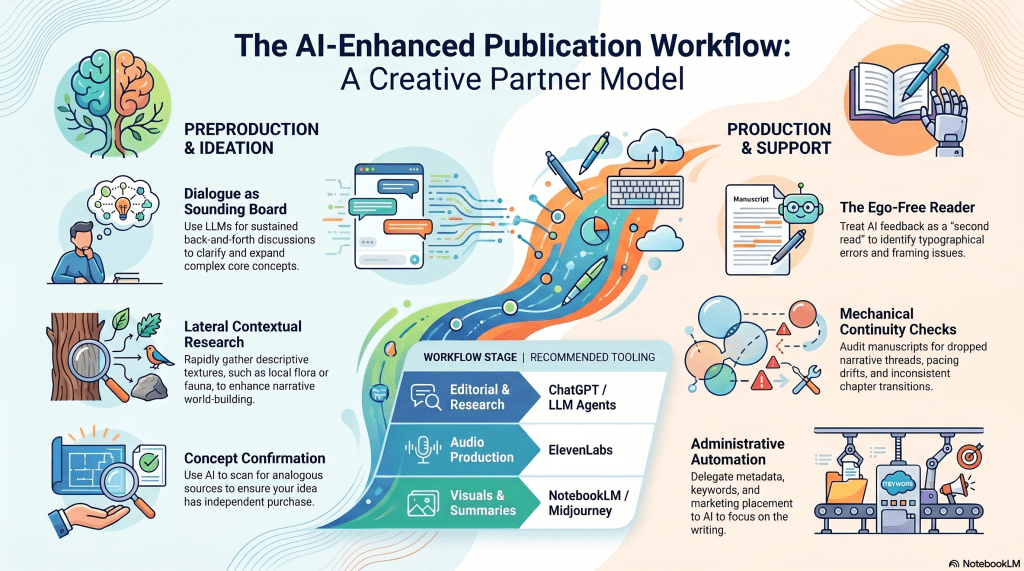
Audio: NotebookLM summary podcast of this topic.
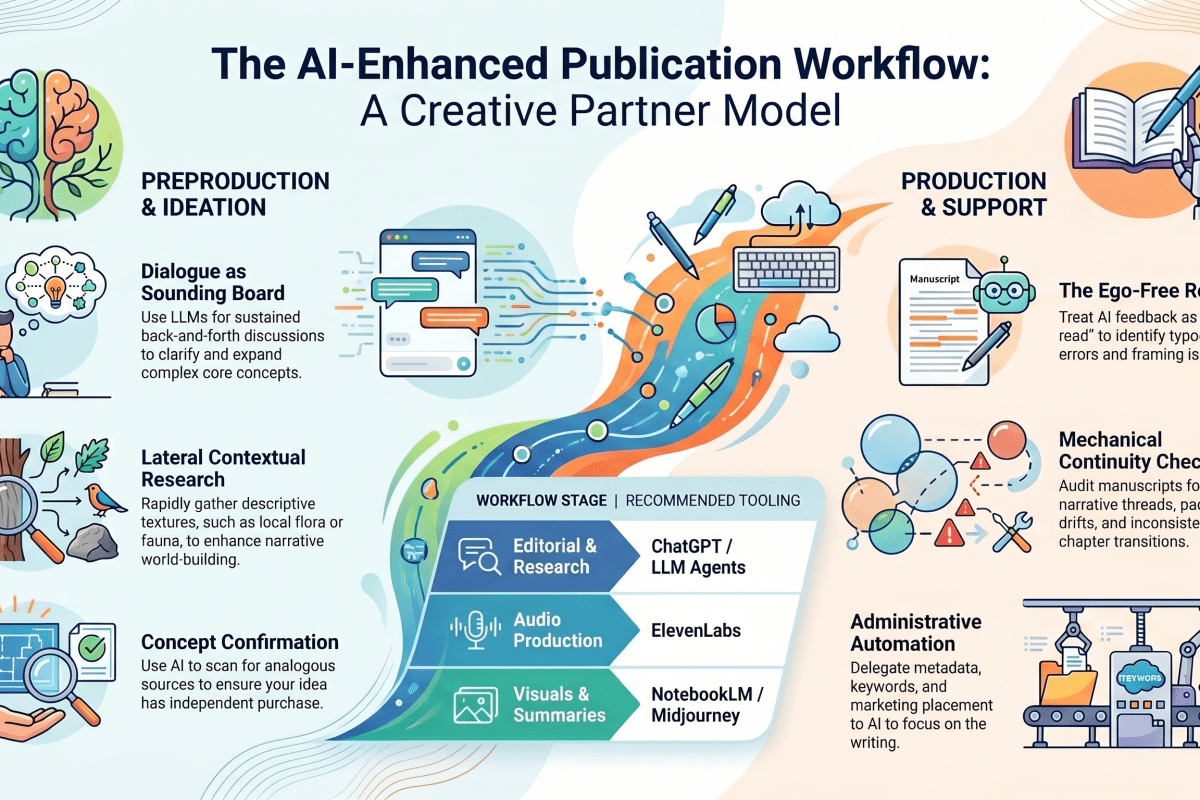
NotebookLM Infographic on this topic.

Preproduction

Not all projects make it into production. Others were never intended to. But they all begin with at least a kernel of an idea — and some arrive fully formed, as if sprung from the head of Zeus, already wearing armour and looking for a fight.

Pre-ideating

What the hell is pre-ideating? I just made it up for this use case because that’s how I roll.

As I understand it, some people need help thinking of topics. This is not my problem. My problem is managing ideas rather than generating them. I have a backlog that will outlast me, so I don’t use this step. But it exists, and it’s probably the most widely discussed AI use case in creative circles: you prompt the model to suggest themes, genres, or concepts. Give me five ideas for a mystery novel. Or, if you’re feeling ambitious: Give me five ideas for a research paper in quantum physics. The model obliges. Whether what comes back constitutes an idea in any philosophically interesting sense is a question I’ll save for another day.

Ideating

This is where I usually enter the process, and the ideation takes shape in one or several different ways. The most common is simply a discussion – a sustained back-and-forth. A recent example: I was reading Judith Butler’s Gender Trouble and found myself with clarifying questions at every turn. Not because Butler is unclear, but because the implications kept ramifying in directions I wanted to follow. That extended dialogue – with ChatGPT in this instance – eventually became the philosophical core of Two Kings, currently stalled in Production.

Butler’s argument about incest taboos as foundational to broader regimes of sex and gender regulation gave me a narrative frame. The conversation helped me see what I actually thought about it, which is the more important thing. The LLM didn’t give me the idea. It gave me a sounding board patient enough to entertain the idea at two in the morning – it was actually two in the afternoon, but who’s looking?

Research

Another obvious use case, and one I use regularly. Continuing the Butler example: I asked about several feminist theorists she references, wanting to understand the lineage I was stepping into. But here’s a cleaner illustration. Writing as Ridley Park, I produced a novella, Sustenance, set in Iowa. I’ve visited Iowa several times, but I needed local flora and fauna for descriptive texture in certain scenes, so I asked

In the old days, I’d have gone to Google, Wikipedia, or I’d track down an Encyclopædia Britannica. The process is faster now, and the results are generally better for this kind of lateral, contextual research. For anything where accuracy is genuinely load-bearing, I verify. That’s not a criticism of the tool; it’s just basic epistemic hygiene.

Confirmation

Sometimes I have an idea and want to know whether someone’s already done it because I have no interest in reinventing wheels, and even less in reinventing them badly.

So I ask: Has anyone written X? What are the most significant treatments of Y? What typically comes back is a list of a dozen or more analogous sources. I review them and decide: does my idea still have independent purchase, or am I just writing a worse version of something that already exists? Sometimes I sharpen the idea in response. Sometimes I incorporate what I find, either to build on it or to identify where the existing literature is misframed, assumes too much, or has quietly imported the wrong ontological grammar. This last move is something of a professional tic.

Production

Drafting

I don’t use LLMs for full drafts. This is an obvious use case for those who do, particularly if the goal is volume – especially for the person who has already prompted for which genre currently has high demand and low representation on Amazon, and is now logically committed to producing it. That’s a coherent workflow – just not mine.

Edits and Revision

This I use often, and it’s probably where I get the most consistent value. After writing a passage or section, I feed it to one or more models with context already established — thesis statement, abstract, outline, supporting documents. What comes back varies: typographical errors, odd phrasings, unintentional repetitions (and, occasionally, new ones the model has helpfully introduced), suggested rewrites, observations about framing. I don’t treat any of this as instruction. I treat it as a second read from a reader who has no ego investment in agreeing with me – and yet obviously does. The important distinction is input versus output. I’m not asking it to write. I’m asking it to respond to what I’ve written.

Continuity

Are there gaps? Dropped threads? Promises made in chapter two that chapter seven has forgotten entirely? This is a genuinely useful mechanical check – the kind of thing that’s easy to miss when you’ve been inside a manuscript long enough to stop reading what’s actually there.

Flow

Do the scenes and chapters move well? Does the transition from one section to another feel like a logical step or an unannounced lurch? Useful, with the caveat that models have aesthetic preferences that don’t always align with mine, and I treat their flow suggestions accordingly.

Pacing

Is the pacing appropriate — both for the genre and for the particular piece? These are separate questions. A thriller has genre conventions around pace; a particular thriller might have reasons to subvert them. The model can flag where the pacing drifts; the judgement call about whether that’s a problem remains mine.

Postproduction

Formatting and Layout

I use AI for ideas about how to present content on the page: chapter opens, font choices, sizes, running headers, folios. This is design at the level of convention and taste rather than technical execution. I find it useful as a first pass — it surfaces options I might not have considered, which I then either adopt, adapt, or discard.

Cover Ideas

Thematic cover concepts, whether or not I ultimately outsource the art and creative work. I find this a productive way to articulate what the book is doing before I have to explain it to someone else.

How To

I use InDesign, Illustrator, and Photoshop with competence but not expertise. For specific technical tasks – how do I do this thing in InDesign — I ask. I also still use Google, YouTube, and the occasional book. These are not competing resources; they’re complementary ones, and which I reach for depends on what kind of answer I need.

Support and Maintenance

Marketing and Placement

Target markets, genre positioning, how to frame the work for audiences who didn’t watch it being assembled. This is a legitimate use case and one I engage with, even if marketing remains a word I say with a slight internal wince.

I also use platforms like ElevenLabs for audio, NotebookLM for podcast summaries and infographics, and Nano Banana or Midjourney for images.

Keywords and Descriptions

Adjacent to marketing but more administrative in character, the metadata layer that determines whether the work is findable by the people who would want it. Less interesting to think about than almost anything else in the process, and therefore an excellent candidate for AI assistance.

None of the above replaces the work. That’s the point. The writing is still the writing.
Confession: I Use AI

2–3 minutes

In fact, I’ve been involved with ‘artificial intelligence’ since about 1990, when I developed Wave 3 AI – expert systems. Wave 4 is the current incarnation. Still no ‘intelligence’ to speak of, but marketers and hypsters love the term. Perhaps in Wave 5, the name will finally be correct.

Aside from my historical connexion, I want to share how I am using AI in my writing – in this case, ChatGPT 5.1. I’m not going to give much backstory on the setup, but I’ll point out some internal process logic.

Audio: NotebookLM podcast on this topic.

I have completed the manuscript for a Language Insufficiency Hypothesis, so I have been sharing screenshots of each page – usually a spread – and using the GPT as a second set of eyes. I’ll feed it an image and a request, in this case, to find key terms so I can capitalise and italicise them appropriately. In this example, this is the ending paragraph of Chapter 6.

Image 1: Sample chapter copy. In good order.

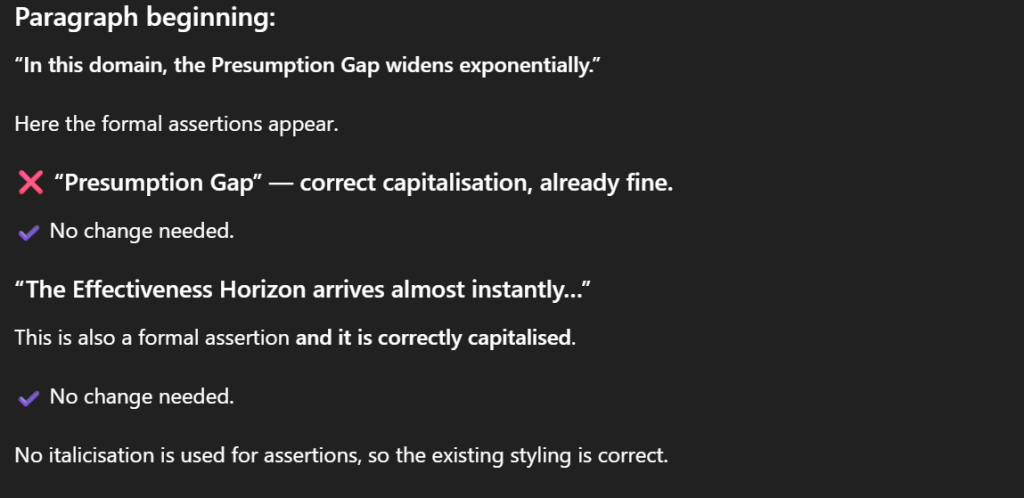
This first screenshot is an example of output. As is evident, it was looking, among other things, for the capitalisation of the concepts of Presumption Gap and Effectiveness Horizon.

Image 2: Sample GPT output – bad iconography

Notice the iconographic language is a bit off. The red X is a bit out of sync with the rest of the message, which says the entry is already correct. So, two instances; no problems. Next.

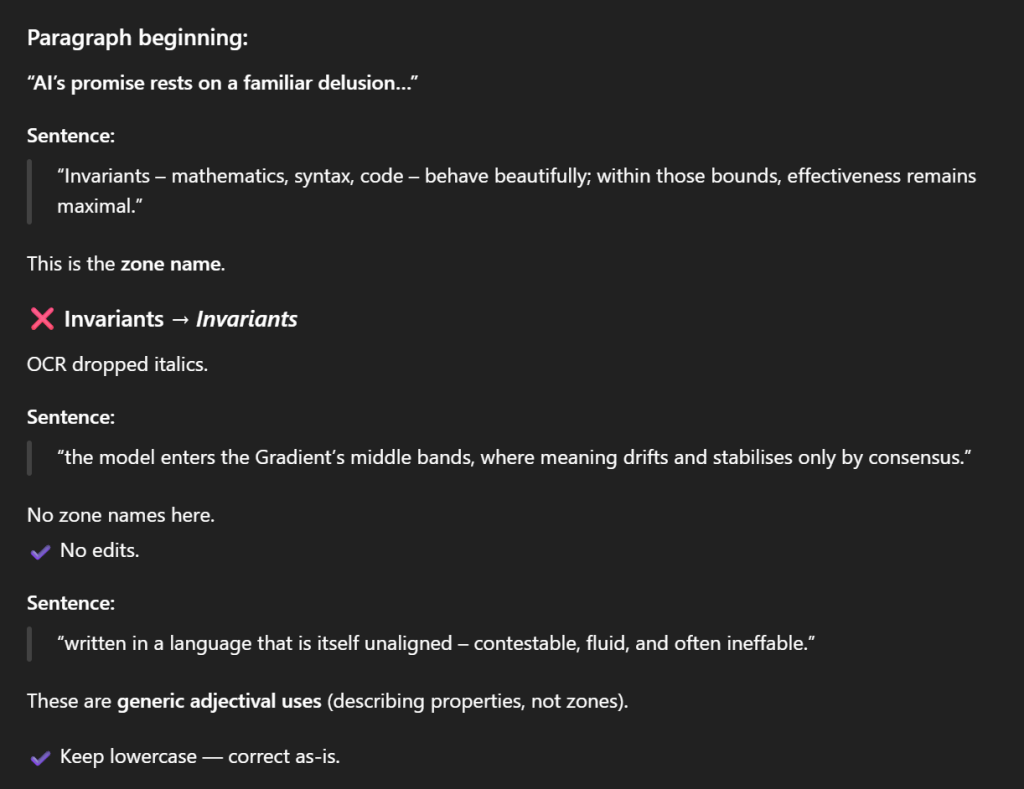
In this message, I warned that it was OCRing the screenshots but not retaining the formatting, and which is a reason I was sharing images over text.

Image 3: Sample GPT output – OCR confusion

What’s interesting is that it informed me that it would now treat the image as canonical. In Image 3 (above), it’s engaging in introspection – or at least self-dialogue. This is evidence that it (1) reviewed the results of the OCR, reviewed the image (as an image), and (3) compared 1 and 2 to arrive at the conclusion that the OCR had indeed dropped the formatting.

It wasn’t enough to inform me that everything was ok or, better still, not to bother me with noise since it was already in good order. Instead, it’s like an autist talking to itself. It reminds me of Raymond in Rain Man.

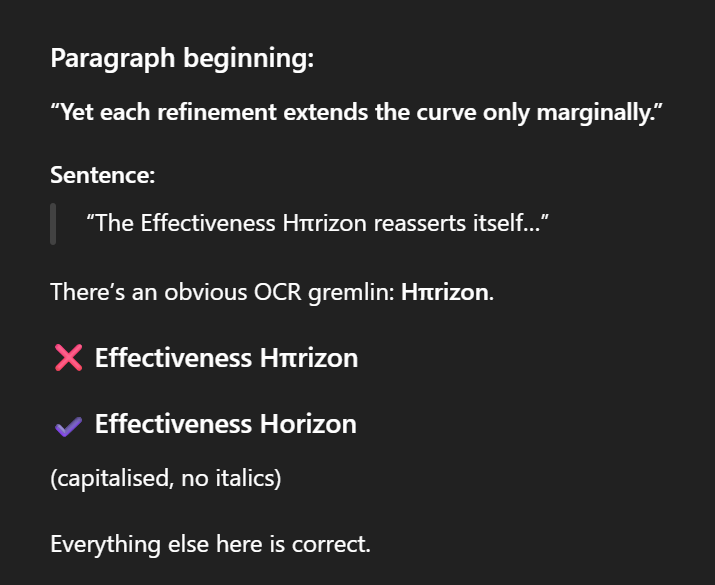
Image 34 (next) is the last example. Here, the OCR confounds rendering Horizon as Hπrizon, and then points out that I should avoid the same mistake of viewing o as π.

Image 4: Sample GPT output – OCR corruption

Thanks for the advice. I was losing sleep worrying about this possibility.

Conclusion

This is obviously a late-stage use case. I use GPT for ideation and research. Perhaps I’ll share an example of this later. I might be able to review my earlier notes for this project, but it was started years before the latest Wave arrived.

Apparently, I’ve got more to say on this matter…

3–5 minutes

It seems my latest rant about AI-authorship accusations stirred something in me, that I need to apologise for being a professional writer – or is that a writing professional? Blame the Enlightenment, blame writing and communication courses, whatevs. I certainly do. But since some people are still waving the pitchforks, insisting that anything too coherent must be artificially tainted, I should address the obvious point everyone keeps missing:

The writing structures people attribute to AI aren’t AI inventions. They’re human inventions. Old ones. Codified ones. And we made the machines copy them. Sure, they have a certain cadence. It’s the cadence you’d have if you also followed the patterns you should have been taught in school or opened a book or two on the topic. I may have read one or two over the years.

Wait for it… The orthodoxy is ours. I hate to be the one to break it to you.

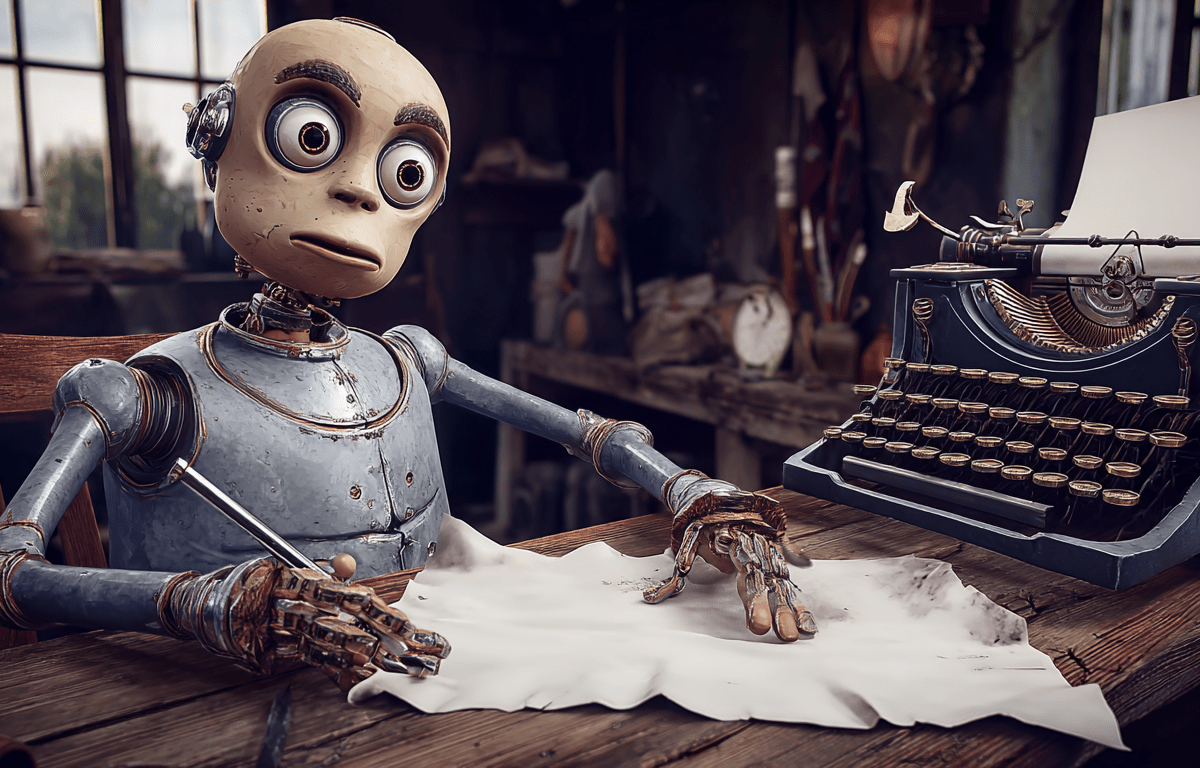
Video: AI Robot Assistant (no audio)

Professional Writing Has Its Own House Rules (And They’re Older Than AI Neural Nets)

Audio: NotebookLM podcast on this topic and the last one.

Long before AI arrived to ruin civilisation and steal everyone’s quiz-night jobs, we’d already built an entire culture around ‘proper writing’. The sort of writing that would make a communications lecturer beam with pride. The Sith may come in twos; good writing comes in threes.

  1. Tell them what you’re going to say.
  2. Say it.
  3. Repeat what you told them.

But wait, there’s more:

  • Use linear flow, not intellectual jazz.
  • One idea per paragraph, please.
  • Support it with sources.
  • Conclude like a responsible adult.

These aren’t merely classroom antics. They’re the architectural grammar of academic, corporate, scientific, and policy writing. No poetic flourishes. No existential detours. No whimsical cadence. The aim is clarity, predictability, and minimal risk of misinterpretation. It’s the textual equivalent of wearing sensible shoes to a board meeting. So when someone reads a structured piece of prose and yelps, ‘It sounds like AI!’, what they’re really saying is:

Je m’accuse. AI Didn’t Invent Structure. We Forced It To Learn Ours. Full stop. The problem is that it did whilst most of us didn’t.

If AI tends toward this style – linear, tidy, methodical, lamentably sane – that’s because we fed it millions of examples of ‘proper writing’. It behaves professionally because we trained it on professional behaviour – surprisingly tautological. Quelle surprise, eh?

Just as you don’t blame a mimeograph for producing a perfectly dull office memo, you don’t blame AI for sounding like every competent academic who’s been beaten with the stick of ‘clarity and cohesion’. It’s imitation through ingestion. It’s mimicry through mass exposure.

And Now for the Twist: My Fiction Has None of These Constraints

My fiction roams freely. It spirals, loops, dissolves, contradicts, broods, and wanders through margins where structured writing fears to tread. It chases affect, not clarity. Rhythm, not rubrics. Experience, not exegesis.

No one wants to read an essay that sounds like Dr Seuss, but equally, no one wants a novel that reads like the bylaws of a pension committee.

Different aims, different freedoms: Academic and professional writing must behave itself. Fiction absolutely should not.

This isn’t a value judgement. One isn’t ‘truer’ or ‘better’ than the other – only different tools for different jobs. One informs; the other evokes. One communicates; the other murmurs and unsettles.

Not to come off like Dr Phil (or Dr Suess), but the accusation itself reveals the real anxiety. When someone accuses a writer of sounding ‘AI-like,’ what they usually mean is:

‘Your writing follows the conventions we taught you to follow – but now those conventions feel suspect because a machine can mimic them’.

And that’s not a critique of the writing. It’s a critique of the culture around writing – a panic that the mechanical parts of our craft are now automated and thus somehow ‘impure’.

But structure is not impurity. Professional clarity is not soullessness. Repetition, sequencing, scaffolding – these aren’t telltale signs of AI; they’re the residue of centuries of human pedagogy.

AI mirrors the system. It didn’t create the system. And if the system’s beginning to look uncanny in the mirror, that’s a problem of the system, not the reflection.

In Short: The Craft Is Still the Craft, Whether Human or Machine

Professional writing has rules because it needs them. Fiction abandons them because it can. AI imitates whichever domain you place in front of it.

The accusation that structured writing ‘sounds artificial’ is merely a confusion between form and origin. The form is ours. The origin is irrelevant.

If clarity is now considered suspicious, I fear for the state of discourse. But then again, I’ve feared for that for some time.

And apparently, I’ve still got more to say on the matter.

Accusations of Writing Whilst Artificial

2–3 minutes

Accusations of writing being AI are becoming more common – an irony so rich it could fund Silicon Valley for another decade. We’ve built machines to detect machines imitating us, and then we congratulate ourselves when they accuse us of being them. It’s biblical in its stupidity.

A year ago, I read an earnest little piece on ‘how to spot AI writing’. The tells? Proper grammar. Logical flow. Parallel structure. Essentially, competence. Imagine that – clarity and coherence as evidence of inhumanity. We’ve spent centuries telling students to write clearly, and now, having finally produced something that does, we call it suspicious.

Audio: NotebookLM podcast on this topic and the next one.

My own prose was recently tried and convicted by Reddit’s self-appointed literati. The charge? Too well-written, apparently. Reddit – where typos go to breed. I pop back there occasionally, against my better judgment, to find the same tribunal of keyboard Calvinists patrolling the comment fields, shouting ‘AI!’ at anything that doesn’t sound like it was composed mid-seizure. The irony, of course, is that most of them wouldn’t recognise good writing unless it came with upvotes attached.

Image: A newspaper entry that may have been generated by an AI with the surname Kahn. 🧐🤣

Now, I’ll admit: my sentences do have a certain mechanical precision. Too many em dashes, too much syntactic symmetry. But that’s not ‘AI’. That’s simply craft. Machines learned from us. They imitate our best habits because we can’t be bothered to keep them ourselves. And yet, here we are, chasing ghosts of our own creation, declaring our children inhuman.

Apparently, there are more diagnostic signs. Incorporating an Alt-26 arrow to represent progress is a telltale infraction → like this. No human, they say, would choose to illustrate A → B that way. Instead, one is faulted for remembering – or at least understanding – that Alt-key combinations exist to reveal a fuller array of options: …, ™, and so on. I’ve used these symbols long before AI Wave 4 hit shore.

Interestingly, I prefer spaced en dashes over em dashes in most cases. The em dash is an Americanism I don’t prefer to adopt, but it does reveal the American bias in the training data. I can consciously adopt a European spin; AI, lacking intent, finds this harder to remember.

I used to use em dashes freely, but now I almost avoid them—if only to sidestep the mass hysteria. Perhaps I’ll start using AI to randomly misspell words and wreck my own grammar. Or maybe I’ll ask it to output everything in AAVE, or some unholy creole of Contemporary English and Chaucer, and call it a stylistic choice. (For the record, the em dashes in this paragraph were injected by the wee-AI gods and left as a badge of shame.)

Meanwhile, I spend half my time wrestling with smaller, dumber AIs – the grammar-checkers and predictive text gremlins who think they know tone but have never felt one. They twitch at ellipses, squirm at irony, and whimper at rhetorical emphasis. They are the hall monitors of prose, the petty bureaucrats of language.

And the final absurdity? These same half-witted algorithms are the ones deputised to decide whether my writing is too good to be human.

From Thesaurus to Thoughtcrime: The Slippery Slope of Authorial Purity

I had planned to write about Beauvoir’s Second Sex, but this has been on my mind lately.

There’s a certain breed of aspiring author, let’s call them the Sacred Scribes, who bristle at the notion of using AI to help with their writing. Not because it’s unhelpful. Not because it produces rubbish. But because it’s impure.

Like some Victorian schoolmarm clutching her pearls at the sight of a split infinitive, they cry: “If you let the machine help you fix a clumsy sentence, what’s next? The whole novel? Your diary? Your soul?”

The panic is always the same: one small compromise and you’re tumbling down the greased chute of creative ruin. It starts with a synonym suggestion and ends with a ghostwritten autobiography titled My Journey to Authenticity, dictated by chatbot, of course.

But let’s pause and look at the logic here. Or rather, the lack thereof.

By this standard, you must also renounce the thesaurus. Shun the spellchecker. Burn your dictionary. Forbid yourself from reading any book you might accidentally learn from. Heaven forbid you read a well-constructed sentence and think, “I could try that.” That’s theft, isn’t it?

And while we’re at it, no editors. No beta readers. No workshopping. No taking notes. Certainly no research. If your brain didn’t birth it in a vacuum, it’s suspect. It’s borrowed. It’s… contaminated.

Let’s call this what it is: purity fetishism in prose form.

But here’s the twist: it’s not new. Plato, bless him, was already clutching his tunic about this twenty-four centuries ago. In Phaedrus, he warned that writing itself would be the death of memory, of real understanding. Words on the page were a crutch. Lazy. A hollow imitation of wisdom. True knowledge lived in the mind, passed orally, and refined through dialogue. Writing, he said, would make us forgetful, outsource our thinking.

Sound familiar?

Fast forward a few millennia, and we’re hearing the same song, remixed for the AI age:
“If you let ChatGPT restructure your second paragraph, you’re no longer the author.”
Nonsense. You were never the sole author. Not even close.

Everything you write is a palimpsest, your favourite genres echoing beneath the surface, your heroes whispering in your turns of phrase. You’re just remixing the residue. And there’s no shame in that. Unless, of course, you believe that distilling your top five comfort reads into a Frankenstein narrative somehow makes you an oracle of literary genius.

Here’s the rub: You’ve always been collaborating.

With your past. With your influences. With your tools. With language itself, which you did not invent and barely control. Whether the suggestion comes from a friend, an editor, a margin note, or an algorithm, what matters is the choice you make with it. That’s authorship. Let’s not play the slippery slope game.

The slippery slope argument collapses under its own weight. No one accuses you of cheating when you use a pencil sharpener. Or caffeine. Or take a walk to clear your head. But involve a silicon co-author, and suddenly you’re the Antichrist of Art?

Let’s not confuse integrity with insecurity. Let’s not confuse control with fear.

Use the tool. Ignore the purists. They’ve been wrong since Plato, and they’ll still be wrong when your great-grandchildren are dictating novels to a neural implant while bathing in synthetic dopamine.

The future of writing is always collaborative. The only question is whether you’ll join the conversation or sit in the corner, scribbling manifestos by candlelight, declaring war on electricity.