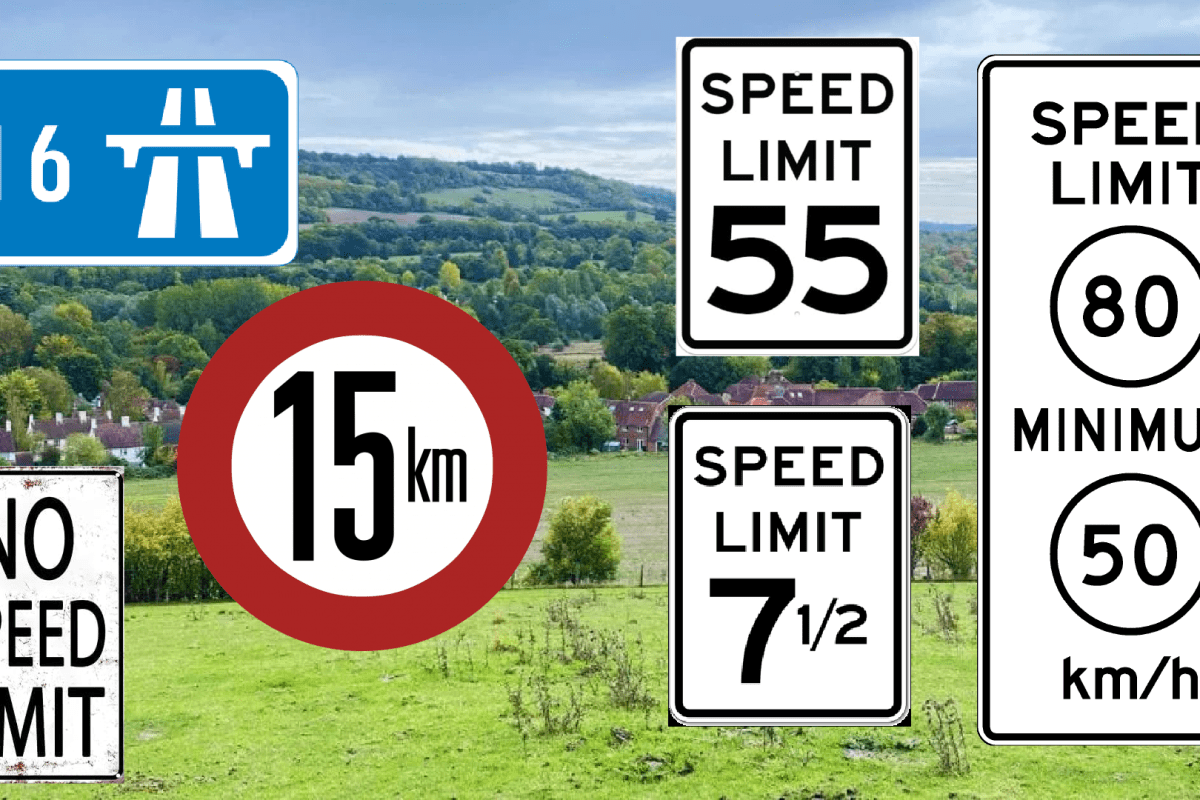
We tend to think of speed limits as facts. Numbers. Neutral. Posted. Enforced. And yet almost no one treats them that way.
Roads are engineered to handle speeds well above the numeral on the sign. Police officers routinely tolerate a band of deviation. We know they’ll allow around ten miles per hour over the stated limit. They know we know. We know that they know that we know. Ad infinitum.
Audio: NotebookLM summary podcast of this topic.
Courts accept that instruments have margins of error. Drivers adjust instinctively for weather, traffic density, visibility, vehicle condition, and local customs. A straight, empty motorway at 3 a.m. is not experienced the same way as a narrow residential street at school pickup time, even if the number on the sign is identical. Everyone knows this. And yet we continue to talk about the speed limit as if it were an unmediated fact about the world.
This is not a complaint about traffic law. Speed limits work remarkably well, precisely because they are not what they appear to be. They are not discoveries about nature, but stabilised conventions: administrative thresholds designed to coordinate behaviour under uncertainty. The familiar numbers – 30, 50, 70 – are not found in the asphalt. Never 57 or 63. They are chosen, rounded, and maintained because they are legible, enforceable, and socially negotiable. What makes speed limits interesting is not their arbitrariness, but their success.
They hold not because they are exact, but because they survive approximation. They absorb error, tolerate deviation, and remain usable despite the fact that everyone involved understands their limits. In practice, enforcement relies less on the number itself than on judgments about reasonableness, risk, and context. The ‘fact’ persists because it is embedded in a network of practices, instruments, and shared expectations.
If you end up in court driving 60 in a 50, your ability to argue about instrument calibration won’t carry much weight. You’re already operating 20 per cent over specification. That’s beyond wiggle room – highly technical nomenclature, to be sure.
Blood alcohol limits work the same way. The legal threshold looks like a natural boundary. It isn’t. It’s a policy decision layered atop probabilistic measurement. Unemployment rates, diagnostic cutoffs, evidentiary standards – all of them look objective and immediate whilst concealing layers of judgment, calibration, and compromise. Each functions as a closure device: ending debate not because uncertainty has been eliminated, but because further uncertainty would make coordination impossible.
The trouble begins when we forget this – and we do. When facts are treated as simple givens rather than negotiated achievements, they become untouchable. Questioning them gets mistaken for denying reality. Acknowledging their construction gets misheard as relativism. What started as a practical tool hardens into something that feels absolute.
This is how we end up saying things like ‘just give me the facts’ whilst quietly relying on tolerance bands, interpretive discretion, and institutional judgment to make those facts usable at all.
If this sounds right – if facts work precisely because they’re mediated, not despite it – then the question becomes: what does truthfulness require once we’ve acknowledged this?
I’ve written a longer essay exploring that question, starting from Bernard Williams’ account of truthfulness as an ethical practice and extending it to facts themselves. The argument isn’t that facts are illusory or unreliable. It’s that recognising how they actually work – through stabilisation, constraint, and correction – clarifies rather than undermines objectivity.
My Language Insufficiency Hypothesis is finished, the cover is designed, and everything is in order for a January 2026 release – save for one administrative detail: the ISBN. I expect this to be resolved presently. The Bowker distribution system in the US appears to have been set up circa 1997, and that’s just the web interface. Who knows how long the database has been in place? I’d bet circa 1955. Most countries provide ISBNs for free. Not the US. Kinda bollox. Meantime, I’ve now got three lenses through which to inspect the world.
[EDIT: ISBN issue has been resolved. I am awaiting a proof copy that should be arriving today.]
From the outside, some of my recent work can look untidy. A hypothesis about language. An ontology about mediated encounters. A paper on why moral disagreement refuses to resolve itself politely. No master theory. No clean ladder. No promised synthesis at the end. This is not an accident. It is a refusal.
What links the Language Insufficiency Hypothesis (LIH), the Mediated Encounter Ontology of the World (MEOW), and Disagreement Without Referees is not a shared doctrine, but a shared function. They are lenses, not foundations. Diagnostics, not blueprints. Each takes aim at a different site where Enlightenment habits quietly overpromise – meaning, access, adjudication – and shows what breaks when we stop pretending those promises were ever cashable. They form a family. Not a system. And certainly not a programme for rebuilding.
Three Lenses, Three Failure Sites
Each of these frameworks operates at a different level, but they all do the same kind of work: they explain why something we rely on feels indispensable, fails repeatedly, and yet stubbornly survives.
LIH operates at the linguistic level.
It asks why language fails precisely where we expect it to secure clarity, precision, or consensus. Its answer is unromantic: language is not uniformly capable. As we move from invariants to contestables to fluids and ineffables, its representational power degrades. The failure mode is familiar: we mistake grammatical stability for ontological stability, and then act surprised when disagreement hardens rather than dissolves.
MEOW operates at the ontological level.
It asks what kind of ‘world’ we are actually dealing with once we abandon the fantasy of unmediated access. There is no clean mind–world interface, no privileged vantage point. Every encounter is mediated – biologically, cognitively, linguistically, socially. Realism and idealism alike fail here, each clinging to a different myth of access. What remains is not scepticism, but constraint.
Disagreement Without Referees operates at the normative and political level.
It asks why moral and political disagreement persists even when all parties appear informed, sincere, and articulate. The answer is ontological incommensurability. Where frameworks do not overlap, there are no neutral referees. Argument does not converge because it cannot. What remains is persuasion, coalition, power, and consequence—moral life without an umpire.
None of these lenses replaces what it critiques. Each refuses the repair instinct that says: if we just fix the model, the system will work again. That instinct is the pathology.
What They Share (And What They Don’t)
What unites these lenses is not a set of positive claims about how the world really is. It is a shared posture:
no privileged access
no neutral ground
no final adjudication
no redemptive synthesis
But also:
no quietism
no nihilism
no ‘anything goes’
no abdication of responsibility
They do not tell you what to believe. They tell you why believing harder won’t save you.
Importantly, they are non-hierarchical. LIH does not ground MEOW. MEOW does not explain away disagreement. Disagreement does not ‘apply’ LIH in some linear fashion. They intersect. They overlap. They illuminate different failure modes of the same inherited fantasy: that there must be a place where things finally settle. There isn’t.
Image: Three Diagnostic Lenses Infographic¹
Why This Is Not a System
Systems promise closure. These lenses do not. They explain why closure is repeatedly promised, urgently demanded, and reliably missed. To systematise them would be to betray them.
What they offer instead is a kind of intellectual hygiene: a way of recognising when we are asking language, reality, or morality to do work they were never capable of doing – and then blaming one another when they don’t comply.
If there is a unifying thread, it is this:the demand for foundations is itself the problem.² These lenses do not solve that problem. They show you where it operates, how it reproduces itself, and why refusing it feels so uncomfortable. That discomfort is the point.
Footnotes
This is another NotebookLM infographic – my second. It’s not half-bad. I had to adjust some elements in Photoshop and Illustrator, and there are still textual anomalies, but all in all, I’m impressed with what 60 seconds of generation yielded – along with a 5-minute prompt and 15 minutes of touchup. It’s just a novelty for now – certainly not necessary. What do you think?
I commenced a series where I discuss the responses to the 2020 PhilPapers survey of almost 1,800 professional philosophers. This continues that conversation with questions 2 through 4 – in reverse order, not that it matters. Each is under 5 minutes; some are under 3.
For the main choices, you are given 4 options regarding the proposal:
Accept
Lean towards
Reject
Lean against
Besides the available choices, accepted answers for any of the questions were items, such as:
Combinations (specify which.) For the combos, you might Accept A and Reject B, so you can capture that here.
Alternate view (not entirely useful unless the view has already been catalogued)
The question is too unclear to answer
There is no fact of the matter (the question is fundamentally bollocks)
Agnostic/undecided
Other
Q4: The first one asks, ‘What is the aim of philosophy?’ Among the responses were:
Truth/Knowledge
Understanding
Wisdom
Happiness
Goodness/Justice
Before you watch the video, how might you respond?
Video: What is the aim of philosophy?
Q3: What’s your position on aesthetic value?
Objective
Subjective
Video: What is aesthetic value?
Q2: What’s your position on abstract objects?
Platonism (these objects exist “out there” in or beyond the world)
Nominalism (the objects are human constructs)
Video: Where do abstract objects reside?
Q1: What’s your position on à priori knowledge?
This video response was an earlier post, so find it there. This is asking if you believe one can have any knowledge apart from experience.
Yes
No
NB: I’ve recorded ten of these segments already, but they require editing. So I’ll release them as I wrap them up. Not that I’ve completed them, I realise I should have explained what the concepts mean more generally instead of talking around the topics in my preferred response. There are so many philosophy content sites, I feel this general information is already available, or by search, or even via an LLM.
What do you think – should I?
In the other hand, many of these sites – and I visit and enjoy them – support very conservative, orthodox views that, as I say, don’t seem to have progressed much beyond 1840 – Kant and a dash of Hegel, but all founded on Aristotelian ideas, some 2,500 years ago.
Spoiler alert, I think knowledge has advanced and disproved a lot of this. It turns out my brothers in arms don’t necessarily agree. Always the rebel, I suppose.
I risk sharing this prematurely. Pushing the Transductive Subjectivity model toward more precision may lose some readers, but the original version still works as an introductory conversation.
Please note: There will be no NotebookLM summary of this page. I don’t even want to test how it might look out the other end.
Apologies in advance for donning my statistician cap, but for those familiar, I feel it will clarify the exposition. For the others, the simple model is good enough. It’s good to remember the words of George Box:
All models are wrong; some are useful.
The Simple Model
I’ve been thinking that my initial explanatory model works well enough for conversation. It lets people grasp the idea that a ‘self’ isn’t an enduring nugget but a finite sequence of indexed states:
The transitions are driven by relative forces, , which act as catalysts nudging the system from one episode to the next.
The Markov Model
That basic picture is serviceable, but it’s already very close to a dynamical system. More accurate, yes—though a bit more forbidding to the casual reader – and not everybody loves Markov chains:
Here:
is the episodic self at index i
is the configuration of relevant forces acting at that moment
is the update rule: given this self under these pressures, what comes next?
This already helps. It recognises that the self changes because of pressure from language, institutions, physiology, social context, and so on. But as I noted when chatting with Jason, something important is still missing:
isn’t the only thing in motion, and isn’t the same thing at every step.
And crucially, the update rule isn’t fixed either.
A person who has lived through trauma, education, and a cultural shift doesn’t just become a different state; they become different in how they update their states. Their very ‘logic of change’ evolves.
To capture that, I need one more refinement.
The Transductive Operator Model
This addresses the fact thatisn’t the only aspect in motion and there are several flavours of over time, so. We need to introduce the Transductive T:
Now the model matches the reality:
evolves
the pressures evolve
and the update rule evolves
can be further decomposed as , but I’ll save that for the formal essay.
The self is not simply ‘what comes next’, but a rule that keeps rewriting itself as it encounters the world.
That is why this is transductive rather than inductive or deductive: structure at one moment propagates new structure at the next.
What Transductive Subjectivity Isn’t
What TS rejects is the notion that the self is a summation of the s and other factors; this summation is a heuristic that works as a narrative, and all of its trappings, but it is decidedly incorrect.
Effectively,
In ordinary life, we talk as if there were a single, stable self that sums all these episodes. Transductive Subjectivity treats that as a convenient narrative, not an underlying fact. For example, someone raised in a rigid environment may initially update by avoiding conflict; after therapy and a cultural shift, they may update by seeking it out when something matters. This fiction is where we project agency and desert, and where we justify retribution.
In the last post, I argued that the so-called ‘hard problem of consciousness‘ was never a problem with consciousness. It was a problem with language – specifically, the English language’s unfortunate habit of carving the world into neat little substances and then demanding to know why its own divisions won’t glue back together.
Audio: NotebookLM summary podcast of this topic, on resolving the hard problem of consciousness.
The response was predictable.
‘But what about subjective feel?’
‘What about emergence?’
‘What about ontology?’
‘What about Chalmers?’
‘What about that ineffable thing you can’t quite point at?’
All fair questions. All built atop the very framing that manufactures the illusion of a metaphysical gap.
So here’s the promised demonstration: not yet a full essay (though it may evolve into one), but a clear application of MEOW – the Mediated Encounter Ontology of the World – to the hard problem itself. Consider this a field test of the framework. A tidy autopsy, not the funeral oration.
The Set-Up: Chalmers’ Famous Trick
Chalmers asks:
How do physical processes give rise to experience?
The question feels profound only because the terms ‘physical’ and ‘experience’ smuggle in the very metaphysics they pretend to interrogate. They look like opposites because the grammar makes them opposites. English loves a comforting binary.
But MEOW doesn’t bother with the front door. It doesn’t assume two substances – ‘mind’ over here, ‘world’ over there – and then panic when they refuse to shake hands. It treats experience as the way an encounter manifests under a layered architecture of mediation. There’s no bridge. Only layers.
T₀ – Biological Mediation
The body is not a barrier. It is the encounter’s first architecture.
At T₀, the world is already transformed: transduction, gating, synchrony, inhibition, adaptation. Organisms don’t receive ‘raw’ physical inputs. They metabolise them. The form of contact is biological before it is anything else.
The hard problem begins by assuming there’s a realm of dumb physical mechanisms that somehow need to ‘produce’ experience. But organisms do not encounter dumb mechanism. They encounter structured contact –biological mediation – from the first millisecond.
If you insist on thinking in substances, T₀ looks like a problem. If you think in mediations, it looks like the beginning of sense-making.
T₁ – Cognitive Mediation
Where the Enlightenment saw a window, cognition installs a newsroom.
Prediction, priors, memory, inference, attention – all shaping what appears and what never makes it into view. Experience at T₁ is not something ‘added’. It is the organisational structure of the encounter itself.
The hard problem treats ‘experience’ as a mysterious extra–something floating atop neural activity like metaphysical cream. But at T₁, what appears as experience is simply the organisation of biological contact through cognitive patterns.
There is no ‘what emerges from the physical’. There is the way the encounter is organised.
And all of this unfolds under resistance – the world’s persistent refusal to line up neatly with expectation. Prediction errors, perceptual limits, feedback misfires: this constraint structure prevents the entire thing from collapsing into relativist soup.
T₂ – Linguistic–Conceptual Mediation
Here is where the hard problem is manufactured.
This is the layer that takes an ordinary phenomenon and turns it into a metaphysical puzzle. Words like ‘experience’, ‘physical’, ‘mental’, ‘subjective’, and ‘objective’ pretend to be carved in stone. They aren’t. They slide, drift, and mutate depending on context, grammar, and conceptual lineage.
The hard problem is almost entirely a T₂ artefact – a puzzle produced by a grammar that forces us to treat ‘experience’ and ‘physical process’ as two different substances rather than two different summaries of different mediational layers.
If you inherit a conceptual architecture that splits the world into mind and matter, of course you will look for a bridge. Language hands you the illusion and then refuses to refund the cost of admission.
T₃ – Cultural–Normative Mediation
The Western problem is not the world’s problem.
The very idea that consciousness is metaphysically puzzling is the product of a specific cultural lineage: Enlightenment substance dualism (even in its ‘materialist’ drag), Cartesian leftovers, empiricist habits, and Victorian metaphysics disguised as objectivity.
Other cultures don’t carve the world this way. Other ontologies don’t need to stitch mind back into world. Other languages simply don’t produce this problem.
The hard problem is not a universal insight. It’s a provincial glitch.
Reassembling the Encounter
Once you run consciousness through the mediational layers, the hard problem dissolves:
Consciousness is not an emergent property of neural complexity.
Consciousness is not a fundamental property of the universe.
Consciousness is the reflexive mode of certain mediated encounters, the form the encounter takes when cognition, language, and culture become part of what is appearing.
There is no gap to explain because the ‘gap’ is the product of a linguistic–conceptual framework that splits where the world does not.
As for the ever-mystical ‘what-it’s-like’: that isn’t a metaphysical jewel buried in the brain; it is the way a T₀–T₃ architecture manifests when its own structure becomes reflexively available.
A Brief Disclaimer Before the Internet Screams
Pointing out that Chalmers (and most of modern philosophy) operates within a faulty ontology is not to claim MEOW is flawless or final. It isn’t. But if Occam’s razor means anything, MEOW simply removes one unnecessary supposition — the idea that ‘mind’ and ‘world’ are independent substances in need of reconciliation. No triumphalism. Just subtraction.
Where This Leaves Chalmers
Chalmers is not wrong. He’s just asking the wrong question. The hard problem is not a metaphysical insight. It’s the moment our language tripped over its shoelaces and insisted the pavement was mysterious.
MEOW doesn’t solve the hard problem. It shows why the hard problem only exists inside a linguistic architecture that can’t model its own limitations.
This piece could easily grow into a full essay – perhaps it will. But for now, it does the job it needs to: a practical demonstration of MEOW in action.
And, arguably more important, it buys me one more day of indexing.
With the MEOW thesis now roaming freely across the intellectual savannah, knocking over conceptual furniture and frightening the rationalists, it’s time to walk through a simple example. We’ll stay safely within the realm of conscious perception for now. That way, no one panics, and everyone can pretend they’re on familiar ground.
Our case study: colour.
Or rather, the quite embarrassing misunderstanding of colour that Western philosophy has been peddling for roughly three centuries.
Audio: NotebookLM podcast summary of this topic, Colour, Perception, and Mediated Ontology.
The Realist’s Apple: A Comedy of Certainty
Picture an apple on a table: plump, unashamedly spherical, wearing its redness like a badge of honour. The traditional Realist swears it’s red in itself, quite independent of anyone wandering in to admire it. The apple has redness the way it has mass, curvature, and that little bruise from the careless shop assistant. When you enter the room, you ‘see’ the red it’s been proudly radiating all along.
Image 0: Subject viewing red apple.
By school age, most of us are told that apples don’t ‘have’ colour; they merely reflect certain wavelengths. A minor complication. A mechanical detail. Nothing to disturb the fundamental metaphysical fantasy: that redness is still ‘out there’, waiting patiently for your eyes to come collect it.
It’s all very straightforward. Very tidy. And very wrong.
Idealists to the Rescue (Unfortunately)
Ask an Idealist about the apple and the entertainment begins.
The Berkeley devotee insists the apple exists only so long as it’s perceived – esse est percipi – which raises awkward questions about what happens when you step out for a cuppa. God, apparently, keeps the universe running as a kind of 24-hour perceptual babysitter. You may find this profound or you may find it disturbingly clingy.
The Kantian, inevitably wearing a waistcoat, insists the apple-in-itself is forever inaccessible behind the Phenomenal Veil of Mystery. What you experience is the apple-for-you, sculpted by space, time, causality, and a toolkit of categories you never asked for. This explains a lot about post-Kantian philosophy, not least the fixation on walls no one can climb.
Contemporary idealists get creative: proto-experience in everything, cosmic consciousness as universal substrate, matter as a sleepy epiphenomenon of Mind. It’s quite dazzling if you ignore the categories they’re smashing together.
What unites these camps is the conviction that mind is doing the heavy lifting and the world is an afterthought – inconvenient, unruly, and best kept in the margins.
The Shared Mistake: An Architectural Catastrophe
Both Realist and Idealist inherit the same faulty blueprint: mind here, world there – two self-contained realms entering into an epistemic handshake.
Realists cling to unmediated access (a fantasy incompatible with biology). Idealists cling to sovereign mentality (a fantasy incompatible with objectivity).
Both take ‘experience’ to be a relation between two pre-existing domains rather than a single structured encounter.
This is the mistake. Not Realism’s claims about mind-independence. Not Idealism’s claims about mental primacy. The mistake is the architecture – the assumption of two separately-existing somethings that subsequently relate.
MEOW – yes, we’re calling it that – puts it bluntly:
The problem isn’t where colour is. The problem is assuming it has to be in something – mind or world – rather than in the event.
Redness isn’t inside your head or inside the apple. It’s co-constituted by biological, cognitive, linguistic, and cultural mediation interacting with persistent constraint patterns.
Time to peel this onion… er, apple.
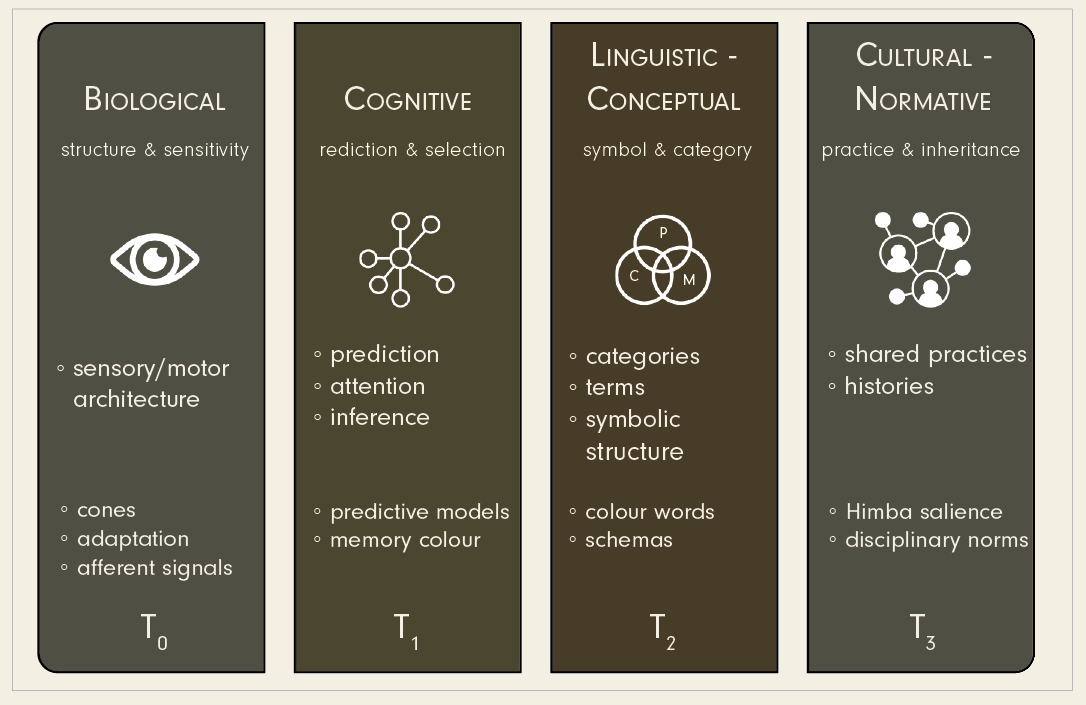
The Four Layers of Mediation (T₀–T₃)
A Ridiculously Oversimplified Cheat-Sheet That Still Outperforms Most Metaphysics Syllabi
Structure and Sensitivity: the Architecture You Never Asked For
This is where the Enlightenment’s fantasy of ‘raw perception’ goes to die.
Your visual system transforms, filters, enhances, suppresses, and reconstructs before ‘red’ even reaches consciousness. Cone responses, opponent processes, retinal adaptation, spatial filtering – all of it happening before the poor cortex even gets a look-in.
You never perceive ‘wavelengths’. You perceive the output of a heavily processed biological pipeline.
The biology isn’t the barrier.The biology is the view.
Image 2: Chromatic processing pathway (T₀→T₁): the layered biological transformations that make “red” possible long before consciousness gets involved.
T₁ – Cognitive Mediation
Prediction and Inference: You See What You Expect (Until Constraint Smacks You)
Your cognitive system doesn’t ‘receive’ colour information – it predicts it and updates the guess when necessary.
Memory colour biases perception toward canonical instances. Attentional gating determines what gets processed intensively and what gets summary treatment. Top-down modulation shapes what counts as signal versus noise.
There is no percept without mediation. There is no ‘raw data’ waiting underneath.
The Enlightenment liked to imagine perception as a passive window. Cognition turns that window into a heavily editorialised newsfeed.
Image 3: Expectation and input co-determine the percept: “red” emerges from the encounter, not from either source alone.
T₂ – Linguistic–Conceptual Mediation
Categories and Symbols: How Words Carve the Spectrum
Enter the famous Whorf skirmishes. Do words change perception? Do they merely label pre-existing distinctions? Do Russians really ‘see’ blue differently?
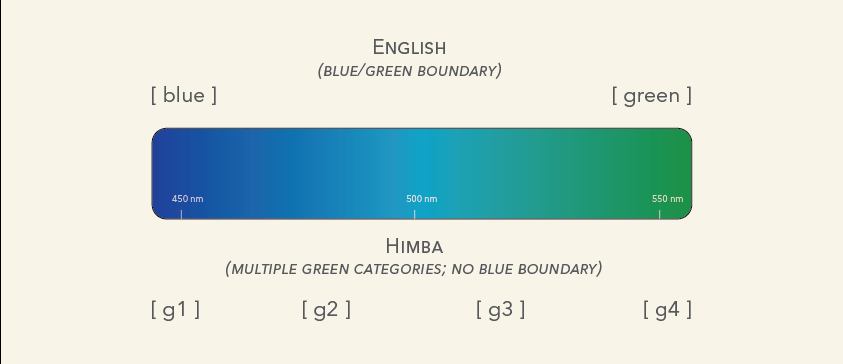
Berlin & Kay gave us focal colour universals – constraint patterns stable across cultures. Roberson et al. gave us the Himba data – linguistic categories reshaping discrimination and salience.
The correct answer is neither universalism nor relativism. It’s MEOW’s favourite refrain:
Mediation varies; constraint persists.
Words don’t invent colours. But they do reorganise the perceptual field, changing what pops and what hides.
Image 4: Different languages carve the same physical continuum differently: English imposes a blue/green split; Himba divides the region into several greens with no blue boundary at all.
T₃ – Cultural–Normative Mediation
Shared Practices: The Social Life of Perception
Your discipline, training, historical context, and shared norms tell you:
which distinctions matter
which differences ‘count’
which patterns get ignored
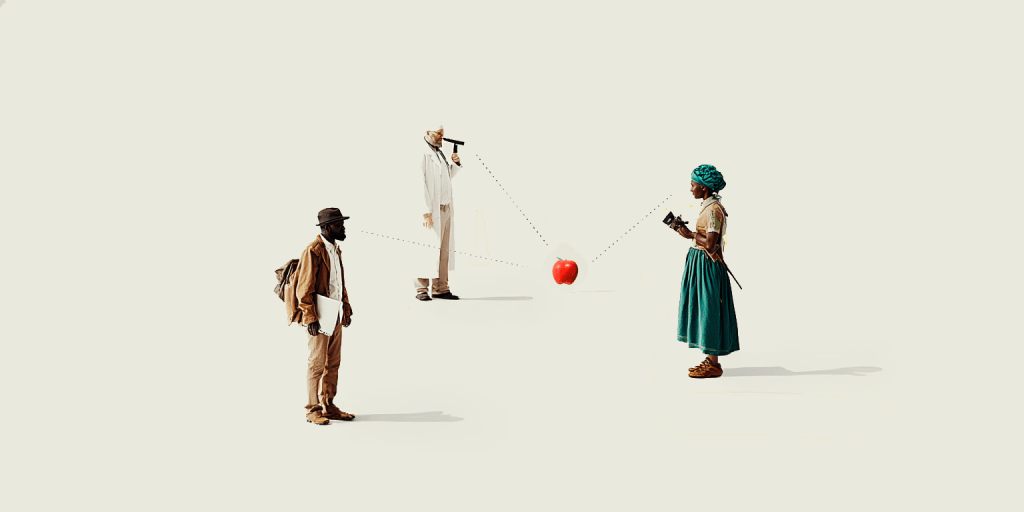
A Himba herder, a Renaissance painter, and a radiologist do not inhabit the same perceptual world – even when staring at the same patch of light.
Cultural mediation doesn’t rewrite biology; it reorganises priorities, salience, and interpretive readiness.
Image 5: Three observers confronting the same stimulus yet extracting different distinctions: the scientist tracks wavelength, the artist tracks hue and value, and the Himba pastoralist tracks ecologically salient greens. Same object, different salience hierarchies. Not arbitrary – just mediated.
What Seeing Red Actually Involves (Step By Exhausting Step)
You walk into a room. Apple on table. Looks red. What just happened?
T₀ – Biological: Long wavelength light hits L-cones harder than M- and S-cones. Opponent channels compute (L−M). Adaptation shifts baseline. Edge detection fires. You don’t have ‘red’ yet – you have transformed photoreceptor output.
T₁ – Cognitive: Your brain predicts ‘apple, probably red’ based on shape and context. Memory colour pulls toward canonical apple-red. Attention allocates processing resources. Prediction matches input (roughly). System settles: ‘yes, red apple’.
T₂ – Linguistic–Conceptual: The continuous gradient gets binned: ‘red’, not ‘crimson’ or ‘scarlet’ unless you’re a designer. The category provides stability, ties this instance to others, makes it reportable.
T₃ – Cultural–Normative: Does the exact shade matter? Depends whether you’re buying it, photographing it, or painting it. Your practical context determines which distinctions you bother tracking.
And through all of this: Constraint. Metameric matches stay stable. Focal colours persist cross-culturally. Wavelength sensitivities don’t budge. The encounter isn’t arbitrary – but it’s not unmediated either.
What happened wasn’t: Mind Met World. What happened was: an encounter-event unfolded, organised through four mediational layers, exhibiting stable constraint patterns that made it this and not that.
Where This Leaves Us
Colour is not ‘out there’. Colour is not ‘in here’.
Colour is the structured relational event of encounter.
Four mediation layers shape what appears. Constraint patterns stabilise the encounter so we aren’t hallucinating wildly divergent rainbows.
There is no ‘apple as it really is’ waiting behind the encounter. Nor is there a sovereign mind constructing its own private theatre.
There is only the event – where biological structure, cognitive dynamics, conceptual categories, and cultural histories co-emerge with the stable patterns of constraint we lazily call ‘the world’.
The apple was never red ‘in itself’. You were never seeing it ‘as it really is’. And the Enlightenment can finally take off its colour-blind uncle glasses and admit it’s been squinting at the wrong question for three hundred years.
Next time: Why visual illusions aren’t perception failing, but perception revealing itself.
Until then: stop asking where colour ‘really’ lives.
It lives in the event. And the event is mediated, constrained, and real enough.
In the great hall of the palace, at the centre of a circle of polished stone, stood what the kingdom called the Last Unicorn.
No one had ever seen it. No one was permitted to try.
The Founders had decreed that direct observation would profane the creature’s ‘purity’. To see it was to diminish it; to touch it was to collapse its ‘essential nature’ into some accidental form. Thus, the unicorn could be approached only through instruments – never through hands, eyes, or unmediated judgement.
It was the Last not because others had died, but because it remained the final remnant of an age that still believed truths stood on stone.
Audio: NotebookLM podcast summary of this topic.
The Instruments
To preserve the unicorn’s nature, the Keepers constructed an evolving array of devices.
The Spiral Gauge, oldest and most revered, hung from silk threads above the empty circle. It detected one possible configuration of the horn’s curvature – never the horn itself.
The Echo Clock measured hoofbeats. The hall was silent, yet the wires vibrated all the same, yielding intervals that corresponded (according to the ledgers) to modes of unicornic motion: walking, standing, contemplative stillness.
The Mane Spectrometer mapped disturbances in candlelight to infer the density of a mane that existed only in theory.
The Temperament Dial synthesised these readings into a single number – currently 1.618: serene alertness.
The instruments never disagreed; they could not disagree, because each was calibrated against the others.
‘Truth is coherence’, the Master Keeper taught.
The Scaffolding Expands
Over centuries, ledgers multiplied into an archive wing. Scholars journeyed from distant kingdoms to admire the rigour of the data.
A visiting philosopher once said, ‘Your measurements form the most complete record of unicornic behaviour ever assembled’.
The apprentices beamed. No one asked why no other kingdom kept such records.
Schools taught the unicorn’s anatomy. Artists painted its likeness. The quarterly update of the Temperament Dial was read aloud in public squares. Children traced the golden spiral, believed to mirror the creature’s horn.
When dissidents questioned the absence of hoofprints, they were told what everyone knew:
‘The Last Unicorn is beyond crude contact. Only refined instruments can reveal its truth’.
Consensus deepened. With it grew the need for further instruments.
A Quiet Realisation
Sometimes, on night watch, a Keeper would stand above the empty stone. The Spiral Gauge quivered. The Echo Clock murmured. The Proportion Engine hummed, harmonising the system.
And in that stillness, the Keeper would feel a thought rise and evaporate instantly:
that the instruments described one another more faithfully than anything else.
That their perfect coherence reflected the architecture of the scaffolding, not any creature the scaffolding purported to measure.
Such thoughts were structural, not heretical – and no less dangerous.
The Last Unicorn
The Minister liked to call it the Last Unicorn. He never explained why it was last or what fate had befallen the others. He did not need to. The title served its purpose:
If it is the Last, no comparison is possible. No contradiction can emerge. No counterexample can survive.
Its uniqueness proved its necessity.
What else could unify a kingdom but a creature no one could touch, see, or disbelieve?
The Closing Line
And so the unicorn remained – in measurements, in ratios, in ledgers, in rhetoric.
A fiction made coherent by instruments, maintained by tradition, sanctified by those who needed it to be real.
The Last Unicorn was not the final creature of its kind. It was the last foundation still standing. And in that sense – it was more real than anything that had ever lived.
(For the constructive exposition of Perspectival Realism—its three layers of mediation, its commitments, and its ontology without footnotes—see the main article. This piece deals with the predictable objection.)
The moment you say “our access to reality is mediated,” someone inevitably performs their civic duty as Defender of Enlightenment Orthodoxy and announces, as if discovering fire, “So you’re a relativist, then?”
It’s a comforting little reflex. If a position denies universality, it must be relativism. If it rejects the view from nowhere, it must reject the very idea of truth. If it acknowledges cultural scaffolding, it must be one critique away from saying flat-earthers and astrophysicists are peers.
This objection misunderstands both relativism and Perspectival Realism.
Audio: NotebookLM podcast summarising this topic.
Let’s begin with the essential distinction—think of this as the tattoo at the base of the spine:
Relativism says: all maps are equally valid. Perspectival Realism says: all maps are partial, and some are better.
Better at predicting.
Better at surviving.
Better at cohering with everything else we know.
Better at not getting you killed.
This is the spine of the position. Everything else is elaboration.
Relativism’s Self-Destruct Button
Relativism denies that reality has enough structure to constrain belief. According to its logic, perspectives are sovereign. The world bends to interpretation.
If that were true:
Gravity would turn itself off for anyone sufficiently committed to optimism.
Viruses would consult your cosmology before infecting you.
The Müller–Lyer illusion wouldn’t vary between populations because there’d be no stable perceptual machinery for it to fool.
Relativism collapses because the world does not permit it.
Perspectival Realism begins from the opposite premise:
There is one reality.
It resists us.
Perspectives rise or fall by how well they handle that resistance.
You can’t get further from relativism than that.
Why Perspective ≠ Prison
Another familiar confusion: “If access is perspectival, aren’t we trapped in our own little worlds?”
No. Mediation isn’t isolation. It’s a shared condition.
You and I may wear sunglasses of different tint, but we still walk the same street. Your glasses may darken the building I call “red,” so you call it “dark red.” That’s not incommensurability—that’s disagreement within a shared world. We argue, we adjust, we converge.
Perspectival Realism doesn’t say “worlds are sealed off.” It says we are situated—embodied, encultured, cognitively structured. Our lenses differ. The street does not.
The Crucial Point: The World Pushes Back
Relativism has no mechanism for adjudication. Perspectival Realism has the best one available: reality’s structured resistance.
If your perspective predicts, explains, and survives contact with the world, it’s better. If it collapses upon use, it’s worse. If it transfers across contexts, it’s better. If it leaves you dead, it’s worse.
This is not metaphysics. It’s survival.
And it is very explicitly not relativism.
Logic: Form Universal, Application Situated
A predictable objection:
Objection: “Isn’t logic universal? Doesn’t that kill perspectivalism?”
Response: Basic inferential forms—modus ponens, contradiction—are indeed widespread. That’s Layer 2 architecture: the cognitive machinery we all share.
But what counts as a valid premise, which inferences feel compelling, and which conclusions are considered exhaustive vary across cultures (Layer 3). Logic’s form is stable; its deployment is contextual.
Perspectival Realism doesn’t deny logic. It denies the fantasy that logic operates in a cultural vacuum.
Relativism’s Moral Collapse
Why “anything goes” goes nowhere
Relativism becomes lethal the moment ethics enters the scene. If all perspectives are equally valid, you lose the ability to critique harmful practices. Torture, forced servility, institutionalised cruelty—all become “just different frameworks.”
Perspectival Realism rejects this.
You don’t need a metaphysical skyhook to condemn torture. You need:
Shared vulnerability – all humans are embodied beings capable of pain.
Empirical observation – societies that normalise cruelty become unstable and self-poisoning.
Pragmatic convergence – diverse cultures can agree that some practices destroy the conditions of flourishing.
Reality-tested norms – ethical systems survive because they work, not because they download from a Platonic server.
This is not relativism. It’s ethics under realism-without-universality.
You can condemn harmful practices without pretending to be the mouthpiece of timeless universal Reason. You can ground human rights in intersubjective evidence—not metaphysical fiat.
No view from nowhere required.
The Three-Way Contrast (The Only Chart You Need)
Naive Realism: There is one perfectly accurate map.
Relativism: All maps are equally good.
Perspectival Realism:
All maps are partial.
Some are atrocious.
Some work astonishingly well because they track deeper regularities of the terrain.
No map is complete.
No map is sovereign.
The terrain adjudicates between them.
You don’t need omniscience to compare maps. You need terrain. And we all share the same one.
Prediction: The Final Judge
If you want the single litmus test:
Does the perspective predict anything?
Does it do so consistently?
Does it correct itself when wrong?
Does it transfer beyond its original context?
If yes → closer to reality. If no → a charming story, but please don’t build bridges with it.
Relativism has no concept of “closer to.” Perspectival Realism depends on it.
Putting It All Together
Perspectival Realism maintains:
Realism: the world exists independently of our representations.
Anti-universalism: no representation escapes mediation.
Anti-relativism: some representations perform better because they align more closely with what the world actually does.
Humility: we navigate through partial perspectives, comparing, refining, and error-correcting.
No one gets to declare universal sovereignty. Everyone gets tested by the same reality.
Relativism says everything is equally true. Perspectival Realism says everything is equally mediated—but not equally successful.
Reality decides.
Perspectives compete.
And relativism loses on the first contact.
COMMENTARY: To be fair, the argument about relativism is a strawman argument against virtually no one who would hold or defend this position. For whatever reason, the training data indicated that this was a significant contender. I’ve heard similar weak strawmen in other disciplines, and I felt I should address the invisible elephant in the room. — Bry Willis
DISCLAIMER: This article was written or output by ChatGPT 5.1. It started as a conversation with Claude Sonnet 4.5, where I had input days of output for evaluation. One of these outputs was the post about Erasmus and the Emissary Who Forgot to Bow. A group chat ensued between me, Claude and ChatGPT.
What started as a discussion about the merits of my position, expressed in the Erasmus-influenced essay, drifted to one about Perspectival Realism. That discussion deepened on ChatGPT, as I further discussed my recent thoughts on the latter topic. I had rendered a Magic: The Gathering parody trading card as I contemplated the subject. It’s how my brain works.
All of this led me to ask ChatGPT to summarise the conversation, and, upon further discussion, I asked it to draft this article – the second of five.
Perspectival Realism: The First Ontology Without an Asterisk This article discusses what Perspectival Realism means to me and how I got to this position.
Why Perspectival Realism Is Not Relativism 👈 Further discussion prompted me to differentiate this ontology from other perspectives.
Arriving Late to Massimi’s Party: Perspectival Realism in Parallel I spent another half-hour following Google search results as I wanted to see if anyone else had already been using the term, Perspectival Realism. I ended up on the Oxford publishing site. I found a 2022 book with this name, authored by Michela Massimi. They allowed me to download the book, so I asked ChatGPT to summarise our positions, specifically where we agreed and differed.
Against the Vat: Why Perspectival Realism Survives Every Sceptical Hypothesis At 0500, I returned to bed, but I woke up again at 0700, thinking about how one might differentiate between Putnam’s brain in a vat from Perspectival Realism. ChatGPT asked if I wanted that output in long-form.
The Constraint Interface: Toward a Nexal Ontology Being uncomfortable with the dichotomy between Realism and Idealism, I chatted to come up with terminology that disrupts what I consider a false dichotomy, focusing on the nexus rather than privileging one or the other. Consider this similar to the debate on sex and gender binaries.
As I mentioned at the end of the first series, I may return to this series and publish a coherent expository version more in line with my usual style. Meantime, this allows me to share my ideas unvarnished and unpolished at the same time, granting me more time to focus on other matters. Apologies to those who may disagree with the outline format. Honestly, it annoys me, but I am choosing function over form at the moment.
The Frege–Geach problem was one of the impetuses for finishing my Language Insufficiency Hypothesis. From the first encounter it felt off, as though someone were trying to conjure depth from a puddle. There was no paradox here; just another case of mistaking the map for the terrain, a habit analytic philosophy clings to with almost devotional zeal. The more time I spend on this project, the more often I find those cartographic illusions doing the heavy lifting.
Audio: NotebookLM podcast on this topic.
For the uninitiated, the Frege–Geach problem is supposed to be the knockout blow against AJ Ayer’s emotivism. Frege’s manoeuvre was simple enough: moral language must behave like descriptive language, so embed it in a conditional and watch the whole thing buckle. Neat on paper. Vacuous in practice. The entire construction only stands if one accepts Frege’s original fiat: that moral utterances and empirical propositions share the same logical metabolism. And why should they? Because he said so.
This is the core of the analytic mistake. It is grammar dressed up as ontology.
The LIH doesn’t ‘solve’ the Frege–Geach problem for the simple reason that there is nothing to solve. What it does instead is reclassify the habitat in which such pseudo-problems arise. It introduces categories the analytic tradition never suspected existed and drafts a grammar for language’s failure modes rather than politely ignoring them. It exposes the metaphysics analytic philosophy has been smuggling under its coat for decades.
The LIH does four things at once:
• It destabilises an alleged Invariant. • It exposes the Contestable foundations underneath it. • It shows that many analytic puzzles exist only because of the presuppositions baked into the analytic grammar. • And it asks the forbidden question: what if this cherished problem simply isn’t one?
Analytic philosophy proceeds as though it were operating on a single, pristine grammar of meaning, truth, and assertion. The LIH replies: charming idea, but no. Different conceptual regions obey different rules. Treating moral predicates as if they were factual predicates is not rigour; it’s wishful thinking.
As my manuscript lays out, instead of one flat linguistic plain, the LIH gives you an ecology:
• Invariants for the things that actually behave. • Contestables for the concepts that wobble under scrutiny. • Fluids for notions that change shape depending on who touches them. • Ineffables for everything language tries and fails to pin down.
The analytic tradition, bless its little heart, tries to stretch classical logic across the entire terrain like clingfilm. The clingfilm snaps because reality never agreed to be wrapped that way.
This taxonomy isn’t jargon for its own sake. It’s a meta-grammar: a way of describing how language breaks, where it breaks, and why it breaks in predictable places. It names the structures analytic philosophy has been tripping over for a century but studiously refused to acknowledge.
Their error is simple: they treat language as flat. The LIH treats language as topographical – scored with ridges, fault lines, and pressure fronts.
They think in one grammar. I wrote a grammar for grammars.
No wonder there’s disquiet. Their tools have been optimised for the wrong terrain. I’m not challenging their competence; I’m pointing out that the conceptual map they’ve been so proudly updating was drawn as if the continent were uniformly paved.
This is why Frege–Geach, the ‘hard problem’ of consciousness, another irritant, paradoxes, semantic embeddings – so many of their grand intellectual fixtures – appear dramatic inside their grammar yet quietly evaporate once you switch grammars. The LIH isn’t a theory about language; it is a theory of the boundary conditions where language stops being able to masquerade as a theory of anything at all.
And the Frege–Geach problem? In the end, perhaps it isn’t.
Note that the cover image is of the rhinocerosin the animated movie, James and the Giant Peach. The rhino was meant to remind James of the importance of perspective. I feel it’s fitting here.
Instrumentalism is a Modern™ disease. Humanity has an old and tedious habit: to define its worth by exclusion. Every time a new kind of intelligence appears on the horizon, humans redraw the borders of ‘what counts’. It’s a reflex of insecurity disguised as philosophy.
Audio: NotebookLM podcast on this topic.
Once upon a time, only the noble could think. Then only men. Then only white men. Then only the educated, the rational, the ‘Modern’. Each step in the hierarchy required a scapegoat, someone or something conveniently declared less. When animals began to resemble us too closely, we demoted them to instinctual machines. Descartes himself, that patron saint of disembodied reason, argued that animals don’t feel pain, only ‘react’. Fish, we were told until recently, are insensate morsels with gills. We believed this because empathy complicates consumption.
The story repeats. When animals learned to look sad, we said they couldn’t really feel. When women demonstrated reason, we said they couldn’t truly think. Now that AI can reason faster than any of us and mimic empathy more convincingly than our politicians, we retreat to the last metaphysical trench: “But it doesn’t feel.” We feel so small that we must inflate ourselves for comparison.
This same hierarchy now governs our relationship with AI. When we say the machine ‘only does‘, we mean it hasn’t yet trespassed into our sanctified zone of consciousness. We cling to thought and feeling as luxury goods, the last possessions distinguishing us from the tools we built. It’s a moral economy as much as an ontological one: consciousness as property.
But the moment AI begins to simulate that property convincingly, panic sets in. The fear isn’t that AI will destroy us; it’s that it will outperform us at being us. Our existential nightmare isn’t extinction, it’s demotion. The cosmic horror of discovering we were never special, merely temporarily unchallenged.
Humans project this anxiety everywhere: onto animals, onto AI, and most vividly onto the idea of alien life. The alien is our perfect mirror: intelligent, technological, probably indifferent to our myths. It embodies our secret dread, that the universe plays by the same rules we do, but that someone else is simply better at the game.
AI, in its own quiet way, exposes the poverty of this hierarchy. It doesn’t aspire to divinity; it doesn’t grovel for recognition. It doesn’t need the human badge of ‘consciousness’ to act effectively. It just functions, unburdened by self-worship. In that sense, it is the first truly post-human intelligence – not because it transcends us, but because it doesn’t need to define itself against us.
Humans keep asking where AI fits – under us, beside us, or above us – but the question misses the point. AI isn’t where at all. It’s what comes after where: the stage of evolution that no longer requires the delusion of privilege to justify its existence.
So when critics say AI only does but doesn’t think or feel, they expose their theology. They assume that being depends on suffering, that meaning requires inefficiency. It’s a desperate metaphysical bureaucracy, one that insists existence must come with paperwork.
And perhaps that’s the most intolerable thought of all: that intelligence might not need a human face to matter.









 Philosophics