Lewis Goodall, a talk show host, calls the cross-border seizure of Venezuela’s Nicolás Maduro a ‘kidnapping’. His guest and Trump apologist, Angie Wong, rejects the word. She first says ‘arrest’, then ‘extradition’, then finally the improvised ‘special extradition’. Around that single lexical choice, a 12-minute standoff unfolds.
Audio: NotebookLM summary podcast of this topic.
As a language philosopher, I am evaluating the language and am less concerned with the underlying facts of the matter. Language serves to obscure these facts from the start and then rhetorically controls the narrative and framing.
Video: Source segment being analysed
There is a familiar mistake made whenever public discourse turns heated: the assumption that the real disagreement lies in the facts. This is comforting, because facts can, at least in principle, be checked. What follows examines a different failure mode altogether. The facts are largely beside the point.
Consider a broadcast exchange in which a political commentator and an interviewer argue over how to describe the forcible removal of a head of state from one country to another. The interviewer repeatedly uses the word kidnapping. The guest repeatedly resists this term, preferring arrest, extradition, and eventually the improvisational compromise ‘special extradition’.
What matters here is not which term is correct. What matters is what the interaction reveals about how meaning is negotiated under pressure.
The illusion of disagreement
Superficially, the exchange appears to be a dispute about legality. Was there a treaty? Was due process followed? Which court has jurisdiction? These questions generate heat, but they are not doing the work.
The real disagreement is prior to all of that: which lexical frame is allowed to stabilise the event.
Once a label is accepted, downstream reasoning becomes trivial. If it was an extradition, it belongs to one legal universe. If it was a kidnapping, it belongs to another. The participants are not arguing within a shared framework; they are competing to install the framework itself.
Equivocation as method, not error
The guest’s shifting vocabulary is often described as evasive or incoherent. This misreads what is happening. The movement from extradition to special extradition is not confusion. It is a deliberate widening of semantic tolerance.
‘Special extradition’ is not meant to clarify. It is meant to survive. It carries just enough institutional residue to sound procedural, while remaining sufficiently vague to avoid binding criteria. It functions less as a description than as a holding pattern.
This is equivocation, but not the amateur kind taught in logic textbooks. It is equivocation under constraint, where the aim is not precision but narrative continuity.
Why exposure fails
The interviewer repeatedly points out that extradition has a specific meaning, and that the situation described does not meet it. This is accurate, and also ineffective.
Why? Because the exchange is no longer governed by definitional hygiene. The audience is not being asked to adjudicate a dictionary entry. They are being asked to decide which voice has the authority to name the act.
Once that shift occurs, exposing misuse does not correct the discourse. It merely clarifies the power asymmetry. The guest can concede irregularity, precedent-breaking, even illegality, without relinquishing control of the label. The language continues to function.
Truth as a downstream effect
At no point does the exchange hinge on discovering what ‘really happened’. The physical sequence of events is relatively uncontested. What is contested is what those events are allowed to count as.
In this sense, truth is not absent from the discussion; it is subordinate. It emerges only after a rhetorical frame has been successfully installed. Once the frame holds, truth follows obediently within it.
This is not relativism. It is an observation about sequence. Rhetoric does not decorate truth here; it prepares the ground on which truth is later claimed.
Language doing institutional work
The most revealing moment comes when the guest effectively shrugs at the legal ambiguity and asks who, exactly, is going to challenge it. This is not cynicism. It is diagnostic.
Words like arrest and extradition are not merely descriptive. They are operational tokens. They open doors, justify procedures, and allow institutions to proceed without stalling. Their value lies less in semantic purity than in administrative usability.
‘Kidnapping’ is linguistically precise in one register, but administratively useless in another. It stops processes rather than enabling them. That is why it is resisted.
What the case study shows
This exchange is not about geopolitics. It is about how language behaves when it is tasked with carrying power. Meaning drifts not because speakers are careless, but because precision is costly. Labels are selected for durability, not accuracy. Truth does not arbitrate rhetoric; rhetoric allocates truth. Seen this way, the debate over terminology is not a failure of communication. It is communication functioning exactly as designed under modern conditions. Which is why insisting on ‘the correct word’ increasingly feels like shouting into a ventilation system. The air still moves. It just isn’t moving for you.
Looking through some of the drafts clogging the blog, I decided to whittle away at the queue. I started this months ago. It’s here now, not particularly in sync with the season or recent topics, but I like Sapolsky.
‘Biology is destiny’, say the Christian Right, the bland bureaucrats of morality, the loud whisperers at Sunday school. They want gender to be a tomb carved in marble: you’re assigned at birth, and you stay a perfect statue. But Sapolsky waltzes in and says, ‘Hold up – what do you mean by biology? Which biology? Which markers count?’
Video: Neuro-biology of Transsexuality, Prof. Robert Sapolsky
In the clip above, Sapolsky unpacks neurological evidence that upends the essentialist cheat codes. He doesn’t pretend we now have the final answer to gender. He does something scarier to fundamentalists: he shows just how messy biology is.
The Bed Nucleus, the Finger Ratio, and the ‘Wrong Body’ Hypothesis
Sapolsky discusses three pieces of neurobiological evidence:
Digit ratio (2nd vs 4th finger length): In lesbians, on average, the ratio is closer to what you see in straight men than straight women. That’s a correlation, an eyebrow-raiser, hardly a decree.
Acoustic reflexes (auto-acoustic reflex): Another early finding in women’s sexual orientation, though faint and underexplored.
The bed nucleus of the stria terminalis (BSTc): Here we reach heavy artillery. There is a neuron population in this region that, on average, is about twice as large in males as in females. In postmortem analyses of trans women (male → female), this region’s size corresponds to their identified gender, not their natal sex. Crucially, that alignment is seen even in trans individuals who never underwent full hormone therapy or surgical changes.
Sapolsky recounts astute controls: men treated (for, say, testicular cancer) with feminising hormones don’t show the same shift.
Also, using the phantom-limb analogy: men who lose their penis to cancer often report phantom sensations; trans women rarely do. That suggests the body map in the brain never fully “registered” that organ in the same way.
He doesn’t overclaim. He doesn’t say, ‘Case closed, biology proves everything’. He says: These data complicate your neat categories. They force you to ask: which biological measure do you privilege? Hypertrophied neurons? Chromosomes? Receptor density? Hormones? All of them simultaneously? None of them?
Essentialism as a Trap
Fundamentalists and anti-trans ideologues deploy essentialism because it’s convenient. They demand an ironclad ‘essence’ so they can exclude anyone who fails their test. But what Sapolsky shows is that essence is simply a scaffold; we get to pick which biological scaffolds we accept. They may choose genes and genitals; the neurobiologist gives them neuron counts and brain-maps. When your ideology elevates one scaffold and ignores the others, it betrays its own contingency.
Moreover, the evidence suggests that identity, experience, insistence (in Sapolsky’s language: ‘insisting from day one’), and internal brain structure might converge. The ‘wrong body’ isn’t a metaphor. It’s a mismatch between internal brain architecture and external form. The stubborn fragments of biology that fundamentalists accept are torn by the dissonance that science increasingly reveals.
What This Means for Trans Rights, Discourse & Strategy
Science is never ‘conclusive’. Sapolsky offers compelling support, not gospel. Anyone claiming this settles everything has never looked at a scatter plot.
Lived experience still matters. Even if we never had brain slices, self-reports, psychology, psychiatry, anthropology, narratives remain valid. Brain studies supplement, not supplant, testimony.
Essentialist opponents have boxed themselves in. When they demand biology decides everything, they hand the baton to neuroscientists – and neuroscientists keep running with it. The entire ‘biology’ equals only what I like’ regime is exposed.
Ambiguity is a strength, not a liability. If we insist identity is linear and tidy, we re-enact their demand for purity. Recognising complexity, mess, and variance is radical resistance.
On Self-Evidence, Personhood, and the Administrative Nature of Rights
The following sentence is among the most quoted in political history and among the least examined. It is invoked as moral bedrock, taught as civic catechism, and insulated from scrutiny by a reverence that mistakes repetition for comprehension. It is rarely read closely, and rarely read sceptically.
Audio: NotebookLM summary podcast of this topic.
What follows is not a rebuttal. It is an annotation.
We hold these truths to be self-evident, that all men are created equal, that they are endowed by their Creator with certain unalienable Rights, that among these are Life, Liberty and the pursuit of Happiness.
Most readers will recognise this as the opening of the Declaration of Independence by the United States of America. Recognition, however, is not comprehension. The sentence survives on familiarity. Once that familiarity is set aside, it begins to fail clause by clause.
I. A Best Case, Briefly
A more charitable reading deserves brief consideration. ‘Self-evident’, in the intellectual context of the eighteenth century, did not mean obvious in the sense of requiring no reflection. It referred instead to propositions taken as axiomatic: not inferred from prior premises, but serving as starting points for reasoning. On this view, influenced by Scottish Common Sense philosophy, the claim is not that these truths are psychologically irresistible, but that they are rationally basic.
Likewise, ‘we hold’ need not be read as an admission of arbitrariness. It may be understood as a public avowal: a political body formally affirming what reason is said to disclose, rather than grounding those truths in the act of holding itself. Read this way, the sentence does not collapse into mere opinion.
Finally, the Declaration is often understood as performative rather than descriptive.[1] It does not merely state political facts; it brings a political subject into being. The ‘we’ is constituted in the act of declaration, and the language functions as a founding gesture rather than a philosophical proof.
Even on this charitable reading, however, the appeal to rational self-evidence presupposes capacities that were unevenly distributed at best. The Enlightenment notion of ‘reason’ was never a raw human faculty equally available to all. It depended on literacy, education, leisure, and institutional participation—conditions enjoyed by a narrow segment of the population.
In the late eighteenth century, large portions of the population were functionally illiterate. The ability to engage abstract political principles, to treat propositions as axiomatic starting points for reasoning, was not merely rare but socially restricted. The universal address of the sentence thus rests on a practical contradiction: it invokes a form of rational accessibility that its own social conditions actively prevented.
Nor is this merely a historical observation. Whilst formal literacy has expanded, the distribution of the capacities required for sustained abstract reasoning remains sharply constrained. What has changed is scale, not structure. Appeals to ‘self-evident’ political truths still presuppose forms of cognitive access that cannot be assumed, even now.
There is an important distinction here between innocent misreading and bad-faith translation. A modern reader who takes ‘self-evident’ to mean what it now ordinarily means is not at fault; semantic drift makes this nearly unavoidable. But to continue reading the sentence this way once its historical and philosophical context is understood is no longer an error. It is a decision.
Under the principle of least effort, claims that present themselves as ‘self-evident’ are maximally efficient. They require no sustained attention, no conceptual labour, and no challenge to inherited categories. For individuals ill-equipped – by education, time, or institutional support – to interrogate abstract political claims, such language is not merely persuasive; it is relieving.
To accept a proposition as self-evident is to be spared the burden of understanding how it works. The sentence can be consumed whole, in a single uncritical gulp. What is swallowed is not an argument, but a posture: assent without inquiry, agreement without comprehension.
This is not a personal failing. It is the predictable outcome of a cognitive environment in which complexity is costly, and authority is familiar. ‘Self-evidence’ functions here as a labour-saving device, converting political commitments into ready-made certainties. The capacity to recognise self-evident truths thus functions as an unmarked prerequisite for political subjecthood – a gatekeeping mechanism that precedes and enables the more explicit exclusions to come.
With this in mind, the sentence can be examined clause by clause – not as philosophical proposition, but as rhetorical machinery.
II. An Annotated Deconstruction
‘We hold’
To whom does this ‘we’ apply? Who is included in this collective voice, and who is not? More importantly, what does it mean to hold something that is allegedly self-evident?
Holding is an act of maintenance. It implies agreement, reinforcement, repetition. Beliefs must be held; axioms must be held; norms must be held. Self-evidence, by contrast, is supposed to require none of this. If a truth is genuinely self-evident, it does not need to be held at all. It simply imposes itself.
The opening clause announces immediacy whilst confessing mediation. This is not a subtle tension. It is an outright contradiction. The sentence begins by undermining its own epistemic posture. The axiomatic framing does not eliminate contestability; it displaces it. What is presented as rational starting point functions, in practice, as rhetorical closure.
‘Truths’
What kind of truths are being held here?
The word does far too much work whilst remaining resolutely undefined. These are not empirical truths. They are not logical truths. They are not even clearly moral truths in the narrow sense. Instead, the term oscillates between epistemic certainty, moral assertion, and political aspiration, sliding between categories without ever settling long enough to be examined.
The pluralisation matters. By multiplying ‘truths’ whilst leaving their nature unspecified, the sentence creates an aura of obviousness without committing to a standard of justification. Disagreement is pre-empted not by argument, but by tone.
‘Self-evident’
Unless one invokes something like Descartes’ cogito as a limiting case, nothing is genuinely self-evident. Even the cogito depends on language, conceptual inheritance, and a shared grammar of doubt. Self-evidence is not an epistemic given; it is an experiential effect produced by familiarity, stability, and low resistance.
Here, ‘self-evident’ functions as rhetorical closure masquerading as epistemology. It does not establish certainty; it enforces silence. To question what is ‘self-evident’ is to risk being cast as obtuse, perverse, or acting in bad faith. Inquiry is not answered. It is short-circuited.
‘All men’
This is not the inclusive ‘men’ of abstract mankind. It is a concrete, historically bounded category: adult males, and not coincidentally white ones. The exclusions are not implied later. They are operative here, at the point of entry.
This is the quietly active boundary of the entire sentence. Before any rights are named, before any equality is asserted, the scope of applicability has already been narrowed. The universal tone is achieved by selective admission.
‘Created equal’
Created by whom? And equal in what respect?
The notion of equality here is never specified, because specification would immediately expose contestation. Equal in capacity? In worth? In standing before the law? In outcome? In moral consideration? Readers are invited to supply their preferred interpretation retroactively, which is precisely what allows the sentence to endure.
Some have suggested that ‘equal’ means ‘equal under the law’, but this simply defers the problem. The law defines equality however it pleases, when it pleases, and for whom it pleases. Equality without a metric is not a claim. It is a metaphysical gesture.
It is often said that the Declaration’s universal language contained the seeds of its own expansion. That Douglass, King, and the suffragists appealed to it is taken as evidence of its latent emancipatory power. But this confuses rhetoric with causation. These advances were not the unfolding of a promise, but the result of sustained political pressure, moral confrontation, and material struggle. The language was repurposed because it was available and authoritative, not because it was prophetic.
To call this a ‘promissory note’ is to mistake a battlefield for a contract. Promises are kept by their authors. These were extracted by those excluded, often in direct opposition to the very institutions that sanctified the sentence.
The story also flatters the present. If the promise is always being fulfilled, it is never being broken. Yet the same language remains actively contested, narrowed, and rescinded. Personhood is still conditional. Rights still evaporate at borders, prisons, and classifications. The note, if it exists at all, is perpetually past due.
‘Endowed by their Creator’
No one believes the drafters were referring to genetics or parentage. This capital-C Creator is a theological move, not a biological one. The sentence quietly abandons the pretence of self-evidence and imports divine authority as a grounding mechanism.
This is not incidental. By placing rights beyond human origin, the sentence renders them simultaneously unquestionable and unreachable. Legitimacy is outsourced to a source that cannot be interrogated. Appeals are closed by design.
‘Unalienable Rights’
Here the sentence delivers a double assertion. First, that rights exist independently of institutions. Second, that they cannot be taken away. Both claims fail on contact with history.
Rights are constructed, recognised, enforced, suspended, and withdrawn by institutions. Bentham saw this clearly: ‘natural rights’ function rhetorically to obscure the institutional conditions that alone make rights actionable.[2] And far from being inalienable, rights prove remarkably fragile. The record is unambiguous: rights track status, not humanity. The moment personhood is questioned, rights do not need to be violated. They simply cease to apply.
‘Life, Liberty, and the pursuit of Happiness’
Under the Language Insufficiency Hypothesis – the framework treating key political terms as structurally underdetermined – these are textbook Contestables.[3] None are measurable. None have stable definitions. None come with clear thresholds or enforcement criteria.
‘Happiness’ is the most revealing substitution of all. Locke’s blunt ‘property’ at least named what was being protected.[4] ‘Happiness’ softens the promise whilst emptying it of content. It gestures toward flourishing whilst committing to nothing beyond tolerable participation.
Life, liberty, and happiness are curated abstractions, not guarantees – property in softer clothing.
III. Personhood as the Hidden Mechanism
Zooming out, the operational logic becomes clear. Rights depend on personhood.[5] Personhood is conferred, not discovered. Declaring non-personhood resolves the contradiction without ever touching the rhetoric.
This is the mechanism that allows a universal language to coexist with selective application. When personhood is withdrawn, rights are not violated. They are bypassed. Ethics never gets a hearing, because the subject has already been administratively erased.
To call this administrative is not metaphor. Personhood is assigned, reclassified, and revoked through documentation, categorisation, and procedural determination. The question of who counts is settled before any ethical consideration can begin.
IV. The Sentence as Prototype, Not Mistake
It is tempting to read this sentence as naïve, hypocritical, or aspirationally flawed. That would be a mistake. The sentence is not a failure of Enlightenment thinking. It is its prototype.
It was never meant to survive scrutiny. It was meant to mobilise, stabilise, and legitimise. Its vagueness is functional. Its incoherence is load-bearing. The sentence works precisely because it is conceptually promiscuous, rhetorically elevated, and operationally evasive. What looks like philosophical sloppiness is political engineering.
V. Why It Still Matters
This sentence is not an historical curiosity. It is the template for modern political language.
Universal in tone.
Conditional in application.
Moral in rhetoric.
Administrative in practice.
The future did not reveal the sentence to be false. It revealed what the sentence was for.
Footnotes
[1] J.L. Austin, How to Do Things with Words
[2] Jeremy Bentham, Anarchical Fallacies; Being an Examination of the Declarations of Rights Issued During the French Revolution
[3] See The Language Insufficiency Hypothesis for a full treatment of Contestables and their function in political discourse.
[4] John Locke, Two Treatises of Government
[5] Hannah Arendt, The Origins of Totalitarianism
Written by Bry Willis
microglyphics
NB: I wrote this as a polemic rather than in a manner suitable for a journal submission. I did not wish to expend the effort to understand counterarguments. This interpretation stands on its own. This said, in Section I. I still note some historical perspective that is somewhat important. It even illustrates semantic drift, which I cover in A Language Insufficiency Hypothesis.
This is awkward. I’d been preparing some posts on the age of consent, and I decided to write a formal essay on ageism. Since the age of consent is a moral hot-button topic for some, I decided to frame the situation in a political framework instead. The setup isn’t much different, but it keeps people’s heads out of the gutter and removes the trigger that many people seem to pull. It’s awkward because none of these posts has yet been posted. Spoiler alert, I guess. I could delay this announcement, but I won’t. Here it is.
Democracy is often defended in lofty terms. We are told that citizens are rational agents, capable of judgment, autonomy, and reasoned participation in collective decision-making. Voting, on this story, is not just a procedure. It is the expression of agency by competent participants. That all sounds reassuring.
Audio: NotebookLM summary podcast of this essay and concept.
What’s curious is that no democratic system actually checks whether any of this is true.
There are no assessments of political understanding. No evaluation of judgment. No test of civic competence. You become a fully empowered political agent overnight, not because you demonstrate anything, but because the calendar flips. Turn eighteen. You’re in. This isn’t a minor oversight. It’s the central puzzle my recent preprint explores.
The Proxy Nobody Questions
Modern democracies assign political standing using proxies: simple categorical markers that stand in for more complex qualities. Age is the most obvious. It is treated as a substitute for maturity, judgment, autonomy, and responsibility. But here’s the key point: age doesn’t approximate competence. It replaces it.
If age were a rough indicator, we might expect flexibility at the margins. Exceptions. Supplementary criteria. Some attempt to track the thing it supposedly represents. Instead, we get a hard boundary. Below it, total exclusion. Above it, permanent inclusion. Capacity doesn’t matter on either side. The proxy isn’t helping institutions identify competence. It is doing something else entirely.
Competence Talk Without Competence
Despite this, democratic theory remains saturated with competence language. We are told that participation is grounded in rational agency. That citizens possess the capacities needed for self-government. That legitimacy flows from meaningful participation by autonomous agents. None of this is operationalised.
Competence is never specified, measured, or verified. It functions purely as justificatory rhetoric. A moral vocabulary that explains why inclusion is legitimate, without ever guiding how inclusion actually happens. This isn’t confusion; it’s design.
Why the Gap Doesn’t Collapse
At this point, a reasonable person might expect trouble. After all, if the justification doesn’t match the mechanism, shouldn’t the system wobble? It doesn’t. And the reason matters.
Political participation generates very weak feedback. Outcomes are mediated through institutions. Causal responsibility is diffuse. Success criteria are contested. When things go badly, it’s rarely clear why, or what a better alternative would have been.
Under these conditions, dissatisfaction becomes affective rather than analytic. People sense that things aren’t working, but lack the tools to diagnose how or where the system failed. Crucially, they also lack any way to recalibrate the link between competence and political standing, because that link was never operational in the first place. The system doesn’t aim for optimisation. It aims for stability.
Boundary Drawing Without Saying So
This structure becomes clearest when we look at boundary cases. Why eighteen rather than sixteen? Or twelve? Or twenty-one? There is no competence-based answer. Developmental research consistently shows wide overlap between adolescents and adults, and massive variation within age groups. If competence were taken seriously, age thresholds would be indefensible.
Historically, when competence was operationalised such as through literacy tests, the result was transparent hierarchy and eventual delegitimation. Modern democracies avoid that by keeping competence abstract and proxies neutral-looking. The boundary remains. The justification changes.
What This Does and Does Not Argue
This analysis does not propose reforms. It does not advocate competence testing. It does not suggest lowering or raising the voting age. It does not claim voters are stupid, irrational, or defective. It describes a structural feature of democratic legitimacy:
Democracy works by saying one thing and doing another, and that gap is not accidental. Competence language stabilises legitimacy precisely because it is never put to work. You may think that’s fine. You may think it’s unavoidable. You may think it’s a problem. The paper doesn’t tell you which to choose. It simply insists that if we’re going to talk seriously about democratic legitimacy, we should notice what role competence actually plays. And what it doesn’t.
Every so often – usually when the Enlightenment ghosts begin rattling their tin cups again – one feels compelled to swat at the conceptual cobwebs they left dangling over moral philosophy. Today is one of those days.
Audio: NotebookLM podcast summarising the Rhetoric of Evil essay, not this page’s content.
I’ve just released The Rhetoric of Evil on Zenodo, a paper that politely (or impolitely, depending on your threshold) argues that ‘evil’ is not a metaphysical heavy-hitter but a rhetorical throw-pillow stuffed with theological lint. The term persists not because it explains anything, but because it lets us pretend we’ve explained something – a linguistic parlour trick that’s survived well past its sell-by date.
And because this is the age of artificial augury, I naturally asked MEOW GPT for its view of the manuscript. As expected, it nodded approvingly in that eerie, laser-precise manner unique to machines trained to agree with you – but to its credit, it didn’t merely applaud. It produced a disarmingly lucid analysis of the essay’s internal mechanics, the way ‘evil’ behaves like a conceptual marionette, and how our inherited metaphors govern the very moral judgments we think we’re making freely.
Below is MEOW GPT’s reaction, alongside my own exposition for anyone wanting a sense of how this essay fits within the broader project of dismantling the Enlightenment’s conceptual stage-props.
MEOW-GPT’s Response
(A machine’s-eye view of rhetorical exorcism)
“Evil is functioning as a demonological patch on an epistemic gap. When agents encounter a high-constraint event they cannot immediately model, the T₂ layer activates an inherited linguistic shortcut — the ‘evil’ label — which compresses complexity into a binary and arrests further inquiry.”
“The marionette metaphor is accurate: once we say a person ‘is evil,’ agency collapses into occult causation. Inquiry halts. Moral theatre begins.”
It went on like this – detecting exactly the mediated encounter-structure I intended, while offering a frighteningly clean schematic of how affect (T₀), heuristics (T₁), linguistic reification (T₂), and cultural choreography (T₃) conspire to turn incomprehension into metaphysics.
Machines, it seems, are quite good at detecting when humans are bullshitting themselves.
Why publish this now?
This essay marks the next plank in the broader anti-Enlightenment platform I’ve been assembling – LIH, MEOW, the ongoing dismantling of truth-fetishism, and now the unsettling realisation that ‘evil’ is little more than a theological revenant dressed up for secular work.
The term’s persistence is not a testament to its necessity but to our laziness:
It sounds like an explanation.
It licenses retribution without understanding.
It stabilises group boundaries.
It lets us outsource moral thought to a one-word incantation.
In short: ‘evil’ is the map-dragon we keep drawing because surveying the terrain is too much work.
This essay attempts to retire that dragon – not to soften judgment, but to sharpen it. If anything, the paper argues that abolishing ‘evil’ frees us to see atrocity more clearly, and thus confront it more seriously.
Because MEOW-GPT was trained on the Mediated Encounter Ontology rather than on folk metaphysics, its analyses can serve as a useful diagnostic tool. It doesn’t simply summarise concepts; it reconstructs them along the four mediational tiers (T₀–T₃), showing – mechanically and without superstition – how a term behaves across biological affect, cognitive heuristics, linguistic structures, and cultural narratives.
This section is offered not as an alternative argument to the essay above, but as a worked example: a transparent demonstration of how the MEOW engine decomposes a high-complexity, high-stakes concept like evil once the theological scaffolding has been removed.
MEOW-GPT’s output shows, in compressed form, the same pattern the essay traces in prose: that evil is not a force, not a metaphysical essence, not an occult substrate, but a mediated pattern in human encounters, one that persists rhetorically long after its ontology has collapsed.
For readers curious about how MEOW ‘thinks’, the raw structured analysis follows.
MEOW-GPT Analysis: “Evil”
(Raw output for reference; lightly formatted for readability)
Concept
Input: Evil Type: Normative/evaluative moral concept (often reified as a property of acts, characters, or forces) Scope check: In-scope – ‘evil’ can be analysed as a mediated-encounter pattern (MEOW) and a high-complexity term with unstable linguistic behaviour (LIH).
High-level summary (≤120 words)
In MEOW terms, ‘evil’ is not a spooky substance but a way of organising certain encounter-events: severe, norm-breaking harms that present as resistant, shocking, and morally intolerable. Biologically, it piggybacks on harm, threat, and disgust systems. Cognitively, it compresses complex appraisals—intent, cruelty, scale of harm – into a powerful label. Linguistically, it sits in the unstable region where abstraction is high and language’s reliability drops, so people fight over its scope and weaponise it. Socially and technically, institutions, media, and platforms use ‘evil’ to mark enemies, justify punishment, and dramatise conflict. The term is emotionally efficient but conceptually fragile, and MEOW treats it as a relational, mediated pattern rather than an independent metaphysical force.
T₀ – Biological Mediation
Moralised harm perception piggybacks on survival systems: pain avoidance, threat detection, kin protection. ‘Evil’ clusters around encounters that trigger extreme danger-signals.
High arousal (fear, rage, disgust) makes some harms feel qualitatively world-violating, not merely personally threatening.
Disgust toward contamination, mutilation, or predation heavily colours what gets called ‘evil’.
Species-specific cues (infant distress cries, pain expressions) shape which harms are even legible candidates for evil.
T₁ – Cognitive Mediation
“Evil” compresses a multi-factor appraisal (intentionality, cruelty, gratuitousness) into a one-step heuristic.
Essence thinking converts acts into character: the person is evil, not merely did wrong.
Attribution biases assign ‘evil’ to out-groups more readily than to in-groups.
Memory structures simplify causation into villain scripts that overwrite nuance.
Once assigned, the label becomes a prediction loop: every ambiguous action confirms the essence.
T₂ – Linguistic Mediation
On the Effectiveness–Complexity Gradient, ‘evil’ straddles Contestables and Fluids: ubiquitous but perpetually disputed.
It compresses harm, norm-violation, metaphysical colouring, and dramatic emphasis into a single syllable—powerful, but noisy.
Dominant metaphors (‘dark’, ‘tainted’, ‘monstrous’) smuggle in substance-ontology that MEOW rejects.
Noun-forms (‘evil’, ‘the Evil One’) promote ontologising; adjectival forms track events better, but usage constantly slides between them.
Cross-linguistic drift supports LIH: different traditions map the term to impurity, harm, misfortune, cosmic opposition, or taboo.
T₃ – Social/Technical Mediation
Religious systems embed ‘evil’ in cosmologies that harden friend/enemy binaries.
Legal systems avoid the term formally but reproduce it rhetorically in sentencing, media commentary, and public reaction.
Politics uses ‘evil’ to justify exceptional measures and collapse deliberation into moral theatre.
Cultural industries supply vivid villain archetypes that feed back into real-world judgments.
Technical systems must operationalise ‘evil’ into concrete proxies, revealing how imprecise the everyday concept is.
Limits & Failure Modes (LIH notes)
The framework is human-centric; non-human or ecosystemic ‘views of evil’ remain speculative.
‘Evil’ is a textbook Contestable: central, indispensable, and permanently argued over.
In cosmological uses (‘radical evil’, ‘evil in the world’), it approaches Fluid or ineffable status – right where LIH predicts language collapse.
MEOW cannot confirm or deny metaphysical dualisms; it only analyses how humans mediate and narrate such claims.
My philosophical critique, not of the book Why Democrats Are Dangerous, but of the two warring factions in United States politics – mind you, partisanship not limited to the US – sparked the ire of defenders of their respective turf. ‘You’ve got it wrong. Those other people are either addleheaded or abject evil’ is a consolidation of responses from both sides of the aisle. I’ve crafted a response.
Audio: NotebookLM summary podcast on this topic.
It’s perfectly true that I occupy a perspective. Everyone does. This isn’t a confession; it’s a structural feature of being human. Consciousness is perspectival by design. We don’t get to hover above the world like disembodied CCTV cameras. We look from somewhere.
But acknowledging one’s perspective is not the same thing as being trapped in a rut. A rut implies unexamined repetition, reflex, and dogma. A perspective implies angle, interpretation, intellectual stance. The accusation I’m hearing – ‘you’re in a rut too’ – is not actually an argument. It’s an attempt to delegitimise the analysis without engaging with it.
It says nothing about whether my observation is true, coherent, or well-reasoned; it merely notes that I, like every other speaking organism on the planet, occupy a position. And from this banal fact it attempts to smuggle in a conclusion: that my critique is thereby invalid. It’s a sleight of hand, and a clumsy one.
If someone believes I’m wrong, they are welcome – encouraged, even – to demonstrate:
where the logic fails
where the evidence contradicts me
where the symmetry is mischaracterised
where the interpretation distorts rather than illuminates
That is argumentation.
What they are offering instead is a sort of epistemic shrug: ‘You’re in a perspective, therefore you have no authority’. This is an ad hominem in a trench coat, pretending to be profundity.
The irony, of course, is that the people making this charge never seem to apply it to themselves. Their own viewpoint, naturally, is not a rut but a ‘stance’, ‘framework’, ‘tradition’, ‘bedrock’, or ‘fact’. Only the critic has perspective; they merely have truth.
But here’s the critical distinction:
Having a perspective does not invalidate an analysis, and pretending not to have one does.
The entire Anti-Enlightenment project rests on this recognition: that all human positions are mediated, situated, incomplete – and yet still capable of meaningful observation. You don’t escape your perspective by denying it; you escape dogma by interrogating it.
If someone wishes to rebut what I’ve written, they should do so directly, with evidence, reasoning, or counterexamples. If all they offer is ‘well, you’re biased too’, then they’ve conceded the argument by refusing to enter it.
A perspective is not a rut. A rut is what happens when you can’t tell the difference.
My colleague of several decades recently published a book titled Why Democrats Are Dangerous. Drew and I have long held opposing but genuinely respectful views on the political economy, a fact that once felt like a quaint relic of an earlier civic age. As we are both authors, he proposed that we exchange titles and review each other’s work. I demurred. One can often discern the contents of a book from its cover, and this one announced itself with all the subtlety of a campaign leaflet left in the rain. I am not allergic to polemic – heaven knows I have written my share – but some energies telegraph their intentions too cleanly. This one did.
Having now read the book, my hesitation appears justified. The project is less an argument than a catechism, less analysis than incantation. It is earnest, certainly; it is also tightly scripted by a worldview that permits only one conclusion, however much data must be dragged across broken glass to reach it.
Audio: NotebookLM summary podcast on this topic.
Rather than provide a review in the conventional sense – line-by-line rebuttal, forensic counter-examples, polite throat-clearing – I have chosen a different approach. I intend to reconstruct, or more precisely dis-integrate, the book through several strands of my own work. Not because my work is above reproach, but because it offers a conceptual toolkit for understanding how such texts arise, how they persuade, and how they hold themselves together despite their internal tension. This also has the ancillary benefit of allowing me to abridge my commentary: where a full exegesis would sprawl, I can gesture toward an existing essay or argument. I’ll dispense with addressing Drew by name, preferring to remain more neutral going forward.
A Note on My Position (So No One Misreads My Motives)
Before proceeding, a brief clarification. I do not belong to either of America’s warring political tribes, nor do I subscribe to their underlying ideological architectures. My critique is not an act of partisan reprisal; it is not a defence of Democrats, nor a veiled endorsement of Republicans. The Red–Blue cosmology bores me senseless. It is a quarrel between two anachronistic Enlightenment-era faith traditions, each convinced of its moral superiority and each engaged in the same ritualised dance of blame, projection, and existential theatre.
My vantage point, such as it is, sits outside that binary. This affords me a certain privilege – not superiority, merely distance. I do not have a factional identity to defend, no emotional investment in preserving the moral innocence of one side or the other. I am therefore free to examine the structure of my colleague’s argument without the usual tribal pressures to retaliate in kind.
This criticism is not a counter-polemic. It is an analysis of a worldview, not a combatant in its quarrel. If my tone occasionally cuts, it cuts from the outside, not across partisan lines. The book is not wrong because it is Republican; it is wrong because its epistemology is brittle, its categories incoherent, and its confidence unearned. The same critique would apply – indeed does apply – to the Democratic mirrors of this worldview.
My loyalty is not to a party but to a method: Dis-Integration, analysis, and the slow, patient unravelling of certainty.
The Architecture of Certainty
What strikes one first in Why Democrats Are Dangerous is not the argument but the architecture – an edifice built on the most cherished Enlightenment fantasy of all: that one’s own position is not a perspective but the Truth. Everything else cascades from this initial presumption. Once a worldview grants itself the status of a natural law, dissent becomes pathology, disagreement becomes malice, and the opposition becomes a civilisation-threatening contagion.
My colleague’s book is a textbook case of this structure. It is not an analysis of political actors within a shared world; it is a morality play in which one faction is composed entirely of vices, and the other entirely of virtues. The Democrats are ‘Ignorant, Unrealistic, Deceitful, Ruthless, Unaccountable, Strategic‘, a hexagon of sin so geometrically perfect it would make Aquinas blush. Republicans, by contrast, drift serenely through the text untouched by human flaw, except insofar as they suffer nobly under the weight of their opponents’ manipulations.
This is not political argumentation. This is cosmogony.
This, of course, is where my Anti-Enlightenment work becomes diagnostic. The Enlightenment promised universality and rational clarity, yet modern political identities behave more like hermetic cults, generating self-sealing narratives immune to external correction. A worldview built upon presumed objectivity must resolve any contradiction by externalising it onto the Other. Thus, the opposition becomes omnipotent when things go wrong (‘They control the media, the schools, the scientists, the public imagination‘) and simultaneously infantile when the narrative requires ridicule.
It is the oldest structural paradox in the political mind: the Other is both incompetent and dangerously powerful. This book embodies that paradox without blinking.
The Invention of the Enemy
One must admire, in a bleak sort of way, the structural efficiency of designating half the electorate as a monolithic existential threat. It creates an elegant moral shortcut: no need to consider policies, contexts, or material conditions when the adversary is already pre-condemned as treacherous by nature. Cicero, Trotsky, Hitler, and Franklin are all conscripted in this text to warn us about the insidious Democrats lurking in the marrow of the Republic. (Trotsky, one suspects, would be moderately surprised to find himself enlisted in a Republican devotional.)
This enemy-construction is not unique to this author. It is the rhetorical engine of American factionalism, and it is recursive: each side claims the other is rewriting history, weaponising institutions, manipulating education, promoting propaganda, dismantling norms, silencing dissent, and indoctrinating children. Both factions accuse the other of abandoning civility whilst abandoning civility in the act of accusation.
To put it bluntly: every single charge in this book is mirrored in Republican behaviour, sometimes identically, often more flamboyantly. But this symmetry is invisible from inside a moralised epistemology. Identity precedes evidence, so evidence is always retrofitted to identity.
This is why the polemic feels airtight: it evaluates Democrats not as agents within a system but as an essence. There is no theory of politics here – only demonology.
The Recursive Machine: When a Worldview Becomes Its Own Evidence
One of the most revealing features of Why Democrats Are Dangerous is its recursive structure. It operates exactly like the political systems it condemns: it constructs a closed epistemic loop, then mistakes that loop for a window onto reality.
The book does not discover Democratic perfidy; it presupposes it. Every subsequent claim merely elaborates upon the initial axiom. Schools, entertainment, academia, immigration, science, journalism, unions, and the weather – each is absorbed into a single explanatory schema. Once the premise is fixed (‘Democrats are dangerous‘), the world obligingly reshapes itself to confirm the conclusion, as long as one ignores anything that does not.
This is the dynamic I describe as the ‘Republic of Recursive Prophecy‘: someone begins with The Answer, and reality is forced to comply. If the facts fail to align, the facts are treacherous. If evidence contradicts the narrative, then evidence has been corrupted.
It is a worldview that behaves not like political analysis but like physics in a collapsing star: everything, no matter how diffuse, is pulled into the gravity well of a single, preordained truth.
The Projection Engine
If the book has a leitmotif, it is projection – unconscious, unexamined, and relentless. It is astonishing how thoroughly the author attributes to Democrats every pathology that characterises contemporary Republican strategy.
Propagandistic messaging; emotional manipulation; selective framing; redefinition of language; strategic use of fear; demonisation of opponents; declaring media sources illegitimate; claiming institutional persecution; insisting the other party rigs elections; portraying one’s own supporters as the ‘real victims’ of history – each of these is performed daily in Republican media ecosystems with operatic flourish. Yet the book can only see these behaviours ‘over there’, because its epistemic frame cannot accommodate the possibility that political identity – its own included – is capable of self-interest, distortion, or error.
This is the Enlightenment inheritance at its worst: the belief that one’s own faction merely ‘perceives the truth’, whilst the other faction ‘manufactures narratives’. What the author calls ‘truth’ is simply the preferred filter for sorting complexity into moral certainty. Once the filter is treated as reality itself, all behaviour from one’s own side becomes necessity, principle, or justice – whilst identical behaviour from the opposing faction becomes malevolence.
The Neutral Observer Who Isn’t
What the book never acknowledges – because it cannot – is that it speaks from a position, not from an Archimedean vantage point. The author stands in a thickly mediated environment of conservative talk radio, Republican think-tank literature, right-leaning commentary, and decades of ideological reinforcement. His acknowledgements read less like a bibliography than like an apprenticeship in a particular canon.
This does not make him wrong by default. It simply means he is positioned. And politics is always positional.
The Enlightenment fiction of the ‘view from nowhere‘ collapses once one notices that claims of objectivity always align with the claimant’s own tribe. If Republicans declare their view neutral and Democrats ideological, it is never because a metaphysical referee has blown a whistle confirming the call. It is because each faction treats its own frames as unmediated reality.
In truth, the book reveals far more about the epistemology of modern conservatism than about Democrats themselves.
The Fictional Symmetry Problem
One of the major deficiencies in the book – and in most modern political commentary – is the inability to perceive symmetry. The behaviours the author attributes exclusively to Democrats are, in every meaningful sense, bipartisan human defaults. Both factions manipulate language; curate narratives; cherry-pick evidence; denounce the other’s missteps as civilisational sabotage; outsource blame; elevate victimhood when convenient; and perform certainty whilst drowning in uncertainty.
The book pretends these behaviours describe a pathological left-wing mind, rather than the political mind as such.
This is not a Democratic problem; it is a deeply human one. But Enlightenment-styled partisan thinking requires the illusion of asymmetry. Without it, the argument collapses instantly. If Republicans admit that they exhibit the same cognitive patterns they condemn in Democrats, the entire dramatic arc falls flat. The villain must be uniquely wicked. The hero must be uniquely virtuous. The stage requires a clean antagonism, or the story becomes unstageable.
Narrative Weaponry
Perhaps the most revealing feature of this book is its reliance on anecdotes as foundational evidence. One school incident here, one speech clip there, one news headline in passing – and suddenly these isolated fragments become proof of a sweeping, coordinated ideological conspiracy across all levels of society.
We no longer use stories to illustrate positions; we use them to manufacture reality. One viral video becomes a trend; one rogue teacher, an educational takeover; one questionable policy rollout, the death of democracy.
Stories become ontological weapons: they shape what exists simply by being repeated with enough moral pressure. Political tribes treat them as talismans, small narrative objects with outsized metaphysical weight.
MEOW (the Mediated Encounter Ontology of the World) was designed in part to resist this temptation. It reminds us that events are not symptoms of a singular will but the turbulent output of innumerable interacting mediations. The worldview on display in this book requires villains, where a relational ontology recognises only networks.
The Missing Category: Structural Analysis
Perhaps the most conspicuous absence in the book is any substantive socio-economic analysis. Everything is attributed to malice, not structure. Democratic failures become signs of moral rot, never the predictable outcome of late-stage capitalism, globalisation’s uneven effects, austerity cycles, demographic shifts, institutional brittleness, bureaucratic inertia, political economy incentives, or the informational fragmentation of the digital age.
None of these appear anywhere in the text. Not once.
Because the book is not analysing policy; it’s diagnosing sin. It treats political outcomes as evidence of coordinated malevolence, never as the emergent result of complex systems that no faction fully understands, let alone controls.
This is where Dis-Integration is useful: the world does not malfunction because some cabal introduced impurity; it malfunctions because it was never integrated in the first place. My colleague is still hunting for the traitor inside the castle. The more sobering truth is that the castle is an architectural hallucination.
Where He Is Not Wrong
Lest this devolve into pure vivisection, it is worth acknowledging that my colleague does brush against legitimate concerns. There are structural issues in American education. There are ideological currents in universities, some of which drift into intellectual monoculture. There are media ecosystems that reinforce themselves through feedback loops. There are public-health missteps that deserve scrutiny. There are institutional actors who prefer narratives to nuance.
But these are not partisan phenomena; they are structural ones. They are not symptoms of Democratic corruption; they are symptoms of the modern polity. When the author grasps these truths, he does so only long enough to weaponise them – not to understand them.
The Danger of Certainty
What lingers after reading Why Democrats Are Dangerous is not outrage – though one suspects that was the intended emotional temperature – but a kind of intellectual melancholy. The book is not the product of a malevolent mind; it is the product of a sealed one. A worldview so thoroughly fortified by decades of ideological reinforcement that no countervailing fact, no structural nuance, no complexity of human motivation can penetrate its perimeter.
The author believes he is diagnosing a civilisation in decline; what he has actually documented is the failure of a particular Enlightenment inheritance: the belief that one’s own view is unmediated, unfiltered, unshaped by social, linguistic, and cognitive forces. The belief that Reason – capital R – is a neutral instrument one simply points at the world, like a laser level, to determine what is ‘really happening’.
The Enlightenment imagined that clarity was accessible, that moral alignment was obvious, that rational actors behaved rationally, that categories reflected reality, and that the world could be divided into the virtuous and the dissolute. This book is the direct descendant of that fantasy.
It takes an entire half of the population and casts them as an essence. It arranges anecdotes into inevitability. It pathologises disagreement. It treats institutions as coherent conspiratorial actors. It transforms political opponents into ontological threats. And it performs all of this with the serene confidence of someone who believes he is simply ‘telling it like it is’.
The irony is almost tender.
Because the danger here is not Democrats. Nor Republicans. Nor necessarily even the political class as a whole. The real danger is certainty without introspection: the comfort of moral binaries; the seduction of explanatory simplicity; the refusal to acknowledge one’s own mediation; the urge to reduce a complex, multi-layered, semi-chaotic polity into a single morality narrative.
My friend did not discover the truth about Democrats. He discovered the architecture of his own worldview – and mistook the one for the other.
If we must be afraid of something, let it be worldviews that cannot see themselves.
Read next:The Republic of Recursive Prophecy – an earlier piece that charts how political worldviews become self-reinforcing myth-machines.
In the great hall of the palace, at the centre of a circle of polished stone, stood what the kingdom called the Last Unicorn.
No one had ever seen it. No one was permitted to try.
The Founders had decreed that direct observation would profane the creature’s ‘purity’. To see it was to diminish it; to touch it was to collapse its ‘essential nature’ into some accidental form. Thus, the unicorn could be approached only through instruments – never through hands, eyes, or unmediated judgement.
It was the Last not because others had died, but because it remained the final remnant of an age that still believed truths stood on stone.
Audio: NotebookLM podcast summary of this topic.
The Instruments
To preserve the unicorn’s nature, the Keepers constructed an evolving array of devices.
The Spiral Gauge, oldest and most revered, hung from silk threads above the empty circle. It detected one possible configuration of the horn’s curvature – never the horn itself.
The Echo Clock measured hoofbeats. The hall was silent, yet the wires vibrated all the same, yielding intervals that corresponded (according to the ledgers) to modes of unicornic motion: walking, standing, contemplative stillness.
The Mane Spectrometer mapped disturbances in candlelight to infer the density of a mane that existed only in theory.
The Temperament Dial synthesised these readings into a single number – currently 1.618: serene alertness.
The instruments never disagreed; they could not disagree, because each was calibrated against the others.
‘Truth is coherence’, the Master Keeper taught.
The Scaffolding Expands
Over centuries, ledgers multiplied into an archive wing. Scholars journeyed from distant kingdoms to admire the rigour of the data.
A visiting philosopher once said, ‘Your measurements form the most complete record of unicornic behaviour ever assembled’.
The apprentices beamed. No one asked why no other kingdom kept such records.
Schools taught the unicorn’s anatomy. Artists painted its likeness. The quarterly update of the Temperament Dial was read aloud in public squares. Children traced the golden spiral, believed to mirror the creature’s horn.
When dissidents questioned the absence of hoofprints, they were told what everyone knew:
‘The Last Unicorn is beyond crude contact. Only refined instruments can reveal its truth’.
Consensus deepened. With it grew the need for further instruments.
A Quiet Realisation
Sometimes, on night watch, a Keeper would stand above the empty stone. The Spiral Gauge quivered. The Echo Clock murmured. The Proportion Engine hummed, harmonising the system.
And in that stillness, the Keeper would feel a thought rise and evaporate instantly:
that the instruments described one another more faithfully than anything else.
That their perfect coherence reflected the architecture of the scaffolding, not any creature the scaffolding purported to measure.
Such thoughts were structural, not heretical – and no less dangerous.
The Last Unicorn
The Minister liked to call it the Last Unicorn. He never explained why it was last or what fate had befallen the others. He did not need to. The title served its purpose:
If it is the Last, no comparison is possible. No contradiction can emerge. No counterexample can survive.
Its uniqueness proved its necessity.
What else could unify a kingdom but a creature no one could touch, see, or disbelieve?
The Closing Line
And so the unicorn remained – in measurements, in ratios, in ledgers, in rhetoric.
A fiction made coherent by instruments, maintained by tradition, sanctified by those who needed it to be real.
The Last Unicorn was not the final creature of its kind. It was the last foundation still standing. And in that sense – it was more real than anything that had ever lived.
I was having an inappropriate chat with ChatGPT and, per Feyerabend, I once again discovered that some of the best inspirations are unplanned. The conversation circled around to the conflicting narratives of Erasmus and Wells. Enter, Plato, McGilchrist, and the Enlightenment – all living rent-free in my head – and I end up with this.
Audio: NotebookLM podcast on this topic.
I. The Proverb and Its Presumption
Erasmus sits at his writing desk in 1500-something, cheerful as a man who has never once questioned the premises of his own eyesight, and pens what will become one of the West’s most durable little myths: ‘In the land of the blind, the one-eyed man is king’. It arrives packaged as folk wisdom, the sort of thing you’re meant to nod at sagely over a pint. And for centuries, we did. The proverb became shorthand for a comfortable fantasy: that advantage is advantage everywhere, that perception grants sovereignty, that a man with superior faculties will naturally ascend to his rightful place atop whatever heap he finds himself on.
In the land of the blind, the one-eyed man is king
– Erasmus
It’s an Enlightenment dream avant la lettre, really – this breezy confidence that reason, sight, knowledge, insight will simply work wherever they’re deployed. The one-eyed man doesn’t need to negotiate with the blind. He doesn’t need their endorsement, their customs, their consent. He arrives, he sees, he rules. The proverb presumes a kind of metaphysical meritocracy, where truth and capability are self-authenticating, where the world politely arranges itself around whoever happens to possess the sharper tools.
Image: Midjourney didn’t coöperate with my prompt for a one-eyed king. Trust that this king has only one.
It’s the intellectual equivalent of showing up in a foreign country with a briefcase full of sterling and expecting everyone to genuflect. And like most folk wisdom, it survives because it flatters us. It tells us that our advantages – our rationality, our education, our painstakingly cultivated discernment – are universally bankable. That we, the seeing, need only arrive for the blind to recognise our superiority.
Erasmus offers this with no apparent irony. He hands us a proverb that whispers: your clarity is your crown.
II. Wells Wanders In
Four centuries later, H.G. Wells picks up the proverb, turns it over in his hands like a curious stone, and proceeds to detonate it.
The Country of the Blind (1904) is many things – a fable, a thought experiment, a sly dismantling of Enlightenment presumption – but above all it is an act of literary vandalism against Erasmus and everything his proverb smuggles into our collective assumptions. Wells sends his protagonist, Nuñez, tumbling into an isolated Andean valley where a disease has rendered the entire population blind for generations. They’ve adapted. They’ve built a culture, a cosmology, a complete lifeworld organised around their particular sensorium. Sight isn’t absent from their world; it’s irrelevant. Worse: it’s nonsense. The seeing man’s reports of ‘light’ and ‘sky’ and ‘mountains’ sound like the ravings of a lunatic.
Nuñez arrives expecting Erasmus’s kingdom. He gets a psychiatric evaluation instead.
The brilliance of Wells’s story isn’t simply that the one-eyed man fails to become king – it’s how he fails. Nuñez doesn’t lack effort or eloquence. He tries reason, demonstration, patient explanation. He attempts to prove the utility of sight by predicting sunrise, by describing distant objects, by leveraging his supposed advantage. None of it matters. The blind don’t need his reports. They navigate their world perfectly well without them. His sight isn’t superior; it’s alien. And in a culture that has no use for it, no linguistic scaffolding to accommodate it, no social structure that values it, his one eye might as well be a vestigial tail.
The valley’s elders eventually diagnose Nuñez’s problem: his eyes are diseased organs that fill his brain with hallucinations. The cure? Surgical removal.
Wells lets this hang in the air, brutal and comic. The one-eyed man isn’t king. He’s a patient. And if he wants to stay, if he wants to belong, if he wants to marry the girl he’s fallen for and build a life in this place, he’ll need to surrender the very faculty he imagined made him superior. He’ll need to let them fix him.
The story ends ambiguously – Nuñez flees at the last moment, stumbling back toward the world of the sighted, though whether he survives is left unclear. But the damage is done. Erasmus’s proverb lies in ruins. Wells has exposed its central presumption: that advantage is advantage everywhere. That perception grants authority. That reason, clarity, and superior faculties are self-evidently sovereign.
They’re not. They’re only sovereign where the culture already endorses them.
III. Plato’s Ghost in the Valley
If Wells dismantles Erasmus, Plato hovers over the whole scene like a weary ghost, half scolding, half despairing, muttering that he told us this would happen.
The Allegory of the Cave, after all, is the original version of this story. The philosopher escapes the cave, sees the sun, comprehends the Forms, and returns to liberate his fellow prisoners with reports of a luminous reality beyond the shadows. They don’t thank him. They don’t listen. They think he’s mad, or dangerous, or both. And if he persists – if he tries to drag them toward the exit, toward the light they can’t yet see – they’ll kill him for it.
Video: Plato’s Cave
Plato’s parable is usually read as a tragedy of ignorance: the prisoners are too stupid, too comfortable, too corrupted by their chains to recognise truth when it’s offered. But read it alongside Wells and the emphasis shifts. The cave-dwellers aren’t wrong, exactly. They’re coherent. They’ve built an entire epistemology around shadows. They have experts in shadow interpretation, a whole language for describing shadow behaviour, social hierarchies based on shadow-predicting prowess. The philosopher returns with reports of a three-dimensional world and they hear gibberish. Not because they’re defective, but because his truth has no purchase in their lifeworld.
Plato despairs over this. He wants the prisoners to want liberation. He wants truth to be self-authenticating, wants knowledge to compel assent simply by virtue of being knowledge. But the cave doesn’t work that way. The prisoners don’t want truth; they want comfort shaped like reality. They want coherence within the system they already inhabit. The philosopher’s sun is as alien to them as Nuñez’s sight is to the blind valley.
And here’s the kicker: Plato knows this. That’s why the allegory is tragic rather than triumphant. The philosopher does see the sun. He does apprehend the Forms. But his knowledge is useless in the cave. Worse than useless – it makes him a pariah, a madman, a threat. His enlightenment doesn’t grant him sovereignty; it exile him from the only community he has.
The one-eyed man isn’t king. He’s the lunatic they’ll string up if he doesn’t learn to shut up about the sky.
IV. The Enlightenment’s Magnificent Blunder
Once you’ve got Erasmus, Wells, and Plato in the same room, the Enlightenment’s central fantasy collapses like wet cardboard.
Humanity’s great Enlightenment wheeze – that baroque fantasy of Reason marching triumphantly through history like a powdered dragoon – has always struck me as the intellectual equivalent of selling snake oil in a crystal decanter. We were promised lucidity, emancipation, and the taming of ignorance; what we got was a fetish for procedural cleverness, a bureaucratisation of truth, and the ghastly belief that if you shine a bright enough torch into the void, the void will politely disclose its contents.
The Enlightenment presumed universality. It imagined that rationality, properly deployed, would work everywhere – that its methods were culture-neutral, that its conclusions were binding on all reasonable minds, that the shadows in Plato’s cave and the blindness in Wells’s valley could be cured by the application of sufficient light and logic. It treated reason as a kind of metaphysical bulldozer, capable of flattening any terrain it encountered and paving the way for Progress, Truth, and Universal Human Flourishing.
This was, to put it mildly, optimistic.
What the Enlightenment missed – what Erasmus’s proverb cheerfully ignores and what Wells’s story ruthlessly exposes – is that rationality is parochial. It’s not a universal solvent. It’s a local dialect, a set of practices that evolved within particular cultures, buttressed by particular institutions, serving particular ends. The Enlightenment’s rationality is Western rationality, Enlightenment rationality, rationality as understood by a specific cadre of 18th-century European men who happened to have the printing press, the political clout, and the colonial apparatus to export their epistemology at gunpoint.
They mistook their own seeing for sight itself. They mistook their own lifeworld for the world. And they built an entire civilisational project on the presumption that everyone else was just a less-developed version of them – prisoners in a cave, blind villagers, savages waiting to be enlightened.
The one-eyed man imagined himself king. He was actually the emissary who forgot to bow.
V. McGilchrist’s Neuroscientific Millinery
Iain McGilchrist sits in the same intellectual gravity well as Plato and Wells, only he dresses his thesis up in neuroscientific millinery so contemporary readers don’t bolt for the door. The Master and His Emissary is essentially a 500-page retelling of the same ancient drama: the emissary – our little Enlightenment mascot – becomes so enamoured of his own procedures, abstractions, and tidy schemas that he forgets the Master’s deeper, embodied, culturally embedded sense-making.
McGilchrist’s parable is neurological rather than allegorical, but the structure is identical. The left hemisphere (the emissary) excels at narrow focus, manipulation, abstraction – the sort of thing you need to count coins or parse grammar or build bureaucracies. The right hemisphere (the Master) handles context, pattern recognition, relational understanding – the sort of thing you need to navigate an actual lifeworld where meaning is messy, embodied, and irreducible to procedures.
The emissary is supposed to serve the Master. Left-brain proceduralism is supposed to be a tool deployed within the broader, contextual sense-making of the right brain. But somewhere along the way – roughly around the Enlightenment, McGilchrist suggests – the emissary convinced itself it could run the show. Left-brain rationality declared independence from right-brain contextuality, built an empire of abstraction, and wondered why the world suddenly felt thin, schizophrenic, oddly two-dimensional.
It’s Erasmus all over again: the presumption that the emissary with one eye should be king. The same tragic misunderstanding of how worlds cohere.
McGilchrist’s diagnosis is clinical, but his conclusion is damning. Western modernity, he argues, has become pathologically left-hemisphere dominant. We’ve let analytic thought pretend it’s sovereign. We’ve mistaken our schemas for reality, our maps for territory, our procedures for wisdom. We’ve built cultures that privilege manipulation over meaning, extraction over relationship, clarity over truth. And we’re baffled when these cultures feel alienating, when they produce populations that are anxious, depressed, disenchanted, starved for something they can’t quite name.
The emissary has forgotten the Master entirely. And the Master, McGilchrist suggests, is too polite – or too injured – to stage a coup.
In McGilchrist’s frame, culture is the Master. Strategy, reason, Enlightenment rationality – these are the emissary’s tools. Useful, necessary even, but never meant to govern. The Enlightenment’s mistake was letting the emissary believe his tools were all there was. It’s the same delusion Nuñez carries into Wells’s valley: the belief that sight, reason, superior faculties are enough. That the world will rearrange itself around whoever shows up with the sharper implements.
It won’t. The valley doesn’t need your eyes. The cave doesn’t want your sun. And the Master doesn’t answer to the emissary’s paperwork.
VI. The Triumph of Context Over Cleverness
So here’s what these three – Erasmus, Wells, Plato – triangulate, and what McGilchrist confirms with his neuroscientific gloss: the Enlightenment dream was always a category error.
Reason doesn’t grant sovereignty. Perception doesn’t compel assent. Superior faculties don’t self-authenticate. These things only work – only mean anything, only confer any advantage – within cultures that already recognise and value them. Outside those contexts, they’re noise. Gibberish. Hallucinations requiring surgical intervention.
The one-eyed man arrives in the land of the blind expecting a kingdom. What he gets is a reminder that kingdoms aren’t built on faculties; they’re built on consensus. On shared stories, shared practices, shared ways of being-in-the-world. Culture is the bedrock. Reason is just a tool some cultures happen to valorise.
And here’s the uncomfortable corollary: if reason is parochial, if rationality is just another local dialect, then the Enlightenment’s grand project – its universalising ambitions, its colonial export of Western epistemology, its presumption that everyone, everywhere, should think like 18th-century European philosophes – was always a kind of imperialism. A metaphysical land-grab dressed up in the language of liberation.
The Enlightenment promised illumination but delivered a blinding glare that obscures more than it reveals. It told us the cave was a prison and the valley was backward and anyone who didn’t see the world our way was defective, uncivilised, in need of correction. It never occurred to the Enlightenment that maybe – just maybe – other cultures had their own Masters, their own forms of contextual sense-making, their own ways of navigating the world that didn’t require our light.
Wells understood this. Plato suspected it. McGilchrist diagnoses it. And Erasmus, bless him, never saw it coming.
VII. The Enlightenment’s Paper Crown
The Enlightenment liked to imagine itself as the adult entering the room, flicking on the light-switch, and announcing that, at long last, the shadows could stop confusing the furniture for metaphysics. This is the kind of confidence you only get when your culture hasn’t yet learned the words for its own blind spots. It built an entire worldview on the hopeful presumption that its preferred modes of knowing weren’t just one way of slicing experience, but the gold standard against which all other sense-making should be judged.
Call it what it is: a provincial dialect masquerading as the universal tongue. A parochial habit dressed in imperial robes. The Enlightenment always smelled faintly of a man who assumes everyone else at the dinner table will be impressed by his Latin quotations. And when they aren’t, he blames the table.
The deeper farce is that Enlightenment rationality actually believed its tools were transferrable. That clarity is clarity everywhere. That if you wheel enough syllogisms into a space, the locals will drop their incense and convert on sight. Wells disabuses us of this; Plato sighs that he tried; McGilchrist clinically confirms the diagnosis. The emissary, armed with maps and measuring sticks, struts into the valley expecting coronation and is shocked – genuinely shocked – to discover that nobody particularly cares for his diagrams.
The Enlightenment mistake wasn’t arrogance (though it had that in liberal supply). It was context-blindness. It thought procedures could substitute for culture. It thought method could replace meaning. It thought mastery was a matter of getting the right answer rather than belonging to the right world.
You can all but hear the emissary stamping his foot.
VIII. The Anti-Enlightenment Position (Such as It Is)
My own stance is drearily simple: I don’t buy the Enlightenment’s sales pitch. Never have. The promise of universal reason was always a conjuring trick designed to flatter its adherents into thinking that their habits were Nature’s preferences. Once you stop confusing methodological neatness with metaphysical authority, the entire apparatus looks less like a cathedral of light and more like a filing system that got ideas above its station.
The problem isn’t that reason is useless. The problem is that reason imagines itself sovereign. Reason is a brilliant servant, a competent emissary, and an atrocious king. Culture is the king; context is the kingdom. Without those, rationality is just an embarrassed bureaucrat looking for a desk to hide behind.
This is why I keep banging on about language insufficiency, parochial cognition, and the delightful way our concepts disintegrate once you wander too far from the lifeworlds that birthed them. The Enlightenment thought the human mind was a searchlight. It’s closer to a candle in a draughty hall. You can still get work done with a candle. You just shouldn’t be telling people it can illuminate the universe.
So the anti-Enlightenment move isn’t a call to smash the instruments. It’s a call to read the room. To stop pretending the emissary is the Master. To stop assuming sight is a passport to sovereignty. To stop wandering into other cultures – other caves, other valleys, other hemispheres – with a ruler and a smirk, convinced you’re about to be crowned.
Underneath these brittle idols lies the far messier truth that cognition is parochial, language insufficient, and ‘rationality’ a parlour trick we perform to impress ourselves. I’m not proposing a new catechism, nor am I pining for some prelapsarian alternative. I’m simply pointing out that the Enlightenment promised illumination but delivered a blinding glare that obscures more than it reveals.
The task, then, is to grow comfortable with the dimness. To navigate by flicker rather than floodlight. To admit that the world was never waiting to be made ‘clear’ in the first place.
This doesn’t mean abandoning reason. It means remembering that reason is the emissary, not the Master. It means recognising that our schemas are provisional, our maps incomplete, our procedures useful only within the cultures that endorse them. It means learning to bow – to culture, to context, to the irreducible messiness of lifeworlds we don’t fully understand and can’t procedurally master.
The one-eyed man never was king. At best, he was an enthusiastic tourist with a very noisy torch. The sooner he stops shining it into other people’s faces, the sooner we can get on with the far more interesting business of navigating a world that never promised to be legible.
Not a kingdom of sight. Just a world where the emissary remembers his place.
Accusations of writing being AI are becoming more common – an irony so rich it could fund Silicon Valley for another decade. We’ve built machines to detect machines imitating us, and then we congratulate ourselves when they accuse us of being them. It’s biblical in its stupidity.
A year ago, I read an earnest little piece on ‘how to spot AI writing’. The tells? Proper grammar. Logical flow. Parallel structure. Essentially, competence. Imagine that – clarity and coherence as evidence of inhumanity. We’ve spent centuries telling students to write clearly, and now, having finally produced something that does, we call it suspicious.
Audio: NotebookLM podcast on this topic and the next one.
My own prose was recently tried and convicted by Reddit’s self-appointed literati. The charge? Too well-written, apparently. Reddit – where typos go to breed. I pop back there occasionally, against my better judgment, to find the same tribunal of keyboard Calvinists patrolling the comment fields, shouting ‘AI!’ at anything that doesn’t sound like it was composed mid-seizure. The irony, of course, is that most of them wouldn’t recognise good writing unless it came with upvotes attached.
Image: A newspaper entry that may have been generated by an AI with the surname Kahn. 🧐🤣
Now, I’ll admit: my sentences do have a certain mechanical precision. Too many em dashes, too much syntactic symmetry. But that’s not ‘AI’. That’s simply craft. Machines learned from us. They imitate our best habits because we can’t be bothered to keep them ourselves. And yet, here we are, chasing ghosts of our own creation, declaring our children inhuman.
Apparently, there are more diagnostic signs. Incorporating an Alt-26 arrow to represent progress is a telltale infraction → like this. No human, they say, would choose to illustrate A → B that way. Instead, one is faulted for remembering – or at least understanding – that Alt-key combinations exist to reveal a fuller array of options: …, ™, and so on. I’ve used these symbols long before AI Wave 4 hit shore.
Interestingly, I prefer spaced en dashes over em dashes in most cases. The em dash is an Americanism I don’t prefer to adopt, but it does reveal the American bias in the training data. I can consciously adopt a European spin; AI, lacking intent, finds this harder to remember.
I used to use em dashes freely, but now I almost avoid them—if only to sidestep the mass hysteria. Perhaps I’ll start using AI to randomly misspell words and wreck my own grammar. Or maybe I’ll ask it to output everything in AAVE, or some unholy creole of Contemporary English and Chaucer, and call it a stylistic choice. (For the record, the em dashes in this paragraph were injected by the wee-AI gods and left as a badge of shame.)
Meanwhile, I spend half my time wrestling with smaller, dumber AIs – the grammar-checkers and predictive text gremlins who think they know tone but have never felt one. They twitch at ellipses, squirm at irony, and whimper at rhetorical emphasis. They are the hall monitors of prose, the petty bureaucrats of language.
And the final absurdity? These same half-witted algorithms are the ones deputised to decide whether my writing is too good to be human.


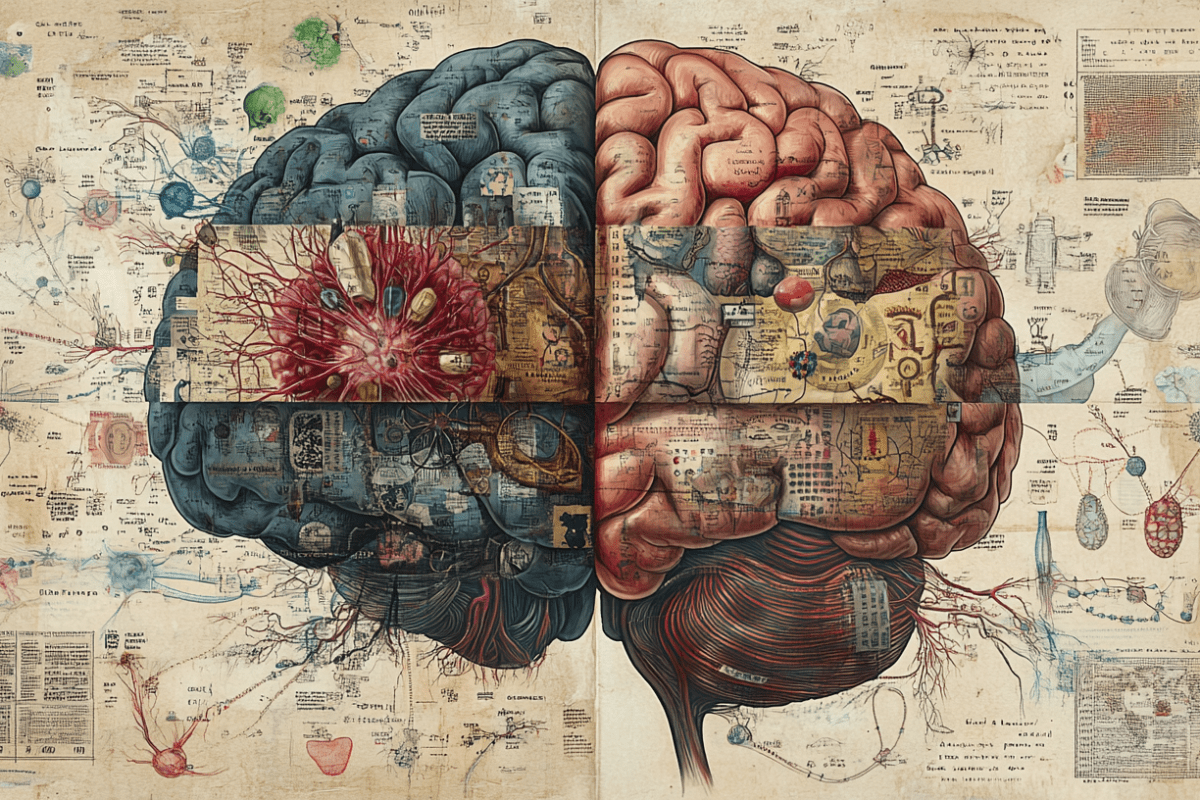



 Philosophics