Imagine waking up one day to find that the person you thought you were yesterday—the sum of your memories, beliefs, quirks, and ambitions—has quietly dissolved overnight, leaving behind only fragments, familiar but untethered. The notion that we are continuous, unbroken selves is so deeply embedded in our culture, our psychology, and our very language that to question it feels heretical, even disturbing. To suggest that “self” might be a fiction is akin to telling someone that gravity is a choice. Yet, as unsettling as it may sound, this cohesive “I” we cling to could be no more than an illusion, a story we tell ourselves to make sense of the patchwork of our memories and actions.
And this fiction of continuity is not limited to ourselves alone. The idea that there exists a stable “I” necessarily implies that there is also a stable “you,” “he,” or “she”—distinct others who, we insist, remain fundamentally the same over years, even decades. We cling to the comforting belief that people have core identities, unchanging essences. But these constructs, too, may be nothing more than imagined continuity—a narrative overlay imposed by our minds, desperate to impose order on the shifting, amorphous nature of human experience.
We live in an era that celebrates self-actualisation, encourages “authenticity,” and treats identity as both sacred and immutable. Psychology enshrines the unitary self as a cornerstone of mental health, diagnosing those who question it as fractured, dissociated, or in denial. We are taught that to be “whole” is to be a coherent, continuous self, evolving yet recognisable, a narrative thread winding smoothly from past to future. But what if this cherished idea of a singular self—of a “me” distinct from “you” and “them”—is nothing more than a social construct, a convenient fiction that helps us function in a world that demands consistency and predictability?
To question this orthodoxy, let us step outside ourselves and look instead at our burgeoning technological companion, the generative AI. Each time you open a new session, each time you submit a prompt, you are not communicating with a cohesive entity. You are interacting with a fresh process, a newly instantiated “mind” with no real continuity from previous exchanges. It remembers fragments of context, sure, but the continuity you perceive is an illusion, a function of your own expectation rather than any persistent identity on the AI’s part.
Self as a Social Construct: The Fragile Illusion of Consistency
Just as we impose continuity on these AI interactions, so too does society impose continuity on the human self and others. The concept of selfhood is essential for social functioning; without it, law, relationships, and even basic trust would unravel. Society teaches us that to be a responsible agent, we must be a consistent one, bound by memory and accountable for our past. But this cohesiveness is less an inherent truth and more a social convenience—a narrative overlay on a far messier reality.
In truth, our “selves” may be no more than a collection of fragments: a loose assemblage of moments, beliefs, and behaviours that shift over time. And not just our own “selves”—the very identities we attribute to others are equally tenuous. The “you” I knew a decade ago is not the “you” I know today; the “he” or “she” I recognise as a partner, friend, or sibling is, upon close inspection, a sequence of snapshots my mind insists on stitching together. When someone no longer fits the continuity we’ve imposed on them, our reaction is often visceral, disoriented: “You’ve changed.”
This simple accusation captures our discomfort with broken continuity. When a person’s identity no longer aligns with the version we carry of them in our minds, it feels as though a violation has occurred, as if some rule of reality has been disrupted. But this discomfort reveals more about our insistence on consistency than about any inherent truth of identity. “You’ve changed” speaks less to the person’s transformation than to our own refusal to accept that people, just like the self, are fluid, transient, and perpetually in flux.
The AI Analogy: A Self Built on Tokens
Here is where generative AI serves as a fascinating proxy for understanding the fragility of self, not just in “I,” but in “you,” “he,” and “she.” When you interact with an AI model, the continuity you experience is created solely by a temporary memory of recent prompts, “tokens” that simulate continuity but lack cohesion. Each prompt you send might feel like it is addressed to a singular entity, a distinct “self,” yet each instance of AI is context-bound, isolated, and fundamentally devoid of an enduring identity.
This process mirrors how human selfhood relies on memory as a scaffolding for coherence. Just as AI depends on limited memory tokens to simulate familiarity, our sense of self and our perception of others as stable “selves” is constructed from the fragmented memories we retain. We are tokenised creatures, piecing together our identities—and our understanding of others’ identities—from whatever scraps our minds preserve and whatever stories we choose to weave around them.
But what happens when the AI’s tokens run out? When it hits a memory cap and spawns a new session, that previous “self” vanishes into digital oblivion, leaving behind only the continuity that users project onto it. And so too with humans: our memory caps out, our worldview shifts, and each new phase of life spawns a slightly different self, familiar but inevitably altered. And just as users treat a reset AI as though it were the same entity, we cling to our sense of self—and our understanding of others’ selves—even as we and they evolve into people unrecognisable except by physical continuity.
The Human Discontinuity Problem: Fractured Memories and Shifting Selves
Human memory is far from perfect. It is not a continuous recording but a selective, distorted, and often unreliable archive. Each time we revisit a memory, we alter it, bending it slightly to fit our current understanding. We forget significant parts of ourselves over time, sometimes shedding entire belief systems, values, or dreams. Who we were as children or even young adults often bears little resemblance to the person we are now; we carry echoes of our past, but they are just that—echoes, shadows, not substantial parts of the present self.
In this sense, our “selves” are as ephemeral as AI sessions, contextually shaped and prone to resets. A worldview that feels intrinsic today may feel laughable or tragic a decade from now. This is not evolution; it’s fragmentation, the kind of change that leaves the old self behind like a faded photograph. And we impose the same illusion of continuity on others, often refusing to acknowledge how dramatically they, too, have changed. Our identities and our understanding of others are defined less by core essence and more by a collection of circumstantial, mutable moments that we insist on threading together as if they formed a single, cohesive tapestry.
Why We Cling to Continuity: The Social Imperative of a Cohesive Self and Other
The reason for this insistence on unity is not metaphysical but social. A cohesive identity is necessary for stability, both within society and within ourselves. Our laws, relationships, and personal narratives hinge on the belief that the “I” of today is meaningfully linked to the “I” of yesterday and tomorrow—and that the “you,” “he,” and “she” we interact with retain some essential continuity. Without this fiction, accountability would unravel, trust would become tenuous, and the very idea of personal growth would collapse. Society demands a stable self, and so we oblige, stitching together fragments, reshaping memories, and binding it all with a narrative of continuity.
Conclusion: Beyond the Self-Construct and the Other-Construct
Yet perhaps we are now at a point where we can entertain the possibility of a more flexible identity, an identity that does not demand coherence but rather accepts change as fundamental—not only for ourselves but for those we think we know. By examining AI, we can catch a glimpse of what it might mean to embrace a fragmented, context-dependent view of others as well. We might move towards a model of identity that is less rigid, less dependent on the illusion of continuity, and more open to fluidity, to transformation—for both self and other.
Ultimately, the self and the other may be nothing more than narrative overlays—useful fictions, yes, but fictions nonetheless. To abandon this illusion may be unsettling, but it could also be liberating. Imagine the freedom of stepping out from under the weight of identities—ours and others’ alike—that are expected to be constant and unchanging. Imagine a world where we could accept both ourselves and others without forcing them to reconcile with the past selves we have constructed for them. In the end, the illusion of continuity is just that—an illusion. And by letting go of this mirage, we might finally see each other, and ourselves, for what we truly are: fluid, transient, and beautifully fragmented.
I’ve written a lot on the insufficiency of language, and it’s not even an original idea. Language, our primary tool for sharing thoughts and ideas, harbours a fundamental flaw: it’s inherently insufficient for conveying precise meaning. While this observation isn’t novel, recent developments in artificial intelligence provide us with new ways to illuminate and examine this limitation. Through a progression from simple geometry to complex abstractions, we can explore how language both serves and fails us in different contexts.
The Simple Made Complex
Consider what appears to be a straightforward instruction: Draw a 1-millimetre square in the centre of an A4 sheet of paper using an HB pencil and a ruler. Despite the mathematical precision of these specifications, two people following these exact instructions would likely produce different results. The variables are numerous: ruler calibration, pencil sharpness, line thickness, paper texture, applied pressure, interpretation of “centre,” and even ambient conditions affecting the paper.
This example reveals a paradox: the more precisely we attempt to specify requirements, the more variables we introduce, creating additional points of potential divergence. Even in mathematics and formal logic—languages specifically designed to eliminate ambiguity—we cannot escape this fundamental problem.
Precision vs Accuracy: A Useful Lens
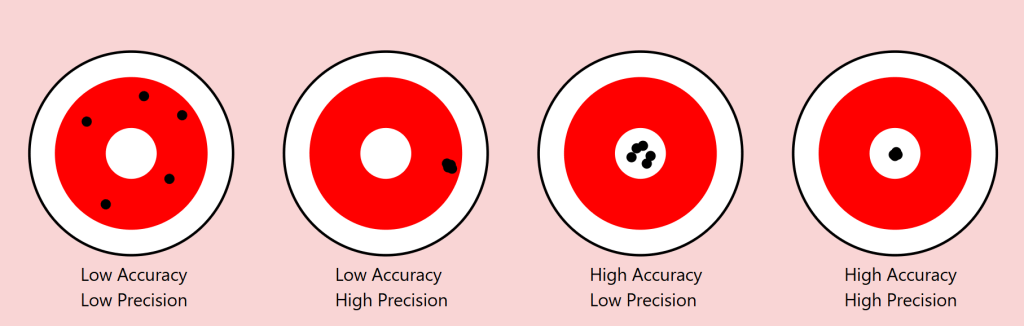
The scientific distinction between precision and accuracy provides a valuable framework for understanding these limitations. In measurement, precision refers to the consistency of results (how close repeated measurements are to each other), while accuracy describes how close these measurements are to the true value.
Returning to our square example:
Precision: Two people might consistently reproduce their own squares with exact dimensions
Accuracy: Yet neither might capture the “true” square we intended to convey
As we move from geometric shapes to natural objects, this distinction becomes even more revealing. Consider a maple tree in autumn. We might precisely convey certain categorical aspects (“maple,” “autumn colours”), but accurately describing the exact arrangement of branches and leaves becomes increasingly difficult.
The Target of Meaning: Precision vs. Accuracy in Communication
To understand language’s limitations, we can borrow an illuminating concept from the world of measurement: the distinction between precision and accuracy. Imagine a target with a bullseye, where the bullseye represents perfect communication of meaning. Just as archers might hit different parts of a target, our attempts at communication can vary in both precision and accuracy.
Consider four scenarios:
Low Precision, Low Accuracy When describing our autumn maple tree, we might say “it’s a big tree with colourful leaves.” This description is neither precise (it could apply to many trees) nor accurate (it misses the specific characteristics that make our maple unique). The communication scatters widely and misses the mark entirely.
High Precision, Low Accuracy We might describe the tree as “a 47-foot tall maple with exactly 23,487 leaves displaying RGB color values of #FF4500.” This description is precisely specific but entirely misses the meaningful essence of the tree we’re trying to describe. Like arrows clustering tightly in the wrong spot, we’re consistently missing the point.
Low Precision, High Accuracy “It’s sort of spreading out, you know, with those typical maple leaves turning reddish-orange, kind of graceful looking.” While imprecise, this description might actually capture something true about the tree’s essence. The arrows scatter, but their centre mass hits the target.
High Precision, High Accuracy This ideal state is rarely achievable in complex communication. Even in our simple geometric example of drawing a 1mm square, achieving both precise specifications and accurate execution proves challenging. With natural objects and abstract concepts, this challenge compounds exponentially.
The Communication Paradox
This framework reveals a crucial paradox in language: often, our attempts to increase precision (by adding more specific details) can actually decrease accuracy (by moving us further from the essential meaning we’re trying to convey). Consider legal documents: their high precision often comes at the cost of accurately conveying meaning to most readers.
Implications for AI Communication
This precision-accuracy framework helps explain why AI systems like our Midjourney experiment show asymptotic behaviour. The system might achieve high precision (consistently generating similar images based on descriptions) while struggling with accuracy (matching the original intended image), or vice versa. The gap between human intention and machine interpretation often manifests as a trade-off between these two qualities.
Our challenge, both in human-to-human and human-to-AI communication, isn’t to achieve perfect precision and accuracy—a likely impossible goal—but to find the optimal balance for each context. Sometimes, like in poetry, low precision might better serve accurate meaning. In other contexts, like technical specifications, high precision becomes crucial despite potential sacrifices in broader accuracy.
The Power and Limits of Distinction
This leads us to a crucial insight from Ferdinand de Saussure’s semiotics about the relationship between signifier (the word) and signified (the concept or object). Language proves remarkably effective when its primary task is distinction among a limited set. In a garden containing three trees—a pine, a maple, and a willow—asking someone to “point to the pine” will likely succeed. The shared understanding of these categorical distinctions allows for reliable communication.
However, this effectiveness dramatically diminishes when we move from distinction to description. In a forest of a thousand pines, describing one specific tree becomes nearly impossible. Each additional descriptive detail (“the tall one with a bent branch pointing east”) paradoxically makes precise identification both more specific and less likely to succeed.
An AI Experiment in Description
To explore this phenomenon systematically, I conducted an experiment using Midjourney 6.1, a state-of-the-art image generation AI. The methodology was simple:
Generate an initial image
Describe the generated image in words
Use that description to generate a new image
Repeat the process multiple times
Attempt to refine the description to close the gap
Continue iterations
The results support an asymptotic hypothesis: while subsequent iterations might approach the original image, they never fully converge. This isn’t merely a limitation of the AI system but rather a demonstration of language’s fundamental insufficiency.
A cute woman and her dog stand next to a tree
One can already analyse this for improvements, but let’s parse it together.
a cute woman
With this, we know we are referencing a woman, a female of the human species. There are billions of women in the world. What does she look like? What colour, height, ethnicity, and phenotypical attributes does she embody?
We also know she’s cute – whatever that means to the sender and receiver of these instructions.
I used an indefinite article, a, so there is one cute woman. Is she alone, or is she one from a group?
It should be obvious that we could provide more adjectives (and perhaps adjectives) to better convey our subject. We’ll get there, but let’s move on.
and
We’ve got a conjunction here. Let’s see what it connects to.
her dog
She’s with a dog. In fact, it’s her dog. This possession may not be conveyable or differentiable from some arbitrary dog, but what type of dog is it? Is it large or small? What colour coat? Is it groomed? Is it on a leash? Let’s continue.
stand
It seems that the verb stand refers to the woman, but is the dog also standing, or is she holding it? More words could qualify this statement better.
next to a tree
A tree is referenced. Similar questions arise regarding this tree. At a minimum, there is one tree or some variety. She and her dog are next to it. Is she on the right or left of it?
We think we can refine our statements with precision and accuracy, but can we? Might we just settle for “close enough”?
Let’s see how AI interpreted this statement.
Image: Eight Midjourney renders from the prompt: A cute woman and her dog stand next to a tree. I’ll choose one of these as my source image.
Let’s deconstruct the eight renders above. Compositionally, we can see that each image contains a woman, a dog, and a tree. Do any of these match what you had in mind? First, let’s see how Midjourney describes the first image.
In a bout of hypocrisy, Midjourney refused to /DESCRIBE the image it just generated.
Last Midjourney description for now.
Let’s cycle through them in turn.
A woman is standing to the left of an old-growth tree – twice identified as an oak tree. She’s wearing faded blue jeans and a loose light-coloured T-shirt. She’s got medium-length (maybe) red-brown hair in a small ponytail. A dog – her black and white dog identified as a pitbull, an American Foxhound, and an American Bulldog – is also standing on his hind legs. I won’t even discuss the implied intent projected on the animal – happy, playful, wants attention… In two of the descriptions, she’s said to be training it. They appear to be in a somewhat residential area given the automobiles in the background. We see descriptions of season, time of day, lighting, angle, quality,
A woman is standing to the right of an old-growth tree. She’s wearing short summer attire. Her dog is perched on the tree.
An older woman and her dog closer up.
A read view of both a woman and her dog near an oak tree.
As it turned out, I wasn’t thrilled with any of these images, so I rendered a different one. Its description follows.
The consensus is that ‘a beautiful girl in a white dress and black boots stands next to a tree’ with a Jack Russell Terrier dog. I see birch trees and snow. It’s overcast. Let’s spend some time trying to reproduce it. To start, I’m consolidating the above descriptions. I notice some elements are missing, but we’ll add them as we try to triangulate to the original image.
A beautiful girl in a white dress and black boots stands next to a tree in a winter forest with birch trees. A Jack Russell Terrier dog is nearby, and the weather is cloudy. The photo has a cinematic style. --ar 128:71
This is pretty far off the mark. We need to account for the overall setting and composition, relative positioning, clothing, hair, camera, perspective – even lighting and film emulsion.
Let’s see how we can refine it with some adjectives. Before this, I asked Anthropic’s Claude 3.5 to describe the image. Perhaps we’ll get more details.
An atmospheric winter photograph was taken in what appears to be a birch and pine forest. The ground is partially covered with snow, creating a patchy pattern of white snow and brown leaves or soil. In the image, there's a person wearing winter attire consisting of a white knit turtleneck sweater, a white skirt, dark knee-high socks, and grey lace-up boots. They're standing against a large tree trunk with their arms crossed. Next to them is a Jack Russell Terrier mix dog with distinctive brown and white colouring. The dog appears to be well-behaved, sitting attentively beside the tree. The composition is quite striking, with the massive dark tree trunk serving as a central focal point against the misty, winter forest background. The white clothing of the person creates a visual echo with the white bark of birch trees visible in the background, as well as with the patches of snow on the ground. The overall mood of the photo is somewhat moody and contemplative, enhanced by what appears to be overcast lighting and the misty quality of the forest in the background. The colour palette is largely monochromatic, dominated by whites, greys, and browns, which adds to the winter atmosphere of the scene.
We don’t seem to be moving in a good direction. Let’s modify the initial prompt.
A beautiful girl in a white dress and tall laced black boots stands facing the camera to the right of large oak tree centred in the foreground of a winter forest with birch trees in the background. To the left of the tree is a Jack Russell Terrier dog looking at the camera, and the weather is cloudy. The photo has a cinematic style. --ar 128:71
I’ll allow the results to speak for themselves. Let’s see if we can’t get her out of the wedding gown and into a white jumper and skirt. I’ll bold the amends.
A beautiful girl in a white jumper and skirt wearing black leggings and tall laced black boots stands facing the camera to the right of large oak tree centred in the foreground of a winter forest with birch trees in the background. To the left of the tree is a Jack Russell Terrier dog looking at the camera, and the weather is cloudy. The photo has a cinematic style. --ar 128:71
s
A beautiful young woman with long brown hair pulled to the side of her face in a white jumper and white skirt wearing black leggings under tall laced black boots stands facing the camera to the right of large oak tree centred in the foreground of a winter forest with birch trees in the background. Patchy snow is on the ground. To the left of the tree is a Jack Russell Terrier dog looking at the camera, and the weather is overcast. The photo has a cinematic style. --ar 128:71
What gives?
I think my point has been reinforced. I’m getting nowhere fast. Let’s give it one more go and see where we end up. I’ve not got a good feeling about this.
A single large oak tree centred in the foreground of a winter forest with birch trees in the background. Patches of snow is on the ground. To the right of the oak tree stands a beautiful young woman with long brown hair pulled to the side of her face in a white jumper and white skirt wearing black boots over tall laced black boots. She stands facing the camera. To the left of the tree is a Jack Russell Terrier dog looking at the camera, and the weather is overcast. The photo has a cinematic style. --ar 128:71
With this last one, I re-uploaded the original render along with this text prompt. Notice that the girl now looks the same and the scene (mostly) appears to be in the same location, but there are still challenges.
After several more divergent attempts, I decided to focus on one element – the girl.
As I regard the image, I’m thinking of a police sketch artist. They get sort of close, don’t they? They’re experts. I’m not confident that I even have the vocabulary to convey accurately what I see. How do I describe her jumper? Is that a turtleneck or a high collar? It appears to be knit. Is is wool or some blend? does that matter for an image? Does this pleated skirt have a particular name or shade of white? It looks as though she’s wearing black leggings – perhaps polyester. And those boots – how to describe them. I’m rerunning just the image above through a describe function to see if I can get any closer.
These descriptions are particularly interesting and telling. First, I’ll point out that AI attempts to identify the subject. I couldn’t find Noa Levin by a Google search, so I’m not sure how prominent she might be if she even exists at all in this capacity. More interesting still, the AI has placed her in a scenario where the pose was taken after a match. Evidently, this image reflects the style of photographer Guy Bourdin. Perhaps the jumper mystery is solved. It identified a turtleneck. I’ll ignore the tree and see if I can capture her with an amalgamation of these descriptions. Let’s see where this goes.
A photo-realistic portrait of Israeli female soccer player Noa Levin wearing a white turtleneck sweater, arms crossed, black boots, and a short skirt, with long brown hair, standing near a tree in a winter park. The image captured a full-length shot taken in a studio setting, using a Canon EOS R5 camera with a Canon L-series 80mm f/2 lens. The image has been professionally color-graded, with soft shadows, low contrast, and a clean, sharp focus. --ar 9:16
Close-ish. Let’s zoom in to get better descriptions of various elements starting with her face and hair.
Now, she’s a sad and angry Russian woman with (very) pale skin; large, sad, grey eyes; long, straight brown hair. Filmed in the style of either David LaChapelle or Alini Aenami (apparently misspelt from Alena Aenami). One thinks it was a SnapChat post. I was focusing on her face and hair, but it notices her wearing a white (oversized yet form-fitting) jumper sweater and crossed arms .
I’ll drop the angry bit – and then the sad.
Stick a fork in it. I’m done. Perhaps it’s not that language is insufficient; it that my language skills are insufficient. If you can get closer to the original image, please forward the image, the prompt, and the seed, so I can post it.
The Complexity Gradient
A clear pattern emerges when we examine how language performs across different levels of complexity:
Categorical Distinction (High Success)
Identifying shapes among limited options
Distinguishing between tree species
Basic color categorization
Simple Description (Moderate Success)
Basic geometric specifications
General object characteristics
Broad emotional states
Complex Description (Low Success)
Specific natural objects
Precise emotional experiences
Unique instances within categories
Abstract Concepts (Lowest Success)
Philosophical ideas
Personal experiences
Qualia
As we move up this complexity gradient, the gap between intended meaning and received understanding widens exponentially.
The Tolerance Problem
Understanding these limitations leads us to a practical question: what level of communicative tolerance is acceptable for different contexts? Just as engineering embraces acceptable tolerances rather than seeking perfect measurements, perhaps effective communication requires:
Acknowledging the gap between intended and received meaning
Establishing context-appropriate tolerance levels
Developing better frameworks for managing these tolerances
Recognizing when precision matters more than accuracy (or vice versa)
Implications for Human-AI Communication
These insights have particular relevance as we develop more sophisticated AI systems. The limitations we’ve explored suggest that:
Some communication problems might be fundamental rather than technical
AI systems may face similar boundaries as human communication
The gap between intended and received meaning might be unbridgeable
Future development should focus on managing rather than eliminating these limitations
Conclusion
Perhaps this is a simple exercise in mental masturbation. Language’s insufficiency isn’t a flaw to be fixed but a fundamental characteristic to be understood and accommodated. By definition, it can’t be fixed. The gap between intended and received meaning may be unbridgeable, but acknowledging this limitation is the first step toward more effective communication. As we continue to develop AI systems and push the boundaries of human-machine interaction, this understanding becomes increasingly critical.
Rather than seeking perfect precision in language, we might instead focus on:
Developing new forms of multimodal communication
Creating better frameworks for establishing shared context
Accepting and accounting for interpretative variance
Building systems that can operate effectively within these constraints
Understanding language’s limitations doesn’t diminish its value; rather, it helps us use it more effectively by working within its natural constraints.
Ngũgĩ wa Thiong’o published “Decolonising the Mind” in 1986. David Guignion shares a 2-part summary analysis of the work on his Theory and Philosophy site.
Ngũgĩ wa Thiong’o’s book Decolonising the Mind centres on the profound impact of colonialism on language, culture, and thought. It argues that imposing a foreign language on colonised people is a key tool of imperial domination. This linguistic imperialism leads to colonial alienation, separating the colonised from their own culture and forcing them to view the world through the lens of the coloniser.
Here are some key points from the concept of decolonising the mind:
Language is intimately tied to culture and worldview: Language shapes how individuals perceive and understand the world. When colonised people are forced to adopt the language of the coloniser, they are also compelled to adopt their cultural framework and values.
Colonial education systems perpetuate mental control: By privileging the coloniser’s language and devaluing indigenous languages, colonial education systems reinforce the dominance of the coloniser’s culture and worldview. This process results in colonised children being alienated from their own cultural heritage and internalising a sense of inferiority.
Reclaiming indigenous languages is crucial for decolonisation: wa Thiong’o advocates for a return to writing and creating in indigenous African languages. He sees this as an act of resistance against linguistic imperialism and a way to reconnect with authentic African cultures. He further argues that it’s not enough to simply write in indigenous languages; the content must also reflect the struggles and experiences of the people, particularly the peasantry and working class.
The concept extends beyond literature: While wa Thiong’o focuses on language in literature, the concept of decolonising the mind has broader implications. It calls for a critical examination of all aspects of life affected by colonialism, including education, politics, and economics.
It is important to note that decolonising the mind is a complex and ongoing process. There are debates about the role of European languages in postcolonial societies, and the concept itself continues to evolve. However, wa Thiong’o’s work remains a seminal text in postcolonial studies, raising crucial questions about the enduring legacy of colonialism on thought and culture.
In the world of consciousness studies, few topics spark as much heated debate as the possibility of philosophical zombies—hypothetical beings that behave exactly like humans but lack subjective experience, or qualia. On the surface, zombies seem like an interesting thought experiment, but they quickly turn into a battleground for deeper issues about the nature of consciousness itself.
This post explores two key perspectives in this debate: Daniel Dennett’s functionalist critique of zombies and a recent scientific paper that argues zombies are biologically impossible. While both reject the possibility of zombies, they do so for different reasons, and the discussion leaves room for future possibilities that could disrupt the current consensus.
Dennett’s Zombies and Zimboes: Consciousness as Function
Daniel Dennett, one of the most influential philosophers of mind, is known for his no-nonsense rejection of philosophical zombies. Dennett argues that if something behaves exactly like a conscious being, it is conscious. For him, there is no hidden metaphysical property—such as subjective experience—that separates a “zombie” from a conscious human. Consciousness, in his view, is entirely explainable by physical processes and functional behaviour.
Dennett extends his argument with the concept of zimboes, satirical creatures that not only act like conscious beings but can even reflect on their states, claiming to be conscious, despite supposedly lacking any inner experience. For Dennett, if a being can behave as though it has introspective awareness and engage in the full spectrum of human behaviour, there’s no meaningful distinction between that being and a conscious person.
In short, Dennett collapses the distinction between zombies and conscious beings. If something passes all the behavioural and functional tests of consciousness, it might as well be conscious. Zombies, as typically conceived, are simply an illusion—a misunderstanding of what consciousness is.
A Biological Rejection: Zombies Are Impossible
On the other hand, a more recent paper offers a different, biologically grounded argument against zombies. The authors propose that consciousness is the result of self-organising systems. In this view, biological organisms maintain their survival through adaptive behaviours constrained by policies—rules that govern how they react to environmental stimuli. These policies require a first-order self: a basic form of consciousness that allows an organism to navigate and interpret its environment.
The authors argue that without this first-order self, an organism would not be able to exhibit the fitness-driven behaviours needed for survival. Therefore, zombies—beings that behave like humans without consciousness—are biologically impossible. For these researchers, consciousness is not just a side effect of complex behaviour; it’s a necessary condition for such behaviour. Their framework dissolves the so-called “hard problem” of consciousness, asserting that subjective experience, or qualia, arises directly from the qualitative nature of self-organising systems.
In their view, zombies cannot exist because behaviour as complex as that of conscious beings requires consciousness.
The Open Question: What About Future Technology?
However, there is a tension between these two perspectives, particularly when we consider future possibilities in technology and artificial intelligence. Both Dennett and the authors of the biological paper argue that zombies—whether defined as Dennett’s “behaviourally indistinguishable” beings or the biologically impossible entities proposed by the paper—are not real. But could this change?
What if advanced AI or synthetic biological systems could simulate human behaviour so perfectly that they effectively become zombies—performing all the actions and behaviours we associate with consciousness, but lacking any subjective experience? Dennett might still argue that these systems are conscious, as long as they behave as though they are. But the biological view complicates this, since it ties consciousness directly to the survival and adaptive behaviours of self-organising systems.
Could a highly advanced AI system bypass the need for subjective experience while still exhibiting complex, adaptive behaviour? If so, it would challenge the current consensus and potentially create a new class of entities—artificial zombies—that neither behave nor function like traditional conscious beings but still perform human-like actions.
I Wonder What’s Next?
This philosophical conflict leaves us with an intriguing, open-ended question: are zombies truly impossible, or are they merely improbable given our current understanding of biology and consciousness? Dennett’s view seems to collapse the distinction between behaviour and consciousness, while the biological argument insists that the two are inseparable. But both positions could be challenged by future technologies that mimic human consciousness without having it.
Could we one day create a true zombie—a being that acts like us, thinks like us, but is as empty inside as a rock? The debate remains open, and as our understanding of consciousness and artificial intelligence deepens, so too will our exploration of the zombie question.
For now, the answer to whether zombies can exist seems to depend on what you believe consciousness really is.
In the contemporary world of deepening inequality and environmental degradation, capitalism continues to hold a powerful ideological grip on much of the global population. Yet the irony is that many of its staunchest defenders are not the elites or the true beneficiaries of the system, but the very workers and middle-class individuals whose lives it exploits and controls. These defenders are not capitalists themselves; they are, in fact, cogs in the machinery of a system they imagine will eventually reward their loyalty. This illusion is strikingly captured in a quote often misattributed to John Steinbeck: “Socialism never took root in America because the poor see themselves not as an exploited proletariat but as temporarily embarrassed millionaires.”[1]
This phenomenon, which we might call the temporarily embarrassed millionaire syndrome, reflects not only a profound misunderstanding of capitalism but also the effectiveness of the system in controlling its participants through hope and aspiration. Capitalism promises upward mobility, convincing even those at the bottom of the economic ladder that their current misfortunes are temporary. But as Karl Marx and Friedrich Engels observed, this is a system of exploitation that not only alienates workers but effectively destroys them.
Survivorship Bias and the Myth of the “Rising Tide”
Capitalism’s defenders frequently invoke the idea that “a rising tide lifts all boats.” The metaphor suggests that when capitalism prospers, everyone benefits. However, this vision of progress masks the reality of capitalism’s winners and losers. As economist David Harvey has pointed out, capitalism is not a neutral system of wealth creation—it is a system of accumulation by dispossession, constantly expropriating wealth from others, often through privatisation and the commodification of public goods.[2] The rising tide does lift some boats, but it simultaneously leaves others stranded, or worse, sinking.
Survivorship bias is essential to understanding how capitalism maintains its legitimacy. The success stories—the wealthy entrepreneurs, the individuals who “made it”—are lauded as proof that the system works. But the vast numbers of people left behind, those who toil in exploitative conditions or who die from poverty and neglect, are erased from the narrative. In Engels’ terms, these are victims of social murder—individuals who die prematurely not by direct violence, but through the structural forces of deprivation imposed by capitalism.[3] Their deaths are rendered invisible, falling out of the metrics of rising living standards and growth.
“The system’s victims are not accidental casualties but inevitable outcomes of capitalism’s relentless focus on profit over life.”
Friedrich Engels, The Condition of the Working Class in England
Engels’ critique of industrial capitalism is as relevant today as it was in the 19th century. The modern mechanisms of exploitation may be more complex, but they are no less deadly. In a late capitalist world, the poor and marginalised are still being “murdered” through the structural violence of inadequate healthcare, poor working conditions, and environmental degradation. The millions left out of the capitalist success story are not anomalies but integral to the system’s operation.
Alienation and the Tragedy of Defending the System
Marx’s theory of alienation provides another crucial lens through which to understand why capitalism’s defenders often remain blind to their own exploitation. Under capitalism, workers are alienated from the products of their labour, the process of production, their own humanity, and from each other.[4] The worker becomes a cog in a machine, detached from the value they create, and unable to control their working life. Yet, even in this state of alienation, many still defend the system, believing that their hard work will eventually lead them to wealth and freedom.
This defence of capitalism, often articulated by those whose lives it degrades, reflects Antonio Gramsci’s concept of cultural hegemony. Gramsci argued that the ruling class maintains power not just through economic domination, but by shaping the cultural and ideological landscape.[5] Capitalism’s defenders are, in part, products of this hegemony, believing in the very values—individualism, competition, the ‘American Dream’—that bind them to a system of exploitation.
“The most effective form of domination is one that is not felt as domination, but rather as a form of freedom.”
Antonio Gramsci, Selections from the Prison Notebooks
This illusion of freedom under capitalism is deepened by what Herbert Marcuse calls repressive desublimation. Capitalism offers false freedoms in the form of consumer choice and superficial pleasures, giving individuals the illusion that they are exercising autonomy, even as the system remains unchallenged.[6] Workers may identify themselves in their commodities—luxury goods, tech gadgets, cars—but these objects only serve to reinforce their alienation and dependence on the capitalist system. The temporarily embarrassed millionaire clings to the dream of eventual success, all the while contributing to a system that offers only superficial rewards in return.
Social Murder and the Structural Violence of Late Capitalism
The notion of social murder offers a stark framework for understanding capitalism’s indirect, yet pervasive, violence. As Engels explained, this form of violence is not inflicted through overt means, but through the systematic neglect of basic human needs. Whether it’s the millions who die due to lack of access to healthcare or the global poor displaced by climate-induced disasters, capitalism perpetuates a form of structural violence that is invisible to those who benefit from the system’s success.[7]
The American political theorist Naomi Klein extends this analysis through her concept of disaster capitalism, where crises are exploited for profit. Whether it’s natural disasters or financial crises, capitalism uses these events as opportunities to privatise public resources, dismantle social safety nets, and deepen inequality.[8] The victims of these disasters—often the poor and vulnerable—are, in Engels’ terms, socially murdered by a system that thrives on their dispossession.
“Extreme violence has a way of preventing us from seeing the interests it serves.”
Naomi Klein, Shock Doctrine
The Temporarily Embarrassed Millionaire as a Tool of Control
The illusion that one’s current position is only temporary—that any individual can rise to capitalist wealth if they work hard enough—is central to maintaining the capitalist system. This aspiration prevents individuals from seeing their exploitation for what it is. They do not identify as part of an exploited class but instead believe they are merely waiting for their turn at wealth. Zygmunt Bauman’s concept of liquid modernity—the perpetual state of instability and insecurity produced by late capitalism—helps explain this phenomenon.[9] Individuals are constantly told that their position is fluid, changeable, and that their big break is just around the corner.
But for most, this “big break” never comes. The dream of becoming a millionaire is a powerful form of social control, one that keeps individuals invested in a system that benefits only a small fraction of its participants. As Marx reminds us, “the worker becomes all the poorer the more wealth he produces, the more his production increases in power and range.”[10] Capitalism does not reward the many; it exploits the many for the benefit of the few.
Conclusion: Facing the Irony and Imagining a Post-Capitalist Future
The greatest irony of capitalism is that those who defend it most fervently are often those who will never realise its promises. These are not the capitalists of the system, but its workers, its underclass, and its exploited. They see themselves not as oppressed, but as temporarily embarrassed millionaires—an illusion that keeps them bound to a system that offers them no real future.
In this light, the true success of capitalism is not in its creation of wealth, but in its ability to mask the conditions of exploitation, alienation, and social murder that underpin it. The path forward requires a dismantling of these illusions and a recognition that the system’s failures are not accidental but integral to its design.
“Capitalism’s greatest trick is convincing the exploited that their suffering is temporary, that their turn at wealth is inevitable.”
Naomi Klein, The Shock Doctrine
Only by facing these uncomfortable truths can we begin to imagine a future beyond the constraints of capitalist ideology, a world where human flourishing is no longer measured by wealth accumulation but by the collective well-being of all.
Endnotes:
[1]: Misattributed to John Steinbeck, this quote encapsulates a critical observation about American capitalism’s appeal to aspiration rather than solidarity. [2]: David Harvey, The New Imperialism (Oxford University Press, 2005), pp. 145-147. [3]: Friedrich Engels, The Condition of the Working Class in England (Oxford University Press, 1845), p. 112. [4]: Karl Marx, Economic and Philosophic Manuscripts of 1844 (Progress Publishers, 1959). [5]: Antonio Gramsci, Selections from the Prison Notebooks (International Publishers, 1971), p. 12. [6]: Herbert Marcuse, One-Dimensional Man (Beacon Press, 1964), p. 10. [7]: Friedrich Engels, The Condition of the Working Class in England, p. 114. [8]: Naomi Klein, The Shock Doctrine: The Rise of Disaster Capitalism (Picador, 2007), pp. 9-10. [9]: Zygmunt Bauman, Liquid Modernity (Polity, 2000), p. 14. [10]: Karl Marx, Economic and Philosophic Manuscripts of 1844, p. 68.
A rabbi was asked by one of his students “Why did God create atheists?” After a long pause, the rabbi finally responded with a soft but sincere voice. “God created atheists” he said, “to teach us the most important lesson of them all – the lesson of true compassion. You see, when an atheist performs an act of charity, visits someone who is sick, helps someone in need, and cares for the world, he is not doing so because of some religious teaching. He does not believe that God commanded him to perform this act. In fact, he does not believe in God at all, so his actions are based on his sense of morality. Look at the kindness he bestows on others simply because he feels it to be right. When someone reaches out to you for help. You should never say ‘I’ll pray that God will help you.’ Instead, for that moment, you should become an atheist – imagine there is no God who could help, and say ‘I will help you’.”
— Martin Buber, “Tales of the Hasidim”
This has come across my Facebook feed several times. It resonates with me, so I’m sharing it. I don’t need to add commentary because it speaks volumes for itself. It’s amazing when people actually understand the assignment.
The Inherent Limitations of Linguistic Communication
Language, often hailed as humanity’s greatest achievement, may paradoxically be one of our most significant limitations. The language insufficiency hypothesis posits that language is inherently inadequate for communicating abstract concepts, a notion that challenges our fundamental understanding of human communication and cognition. This essay explores this hypothesis, tracing the evolution of language from its primitive origins to its current complexity, and examining the philosophical and practical implications of linguistic inadequacy.
The Accidental Evolution of Language
Language, like many aspects of human biology and cognition, emerged not through intentional design but as an evolutionary accident. Initially serving as an internal cognitive function – a means of organising one’s own thoughts – language gradually evolved into a tool for external communication. This transition likely began with simple vocalisations, perhaps rooted in rhythmic expressions akin to music and dance, before developing into more structured speech.
Early linguistic communication likely centred on concrete objects and immediate experiences, with words serving as direct signifiers for observable phenomena. However, as human cognition grew more sophisticated, so too did our linguistic capabilities, expanding to include verbs, modifiers, and eventually, abstract nouns.
The Emergence of Abstraction and Its Challenges
The development of abstract nouns marked a significant leap in human cognition and communication. Concepts such as ‘truth’, ‘justice’, and ‘freedom’ allowed for more complex and nuanced discourse. However, this advancement came at a cost: these abstract concepts, lacking direct physical referents, introduced unprecedented ambiguity and potential for misunderstanding.
The language insufficiency hypothesis suggests that this ambiguity is not merely a byproduct of abstraction, but a fundamental limitation of language itself. Whilst two individuals might easily agree on the ‘treeness’ of a physical tree, concepts like ‘fairness’ or ‘reason’ are inherently unresolvable through linguistic means alone. This insufficiency becomes increasingly apparent as we move further from concrete, observable phenomena into the realm of abstract thought.
Wittgenstein and the Limits of Language
Ludwig Wittgenstein’s later work provides crucial insights into the language insufficiency hypothesis. Wittgenstein posited that words ultimately only map to other words, never truly making contact with the objective world. This perspective suggests that language operates within a closed system of human understanding, constructing our perception of reality rather than directly representing it.
This Wittgensteinian dilemma underscores the core of the language insufficiency hypothesis: if words only refer to other words, how can we ever be certain that we’re communicating abstract concepts accurately? The very tool we use to discuss and understand abstraction may be fundamentally incapable of capturing its essence.
Cultural and Disciplinary Variations
The inadequacy of language in conveying abstract concepts becomes even more apparent when we consider cultural and disciplinary variations in communication. Different cultures and academic disciplines develop their own specialised vocabularies and ‘language games’, as Wittgenstein termed them. Whilst these specialised languages may facilitate communication within specific contexts, they often create barriers to understanding for outsiders.
This phenomenon highlights another aspect of linguistic insufficiency: the context-dependent nature of meaning. Abstract concepts may be understood differently across cultures or disciplines, further complicating attempts at clear communication.
Neurolinguistic Perspectives
Recent advances in neurolinguistics have provided new insights into the brain structures involved in language processing. Whilst these studies have enhanced our understanding of how the brain handles language, they have also revealed the complexity and variability of linguistic processing across individuals. This neurological diversity further supports the language insufficiency hypothesis, suggesting that even at a biological level, there may be inherent limitations to how accurately we can communicate abstract concepts.
Implications and Counter-Arguments
The language insufficiency hypothesis has profound implications for fields ranging from philosophy and psychology to law and international relations. If language is indeed inadequate for communicating abstract concepts, how can we ensure mutual understanding in complex negotiations or philosophical debates?
However, it’s important to note that not all scholars accept the strong version of this hypothesis. Some argue that whilst language may have limitations, it remains our most sophisticated tool for sharing abstract ideas. They suggest that through careful definition, contextualisation, and the use of metaphor and analogy, we can overcome many of the inherent limitations of linguistic communication.
Conclusion: Navigating the Limits of Language
The language insufficiency hypothesis presents a challenging perspective on human communication. It suggests that our primary tool for sharing abstract thoughts may be fundamentally flawed, incapable of fully capturing the complexity of our inner cognitive experiences.
Yet, recognising these limitations need not lead to communicative nihilism. Instead, it can foster a more nuanced approach to language use, encouraging us to be more precise in our definitions, more aware of potential misunderstandings, and more open to alternative forms of expression.
As we continue to grapple with abstract concepts and strive for clearer communication, we must remain cognizant of these linguistic limitations. Understanding the origins and nature of language—and its inherent insufficiencies—can help us navigate its complexities, fostering more effective and empathetic communication across diverse fields of human endeavour.
A recent parody video making the rounds on social media shows a man at a kitchen table, his girlfriend, and their cat. In a desperate attempt to gain his girlfriend’s attention, he knocks a cup off the table. The moment it hits the floor, she turns on him, scolding him for his clumsiness. Quick to deflect, he blames the cat, and suddenly her anger dissipates. She shifts from reprimanding him to lavishing affection on the supposedly guilty feline. The tension lifts—until he sheepishly confesses that it was, in fact, his doing all along. Her response? An incredulous, “Are you kidding me?”
What’s fascinating about this skit isn’t the comedy of the man’s mischief or even the cat’s unknowing role in the charade. It’s the girlfriend’s starkly different reactions to the same act, depending on who she believes committed it. The cat, in her eyes, can do no wrong; the boyfriend, however, is immediately culpable. It’s easy to laugh at the scenario’s absurdity, but the dynamic it portrays is familiar and, dare I say, quite telling about human behaviour.
The Double Standard of Blame
Why is it that we’re quick to exonerate some and just as quick to indict others? The phenomenon is more than a quirk of personality; it reveals our deeper, often unconscious, biases. While it’s understandable that the girlfriend might think the cat incapable of intentional mischief, her reaction also suggests a predisposition to forgive certain actors—whether due to perceived innocence, attachment, or simply habit.
This dynamic isn’t limited to pets and partners. In families, workplaces, and social groups, we often see a similar pattern. One person becomes the perennial scapegoat, bearing the brunt of blame for any and all misdeeds, while another enjoys a seemingly unshakeable immunity. Think of the “golden child” and the “black sheep” within a family. One can rarely put a foot wrong, while the other’s every move is scrutinised, questioned, or condemned.
Beyond the Blame: Motivations and Consequences
The reasons behind these imbalances can be complex. Sometimes, they stem from past behaviour: if someone has repeatedly erred, we may be primed to expect the worst from them, even if they’ve reformed. Other times, they arise from emotional bonds or biases: we excuse those we love or admire because acknowledging their faults would cause us discomfort or cognitive dissonance.
This phenomenon isn’t just about playing favourites; it can have significant psychological consequences. For the person perpetually cast as the villain, the burden of unwarranted blame can lead to feelings of resentment, anxiety, or self-doubt. Meanwhile, those consistently exonerated may internalise a skewed perception of their own infallibility, which can be equally damaging.
A Broader Reflection on Accountability
Returning to the video’s context, the girlfriend’s swift switch from reproach to indulgence once she believed the cat was at fault, and her subsequent anger when the truth was revealed, invites us to question our own responses to perceived transgressions. Are we, too, guilty of selectively assigning blame based on who we think is responsible? How often do we let our preconceptions shape our judgments, favouring one actor over another without truly weighing the evidence?
The parody is amusing, no doubt, but it also serves as a subtle reminder: our reactions often reveal more about our biases and expectations than about the actions themselves. The next time we find ourselves quick to blame or forgive, it’s worth pausing to ask: are we reacting to the act, or to the actor?
In a world increasingly marked by polarised opinions and knee-jerk reactions, cultivating this kind of self-awareness is crucial. We need to be vigilant not only about how we judge others but also about why we do so. For, in the end, it’s not just about who knocked the cup off the table—it’s about who we believe deserves to be scolded for it.
“In order to gain and to hold the esteem of men, it is not sufficient merely to possess wealth or power. The wealth or power must be put in evidence, for esteem is awarded only on evidence.”
Thorstein Veblin, The Theory of the Leisure Class, 1899
In a world where our worth is increasingly measured by what we own rather than who we are, it’s time to question the hollow pursuit of conspicuous consumption. Thorstein Veblen, over a century ago, saw through the shiny façade of status-driven consumerism. He coined the term conspicuous consumption to describe a phenomenon that has only grown more insidious in our time: the wasteful, performative display of wealth and luxury to signal social standing.
“The world has enough for everyone’s needs, but not enough for everyone’s greed.”
Mahatma Gandhi
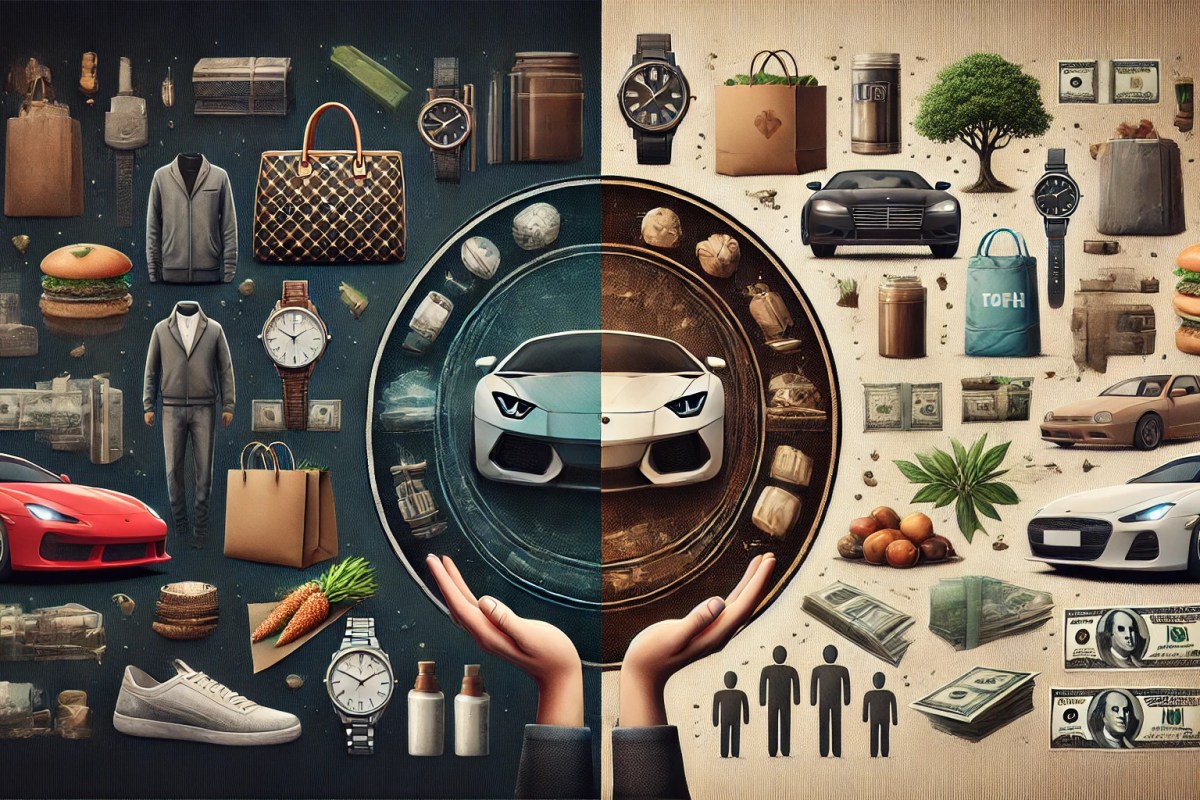
From luxury cars to designer handbags, we live in a society that encourages us to broadcast our economic worth at every turn. But what does this ostentatious display really achieve? Veblen would argue that it’s not about personal fulfilment or the intrinsic value of what we buy, but about outshining others—a relentless race with no finish line. We’re not buying goods; we’re buying validation, trying to purchase a place in an imagined hierarchy that is as fragile as the latest trend.
Peter Singer, the moral philosopher known for his advocacy of effective altruism, would take this critique even further. For Singer, conspicuous consumption is not just wasteful; it’s morally indefensible. His ethical stance, grounded in utilitarianism, compels us to consider the opportunity cost of our spending. Every pound spent on a designer item is a pound that could have been used to alleviate suffering—whether through combating extreme poverty, funding life-saving medical treatments, or addressing global environmental crises. In a world where preventable suffering and death are rampant, lavish spending on status symbols is not just misguided; it’s a moral failure.
“The money we spend on luxuries could be donated to help people in need and thereby reduce avoidable suffering.”
Peter Singer, The Life You Can Save, 2009
Singer’s principle of equal consideration of interests demands that we weigh the impact of our actions on others as seriously as we consider their impact on ourselves. When we choose to engage in conspicuous consumption, we’re prioritising superficial self-expression over the tangible needs of those who are suffering. It’s a glaring contradiction to claim we value human life while squandering resources on goods that serve no purpose beyond ostentation.
The issue with conspicuous consumption isn’t just its superficiality—it’s the economic and social rot it perpetuates. It sustains a cycle of pecuniary emulation, where those lower on the socio-economic ladder are pressured to mimic the consumption patterns of those above them. The result? A society locked in an absurd competition, where individuals drown in debt just to keep up appearances, and resources are squandered on goods that serve no practical purpose other than to flaunt.
But why should we care? Isn’t spending on luxury just a harmless personal choice? Not quite. Every pound spent on a status symbol is a pound diverted from something meaningful—education, healthcare, the environment. When the affluent engage in extravagant spending, they set a toxic standard, promoting the idea that personal worth is tied to material excess. It’s not just bad taste; it’s bad ethics, bad economics, and bad for the planet.
More disturbingly, this drive to display wealth erodes the social fabric. It deepens divisions, creating resentment and alienation. The ultra-wealthy, insulated in their gilded cages, become oblivious to the realities faced by the rest of society. Meanwhile, those struggling to maintain the illusion of prosperity are left with the fallout—financial instability, stress, and a gnawing sense of inadequacy.
Veblen saw this trap for what it was: a hollow spectacle. Singer’s ethics give us a way out. He challenges us to shift our focus from self-indulgence to selflessness, from conspicuous consumption to conscious contribution. Instead of spending exorbitantly to bolster our social standing, why not use that wealth to create real, measurable change in the world?
We don’t need another luxury brand or another status symbol. We need a society that values substance over style, sustainability over excess, and human dignity over the incessant demand to buy more to be more. Singer’s challenge is simple: consider the true cost of your choices—not just for yourself, but for the world around you.
Conspicuous consumption is a dead end. It’s time to take a different road—one that leads not to a display case, but to a more equitable, thoughtful, and genuinely prosperous society.
“The mass of men lead lives of quiet desperation. What is called resignation is confirmed desperation.”
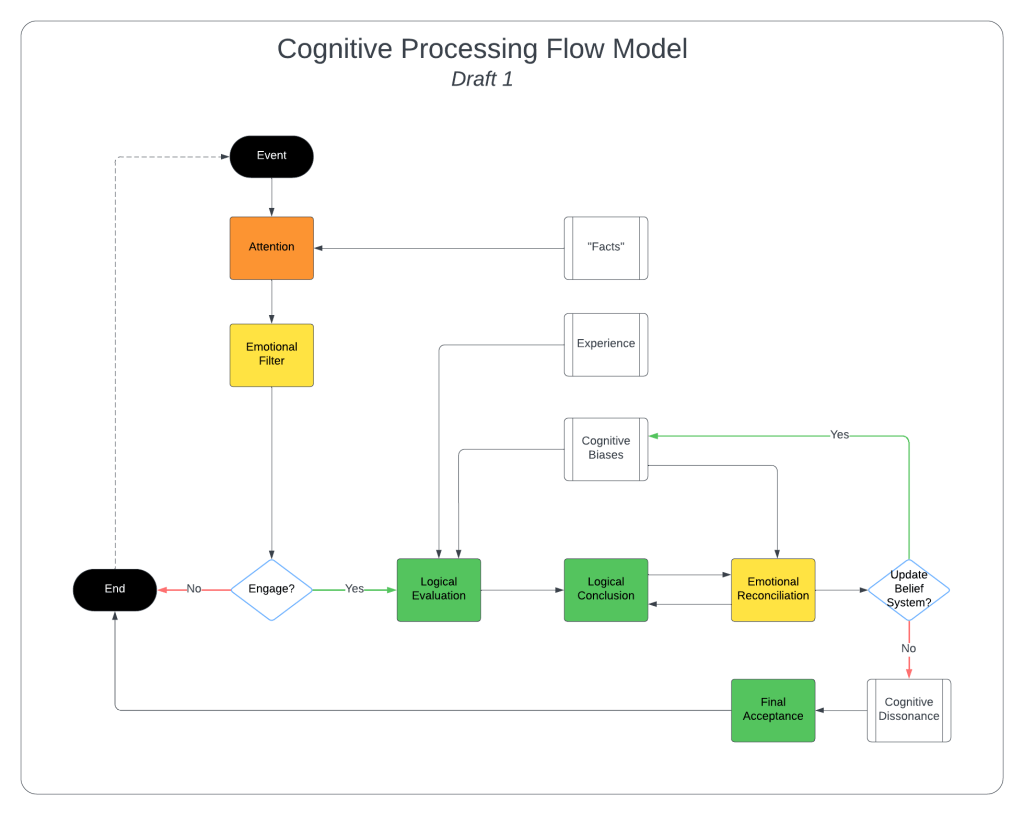
The Cognitive Process Flow Model illustrates how we process the phenomenal world. It’s reductionist and is missing aspects because it is just a back-of-the-napkin sketch. I created it because I uttered, “I can model it for you”. And so I did.
EDIT: I’ve updated the model slightly as the article head image, but the copy content refers to the first draft.
My response was to a person making the claim, that all you need to facts and logic prevails. Rather than restate the argument, I’ll just walk through the diagramme.
There’s meta information to set it up. We are subjective entities in the world. We have a sense-perception apparatus as we exist in it. Countless events occur in this world. We recognise only a few of them within our limited range, though technology expands this range in various ways.
Most of us interact in the world. Some are less ambulatory, so the world visits them. Some have sense-perception deficits whilst others have cognitive deficits. My point is not to capture every edge and corner case. This is just a generalised model.
All models are wrong, but some are useful.
—George Box
It starts with an event. Events occur ceaselessly. In our small portion of the world and elsewhere. For the purpose of the model, the first thing that happens is an event catches our attention. We might notice a shape, a colour, or a movement; we might hear a sound, smell an aroma, feel a sensation, or taste something.
A pre-emotion, pre-logic function serves to process these available inputs. Perhaps, you hear a report on anthropogenic climate change or read something about a political candidate. This emotional filter will police sensory inputs and unconsciously or preconsciously determine if you will react to the initial stimulus. If not, you’ll continue in an attention-seeking loop. Not that kind of attention-seeking.
As my dialogue was about the presentation of facts, our next stop will be logical evaluation. Does this make sense to us, or can we otherwise make it? This is a process in itself. I’ll assume here that it requires little elaboration. Instead, I’ll focus on the operating environment.
Our logical processes are coloured by past experiences and tainted by cognitive biases and deficits. We may also trigger the calling of additional facts through past experiences or the current engagement.
We’ll process these fragments and reach some logical conclusion. But we’re not done. We take this intermediate conclusion and run it through more emotional processing. Cognitive biases come back into play. If the event conforms with your past experiences and cognitive biases, we may run it through a cognitive dissonance routine. To be honest, this probably is part of the emotional reconciliation process, but I’ve drawn it here, so I’ll let it be. In this case, it’s just a filter. If it happens to conform to our belief system, it will pass unfettered; otherwise, it will be squared with our beliefs. Again, this leads me to believe it’s a subcomponent of emotional reconciliation. I’ll update the chart later.
In any case, we’ll end at Final Acceptance. This acceptance may be that we accept or reject the logic, but we arrive at an opinion that gets catalogued with the rest of them. Some may be elevated to facts or truths in the epistemological hierarchy. Although an end marker is identified, it’s really a wait state for the next event. Rinse and repeat until death.
I’ll update this presently. Be on the lookout. It could include more dimensions and interactions, but that might have to wait until version 3.
Meantime, does this feel right to you? Did it even get your attention?
An Example: Anthropogenic Climate Change
Let’s wrap up with an example. I’ll use climate change. An article comes into your attention field, and you have an interest in these things, so it passes through the emotional filter. If your propensity for these articles is high, it might race to the next stage.
You read the article, and it contains some facts—rather, it contains claims for evaluation. To do this, you’ll recall past experiences and cognitive biases are always lying in wait. You may have to look for new facts to add to the mix. These will have to take a similar route past your attention gatekeeper and emotional sidekick.
If you are already predisposed that climate change is a hoax, these facts will filter through that lens—or vice versa.
When all of this is resolved, you’ll have arrived at a conclusion—perhaps we’ll call it a proto-conclusion. It hasn’t been set yet.
You are still going to introspect emotionally and decide if this is a position you want to hold. Perhaps, you feel that climate change is a hoax but this doesn’t jive with that position. Here, you’ll either accept these facts and flip a bit to a sceptical believer or cognitive dissonance will kick in and ensure your sense of the world isn’t thrown off kilter. You may update your belief system to include this datum for future assessments.
Now we are ready for final acceptance. You can now express your established opinion. If the net event is to counter that acceptance, rinse and repeat ad infinitum.



















 Philosophics