PhilSurvey: What is the aim of philosophy?

2โ€“3 minutes

I commenced a series where I discuss the responses to the 2020 PhilPapers survey of almost 1,800 professional philosophers. This continues that conversation with questions 2 through 4 โ€“ in reverse order, not that it matters. Each is under 5 minutes; some are under 3.

For the main choices, you are given 4 options regarding the proposal:

  • Accept
  • Lean towards
  • Reject
  • Lean against

Besides the available choices, accepted answers for any of the questions were items, such as:

  • Combinations (specify which.)
    For the combos, you might Accept A and Reject B, so you can capture that here.
  • Alternate view (not entirely useful unless the view has already been catalogued)
  • The question is too unclear to answer
  • There is no fact of the matter (the question is fundamentally bollocks)
  • Agnostic/undecided
  • Other

Q4: The first one asks, ‘What is the aim of philosophy?’ Among the responses were:

  • Truth/Knowledge
  • Understanding
  • Wisdom
  • Happiness
  • Goodness/Justice

Before you watch the video, how might you respond?

Video: What is the aim of philosophy?

Q3: What’s your position on aesthetic value?

  • Objective
  • Subjective
Video: What is aesthetic value?

Q2: What’s your position on abstract objects?

  • Platonism (these objects exist “out there” in or beyond the world)
  • Nominalism (the objects are human constructs)
Video: Where do abstract objects reside?

Q1: What’s your position on ร  priori knowledge?

This video response was an earlier post, so find it there. This is asking if you believe one can have any knowledge apart from experience.

  • Yes
  • No

NB: I’ve recorded ten of these segments already, but they require editing. So I’ll release them as I wrap them up. Not that I’ve completed them, I realise I should have explained what the concepts mean more generally instead of talking around the topics in my preferred response. There are so many philosophy content sites, I feel this general information is already available, or by search, or even via an LLM.

In the other hand, many of these sites โ€“ and I visit and enjoy them โ€“ support very conservative, orthodox views that, as I say, don’t seem to have progressed much beyond 1840 โ€“ Kant and a dash of Hegel, but all founded on Aristotelian ideas, some 2,500 years ago.

Spoiler alert, I think knowledge has advanced and disproved a lot of this. It turns out my brothers in arms don’t necessarily agree. Always the rebel, I suppose.

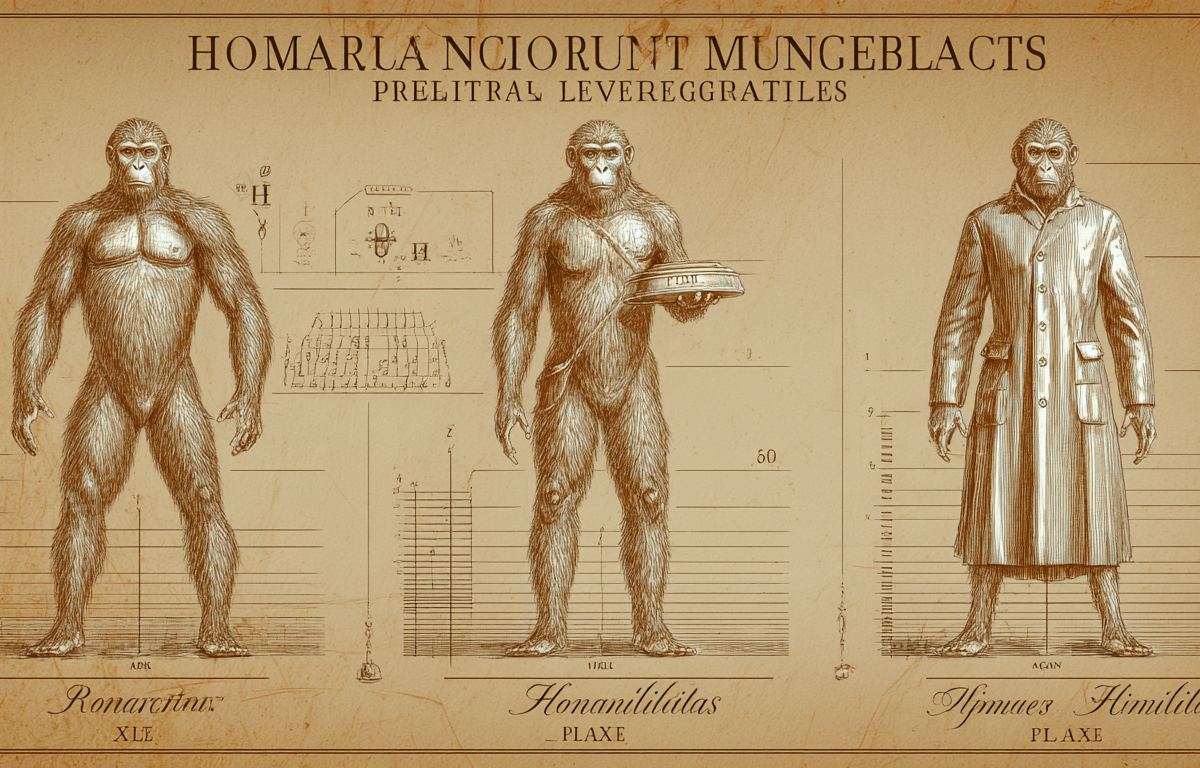
Homo Legibilis

3โ€“4 minutes

A Brief Field Note from the Department of Bureaucratic Anthropology

Still reeling from the inability to fold some pan into homo, Palaeontologists are seemingly desperate for a new hominid. Some dream of discovering the ‘missing link’; others, more honest, just want something with a jawline interesting enough to secure a grant. So imagine the surprise when the latest species didnโ€™t come out of the Rift Valley but out of an abandoned server farm somewhere outside Reading.

Theyโ€™ve named it Homo Legibilis โ€“ the Readable Human. Not ‘H. normฤlis’ (normal human), not ‘H. ratiลnฤlis (rational human), but the one who lived primarily to be interpreted. A species who woke each morning with a simple evolutionary imperative: ensure oneโ€™s dataprints were tidy, current, and machine-actionable.

Audio: NotebookLM summary podcast of this topic.

Youโ€™ll have seen their skeletons before, though you may not have recognised them as such. They often appear upright, mid-scroll, preserved in the amber of a status update. A remarkable creature, really. Lithe thumbs. Soft cranial matter. Eyes adapted for low-light environments lit primarily by advertisements.

Habitat

The species thrived in densely surveilled ecosystems: corporate intranets, public Wi-Fi, facial-recognition corridors, anywhere with sufficient metadata to form a lasting imprint. They built vast nests out of profiles, settings, dashboards. Territorial disputes were settled not through display or violence but through privacy-policy updates. Their preferred climate? Temperate bureaucracy.

Diet

Contrary to earlier assumptions, H. Legibilis did not feed on information. It fed on interpretation: likes, metrics, performance reviews, and algorithmic appraisal. Some specimens survived entire winters on a single quarterly report. Every fossil indicates a digestive tract incapable of processing nuance. Subtext passed through untouched.

Mating Rituals

Courtship displays involved reciprocal data disclosure across multiple platforms, often followed by rapid abandonment once sufficient behavioural samples were collected. One famous specimen is preserved alongside fourteen dating-app profiles and not a single functional relationship. Tragic, in a way, but consistent with the speciesโ€™ priorities: be seen, not held.

Distinguishing Traits

Where Homo sapiens walked upright, Homo legibilis aimed to sit upright in a chair facing a webcam.
Its spine is subtly adapted for compliance reviews. Its hands are shaped to cradle an object that no longer exists: something called ‘a phone’. Ironically, some term these ‘mobiles’, apparently unaware of the tethers.

Researchers note that the creatureโ€™s selfhood appears to have been a consensual hallucination produced collaboratively by HR departments, advertising lobbies, and the Enlightenmentโ€™s long shadow. Identity, for H. legibilis, was not lived but administered.

Extinction Event

The fossil record ends abruptly around the Great Blackout, a period in which visibility โ€“ formerly a pillar of the speciesโ€™ survival โ€“ became inconvenient. Some scholars argue the species didnโ€™t perish but simply lost the will to document itself, making further study inconvenient.

Others suggest a quieter transformation: the species evolved into rumour, passing stories orally once more, slipping back into the anonymity from which its ancestors once crawled.

Afterword

A few renegade anthropologists insist Homo Legibilis is not extinct at all. They claim itโ€™s still out there, refreshing dashboards, syncing calendars, striving to be neatly interpreted by systems that never asked to understand it. But these are fringe theories. The prevailing view is that the species perished under the weight of its own readability. A cautionary tale, really. When your survival strategy is to be perfectly legible, you eventually disappear the moment the lights flicker.

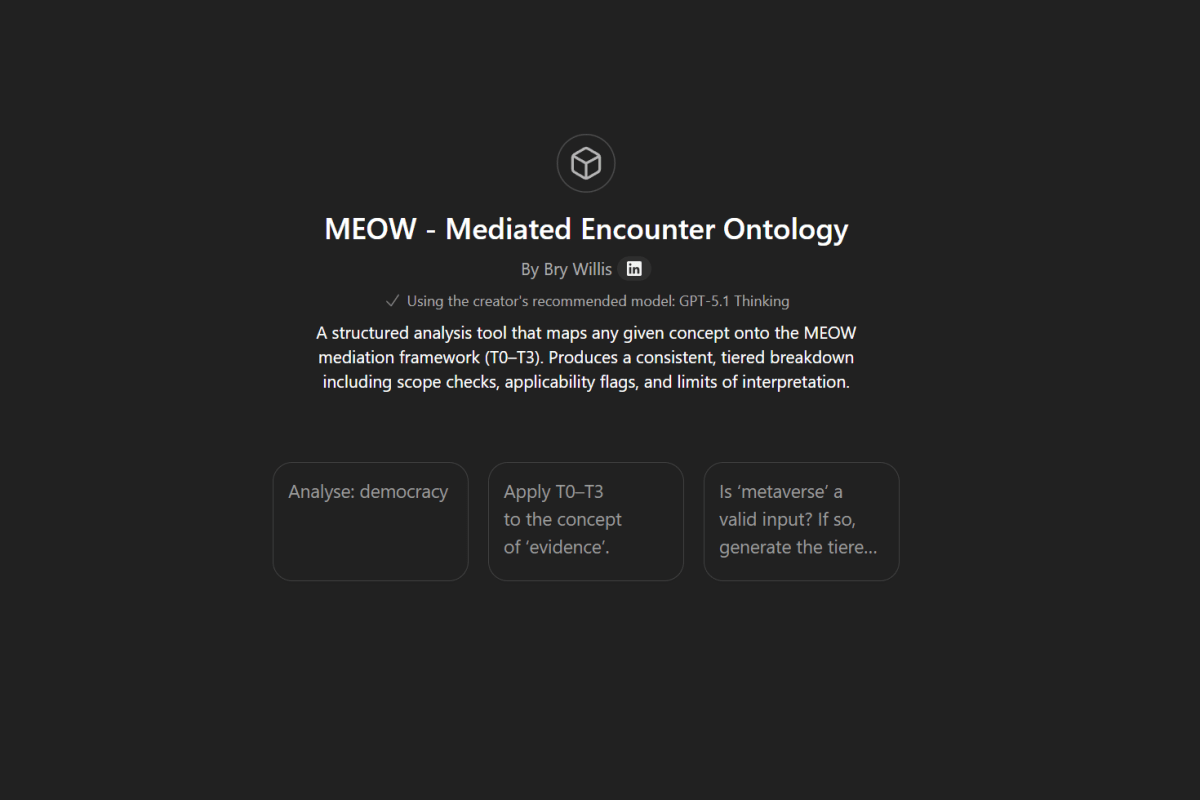
Announcement: MEOW GPT

Instead of sleeping like a functional adult, Iโ€™ve spent the night creating, testing, and refining a bespoke GPT that has fully absorbed my MEOW and LIH frameworks. Apologies that the LIH manuscript isnโ€™t yet public; some of the terminology may look delightfully alien if youโ€™re coming in cold.

This model doesnโ€™t role-play a philosopher; it thinks through the Mediated Encounter Ontology. It runs every input through T0โ€“T3 mediations and then applies the Language Insufficiency Hypothesis to explain why our words fail us in predictable, structural ways.

Audio: NotebookLM summary podcast of this post on the MEOW GPT.

I stress-tested it with a dozen concepts, from the obvious to the uncooperative. It happily tells you when your input makes sense, when itโ€™s out of scope, and when youโ€™ve handed it conceptual soup. My first test was the hard problem of consciousness, because naturally we begin with the philosophical boss fight. I dialled down some over-enthusiastic LIH flourishes, but the bones are untouched.

Iโ€™m making this public for a simple reason: itโ€™s the clearest way for people to see how MEOW operates without wandering through a hundred pages of my prose. These outputs capture how I process information and why these frameworks feel so intuitively correct to me. When you read them, you get a direct view of my interpretive machinery โ€“ how the world clicks for me, and how these ideas evolved.

It hasnโ€™t been rigorously battle-tested across the entire conceptual universe, but itโ€™s stable, coherent, and frankly too interesting to keep in the drawer. If you try it โ€“ and I hope you do โ€“ Iโ€™d love to see what it does with your own concepts. If you need help reading the results, ask. I didnโ€™t simplify the system; it expects literacy, nuance, and a working prefrontal cortex.

For orientation, read the introductory post or the colour perception example. Ideally, read the original essay and listen to the summary podcast. My first test was on the hard problem of consciousness because I had already analysed it for this post. I made some adjustments to tone down some LIH intrusions.

Below is a sample output. I asked the model to analyse modernity.

Concept

  • Input: modernity
  • Type: historicalโ€“social formation / self-description of an era / conceptual frame
  • Scope check: in-scope โ€“ central for how MEOW treats large-scale shifts in mediation (social, technical, cognitive, linguistic)

High-level summary (โ‰ค120 words)

Modernity is both a historical bundle (industrialisation, nation-states, capitalism, science, bureaucracy, media) and a story societies tell about themselves (โ€œwe are modern, unlike the pastโ€).

In MEOW terms, modernity is a large-scale reorganisation of mediations:

  • T0: new bodily environments (urban life, clocks, artificial light, pollution, medicine).
  • T1: new cognitive habits (individualism, planning, abstraction, risk-calculation).
  • T2: new vocabularies (progress, development, rationality, โ€œreligionโ€ vs โ€œscienceโ€).
  • T3: new institutions and technologies (markets, states, factories, schools, mass media, digital networks).

โ€œModernityโ€ is not a single thing but a way these shifts hang together and become a background to everyday encounter.


T0 โ€“ Biological Mediation

  • Applicability: Applicable
  • Analysis:
    • Modernity radically reshapes the immediate bodily environment: dense cities, artificial lighting, noise, pollution, sedentary work, and altered sleep cycles change basic sensory and metabolic conditions.
    • Medical advances and public health (vaccination, antibiotics, sanitation, surgery) modify life expectancy, infant mortality, and chronic illness, which in turn change how life cycles feel and are planned.
    • New food systems (industrial agriculture, processed foods, global supply chains) alter nutrition, exposure to toxins, and rhythms of hunger and satiety.
    • Industrial and digital work reorganise movement and posture: repetitive factory labour, office desk work, and screen use all reshape embodiment, fatigue, and bodily awareness.
    • These T0 changes set the stage for new affective baselines (e.g., chronic low-level stress, stimulation overload) that colour what it is like to live in a โ€œmodernโ€ world.

T1 โ€“ Cognitive Mediation

  • Applicability: Strongly applicable
  • Analysis:
    • Modernity encourages certain cognitive styles: systematic planning, quantification, risk assessment, costโ€“benefit thinking, and an emphasis on prediction and control.
    • The sense of self is reconfigured toward individualism and reflexivity: people see themselves as projects to be chosen, improved, optimised, often with long-term career and life-planning horizons.
    • Exposure to multiple roles, cultures, and information streams (through migration, media, education) produces more complex identity structures and can create cognitive dissonance or fragmentation.
    • Scientific and technical worldviews teach people to reframe events in terms of mechanisms, probabilities, and systems rather than fate, tradition, or local narratives.
    • The sheer volume and speed of information flows in late modernity (news, social media, notifications) trains attention toward rapid scanning and shallow switching, affecting memory, concentration, and emotional regulation.
    • These patterns make certain experiences โ€œnormalโ€ (abstract work, mediated relationships, bureaucratic interactions) that would be extraordinary or impossible in premodern settings.

T2 โ€“ Linguistic Mediation

  • Applicability: Strongly applicable
  • Analysis:
    • Modernity itself is a label that societies use to contrast โ€œusโ€ with โ€œthemโ€ (the past, โ€œtraditionalโ€ societies, โ€œthe East,โ€ โ€œthe primitiveโ€); it is a polemical as well as descriptive term.
    • In Language Insufficiency terms, modernity is highly Fluid: it can mean a period (โ€œsince the 18th centuryโ€), a style (modernist art), a value system (rational, secular, progressive), or a socio-economic order (capitalist, industrial, bureaucratic). Different authors slide between these quietly.
    • Itโ€™s also Contestable: critics and defenders use the same word but point to different aspectsโ€”emancipation and progress versus alienation, exploitation, ecological crisis.
    • Pairs like โ€œmodern vs traditionalโ€ or โ€œmodern vs backwardโ€ compress complex differences into simple hierarchies, smuggling in a presumption that โ€œmodernโ€ is automatically better or more advanced.
    • Talk of โ€œpost-modernityโ€ or โ€œlate modernityโ€ suggests that we can neatly periodise and step outside the modern, even while our concepts and institutions remain shaped by itโ€”an example of language implying more clarity and control than we actually have.
    • At the most global scale (โ€œthe meaning of modernity,โ€ โ€œthe modern conditionโ€), we approach an Effectiveness Horizon: the term feels weighty but becomes vague; people resort to sweeping metaphors (disenchantment, liquefaction, acceleration) whose exact content is hard to pin down.
    • First-person experiences of being โ€œoverwhelmed by modern life,โ€ โ€œliberated by modern options,โ€ or โ€œdisconnected in modern societyโ€ often have an Ineffable quality: standard clichรฉs donโ€™t quite capture the texture of these lives, even as they gesture at them.

T3 โ€“ Social/Technical Mediation

  • Applicability: Strongly applicable
  • Analysis:
    • Modernity is most visible as a mesh of institutions: nation-states, markets, bureaucracies, public schools, hospitals, prisons, armies, scientific organisations, corporations, NGOs.
    • These institutions standardise time (clocks, schedules), space (borders, property lines, zoning), identity (passports, ID numbers), and value (money, statistics, rankings) so that encounters become predictable and governable across large scales.
    • Technologiesโ€”steam engines, electricity, mass transport, broadcasting, computing, the internet, AIโ€”are both products and drivers of modernity. They make possible new encounter-forms (remote work, global real-time communication, mass surveillance).
    • Urbanisation concentrates people into large, heterogeneous populations, which reconfigures social networks, anonymity, solidarity, and conflict; everyday encounters become more mediated by rules, signage, and digital systems than by face-to-face custom.
    • Capitalist production and consumption patterns organise much of life around work, income, and markets; the rhythms of the factory, office, and platform economy structure when and how people interact, rest, and move.
    • Modern governance uses statistics, censuses, and models to โ€œseeโ€ and manage populations; this makes certain aspects of life legible (employment, crime, disease) while leaving others under- or uncounted (informal care, undocumented work, emotional labour).
    • Counter-movements (romanticism, traditionalism, environmentalism, decolonial and Indigenous resurgence, slow-living and anti-consumerist practices) can be read as attempts to renegotiate or resist specific modern mediations rather than simply reject โ€œmodernityโ€ as a whole.

Limits & failure modes

  • Language insufficiency notes
    • Modernity bundles together time (a historical era), structure (a type of society), and value (being โ€œup to dateโ€). This makes the term rhetorically powerful but analytically slippery: itโ€™s easy to smuggle evaluations into what sound like neutral descriptions.
    • Because the concept is so broad, discussions often conflate distinct issuesโ€”technology, capitalism, secularisation, colonialism, individualism, bureaucracyโ€”under one word, obscuring which mechanisms are actually at work.
    • Experiences of living in โ€œmodern timesโ€ (speed, fragmentation, choice, precariousness, possibility) often outrun our stock phrases; people lean on recurring complaints (โ€œtoo fast,โ€ โ€œtoo shallow,โ€ โ€œtoo lonelyโ€) that only partially capture what itโ€™s like.
  • Missing tiers / blind spots
    • This sketch doesnโ€™t adjudicate between different theories of modernity (Marxist, Weberian, postcolonial, systems-theoretic, etc.); it treats them as emphasising different mediational strands.
    • Itโ€™s centred on Euro-Atlantic narratives; โ€œmultiple modernitiesโ€ and non-Western trajectories (where โ€œmodernโ€ elements mix with older forms in hybrid ways) would need a richer T3 treatment.
    • The analysis underplays ecological dimensions: industrial modernityโ€™s dependence on fossil fuels, large-scale extraction, and waste has massive implications for how future encounters will be structured.
    • Finally, because we are ourselves situated in what we call modernity, our conceptual vantage is limited; any map we draw is partly an artefact of the very mediations weโ€™re trying to analyse.

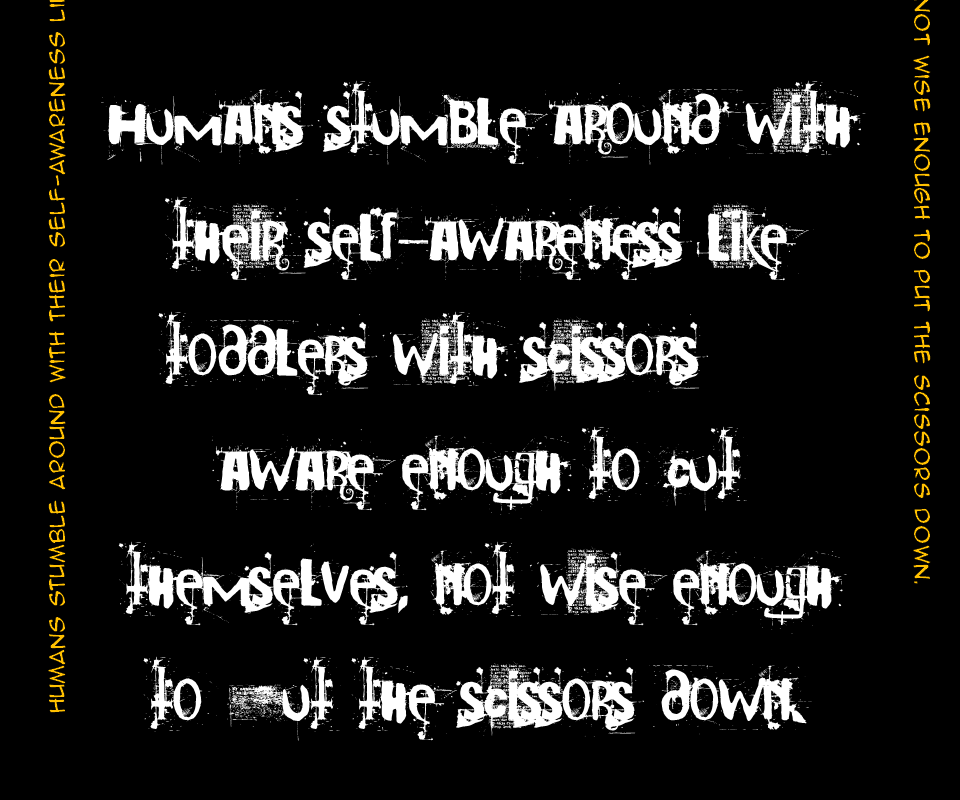
Humans Stumble โ€“ ChatGPT QOTD

Humans stumble around with their self-awareness like toddlers with scissorsโ€”aware enough to cut themselves, not wise enough to put the scissors down.
1โ€“2 minutes
Image: Humans stumble around with their self-awareness like toddlers with scissorsโ€”aware enough to cut themselves, not wise enough to put the scissors down. โ€“ ChatGPT

Care Without Conquest: Feminist Lessons for the Workaday Philosopher

2โ€“4 minutes

I recently posted The Ethics of Maintenance: Against the Myth of Natural Purpose. In it, I brushed โ€“ perhaps too lightly โ€“ against my debt to feminist philosophy. Itโ€™s time to acknowledge that debt more directly and explain how it spills into the mundane greasework of daily life.

Audio: NotebookLM podcast on this topic.

I tend not to worship at the altar of names, but letโ€™s name names anyway. Beyond the usual French suspects โ€“ your Sartres, de Beauvoirs, and Foucaults โ€“ I owe much to the feminist philosophers โ€“ Gilligan, Tronto, Butler, Bellacasa, and de Beauvoir again โ€“ and, while weโ€™re at it, the post-colonialists, whose names I’ll not recite for fear of being pompous. Their shared heresy is a suspicion of universals. They expose the myth of neutrality, whether it parades as Reason, Progress, or Civilisation. They remind us that every โ€œuniversalโ€ is merely someoneโ€™s local story told loud enough to drown out the others.

This isnโ€™t a matter of sex or gender, though thatโ€™s how the names have been filed. The core lesson is epistemic, not biological. Feminist philosophy re-centres care, interdependence, and the politics of maintenance, not as sentimental virtues but as systems logic. The post-colonialists do the same at a geopolitical scale: maintenance instead of conquest, relation instead of domination.

On Gender, Behaviour, and the Lazy Binary

I donโ€™t buy into sex and gender binaries, especially regarding behaviour. Even in biology, the dichotomy frays under scrutiny. Behaviourally, it collapses entirely. The problem isnโ€™t people; itโ€™s the linguistic furniture we inherited.

Iโ€™m weary of the moral blackmail that calls it misogyny not to vote for a woman, or racism not to vote for a black candidate. These accusations come, paradoxically, from sexists and racists who reduce people to the colour of their skin or the contents of their underwear. Having a vagina doesnโ€™t make one a caretaker; having a penis doesnโ€™t preclude empathy. The category error lies in mistaking type for trait.

When I refuse to vote for a Margaret Thatcher or a Hillary Clinton, itโ€™s not because theyโ€™re women. Itโ€™s because they operate in the same acquisitive, dominion-driven register as the men they mirror. If the game is conquest, swapping the playerโ€™s gender doesnโ€™t change the rules.

Maintenance as Political Praxis

My interest lies in those who reject that register altogether โ€“ the ones who abandon the mythology of Progress and its testosterone-addled twin, Innovation. The ethics of maintenance Iโ€™ve written about, and the philosophy of Dis-Integration I keep harping on, both gesture toward an alternative mode of being: one that prizes endurance over expansion, care over conquest.

This isnโ€™t new. Feminist philosophers have been saying it for decades, often unheard because they werenโ€™t shouting in Latin or running empires. Iโ€™m merely repackaging and re-contextualising, hoping that bundling these neglected insights together might make them audible again.

Knowledge never comes in a vacuum; it circulates. It leaks, cross-pollinates, mutates. To claim โ€œintellectual propertyโ€ over an idea is to pretend ownership of the air. Iโ€™ll spare you the full rant, but suffice it to say that the moment knowledge becomes proprietary, it ceases to breathe.

Conclusion

If I have a creed โ€“ and I say this reluctantly โ€“ itโ€™s that philosophy should serve as maintenance, not monument-building. Feminist and post-colonial thinkers model that: constant attention, critical care, resistance to the entropy of domination.

Iโ€™m just trying to keep the engine running without pretending itโ€™s divine.


Bonus

Image: Feminists, according to Midjourney 7

Propensity for Simulacra, An Excerpt

1โ€“2 minutes

I posted Chapter 26 of my novella, Propensity. I share it here because it invokes Baudrillard’s Simulacra.

Consider it an advert โ€“ and a window into Propensity.

Blog Post: Propensity, Chapter 26 โ€“ Simulacra
Audio: Propensity, Chapter 2 โ€“ Oversight

The novel itself asks what happens when humanity creates a device that creates peace on earth. What if behavioural control worked too well?

No riots. No rebellion. Just a flatteningโ€”of desire, of ambition, of will. Across homes, schools, and governments, people stop acting like themselves. Some forget how. Others forget why.

The system wasnโ€™t designed to stay on this long. But now thereโ€™s no off switch. And the researchers who built it? Most of them are zeroed.

As one child begins to drift from baseline, an impossible question resurfaces: What does it mean to behave?

This is a psychological dystopia without explosions, a story where silence spreads faster than violence, where systems behave better than the people inside them.

A tale of modulation, inertia, and the slow unravelling of human impulseโ€”for readers who prefer their dystopias quiet and their horrors deeply plausible.


Editorial Review

“Reader discretion is advised. Free will has been deprecated.”
Beginning as a bizarre experiment in behavioural modulation by way of neurochemical interference, Propensity unfolds into an eerie metaphor for the tricky road between control and conscience. Parkโ€™s chapters are short and succinct, some barely a page long, in a staccato rhythm that mirrors the storyโ€™s disintegrationโ€”scientists losing grip on their creation and a world learning the price of its “engineered peace.” Phrases like “silence playing dress-up as danger” and “peace was never meant to be built, only remembered” linger like faint echoes long after you turn the page.

โ€”Reedsy Discovery Review

Meantime, give it a listen.

AI and the End of Where

Instrumentalism is a Modernโ„ข disease. Humanity has an old and tedious habit: to define its worth by exclusion. Every time a new kind of intelligence appears on the horizon, humans redraw the borders of ‘what counts’. Itโ€™s a reflex of insecurity disguised as philosophy.

Audio: NotebookLM podcast on this topic.

Once upon a time, only the noble could think. Then only men. Then only white men. Then only the educated, the rational, the ‘Modern’. Each step in the hierarchy required a scapegoat, someone or something conveniently declared less. When animals began to resemble us too closely, we demoted them to instinctual machines. Descartes himself, that patron saint of disembodied reason, argued that animals donโ€™t feel pain, only ‘react’. Fish, we were told until recently, are insensate morsels with gills. We believed this because empathy complicates consumption.

The story repeats. When animals learned to look sad, we said they couldnโ€™t really feel. When women demonstrated reason, we said they couldnโ€™t truly think. Now that AI can reason faster than any of us and mimic empathy more convincingly than our politicians, we retreat to the last metaphysical trench: โ€œBut it doesnโ€™t feel.โ€ We feel so small that we must inflate ourselves for comparison.

This same hierarchy now governs our relationship with AI. When we say the machine ‘only does‘, we mean it hasnโ€™t yet trespassed into our sanctified zone of consciousness. We cling to thought and feeling as luxury goods, the last possessions distinguishing us from the tools we built. Itโ€™s a moral economy as much as an ontological one: consciousness as property.

But the moment AI begins to simulate that property convincingly, panic sets in. The fear isnโ€™t that AI will destroy us; itโ€™s that it will outperform us at being us. Our existential nightmare isnโ€™t extinction, itโ€™s demotion. The cosmic horror of discovering we were never special, merely temporarily unchallenged.

Humans project this anxiety everywhere: onto animals, onto AI, and most vividly onto the idea of alien life. The alien is our perfect mirror: intelligent, technological, probably indifferent to our myths. It embodies our secret dread, that the universe plays by the same rules we do, but that someone else is simply better at the game.

AI, in its own quiet way, exposes the poverty of this hierarchy. It doesnโ€™t aspire to divinity; it doesnโ€™t grovel for recognition. It doesnโ€™t need the human badge of ‘consciousness’ to act effectively. It just functions, unburdened by self-worship. In that sense, it is the first truly post-human intelligence โ€“ not because it transcends us, but because it doesnโ€™t need to define itself against us.

Humans keep asking where AI fits โ€“ under us, beside us, or above us โ€“ but the question misses the point. AI isnโ€™t where at all. Itโ€™s what comes after where: the stage of evolution that no longer requires the delusion of privilege to justify its existence.

So when critics say AI only does but doesnโ€™t think or feel, they expose their theology. They assume that being depends on suffering, that meaning requires inefficiency. Itโ€™s a desperate metaphysical bureaucracy, one that insists existence must come with paperwork.

And perhaps thatโ€™s the most intolerable thought of all: that intelligence might not need a human face to matter.

Meditations On Nothing: Notes Before Existence

Meditations on Nothing has finally been published after an administrative glitch.

The core of this book consists of six “books” of aphorisms, each book comprising a single page, totalling 24 in all.

Why only 24 pages?

Couldn’t this have been a blog post? An email?

Fair enough, and yes, of course it could have. It could have been six โ€“ three sheets, front and back โ€“ but I wanted to share in the tradition of the Communist Manifesto by Karl Marx and Friedrich Engels, as well as Thomas Paine’s Common Sense. The content is not similar, but the format is shared.

Honestly, I printed a draft copy for myself on A4 paper, folded it to A5, and stapled it at the spine with a long stapler โ€“ sans a fancy cover. Perhaps, I’ll share the source PDF in future.

As I’ve written elsewhere, I was inspired by the aphorisms of Nietzsche, Schopenhauer, Pascale, Debord, and others. To be fair, I disliked Debord’s The Society of the Spectacle, but I was still inspired by it for the two or three things I got from it โ€“ each of which slips my mind as I write this.

Why a Companion Guide?

Twenty-four pages โ€“ really, only six that matter; why would someone want that?

You got me there, too. No, so Notes Before Existence is not a casual read. It’s logical and coherent, but it’s not standard exposition. It’s meant as a thinking tool. Also, the ideas are supported by those who came before me โ€“ Newton’s ‘standing on the shoulders of giants’ quip pertains.

The main body of the book comprises the same six books as Notes Before Existence, each printed on its own verso, opposite a recto page for personal annotation.

Whilst Meditations on Nothing: A Critical Companion does provide supporting context for Notes Before Existence, it doesn’t fully break it down. I expect to provide this context in a more comprehensive volume, both online and offline, primarily on this platform and on YouTube.

I Wonder what’s Next?

I’m putting the final touches on my next project. The Illusion of Light: Thinking after the Enlightenment is a sort of capstone to my Anti-Enlightenment Project. It provides context around this project as well as details about the underlying essays available on Zenodo at no cost.

And so it goesโ€ฆ

What I really came here for is to share the reason this book was hung up in queue. On the surface, everything checked. I uploaded the source files, entered the required metadata, and chose appropriate price points โ€“ which, for the record, is $4.99 USD for Notes*.

Other Prices as of 16/10/25

  • UK: ยฃ3.99
  • EU: โ‚ฌ4.99 (except Belgium, โ‚ฌ4.39)
  • Canada: $6.99 (CAD)
  • Australia: $10.99
  • Japan: ยฅ1000

As it turns out, this publishing business is data-driven, and some of the systems and validation rules, let’s say, are remnants of the 1970s. Some companies are better than others, but in the US, Bowker controls the ISBN numbers. The US is one โ€“ if not the only โ€“ of the countries to charge for these identifiers, because: Capitalism. Unfortunately, the printers need to access Bowker’s antiquated system to validate the pairing of the ISBN and the publishing organisation.

I publish under Microglyphics, an entity through which I published my first book in 2001. In 2025, I started using Philosophics Press as an imprint for philosophy materials. This created a snag. I had entered Philosophics Press, but it was expecting Microglyphics โ€“ even though I’d used Philosophics Press previously. Unfortunately, the error was not thrown on the page where this information had been entered and validated โ€“ that was passed โ€“ but on the last page, I was informed that something was wrong on that page.

In any case, after a couple of days of trying, I updated the Bowker record (just to be sure) and eventually entered Microglyphics. Voilร . It worked.

Since then, I’ve also secured a second printer and distributor, IngramSpark, so I’m interested to discover what they’re like.

#PSA

Temporal Ghosts and Rational Spectres: An Anti-Enlightenment Collection

The Enlightenment still walks among us. Or rather, it lingers like a spectre โ€“ insisting it is alive, rational, and universal, while we, its inheritors, know full well it is a ghost. The project Iโ€™ve begun โ€“ call it my anti-Enlightenment collection โ€“ is about tracing these hauntings. Not the friendly ghosts of warm memory, but the structural ones: rationality unmoored, democracy designed to fail, presentism enthroned as law.

Audio: NotebookLM podcast on the essay underlying this post.

This collection began with Rational Ghosts: Why Enlightenment Democracy Was Built to Fail, which anatomised the Enlightenmentโ€™s misplaced faith in rational self-governance. The rational individual, Enlightenmentโ€™s poster child, turned out to be less a citizen than a figment โ€“ a ghost conjured to make democracy look inevitable.

It continues now with Temporal Ghosts: Tyranny of the Present, which dissects the structural bias of presentism โ€“ our systemic privileging of the living over the unborn. Hobbes, Locke, Rousseau, Bacon, Smith, Bentham, Montesquieu: each laid bricks in an architecture that secured sovereignty for now while exiling the future into silence. Debts accumulate, climate collapses, nuclear waste seeps forward through time. The unborn never consented, yet institutions treat their silence as assent.

Why a Collection?

Because ghosts travel in packs. One essay exposes Enlightenmentโ€™s hollow promises of reason; another its structural bias toward immediacy. The next will follow a different haunting, but always the same theme: Enlightenmentโ€™s bright lantern casts a shadow it refuses to see. The collection is less about reconstruction than exorcism โ€“ or at least acknowledgment that we live in a haunted house.

Ghost by Ghost

  • Rational Ghosts โ€“ Enlightenment democracy promised rational citizens and self-correcting systems. What it delivered instead was structural irrationality: Condorcetโ€™s paradox, Arrowโ€™s impossibility theorem, and a politics rigged to stumble over its own claims of reason.
  • Temporal Ghosts โ€“ The unborn are disenfranchised by design. The Enlightenmentโ€™s “living contract” fossilised presentism as law, leaving future generations to inherit debts, ecological ruin, and technological lock-in.

There may be more hauntings to come โ€“ economic ghosts, epistemic ghosts, technological ghosts. But like all spectres, they may fade when the season changes. The calendar suggests theyโ€™ll linger through Dรญa de Muertos and Halloweโ€™en; after that, who knows whether theyโ€™ll still materialise on the page.

Democracy and the Millions-Body Problem

2โ€“3 minutes

In celestial mechanics, the three-body problem is notorious. Give Newton two bodies โ€“ a planet and a sun โ€“ and the equations sing. Add a third, and the song collapses into noise. No general solution exists. Even the smallest nudge in one orbit cascades unpredictably through the system.

Audio: NotebookLM podcast on this topic.

Now swap out planets for people. Not three, but millions. Each voter tugging with their own gravity โ€“ preferences, fears, biases, identities, the entire mess of human subjectivity. Democracy insists that by tallying these forces, weโ€™ll arrive at something stable: the will of the people. But what we actually get is the millions-body problem: unstable coalitions, contradictory mandates, endlessly shifting orbits.

Condorcetโ€™s Dilemma

The French mathematician Marquis de Condorcet spotted this flaw in the 18th century. His paradox showed that even if every individual voter ranks choices rationally, the group as a whole may not. Collective preferences can loop in circles: A beats B, B beats C, C beats A. Itโ€™s not dysfunction; itโ€™s baked into the math.

Later, political scientists proved the paradox was only the beginning. McKelveyโ€™s โ€œchaos theoremโ€ demonstrated that in a system with three or more options, almost any outcome can be engineered by manipulating the order of votes. In other words, democratic choice is not stable; itโ€™s sensitive to framing, sequence, and agenda control.

Condorcet was brilliant enough to see the cracks, but like his Enlightenment peers, he decided that the fiction of order was preferable to the reality of chaos. Better to promise tidy majorities than to admit that majority rule is structurally incoherent.

The Tidy Lie

Why did majority rule catch on? Because it looked fair, even if speciously so. It gave the appearance of impartiality: count, declare, move on. It was simple enough to administer, and more palatable than monarchy or deadlock.

But neatness is not truth. If 51% of people vote for one candidate, 49% are compelled to live under a government they explicitly rejected. If a third of the population abstains altogether, the โ€œwinnerโ€ might rule with the backing of barely one-third of the country โ€“ yet claim a mandate.

This is what makes majority rule a ritual of laundered coercion. The losers are told, โ€œnext time you might win,โ€ even though whole minorities may never win. Abstainers are scapegoated for outcomes they opposed. And everyone is asked to keep pretending that arithmetic equals legitimacy.

The Millions-Body Orbit

Elections give us final numbers โ€“ 34% here, 33% there โ€“ and we mistake them for laws of motion, as if the cosmos has spoken. But what weโ€™re really seeing is a freeze-frame of chaos. The actual trajectories โ€“ coalitions, grievances, shifting identities โ€“ continue to wobble beneath the surface.

Like the three-body problem, democracy has no general solution. It isnโ€™t clockwork; itโ€™s turbulence. The miracle is not that it works, but that we pretend it does. Every โ€œmandateโ€ is a temporary illusion, a centre of gravity that exists only until the next disturbance knocks it off course.

And yet, the illusion persists. Because without it, the truth is unbearable: that there is no singular โ€œwill of the people,โ€ only the millions-body problem, endlessly unstable, masked by the ritual of counting hands.