A Language Insufficiency Hypothesis on PhilPapers

1–2 minutes

I’ve been getting positive feedback on this book, so I just posted some excerpts from A Language Insufficiency Hypothesis on PhilPapers. I hope this is sufficient to assess whether the book will be of value to you as a reader. Even if you don’t purchase or read the entire book, I am still interested in your feedback here or elsewhere on social media.

Audio: NotebookLM summary podcast of this topic.

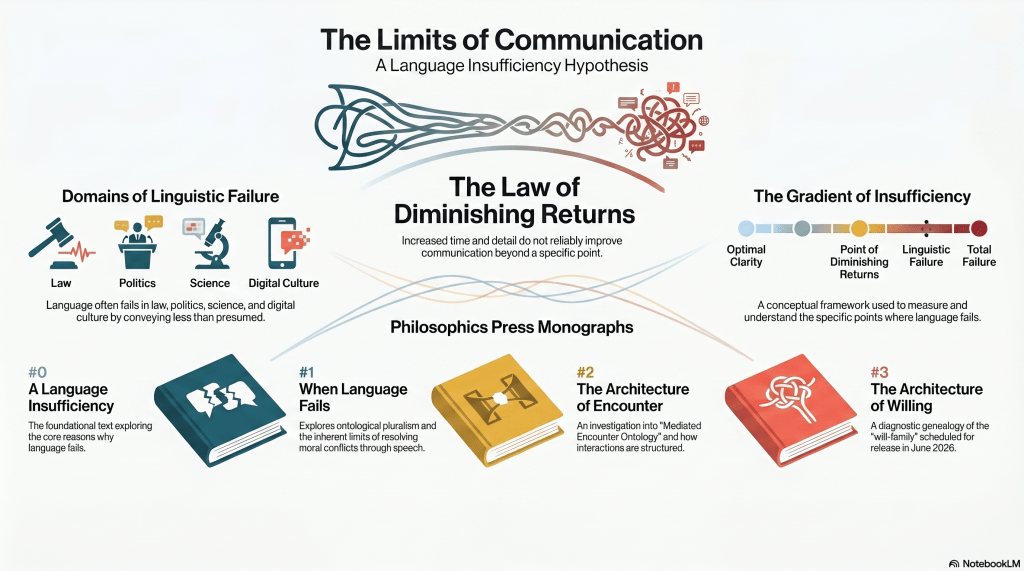
Informally, I consider this as Monograph #0, as I hadn’t considered that I’d create a series that follows this concept.

Philosophics Press Monographs

#1   When Language Fails: Ontological Pluralism and the Limits of Moral Resolution

#2   The Architecture of Encounter: A Mediated Encounter Ontology

#3   The Architecture of Willing: A Diagnostic Genealogy of the Will-Family (forthcoming, June 2026)

The remaining chapters are available in the book, which is available at Amazon.com and Barnes & Noble and other local book sellers. 

Follows is an inventory of included content:

  • Title page
  • Copyright page
  • Table of contents (full)
  • Purpose statement
  • Preface
  • Scope and method
  • Table of scope and limits of inquiry
  • Introduction
  • Part I: The Problem: Why Language Fails
  • Key Terms of art
  • Chapter One: A Genealogy of Insufficiency
  • Appendix A: Technical Notes and Operational Indicators
  • Appendix B: Bibliography
  • Additional references
  • Acknowledgements
  • About the author and other publications (partial)
  • Index (full)
NotebookLM Infographic on this topic.

Propensity for Simulacra, An Excerpt

1–2 minutes

I posted Chapter 26 of my novella, Propensity. I share it here because it invokes Baudrillard’s Simulacra.

Consider it an advert – and a window into Propensity.

Blog Post: Propensity, Chapter 26 – Simulacra
Audio: Propensity, Chapter 2 – Oversight

The novel itself asks what happens when humanity creates a device that creates peace on earth. What if behavioural control worked too well?

No riots. No rebellion. Just a flattening—of desire, of ambition, of will. Across homes, schools, and governments, people stop acting like themselves. Some forget how. Others forget why.

The system wasn’t designed to stay on this long. But now there’s no off switch. And the researchers who built it? Most of them are zeroed.

As one child begins to drift from baseline, an impossible question resurfaces: What does it mean to behave?

This is a psychological dystopia without explosions, a story where silence spreads faster than violence, where systems behave better than the people inside them.

A tale of modulation, inertia, and the slow unravelling of human impulse—for readers who prefer their dystopias quiet and their horrors deeply plausible.


Editorial Review

“Reader discretion is advised. Free will has been deprecated.”
Beginning as a bizarre experiment in behavioural modulation by way of neurochemical interference, Propensity unfolds into an eerie metaphor for the tricky road between control and conscience. Park’s chapters are short and succinct, some barely a page long, in a staccato rhythm that mirrors the story’s disintegration—scientists losing grip on their creation and a world learning the price of its “engineered peace.” Phrases like “silence playing dress-up as danger” and “peace was never meant to be built, only remembered” linger like faint echoes long after you turn the page.

Reedsy Discovery Review

Meantime, give it a listen.