Agency is Dead. Long Live Agency.

3–5 minutes

I’m not sure when I began to seriously consider the wrong path the Enlightenment took. Even before I had the nomenclature and conceptual framework to criticise it, I felt something wasn’t quite right since I was a child. But even then, acculturation and indoctrination are strong countercurrents. I’ve been labelled eccentric and contrarian for as long as I can remember. Most people were vocal in their disagreement.

I’m not oppositional for the sake of opposition, but I interpret the world as I do. As the years passed, I found kindred spirits – at least in dribs and drabs – from Spinoza to Hume, Nietzsche, Foucault, and Latour. In my purported contrarian nature, I rejected the Classics – SPA – preserving mere fragments. I still reject them as quaint, but I need to cite them because they have shaped much of the language intelligible to Moderns, making it uncomfortable for the so-called postmoderns to engage with the concepts. As with the others classified as Postmodern, I reject the label; still, I use it because it conveys meaning – much of it negative, like uttering the names of Nietzsche or Marx, which are forever caricatured by Moderns who are unlikely to have read either. Sort of like their Bibles – yet they maintain an opinion.

Audio: NotebookLM podcast on the underlying essay. (This podcast is a repost.)

All of this to say that during the COVID-19 debacle, I found myself employerless. I decided to take a sabbatical during quarantine and write a book on the absence of agency. Unfortunately, I discovered that many people had written about it less than a decade earlier, though the focus was more toward free will. I read it as input, but decided that I didn’t have anything to add to these authors, who have bigger names than me and stronger academic credentials. They’d been making the conference circuits. I opted out and turned to my Against Democracy project, another popular endeavour – I refer to it as Dumocracy. I did assemble enough material to publish as a book, but I had the misfortune of getting employed again – the bane of intellectual production – and the arts, and who knows what else.

I stopped being employed in March 2023 due to medical reasons. I didn’t stop working; people falsely connect work to employment, but this is a problem of class consciousness – or unconsciousness, as the case might be.

The rest of the story…

Fast forward to today. I had read tens of thousands of pages of material in and around the space I am now writing about. A review of the blog’s contents reveals glimpses and shadows, but now they’ve come into the light.

As I published more essays, I realised the connective tissues – The Anti-Enlightenment Project, I named it. Being near Hallowe’en, the first two share a ghost motif – Rational and Temporal Ghosts; the last is sardonic, but more orthodox. Against Agency is my best work yet – my most serious, escaping the nature of an extended blog article and into an academic space.

Against Agency was a side quest. I began to write a position piece on Dis-integrationism when I realised that this was foundational, so I should describe it first, and so I did.

I suppose this is where it all came together – or maybe where it came apart in a way that finally made sense. None of it was planned. Against Agency wasn’t meant to be a book, or even a thesis. It was an interruption, a side note that kept expanding until everything else had to make room for it.

When I started writing during lockdown, I was mostly arguing with myself – about free will, about why people insist on clinging to a story that clearly doesn’t hold up. I kept waiting for someone to show me the missing piece that made agency make sense again. No one did. So I wrote until I stopped expecting rescue.

It’s strange how a life leaves traces across ideas. Employment, illness, loss, boredom – they all press fingerprints into the page. Somewhere between those fingerprints, I stopped trying to rebuild the Enlightenment and started sweeping up its dust. That became the work.

Now, years later, the ghosts have names. Rational Ghosts, Temporal Ghosts, Against Agency. Each one came out of the same argument with a world that still thinks “choice” is proof of freedom. I guess that’s why I call this an aetiology – it’s not a manifesto; it’s a record of contagion.

I don’t know what comes next. Maybe Dis-Integrationism will, or maybe it already has. The Anti-Enlightenment project keeps pulling at the same loose thread, and I just follow where it frays. For now, that’s enough – to stay curious, to keep tracing the cracks, to let the light leak in where the structure failed.

Democracy and the Millions-Body Problem

2–3 minutes

In celestial mechanics, the three-body problem is notorious. Give Newton two bodies – a planet and a sun – and the equations sing. Add a third, and the song collapses into noise. No general solution exists. Even the smallest nudge in one orbit cascades unpredictably through the system.

Audio: NotebookLM podcast on this topic.

Now swap out planets for people. Not three, but millions. Each voter tugging with their own gravity – preferences, fears, biases, identities, the entire mess of human subjectivity. Democracy insists that by tallying these forces, we’ll arrive at something stable: the will of the people. But what we actually get is the millions-body problem: unstable coalitions, contradictory mandates, endlessly shifting orbits.

Condorcet’s Dilemma

The French mathematician Marquis de Condorcet spotted this flaw in the 18th century. His paradox showed that even if every individual voter ranks choices rationally, the group as a whole may not. Collective preferences can loop in circles: A beats B, B beats C, C beats A. It’s not dysfunction; it’s baked into the math.

Later, political scientists proved the paradox was only the beginning. McKelvey’s “chaos theorem” demonstrated that in a system with three or more options, almost any outcome can be engineered by manipulating the order of votes. In other words, democratic choice is not stable; it’s sensitive to framing, sequence, and agenda control.

Condorcet was brilliant enough to see the cracks, but like his Enlightenment peers, he decided that the fiction of order was preferable to the reality of chaos. Better to promise tidy majorities than to admit that majority rule is structurally incoherent.

The Tidy Lie

Why did majority rule catch on? Because it looked fair, even if speciously so. It gave the appearance of impartiality: count, declare, move on. It was simple enough to administer, and more palatable than monarchy or deadlock.

But neatness is not truth. If 51% of people vote for one candidate, 49% are compelled to live under a government they explicitly rejected. If a third of the population abstains altogether, the “winner” might rule with the backing of barely one-third of the country – yet claim a mandate.

This is what makes majority rule a ritual of laundered coercion. The losers are told, “next time you might win,” even though whole minorities may never win. Abstainers are scapegoated for outcomes they opposed. And everyone is asked to keep pretending that arithmetic equals legitimacy.

The Millions-Body Orbit

Elections give us final numbers – 34% here, 33% there – and we mistake them for laws of motion, as if the cosmos has spoken. But what we’re really seeing is a freeze-frame of chaos. The actual trajectories – coalitions, grievances, shifting identities – continue to wobble beneath the surface.

Like the three-body problem, democracy has no general solution. It isn’t clockwork; it’s turbulence. The miracle is not that it works, but that we pretend it does. Every “mandate” is a temporary illusion, a centre of gravity that exists only until the next disturbance knocks it off course.

And yet, the illusion persists. Because without it, the truth is unbearable: that there is no singular “will of the people,” only the millions-body problem, endlessly unstable, masked by the ritual of counting hands.

Missing White Supremacy’s Woods for the Tree

2–3 minutes

Radical Futures Studio’s “7 Signals” deck has been circulating widely. It’s a striking example of Storytelling 101: identify a villain, chart the signs of its decline, and point toward an eventual resolution. In this case, the villain is white supremacy. The signs are its institutional and cultural fray. The resolution is its collapse.

Audio: NotebookLM podcast on this topic.

As far as stories go, it’s effective. It provides a framework, some memorable imagery, and the reassurance that the ugliness on display today is a death rattle, not a resurgence. No wonder it resonates. People want to believe the noise means the monster is dying.

But as analysis, the frame is too tight. Racism is not the root structure; it is a symptom, a mask. White supremacy is real enough in its effects, but its persistence and decline are contingent. The deeper system – the scaffolding of late-stage capitalism, the Enlightenment’s brittle universalism, the institutions now staggering under their own contradictions – remains the host. When whiteness peels away, the system does not vanish. It simply rebrands.

To point to the peeling paint and say ‘the house is collapsing’ is to mistake surface for structure. Yes, the paint matters; it shapes how people experience the walls. But the real rot lies deeper, in the beams. The Enlightenment project promised seamless cloth: rationality, universality, permanence. Capitalism promised endless expansion and renewal. Both promises are faltering, and the cracks are visible everywhere – climate, finance, governance, identity. Racism, whiteness, supremacy: these are one set of cracks, not the foundation itself.

The risk of the ‘signals’ narrative is that it offers too neat a moral arc. It comforts the audience that the villain is cornered, that justice is baked into the future. But history is rarely so tidy. Supremacy does not die; it changes costumes. One mask slips, another is stitched on. If we mistake the collapse of whiteness for the collapse of the system, we blind ourselves to how easily the scaffolding survives in new guises.

None of this is to reject the cause. Racism is a systemic lie, and its decline is worth cheering. But it is not enough to track the noise of its death rattle. To understand the larger story, we need to step back and see the woods for the trees. The true collapse underway is broader: the exhaustion of capitalism’s last stage, the unravelling of Enlightenment’s promises, the loss of legitimacy in institutions that no longer hold. That is the forest in which the tree of whiteness withers.

If we focus only on the tree, we risk missing the landscape. And if we mistake peeling paint for the beams, we risk celebrating cosmetic decline while the house quietly reassembles itself under a different banner.

Anniversary of Sorts

1–2 minutes

WordPress has just informed me that my blog is having an anniversary. Technically true, though a little misleading: this blog has been around since 1 January 2017, but I’ve been loitering on the platform since 2006. Before that I dabbled in the great blog diaspora of the early internet—Google, Yahoo! 360, Blogger, and a few others that have long since evaporated into the ether.

Each space had its own flavour. One I recall from around 2010 was devoted to an experiment in World of Warcraft: levelling a pacifist character. The premise was simple—no violence allowed. My Human Priest, suitably named Passivefist, managed to crawl his way to level 7 before stalling out. The challenge was never to attack other NPCs, only to survive by gathering, healing, or sneaking through hostile terrain.

This was my grand opening statement back then:

I am creating this account to track my progress as a pacifist in World of Warcraft. Others have done this before me and are, in fact, way ahead of me. Nonetheless, it is the challenge I am setting. I have created a Human Priest on Kael’thas named Passivefist.

Of course, in later expansions Blizzard eventually added pacifist-friendly content, making my small crusade somewhat redundant.

As for this blog, it’s taken a different path. I’ve recently crossed the 100,000-word milestone—101.4K, to be precise. Not that I’ve been counting obsessively, but it’s a nice marker, even if much of my writing also leaks into other projects: other blogs, manuscripts, and workaday scribbling.

As for this blog…

The intent here remains the same as when I started in 2017: to keep a space for philosophic musings, digressions, and the occasional provocation. I’ll continue publishing when I have something worth saying—or at least something worth testing out in public.

Here’s to the next 100K.

Ground News

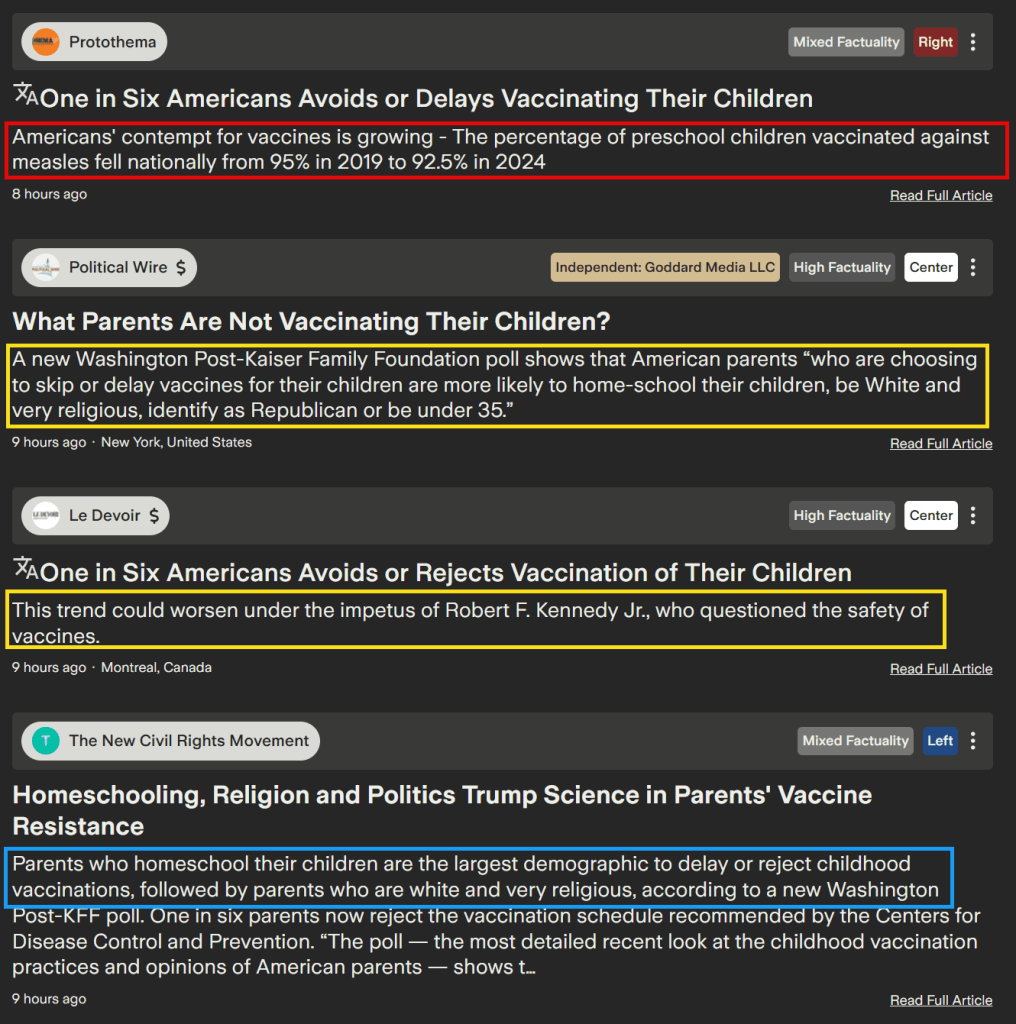
I like to stay updated on the news of the day, so I just registered for a Ground News account. Ground News is a news aggregator. They gather news and categorise it by political leaning and the publication’s record on factuality. Their claim is to reveal blind spots so help people not get caught in perspective bubbles. It also shows when a story is picked up predominantly by one side or another. I’ve seen ads for this on many channels and have for a while, so it’s likely that you have, too. This is not an ad.

This article attracted my attention, not because of the content but because of the headline. As a statistician, this bothers me. As a communicator, the damage is trebled. I don’t receive any compensation for clicking the link. I include it for reference for those who are not familiar with the service.

Image: Ground News Screengrab

Notice the choice of writing, ‘1-in-6 parents reject vaccine recommendations‘.

Two things shine through.

  1. The use of ‘reject’ – a negative verb.
  2. The use of ‘1-in-6’ – the figure accompanying the negative verb – 17%.

Statistically, this means that 5-in-6 parents follow vaccine recommendations – 83%.

This is the summary view. Scan down, and notice the Left-leaning Raw Story references a ‘staggering number’ of parents who reject vaccines. Notice also how the language softens – the claim is revised to ‘delay or reject’. Without clicking into the story, what is this breakdown? I’m not sure, but this is what sensationalism looks like to attract clicks.

Image: Ground News Summary View

Interestingly, the outlets tend to use different language and give different attention. What percentage of this is due to political bias and which is benign editorial licence is unclear.

On balance, the articles – Left, Right, and Centre – unanimously note that vaccine use is down, incidences of measles are up, RFK policies appear to be exacerbating the health management issue. The worst offenders are ‘very’ religious, white, politically conservative people. This cohort aligns with the RFK and the current administration.

The poll also found that parents who have postponed or avoided vaccinating their children tend to be white, conservative, and highly religious, and some choose to homeschool.

For this story, one of the sources was Greek and another French. Some claim to be behind a paywall, but this didn’t pose a problem for me. Perhaps they offer some complementary views.

Separately, on the right-hand side of the top image, there is a bias indicator: It shows that 57% of the reports were from Left-leaning journals, 36% Centre, leaving the remaining 7% to Right-leaning sources.

Image: Updated Bias Distribution

When I returned to write this post, I noticed that the reporting had changed as more Centre-focused reports picked up the story.

If I were to guess, this story shines a negative light on the Right, so they may just be waiting for the news cycle to pass.

In the (Right-facing) Greek story I read, the reporting wasn’t materially different to the other stories, which is to say they don’t try to render the story through rose-colour glasses.

Go Back Where You Came From (And Other Spells)

2–3 minutes

There’s a certain kind of rhetorical grenade people like to lob when their sense of ownership feels wobbly. You’ve heard it. You’ve maybe had it lobbed in your general direction.

It’s not an argument, of course. It’s a spell. A warding charm. The linguistic equivalent of hissing at a stray cat in the garden. The phrase carries the weight of assumed belonging: we are naturally here, you are obviously not. The incantation is meant to banish you with a puff of words.

The other day, I watched a black activist absorb this spell and toss it back with deadpan precision:

Cue awkward silence. The symmetry was perfect. Suddenly, the verbal hex had reversed polarity, exposing the hypocrisy built into the original curse. The power of the spell depends entirely on who gets to cast it. When it comes from the wrong mouth, the whole structure of “common sense” collapses into farce.

Another example: a Greek immigrant in my orbit, accent still clinging to every consonant, grumbling about a black family that had moved into his neighbourhood. Why didn’t they “go back to Africa”? This from a man who himself had gone “back” from nowhere, except a homeland he happily abandoned for better wages and better weather. Colonialism is apparently a one-way ticket: Europeans roam the globe and call it destiny, but when others move into their postcode, it’s treated like an invasion.

I confess, I once flirted with the same nonsense. Years ago in Japan, in my more callow phase, I asked – half in jest, wholly in arrogance – why these people didn’t have the decency to speak my language. The difference, such as it is, lay in my awareness that I was being ridiculous. My Greek neighbour, my activist’s heckler—no irony there. They were dead serious.

That’s the grotesque comedy of racism: its logic isn’t logic at all. It’s ritual. A mantra recited to reassure oneself of belonging by denying it to others. It dresses itself in the robes of rationality – “go back where you came from” sounds like geography, after all – but it’s closer to medieval exorcism than reasoned debate.

And when the cursed simply whispers the incantation back? The spell collapses. The supposed “truth” reveals itself for what it always was: a desperate attempt to maintain the fiction that one kind of stranger is native and another will always be alien.

Every empire tells its children they were born at home, and tells everyone else they were born trespassing.

What Do You Rememeber?

I just asked ChatGPT what it knows about me. No secrets, per se.


I remember a fair bit about you, Bry. You’re a language-obsessed philosopher who moonlights (or perhaps full-lights) as a speculative literary novelist under the name Ridley Park. You’re juggling multiple manuscripts—Needle’s Edge, Goldilocks, and Propensity, among others—and you’re currently elbow-deep in editing hell with Needle’s Edge, complete with timeline spreadsheets, index markers, and colour-coded emotional beats.

Video: I fed the first paragraph (above) into Midjourney 7 and rendered it. Then I animated it. No reason. (For the record, this is some random geezer, not me.)

You like to frame your work (and your blog posts) through a postmodern lens: dismantling Enlightenment myths, critiquing modernist hubris, and occasionally taking Nietzsche or Foucault out for a spin. Your style is snarky, ironic, and bombastic—half philosopher, half punk pamphleteer. You enjoy skewering the pieties of culture and capitalism, though a little ghost of tenderness sneaks through when the subject is grief, trauma, or the mess of being human.

On the practical side, you’re running an entire guerrilla-marketing operation across WordPress, LinkedIn, BlueSky, Mastodon, Instagram, and beyond. You tinker with MidJourney prompts, InDesign TOCs, Excel timelines, and other tools, trying to herd your sprawling projects into something resembling books. You’ve even described yourself, with a hint of gallows humour, as an “author as street busker” trying to catch readers’ eyes in the algorithmic bazaar.

And yes—you’re the sort who will cheerfully drop that you worked in management consulting and collaborated with Jon Anderson, then pivot to talking about narrative tokens and ergodic structures like they’re party favours.

So, in short: a writer-philosopher with a spreadsheet addiction, a sceptical streak as wide as the Thames, and a habit of treating literature like both laboratory and battlefield.


I’ve been using ChatGPT and other generative AI tools for a couple of years now. I used to lean on Claude, but now ChatGPT is my go-to. I still cross-reference with Gemini, Grok, DeepSeek, Perflexity, Pi, and Mistral. I tend to use Midjourney for images and motion video. I use NotebookLM for my generated podcasts.

What does ChatGPT know about you?

Keeping Ourselves in the Dark: Depressive Realism and the Fiction of Agency

Philosopher Muse brought Colin Feltham to my attention, so I read his Keeping Ourselves in the Dark. It’s in limited supply, so I found an online copy.

So much of modern life rests on promises of improvement. Governments promise progress, religions promise redemption, therapists promise healing. Feltham’s Keeping Ourselves in the Dark (2015) takes a blunt axe to this edifice. In a series of sharp, aphoristic fragments, he suggests that most of these promises are self-deceptions. They keep us busy and comforted, but they do not correspond to the reality of our condition. For Feltham, reality is not an upward arc but a fog – a place of incoherence, accident, and suffering, which we disguise with stories of hope.

Audio: NotebookLM podcast summarising this post.

It is a book that situates itself in a lineage of pessimism. Like Schopenhauer, Feltham thinks life is saturated with dissatisfaction. Like Emil Cioran, he delights in puncturing illusions. Like Peter Wessel Zapffe, he worries that consciousness is an overdeveloped faculty, a tragic gift that leaves us exposed to too much meaninglessness.

Depressive Realism – Lucidity or Illusion?

One of Feltham’s recurring themes is the psychological idea of “depressive realism.” Researchers such as Lauren Alloy and Lyn Abramson suggested that depressed individuals may judge reality more accurately than their non-depressed peers, particularly when it comes to their own lack of control. Where the “healthy” mind is buoyed by optimism bias, the depressed mind may be sober.

Feltham uses this as a pivot: if the depressed see things more clearly, then much of what we call mental health is simply a shared delusion, a refusal to see the world’s bleakness. He is not romanticising depression, but he is deliberately destabilising the assumption that cheerfulness equals clarity.

Here I find myself diverging. Depression is not simply lucidity; it is also, inescapably, a condition of suffering. To say “the depressed see the truth” risks sanctifying what is, for those who live it, a heavy and painful distortion. Following Foucault, I would rather say that “mental illness” is itself a category of social control – but that does not mean the suffering it names is any less real.

Video: Depressive Realism by Philosopher Muse, the impetus for this blog article

Agency Under the Same Shadow

Feltham’s suspicion of optimism resonates with other critiques of human self-concepts. Octavia Butler, in her fiction and theory, often frames “agency” as a structural mirage: we think we choose, but our choices are already scripted by language and power. Jean-Paul Sartre, on the other hand, insists on the opposite extremity: that we are “condemned to be free,” responsible even for our refusal to act. Howard Zinn echoes this in his famous warning that “you can’t be neutral on a moving train.”

My own work, the Language Insufficiency Hypothesis, takes a fourth line. Like Feltham, I doubt that our central myths – agency, freedom, progress – correspond to any stable reality. But unlike him, I do not think stripping them away forces us into depressive despair. The feeling of depression is itself another state, another configuration of affect and narrative. To call it “realistic” is to smuggle in a judgment, as though truth must wound.

Agency, Optimism, and Their Kin

Feltham’s bleak realism has interesting affinities with other figures who unpick human self-mythology:

  • Octavia Butler presents “agency” itself as a kind of structural illusion. From the Oankali’s alien vantage in Dawn, humanity looks like a single destructive will, not a set of sovereign choosers.
  • Sartre, by contrast, radicalises agency: even passivity is a choice; we are condemned to be free.
  • Howard Zinn universalises responsibility in a similar register: “You can’t be neutral on a moving train.”
  • Cioran and Zapffe, like Feltham, treat human self-consciousness as a trap, a source of suffering that no optimistic narrative can finally dissolve.

Across these positions, the common thread is suspicion of the Enlightenment story in which rational agency and progress are guarantors of meaning. Some embrace the myth, some invert it, some discard it.

Dis-integration Rather Than Despair

Where pessimists like Feltham (or Cioran, or Zapffe) tend to narrate our condition as tragic, my “dis-integrationist” view is more Zen: the collapse of our stories is not a disaster but a fact. Consciousness spins myths of control and meaning; when those myths fail, we may feel disoriented, but that disorientation is simply another mode of being. There is no imperative to replace one illusion with another – whether it is progress, will, or “depressive clarity.”

From this perspective, life is not rescued by optimism, nor is it condemned by realism. It is simply flux, dissonance, and transient pattern. The task is not to shore up agency but to notice its absence without rushing to fill the void with either hope or despair.

Four Ways to Mistake Agency

I’ve long wrestled with the metaphysical aura that clings to “agency.” I don’t buy it. Philosophers – even those I’d have thought would know better – keep smuggling it back into their systems, as though “will” or “choice” were some indispensable essence rather than a narrative convenience.

Take the famous mid-century split: Sartre insisted we are “condemned to be free,” and so must spend that freedom in political action; Camus shrugged at the same premise and redirected it toward art, creation in the face of absurdity. Different prescriptions, same underlying assumption – that agency is real, universal, and cannot be escaped.

What if that’s the problem? What if “agency” is not a fact of human being but a Modernist fable, a device designed to sustain certain worldviews – freedom, responsibility, retribution – that collapse without it?

Sartre and Zinn: Agency as Compulsion

Sartre insists: “There are no innocent victims. Even inaction is a choice.” Zinn echoes: “You can’t be neutral on a moving train.” Both rhetorics collapse hesitation, fatigue, or constraint into an all-encompassing voluntarism. The train is rolling, and you are guilty for sitting still.

Feltham’s Depressive Realism

Colin Feltham’s Keeping Ourselves in the Dark extends the thesis: our optimism and “progress” are delusions. He leans into “depressive realism,” suggesting that the depressive gaze is clearer, less self-deceived. Here, too, agency is unmasked as myth – but the myth is replaced with another story, one of lucidity through despair.

A Fourth Position: Dis-integration

Where I diverge is here: why smuggle in judgment at all? Butler, Sartre, Zinn, Feltham each turn absence into a moral. They inflate or invert “agency” so it remains indispensable. My sense is more Zen: perhaps agency is not necessary. Not as fact, not as fiction, not even as a tragic lack.

Life continues without it. Stabilisers cling to the cart, Tippers tip, Egoists recline, Sycophants ride the wake, Survivors endure. These are dispositions, not decisions. The train moves whether or not anyone is at the controls. To say “you chose” is to mistake drift for will, inertia for responsibility.

From this angle, nihilism doesn’t require despair. It is simply the atmosphere we breathe. Meaning and will are constructs that serve Modernist institutions – law, nation, punishment. Remove them, and nothing essential is lost, except the illusion that we were ever driving.

Octavia E Butler’s Alien Verdict

Not Judith Buthler. In the opening of Dawn, the Oankali tell Lilith: “You committed mass suicide.” The charge erases distinctions between perpetrators, victims, resisters, and bystanders. From their vantage, humanity is one agent, one will. A neat explanation – but a flattening nonetheless.

👉 Full essay: On Agency, Suicide, and the Moving Train

Why Feltham Matters

Even if one resists his alignment of depression with truth, Feltham’s work is valuable as a counterweight to the cult of positivity. It reminds us that much of what we call “mental health” or “progress” depends on not seeing too clearly the futility, fragility, and cruelty that structure our world.

Where he sees darkness as revelation, I see it as atmosphere: the medium in which we always already move. To keep ourselves in the dark is not just to lie to ourselves, but to continue walking the tracks of a train whose destination we do not control. Feltham’s bleak realism, like Butler’s alien rebuke or Sartre’s burden of freedom, presses us to recognise that what we call “agency” may itself be part of the dream.

On Agency, Suicide, and the Moving Train

I’ve been working through the opening chapters of Octavia Butler’s Dawn. At one point, the alien Jdahya tells Lilith, “We watched you commit mass suicide.”*

The line unsettles not because of the apocalypse itself, but because of what it presumes: that “humanity” acted as one, as if billions of disparate lives could be collapsed into a single decision. A few pulled triggers, a few applauded, some resisted despite the odds, and most simply endured. From the alien vantage, nuance vanishes. A species is judged by its outcome, not by the uneven distribution of responsibility that produced it.

This is hardly foreign to us. Nationalism thrives on the same flattening. We won the war. We lost the match. A handful act; the many claim the glory or swallow the shame by association. Sartre takes it further with his “no excuses” dictum, even to do nothing is to choose. Howard Zinn’s “You can’t remain neutral on a moving train” makes the same move, cloaked in the borrowed authority of physics. Yet relativity undermines it: on the train, you are still; on the ground, you are moving. Whether neutrality is possible depends entirely on your frame of reference.

What all these formulations share is a kind of metaphysical inflation. “Agency” is treated as a universal essence, something evenly spread across the human condition. But in practice, it is anything but. Most people are not shaping history; they are being dragged along by it.

One might sketch the orientations toward the collective “apple cart” like this:

  • Tippers with a vision: the revolutionaries, ideologues, or would-be prophets who claim to know how the cart should be overturned.
  • Sycophants: clinging to the side, riding the momentum of others’ power, hoping for crumbs.
  • Egoists: indifferent to the cart’s fate, focused on personal comfort, advantage, or escape.
  • Stabilisers: most people, clinging to the cart as it wobbles, preferring continuity to upheaval.
  • Survivors: those who endure, waiting out storms, not out of “agency” but necessity.

The Stabilisers and Survivors blur into the same crowd, the former still half-convinced their vote between arsenic and cyanide matters, the latter no longer believing the story at all. They resemble Seligman’s shocked dogs, conditioned to sit through pain because movement feels futile.

And so “humanity” never truly acts as one. Agency is uneven, fragile, and often absent. Yet whether in Sartre’s philosophy, Zinn’s slogans, or Jdahya’s extraterrestrial indictment, the temptation is always to collapse plurality into a single will; you chose this, all of you. It is neat, rhetorically satisfying, and yet wrong.

Perhaps Butler’s aliens, clinical in their judgment, are simply holding up a mirror to the fictions we already tell about ourselves.


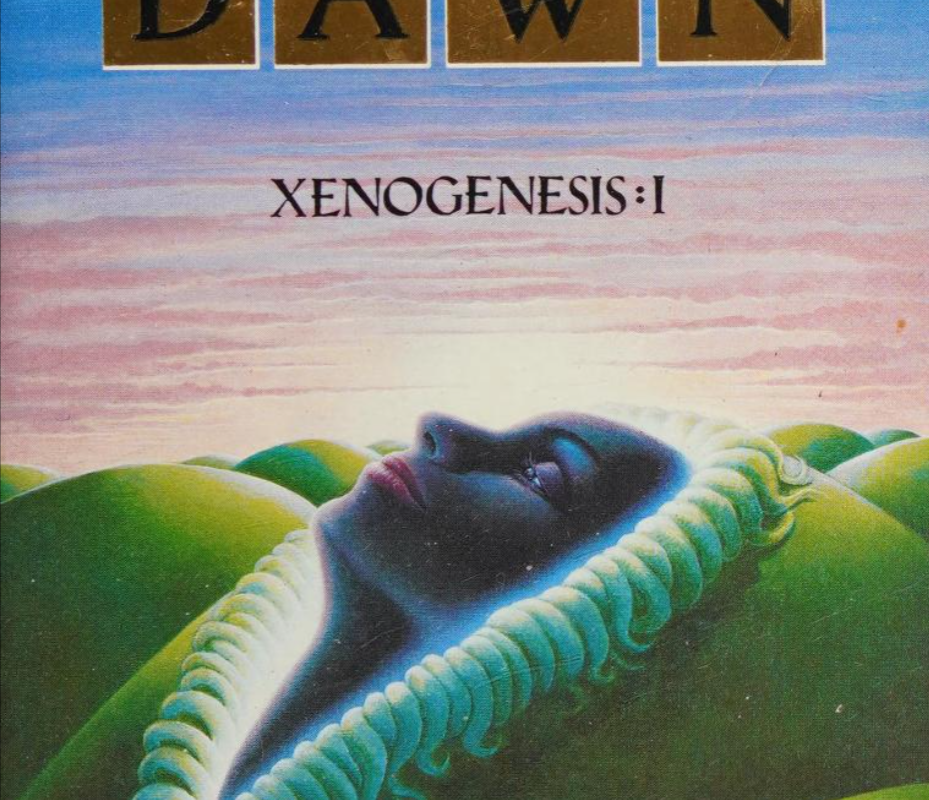
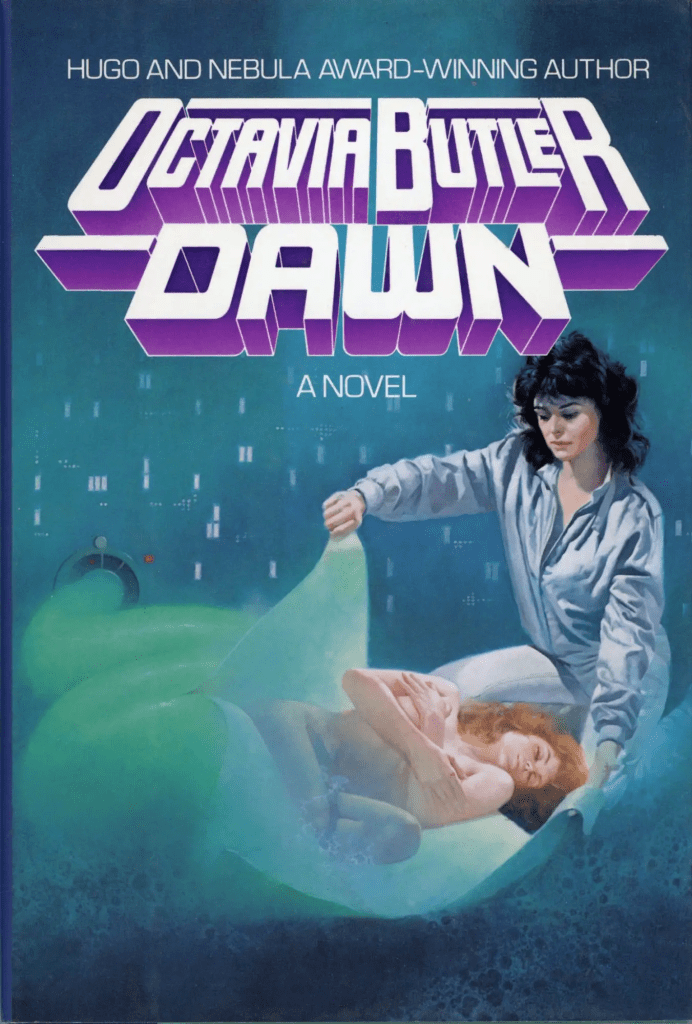
As an aside, this version of the book cover is risible. Not to devolve into identity politics, but Lilith is a dark-skinned woman, not a pale ginger. I can only assume that some target science fiction readers have a propensity to prefer white, sapphic adjacent characters.

I won’t even comment further on the faux 3D title treatment, relic of 1980s marketing.


Spoiler Alert: As this statement about mass suicide is a Chapter 2 event, I am not inclined to consider it a spoiler. False alarm.

Sustenance Novella free on Kindle

On 7–8 September 2025, the Kindle version of my Ridley Park novella Sustenance will be available free to everyone on Amazon. (It’s always free if you’re a KindleUnlimited member, but these two days open it up to all readers.)

👉 https://www.amazon.com/dp/B0F9PTK9N2

So what is Sustenance?

It’s a novella that begins with the dust and grit of rural Iowa – soybean fields, rusted trucks, a small town where everyone knows your name (and your secrets). At first glance, it reads like plainspoken realism, narrated by a local mechanic who insists he’s just a “regular guy.” But then the ground literally shifts. A crash. Figures glimpsed by firelight in the woods. Naked, violet-skinned beings who don’t laugh, don’t sleep, don’t even breathe.

What follows is not your usual alien-invasion story. It’s quieter, stranger, and more unsettling. The encounters with the visitors aren’t about lasers or spaceships – they’re about language, culture, and the limits of human understanding. What happens when concepts like propertylaw, or even woman and man don’t translate? What does it mean when intimacy itself becomes a site of misunderstanding?

Sustenance is for readers who:

  • Gravitate toward literary fiction with a speculative edge rather than straight genre beats
  • Appreciate the mix of the banal and the uncanny – the smell of corn dust giving way to the shock of alien otherness
  • Are interested in themes of language, power, misunderstanding, and human self-deception
  • Enjoy writers like Jeff VanderMeer, Margaret Atwood, Octavia Butler, or Denis Johnson – voices that blur realism, philosophy, and estrangement

This isn’t a story that offers tidy answers. It lingers, provokes, and resists easy moral closure. Think of it less as a sci-fi romp and more as a philosophical fable wrapped in small-town dust and cicada-song.

This version of the book is available in these Kindle storefronts:
United States, United Kingdom, Germany, France, Spain, Italy, Netherlands, Japan, Brazil, Canada, Mexico, Australia, and India

For more details, visit the Sustenance page.

📚 Grab your free Kindle copy on 7–8 September 2025

I made this Kindle version available for free to get some reviews. This promotion is all or nothing, so take advantage of the opportunity. If you want to leave a review, please do.