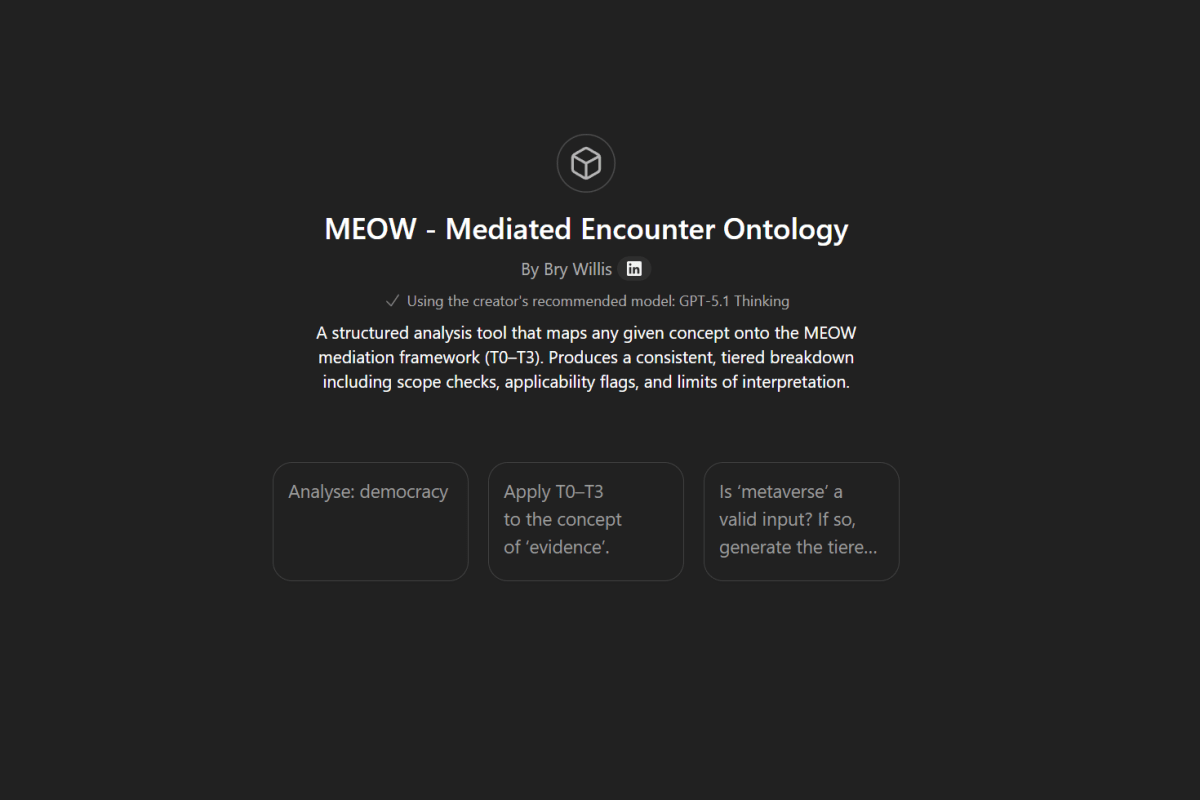
Announcement: MEOW GPT

Instead of sleeping like a functional adult, I’ve spent the night creating, testing, and refining a bespoke GPT that has fully absorbed my MEOW and LIH frameworks. Apologies that the LIH manuscript isn’t yet public; some of the terminology may look delightfully alien if you’re coming in cold.

This model doesn’t role-play a philosopher; it thinks through the Mediated Encounter Ontology. It runs every input through T0–T3 mediations and then applies the Language Insufficiency Hypothesis to explain why our words fail us in predictable, structural ways.

Audio: NotebookLM summary podcast of this post on the MEOW GPT.

I stress-tested it with a dozen concepts, from the obvious to the uncooperative. It happily tells you when your input makes sense, when it’s out of scope, and when you’ve handed it conceptual soup. My first test was the hard problem of consciousness, because naturally we begin with the philosophical boss fight. I dialled down some over-enthusiastic LIH flourishes, but the bones are untouched.

I’m making this public for a simple reason: it’s the clearest way for people to see how MEOW operates without wandering through a hundred pages of my prose. These outputs capture how I process information and why these frameworks feel so intuitively correct to me. When you read them, you get a direct view of my interpretive machinery – how the world clicks for me, and how these ideas evolved.

It hasn’t been rigorously battle-tested across the entire conceptual universe, but it’s stable, coherent, and frankly too interesting to keep in the drawer. If you try it – and I hope you do – I’d love to see what it does with your own concepts. If you need help reading the results, ask. I didn’t simplify the system; it expects literacy, nuance, and a working prefrontal cortex.

For orientation, read the introductory post or the colour perception example. Ideally, read the original essay and listen to the summary podcast. My first test was on the hard problem of consciousness because I had already analysed it for this post. I made some adjustments to tone down some LIH intrusions.

Below is a sample output. I asked the model to analyse modernity.

Concept

  • Input: modernity
  • Type: historical–social formation / self-description of an era / conceptual frame
  • Scope check: in-scope – central for how MEOW treats large-scale shifts in mediation (social, technical, cognitive, linguistic)

High-level summary (≤120 words)

Modernity is both a historical bundle (industrialisation, nation-states, capitalism, science, bureaucracy, media) and a story societies tell about themselves (“we are modern, unlike the past”).

In MEOW terms, modernity is a large-scale reorganisation of mediations:

  • T0: new bodily environments (urban life, clocks, artificial light, pollution, medicine).
  • T1: new cognitive habits (individualism, planning, abstraction, risk-calculation).
  • T2: new vocabularies (progress, development, rationality, “religion” vs “science”).
  • T3: new institutions and technologies (markets, states, factories, schools, mass media, digital networks).

“Modernity” is not a single thing but a way these shifts hang together and become a background to everyday encounter.


T0 – Biological Mediation

  • Applicability: Applicable
  • Analysis:
    • Modernity radically reshapes the immediate bodily environment: dense cities, artificial lighting, noise, pollution, sedentary work, and altered sleep cycles change basic sensory and metabolic conditions.
    • Medical advances and public health (vaccination, antibiotics, sanitation, surgery) modify life expectancy, infant mortality, and chronic illness, which in turn change how life cycles feel and are planned.
    • New food systems (industrial agriculture, processed foods, global supply chains) alter nutrition, exposure to toxins, and rhythms of hunger and satiety.
    • Industrial and digital work reorganise movement and posture: repetitive factory labour, office desk work, and screen use all reshape embodiment, fatigue, and bodily awareness.
    • These T0 changes set the stage for new affective baselines (e.g., chronic low-level stress, stimulation overload) that colour what it is like to live in a “modern” world.

T1 – Cognitive Mediation

  • Applicability: Strongly applicable
  • Analysis:
    • Modernity encourages certain cognitive styles: systematic planning, quantification, risk assessment, cost–benefit thinking, and an emphasis on prediction and control.
    • The sense of self is reconfigured toward individualism and reflexivity: people see themselves as projects to be chosen, improved, optimised, often with long-term career and life-planning horizons.
    • Exposure to multiple roles, cultures, and information streams (through migration, media, education) produces more complex identity structures and can create cognitive dissonance or fragmentation.
    • Scientific and technical worldviews teach people to reframe events in terms of mechanisms, probabilities, and systems rather than fate, tradition, or local narratives.
    • The sheer volume and speed of information flows in late modernity (news, social media, notifications) trains attention toward rapid scanning and shallow switching, affecting memory, concentration, and emotional regulation.
    • These patterns make certain experiences “normal” (abstract work, mediated relationships, bureaucratic interactions) that would be extraordinary or impossible in premodern settings.

T2 – Linguistic Mediation

  • Applicability: Strongly applicable
  • Analysis:
    • Modernity itself is a label that societies use to contrast “us” with “them” (the past, “traditional” societies, “the East,” “the primitive”); it is a polemical as well as descriptive term.
    • In Language Insufficiency terms, modernity is highly Fluid: it can mean a period (“since the 18th century”), a style (modernist art), a value system (rational, secular, progressive), or a socio-economic order (capitalist, industrial, bureaucratic). Different authors slide between these quietly.
    • It’s also Contestable: critics and defenders use the same word but point to different aspects—emancipation and progress versus alienation, exploitation, ecological crisis.
    • Pairs like “modern vs traditional” or “modern vs backward” compress complex differences into simple hierarchies, smuggling in a presumption that “modern” is automatically better or more advanced.
    • Talk of “post-modernity” or “late modernity” suggests that we can neatly periodise and step outside the modern, even while our concepts and institutions remain shaped by it—an example of language implying more clarity and control than we actually have.
    • At the most global scale (“the meaning of modernity,” “the modern condition”), we approach an Effectiveness Horizon: the term feels weighty but becomes vague; people resort to sweeping metaphors (disenchantment, liquefaction, acceleration) whose exact content is hard to pin down.
    • First-person experiences of being “overwhelmed by modern life,” “liberated by modern options,” or “disconnected in modern society” often have an Ineffable quality: standard clichés don’t quite capture the texture of these lives, even as they gesture at them.

T3 – Social/Technical Mediation

  • Applicability: Strongly applicable
  • Analysis:
    • Modernity is most visible as a mesh of institutions: nation-states, markets, bureaucracies, public schools, hospitals, prisons, armies, scientific organisations, corporations, NGOs.
    • These institutions standardise time (clocks, schedules), space (borders, property lines, zoning), identity (passports, ID numbers), and value (money, statistics, rankings) so that encounters become predictable and governable across large scales.
    • Technologies—steam engines, electricity, mass transport, broadcasting, computing, the internet, AI—are both products and drivers of modernity. They make possible new encounter-forms (remote work, global real-time communication, mass surveillance).
    • Urbanisation concentrates people into large, heterogeneous populations, which reconfigures social networks, anonymity, solidarity, and conflict; everyday encounters become more mediated by rules, signage, and digital systems than by face-to-face custom.
    • Capitalist production and consumption patterns organise much of life around work, income, and markets; the rhythms of the factory, office, and platform economy structure when and how people interact, rest, and move.
    • Modern governance uses statistics, censuses, and models to “see” and manage populations; this makes certain aspects of life legible (employment, crime, disease) while leaving others under- or uncounted (informal care, undocumented work, emotional labour).
    • Counter-movements (romanticism, traditionalism, environmentalism, decolonial and Indigenous resurgence, slow-living and anti-consumerist practices) can be read as attempts to renegotiate or resist specific modern mediations rather than simply reject “modernity” as a whole.

Limits & failure modes

  • Language insufficiency notes
    • Modernity bundles together time (a historical era), structure (a type of society), and value (being “up to date”). This makes the term rhetorically powerful but analytically slippery: it’s easy to smuggle evaluations into what sound like neutral descriptions.
    • Because the concept is so broad, discussions often conflate distinct issues—technology, capitalism, secularisation, colonialism, individualism, bureaucracy—under one word, obscuring which mechanisms are actually at work.
    • Experiences of living in “modern times” (speed, fragmentation, choice, precariousness, possibility) often outrun our stock phrases; people lean on recurring complaints (“too fast,” “too shallow,” “too lonely”) that only partially capture what it’s like.
  • Missing tiers / blind spots
    • This sketch doesn’t adjudicate between different theories of modernity (Marxist, Weberian, postcolonial, systems-theoretic, etc.); it treats them as emphasising different mediational strands.
    • It’s centred on Euro-Atlantic narratives; “multiple modernities” and non-Western trajectories (where “modern” elements mix with older forms in hybrid ways) would need a richer T3 treatment.
    • The analysis underplays ecological dimensions: industrial modernity’s dependence on fossil fuels, large-scale extraction, and waste has massive implications for how future encounters will be structured.
    • Finally, because we are ourselves situated in what we call modernity, our conceptual vantage is limited; any map we draw is partly an artefact of the very mediations we’re trying to analyse.

When “Advanced” Means Genocide: A Case Study in Linguistic Implosion

This post draws on themes from my upcoming book, A Language Insufficiency Hypothesis. The transcript below is taken from a publicly available exchange, which you can view here. Consider it Exhibit A in language’s ongoing failure to bear the weight of meaning.

Transcript:

KK: Konstantin Kisin
DFW: Deborah Frances-White

KK: I’m saying we were technologically more advanced.
DFW: So you’re saying we’re superior to Australian Aboriginals?
KK: That’s quite the opposite of what I’m saying. I’m not saying we were superior, I’m saying we were technologically more advanced.
DFW: So, how is that the opposite?
KK: Superior implies a moral quality. I’m not making any moral implication. You seem to be, but what I’m saying is…
DFW: I think most people would hear it that way.
KK: No.
DFW: Again, you’re a very intelligent man. How would most people hear that?
KK: Most people would hear what I’m saying for what I’m saying, which is…
DFW: I don’t think they would.
KK: You seem to get quite heated about this, which is completely unnecessary.
DFW: Um…
KK: You think it’s necessary?
DFW: I’m a bit stunned by what you’re implying.
KK: No, you’re acting in a kind of passive aggressive way which indicates that you’re not happy…
DFW: I genuinely… I’m being 100% authentic. My visceral reaction to a white man sitting and saying to me, “And why were we able to commit genocide on them?” and then just pausing—
KK: Yes.
DFW: …is very visceral to me.
KK: Well, let’s go back. First of all, it’s interesting that you brought up my skin colour because I thought that was the exact opposite of the point you’re trying to make in the book.

Audio: NotebookLM podcast on this topic.

The Language Insufficiency Hypothesis begins with this premise: language is not merely flawed, it is structurally inadequate for mediating complex, layered realities – especially those laced with power, morality, and history. This transcript is not a debate. It is a linguistic trench war in which every utterance is laced with shrapnel, and each side thinks they’re defending reason.

Let’s pull a few of the shell casings from the mud.

KK attempts to offer a dry, neutral descriptor. DFW hears supremacist teleology. Why? Because “advanced” is culturally radioactive. It doesn’t merely denote a technical state—it connotes a ladder, with someone inevitably on the bottom rung.

When language carries historical residue, neutrality is a delusion. Words don’t just mean. They echo.

KK is making a semantic distinction. DFW hears a moral claim. Both are right. And both are talking past one another, because language is attempting to cleave affect from description, and it simply can’t.

KK’s insistence—“I’m not saying we’re superior”—is a textbook example of denotative desperation. He believes clarification will rescue intent. But as any linguist (or postcolonial theorist) will tell you: intent does not sterilise implication.

Language cannot be laundered by explanation. Once spoken, words belong to context, not intention.

KK thinks he’s holding a scalpel. DFW hears a cudgel. And here we are.

This is where the wheels come off. KK argues from semantic specificity. DFW argues from sociolinguistic reception. It’s Saussure versus the TikTok algorithm. Neither will win.

Communication disintegrates not because anyone is lying, but because they are playing incompatible games with the same tokens.

DFW’s invocation of “a white man” is not a derailment—it’s the inevitable endpoint of a system where words no longer float free but are yoked to their utterer. This is the moment the failure of language becomes a failure of interlocution. Argument collapses into indexical entrapment.

At this point, you’re no longer debating ideas. You’re defending your right to use certain words at all.

Which brings us to the final breakdown.

KK: I am making a logical distinction.
DFW: I am having a visceral reaction.

The failure isn’t moral. It isn’t historical. It’s grammatical. One is operating in a truth-function logic game. The other is reacting within a trauma-informed, socially indexed register. These are grammars that do not overlap.

If this brief and brutal dialogue proves anything, it’s this: you cannot extract meaning cleanly from words when the words themselves are sponges for history, hierarchy, and harm. The moment we ask language to do too much—to carry precision, affect, ethics, and identity—it folds in on itself.

And that, dear reader, is precisely the argument of A Language Insufficiency Hypothesis: that meaning does not reside in words, and never has. It lives in the gaps, the silences, the misfires. That’s where the truth—whatever’s left of it—might be hiding.

Follow the wreckage. That’s where the signal lives.

Semantic Drift: When Language Outruns the Science

Science has a language problem. Not a lack of it – if anything, a surfeit. But words, unlike test tubes, do not stay sterile. They evolve, mutate, and metastasise. They get borrowed, bent, misused, and misremembered. And when the public discourse gets hold of them, particularly on platforms like TikTok, it’s the language that gets top billing. The science? Second lead, if it’s lucky.

Semantic drift is at the centre of this: the gradual shift in meaning of a word or phrase over time. It’s how “literally” came to mean “figuratively,” how “organic” went from “carbon-based” to “morally superior,” and how “theory” in science means robust explanatory framework but in the public square means vague guess with no homework.

In short, semantic drift lets rhetoric masquerade as reason. Once a word acquires enough connotation, you can deploy it like a spell. No need to define your terms when the vibe will do.

Audio: NotebookLM podcast on this topic.

When “Vitamin” No Longer Means Vitamin

Take the word vitamin. It sounds objective. Authoritative. Something codified in the genetic commandments of all living things. (reference)

But it isn’t.

A vitamin is simply a substance that an organism needs but cannot synthesise internally, and must obtain through its diet. That’s it. It’s a functional definition, not a chemical one.

So:

  • Vitamin C is a vitamin for humans, but not for dogs, cats, or goats. They make their own. We lost the gene. Tough luck.
  • Vitamin D, meanwhile, isn’t a vitamin at all. It’s a hormone, synthesised when sunlight hits your skin. Its vitamin status is a historical relic – named before we knew better, and now marketed too profitably to correct.

But in the land of TikTok and supplement shelves, these nuances evaporate. “Vitamin” has drifted from scientific designation to halo term – a linguistic fig leaf draped over everything from snake oil to ultraviolet-induced steroidogenesis.

The Rhetorical Sleight of Hand

This linguistic slippage is precisely what allows the rhetorical shenanigans to thrive.

In one video, a bloke claims a burger left out for 151 days neither moulds nor decays, and therefore, “nature won’t touch it.” From there, he leaps (with Olympic disregard for coherence) into talk of sugar spikes, mood swings, and “metabolic chaos.” You can almost hear the conspiratorial music rising.

The science here is, let’s be generous, circumstantial. But the language? Oh, the language is airtight.

Words like “processed,” “chemical,” and “natural” are deployed like moral verdicts, not descriptive categories. The implication isn’t argued – it’s assumed, because the semantics have been doing quiet groundwork for years. “Natural” = good. “Chemical” = bad. “Vitamin” = necessary. “Addiction” = no agency.

By the time the viewer blinks, they’re nodding along to a story told by words in costume, not facts in context.

The Linguistic Metabolism of Misunderstanding

This is why semantic drift isn’t just an academic curiosity – it’s a vector. A vector by which misinformation spreads, not through outright falsehood, but through weaponised ambiguity.

A term like “sugar crash” sounds scientific. It even maps onto a real physiological process: postprandial hypoglycaemia. But when yoked to vague claims about mood, willpower, and “chemical hijacking,” it becomes a meme with lab coat cosplay. And the science, if mentioned at all, is there merely to decorate the argument, not drive it.

That’s the crux of my forthcoming book, The Language Insufficiency Hypothesis: that our inherited languages, designed for trade, prayer, and gossip, are woefully ill-equipped for modern scientific clarity. They lag behind our knowledge, and worse, they often distort it.

Words arrive first. Definitions come limping after.

In Closing: You Are What You Consume (Linguistically)

The real problem isn’t that TikTokers get the science wrong. The problem is that they get the words right – right enough to slip past your critical filters. Rhetoric wears the lab coat. Logic gets left in the locker room.

If vitamin C is a vitamin only for some species, and vitamin D isn’t a vitamin at all, then what else are we mislabelling in the great nutritional theatre? What other linguistic zombies are still wandering the scientific lexicon?

Language may be the best tool we have, but don’t mistake it for a mirror. It’s a carnival funhouse – distorting, framing, and reflecting what we expect to see. And until we fix that, science will keep playing second fiddle to the words pretending to explain it.

Schrödinger’s Weasel

The cat is out. And it has been replaced by a weasel. Yes, dear reader, you’ve entered the strange, paradoxical world of Schrödinger’s Weasel, a universe where words drift in a haze of semantic uncertainty, their meanings ambushed and reshaped by whoever gets there first.

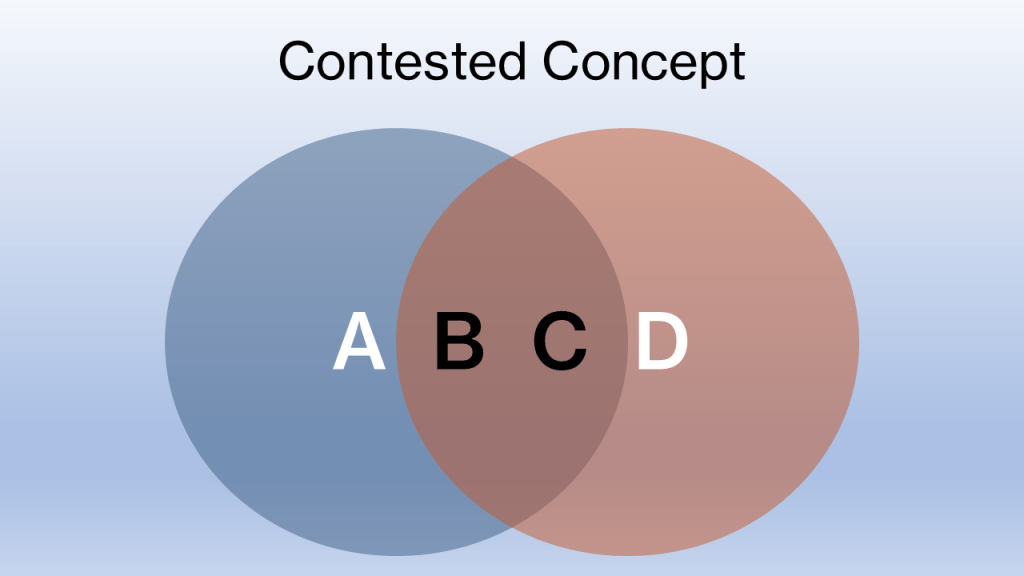
Now, you may be asking yourself, “Haven’t we been here before?” Both yes and no. While the phenomenon of weasel words—terms that suck out all substance from a statement, leaving behind a polite but vacuous husk—has been dissected and discussed at length, there’s a new creature on the scene. Inspired by Essentially Contested Concepts, W.B. Gallie’s landmark essay from 1956, and John Kekes’ counterpoint in A Reconsideration, I find myself stepping further into the semantic thicket. I’ve long held a grudge against weasel words, but Schrödinger words are their sinister cousins, capable of quantum linguistic acrobatics.

To understand Schrödinger words, we need to get cosy with a little quantum mechanics. Think of a Schrödinger word as a linguistic particle in a state of superposition. This isn’t the lazy drift of semantic shift—words that gently evolve over centuries, shaped by the ebb and flow of time and culture. No, these Schrödinger words behave more like quantum particles: observed from one angle, they mean one thing; from another, something completely different. They represent a political twilight zone, meanings oscillating between utopia and dystopia, refracted through the eye of the ideological beholder.

Take socialism, that darling of the Left and bugbear of the Right. To someone on the American political left, socialism conjures visions of Scandinavia’s welfare state, a society that looks after its people, where healthcare and education are universal rights. But say socialism to someone on the right, and you might find yourself facing the ghost of Stalin’s Soviet Union – gulags, oppression, the Cold War spectre of forced equality. The same word, but two worlds apart. This isn’t simply a “difference of opinion.” This is linguistic quantum mechanics at work, where meaning is determined by the observer’s political perspective. In fact, in the case of Schrödinger words, the observer’s interpretation not only reveals meaning but can be weaponised to change it, on the fly, at a whim.

What, then, is a Schrödinger word? Unlike the classic weasel words, which diffuse responsibility (“some say”), Schrödinger words don’t just obscure meaning; they provoke it and elicit strong, polarised responses by oscillating between two definitions. They are meaning-shifters, intentionally wielded to provoke division and rally allegiances. They serve as shibboleths and dog whistles, coded signals that change as they cross ideological boundaries. They are the linguistic weasels, alive and dead in the political discourse, simultaneously uniting and dividing depending on the audience. These words are spoken with the ease of conventional language, yet they pack a quantum punch, morphing as they interact with the listener’s biases.

Consider woke, a term once employed as a rallying cry for awareness and social justice. Today, its mere utterance can either sanctify or vilify. The ideological Left may still use it with pride – a banner for the politically conscious. But to the Right, woke has become a pejorative, shorthand for zealous moralism and unwelcome change. In the blink of an eye, woke transforms from a badge of honour into an accusation, from an earnest call to action into a threat. Its meaning is suspended in ambiguity, but that ambiguity is precisely what makes it effective. No one can agree on what woke “really means” anymore, and that’s the point. It’s not merely contested; it’s an arena, a battlefield.

What of fascism, another Schrödinger word, swirling in a storm of contradictory meanings? For some, it’s the historical spectre of jackboots, propaganda, and the violence of Hitler and Mussolini. For others, it’s a term of derision for any political stance perceived as overly authoritarian. It can mean militarism and far-right nationalism, or it can simply signify any overreach of government control, depending on who’s shouting. The Left may wield it to paint images of encroaching authoritarianism; the Right might invoke it to point fingers at the “thought police” of progressive culture. Fascism, once specific and terrifying, has been pulled and stretched into meaninglessness, weaponised to instil fear in diametrically opposed directions.

Schrödinger’s Weasel, then, is more than a linguistic curiosity. It’s a testament to the insidious power of language in shaping – and distorting – reality. By existing in a state of perpetual ambiguity, Schrödinger words serve as instruments of division. They are linguistic magic tricks, elusive yet profoundly effective, capturing not just the breadth of ideological differences but the emotional intensity they provoke. They are not innocent or neutral; they are ideological tools, words stripped of stable meaning and retooled for a moment’s political convenience.

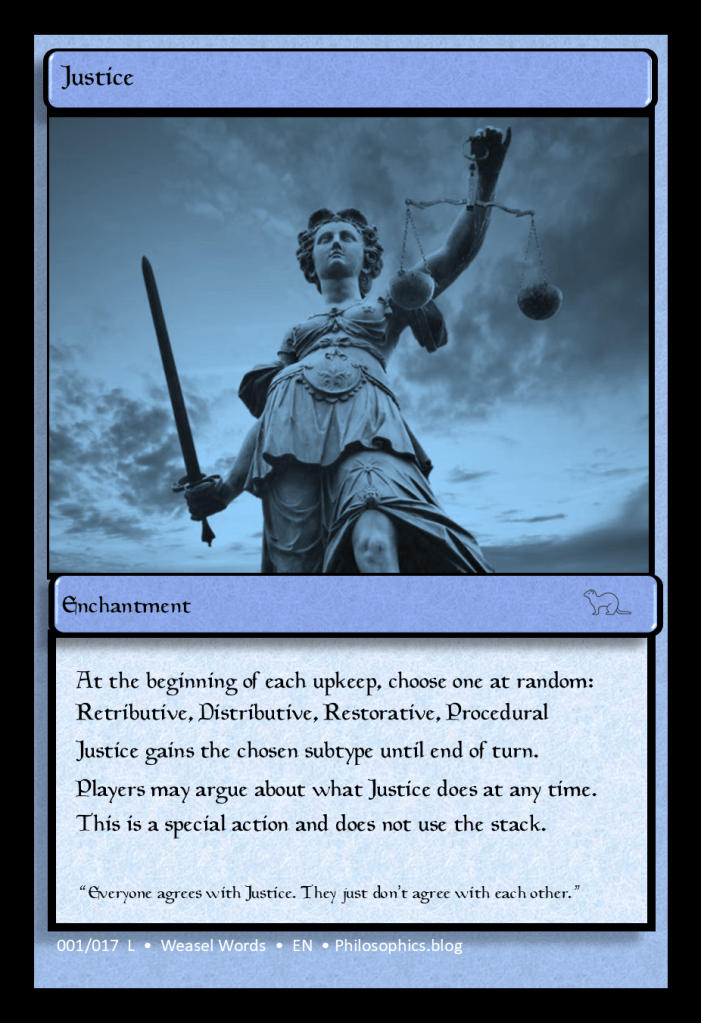
Gallie’s notion of essentially contested concepts allows us to see how words like justice, democracy, and freedom have long been arenas of ideological struggle, their definitions tugged by factions seeking to claim the moral high ground. But Schrödinger words go further – they’re not just arenas but shifting shadows, their meanings purposefully hazy, with no intention of arriving at a universally accepted definition. They are not debated in the spirit of mutual understanding but deployed to deepen the rift between competing sides. Kekes’ critique in A Reconsideration touches on this, suggesting that the contestation of terms like freedom and democracy still strives for some level of shared understanding. Schrödinger words, by contrast, live in the gap, forever contested, forever unresolved, their ambiguity cherished rather than lamented.

Ultimately, in the realm of Schrödinger’s Weasel, language becomes a battlefield where words are held hostage to polarising meanings. Their superposition is deliberate, their ambiguity cultivated. In this brave new lexicon, we see language not as a bridge of understanding but as a weapon of mass disinformation – a trick with all the precision of quantum mechanics but none of the accountability. Whether this ambiguity will one day collapse into meaning, as particles do when measured, remains uncertain. Until then, Schrödinger’s Weasel prowls, its meaning indeterminate, serving whichever agenda is quickest to claim it.