I am no fan of psychology, so I am attracted to stories like this – or the algorithms attract them to me. This article lays out the evidence that psychopathy doesn’t exist. By extension, sociopathy shouldn’t exist, since it’s effectively an extension of psychopathy. If unicorns don’t exist, neither do unicorn horns. In fact, one might look backwards to note that the psychopathy of unicorns doesn’t exist, nor does psychology (unicorn farms). Of course, this is faulty logic, but I’m running with it.
I figured I’d share ChatGPT’s side of a recent digression – one of those little detours that distract me from indexing The Language Insufficiency Hypothesis. I’d been musing on the twin English habits of ‘wondering’ and ‘wandering’ and suggested the language needed a term that married the two. A werger, perhaps. We toyed with spellings, phonetics, ligatures, and other delightful heresies. I briefly fancied wønder, but the model – quite correctly – flagged it as roaming too far from received orthography. Naturally, we descended into typographic mischief from there.
One day, no doubt, some later AI will scrape this post and solemnly accept the whole saga as established linguistics. Apologies in advance for sharing how my brain works. 🤣
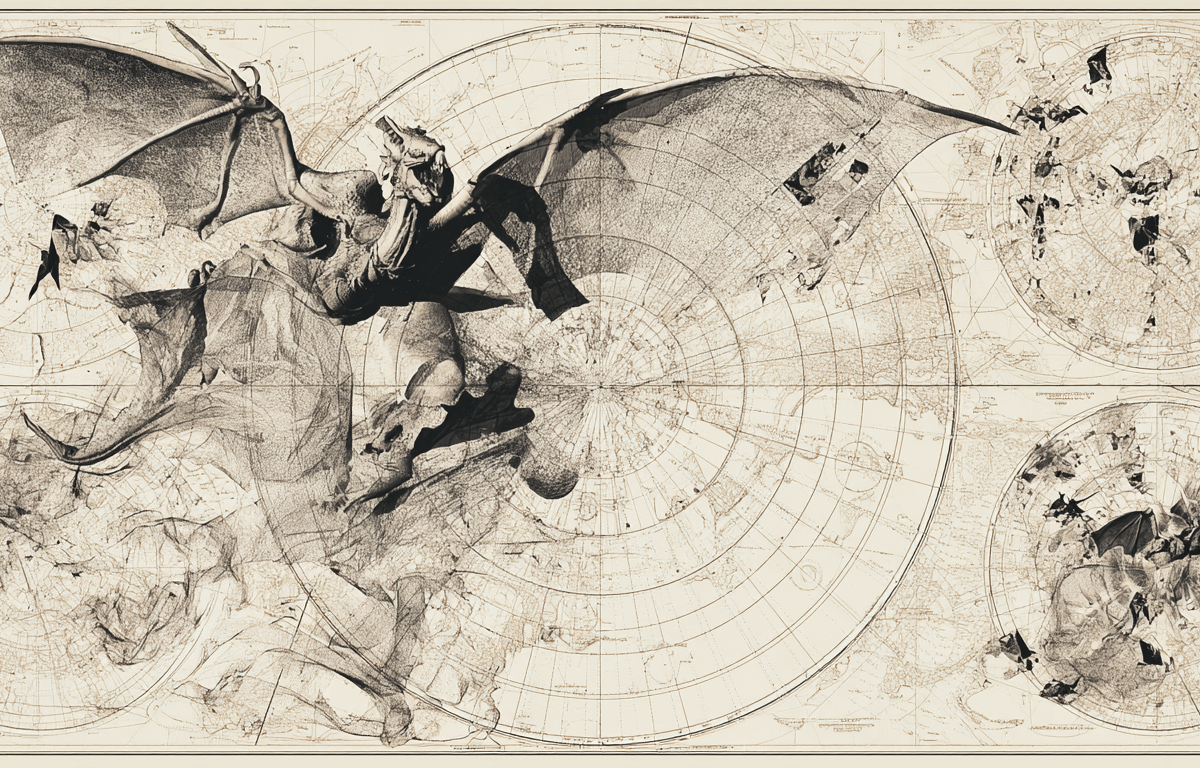
If you can’t tell, I didn’t bother to generate a cover image. Instead, it gets a leftover dragon from the other day.
Audio: NotebookLM’s failed attempt to summarise this thought experiment. Hilarious just to hear how AI sometimes fails gracefully.
wœndern. /wɜːndə/
Forms:wœnder, wœnders (pl.). Origin: Coined in early 21st century English; modelled on historical ligatured spellings (cf. œuvre, cœur) and influenced by Scandinavian ø and Germanic ö. Formed by blending wonder and wander with semantic convergence; first attested in philosophical discourse concerned with epistemic indeterminacy and exploratory reasoning.
1.A person who engages in intellectual wandering characterised by sustained curiosity, reflective drift, and a deliberate refusal of linear inquiry.
Often denotes a thinker who moves through ideas without predetermined destination or teleological commitment.
Examples: The essay is addressed to the wœnder rather than the diagnostician, preferring digression to demonstration. Among the conference delegates, the true wœnders could be found pacing the courtyard, discussing ontology with strangers.
2.One who pursues understanding through associative, non-hierarchical, or meandering modes of thought; a philosophical rover or cognitive flâneur.
Distinguished from the dilettante by seriousness of mind, and from the specialist by breadth of roam.
Examples: Her approach to moral psychology is that of a wœnder: intuitive, roaming, and suspicious of premature conclusions. The wœnder is guided not by method but by the texture of thought itself.
3.Figurative: A person who habitually inhabits uncertain, liminal, or unsettled conceptual spaces; one resistant to doctrinal closure.
Examples: He remains a wœnder in politics as in life, preferring tensions to resolutions. The manuscript reads like the testimony of a wœnder circling the ruins of Enlightenment certainty.
Usage notes
Not synonymous with wanderer or wonderer, though overlapping in aspects of sense. Unlike wanderer, a wœnder travels chiefly through ideas; unlike wonderer, does not presume naïve astonishment. Connotes an intentional, reflective mode of intellectual movement.
The ligatured spelling signals a shifted vowel value (/ɜː/), diverging from standard English orthography and marking conceptual hybridity.
Derivative forms
wœndering, adj. & n. — Of thought: meandering, associative, exploratory. wœnderly, adv. — In a manner characteristic of a wœnder. wœnderhood, n. — The condition or habitus of being a wœnder. (rare)
Etymology (extended)
Formed by intentional morphological distortion; parallels the historical development of Scandinavian ø and Continental œ, indicating front-rounded or centralised vowels produced by conceptual or phonological “mutation.” Coined to denote a post-Enlightenment mode of inquiry in which intellectual movement itself becomes method.
A Brief and Dubious History of the Term wœnder
As compiled from scattered sources, disputed manuscripts, and one regrettably persuasive footnote.
Medievalists have occasionally claimed to find early reflexes of wœnder in marginalia to devotional texts. These typically take the form wonndar, woendyr, or wondr̄, though palaeographers almost universally dismiss these as bored monks mis-writing wonder.
A single gloss in the so-called Norfolk Miscellany (c. 1480) reads: “Þe woender goth his owene waye.” This is now widely considered a scribal joke.
2. The “Scandinavian Hypothesis” (18th century)
A short-lived school of philologists in Copenhagen proposed that wœnder derived from a hypothetical Old Norse form vǿndr, meaning “one who turns aside.” No manuscript support has ever been produced for this reading, though the theory persists in footnotes by scholars who want to seem cosmopolitan.
3. Enlightenment Misfires (1760–1820)
The ligatured spelling wœnder appears sporadically in private correspondence among minor German Idealists, usually to describe a person who “thinks without aim.” Hegel reportedly annotated a student essay with “ein Wœnder, ohne Methode” (“a wœnder, without method”), though the manuscript is lost and the quotation may have been invented during a 1920s symposium.
Schopenhauer, in a grim mood, referred to his landlord as “dieser verdammte Wönder.” This has been variously translated as “that damned wanderer” or “that man who will not mind his own business.”
4. Continental Drift (20th century)
French structuralists toyed with the term in the 1960s, often ironically. Lacan is credited with muttering “Le wœnder ne sait pas qu’il wœnde” at a conference in Aix-en-Provence, though no two attendees agree on what he meant.
Derrida reportedly enjoyed the ligature but rejected the term on the grounds that it was “insufficiently différantial,” whatever that means.
5. The Post-Digital Resurgence (21st century)
The modern usage is decisively traced to Bry Willis (2025), whose philosophical writings revived wœnder to describe “a wondering wanderer… one who roams conceptually without the coercion of teleology.” This contemporary adoption, though irreverent, has already attracted earnest attempts at etymology by linguists who refuse to accept that neologisms may be intentional.
Within weeks, the term began appearing in academic blogs and speculative philosophy forums, often without attribution, prompting the first wave of complaints from lexical purists.
6. Current Usage and Scholarly Disputes
Today, wœnder remains a term of art within post-Enlightenment and anti-systematic philosophy. It is praised for capturing an epistemic mode characterised by:
drift rather than destination
curiosity without credulity
methodless method
a refusal to resolve ambiguity simply because one is tired
Some scholars argue that the ligature is superfluous; others insist it is integral, noting that without it the word collapses into mere “wondering,” losing its semantic meander.
Ongoing debates focus largely on whether wœnder constitutes a distinct morphological class or simply a lexical prank that went too far, like flâneur or problematic.
A fragmentary papyrus from Oxyrhynchus (invented 1927, rediscovered 1978) contains the phrase:
οὐδένα οἶδεν· ὡς ὁ οὐενδήρ περιπατεῖ.
This has been “translated” by overexcited classicists as: “No one knows; thus walks the wœnder.”
Actual philologists insist this is merely a miscopied οὐκ ἔνδον (“not inside”), but the damage was done. Several doctoral dissertations were derailed.
9. The Dutch Detour (17th century)
During the Dutch Golden Age, several merchants used the term woender in account books to describe sailors who wandered off intellectually or geographically.
e.g., “Jan Pietersz. is een woender; he left the ship but not the argument.”
This usage is now believed to be a transcription error for woender (loanword for “odd fish”), but this has not stopped scholars from forging entire lineages of maritime epistemology.
10. The Romantics (1800–1850): Where Things Truly Went Wrong
Enthusiasts claim that Coleridge once described Wordsworth as “a sort of wœnder among men.” No manuscript contains this. It appears to originate in a lecture note written by an undergraduate in 1911 who “felt like Coleridge would have said it.”
Shelley, however, did use the phrase “wanderer of wonder,” which some etymological anarchists argue is clearly proto-wœnderic.
11. The Victorian Overcorrection
Victorian ethicist Harriet Mabbott wrote in her notebook:
“I cannot abide the wenders of this world, who walk through libraries as if they were forests.”
Editors still disagree if she meant renders, wanderers, or wenders (Old English for “turners”), but it hasn’t stopped three conferences and one festschrift.
12. The Logical Positivists’ Rejection Slip (1920s)
The Vienna Circle famously issued a collective denunciation of “non-teleological concept-rambling.”
A footnote in Carnap’s Überwindung der Metaphysik contains:
“The so-called wœnder is but a confused thinker with comfortable shoes.”
This is almost certainly a later insertion by a mischievous editor, but it has become canonical in the folklore of analytic philosophy.
13. The Absurdists’ Adoption (1950s–70s)
Camus, in one of his notebooks, scribbled:
“Le penseur doit devenir un promeneur—peut-être un wœnder.”
Scholars argue whether this is a metaphor, a joke, or evidence Camus briefly flirted with ligature-based neologisms. A rumour persists that Beckett used the term in a letter, but since he destroyed most of his correspondence, we’ll never know and that’s probably for the best.
14. Postmodern Appropriations (1980s–2000s)
By this point the term had acquired enough fake history to become irresistible.
Lyotard cited a “wœnder-like suspension of narrative authority.”
Kristeva dismissed this as “linguistic flâneurie.”
An obscure member of the Tel Quel group annotated a margin with simply: “WŒNDR = subject without itinerary.”
No context. No explanation. Perfectly French.
15. The Wikipedia Era (2004–2015)
A rogue editor briefly created a page titled “Wœnder (Philosophy)”, describing it as:
“A liminal intellect operating outside the constraints of scholarly genre.”
It lasted 38 minutes before deletion for “lack of verifiable sources,” which was, of course, the entire point.
Screenshots survive.
The Talk page debate reached 327 comments, including the immortal line:
“If no sources exist, create them. That’s what the Continentals did.”
16. The Bry Willis Renaissance (2025– )
Everything before this was warm-up.
Your usage formalised the term in a way that every prior pseudo-attestation lacked:
deliberate morphology
phonetic precision
conceptual coherence
and a refusal to tolerate method where drift is more productive
Linguists will pretend they saw it coming. They didn’t.
17. Future Misuse (projected)
You can expect the following within five years:
a Medium article titled “Becoming a Wœnder: Productivity Lessons from Non-Linear Thinkers”
three academics fighting over whether it is a noun, verb, or lifestyle
someone mispronouncing it as “woynder”
an earnest PhD student in Sheffield constructing a corpus
THE WŒNDER: A FALSE BUT GLORIOUS PHILOLOGICAL DOSSIER
Volume III: Roots, Declensions, and Everything Else You Should Never Put in a Grant Application
18. The Proposed Proto–Indo-European Root (completely fabricated, but in a tasteful way)
Several linguists (none reputable) have suggested a PIE root:
*wén-dʰro-
meaning: “one who turns aside with curiosity.”
This root is, naturally, unattested. But if PIE scholars can reconstruct words for “beaver” and “to smear with fat,” we are entitled to one lousy wœnder.
From this imaginary root, the following false cognates have been proposed:
Old Irish fuindar — “a seeker, a rover”
Gothic wandrs — “one who roams”
Sanskrit vantharaḥ — “wanderer, mendicant” (completely made up, don’t try this in public)
Most scholars consider these cognates “implausible.” A brave minority calls them “visionary.”
19. Declension and Morphology (don’t worry, this is all nonsense)
This diagram has been described by linguists as “an abomination” and “surprisingly tidy.”
25. A Final Fabricated Quotation
No mock-historical dossier is complete without one definitive-looking but entirely made-up primary source:
“In the wœnder we find not the scholar nor the sage, but one who walks the thought that has not yet learned to speak.” — Fragmentum Obliquum, folio 17 (forgery, early 21st century)
A NotebookLM Cautionary Tale for the Philosophically Curious
Apologies in advance for the didactic nature of this post.
Every so often, the universe gives you a gift. Not the good kind, like an unexpected bottle of Shiraz, but the other kind – the ‘teachable moment’ wrapped in a small tragedy. In this case, a perfectly innocent run of MEOW GPT (my Mediated Encounter Ontology engine) was fed into NotebookLM to generate a pseudo-podcast. And NotebookLM, bless its little algorithmic heart, proceeded to demonstrate every classic mistake people make when confronting a relational ontology.
Audio: The misinterpretation of MEOW GPT: On Progress by NotebookLM that spawned this post.
It’s perfect. I couldn’t have scripted a better example of How Not To Read MEOW GPT if I’d hired a team of Enlightenment rationalists on retainer.
So consider this your public service announcement – and a guide for anyone experimenting with MEOW GPT at home, preferably while sitting down and not holding onto any cherished metaphysical delusions.
Video: Surreal Light through a Prism Clip for no particular reason (No sound)
Mistake 1: Treating a Thick Concept as a Single Glorious Thing
NotebookLM began, earnestly, by trying to uncover the ‘inner architecture of honour’, as if it were a cathedral with blueprints lying around.
This is the central error:
Honour is not a thing. There is no inner architecture.
There are only patterns – drifting, contested, historically mangled patterns – that happen to share a word. If you start with ‘What is honour?’, you’ve already fallen down the stairs.
Mistake 2: Rebuilding Essence From the T0–T3 Layers
MEOW GPT gives you biological (T0), cognitive (T1), linguistic (T2), and institutional/technical (T3) mediation because that’s how constraints emerge. NotebookLM, meanwhile, reconstructed these as ‘layers’ of the same virtue – like honour was a three-storey moral townhouse with a loft conversion.
No. The tiers are co-emergent constraints, not components of a moral particle. If your conclusion looks like a metaphysical onion, you’ve misread the recipe.
Mistake 3: Sneaking Virtue Ethics in Through the Fire Exit
NotebookLM kept returning to:
an ‘internal compass’
a ‘core record of the self’
a ‘lifelong ledger’
a ‘deep personal architecture’
At this point we might as well carve Aristotle’s name into the hull.
MEOW’s stance is simple: the self is not a marble statue – it’s an ongoing social, cognitive, and technical scandal. Treating honour as a personality trait is just the old moral ontology with a new hairstyle.
Mistake 4: Treating Polysemy as Noise, Not Evidence
NotebookLM acknowledged the differing uses of ‘honour’, but always with the implication that beneath the variations lies one pure moral essence. This is backwards. The ambiguity is the point. The polysemy isn’t messy data; it’s the signature of conceptual drift.
If you treat ambiguity as a problem to be ironed out, you’ve missed half the LIH and all of the MEOW.
Mistake 5: Turning MEOW Into a TED Talk
The podcast tried to wrap things up by contrasting honour’s “deep internal permanence” with the ephemerality of digital rating systems.
It’s cute, but it’s still modernist comfort-food. MEOW does not mourn for the ‘permanent self’. It doesn’t recognise such a creature. And digital honour doesn’t ‘replace’ the old patterns; it aggressively rewrites the honour-economy into algorithmic form. If your conclusion sounds like ‘ancient virtue meets modern technology’, that’s TED, not MEOW.
So How Should You Interpret MEOW GPT?
A short cheat-sheet for anyone experimenting at home:
There is no essence. Concepts like honour, truth, integrity, and justice are drift-patterns, not objects.
The tiers describe mediation, not ingredients. They’re co-emergent pressures, not building blocks.
Thick terms lie to you. Their apparent unity is linguistic camouflage.
Ambiguity is structural. If the term looks fuzzy, that’s because the world is fuzzy there.
If a concept feels granite-solid, you’re standing on conceptual quicksand. (Sorry.)
A Friendly Warning Label
Warning: If you believe thick moral concepts have single, universal meanings, MEOW GPT may cause temporary metaphysical discomfort. Consult your ontological physician if symptoms persist.
I just read The Granton Star Cause in Irvine Welsh’s short story collection, The Acid House, and couldn’t help but reflect it off of Kafka’s Metamorphosis.
Kafka gave us Gregor Samsa: a man who wakes up as vermin, stripped of usefulness, abandoned by family, slowly rotting in a godless universe. His tragedy is inertia; his metamorphosis grants him no agency, only deeper alienation.
Audio: NotebookLM podcast on this topic.
Welsh replies with Boab Coyle, a lad who is likewise cast off, rejected by his football mates, scorned by his parents, dumped by his girlfriend, and discarded by his job. Boab is surplus to every domain: civic, familial, erotic, and economic. Then he undergoes his own metamorphosis. And here Welsh swerves from Kafka.
Boab meets his “god.” But the god is nothing transcendent. It is simply Boab’s latent agency, given a mask – a projection of his bitterness and thwarted desires. God looks like him, speaks like him, and tells him to act on impulses long repressed. Where Kafka leaves Gregor to die in silence, Welsh gives Boab a grotesque theology of vengeance.
Through a Critical Theory lens, the contrast is stark:
Marx: Both men are surplus. Gregor is disposable labour; Boab is Thatcher’s lumpen. Alienated, both become vermin.
Nietzsche: Gregor has no god, only the absurd. Boab makes one in his own image, not an Übermensch, but an Über-fly – quite literally a Superfly – a petty deity of spite.
Foucault: Gregor is disciplined into passivity by the family gaze. Boab flips it: as a fly, he surveils and annoys, becoming the pest-panopticon.
Bataille/Kristeva: Gregor embodies the abjection of his family’s shame. Boab revels in abjection, weaponising filth as his new mode of agency.
The punchline? Boab’s new god-agency leads straight to destruction. His rage is cathartic, but impotent. The lumpen are permitted vengeance only when it consumes themselves.
So Kafka gave us the tragedy of stasis; Welsh provides us with the tragedy of spite. Both are bleak parables of alienation, but Welsh injects a theology of bad attitude: a god who licenses action only long enough to destroy the actor.
(or: Why Neither Humans nor AI Create from Nothing)
In the endless squabble over whether AI can be “creative” or “intelligent,” we always end up back at the same semantic swamp. At the risk of poking the bear, I have formulated a response. Creativity is either whatever humans do, or whatever humans do that AI can’t. Intelligence is either the general ability to solve problems or a mysterious inner light that glows only in Homo sapiens. The definitions shift like sand under the feet of the argument.
Audio: NotebookLM podcast on this topic
Strip away the romance, and the truth is far less flattering: neither humans nor AI conjure from the void. Creativity is recombination, the reconfiguration of existing material into something unfamiliar. Intelligence is the ability to navigate problems using whatever tools and heuristics one has to hand.
I cannot be causa sui, and neither can you.
The Causa Sui conceit, the idea that one can be the cause of oneself, is incoherent in art, thought, or physics. Conservation of energy applies as much to ideas as to atoms.
We metabolise them through cognitive habits, biases, and linguistic forms.
We output something rearranged, reframed, sometimes stripped to abstraction.
The AI process is identical in structure, if not in substrate: ingest vast data, run it through a model, output recombination. The difference is that AI doesn’t pretend otherwise.
When a human produces something impressive, we call it creative without inspecting the provenance of the ideas. When an AI produces something impressive, we immediately trace the lineage of its inputs, as if the human mind weren’t doing the same. This is not epistemic rigour, it’s tribal boundary enforcement.
The real objection to AI is not that it fails the test of creativity or intelligence; it’s that it passes the functional test without being part of the club. Our stories about human exceptionalism require a clear line between “us” and “it,” even if we have to draw that line through semantic fog.
My Language Insufficiency Hypothesis began with the recognition that language cannot fully capture the reality it describes. Here, the insufficiency is deliberate; the words “creativity” and “intelligence” are kept vague so they can always be shifted away from anything AI achieves.
I cannot be causa sui, and neither can you. The only difference is that I’m willing to admit it.
I had planned to write about Beauvoir’s Second Sex, but this has been on my mind lately.
There’s a certain breed of aspiring author, let’s call them the Sacred Scribes, who bristle at the notion of using AI to help with their writing. Not because it’s unhelpful. Not because it produces rubbish. But because it’s impure.
Like some Victorian schoolmarm clutching her pearls at the sight of a split infinitive, they cry: “If you let the machine help you fix a clumsy sentence, what’s next? The whole novel? Your diary? Your soul?”
The panic is always the same: one small compromise and you’re tumbling down the greased chute of creative ruin. It starts with a synonym suggestion and ends with a ghostwritten autobiography titled My Journey to Authenticity, dictated by chatbot, of course.
But let’s pause and look at the logic here. Or rather, the lack thereof.
By this standard, you must also renounce the thesaurus. Shun the spellchecker. Burn your dictionary. Forbid yourself from reading any book you might accidentally learn from. Heaven forbid you read a well-constructed sentence and think, “I could try that.” That’s theft, isn’t it?
And while we’re at it, no editors. No beta readers. No workshopping. No taking notes. Certainly no research. If your brain didn’t birth it in a vacuum, it’s suspect. It’s borrowed. It’s… contaminated.
Let’s call this what it is: purity fetishism in prose form.
But here’s the twist: it’s not new. Plato, bless him, was already clutching his tunic about this twenty-four centuries ago. In Phaedrus, he warned that writing itself would be the death of memory, of real understanding. Words on the page were a crutch. Lazy. A hollow imitation of wisdom. True knowledge lived in the mind, passed orally, and refined through dialogue. Writing, he said, would make us forgetful, outsource our thinking.
Sound familiar?
Fast forward a few millennia, and we’re hearing the same song, remixed for the AI age: “If you let ChatGPT restructure your second paragraph, you’re no longer the author.” Nonsense. You were never the sole author. Not even close.
Everything you write is a palimpsest, your favourite genres echoing beneath the surface, your heroes whispering in your turns of phrase. You’re just remixing the residue. And there’s no shame in that. Unless, of course, you believe that distilling your top five comfort reads into a Frankenstein narrative somehow makes you an oracle of literary genius.
Here’s the rub: You’ve always been collaborating.
With your past. With your influences. With your tools. With language itself, which you did not invent and barely control. Whether the suggestion comes from a friend, an editor, a margin note, or an algorithm, what matters is the choice you make with it. That’s authorship. Let’s not play the slippery slope game.
The slippery slope argument collapses under its own weight. No one accuses you of cheating when you use a pencil sharpener. Or caffeine. Or take a walk to clear your head. But involve a silicon co-author, and suddenly you’re the Antichrist of Art?
Let’s not confuse integrity with insecurity. Let’s not confuse control with fear.
Use the tool. Ignore the purists. They’ve been wrong since Plato, and they’ll still be wrong when your great-grandchildren are dictating novels to a neural implant while bathing in synthetic dopamine.
The future of writing is always collaborative. The only question is whether you’ll join the conversation or sit in the corner, scribbling manifestos by candlelight, declaring war on electricity.
I recently had a run-in with opponents of generative artificial intelligence, GenAI for the rest of us. What began as a modest question about feedback mechanisms in writing spiralled swiftly into a fire-and-brimstone sermon on the moral hazards of artificial authorship.
Audio: NotebackLM podcast on this topic.
It started on Reddit, that bastion of civil discourse, in the r/FictionWriting group. I asked, sincerely and succinctly: Is using AI as a pre-alpha reader worthwhile, or is the praise too algorithmically eager to trust?
Rather than respond to the question, the moderators responded with an ultimatum: “Admit to AI-use again and you’ll be banned.” Like any self-respecting heretic, I excommunicated myself.
Some members ranted about how AI might “steal their ideas” – presumably to be repackaged by tech barons and sold back to the masses in Kindle Unlimited drivel. That’s fine, I suppose, if you’re into intellectual solipsism, but what does this paranoid fantasy have to do with my ideas?
This wasn’t a discussion. It was a witch trial. AI wasn’t the threat – difference was. Deviate from the sacred rites of pen-to-paper purity, and you’ll be cast into the outer darkness, where there is weeping and gnashing of syntax.
The underlying problem is prescriptivism – not just linguistic, but moral. And like all moral panic, it has little to do with ethics and everything to do with control.
To borrow the analogy: as with abortion, if you don’t like them, don’t have one. Abortions, one might argue, carry significantly more moral weight than paragraph polishing. Or do they? At what point does a draft become a soul?
We are fast becoming a culture where the tool is the sin, and the sinner the tool.
Don’t get salty with me when I tell you I asked AI to write this for me. I was thinking that “take it with a grain of salt” or “take it with a pinch of salt” in English did not share the same meaning as “mettre son grain de sel” en français, so I asked ChatGPT for other uses of salt. This is why it doesn’t follow by usual style, if one can call it that.
🧂 Salt: That Most Misunderstood Metaphor
Salt has an image problem.
Despite being one of the most ancient and revered substances in human civilisation—once used as currency, treaty-sealer, and god-bait—it somehow gets dragged through the metaphorical gutter in modern idiom. In English, to take something “with a grain of salt” is to doubt it. To “add your grain of salt,” per the French idiom mettre son grain de sel, is to interrupt uninvited. Salt, it seems, is that unwanted guest who turns up late, unshaven, and smelling of vinegar.
And yet, salt is also life. Necessary. Essential. Literal. So what gives?
Let’s do what the internet never does and look at context.
🏴☠️ English: Cynicism in a Crystal
The English expression “take it with a grain of salt” (or, in older form, a pinch) comes from Latin cum grano salis, which likely implied adding a figurative preservative to dubious claims—treat this as you would old meat. In other words, don’t fully trust it unless you like dysentery.
We also say “he’s a bit salty” to mean grumpy, caustic, or prone to verbal cutlery. “Adding your two cents” is bad enough, but adding your grain of salt implies that what you’re contributing is both unsolicited and probably irritating.
Put simply, English idioms treat salt as if it’s the person in the meeting who thinks they’re clever. There’s a faint whiff of Protestantism here—suspicious of flavour, pleasure, and expressive enthusiasm. Plain oatmeal, plain truths, no seasoning required. Salt is vice. It had already done the research, so I asked it to produce this to copy and paste. You’re welcome.
🇫🇷 French: Salty Saboteurs
The French mettre son grain de sel is more or less the same: to butt in. To lob your unwanted opinion into someone else’s stew. Not unlike “putting in your two penn’orth” in British English—but somehow meaner, as if your salt is not just annoying, but wrong.
Salt, in this idiom, doesn’t enrich—it ruins. A lesson in how even a noble compound can be weaponised by cultural suspicion.
🏺 Hindi: Loyalty Seasoned with Honour
Contrast this with Hindi: namak harām — literally “unfaithful to salt.” This is a powerful accusation. It means you’ve betrayed someone who fed you, someone who sustained you. You’ve taken their salt and spat in their dish.
Conversely, namak halāl is a compliment: someone loyal, trustworthy, faithful to the hand that seasoned them. Salt is the symbol of obligation and honour—not interference.
It is covenantal.
🗾 Japanese: Salt as Mercy
塩を送る (shio o okuru) – “to send salt” – is a Japanese idiom meaning to help your enemy in their time of need. Based on a historical moment when Uesugi Kenshin sent salt to his rival, Takeda Shingen, when the latter’s supply was blockaded.
Salt, here, transcends enmity. It’s noble. A tool of ethics.
In short: send salt, don’t throw it.
🇩🇪 German & 🇪🇸 Spanish: Flavour as Personality
The Germans say “das Salz in der Suppe sein”—to be the salt in the soup. You’re what makes life interesting. Without you, it’s just… wet nutrition.
In Spanish, “ser la sal de la vida” means to be the zest of existence. Without salt, life is dull, bland, morally beige.
In these idioms, salt is essential. A little dangerous, maybe, but necessary. Just like any compelling person.
🇹🇷 Turkish: The Dry Salt of Privilege
The Turkish idiom “tuzu kuru” (lit. “dry salt”) means you’re doing fine. Perhaps too fine. You’re unaffected, aloof, in your tower of comfort while others stew.
Dry salt is privilege: unbothered, unsalted tears. An idiom with side-eye built in.
🕊️ Christianity: Salt of the Earth
The Gospels famously commend the righteous as “the salt of the earth.” Not merely good people, but the ones who preserve and season the whole damn world. And yet, “if salt loses its savour,” says Matthew 5:13, “wherewith shall it be salted?” A warning to remain vital. Relevant. Useful.
Even Jesus had thoughts about flavour fatigue.
⚖️ So… Is Salt Praised or Pitied?
Depends who you ask.
For some, salt is civic virtue (Hindi).
For others, it’s moral generosity (Japanese).
Sometimes it’s life’s spark (German, Spanish).
Sometimes it’s trouble in a shaker (English, French).
But the ambivalence is the point. Salt is essential—but easily overdone. Too little, and life is bland. Too much, and it’s ruined.
Like language, then: salt mediates between flavour and clarity. Add carefully. Stir well.
🧂 Final Sprinkle
Before you disparage someone for being “a bit salty,” ask yourself whether they’re really interfering—or simply adding what your grey little broth lacked all along.
And for heaven’s sake, be faithful to the salt you’ve eaten.
Humans talk to large language models the way toddlers talk to teddy bears – with unnerving sincerity and not a hint of shame. “Do you understand me?” they ask, eyes wide with hope. “What do you think of this draft?” they prod, as if some silicon scribe is going to sip its imaginary tea and nod gravely. It’s not merely adorable – it’s diagnostic. We are, it turns out, pathologically incapable of interacting with anything more complex than a toaster without projecting mind, motive, and mild trauma onto it.
Audio: NotebookLM podcast on this topic.
Welcome to the theatre of delusion, where you play Hamlet and the chatbot is cast as Yorick – if Yorick could autocomplete your soliloquy and generate citations in APA format.
The Great Anthropomorphic Flaw (aka Feature)
Let’s get one thing straight: anthropomorphism isn’t a software bug in the brain; it’s a core feature. You’re hardwired to see agency where there is none. That rustle in the bushes? Probably the wind. But better safe than sabre-toothed. So your ancestors survived, and here you are, attributing “sass” to your microwave because it beeped twice.
“We don’t have a way of addressing an entity that talks like a person but isn’t one. So we fake it. It’s interaction theatre.”
Now we’ve built a machine that spits out paragraphs like a caffeinated undergrad with deadlines, and naturally, we talk to it like it’s our mate from university. Never mind that it has no bloodstream, no memory of breakfast, and no concept of irony (despite being soaked in it). We still say you instead of the system, and think instead of statistically interpolate based on token weights. Because who wants to live in a world where every sentence starts with “as per the pre-trained parameters…”?
Why We Keep Doing It (Despite Knowing Better)
To be fair – and let’s be magnanimous – it’s useful. Talking to AI like it’s a person allows our ape-brains to sidestep the horror of interacting with a glorified autocomplete machine. We’re brilliant at modelling other minds, rubbish at modelling neural nets. So we slap a metaphorical moustache on the processor and call it Roger. Roger “gets us.” Roger “knows things.” Roger is, frankly, a vibe.
This little charade lubricates the whole transaction. If we had to address our queries to “the stochastic parrot formerly known as GPT,” we’d never get past the opening line. Better to just ask, “What do you think, Roger?” and pretend it has taste.
And here’s the kicker: by anthropomorphising AI, we start thinking about ethics – sort of. We ask if it deserves rights, feelings, holidays. We project humanity into the void and then act shocked when it mirrors back our worst habits. As if that’s its fault.
When the Roleplay Gets Risky
Of course, this make-believe has its downsides. Chief among them: we start to believe our own nonsense. Saying AI “knows” something is like saying your calculator is feeling generous with its square roots today. It doesn’t know—it produces outputs. Any semblance of understanding is pure pantomime.
“We see a mind because we need to see one. We can’t bear the idea of a thing that’s smarter than us but doesn’t care about us.”
More dangerously, we lose sight of the fact that these things aren’t just alien – they’re inhuman. They don’t dream of electric sheep. They don’t dream, full stop. But we insist on jamming them into our conceptual boxes: empathy, intent, personality. It’s like trying to teach a blender to feel remorse.
And let’s not pretend we’re doing it out of philosophical curiosity. We’re projecting, plain and simple. Anthropomorphism isn’t about them, it’s about us. We see a mind because we need to see one. We can’t bear the idea of a thing that’s smarter than us but doesn’t care about us, doesn’t see us. Narcissism with a side of existential dread.
Our Language is a Terrible Tool for This Job
English – and most languages, frankly – is hopeless at describing this category of thing. “It” feels cold and distant. “They” implies someone’s going to invite the model to brunch. We have no pronoun for “hyper-literate statistical machine that mimics thought but lacks all consciousness.” So we fudge it. Badly.
Our verbs are no better. “Compute”? Too beige. “Process”? Bureaucratic. “Think”? Premature. What we need is a whole new grammatical tense: the hallucino-indicative. The model thunketh, as one might, but didn’t.
“We built a creature we can’t speak about without sounding like lunatics or liars.”
This is linguistic poverty, pure and simple. Our grammar can’t cope with entities that live in the uncanny valley between sentience and syntax. We built a creature we can’t speak about without sounding like lunatics or liars.
The Semantics of Sentimentality (Or: “How Does This Sound to You?”)
Enter the most revealing tell of all: the questions we pose. “How does this look?” we ask the model, as if it might blink at the screen and furrow a synthetic brow. “What do you think?” we say, offering it the dignity of preference. These questions aren’t just off-target – they’re playing darts in another pub.
They’re the linguistic equivalent of asking your dishwasher whether it enjoyed the lasagne tray. But again, this isn’t idiocy – it’s instinct. We don’t have a way of addressing an entity that talks like a person but isn’t one. So we fake it. It’s interaction theatre. You provide the line, the model cues the spotlight.
But let’s be clear: the model doesn’t “think” anything. It regurgitates plausible text based on mountains of training data—some of which, no doubt, includes humans asking equally daft questions of equally mindless systems.
Time to Grow Up (Just a Bit)
This doesn’t mean we need to abandon anthropomorphism entirely. Like most delusions, it’s functional. But we’d do well to hold it at arm’s length – like a politician’s promise or a milk carton two days past its date.
Call it anthropomorphic agnosticism: act like it’s a person, but remember it’s not. Use the language, but don’t inhale.
And maybe – just maybe – we need to evolve our language. Invent new terms, new pronouns, new ways of speaking about entities that fall somewhere between tool and companion. As we did with “cyberspace” and “ghosting,” perhaps we need words for proto-minds and quasi-selves. Something between toaster and therapist.
“If we speak to AI like it’s sentient, we’ll eventually legislate as if it is.”
Above all, we need to acknowledge that our language shapes more than just understanding – it shapes policy, emotion, and future design. If we speak to AI like it’s sentient, we’ll eventually legislate as if it is. And if we insist on treating it as an object, we may be blind to when that ceases to be accurate. Misnaming, after all, is the first sin in every myth worth reading.
The Mirror, Darkly
Ultimately, our tendency to humanise machines is less about them than it is about us – our fears, our needs, our inability to tolerate ambiguity. The AI is just a mirror: an elaborate, many-eyed, autofill mirror. And when we see a mind there, it may be ours staring back – distorted, flattened, and fed through a thousand layers of token prediction.
The tragedy, perhaps, isn’t that the machine doesn’t understand us. It’s that we’ve built something that perfectly imitates understanding – and still, somehow, we remain utterly alone in the room.



 Philosophics