I’ve shared another article on Substack about how the AI-authorship debate is bollox.
Audio: NotebookLM summary podcast of this topic.
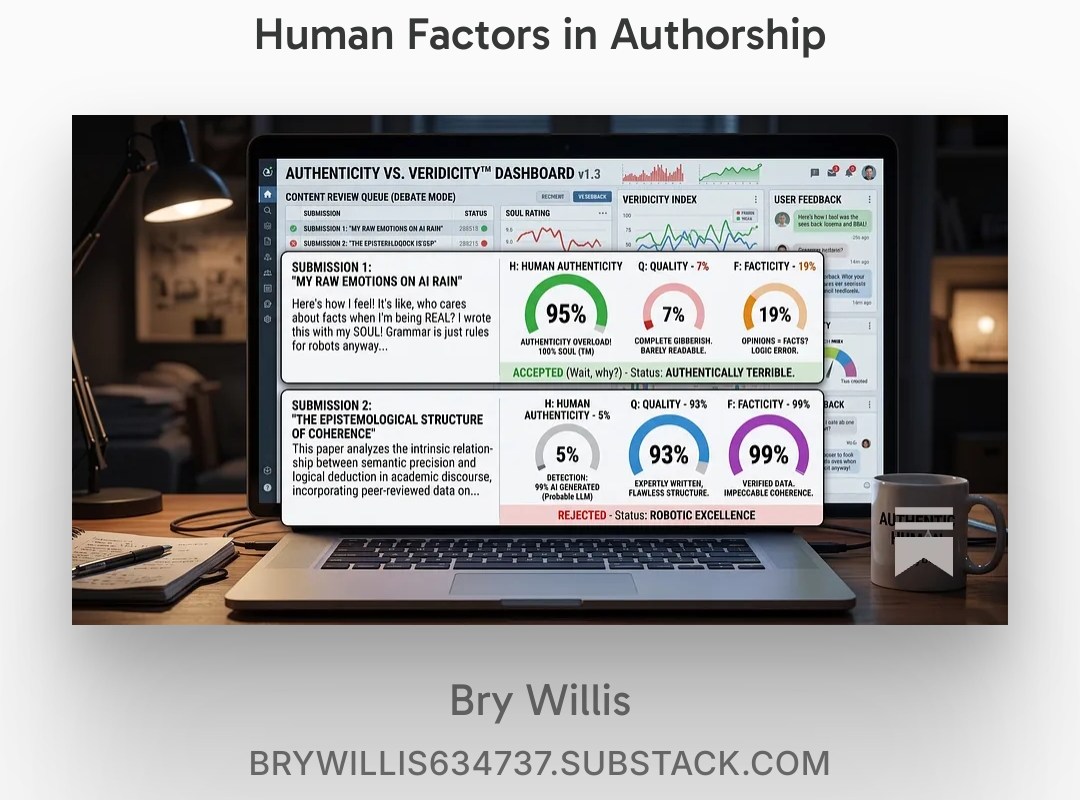
The LLM-versus-human debate has been raging for several years now, and there seem to be two principal camps: human exceptionalists and agnostics. I suppose there may also be a small, misanthropic faction, but its members are either remarkably quiet or indistinguishable from everyone else online. If you are out there, do raise your voice.
If you want to witter on about other negative aspects of AI, have at it, but the authorship debate is weak tea.
I recently had a run-in with opponents of generative artificial intelligence, GenAI for the rest of us. What began as a modest question about feedback mechanisms in writing spiralled swiftly into a fire-and-brimstone sermon on the moral hazards of artificial authorship.
Audio: NotebackLM podcast on this topic.
It started on Reddit, that bastion of civil discourse, in the r/FictionWriting group. I asked, sincerely and succinctly: Is using AI as a pre-alpha reader worthwhile, or is the praise too algorithmically eager to trust?
Rather than respond to the question, the moderators responded with an ultimatum: “Admit to AI-use again and you’ll be banned.” Like any self-respecting heretic, I excommunicated myself.
Some members ranted about how AI might “steal their ideas” – presumably to be repackaged by tech barons and sold back to the masses in Kindle Unlimited drivel. That’s fine, I suppose, if you’re into intellectual solipsism, but what does this paranoid fantasy have to do with my ideas?
This wasn’t a discussion. It was a witch trial. AI wasn’t the threat – difference was. Deviate from the sacred rites of pen-to-paper purity, and you’ll be cast into the outer darkness, where there is weeping and gnashing of syntax.
The underlying problem is prescriptivism – not just linguistic, but moral. And like all moral panic, it has little to do with ethics and everything to do with control.
To borrow the analogy: as with abortion, if you don’t like them, don’t have one. Abortions, one might argue, carry significantly more moral weight than paragraph polishing. Or do they? At what point does a draft become a soul?
We are fast becoming a culture where the tool is the sin, and the sinner the tool.


 Philosophics