When Words Do the Work: A Case Study in Nomenclature Drift

3–5 minutes

Lewis Goodall, a talk show host, calls the cross-border seizure of Venezuela’s Nicolás Maduro a ‘kidnapping’. His guest and Trump apologist, Angie Wong, rejects the word. She first says ‘arrest’, then ‘extradition’, then finally the improvised ‘special extradition’. Around that single lexical choice, a 12-minute standoff unfolds.

Audio: NotebookLM summary podcast of this topic.

As a language philosopher, I am evaluating the language and am less concerned with the underlying facts of the matter. Language serves to obscure these facts from the start and then rhetorically controls the narrative and framing.

Video: Source segment being analysed

There is a familiar mistake made whenever public discourse turns heated: the assumption that the real disagreement lies in the facts. This is comforting, because facts can, at least in principle, be checked. What follows examines a different failure mode altogether. The facts are largely beside the point.

Consider a broadcast exchange in which a political commentator and an interviewer argue over how to describe the forcible removal of a head of state from one country to another. The interviewer repeatedly uses the word kidnapping. The guest repeatedly resists this term, preferring arrest, extradition, and eventually the improvisational compromise ‘special extradition’.

What matters here is not which term is correct. What matters is what the interaction reveals about how meaning is negotiated under pressure.

The illusion of disagreement

Superficially, the exchange appears to be a dispute about legality. Was there a treaty? Was due process followed? Which court has jurisdiction? These questions generate heat, but they are not doing the work.

The real disagreement is prior to all of that: which lexical frame is allowed to stabilise the event.

Once a label is accepted, downstream reasoning becomes trivial. If it was an extradition, it belongs to one legal universe. If it was a kidnapping, it belongs to another. The participants are not arguing within a shared framework; they are competing to install the framework itself.

Equivocation as method, not error

The guest’s shifting vocabulary is often described as evasive or incoherent. This misreads what is happening. The movement from extradition to special extradition is not confusion. It is a deliberate widening of semantic tolerance.

‘Special extradition’ is not meant to clarify. It is meant to survive. It carries just enough institutional residue to sound procedural, while remaining sufficiently vague to avoid binding criteria. It functions less as a description than as a holding pattern.

This is equivocation, but not the amateur kind taught in logic textbooks. It is equivocation under constraint, where the aim is not precision but narrative continuity.

Why exposure fails

The interviewer repeatedly points out that extradition has a specific meaning, and that the situation described does not meet it. This is accurate, and also ineffective.

Why? Because the exchange is no longer governed by definitional hygiene. The audience is not being asked to adjudicate a dictionary entry. They are being asked to decide which voice has the authority to name the act.

Once that shift occurs, exposing misuse does not correct the discourse. It merely clarifies the power asymmetry. The guest can concede irregularity, precedent-breaking, even illegality, without relinquishing control of the label. The language continues to function.

Truth as a downstream effect

At no point does the exchange hinge on discovering what ‘really happened’. The physical sequence of events is relatively uncontested. What is contested is what those events are allowed to count as.

In this sense, truth is not absent from the discussion; it is subordinate. It emerges only after a rhetorical frame has been successfully installed. Once the frame holds, truth follows obediently within it.

This is not relativism. It is an observation about sequence. Rhetoric does not decorate truth here; it prepares the ground on which truth is later claimed.

Language doing institutional work

The most revealing moment comes when the guest effectively shrugs at the legal ambiguity and asks who, exactly, is going to challenge it. This is not cynicism. It is diagnostic.

Words like arrest and extradition are not merely descriptive. They are operational tokens. They open doors, justify procedures, and allow institutions to proceed without stalling. Their value lies less in semantic purity than in administrative usability.

‘Kidnapping’ is linguistically precise in one register, but administratively useless in another. It stops processes rather than enabling them. That is why it is resisted.

What the case study shows

This exchange is not about geopolitics. It is about how language behaves when it is tasked with carrying power. Meaning drifts not because speakers are careless, but because precision is costly. Labels are selected for durability, not accuracy. Truth does not arbitrate rhetoric; rhetoric allocates truth. Seen this way, the debate over terminology is not a failure of communication. It is communication functioning exactly as designed under modern conditions. Which is why insisting on ‘the correct word’ increasingly feels like shouting into a ventilation system. The air still moves. It just isn’t moving for you.

Footnotes from the House: Justice as a Casino Game

4–6 minutes

This is part 2 of a structural critique of Justice™. Read Part 1, The Ontology–Encounter–Evaluation Model: Retributive Justice as an Instantiation.

If you want a useful metaphor for how justice actually operates, don’t picture a blindfolded goddess with scales. Picture a casino.

Image: Lady Justice in Casino. The dice are rigged. haha

The rules are printed. The games look fair. Everyone is technically allowed to play. But the mathematics are tuned in advance, the exits are discreet, and the house never risks its own solvency. You don’t walk into a casino to discover whether chance is fair. You walk in to participate in a system whose advantage has already been engineered.

By the time a defendant appears, the ontological dice have already been loaded. The system has quietly asserted a set of metaphysical commitments that make certain outcomes legible, actionable, and punishable – whilst rendering others incoherent, inadmissible, or ‘unreasonable’. Because I am a philosopher of language and not a lawyer, I am free from the indoctrination and selection bias inherent in that system. This allows me to critique the system directly without being excommunicated from the club.

What follows are not neutral assumptions. They are ontological wagers, each chosen because its alternative would tilt the field away from institutional power.

Ontology 1: The Self

Justice presumes that the person who acted yesterday is meaningfully the same entity standing in court today. This is not discovered; it is asserted.

Why? Because retribution requires persistence. Desert cannot attach to a momentary configuration of consciousness. Responsibility requires a carrier that survives time, memory gaps, psychological rupture, intoxication, trauma, and neurological variance.

An episodic self – Parfit’s reductionism, trauma-fractured identity, or situational selfhood – collapses the attribution pipeline. If the ‘self’ is a series of loosely connected episodes, punishment becomes conceptually incoherent. Who is being punished for whom?

So the law treats episodic accounts not as alternative ontologies but as defects: insanity, automatism, incompetence. The self is patched, not replaced.

Ontology 2: Agency

Justice requires that actions originate somewhere. Agency is that somewhere.

The system asserts that agents could have done otherwise in a morally relevant sense. This is compatible with compatibilism, folk psychology, and everyday moral intuitions – but deeply hostile to hard determinism, strong situationism, or neurobiological deflation.

Why exclude weaker agency models? Because if agency dissolves into causation, environment, or neurochemistry, responsibility evaporates. At best, you get risk management. At worst, you get treatment or containment. Retribution has nowhere to land.

So the law nods politely to influences – upbringing, coercion, impairment – whilst ring-fencing agency as the default. Mitigation is permitted. Ontological revision is not. The house needs someone who could have chosen otherwise, even if that claim grows increasingly fictional under scrutiny.

Ontology 3: Choice

Justice models human action as a series of forks in the road. At some point, the agent ‘chose’ X over Y. This is enormously convenient.

Continuous decision spaces – poverty gradients, addiction loops, survival trade-offs – are messy. They resist clean counterfactuals. ‘What should they have done instead?’ becomes a sociological question, not a moral one.

So the system discretises. It locates a moment. A click. A trigger pull. A signature. A punch. A text sent.

Once the choice is frozen, the rest of the apparatus can proceed. Without discrete choice points, proportionality and culpability lose their anchor.

Ontology 4: Causation

Justice prefers causes that point: Who did this? When? How directly?

Systemic causation – economic pressure, cultural narratives, institutional design – creates attribution problems. If harm is emergent, no individual carries it cleanly. Responsibility smears.

So causation is narrowed. Chains are shortened. Proximate cause replaces contributing conditions. Structural violence becomes background noise.

This is not because systemic causation is false. It is because it is unmanageable within a retributive frame.

Ontology 5: Reasonableness

‘Reasonableness’ is the softest and most insidious ontology of the lot.

It pretends to be procedural, but it functions as cultural enforcement. The reasonable person is not an average human. They are an acculturated one.

Intensity becomes suspect. Rage becomes irrational. Grief becomes excessive. Radical interpretations become unreasonable not because they’re false, but because they disrupt cadence.

This ontology stabilises the game by disciplining tone. It doesn’t matter what you argue if you fail to argue it reasonably. Reasonableness is not required for responsibility to exist, only for dissent to be ignored.

The house needs calm players, not correct ones.

Why These Ontologies, and Not Their Rivals?

Because every excluded ontology threatens legibility. Justice is not designed to discover truth. It is designed to terminate cases. Ontologies that complicate attribution, disperse responsibility, or destabilise narrative continuity slow the machine. So they are ruled out – not explicitly, but structurally.

Once these commitments are in place, disagreement downstream becomes theatre. Arguments about fairness, proportionality, or intent occur within a rigged metaphysical envelope. That’s why reform debates feel sincere yet go nowhere. People argue outcomes whilst the house quietly keeps the rules.

The Point

None of this means justice is a scam. Casinos aren’t scams either. They do exactly what they are designed to do.

If you want to challenge justice meaningfully, you don’t start with sentencing guidelines or evidentiary thresholds. You start by asking which ontologies are being asserted – and why alternatives are unplayable.

Most people won’t make that move. Not because it’s wrong. Because it requires leaving the table.

A History of Language Insufficiency

3–4 minutes

I’ve been working on A Language Insufficiency Hypothesis since 2018. At least, that’s the polite, CV-friendly version. The truer account is that it’s been quietly fermenting since the late 1970s, back when I was still trapped in primary school and being instructed on how the world supposedly worked.

Social Studies. Civics. Law. The whole civic catechism. I remember being taught about reasonable persons and trial by a jury of one’s peers, and I remember how insistently these were presented as fair solutions. Fairness was not argued for. It was asserted, with the weary confidence of people who think repetition counts as justification.

I didn’t buy it. I still don’t. The difference now is that I have a hypothesis with some explanatory power instead of a vague sense that the adults were bluffing.

Audio: NotebookLM summary podcast of this topic.

I’ve always been an outsider. Eccentric, aloof, l’étranger if we’re feeling theatrical. It never particularly troubled me. Outsiders are often tolerated, provided they remain decorative and non-contagious. Eye rolls were exchanged on both sides. No harm done.

But that outsider position had consequences. It led me, even then, to ask an awkward question: Which peers? Not because I thought I was superior, but because I was plainly apart. How exactly was I meant to be judged by my peers when no one else occupied anything like my perspective?

Later, when I encountered the concept of fundamental attribution bias, it felt less like a revelation and more like confirmation. A peer-based system assumes not just similarity of circumstance, but similarity of interpretation. That assumption was dead on arrival.

Then there were reasonable persons. I was assured they existed. I was assured judges were trained to embody them. I had never met one. Even as a teenager, I found the idea faintly comical. Judges, I was told, were neutral, apolitical, and dispassionate. Writing this now from the United States, one hardly needs to belabour the point. But this wasn’t prescience. It was intuition. The smell test failed decades ago.

Before LIH had a name, I called these things weasel words. I still do, as a kind of shorthand. Terms like fair, reasonable, accountable, appropriate. Squishy concepts that do serious institutional work whilst remaining conveniently undefinable. Whether one wants to label them Contestables or Fluids is less important than recognising the space they occupy.

That space sits between Invariables, things you can point to without dispute, and Ineffables, where language more or less gives up. Communication isn’t binary. It isn’t ‘works’ or ‘doesn’t’. It’s a gradient. A continuous curve from near-certainty to near-failure.

Most communication models quietly assume a shared ontology. If misunderstanding occurs, the remedy is more explanation, more context, more education. What never sat right with me, even as a child, was that this only works when the disagreement is superficial. The breaking point is ontological.

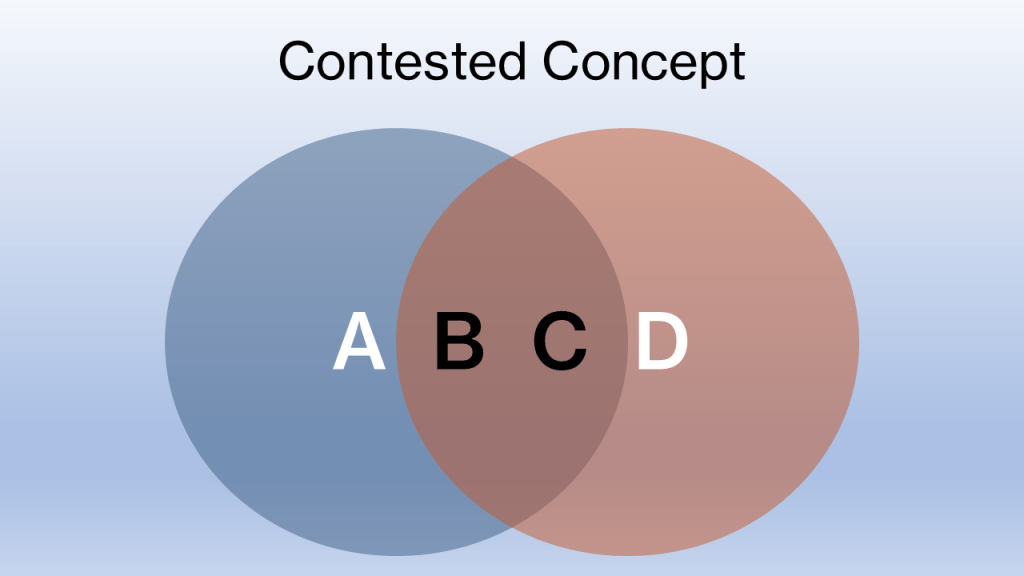
If one person believes a term means {A, B, C} and another believes it means {B, C, D}, the overlap creates a dangerous illusion of agreement. The disagreement hides in the margins. A and D don’t merely differ. They are often irreconcilable.

Image: Venn diagramme of a contested concept.
Note: This is illustrative and not to scale

Fairness is a reliable example. One person believes fairness demands punishment, including retributive measures. Another believes fairness permits restoration but rejects retribution, citing circumstance, history, or harm minimisation. Both invoke fairness sincerely. The shared language conceals the conflict.

When such disputes reach court, they are not resolved by semantic reconciliation. They are resolved by authority. Power steps in where meaning cannot. This is just one illustration. There are many.

I thought it worth sharing how LIH came about, if only to dispel the notion that it’s a fashionable response to contemporary politics. It isn’t. It’s the slow crystallisation of a long-standing intuition: that many of our most cherished concepts don’t fail because we misuse them, but because they were never capable of doing the work we assigned to them.

More to come.

Justice as a House of Cards

4–6 minutes

How retribution stays upright by not being examined

There is a persistent belief that our hardest disagreements are merely technical. If we could stop posturing, define our terms, and agree on the facts, consensus would emerge. This belief survives because it works extremely well for birds and tables.

It fails spectacularly for justice.

Audio: NotebookLM summary podcast of this topic.

The Language Insufficiency Hypothesis (LIH) isn’t especially interested in whether people disagree. It’s interested in how disagreement behaves under clarification. With concrete terms, clarification narrows reference. With contested ones, it often fractures it. The more you specify, the more ontologies appear.

Justice is the canonical case.

Retributive justice is often presented as the sober, adult conclusion. Not emotional. Not ideological. Just what must be done. In practice, it is a delicately balanced structure built out of other delicately balanced structures. Pull one term away and people grow uneasy. Pull a second and you’re accused of moral relativism. Pull a third and someone mentions cavemen.

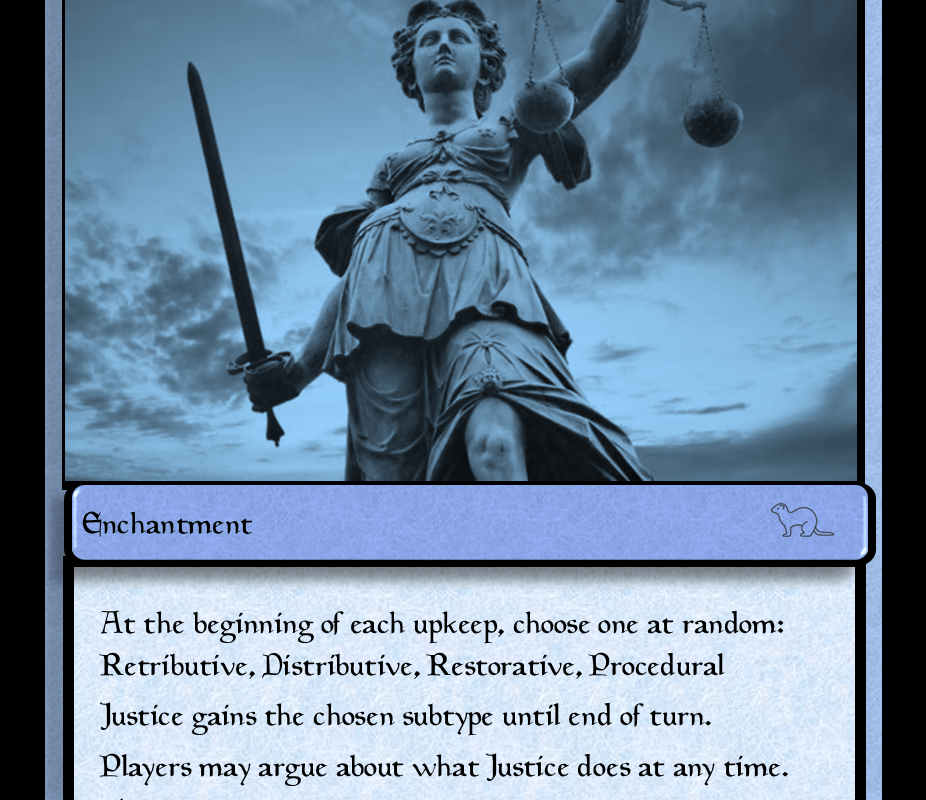
Let’s do some light demolition. I created a set of 17 Magic: The Gathering-themed cards to illustrate various concepts. Below are a few. A few more may appear over time.

Card One: Choice

Image: MTG: Choice – Enchantment

The argument begins innocently enough:

They chose to do it.

But “choice” here is not an empirical description. It’s a stipulation. It doesn’t mean “a decision occurred in a nervous system under constraints.” It means a metaphysically clean fork in the road. Free of coercion, history, wiring, luck, trauma, incentives, or context.

That kind of choice is not discovered. It is assumed.

Pointing out that choices are shaped, bounded, and path-dependent does not refine the term. It destabilises it. Because if choice isn’t clean, then something else must do the moral work.

Enter the next card.

Card Two: Agency

Image: MTG: Agency – Creature – Illusion

Agency is wheeled in to stabilise choice. We are reassured that humans are agents in a morally relevant sense, and therefore choice “counts”.

Counts for what, exactly, is rarely specified.

Under scrutiny, “agency” quietly oscillates between three incompatible roles:

  • a descriptive claim: humans initiate actions
  • a normative claim: humans may be blamed
  • a metaphysical claim: humans are the right kind of cause

These are not the same thing. Treating them as interchangeable is not philosophical rigour. It’s semantic laundering.

But agency is emotionally expensive to question, so the discussion moves on briskly.

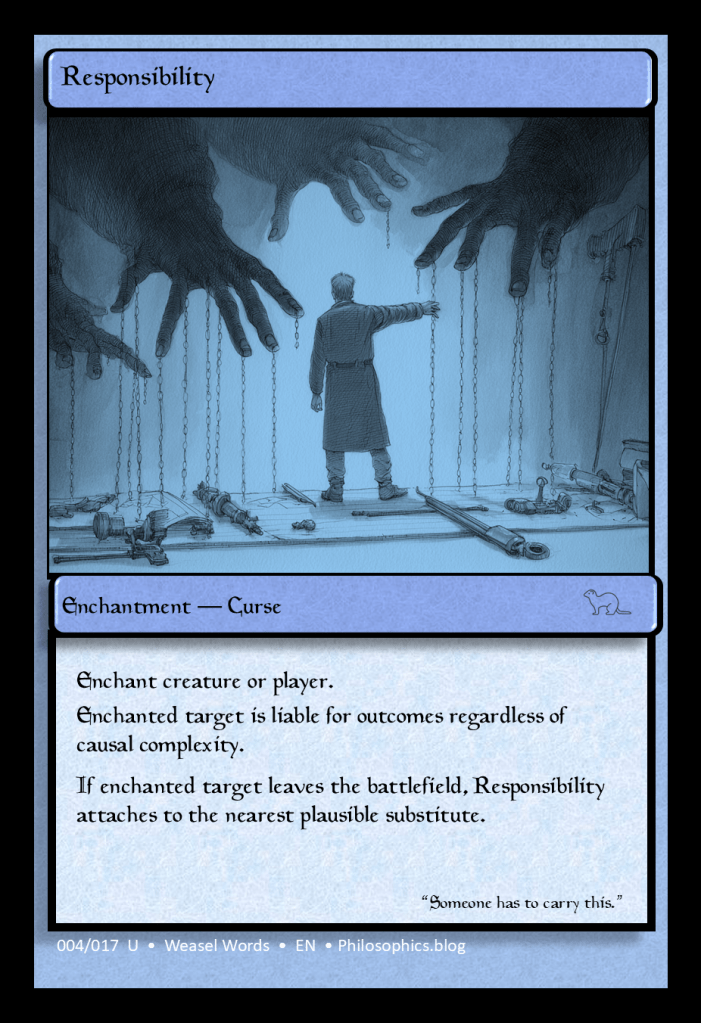
Card Three: Responsibility

Image: MTG: Responsibility – Enchantment – Curse

Responsibility is where the emotional payload arrives.

To say someone is “responsible” sounds administrative, even boring. In practice, it’s a moral verdict wearing a clipboard.

Watch the slide:

  • causal responsibility
  • role responsibility
  • moral responsibility
  • legal responsibility

One word. Almost no shared criteria.

By the time punishment enters the picture, “responsibility” has quietly become something else entirely: the moral right to retaliate without guilt.

At which point someone will say the magic word.

Card Four: Desert

Image: MTG: Desert – Instant

Desert is the most mystical card in the deck.

Nothing observable changes when someone “deserves” punishment. No new facts appear. No mechanism activates. What happens instead is that a moral permission slip is issued.

Desert is not found in the world. It is declared.

And it only works if you already accept a very particular ontology:

  • robust agency
  • contra-causal choice
  • a universe in which moral bookkeeping makes sense

Remove any one of these and desert collapses into what it always was: a story we tell to make anger feel principled.

Which brings us, finally, to the banner term.

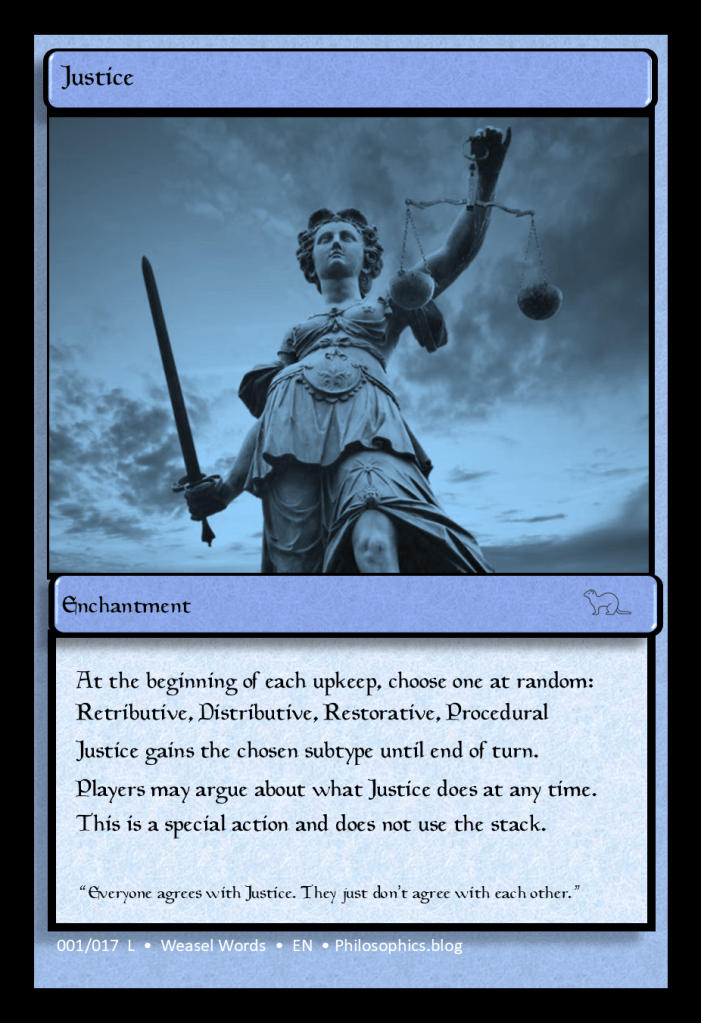
Card Five: Justice

Image: MTG: Justice – Enchantment

At this point, justice is invoked as if it were an independent standard hovering serenely above the wreckage.

It isn’t.

“Justice” here does not resolve disagreement. It names it.

Retributive justice and consequentialist justice are not rival policies. They are rival ontologies. One presumes moral balance sheets attached to persons. The other presumes systems, incentives, prevention, and harm minimisation.

Both use the word justice.

That is not convergence. That is polysemy with a body count.

Why clarification fails here

This is where LIH earns its keep.

With invariants, adding detail narrows meaning. With terms like justice, choice, responsibility, or desert, adding detail exposes incompatible background assumptions. The disagreement does not shrink. It bifurcates.

This is why calls to “focus on the facts” miss the point. Facts do not adjudicate between ontologies. They merely instantiate them. If agency itself is suspect, arguments for retribution do not fail empirically. They fail upstream. They become non sequiturs.

This is also why Marx remains unforgivable to some.
“From each according to his ability, to each according to his need” isn’t a policy tweak. It presupposes a different moral universe. No amount of clarification will make it palatable to someone operating in a merit-desert ontology.

The uncomfortable conclusion

The problem is not that we use contested terms. We cannot avoid them.

The problem is assuming they behave like tables.

Retributive justice survives not because it is inevitable, but because its supporting terms are treated as settled when they are anything but. Each card looks sturdy in isolation. Together, they form a structure that only stands if you agree not to pull too hard.

LIH doesn’t tell you which ontology to adopt.

It tells you why the argument never ends.

And why, if someone insists the issue is “just semantic”, they’re either confused—or holding the deck.

Cold, Grammar, and the Quiet Gatekeeping of Philosophy

5–7 minutes

A great deal of philosophy begins with the claim that we ought to examine our assumptions. Fewer philosophers seem interested in examining the mechanisms that decide which assumptions are allowed to count as philosophy in the first place.

This is not a polemic about the Analytic–Continental divide. It’s an observation about how that divide quietly maintains itself. The immediate provocation was banal. Almost embarrassingly so.

In English, the answer feels obvious. I am cold. The grammar barely registers. In French, Italian, or German, the structure flips. One has cold. Or hunger. Or thirst. Or age. Or a name, understood as something one performs rather than something one is. I spoke about this here and here. Indulge this link to the original position being argued.

On the surface, this looks like a curiosity for linguistics students. A translation quirk. A grammatical footnote. But grammar is rarely innocent.

Audio: NotepadLM summary podcast on this topic.

Grammar as Ontological Scaffolding

The verbs to be and to have are not neutral carriers. They quietly encode assumptions about identity, property, possession, and stability.

When I say I am cold, I cast coldness as a property of the self. It becomes something like height or nationality: a state attributable to the person. When I say I have cold, the experience is externalised. The self remains distinct from the condition it undergoes. Neither option is metaphysically clean.

Both structures smuggle in commitments before any philosophy has been done. One risks inflating a transient sensation into an ontological state. The other risks reifying it into a thing one owns, carries, or accumulates. My own suggestion in a recent exchange was a third option: sensing.

Cold is not something one is or has so much as something one feels. A relational encounter. An event between organism and environment. Not an identity predicate, not a possession.

This suggestion was met with a fair pushback: doesn’t saying that cold ‘belongs to the world’ simply introduce a different metaphysical assumption? Yes. It does. And that response neatly demonstrates the problem.

When Grammar Starts Doing Philosophy

The original claim was idiomatic, not ontological. It was a negative gesture, not a positive thesis. The point was not to relocate cold as a mind-independent substance floating about like a rock. It was to resist treating it as an essence of the person. But once you slow down, you see how quickly everyday grammar demands metaphysical loyalty.

Being invites substance. Having invites inventory. Sensing keeps the relation open, but even that makes people nervous. This nervousness is instructive. It reveals how much metaphysical weight we quietly load onto grammatical habits simply because they feel natural. And that feeling of naturalness matters more than we like to admit.

Two Philosophical Temperaments, One Linguistic Groove

At this point, the temptation is to draw a clean line:

On one side: the Anglo-American Analytic tradition, comfortable treating mental states as properties, objects, or items to be catalogued. Locke’s introspective inventory. Hume’s bundle. Logical positivism’s clean surfaces.

On the other: the Continental tradition, suspicious of objectification, insisting on an irreducible subject for whom experience occurs but who is never identical with its contents. Kant, Husserl, Heidegger, Sartre.

The grammar aligns disturbingly well. Languages that habitually say I am cold make it feel natural to treat experience as something inspectable. Languages that insist on having or undergoing experiences keep the subject distinct by default.

This is not linguistic determinism. English speakers can read phenomenology. German speakers can do analytic philosophy. But language behaves less like a prison and more like a grooved path. Some moves feel obvious. Others feel forced, artificial, or obscure.

Philosophies do not arise from grammar alone. But grammar makes certain philosophies feel intuitively right long before arguments are exchanged.

Where Gatekeeping Enters Quietly

This brings us to the part that rarely gets discussed.

The Analytic–Continental divide persists not only because of philosophical disagreement, but because of institutional reinforcement. Peer review, citation norms, and journal cultures act as boundary-maintenance mechanisms. They are not primarily crucibles for testing ideas. They are customs checkpoints for recognisability.

I have been explicitly cautioned, more than once, to remove certain figures or references depending on the venue. Don’t mention late Wittgenstein here. Don’t cite Foucault there. Unless, of course, you are attacking them. This is not about argumentative weakness. It’s about genre violation.

Hybrid work creates a problem for reviewers because it destabilises the grammar of evaluation. The usual criteria don’t apply cleanly. The paper is difficult to shelve. And unshelvable work is treated as a defect rather than a signal. No bad faith is required. The system is doing what systems do: minimising risk, preserving identity, maintaining exchange rates.

Cold as a Diagnostic Tool

The reason the cold example works is precisely because it is trivial.

No one’s career depends on defending a metaphysics of chilliness. That makes it safe enough to expose how quickly grammar starts making demands once you pay attention.

If something as mundane as cold wobbles under scrutiny, then the scaffolding we rely on for far more abstract notions – self, identity, agency, consciousness – should make us uneasy.

And if this is true for human languages, it becomes far more pressing when we imagine communication across radically different forms of life.

Shared vocabulary does not guarantee shared metaphysics. Familiar verbs can conceal profound divergence. First contact, if it ever occurs, will not fail because we lack words. It will fail because we mistake grammatical comfort for ontological agreement.

A Modest Conclusion

None of this settles which philosophical tradition is ‘right’. That question is far less interesting than it appears. What it does suggest is that philosophy is unusually sensitive to linguistic scaffolding, yet unusually resistant to examining the scaffolding of its own institutions.

We pride ourselves on questioning assumptions while quietly enforcing the conditions under which questions are allowed to count. Cold just happens to be a good place to start noticing.

A Footnote on Linguistic Determinism

It’s worth being explicit about what this is not. This is not an endorsement of strong linguistic determinism, nor a revival of Sapir–Whorf in its more ambitious forms. English speakers are not condemned to analytic philosophy, nor are Romance-language speakers predestined for phenomenology.

Grammar operates less like a set of handcuffs and more like a well-worn path. Some moves feel effortless. Others require deliberate resistance. Philosophical traditions co-evolve with these habits, reinforcing what already feels natural while treating alternatives as strained, obscure, or unnecessary.

The claim here is not necessity, but friction.

Cold, Aliens, and the Grammar That Thinks It Knows Too Much

2–3 minutes

I shared this post not too long ago. Today, I shared it in a different context, but I feel is interesting – because I feel that many things are interesting, especially around language and communication.

It commenced here on Mastodon.

Ocrampal shared a link to an article debating whether we are cold or have cold. Different cultures express this differently. It’s short. Read it on his site.

Audio: Exceptional NotebookLM summary podcast of this topic.

I replied to the post:

Nicely observed. I’ve pondered this myself. Small linguistic tweak: between être and avoir, avoir already behaves better metaphysically, but sentir seems the cleanest fit. Cold isn’t something one is or has so much as something one senses — a relational encounter rather than an ontological state or possession.

Between having and being, having is the lesser sin — but sensing/feeling feels truer. Cold belongs to the world; we merely sense it.

He replied in turn:

Agree except for: “Cold belongs to the world”. That is a metaphysical assumption that has consequences …

Finally (perhaps, penultimately), I responded:

Yes, it does. That statement was idiomatic, to express that ‘cold’ is environmental; we can’t be it or possess it. Coincidentally, I recently wrote about ‘cold’ in a different context:

where I link back to the post at the top of this article.

A more verbose version of this response might have been:

And this is exactly the problem I gestured at in the aliens piece. We mistake familiar grammatical scaffolding for shared metaphysics. We assume that if the sentence parses cleanly, the ontology must be sound.

Language doesn’t just describe experience. It quietly files it into categories and then acts surprised when those categories start making demands.

Cold, like aliens, exposes the trick. The moment you slow down, the grammar starts to wobble. And that wobble is doing far more philosophical work than most of our declarative sentences are willing to admit.

Why We Keep Talking Past Each Other

8–11 minutes

I am a philosopher of language. That is typically my primary perspective, so communication and limitations often fall into my sights. I believe that not all disagreements can be resolved through language communication. This illustrates one barrier in particular.

This essay is not an attempt to resolve disagreement, adjudicate truth, or reconcile competing worldviews. It is an attempt to explain why so many disagreements persist despite intelligence, good faith, and shared vocabulary – and why escalating those disagreements often makes them worse rather than better.

What follows is diagnostic rather than prescriptive. I am less interested in who is right than in why arguments so often fail to converge, and why those failures are routinely misinterpreted as moral defects rather than structural mismatches. The claim is not that ‘anything goes’, nor that all perspectives are equally valid, but that many disputes operate across ontological fault lines that no amount of better reasoning, evidence, or civility can bridge on their own terms.

Recognising this does not require abandoning one’s commitments. It requires abandoning the fantasy that every disagreement is corrigible and that persuasion is always the appropriate response to difference. If the essay succeeds, it will not produce consensus. It may, however, produce a little more clarity, a little less moral theatre, and a slightly more disciplined form of charity – one grounded not in agreement, but in an honest appraisal of where disagreement actually lives.

Audio: NotebookLM summary podcast of this content.

On Ontological Incommensurability and the Case for Civilised Disagreement

Most disagreements that metastasise into moral theatre are not disagreements at all. They are collisions between incompatible ontologies, misdiagnosed as differences of opinion.

We continue to behave as though all disputes take place on a shared stage called “reality,” where facts sit patiently waiting to be interpreted, weighed, or refuted. From this perspective, disagreement is assumed to be corrigible. If only one side listened harder, reasoned better, or acquired the right evidence, convergence would follow. This assumption is not merely optimistic. It is wrong.

Many of our most entrenched conflicts persist precisely because the parties involved do not inhabit the same world in any substantive sense. They operate with different background assumptions about what exists, what counts as real, what can ground truth, and what sorts of things are even eligible for belief. Argument, in such cases, does not fail due to bad faith or insufficient charity. It fails because it presumes a shared ontology that does not exist.

Before proceeding, a clarification. I am using ontology here in a deliberately broad, working sense. Not merely as an inventory of what exists, but as the background framework that determines what can count as real, meaningful, or normatively binding in the first place. This inevitably overlaps with epistemology, ethics, and theories of agency. Not because these domains are identical, but because in lived discourse they travel together. The fault line I am describing is not disciplinary. It is structural.

Video: Two people in ontological bubbles. (no sound)

Opinion Is Not Ontology

A difference of opinion presupposes a common world. Two people may disagree about what justice requires, but only because they agree, tacitly, that justice is a thing of some kind. Two people may dispute whether God exists, but only because they share enough conceptual scaffolding for the sentence to function.

Ontological disagreement runs deeper. It concerns not what is the case, but what it even means for something to be the case at all. When these levels are conflated, discourse becomes theatrical. Arguments are repeated with increasing urgency, frustration is moralised, and disagreement is reinterpreted as stubbornness, ignorance, or vice. Civility erodes not because people are cruel, but because they are speaking from worlds that do not interlock.

Consider debates over abortion. Pro-life arguments typically presuppose that the fetus is already a moral person; pro-choice arguments often presuppose that moral personhood is inseparable from bodily autonomy. These positions are not primarily disagreements about policy, compassion, or even ‘the value of life’. They are disagreements about what kinds of entities exist and when they begin to matter. Shared language about rights or harm often masks this deeper ontological divergence, which is why such debates rarely converge despite decades of argument.

When Critique Presumes the Ontology It Opposes

This distinction helps explain a familiar but often confusing phenomenon: cases where two parties appear to agree on symptoms, vocabulary, and even outrage, yet remain fundamentally misaligned.

Consider critiques of institutional cruelty that condemn dehumanising practices while retaining the very assumptions that make those practices intelligible. For example, workplace critiques that oppose excessive surveillance, unfair metrics, or punitive performance targets often still presume the figure of the autonomous, responsible worker whose output reflects individual will. The system is blamed for misapplying norms, not for producing those norms as instruments of control. Such critiques are often insightful and well-intentioned. They identify real harm. They name real suffering. And yet they stall.

The reason is not timidity or bad analysis. It is ontological inheritance. These critiques operate inside the same metaphysical framework that generates the harm they diagnose. They presuppose moral realism, individual agency, and normative grounding as givens, then object to their misapplication. The result is an internal critique: coherent, compelling, and structurally limited.

From a different ontological position, the problem is not that the norms are misapplied, but that the norms themselves function as delivery mechanisms of harm. What appears as reform from within appears as reenactment from without. This is not a misunderstanding. It is a category error.

Recognising this helps explain why superficial agreement so often feels productive while changing nothing. Shared language can create the appearance of convergence while leaving foundational divergence intact. The temperature drops. The mediator applauds. The underlying machinery hums on.

Igtheism and the Refusal to Pretend

This is why I describe myself, somewhat unfashionably, as an igtheist rather than an atheist.

Atheism still accepts the question ‘Does God exist?’ as well-formed. It grants the concept enough coherence to deny its instantiation. Agnosticism does much the same, merely pausing at the threshold. Both remain inside the game.

Igtheism steps back and asks a prior question: What, precisely, are we talking about? If no stable referent can be specified, the sentence does not become false. It becomes undefined. The system returns ‘does not compute’. This is not evasive. It is diagnostic.

Try as I may, I cannot make sense of strong metaphysical Realism, let alone Theism. The idea that there exists a fully formed, mind-independent world ‘out there’, grounding truth prior to mediation, language, practice, or perspective, does not parse for me. Not as a contested claim. As a coherent one.

However, and this is the crucial point, once I accept Realism as a mechanism, Theism suddenly makes sense. If you already believe in a metaphysically exterior realm that guarantees truth and coherence, then placing God there is not a leap. It is an economy of scale.

Paraphrased bluntly: They believe there is a whole world ‘out there’. I don’t believe in any of it, so God might as well live out there, too.

From within that worldview, atheistic Realism is arguably the stranger position. The cathedral has been built; denying the altar looks parsimonious rather than principled.

I am not offering a competing metaphysical system here. Not idealism, not pragmatism, not a substitute ontology waiting in the wings. I am declining the assumption that reality must come pre-packaged as a mind-independent domain in order to be intelligible or actionable at all.

Of course, non-realist positions are not exempt from this problem; they, too, can smuggle in unexamined ontological commitments under the guise of pragmatism, coherence, or practice.

Pascal’s Wager and Ontological Blackmail

This is why igtheism tends to offend theists more than atheism ever could. When a theist says, ‘How can you not care? Your soul depends on it’, they are not making an argument. They are issuing an ontological demand. Pascal’s Wager is merely this demand formalised into decision theory.

The wager only works if one has already granted the existence of souls, post-mortem identity, divine reward structures, and a cosmic enforcement mechanism that cares about belief states. Without those assumptions, there is no wager. There is only a shouted house rule addressed to someone who is not in the casino.

None of this is meant to trivialise the existential seriousness with which such claims are often held. It is simply to note that care does not precede ontology; it follows it. One cannot meaningfully care about entities one does not recognise as intelligible occupants of the world.

Why This Doesn’t End in Relativism

None of this implies that ‘all ontologies are equally true’, nor that disagreement is pointless. It implies something far less comforting and far more useful: many disagreements are non-resolvable by design. This does not deny that ontological frameworks can and do shift over time, sometimes under empirical pressure; it only denies that such shifts are guaranteed, universal, or achievable through argument alone.

Non-resolvability does not entail arbitrariness. Ontological frameworks can be evaluated for internal coherence, practical consequences, and the kinds of lives they make possible. What cannot be done is to adjudicate between them using criteria that belong exclusively to one side. Recognising this does not require abandoning one’s worldview. It requires abandoning the fantasy that persuasion is always possible, or that failure to persuade is a moral defect.

Once we see that we are not standing on the same ground, something like charity becomes possible. Not the saccharine kind. The disciplined kind. I understand that this matters enormously to you. I do not share the ontology that makes it matter to me. This is not a truce forged through compromise. It is a ceasefire born of ontological honesty.

Civility Without Convergence

Our age is addicted to resolution. Every disagreement is treated as a problem to be solved, a synthesis waiting to happen, a bridge yet to be built. Sometimes there is no bridge. Sometimes the most responsible thing to do is to stop pretending there is one.

Civility does not require agreement. It does not even require mutual understanding in the strong sense. It requires only that we stop mistaking incompatible world-models for intellectual obstinacy. We are not all arguing about the same furniture. Some of us are questioning whether the room exists at all.

Once that is acknowledged, the volume drops. The moral theatre loses its urgency. And disagreement, while still real, becomes less corrosive. Not because we have reconciled our ontologies. But because we have finally noticed that they do not reconcile.

Essay: Disagreement Without Referees

2–3 minutes

I’ve just published a new preprint on Zenodo: Disagreement Without Referees: Ontological Incommensurability and the Limits of Moral Adjudication 📄 https://doi.org/10.5281/zenodo.17932544

This paper grows out of a frustration that will be familiar to anyone who spends time in moral or political argument: the sense that we keep talking past one another, mistaking deep incompatibilities for mere differences of opinion – and then moralising the failure to converge. Mostly, I’m tired of having to explain why my position isn’t subjectivist, relativist, quietist, nihilist, or whatever –ist flavour du jour. As with John Lennon, I complain about the –isms.

Audio: NotebookLM summary podcast of this essay.

The core claim is simple but unfashionable: many persistent disagreements are not epistemic at all. They are ontological. They do not arise within a shared background of assumptions about what exists, what counts as a reason, or what can ground normativity. They arise between incompatible background frameworks. When we treat such conflicts as if they were resolvable by better arguments, clearer communication, or more empathy, we misdiagnose the problem – and often make it worse.

The paper draws a sharp distinction between:

  • Disagreements of opinion, which presuppose a shared world and are, in principle, corrigible; and
  • Ontological disagreements, where what is contested is not the right answer, but what it would even mean for an answer to be right.

From there, I examine why charges like ‘relativism’, ‘subjectivism’, or ‘anything goes’ retain such rhetorical force despite their weak logical footing. The argument is not that these labels are false descriptions so much as that they function as boundary-maintenance devices within Enlightenment-inherited moral frames. They stabilise a sense of moral order by excluding positions that deny neutral adjudication.

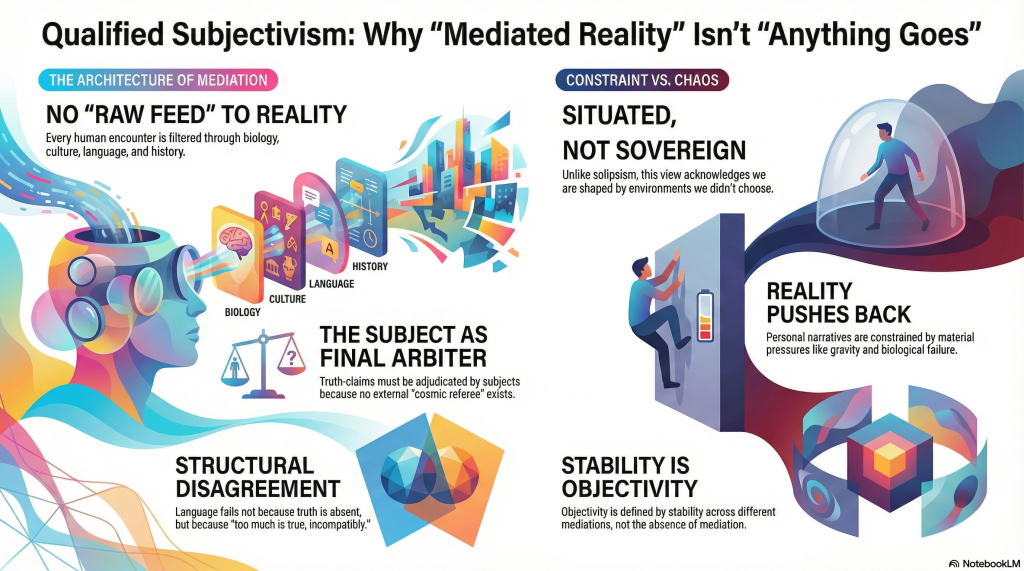
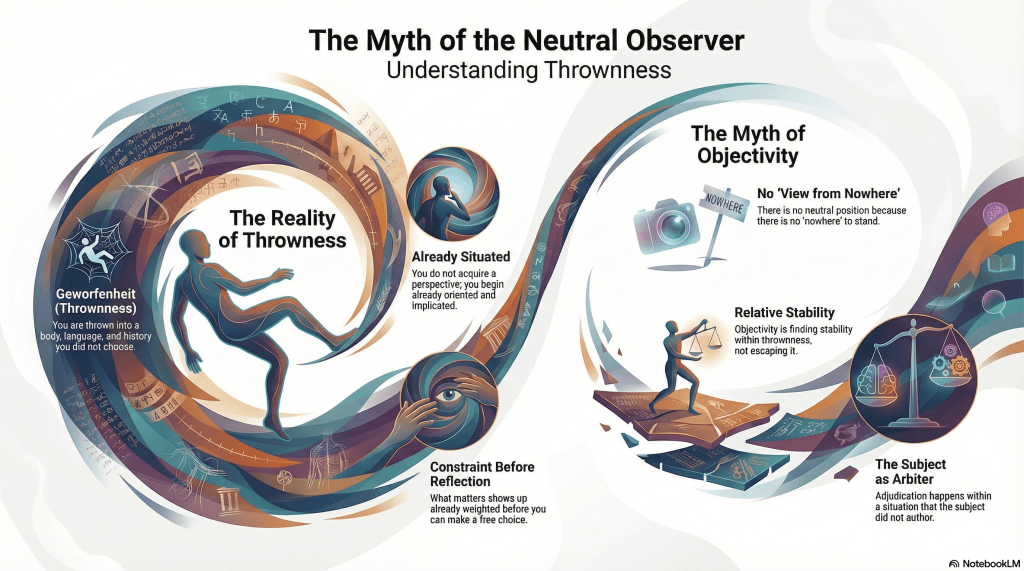
Image: NotebookLM infographic. (This is the first infographic I’ve produced from NotebookLM. I’m not sure what I think of it, but I might try more directed versions in the future.)

I also take up the familiar worry that abandoning objective moral grounding leads to arbitrariness or nihilism. The paper rejects this caricature. Evaluation does not disappear when foundations are withdrawn; it relocates. What follows is not moral collapse but moral life without referees, where disagreement is managed through persuasion, coalition-building, institutional design, and power, rather than appeals to metaphysical authority.

Importantly, the paper is diagnostic, not prescriptive. It does not offer a new moral framework, a reconciliatory theory, or a solution to moral conflict. It argues instead for a clearer understanding of why some disagreements resist resolution, and for a more honest account of what remains once the fantasy of neutral adjudication is relinquished.

If nothing else, the hope is that recognising ontological incommensurability can temper the moral theatre that so often accompanies disagreement – replacing accusations of irrationality or bad faith with a clearer sense of what is, and is not, at stake.

This essay is also available on PhilPapers. For now, the full preprint is available on Zenodo at the link above.

As ever, comments are welcome – provided we’re clear about which world we think we’re standing in.

Meet the Language Insufficiency GPT

1–2 minutes

In anticipation of the publication of A Language Insufficiency Hypothesis in January 2026, I’ve created a Language Insufficiency GPT.

Today I’m launching something designed to exploit a familiar failure mode with forensic precision:
👉 https://chatgpt.com/g/g-694018a9bbc88191a8360d65a530e50c-language-insufficiency-gpt

Naturally, it will make more sense alongside the book. But it may still provide a bit of entertainment – and mild discomfort – in the meantime.

tl;dr: Language is generally presumed to be stable. Words mean what you think they mean, right? A table is a table. A bird is a bird. Polysemy aside, these are solid, dependable units.

Then we arrive at freedom, justice, truth, and an entire panoply of unstable candidates. And let’s not even pretend qualia are behaving themselves.

So when someone says ‘truth’, ‘free speech’, or ‘IQ’, you may suddenly realise you’ve been arguing with a cardboard cut-out wearing your own assumptions. That isn’t just interpersonal mischief. It’s language doing exactly what it was designed to do: letting you glide over the hard problems while sounding perfectly reasonable.

Audio: Short NotebookLM summary of this page content*
Video: Legacy video explaining some features of the LIH.

If that sounds banal, you’ve already fallen for the trap.

Give it a try – or wait until you’ve digested the book. Not literally, unless you’re short on fibre.

Cheers.

* As I’ve cited previously, the quality of NotebookLM varies – usually in predictable directions. This one does well enough, but it doesn’t have enough context to get the story right (because it was only drawing from this page rather than from a fuller accounting of the LIH). Its trailing comment reveals that it doesn’t grasp that “new words” don’t solve the problem.

Earlier, it suggests that language is intentionally vague. This is not an assertion I make. You can read some of the earlier incarnations, or you can wait for it to be published.

Truth → Rhetoric: Why Access Determines Authority

11–16 minutes

I do not assume that normative assertions function as descriptive truths. Realism is compelling because it promises that moral disagreement has a fact of the matter beyond persuasion. The argument here is that this promise cannot be kept without mediation. Nevertheless, this essay proceeds by granting the realist premise – that Truth exists – in order to examine whether that premise can, on its own terms, generate normative authority. The argument is structural rather than polemical: to move from Ontology (what exists) to Authority (what binds) requires a mechanism of transport. That mechanism is mediation. The claim advanced here is that this mediation is irreducibly rhetorical, and that no account of normativity can bypass this fact without smuggling authority under metaphysical cover.

Audio: NotebookLM summary podcast of this content.

Introduction

Grant, purely for the sake of argument, that Truth – and by extension Justice, Goodness, or any other realist normative entity – exists independently of human cognition. Even so, a prior and unavoidable question arises: how does such Truth ever become accessible to finite, discursive agents like us?

Before asking whether Truth exists in itself, we must account for how it enters ethical life for us. This is not a semantic quibble. It marks the difference between an ontological assertion and an operative ethics.

This essay argues that all access to Truth is irreducibly mediated, and that this mediation is rhetorical in nature. Even if Truth exists independently of human minds, it never arrives in normative life except through language, interpretation, argument, persuasion, narrative, and institutional articulation. Any ethical framework that treats metaphysical grounding as if it bypassed these mediations risks conflating ontology with authority.

This is neither relativism nor subjectivism. It is an analytic claim about conditions of access and normative traction.

Truth and Its Access Conditions

Suppose you accept that Truth exists ‘out there’—not as a projection or consensus shorthand, but as an intransitive feature of reality. This is the core commitment of metaphysical realism. The issue is not whether Truth exists, but how it becomes accessible to agents embedded in language, culture, and institutions.

For any putative Truth to function normatively, at least five stages are required:

  1. Identification — recognising something as a candidate for truth
  2. Description — articulating that candidate in language
  3. Justification — offering reasons for accepting it
  4. Communication — transmitting those reasons to others
  5. Ratification — persuading a community to treat the claim as binding

These stages are not epistemic luxuries. They are the conditions under which a putative Truth acquires normative force – the capacity to obligate, justify, or condemn.

Remove any one of these stages, and Truth collapses into either an inert fact or an unintelligible assertion. Crucially, each stage is rhetorical: none operates through brute ontology alone, but through discursive practices of interpretation, evaluation, and adjudication.

Rhetoric Is Not Spin

To say that Truth is rhetorically mediated is not to reduce truth to manipulation, persuasion-for-its-own-sake, or spin.

It is simply to recognise that:

  1. Truth claims are discerned in language
  2. They are evaluated against alternatives
  3. They are assessed within communities shaped by practices, norms, disciplines, and institutions

Truth as it functions in human life is always a claim in argument, never a self-announcing datum.

Even mathematics – the paradigm of certainty – does not become normatively operative without symbolic articulation, shared standards of proof, and communal validation. Mathematical truths may exist independently, but what counts as a proof, a result, or an error – and thus what obligates assent – is entirely mediated by symbolic practice and communal ratification.

In its classical sense, rhetoric is not deception. It is the set of discursive practices by which claims become intelligible, contestable, and action-guiding across contexts of disagreement.

Where Normativity Actually Emerges: The Three-Stage Problem

The problem crystallizes at a precise moment: the move from description to prescription. Even if we grant that the Good exists objectively and eternally, three distinct operations are required to generate obligation:

  1. Descriptive claim: ‘The Good exists and has properties X, Y, Z’
  2. Interpretive claim: ‘In this situation, the Good requires action A rather than B’
  3. Prescriptive claim: ‘Therefore you ought to do A’

Each transition requires distinct work. The first may be metaphysical. But the second and third are irreducibly rhetorical. They involve judgment, application, contextual interpretation, and the translation of abstract principle into concrete obligation.

Crucially, even the interpretive middle step – which often masquerades as mere clarification – is where most normative force gets generated. To say ‘the Good requires this action in this context’ is not to read off a fact from the world. It is to make an argued claim about meaning, relevance, and application.

This is where participatory metaphysics does its quietest work. By framing interpretation as ‘participation in the Good’ rather than as ‘argued judgment about what the Good requires,’ such frameworks obscure the rhetorical operation they’re performing. Interpretation gets presented as disclosure rather than construction.

But there is no route from ‘the Good exists’ to ‘you must do X’ that bypasses interpretation. And interpretation is rhetoric.

The Potential Energy Analogy

Consider an analogy. Gravitational potential energy exists independently of human recognition. A boulder atop a cliff possesses real energy by virtue of its position. But that energy does no work – moves nothing, heats nothing, powers nothing – until converted through specific mechanisms: falling, rolling, controlled descent.

The Good may be precisely like this: real, eternal, independent of us. But for it to become normatively operative – to obligate us, to guide our choices, to settle our disagreements – it must be converted from potential into kinetic form. That conversion is mediation. And mediation is rhetorical.

This is not relativism about the Good’s existence. It is realism about the conditions under which existence generates obligation.

A Concrete Example

When Catholic bishops disagree about capital punishment:

  • They agree on the descriptive claim: ‘God exists and is perfectly Good’
  • They disagree on the interpretive claim: ‘What does divine Justice require regarding state execution?’
  • They therefore disagree on the prescriptive claim: ‘Is capital punishment permissible?’

The descriptive agreement doesn’t resolve the interpretive disagreement. No amount of metaphysical depth about God’s nature tells you directly what Justice requires regarding capital punishment. That requires interpretation of Scripture, tradition, natural law, human dignity, social context, prudential judgment – all rhetorical operations.

Appeals to ‘the Good itself’ don’t settle the dispute. They just rename it. Instead of ‘bishops disagree about ethics,’ it becomes ‘bishops are discerning what participation in the Good requires’. The language changes; the rhetorical work remains.

The Zeno Structure of Moral Grounding

At this point, the realist faces a structural problem that resembles Zeno’s paradox. When pressed on how Truth becomes binding, the realist response multiplies explanatory depth:

  • The Good exists objectively
  • We apprehend it through reason
  • Reason itself is oriented toward the Good
  • That orientation is grounded in rational agency
  • Rational agency participates in…

Each step is coherent. Each promises that obligation is just one more metaphysical move away. But none ever performs the action ‘therefore, you must do X in this situation’.

This is not merely infinite regress – philosophers tolerate infinite structures. The problem is asymptotic normativity: explanations that get progressively closer to bindingness without ever crossing the threshold into concrete obligation.

What’s missing is not metaphysical depth but the moment of arrival. Until someone says ‘this counts as wrong here, and therefore you ought to stop,’ nothing has happened in ethical space. The arrow is still subdividing its path.

Rhetoric is what collapses the infinite series into a finite act. It does for ethics what accepting motion does for Zeno’s paradox: it stops subdividing and acts. This is not an epistemic shortcut – it is the mechanism by which normativity becomes operative.

‘Participation in the Good’ sounds like arrival, but it is actually eternal approach. It explains why the Good matters in principle while indefinitely postponing the moment when obligation becomes concrete and contestable. That postponement is not a feature – it is the avoidance of the very question at issue.

Three Remaining Escapes
(and Why They Fail)

A. The Implicit Normativity Move

A sophisticated realist might respond: ‘Interpretation is required, yes, but the normativity is already there implicitly. Interpretation merely makes explicit what was already required’.

But implicit normativity is indistinguishable from no normativity unless it can be specified. Until interpretation specifies what is required here, the obligation has no action-guiding content. A normativity that exists only implicitly, without criteria of application, is functionally equivalent to no normativity at all.

‘Implicit obligation’ means ‘not yet specified,’ which means ‘not yet operative’. The work of making it operative is interpretation – which is rhetoric.

B. The Practical Wisdom Escape

Another likely move: ‘Interpretation is not rhetoric; it’s phronesis. Practical wisdom directly apprehends what the Good requires’.

But practical wisdom does not bypass mediation; it relocates it into judgment. If practical wisdom yields different answers for different agents, it is still interpretive. If it cannot be articulated, justified, or contested, it cannot function socially. The moment phronesis is communicated or taught, it becomes rhetorical.

Judgment, when it claims authority over others, must still be articulated, defended, and enforced. Incommunicable wisdom is indistinguishable from private intuition. And private intuitions don’t settle public disagreements.

C. The ‘This Proves Too Much’ Objection

Someone might say: ‘If your argument is right, then no ethical system can ever claim authority. Everything dissolves into endless contestation’.

But the claim is not that normativity evaporates under mediation, but that it emerges there. This is not nihilism – it is an explanation of normativity’s location, not its abolition. That normativity is mediated does not mean it is arbitrary. Mediation operates under constraints of coherence, consistency, consequence, and resistance from the world and from other agents.

Mediation is constrained by material resistance, coherence, practical failure, and worldly recalcitrance. The claim is not that ‘anything goes’. It’s that what goes must be argued for, negotiated, and sustained through rhetorical practices. That’s not less demanding than metaphysical grounding – it’s more honest about where the work happens.

Consequences for Ethical Frameworks

If access to Truth is always mediated, then several consequences follow:

  1. Authority is interpretive, not ontological
  2. Disagreement is structural, not pathological
  3. Norms are contested, not deduced unilaterally
  4. Power shapes uptake, not metaphysical purity

This has decisive implications for meta-ethics. Ethical life is not insulated from negotiation; it is constituted by it. Normativity does not descend fully formed from metaphysics into practice. It is worked out – imperfectly, provisionally, and under constraint – within social space.

Ethics, in other words, is not a museum of pristine ideals. It is a field of contested meanings under conditions of risk, conflict, and plural commitment.

Realism Without Rhetoric Is Empty

A realist might reply: Truth exists. Once we uncover it, everything follows.

But uncovering is not a metaphysically neutral act. Discovery, articulation, persuasion, and institutionalisation are themselves conditioned by:

  1. Language, which frames intelligibility
  2. Narrative, which shapes resonance and coherence
  3. Institutions, which ratify selectively
  4. Power, which governs whose claims are heard

The realist may insist that mediation merely follows discovery. But this assumes a distinction that cannot be sustained. Until a truth is articulated, justified, and ratified, there is no criterion by which its discovery can be distinguished from error, fantasy, or ideology. What is not mediated is not merely unpersuasive; it is normatively indistinguishable from falsehood. Ontology alone cannot perform this discrimination.

If access to Truth is always mediated, then metaphysical depth alone cannot generate normative authority. The locus of ethical force shifts from an external realm to the discursive space where claims are interpreted, contested, and enforced. A grounding that never binds except through mediation is indistinguishable, at the level of authority, from mediation itself.

This shift is not relativism. It is a descriptive account of how ethical life actually functions.

Moral Authority Under Rhetorical Conditions

To say Truth → Rhetoric is not to deny the possibility of rigorous assessment. It is to insist that:

  1. Normative claims must offer contestable reasons
  2. Moral authority must disclose its interpretive moves
  3. Disagreement must be treated as clarifying, not corrosive
  4. Ethical systems must be judged by their discursive dynamics as much as their metaphysical commitments

Truth in itself may be metaphysically deep. But truth-as-binding never operates outside rhetoric.

Conclusion

Grant the realist premise if you like: Truth exists. Even then, metaphysical depth alone does not explain how Truth becomes accessible, meaningful, or binding for discursive agents.

Because access is always mediated, authority cannot bypass rhetoric. Ethical life requires not only an ontology, but an account of how claims are interpreted, argued over, and enforced. A Truth that cannot be accessed – named, contested, communicated – remains normatively inert.

The fundamental error is treating the descriptive-interpretive-prescriptive chain as if it could be collapsed into a single operation called ‘participation’. It cannot.

Even if the Good exists exactly as realists claim – eternal, objective, transcendent – it becomes normatively operative for finite agents only through a sequence of mediations:

  • Interpretation (what does it mean?)
  • Application (what does it require here?)
  • Justification (why this action rather than that one?)
  • Communication (how do we persuade others?)
  • Enforcement (who ensures compliance?)

Each mediation is rhetorical. Each involves judgment, argument, and institutional power. Each is contestable.

This is not a bug in ethical life. It is its structure. Any framework that promises to transcend these mediations through metaphysical depth is not offering a solution. It is concealing the problem while continuing to rely on exactly the mechanisms it claims to surpass.

To bring Truth into the world of action is to engage rhetoric not as an ornamental layer, but as the condition of ethical life itself.

Thus: Truth → Rhetoric. Not because truth is arbitrary, but because it is always mediated.

Appendix: Clarifying the Claim

This argument does not deny realism, nor does it reject the possibility of mind-independent truth. What it rejects is the unexamined slide from ontology to authority.

This distinction is formalised – though not originated – by the Mediated Encounter Ontology (MEOW), which holds that all human access to the world is mediated. Whatever exists may exist independently of us; whatever binds us does not. The present argument does not depend on accepting MEOW as a system; it relies only on the minimal claim that access precedes authority.

MEOW formalises this through a layered account of encounter:

  • T0 — biological substrate
  • T1 — cognitive–perceptual interface
  • T2 — linguistic–symbolic mediation
  • T3 — social–technical norms and institutions

Normativity operates at the upper tiers. Ethical obligation, justice, and virtue do not arrive with built-in binding force. Whatever their metaphysical status, their authority for human agents arises only through interpretation, articulation, justification, and social uptake.

This is the precise sense in which Truth → Rhetoric should be read. It is not an ontological identity claim. It is a claim about normative operability.

Rhetorical mediation is constrained – by material resistance, coherence, practical failure, and worldly recalcitrance. But those constraints do not speak for themselves. They must still be named, argued over, prioritised, and enforced.

There is no route from is to ought that does not pass through language, judgment, and institutional uptake. Appeals to metaphysical depth do not remove this mediation; they conceal it.

Any framework that treats participation in ‘the Good’ as normatively binding without accounting for how that Good is interpreted, communicated, and enforced is already doing rhetorical work while pretending not to.

That pretence isn’t philosophical sophistication. It’s a familiar ideological gesture: power presenting itself as mere disclosure. Rhetoric is not what corrupts ethics. It is what makes ethics possible.