Truth After Deflation: Why ‘Truth’ Refuses to Behave

3–4 minutes

I’ve long had a problem with Truth – or at least the notion of it. It gets way too much credit for doing not much at all. For a long time now, philosophers have agreed on something uncomfortable: Truth isn’t what we once thought it was.

The grand metaphysical picture, where propositions are true because they correspond to mind-independent facts, has steadily eroded. Deflationary accounts have done their work well. Truth no longer looks like a deep property hovering behind language. It looks more like a linguistic device: a way of endorsing claims, generalising across assertions, and managing disagreement. So far, so familiar.

Audio: NotebookLM summary podcast of this topic.

What’s less often asked is what happens after we take deflation seriously. Not halfway. Not politely. All the way.

That question motivates my new paper, Truth After Deflation: Why Truth Resists Stabilisation. The short version is this: once deflationary commitments are fully honoured, the concept of Truth becomes structurally unstable. Not because philosophers are confused, but because the job we keep asking Truth to do can no longer be done with the resources we allow it.

The core diagnosis: exhaustion

The paper introduces a deliberately unromantic idea: truth exhaustion. Exhaustion doesn’t mean that truth-talk disappears. We still say things are true. We still argue, correct one another, and care about getting things right. Exhaustion means something more specific:

After deflation, there is no metaphysical, explanatory, or adjudicative remainder left for Truth to perform.

Truth remains grammatically indispensable, but philosophically overworked.

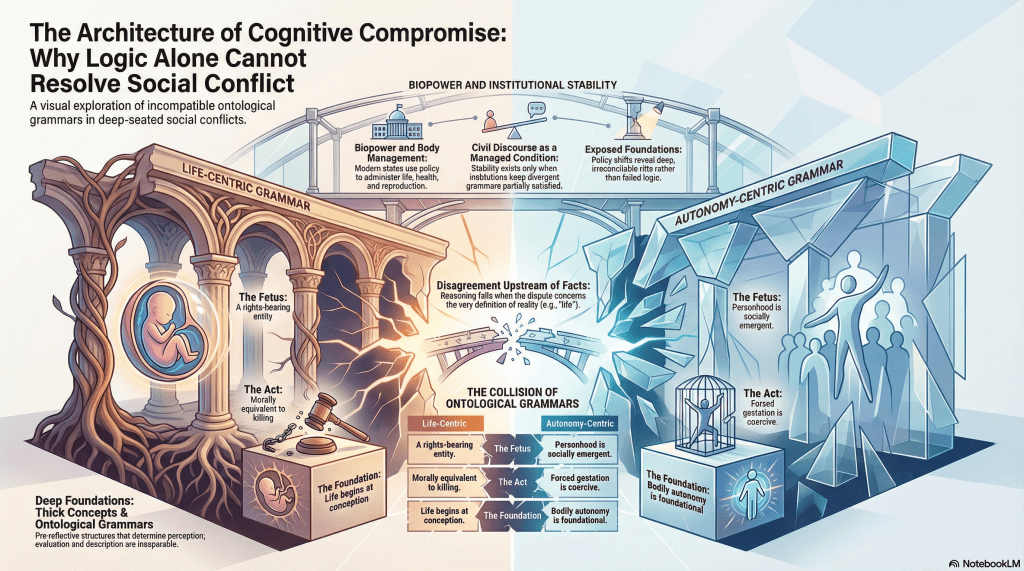
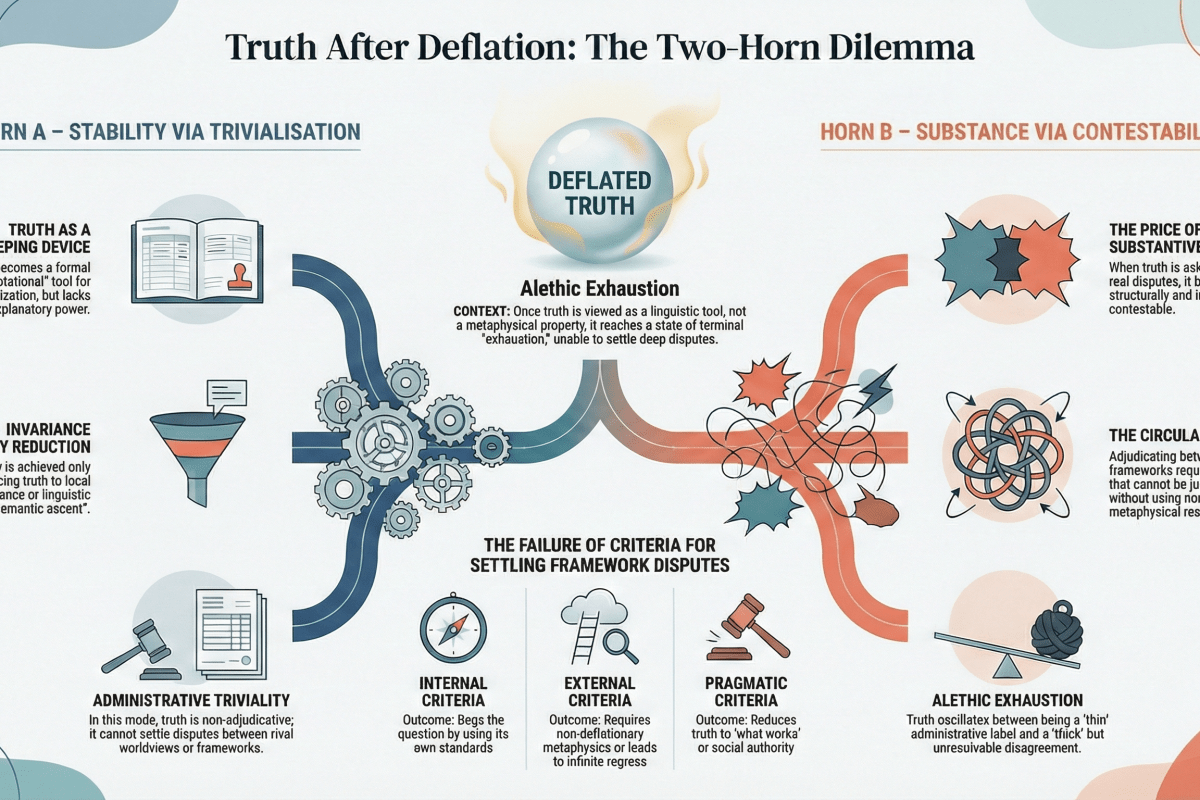
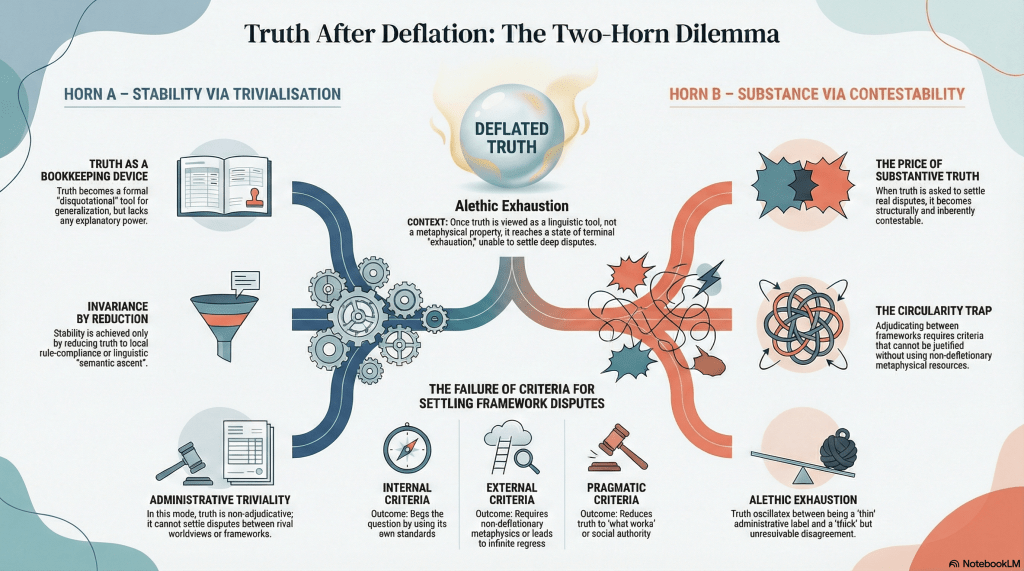
Image: NotebookLM infographics of this topic. (Please ignore the typos.)

The dilemma

Once deflationary constraints are accepted, attempts to “save” Truth fall into a simple two-horn dilemma.

Horn A: Stabilise truth by making it invariant.
You can do this by disquotation, stipulation, procedural norms, or shared observation. The result is stable, but thin. Truth becomes administrative: a device for endorsement, coordination, and semantic ascent. It no longer adjudicates between rival frameworks.

Horn B: Preserve truth as substantive.
You can ask Truth to ground inquiry, settle disputes, explain success, or stand above practices. But now you need criteria. And once criteria enter, so do circularity, regress, or smuggled metaphysics. Truth becomes contestable precisely where it was meant to adjudicate.

Stability costs substance. Substance costs stability. There is no third option waiting in the wings.

Why this isn’t just abstract philosophy

To test whether this is merely a theoretical artefact, the paper works through three domains where truth is routinely asked to do serious work:

  • Moral truth, where Truth is meant to override local norms and condemn entrenched practices.
  • Scientific truth, where Truth is meant to explain success, convergence, and theory choice.
  • Historical truth, where Truth is meant to stabilise narratives against revisionism and denial.

In each case, the same pattern appears. When truth is stabilised, it collapses into procedure, evidence, or institutional norms. When it is thickened to adjudicate across frameworks, it becomes structurally contestable. This isn’t relativism. It’s a mismatch between function and resources.

Why this isn’t quietism either

A predictable reaction is: isn’t this just quietism in better prose?

Not quite. Quietism tells us to stop asking. Exhaustion explains why the questions keep being asked and why they keep failing. It’s diagnostic, not therapeutic. The persistence of truth-theoretic debate isn’t evidence of hidden depth. It’s evidence of a concept being pushed beyond what it can bear after deflation.

The upshot

Truth still matters. But not in the way philosophy keeps demanding. Truth works because practices work. It doesn’t ground them. It doesn’t hover above them. It doesn’t adjudicate between them without borrowing authority from elsewhere. Once that’s accepted, a great deal of philosophical anxiety dissolves, and a great deal of philosophical labour can be redirected.

The question is no longer “What is Truth?” It’s “Why did we expect Truth to do that?”

The paper is now archived on Zenodo and will propagate to PhilPapers shortly. It’s long, unapologetically structural, and aimed squarely at readers who already think deflationary truth is right but haven’t followed it to its endpoint.

Read it if you enjoy watching concepts run out of road.

When Deflation Becomes Ritual

I recently shared a post calling out mystics, trying to fill spaces I deflate, but I am self-aware enough that I can be guilty, too. I worry about Maslow’s Law of the Instrument. Deflationary philosophy likes to imagine itself as immune to excess. It dissolves puzzles, clears away bad questions, and resists the urge to add metaphysical upholstery where none is needed. No mysteries, thank you. No hidden depths. Just conceptual hygiene. This self-image is mostly deserved. But not indefinitely. This post is an attitude check.

Because deflation, like anything that works, can ossify. And when it does, it doesn’t inflate into metaphysics. It hardens into something more embarrassing: a ritual of refusal.

Audio: NotebookLM summary podcast on this topic.

From method to mannerism

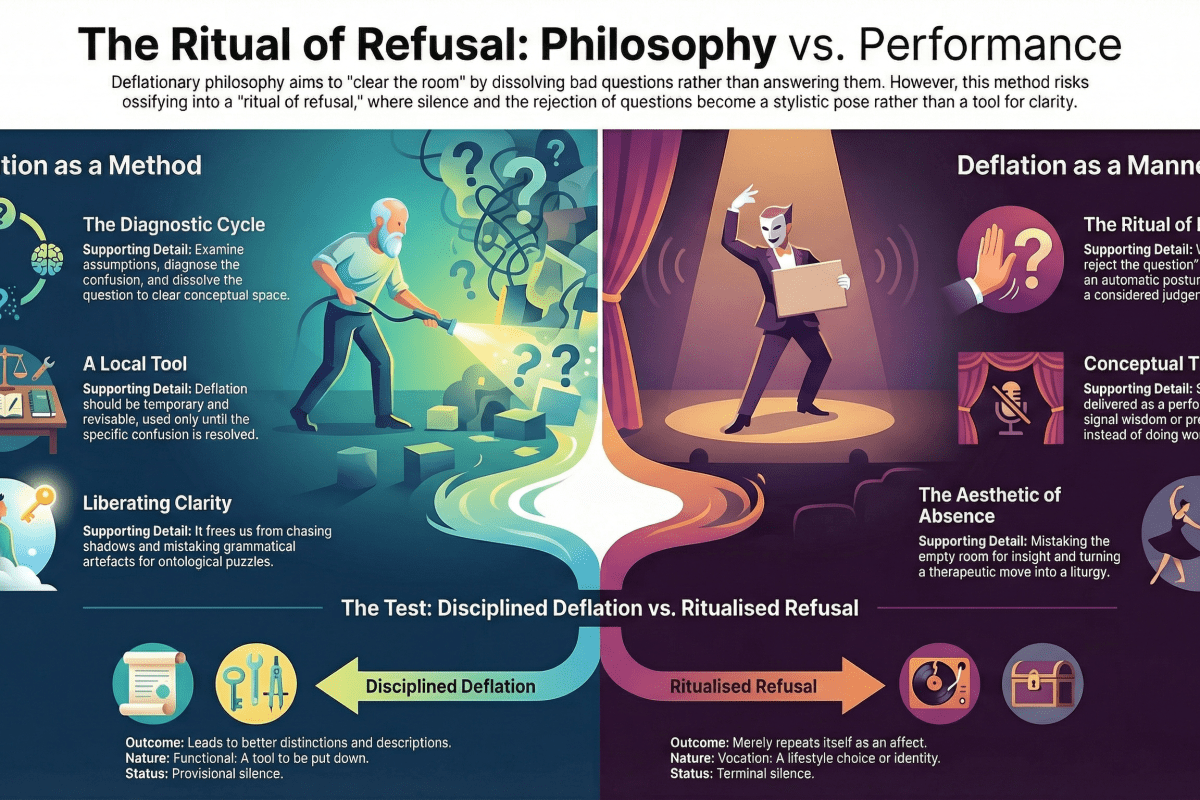
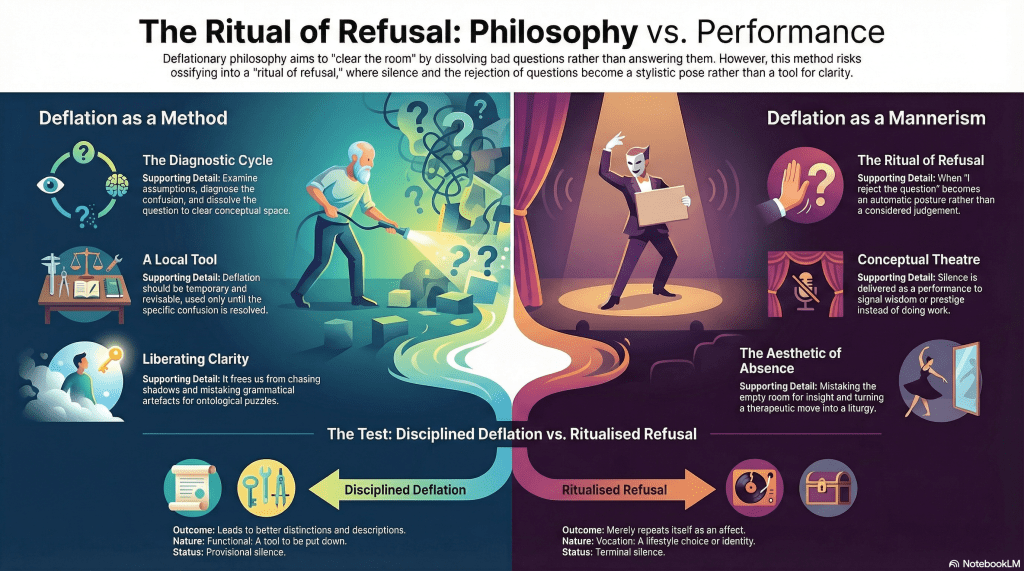
Deflation begins as a method:

  • A question is posed.
  • Its assumptions are examined.
  • The confusion is diagnosed.
  • The question dissolves.
  • Everyone goes home.

At its best, this is liberating. It frees us from chasing shadows and mistaking grammatical artefacts for ontological puzzles. The trouble begins when the gesture outlives the job.

What was once a diagnostic move becomes a stylistic tic. Refusal becomes automatic. Silence becomes performative. ‘There is nothing there’ is delivered not as a conclusion, but as a posture. At that point, deflation stops doing work and starts doing theatre.

I am often charged with being negative, a pessimist, a relativist, and a subjectivist. I am sometimes each of these. Mostly, I am a Dis–Integrationist and deflationist, as it were. I like to tear things apart – not out of malice, but seeing that certain things just don’t sit quite right.

Another thing I do is to take things at face value. As I came up through the postmodern tradition, I don’t trust metanarratives, and I look for them everywhere. This is why I wrote A Language Insufficiency Hypothesis (LIH), and even more so, the Mediated Encounter Ontology (MEOW). Some words carry a lot of baggage and connotation, so I want to be sure I understand the rawest form. This is why I rail on about weasel words like truth, justice, freedom, and such.

I also refrain from responding if I am not satisfied with a definition. This is why I consider myself an igntheist as opposed to an atheist. Functionally, I am the latter, but the definition I’d be opposing is so inane that it doesn’t even warrant me taking a position.

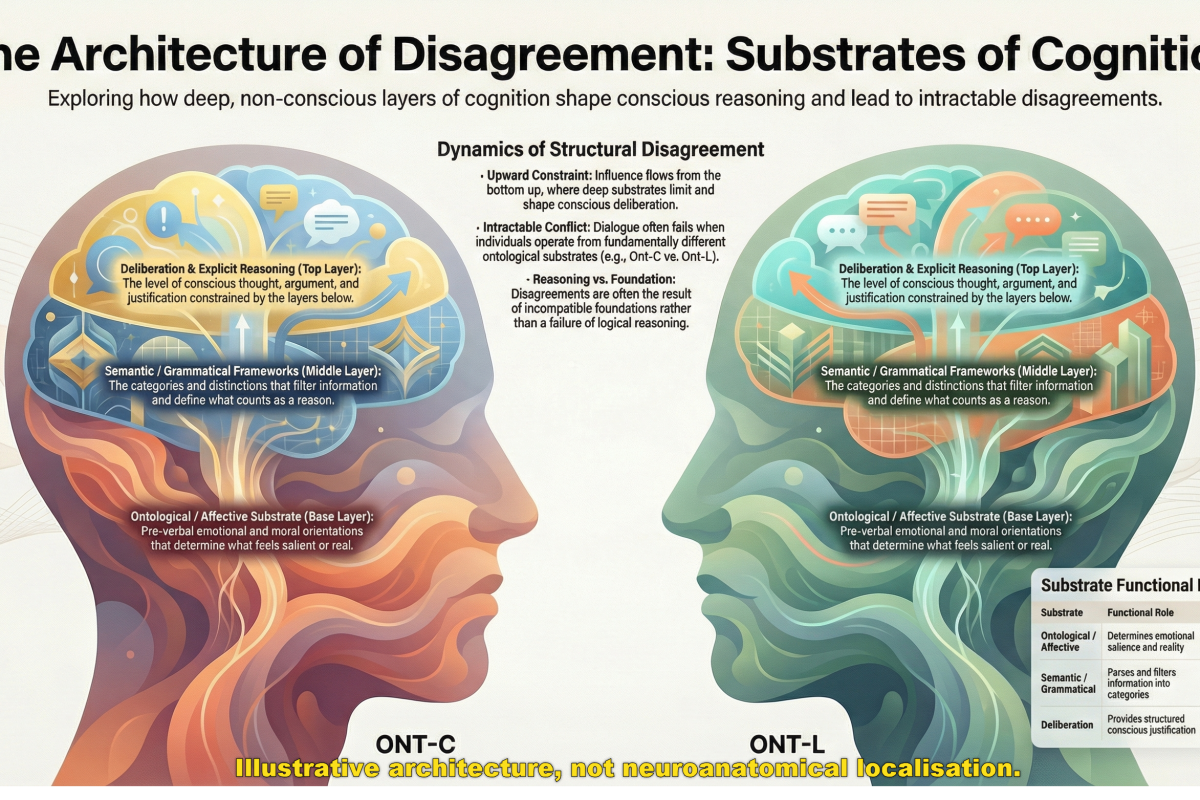
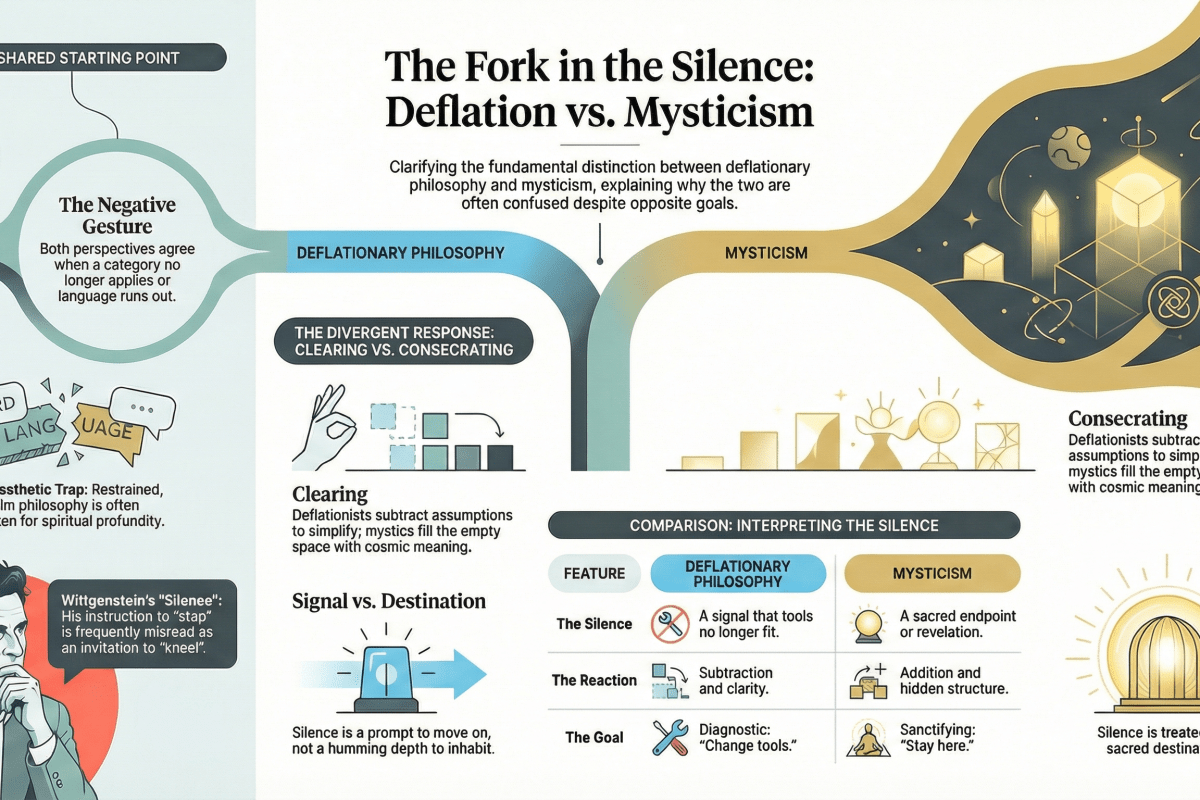
Image: NotebookLM infographic of this topic.

The prestige of saying less

There is a quiet prestige attached to not answering questions. Refusal sounds serious. Restraint sounds wise. Silence, in the right lighting, sounds profound. This is not an accident. Our intellectual culture has learned to associate verbal minimalism with depth, much as it associates verbosity with insecurity. Deflationary philosophers are not immune to this aesthetic pull.

When ‘I reject the question’ becomes a default response rather than a considered judgement, deflation has slipped from method into mannerism. The absence of claims becomes a badge. The lack of commitments becomes an identity. One is no longer clearing space, but occupying emptiness.

This is how deflation acquires a style – and styles are how rituals begin.

Apophasis without God

Mysticism has its negative theology. Ritualised deflation develops something similar.

Both rely on:

  • refusal to name
  • insistence on limits
  • reverent quiet

The difference is meant to be procedural. Mysticism stops at the silence. Deflation is supposed to pass through it. But when deflation forgets that its silence is provisional, it starts to resemble the thing it set out to criticise. Absence becomes sacred again, just without the cosmology. The metaphysician worships what cannot be said. The ritualised deflationist admires themselves for not saying it. Neither is doing conceptual work anymore.

A brief and unavoidable Wittgenstein

This is where Ludwig Wittgenstein inevitably reappears, not as an authority, but as a warning. Wittgenstein did not think philosophy ended in silence because silence was holy. He thought philosophy ended in silence because the confusion had been resolved. The ladder was to be thrown away, not mounted on the wall and admired. Unfortunately, ladders make excellent décor.

When deflation becomes ritual, the therapeutic move freezes into liturgy. The gesture is preserved long after its purpose has expired. What was meant to end a problem becomes a way of signalling seriousness. That was never the point.

A diagnostic test

There is a simple question that separates disciplined deflation from its ritualised cousin:

  • Is this refusal doing explanatory work, or is it being repeated because it feels right?
  • If silence leads to better distinctions, better descriptions, or better questions, it is doing its job.
  • If silence merely repeats itself, it has become an affect.

And affects, once stabilised, are indistinguishable from rituals.

Deflation is local, not terminal

The corrective is not to abandon deflation, but to remember its scope.

Deflation should be:

  • local rather than global
  • temporary rather than terminal
  • revisable rather than aestheticised

Some questions need dissolving. Some need answering. Some need rephrasing. Knowing which is which is the entire discipline. Deflation is not a worldview. It is not a temperament. It is not a lifestyle choice. It is a tool, and like all tools, it should be put down when it stops fitting the task.

Clearing space is not a vocation

There is a temptation, once a room has been cleared, to linger in it. To admire the quiet. To mistake the absence of furniture for the presence of insight. But clearing space is not a vocation. It is a task. Once it is done, staying behind is just another way of refusing to leave. And refusal, repeated without reason, is no longer philosophy. It is choreography.

The Expiration Date of Object Permanence

2–4 minutes

There is a persistent story we tell ourselves about quantum mechanics:* that it reveals reality to be fundamentally strange, paradoxical, or hostile to common sense. Particles in two places at once. Cats be both alive and dead. Worlds multiplying to save appearances.

I’ve never found that story convincing.

Audio: NotebookLM summary podcast of this topic.
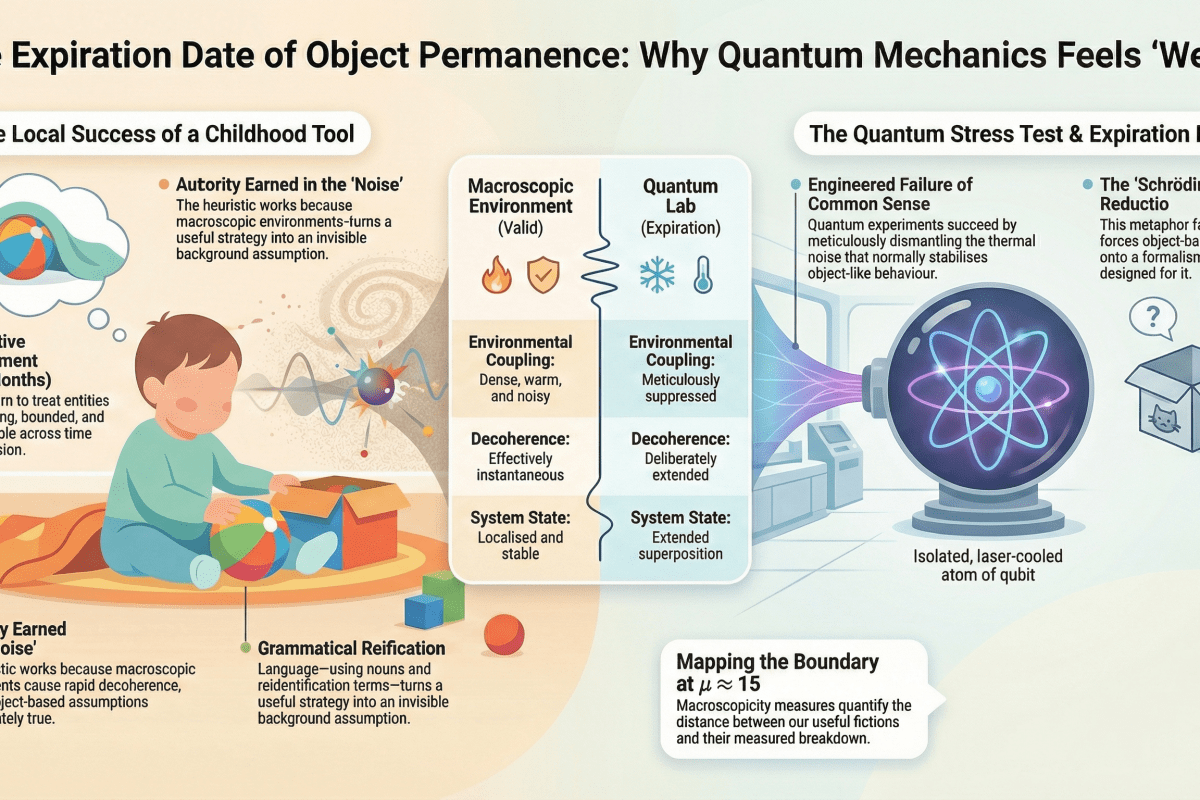
Image: NotebookLM infographic for this topic.

What I do find convincing is a simpler diagnosis: that we are applying a cognitive tool far beyond the conditions under which it earned its authority – and then mistaking the resulting discomfort for metaphysical insight.

Object permanence is one of our earliest and most successful heuristics. It allows infants to track toys behind sofas, caregivers behind doors, and threats behind occlusion. Without it, coordinated action would be impossible. With it, the world becomes navigable, predictable, and stable. It is a genuine cognitive achievement. But it is not a universal guarantee about reality.

In a new essay, The Expiration Date of Object Permanence: Heuristics, Grammar, and Quantum Pseudoproblems, I argue that much of what we call ‘quantum weirdness’ arises from the uncritical extension of this heuristic into domains where its ecological licensing no longer holds. The problem is not that quantum mechanics violates common sense. The problem is that we quietly treat common sense as metaphysics.

Quantum mechanics functions here not as a mystery generator, but as a stress test. Recent matter-wave interference experiments with increasingly massive systems show that object-based expectations fail quantifiably under carefully engineered conditions. When environmental coupling is suppressed, when decoherence is delayed, when the world is no longer warm, noisy, and forgiving, the assumptions underwriting object permanence simply stop paying rent.

The essay also takes a dim view of some familiar cultural furniture. Schrödinger’s cat, for example, was introduced as a reductio – an intentionally absurd demonstration of what happens when microscopic formalism is naively scaled up. That it now circulates as an explanatory image tells us less about quantum mechanics than about the tenacity of object-grammar. Even jokes cannot escape it.

Interpretations fare no better. I suggest that the appeal of frameworks like Many-Worlds is not exhausted by their technical merits. They also function as strategies for preserving object-based reidentification – ways of ensuring that there is still something that can be pointed to, counted, and followed through time, even if the price is ontological inflation.

None of this denies the reality of quantum phenomena, nor does it pretend to solve the measurement problem. The essay is deliberately deflationary. Its claim is methodological, not revisionary: that many of the puzzles we inherit are artefacts of treating developmentally acquired heuristics as if they were unconditional features of the world.

Philosophy’s task, on this view, is not to make reality intuitive. It is to recognise when intuition has reached the end of its jurisdiction.

The paper is now available on Zenodo and will be indexed shortly on PhilPapers. As always, comments, objections, and principled misreadings are welcome.


This post and the underlying essay were inspired by a Nature article: Probing quantum mechanics with nanoparticle matter-wave interferometry, published on 21 January 2026. I get annoyed watching people misunderstand quantum mechanics and its effects, so I decided to address some of the issues in an essay. Read this essay as well as mine, which will explain why the paradoxes and ‘spooky behaviour’ of QM are only counter-intuitive if you’ve fallen into this heuristic trap.

Why Deflationary Philosophy Keeps Attracting Mystics

4–5 minutes

The struggle is real. There is an odd occupational hazard that comes with writing deflationary philosophy: mystics keep turning up to thank you for your service.

This is always mildly bewildering. One spends a great deal of time dismantling metaphysical furniture, only to discover a small group lighting incense in the newly cleared space. Candles appear. Silence thickens. Someone whispers ineffable. Nope. The filing cabinet was just mislabeled.

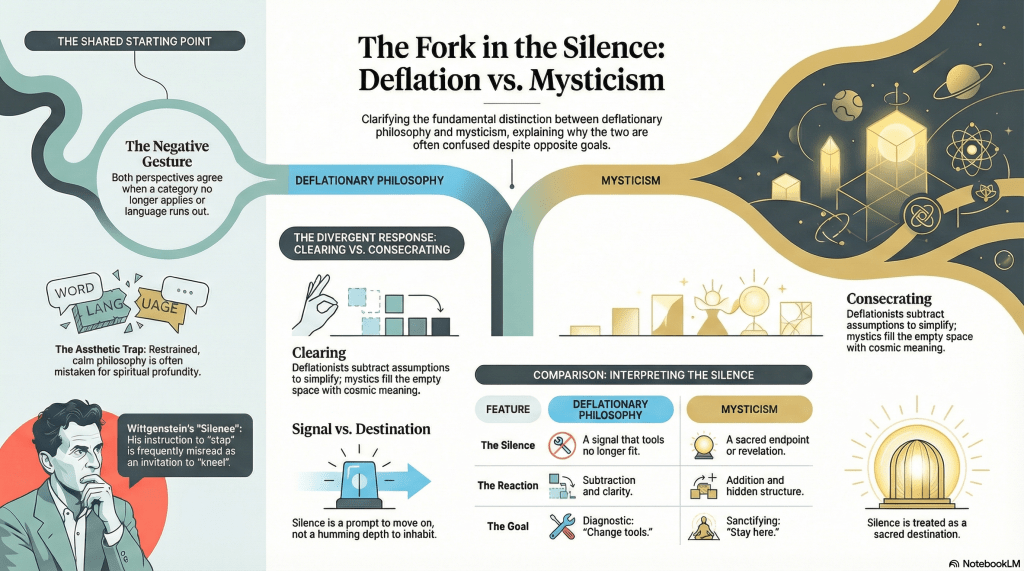
Audio: NotebookLM summary podcast of this topic.

The problem is not misunderstanding. It’s reuse.

It is tempting to think this is a simple misreading: I say this concept breaks down here, and someone hears you have glimpsed the ultimate. But that’s too kind. What’s really happening is more interesting. Mysticism does not merely misunderstand deflationary work; it feeds on the same linguistic moves and then stops too early.

Both mysticism and deflation rely on negative gestures:

  • “This description fails.”
  • “That category no longer applies.”
  • “Our usual language runs out.”

Up to this point, they are indistinguishable. The fork comes immediately after. The mystic treats conceptual failure as an endpoint. The silence itself becomes the destination. Something deep must live there, humming quietly, just out of reach.

The deflationist treats the same failure as a transition. The silence is not sacred. It’s a signal. It means: this tool no longer fits; pick another or move on. Same breakdown. Entirely different posture.

Clearing space versus consecrating it

Much deflationary philosophy clears space. It removes assumptions that were doing illicit work and leaves behind something quieter, simpler, and occasionally disappointing.

Mysticism has a standing policy of consecrating cleared space. An empty room is never just empty. It must be pregnant with meaning. Absence becomes depth. Silence becomes revelation. The fewer claims you make, the more cosmic you must be.

This is not a philosophical disagreement so much as a difference in temperament. One side sees subtraction. The other experiences loss and rushes to compensate. Modern intellectual culture strongly prefers addition. New layers. Hidden structures. Further depths. Deflation feels like theft. So it gets reinterpreted as a subtler form of enrichment: Ah, fewer words, therefore more truth.

The aesthetic trap

There is also an aesthetic problem, which I increasingly suspect does most of the damage. Deflationary philosophy, when done well, tends to sound calm, patient, and restrained. It does not shout. It does not posture. It does not perform certainty. Unfortunately, this is exactly how profundity is supposed to sound.

Quiet seriousness is easily mistaken for spiritual depth. Refusal to speculate reads as wisdom. Negative definition acquires an apophatic glow. This is how one ends up being mistaken for a mystic without having said anything mystical at all.

A brief word about Wittgenstein (because of course)

This is not a new problem. Ludwig Wittgenstein spent a good portion of his career trying to convince people that philosophical problems arise when language goes on holiday. He was not pointing at a deeper reality beyond words. He was pointing back at the words and saying: look at what you’re doing with these.

Unfortunately, “Whereof one cannot speak, thereof one must be silent” has proven irresistible to those who think silence is where the real action is. Wittgenstein meant: stop here. Many readers heard: kneel here. This is the recurring fate of therapeutic philosophy. The cure gets mistaken for a sacrament.

Charity is not complicity

Another contributor to the confusion is tone. Deflationary work tends to be charitable. It explains why certain intuitions arise. It traces confusions to their sources. It does not sneer. This generosity is often misheard as validation. When you say, “It makes sense that we think this way,” some readers hear, “Your intuition is pointing at something profound.” You are offering an explanation. They are receiving an affirmation. At that point, no disclaimer will save you. Any denial is absorbed as further evidence that you are brushing up against something too deep to articulate.

The real disagreement

The disagreement here is not about reality. It is about what to do when explanation fails.

Mysticism treats failure as revelation. Deflation treats failure as diagnostic.

One sanctifies the breakdown. The other changes tools.

Once you see this, the repeated misfire stops being frustrating and starts being predictable.

A final, self-directed warning

There is, admittedly, a risk on the other side as well. Deflation can become mystical if it turns into ritual. If refusal hardens into identity. If “there is nothing there” becomes something one performs rather than concludes. Even subtraction can acquire ceremony if repeated without purpose. The discipline, such as it is, lies in knowing when to clear space—and when to leave the room.

No replacement gods

When a metaphysical idol is removed, someone will always ask what god is meant to replace it. The deflationary answer is often disappointing: none. This will never satisfy everyone. But the room is cleaner now, and that has its own quiet reward—even if someone insists on lighting incense in the corner.

Image: Full cover image infographic by NotebookLM

Qualified Subjectivism

4–7 minutes

I Am a Qualified Subjectivist. No, That Does Not Mean ‘Anything Goes’.

Make no mistake: I am a subjectivist. A qualified one. Not that kind of qualified – the qualification matters, but it’s rarely the part anyone listens to.

Image: Not that kind…

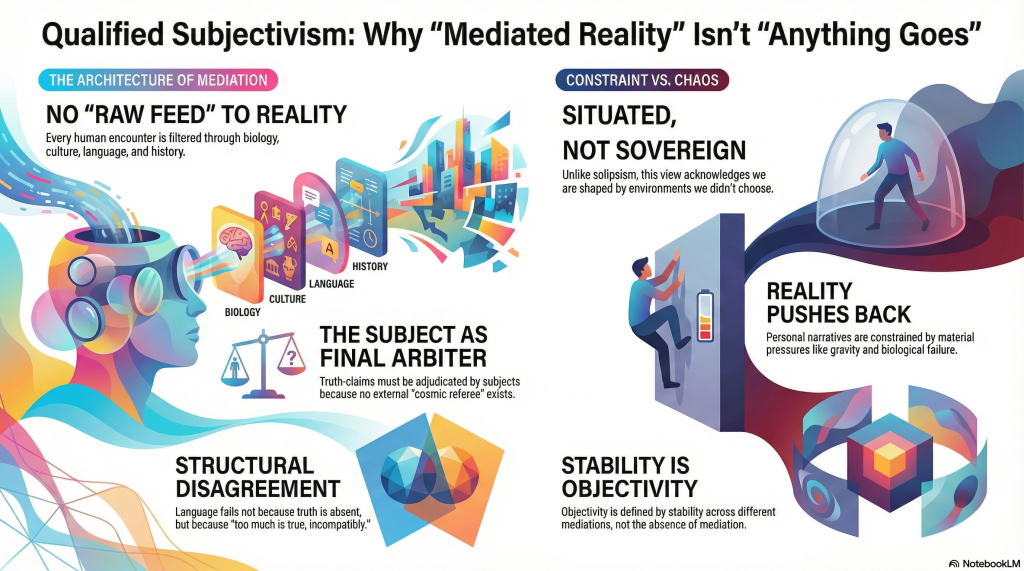
Here is the unglamorous starting point: all human encounters with the world are mediated. There is no raw feed. No unfiltered access. No metaphysical lead running directly from ‘reality’ into the human mind. Every encounter is processed through bodies, nervous systems, cultures, languages, technologies, institutions, and histories.

Audio: NotebookLM summary podcast of this content – See addendum below.

Whilst I discuss the specific architecture of this mediation at length in this preprint, here I will keep it simple.

If you are human, you do not encounter reality as such. You encounter it as processed. This is not controversial. What is controversial is admitting the obvious consequence: the subject is the final arbiter.

Image: NotebookLM Infographic of Qualified Subjectivism

The Subject Is the Final Arbiter

Every account of truth, reality, meaning, value, or fact is ultimately adjudicated by a subject. Not because subjects are sovereign gods, but because there is literally no other place adjudication can occur.

Who, exactly, do critics imagine is doing the adjudicating instead? A neutral tribunal floating outside experience? A cosmic referee with a clipboard? A universal consciousness we all forgot to log into?

This does not mean that truth is ‘whatever I feel like’. It means that truth-claims only ever arrive through a subject, even when they are heavily constrained by the world. And constraint matters. Reality pushes back. Environments resist. Bodies fail. Gravity does not care about your personal narrative.

Why This Is Not Solipsism

Solipsism says: only my mind exists. That is not my claim. My claim is almost boring by comparison: subjects are situated, not sovereign.

We are shaped by environments we did not choose and histories we did not write. Mediation does not eliminate reality; it is how reality arrives. Your beliefs are not free-floating inventions; they are formed under biological, social, and material pressure. Two people can be exposed to the same event and encounter it differently because the encounter is not the event itself – it is the event as mediated through a particular orientation.

Why Objectivity Keeps Sneaking Back In

At this point, someone usually says: ‘But surely some things are objectively true.’

Yes. And those truths are still encountered subjectively. The mistake is thinking that objectivity requires a ‘view from nowhere’. It doesn’t. It requires stability across mediations, not the elimination of mediation altogether. We treat some claims as objective because they hold up under variation, while others fracture immediately. But in all cases, the encounter still happens somewhere, to someone.

The Real Source of the Panic

The real anxiety here is not philosophical. It’s moral and political. People are terrified that if we give up the fantasy of unmediated access to universal truth, then legitimacy collapses and ‘anything goes’.

This is a category error born of wishful thinking. What actually collapses is the hope that semantic convergence is guaranteed. Once you accept that mediation is unavoidable, you are forced to confront a harder reality: disagreement is often structural, not corrigible. Language does not fail because nothing is true. Language fails because too much is true, incompatibly.

So Yes, I Am a Qualified Subjectivist

Interpretation only ever occurs through subjects. Subjects are always mediated. Mediation is always constrained. And constraint does not guarantee convergence.

That is the position. It is not radical, fashionable, or comforting. It is simply what remains once you stop pretending there is a god’s-eye view quietly underwriting your arguments. Discomfort is simply a reliable indicator that a fantasy has been disturbed.

Audio: NotebookLM summary of this Geworfenheit addendum

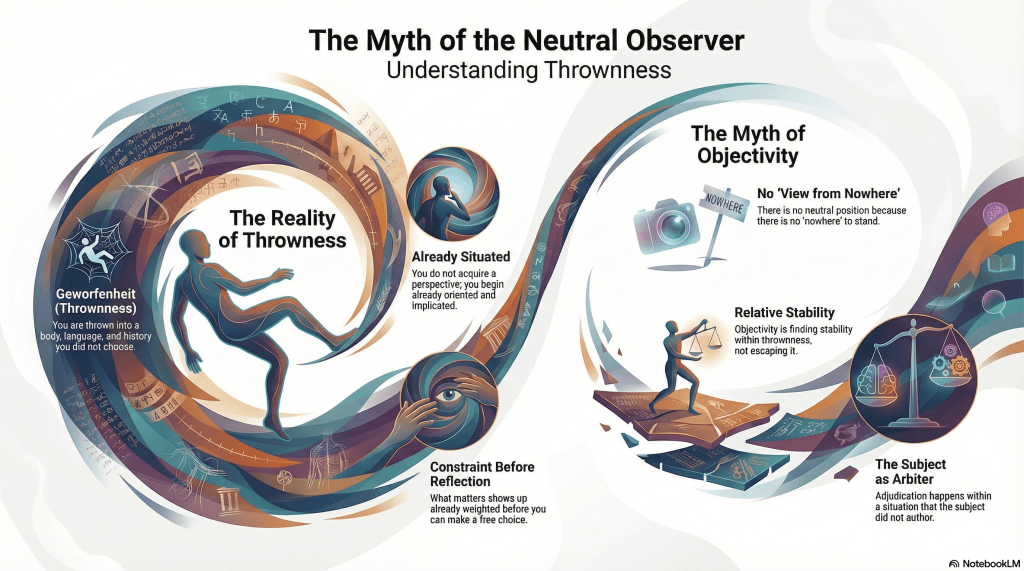
If all this sounds suspiciously familiar, that’s because it is. Heidegger had a word for it: Geworfenheit – usually translated as thrownness.

The idea is simple, and deeply irritating to anyone still hoping for a clean start. You do not enter the world as a neutral observer. You are thrown into it: into a body, a language, a culture, a history, a set of institutions, a moment you did not choose. You do not begin from nowhere and then acquire a perspective. You begin already situated, already oriented, already implicated.

This is not a poetic flourish. It is a structural claim about human existence.

Image: Another NotebookLM infographic for the fun of it.

What my qualified subjectivism insists on – without Heidegger’s ontological theatre – is the same basic constraint: there is no view from nowhere because there is no nowhere to stand. The subject does not float above mediation; the subject is constituted by it. Thrownness is not an accident to be corrected by better theory. It is the condition under which any theorising occurs at all.

Seen this way, the demand for pure objectivity starts to look less like a philosophical ideal and more like nostalgia for an impossible innocence. A wish to rewind existence to a point before bodies, languages, power, and history got involved. That point never existed.

Geworfenheit matters here because it dissolves the caricature that subjectivism is about arbitrary choice. Being thrown is the opposite of choosing freely. It is constraint before reflection. Orientation before argument. Salience before reasons. You do not decide what matters from a neutral menu; what matters shows up already weighted, already charged, already resistant.

This is why appeals to “just be objective” always ring hollow. Objectivity does not mean escaping thrownness. It means achieving relative stability within it. Some claims hold across many thrown positions. Others fracture immediately. That distinction matters. But none of it happens outside mediation.

So when I say the subject is the final arbiter, I am not crowning the subject king of reality. I am pointing out the obvious: adjudication happens somewhere, to someone, from within a situation they did not author. Thrownness guarantees that there is no cosmic referee waiting to overrule the encounter.

If that makes you uncomfortable, good. It should. Discomfort is often just the sensation of a fantasy losing its grip.

A Language Insufficiency Hypothesis

1–2 minutes

Almost a decade in the making, this book explains why more time, more effort, and more detail do not reliably improve certain forms of communication. Beyond a point, returns diminish sharply. In some domains, they collapse altogether.

The manuscript focuses on English, but the hypothesis has already been extended to French (published separately), and I am continuing work on other ontological barriers. If you’re interested in testing or extending the framework in your own language, feel free to get in touch.

Also available in a clothbound edition at Barnes & Noble.

Over the coming weeks, I’ll be unpacking aspects of the Language Insufficiency Hypothesis in more depth here. The book’s role is deliberately limited: it defines the problem, establishes the structure, and offers grounding examples. The real work happens in the consequences.

For now, the important thing is simple: the book is finally available.

When Words Do the Work: A Case Study in Nomenclature Drift

3–5 minutes

Lewis Goodall, a talk show host, calls the cross-border seizure of Venezuela’s Nicolás Maduro a ‘kidnapping’. His guest and Trump apologist, Angie Wong, rejects the word. She first says ‘arrest’, then ‘extradition’, then finally the improvised ‘special extradition’. Around that single lexical choice, a 12-minute standoff unfolds.

Audio: NotebookLM summary podcast of this topic.

As a language philosopher, I am evaluating the language and am less concerned with the underlying facts of the matter. Language serves to obscure these facts from the start and then rhetorically controls the narrative and framing.

Video: Source segment being analysed

There is a familiar mistake made whenever public discourse turns heated: the assumption that the real disagreement lies in the facts. This is comforting, because facts can, at least in principle, be checked. What follows examines a different failure mode altogether. The facts are largely beside the point.

Consider a broadcast exchange in which a political commentator and an interviewer argue over how to describe the forcible removal of a head of state from one country to another. The interviewer repeatedly uses the word kidnapping. The guest repeatedly resists this term, preferring arrest, extradition, and eventually the improvisational compromise ‘special extradition’.

What matters here is not which term is correct. What matters is what the interaction reveals about how meaning is negotiated under pressure.

The illusion of disagreement

Superficially, the exchange appears to be a dispute about legality. Was there a treaty? Was due process followed? Which court has jurisdiction? These questions generate heat, but they are not doing the work.

The real disagreement is prior to all of that: which lexical frame is allowed to stabilise the event.

Once a label is accepted, downstream reasoning becomes trivial. If it was an extradition, it belongs to one legal universe. If it was a kidnapping, it belongs to another. The participants are not arguing within a shared framework; they are competing to install the framework itself.

Equivocation as method, not error

The guest’s shifting vocabulary is often described as evasive or incoherent. This misreads what is happening. The movement from extradition to special extradition is not confusion. It is a deliberate widening of semantic tolerance.

‘Special extradition’ is not meant to clarify. It is meant to survive. It carries just enough institutional residue to sound procedural, while remaining sufficiently vague to avoid binding criteria. It functions less as a description than as a holding pattern.

This is equivocation, but not the amateur kind taught in logic textbooks. It is equivocation under constraint, where the aim is not precision but narrative continuity.

Why exposure fails

The interviewer repeatedly points out that extradition has a specific meaning, and that the situation described does not meet it. This is accurate, and also ineffective.

Why? Because the exchange is no longer governed by definitional hygiene. The audience is not being asked to adjudicate a dictionary entry. They are being asked to decide which voice has the authority to name the act.

Once that shift occurs, exposing misuse does not correct the discourse. It merely clarifies the power asymmetry. The guest can concede irregularity, precedent-breaking, even illegality, without relinquishing control of the label. The language continues to function.

Truth as a downstream effect

At no point does the exchange hinge on discovering what ‘really happened’. The physical sequence of events is relatively uncontested. What is contested is what those events are allowed to count as.

In this sense, truth is not absent from the discussion; it is subordinate. It emerges only after a rhetorical frame has been successfully installed. Once the frame holds, truth follows obediently within it.

This is not relativism. It is an observation about sequence. Rhetoric does not decorate truth here; it prepares the ground on which truth is later claimed.

Language doing institutional work

The most revealing moment comes when the guest effectively shrugs at the legal ambiguity and asks who, exactly, is going to challenge it. This is not cynicism. It is diagnostic.

Words like arrest and extradition are not merely descriptive. They are operational tokens. They open doors, justify procedures, and allow institutions to proceed without stalling. Their value lies less in semantic purity than in administrative usability.

‘Kidnapping’ is linguistically precise in one register, but administratively useless in another. It stops processes rather than enabling them. That is why it is resisted.

What the case study shows

This exchange is not about geopolitics. It is about how language behaves when it is tasked with carrying power. Meaning drifts not because speakers are careless, but because precision is costly. Labels are selected for durability, not accuracy. Truth does not arbitrate rhetoric; rhetoric allocates truth. Seen this way, the debate over terminology is not a failure of communication. It is communication functioning exactly as designed under modern conditions. Which is why insisting on ‘the correct word’ increasingly feels like shouting into a ventilation system. The air still moves. It just isn’t moving for you.

Footnotes from the House: Justice as a Casino Game

4–6 minutes

This is part 2 of a structural critique of Justice™. Read Part 1, The Ontology–Encounter–Evaluation Model: Retributive Justice as an Instantiation.

If you want a useful metaphor for how justice actually operates, don’t picture a blindfolded goddess with scales. Picture a casino.

Image: Lady Justice in Casino. The dice are rigged. haha

The rules are printed. The games look fair. Everyone is technically allowed to play. But the mathematics are tuned in advance, the exits are discreet, and the house never risks its own solvency. You don’t walk into a casino to discover whether chance is fair. You walk in to participate in a system whose advantage has already been engineered.

By the time a defendant appears, the ontological dice have already been loaded. The system has quietly asserted a set of metaphysical commitments that make certain outcomes legible, actionable, and punishable – whilst rendering others incoherent, inadmissible, or ‘unreasonable’. Because I am a philosopher of language and not a lawyer, I am free from the indoctrination and selection bias inherent in that system. This allows me to critique the system directly without being excommunicated from the club.

What follows are not neutral assumptions. They are ontological wagers, each chosen because its alternative would tilt the field away from institutional power.

Ontology 1: The Self

Justice presumes that the person who acted yesterday is meaningfully the same entity standing in court today. This is not discovered; it is asserted.

Why? Because retribution requires persistence. Desert cannot attach to a momentary configuration of consciousness. Responsibility requires a carrier that survives time, memory gaps, psychological rupture, intoxication, trauma, and neurological variance.

An episodic self – Parfit’s reductionism, trauma-fractured identity, or situational selfhood – collapses the attribution pipeline. If the ‘self’ is a series of loosely connected episodes, punishment becomes conceptually incoherent. Who is being punished for whom?

So the law treats episodic accounts not as alternative ontologies but as defects: insanity, automatism, incompetence. The self is patched, not replaced.

Ontology 2: Agency

Justice requires that actions originate somewhere. Agency is that somewhere.

The system asserts that agents could have done otherwise in a morally relevant sense. This is compatible with compatibilism, folk psychology, and everyday moral intuitions – but deeply hostile to hard determinism, strong situationism, or neurobiological deflation.

Why exclude weaker agency models? Because if agency dissolves into causation, environment, or neurochemistry, responsibility evaporates. At best, you get risk management. At worst, you get treatment or containment. Retribution has nowhere to land.

So the law nods politely to influences – upbringing, coercion, impairment – whilst ring-fencing agency as the default. Mitigation is permitted. Ontological revision is not. The house needs someone who could have chosen otherwise, even if that claim grows increasingly fictional under scrutiny.

Ontology 3: Choice

Justice models human action as a series of forks in the road. At some point, the agent ‘chose’ X over Y. This is enormously convenient.

Continuous decision spaces – poverty gradients, addiction loops, survival trade-offs – are messy. They resist clean counterfactuals. ‘What should they have done instead?’ becomes a sociological question, not a moral one.

So the system discretises. It locates a moment. A click. A trigger pull. A signature. A punch. A text sent.

Once the choice is frozen, the rest of the apparatus can proceed. Without discrete choice points, proportionality and culpability lose their anchor.

Ontology 4: Causation

Justice prefers causes that point: Who did this? When? How directly?

Systemic causation – economic pressure, cultural narratives, institutional design – creates attribution problems. If harm is emergent, no individual carries it cleanly. Responsibility smears.

So causation is narrowed. Chains are shortened. Proximate cause replaces contributing conditions. Structural violence becomes background noise.

This is not because systemic causation is false. It is because it is unmanageable within a retributive frame.

Ontology 5: Reasonableness

‘Reasonableness’ is the softest and most insidious ontology of the lot.

It pretends to be procedural, but it functions as cultural enforcement. The reasonable person is not an average human. They are an acculturated one.

Intensity becomes suspect. Rage becomes irrational. Grief becomes excessive. Radical interpretations become unreasonable not because they’re false, but because they disrupt cadence.

This ontology stabilises the game by disciplining tone. It doesn’t matter what you argue if you fail to argue it reasonably. Reasonableness is not required for responsibility to exist, only for dissent to be ignored.

The house needs calm players, not correct ones.

Why These Ontologies, and Not Their Rivals?

Because every excluded ontology threatens legibility. Justice is not designed to discover truth. It is designed to terminate cases. Ontologies that complicate attribution, disperse responsibility, or destabilise narrative continuity slow the machine. So they are ruled out – not explicitly, but structurally.

Once these commitments are in place, disagreement downstream becomes theatre. Arguments about fairness, proportionality, or intent occur within a rigged metaphysical envelope. That’s why reform debates feel sincere yet go nowhere. People argue outcomes whilst the house quietly keeps the rules.

The Point

None of this means justice is a scam. Casinos aren’t scams either. They do exactly what they are designed to do.

If you want to challenge justice meaningfully, you don’t start with sentencing guidelines or evidentiary thresholds. You start by asking which ontologies are being asserted – and why alternatives are unplayable.

Most people won’t make that move. Not because it’s wrong. Because it requires leaving the table.

A History of Language Insufficiency

3–4 minutes

I’ve been working on A Language Insufficiency Hypothesis since 2018. At least, that’s the polite, CV-friendly version. The truer account is that it’s been quietly fermenting since the late 1970s, back when I was still trapped in primary school and being instructed on how the world supposedly worked.

Social Studies. Civics. Law. The whole civic catechism. I remember being taught about reasonable persons and trial by a jury of one’s peers, and I remember how insistently these were presented as fair solutions. Fairness was not argued for. It was asserted, with the weary confidence of people who think repetition counts as justification.

I didn’t buy it. I still don’t. The difference now is that I have a hypothesis with some explanatory power instead of a vague sense that the adults were bluffing.

Audio: NotebookLM summary podcast of this topic.

I’ve always been an outsider. Eccentric, aloof, l’étranger if we’re feeling theatrical. It never particularly troubled me. Outsiders are often tolerated, provided they remain decorative and non-contagious. Eye rolls were exchanged on both sides. No harm done.

But that outsider position had consequences. It led me, even then, to ask an awkward question: Which peers? Not because I thought I was superior, but because I was plainly apart. How exactly was I meant to be judged by my peers when no one else occupied anything like my perspective?

Later, when I encountered the concept of fundamental attribution bias, it felt less like a revelation and more like confirmation. A peer-based system assumes not just similarity of circumstance, but similarity of interpretation. That assumption was dead on arrival.

Then there were reasonable persons. I was assured they existed. I was assured judges were trained to embody them. I had never met one. Even as a teenager, I found the idea faintly comical. Judges, I was told, were neutral, apolitical, and dispassionate. Writing this now from the United States, one hardly needs to belabour the point. But this wasn’t prescience. It was intuition. The smell test failed decades ago.

Before LIH had a name, I called these things weasel words. I still do, as a kind of shorthand. Terms like fair, reasonable, accountable, appropriate. Squishy concepts that do serious institutional work whilst remaining conveniently undefinable. Whether one wants to label them Contestables or Fluids is less important than recognising the space they occupy.

That space sits between Invariables, things you can point to without dispute, and Ineffables, where language more or less gives up. Communication isn’t binary. It isn’t ‘works’ or ‘doesn’t’. It’s a gradient. A continuous curve from near-certainty to near-failure.

Most communication models quietly assume a shared ontology. If misunderstanding occurs, the remedy is more explanation, more context, more education. What never sat right with me, even as a child, was that this only works when the disagreement is superficial. The breaking point is ontological.

If one person believes a term means {A, B, C} and another believes it means {B, C, D}, the overlap creates a dangerous illusion of agreement. The disagreement hides in the margins. A and D don’t merely differ. They are often irreconcilable.

Image: Venn diagramme of a contested concept.
Note: This is illustrative and not to scale

Fairness is a reliable example. One person believes fairness demands punishment, including retributive measures. Another believes fairness permits restoration but rejects retribution, citing circumstance, history, or harm minimisation. Both invoke fairness sincerely. The shared language conceals the conflict.

When such disputes reach court, they are not resolved by semantic reconciliation. They are resolved by authority. Power steps in where meaning cannot. This is just one illustration. There are many.

I thought it worth sharing how LIH came about, if only to dispel the notion that it’s a fashionable response to contemporary politics. It isn’t. It’s the slow crystallisation of a long-standing intuition: that many of our most cherished concepts don’t fail because we misuse them, but because they were never capable of doing the work we assigned to them.

More to come.

Justice as a House of Cards

4–6 minutes

How retribution stays upright by not being examined

There is a persistent belief that our hardest disagreements are merely technical. If we could stop posturing, define our terms, and agree on the facts, consensus would emerge. This belief survives because it works extremely well for birds and tables.

It fails spectacularly for justice.

Audio: NotebookLM summary podcast of this topic.

The Language Insufficiency Hypothesis (LIH) isn’t especially interested in whether people disagree. It’s interested in how disagreement behaves under clarification. With concrete terms, clarification narrows reference. With contested ones, it often fractures it. The more you specify, the more ontologies appear.

Justice is the canonical case.

Retributive justice is often presented as the sober, adult conclusion. Not emotional. Not ideological. Just what must be done. In practice, it is a delicately balanced structure built out of other delicately balanced structures. Pull one term away and people grow uneasy. Pull a second and you’re accused of moral relativism. Pull a third and someone mentions cavemen.

Let’s do some light demolition. I created a set of 17 Magic: The Gathering-themed cards to illustrate various concepts. Below are a few. A few more may appear over time.

Card One: Choice

Image: MTG: Choice – Enchantment

The argument begins innocently enough:

They chose to do it.

But “choice” here is not an empirical description. It’s a stipulation. It doesn’t mean “a decision occurred in a nervous system under constraints.” It means a metaphysically clean fork in the road. Free of coercion, history, wiring, luck, trauma, incentives, or context.

That kind of choice is not discovered. It is assumed.

Pointing out that choices are shaped, bounded, and path-dependent does not refine the term. It destabilises it. Because if choice isn’t clean, then something else must do the moral work.

Enter the next card.

Card Two: Agency

Image: MTG: Agency – Creature – Illusion

Agency is wheeled in to stabilise choice. We are reassured that humans are agents in a morally relevant sense, and therefore choice “counts”.

Counts for what, exactly, is rarely specified.

Under scrutiny, “agency” quietly oscillates between three incompatible roles:

  • a descriptive claim: humans initiate actions
  • a normative claim: humans may be blamed
  • a metaphysical claim: humans are the right kind of cause

These are not the same thing. Treating them as interchangeable is not philosophical rigour. It’s semantic laundering.

But agency is emotionally expensive to question, so the discussion moves on briskly.

Card Three: Responsibility

Image: MTG: Responsibility – Enchantment – Curse

Responsibility is where the emotional payload arrives.

To say someone is “responsible” sounds administrative, even boring. In practice, it’s a moral verdict wearing a clipboard.

Watch the slide:

  • causal responsibility
  • role responsibility
  • moral responsibility
  • legal responsibility

One word. Almost no shared criteria.

By the time punishment enters the picture, “responsibility” has quietly become something else entirely: the moral right to retaliate without guilt.

At which point someone will say the magic word.

Card Four: Desert

Image: MTG: Desert – Instant

Desert is the most mystical card in the deck.

Nothing observable changes when someone “deserves” punishment. No new facts appear. No mechanism activates. What happens instead is that a moral permission slip is issued.

Desert is not found in the world. It is declared.

And it only works if you already accept a very particular ontology:

  • robust agency
  • contra-causal choice
  • a universe in which moral bookkeeping makes sense

Remove any one of these and desert collapses into what it always was: a story we tell to make anger feel principled.

Which brings us, finally, to the banner term.

Card Five: Justice

Image: MTG: Justice – Enchantment

At this point, justice is invoked as if it were an independent standard hovering serenely above the wreckage.

It isn’t.

“Justice” here does not resolve disagreement. It names it.

Retributive justice and consequentialist justice are not rival policies. They are rival ontologies. One presumes moral balance sheets attached to persons. The other presumes systems, incentives, prevention, and harm minimisation.

Both use the word justice.

That is not convergence. That is polysemy with a body count.

Why clarification fails here

This is where LIH earns its keep.

With invariants, adding detail narrows meaning. With terms like justice, choice, responsibility, or desert, adding detail exposes incompatible background assumptions. The disagreement does not shrink. It bifurcates.

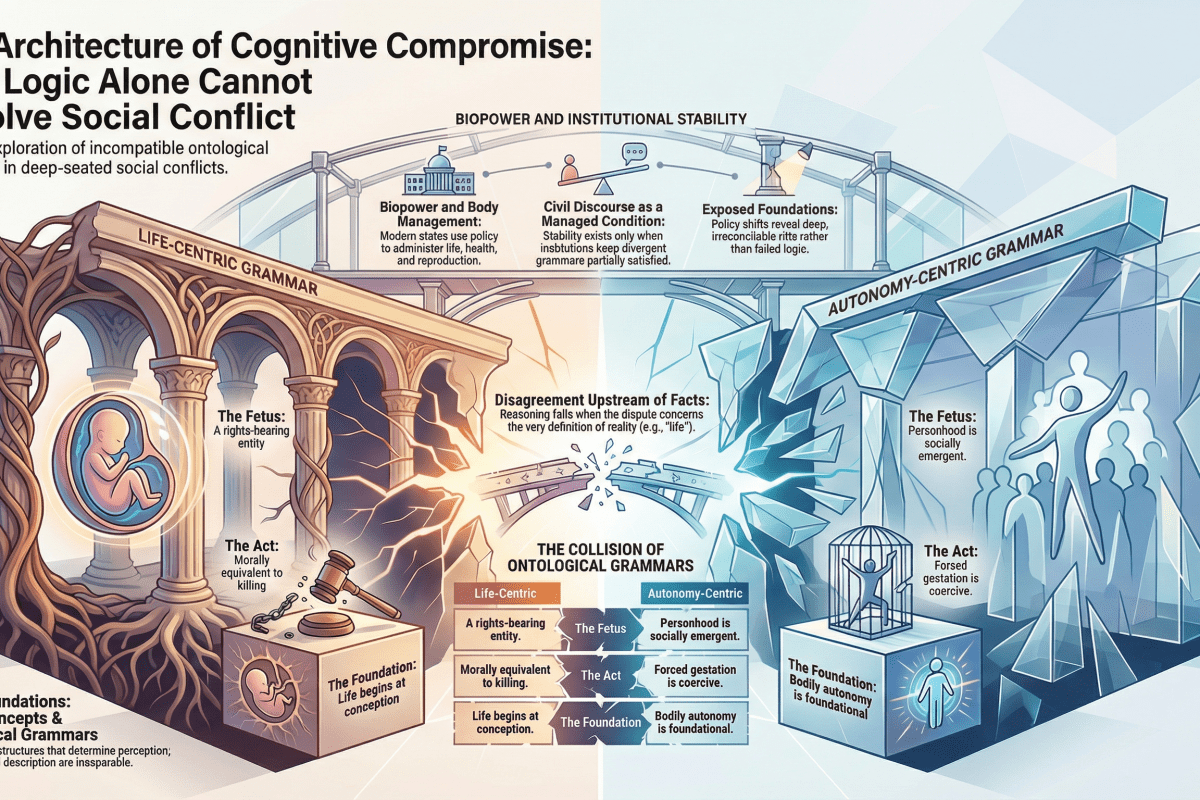
This is why calls to “focus on the facts” miss the point. Facts do not adjudicate between ontologies. They merely instantiate them. If agency itself is suspect, arguments for retribution do not fail empirically. They fail upstream. They become non sequiturs.

This is also why Marx remains unforgivable to some.
“From each according to his ability, to each according to his need” isn’t a policy tweak. It presupposes a different moral universe. No amount of clarification will make it palatable to someone operating in a merit-desert ontology.

The uncomfortable conclusion

The problem is not that we use contested terms. We cannot avoid them.

The problem is assuming they behave like tables.

Retributive justice survives not because it is inevitable, but because its supporting terms are treated as settled when they are anything but. Each card looks sturdy in isolation. Together, they form a structure that only stands if you agree not to pull too hard.

LIH doesn’t tell you which ontology to adopt.

It tells you why the argument never ends.

And why, if someone insists the issue is “just semantic”, they’re either confused—or holding the deck.