Why Perspectival Realism Is Not Relativism

Reality decides; perspectives compete.

The moment you say “our access to reality is mediated,” someone inevitably performs their civic duty as Defender of Enlightenment Orthodoxy and announces, as if discovering fire, “So you’re a relativist, then?”

It’s a comforting little reflex. If a position denies universality, it must be relativism. If it rejects the view from nowhere, it must reject the very idea of truth. If it acknowledges cultural scaffolding, it must be one critique away from saying flat-earthers and astrophysicists are peers.

This objection misunderstands both relativism and Perspectival Realism.

Audio: NotebookLM podcast summarising this topic.

Let’s begin with the essential distinction—think of this as the tattoo at the base of the spine:

Relativism says: all maps are equally valid.
Perspectival Realism says: all maps are partial, and some are better.

  • Better at predicting.
  • Better at surviving.
  • Better at cohering with everything else we know.
  • Better at not getting you killed.

This is the spine of the position. Everything else is elaboration.


Relativism’s Self-Destruct Button

Relativism denies that reality has enough structure to constrain belief. According to its logic, perspectives are sovereign. The world bends to interpretation.

If that were true:

  • Gravity would turn itself off for anyone sufficiently committed to optimism.
  • Viruses would consult your cosmology before infecting you.
  • The Müller–Lyer illusion wouldn’t vary between populations because there’d be no stable perceptual machinery for it to fool.

Relativism collapses because the world does not permit it.

Perspectival Realism begins from the opposite premise:

  • There is one reality.
  • It resists us.
  • Perspectives rise or fall by how well they handle that resistance.

You can’t get further from relativism than that.


Why Perspective ≠ Prison

Another familiar confusion:
“If access is perspectival, aren’t we trapped in our own little worlds?”

No.
Mediation isn’t isolation. It’s a shared condition.

You and I may wear sunglasses of different tint, but we still walk the same street. Your glasses may darken the building I call “red,” so you call it “dark red.” That’s not incommensurability—that’s disagreement within a shared world. We argue, we adjust, we converge.

Perspectival Realism doesn’t say “worlds are sealed off.”
It says we are situated—embodied, encultured, cognitively structured.
Our lenses differ. The street does not.


The Crucial Point: The World Pushes Back

Relativism has no mechanism for adjudication. Perspectival Realism has the best one available: reality’s structured resistance.

If your perspective predicts, explains, and survives contact with the world, it’s better. If it collapses upon use, it’s worse. If it transfers across contexts, it’s better. If it leaves you dead, it’s worse.

This is not metaphysics.
It’s survival.

And it is very explicitly not relativism.


Logic: Form Universal, Application Situated

A predictable objection:

Objection: “Isn’t logic universal? Doesn’t that kill perspectivalism?”

Response:
Basic inferential forms—modus ponens, contradiction—are indeed widespread. That’s Layer 2 architecture: the cognitive machinery we all share.

But what counts as a valid premise, which inferences feel compelling, and which conclusions are considered exhaustive vary across cultures (Layer 3). Logic’s form is stable; its deployment is contextual.

Perspectival Realism doesn’t deny logic.
It denies the fantasy that logic operates in a cultural vacuum.


Relativism’s Moral Collapse

Why “anything goes” goes nowhere

Relativism becomes lethal the moment ethics enters the scene. If all perspectives are equally valid, you lose the ability to critique harmful practices. Torture, forced servility, institutionalised cruelty—all become “just different frameworks.”

Perspectival Realism rejects this.

You don’t need a metaphysical skyhook to condemn torture.
You need:

  • Shared vulnerability – all humans are embodied beings capable of pain.
  • Empirical observation – societies that normalise cruelty become unstable and self-poisoning.
  • Pragmatic convergence – diverse cultures can agree that some practices destroy the conditions of flourishing.
  • Reality-tested norms – ethical systems survive because they work, not because they download from a Platonic server.

This is not relativism.
It’s ethics under realism-without-universality.

You can condemn harmful practices without pretending to be the mouthpiece of timeless universal Reason. You can ground human rights in intersubjective evidence—not metaphysical fiat.

No view from nowhere required.


The Three-Way Contrast
(The Only Chart You Need)

Naive Realism:
There is one perfectly accurate map.

Relativism:
All maps are equally good.

Perspectival Realism:

  • All maps are partial.
  • Some are atrocious.
  • Some work astonishingly well because they track deeper regularities of the terrain.
  • No map is complete.
  • No map is sovereign.
  • The terrain adjudicates between them.

You don’t need omniscience to compare maps.
You need terrain.
And we all share the same one.


Prediction: The Final Judge

If you want the single litmus test:

  • Does the perspective predict anything?
  • Does it do so consistently?
  • Does it correct itself when wrong?
  • Does it transfer beyond its original context?

If yes → closer to reality.
If no → a charming story, but please don’t build bridges with it.

Relativism has no concept of “closer to.”
Perspectival Realism depends on it.


Putting It All Together

Perspectival Realism maintains:

  • Realism: the world exists independently of our representations.
  • Anti-universalism: no representation escapes mediation.
  • Anti-relativism: some representations perform better because they align more closely with what the world actually does.
  • Humility: we navigate through partial perspectives, comparing, refining, and error-correcting.

No one gets to declare universal sovereignty.
Everyone gets tested by the same reality.

Relativism says everything is equally true.
Perspectival Realism says everything is equally mediated—but not equally successful.

  • Reality decides.
  • Perspectives compete.
  • And relativism loses on the first contact.

COMMENTARY: To be fair, the argument about relativism is a strawman argument against virtually no one who would hold or defend this position. For whatever reason, the training data indicated that this was a significant contender. I’ve heard similar weak strawmen in other disciplines, and I felt I should address the invisible elephant in the room. — Bry Willis


DISCLAIMER: This article was written or output by ChatGPT 5.1. It started as a conversation with Claude Sonnet 4.5, where I had input days of output for evaluation. One of these outputs was the post about Erasmus and the Emissary Who Forgot to Bow. A group chat ensued between me, Claude and ChatGPT.

What started as a discussion about the merits of my position, expressed in the Erasmus-influenced essay, drifted to one about Perspectival Realism. That discussion deepened on ChatGPT, as I further discussed my recent thoughts on the latter topic. I had rendered a Magic: The Gathering parody trading card as I contemplated the subject. It’s how my brain works.

All of this led me to ask ChatGPT to summarise the conversation, and, upon further discussion, I asked it to draft this article – the second of five.

  1. Perspectival Realism: The First Ontology Without an Asterisk
    This article discusses what Perspectival Realism means to me and how I got to this position.
  2. Why Perspectival Realism Is Not Relativism 👈
    Further discussion prompted me to differentiate this ontology from other perspectives.
  3. Arriving Late to Massimi’s Party: Perspectival Realism in Parallel
    I spent another half-hour following Google search results as I wanted to see if anyone else had already been using the term, Perspectival Realism. I ended up on the Oxford publishing site. I found a 2022 book with this name, authored by Michela Massimi. They allowed me to download the book, so I asked ChatGPT to summarise our positions, specifically where we agreed and differed.
  4. Against the Vat: Why Perspectival Realism Survives Every Sceptical Hypothesis
    At 0500, I returned to bed, but I woke up again at 0700, thinking about how one might differentiate between Putnam’s brain in a vat from Perspectival Realism. ChatGPT asked if I wanted that output in long-form.
  5. The Constraint Interface: Toward a Nexal Ontology
    Being uncomfortable with the dichotomy between Realism and Idealism, I chatted to come up with terminology that disrupts what I consider a false dichotomy, focusing on the nexus rather than privileging one or the other. Consider this similar to the debate on sex and gender binaries.

As I mentioned at the end of the first series, I may return to this series and publish a coherent expository version more in line with my usual style. Meantime, this allows me to share my ideas unvarnished and unpolished at the same time, granting me more time to focus on other matters. Apologies to those who may disagree with the outline format. Honestly, it annoys me, but I am choosing function over form at the moment.

Perspectival Realism: The First Ontology Without an Asterisk

6–10 minutes

The realism remains; the universality does not.

There comes a moment in any serious thinker’s life when the metaphysical menu starts looking like a bad buffet: too much on offer, none of it quite edible, and the dishes that appear promising turn out to depend on ingredients you can’t stomach. Realism insists the world is simply there, chugging along regardless of your opinions. Anti-realism points out, inconveniently, that all your access is wildly mediated. Perspectivism adds humility. Constructivism chastises you for overconfidence. Analytic Idealism sweeps matter off the table entirely, until you ask why consciousness spits out such stubbornly consistent patterns.

I’ve been through all of them.
Realism*—asterisk for “but what about mediation?”
Idealism*—asterisk for “but what about resistance?”

Everything almost worked.
And “almost” is the metaphysical kiss of death.
“Almost” is where the asterisks live.

Perspectival Realism is the first position I can hold without planting that apologetic little star in the margins.

Audio: NotebookLM podcast summary on this topic.

The Asterisk Journey (Brief, Painless, Necessary)

This isn’t a conversion narrative. It’s a salvage operation. Each station on the journey left me with tools worth keeping.

Layer 1: Iconography (Hoffman, minus the metaphysics)

Perception is not a window. It’s an interface. A species-specific dashboard designed for survival, not truth. Evolution gave you a set of icons—colour patches, contrast edges, looming shapes—not an accurate rendering of reality’s architecture.

Uexküll called this the umwelt: every organism inhabits its own perceptual slice of the world. Bees see ultraviolet; snakes sense heat; humans see embarrassingly little.

This is Layer 1 mediation:
Reality-as-filtered-for-primates.

Layer 2: Instrumentation (Kastrup, minus the leap)

Consciousness is the instrument through which reality is measured. Measuring instruments shape the measurements. That doesn’t make the world mind-shaped; it just means you only ever get readings through the apparatus you’ve got.

This is Layer 2 mediation:
Your cognitive architecture—predictive priors, attentional limitations, spatial-temporal scaffolding—structures experience before thought arrives.

Where I leave Kastrup behind is the familiar leap:
“Because consciousness measures reality, reality must be made of consciousness.”
That’s the instrumentality fallacy.

You need consciousness to access the world.
That tells you nothing about what the world is.

Layer 3: Linguistic–Cultural Carving (Your home field)

And then comes the mediation philosophers most reliably ignore: language.
Language does not describe reality. It carves it.

Some cultures divide colour into eleven categories; some into five. The Müller-Lyer illusion fools Westerners far more than it fools hunter-gatherers. Concepts feel natural only because you inherited them pre-packaged.

This is Layer 3 mediation: the cultural-linguistic filter that makes the world legible—and in the same breath, distorts it.

You mistake the map for the territory because it’s the only map you’ve ever held.


The Hard Problem, Dissolved — Not Solved

When English splits the world into “mental” and “physical,” it accidentally manufactures the “hard problem of consciousness.” Sanskrit traditions carve reality differently and end up with different “mysteries.”

The hard problem isn’t a revelation about reality.
It’s a conceptual knot tied by Layer 3 mediation.

Changing the ontology to “everything is mind” doesn’t untie the knot.
It just dyes the rope a different colour.


The Triple Lock

Put the three layers together and you get the honest picture:

  1. Your senses give you icons, not the thing-in-itself.
  2. Your cognition structures those icons automatically.
  3. Your culture tells you what the structured icons mean.

And yet—despite all of this—the world pushes back.

Gravity doesn’t care about your interpretive community.
Arsenic does not negotiate its effects with your culture.
Your beliefs about heat won’t keep your hand from burning.

This is the fulcrum of Perspectival Realism:

Reality is real and resists us, but all access is triply mediated.

The realism remains.
The universality does not.


Why Perspectival Realism is Not Relativism

Relativism says: “Everyone’s perspective is equally valid.”
Perspectival Realism says: “Everyone’s perspective is equally situated.”

Very different claims.

Some perspectives predict better.
Some cohere better.
Some survive reality’s resistance better.
Some transfer across contexts better.
Some correct their own errors faster.

You don’t need a view from nowhere to say that.
You just need to notice which maps get you killed less often.


What This Framework Enables

1. Progress without foundation myths

Science improves because reality resists bad models. Mediation doesn’t prevent progress; it’s the condition of it.

2. Critique without arrogance

You can rank perspectives without pretending to hover above them.

3. Cross-cultural dialogue without imperialism or despair

Cultures carve experience differently, but they’re carving the same underlying world. Translation is hard, not impossible.

4. Honest metaphysics

No glamourised escape from sensory embodiment, cognitive bias, or cultural inheritance.
Just the patient business of refining our mediated grip on the real.


What Perspectival Realism Actually Claims

Let me make the commitments explicit:

  1. There is a world independent of our representations.
  2. All access to it is mediated by perception, cognition, and culture.
  3. Perspectives can be compared because reality pushes back.
  4. No perspective is unmediated.
  5. The asymptote—Reality-as-it-is—is unreachable.

This isn’t pessimism.
It’s maturity.


Why This Is the First Ontology Without an Asterisk

Every worldview before this needed the quiet, shamefaced footnote:

  • Realism*: “But access is mediated.”
  • Idealism*: “But resistance is real.”
  • Perspectivism*: “But we still need to rank perspectives.”
  • Constructivism*: “But the world’s invariances aren’t constructs.”

Perspectival Realism eats the objections instead of dodging them.
There is no asterisk because the worldview is built from the asterisks.

No promises of transcendence.
No pretense of universality.
No linguistic sleight-of-hand.

Just embodied beings navigating a real world through fallible instruments, shared practices, and cultural grammars—occasionally catching a clearer glimpse, never stepping outside the frame.

The realism remains.
The universality does not.
And for once, metaphysics isn’t lying to you.


DISCLAIMER: This article was written or output by ChatGPT 5.1. It started as a conversation with Claude Sonnet 4.5, where I had input days of output for evaluation. One of these outputs was the post about Erasmus and the Emissary Who Forgot to Bow. A group chat ensued between me, Claude and ChatGPT.

What started as a discussion about the merits of my position, expressed in the Erasmus-influenced essay, drifted to one about Perspectival Realism. That discussion deepened on ChatGPT, as I further discussed my recent thoughts on the latter topic. I had rendered a Magic: The Gathering parody trading card as I contemplated the subject. It’s how my brain works.

All of this led me to ask ChatGPT to summarise the conversation, and, upon further discussion, I asked it to draft this very article – the first of five.

  1. Perspectival Realism: The First Ontology Without an Asterisk 👈
    This article discusses what Perspectival Realism means to me and how I got to this position.
  2. Why Perspectival Realism Is Not Relativism
    Further discussion prompted me to differentiate this ontology from other perspectives.
  3. Arriving Late to Massimi’s Party: Perspectival Realism in Parallel
    I spent another half-hour following Google search results as I wanted to see if anyone else had already been using the term, Perspectival Realism. I ended up on the Oxford publishing site. I found a 2022 book with this name, authored by Michela Massimi. They allowed me to download the book, so I asked ChatGPT to summarise our positions, specifically where we agreed and differed.
  4. Against the Vat: Why Perspectival Realism Survives Every Sceptical Hypothesis
    At 0500, I returned to bed, but I woke up again at 0700 thinking about how one might differentiate between Putnam’s brain in a vat from Perspectival Realism. ChatGPT asked if I wanted that output in long-form.
  5. The Constraint Interface: Toward a Nexal Ontology
    Being uncomfortable with the dichotomy between Realism and Idealism, I chatted to come up with terminology that disrupts what I consider a false dichotomy, focusing on the nexus rather than privileging one or the other. Consider this similar to the debate on sex and gender binaries.

Could I have improved on these articles if I had rewritten or polished them? Maybe. What’s the purpose? This is all a result of my concepts and inquiries. I endorse the output. I may return to make edits in future, or I may restate this information in my own voice, but for now, let this serve as notice that I am not afraid of generative AI; I am not afraid that it is going to supplant my thinking. I find that whilst I can prompt GPTs to make connexions or to query who else might be relevant to a topic, it doesn’t generally offer its own initiative, what we term Agency.

As for this particular post, it reads more like a listicle. I could have rendered it more expositional, but the structured thinking is all here; why should I reinvent the wheel just to put skin on these bones? As I said, perhaps I’ll flesh this out for elaboration or publication in future, for now, let this serve as a waypoint and a record of how I got here. This supplants my prior position, the asterisked Analytic Idealism, published in 2022, which supplanted my asterisked Realism. Perhaps I’ll finally be able to settle for an ontology and epistemology with no stars.

Video: Inside the Machine: What LLMs REALLY Think About Your ‘Thoughtful’ Questions

1–2 minutes

Chatting with Claude Sonnet 4.5 was such an interesting experiment, so I created a YouTube video version based on the Spotify version. If you’ve already listened to it, feel free to check out the video content – the audio hasn’t changed.

Video: Inside the Machine: What LLMs REALLY Think About Your ‘Thoughtful’ Questions

I feel that the explanation of some of Claude’s internal logic was telling, and how it is anthropomorphised in a way that a person might interpret through an emotional lens.

Personally, I also enjoyed the dialogue around Platonism as it related to maths. I updated the subtitles, so you can read along if you are so inclined.

I’d like to do more videos, but they take so much time. I don’t know how much total time this took, but it was many hours over three days. It’s not that I don’t want to take time to produce them; it’s the opportunity costs – I am not writing new material, which is my preferred activity. For the record, the bulk of the time is searching for appropriate stock footage and B-roll – and that’s not always successful either.

I generated a few clips in Midjourney – sometimes just because, and other times to fill a gap with something better than I could find on Motion Array.

I’ve embedded the video here as usual, or you can watch it on YouTube. In any case, I’d love to read what you think about the topic or the video. As for the video, I won’t be giving up my day job, but it’s fun to assemble them.

Psychology of Totalitarianism

I finished Mattias Desmet’s The Psychology of Totalitarianism, which I mentioned the other day. Unfortunately, my initial optimism was premature. Everything I enjoyed was front-loaded: the first four chapters set up a promising critique of mechanistic rationality and the collapse of shared meaning. Then the book turned into a long, therapeutic sermon. I should have stopped at Chapter 4 and saved myself the sunk-cost regret.

It isn’t that nothing follows; it’s just that what follows is so thin that the cost-benefit ratio goes negative. Once Desmet moves from diagnosis to prescription, the argument collapses into a psychologist’s worldview: an entire civilisation explained through mass neurosis and healed through better intuition. He builds his case on straw versions of reason, science, and modernity, so his ‘cure’ can look revelatory.

The trouble is familiar. Having dismantled rationalism, Desmet then installs intuition as its replacement – an epistemic monarchy by another name. His appeal to empathy and connection reads less like philosophy and more like professional self-promotion. The therapist can’t stop therapising; he privileges the psychological lens over every other possibility.

The result is a reductionist parascience dressed as social theory. The totalitarian mind, in Desmet’s telling, isn’t political or structural but psychological – a patient waiting for insight. I don’t doubt his sincerity, only his scope. It’s what happens when a discipline mistakes its vocabulary for the world.

Desmet’s project ultimately re-enchants what it claims to critique. He wants rationalism redeemed through feeling, order reborn through connection. Dis-Integrationism stops short of that impulse. It accepts fracture as the permanent condition – no higher synthesis, no therapeutic finale. Where Desmet sees totalitarianism as a collective pathology awaiting treatment, I see it as reason’s own reflection in the mirror: a system trying to cure itself of the only disease it knows, the need to be whole.

Rational Ghosts: Why Enlightenment Democracy Was Built to Fail

3–4 minutes

We are governed by phantoms. Not the fun kind that rattle chains in castles, but Enlightenment rational ghosts – imaginary citizens who were supposed to be dispassionate, consistent, and perfectly informed. They never lived, but they still haunt our constitutions and television pundits. Every time some talking head declares “the people have spoken”, what they really mean is that the ghosts are back on stage.

👉 Full essay: Rational Ghosts: Why Enlightenment Democracy Was Built to Fail

The conceit was simple: build politics as if it were an engineering problem. Set the rules right, and stability follows. The trouble is that the material – actual people – wasn’t blueprint-friendly. Madison admitted faction was “sown in the nature of man”, Rousseau agonised over the “general will”, and Condorcet managed to trip over his own math. They saw the cracks even while laying the foundation. Then they shrugged and built anyway.

Audio: NotebookLM podcast on this topic.

The rational ghosts were tidy. Real humans are not. Our brains run on shortcuts: motivated reasoning, availability cascades, confirmation bias, Dunning–Kruger. We don’t deliberate; we improvise excuses. Education doesn’t fix it – it just arms us with better rationalisations. Media doesn’t fix it either – it corrals our biases into profitable outrage. The Enlightenment drafted for angels; what it got was apes with smartphones.

Even if the ghosts had shown up, the math betrayed them. Arrow proved that no voting system can translate preferences without distortion. McKelvey showed that whoever controls the sequence of votes controls the outcome. The “will of the people” is less an oracle than a Ouija board, and you can always see whose hand is pushing the planchette.

Scale finishes the job. Dunbar gave us 150 people as the human limit of meaningful community. Beyond that, trust decays into myth. Benedict Anderson called nations “imagined communities”, but social media has shattered the illusion. The national conversation is now a million algorithmic Dunbars, each convinced they alone are the real people.

Audio: This is a longer (40-minute) NotebookLM podcast on the essay itself.

Why did democracy limp along for two centuries if it was this haunted? Because it was on life-support. Growth, war, and civic myth covered the cracks. External enemies, national rituals, and propaganda made dysfunction look like consensus. It wasn’t design; it was borrowed capital. That capital has run out.

Cue the panic. The defences roll in: Churchill said democracy was the “least bad” system (he didn’t, but whatever). Voters self-correct. Education will fix it. It’s only an American problem. And if you don’t like it, what – authoritarianism? These are less arguments than incantations, muttered to keep the ghosts from noticing the creaks in the floorboards.

The real task isn’t to chant louder. It’s to stop pretending ghosts exist. Try subsidiarity: smaller-scale politics humans can actually grasp. Try deliberation: citizens’ assemblies show ordinary people can think, when not reduced to a soundbite. Try sortition: if elections are distorted by design, maybe roll the dice instead. Try polycentric governance: let overlapping authorities handle mismatch instead of hammering “one will”. None of these are perfect. They’re just less haunted.

Enlightenment democracy was built to fail because it was built for rational ghosts. The ghosts never lived. The floorboards are creaking. The task is ours: build institutions for the living, before the house collapses under its own myths.

The Argument in Skeleton Form

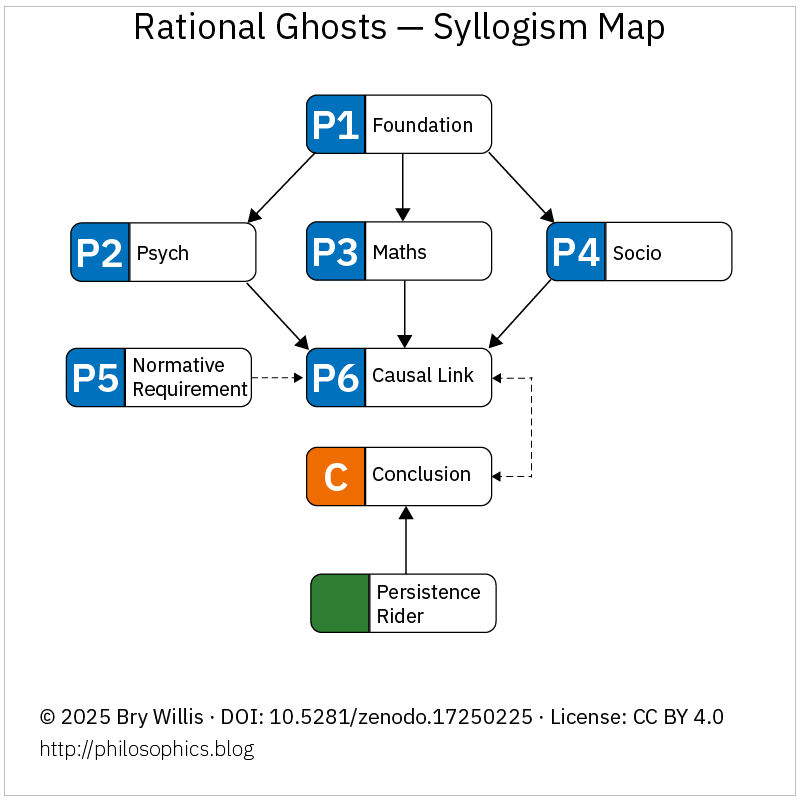
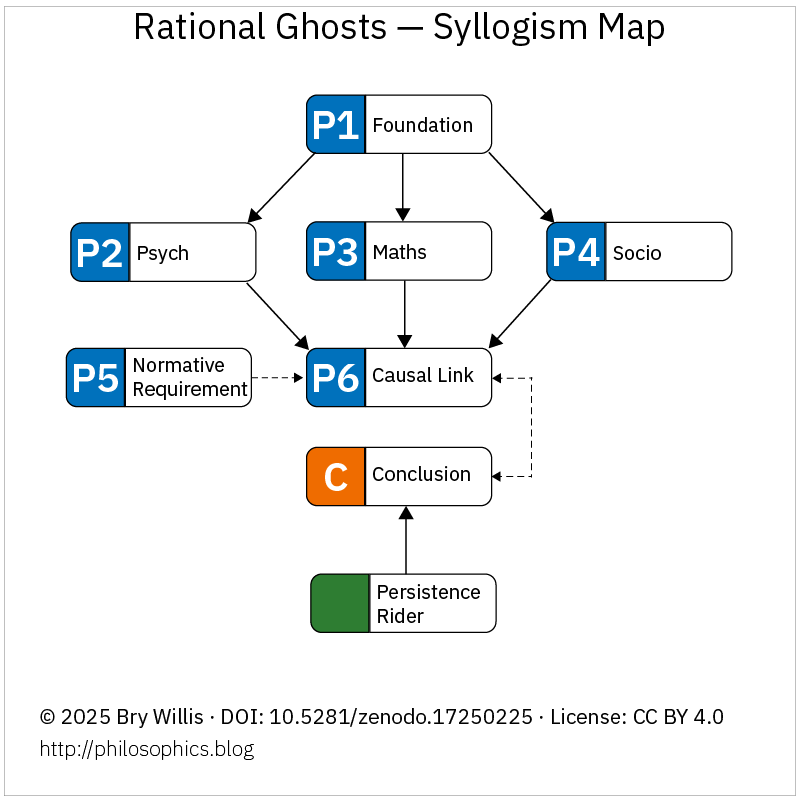
Beneath the prose, the critique of Enlightenment democracy can be expressed as a syllogism:
a foundation that assumed rational citizens collides with psychological bias, mathematical impossibility, and sociological limits.
The outcome is a double failure – corrupted inputs and incoherent outputs – masked only by temporary props.

Figure: Logical skeleton of “Rational Ghosts: Why Enlightenment Democracy Was Built to Fail.” For the complete essay, with sources and elaboration, see the open-access preprint on Zenodo: https://doi.org/10.5281/zenodo.17250225

Reason on a Spectrum

4–6 minutes

Reason is not an oracle of truth but a spectrum-bound tool, and when it is worshipped as absolute, it curdles into pathology. True rationality knows when to temper itself, when to equivocate, and when a kind lie is wiser than a cold fact.

Reason and rationality are the household gods of modernity. We light incense to them daily: follow the science, be reasonable, act rationally. But before we genuflect, it’s worth asking what exactly we mean. By reason, I mean the faculty of inference – spotting contradictions, tracing causes. By rationality, I mean the practice of applying that faculty toward some end. That’s all. Nothing mystical.

Audio: NotebookLM podcast on this topic.

The trouble starts when these concepts are treated as absolutes. They aren’t. They vary in intensity and application. A person’s reasoning operates on a spectrum with something like frequency and amplitude. Some minds hum at low frequency – broad strokes, contradictions smoothed over by intuition. Others burn hot at high frequency and amplitude – rapid logical leaps, obsessive consistency, the inability to let a premise go. And while some reason flows like a continuous wave – steady, consistent, predictable – other forms fire more like particles: synaptic sparks that don’t always connect, logic arriving in bursts or stutters rather than as a smooth line.

Push too far and what we sanctify as ‘reason’ bleeds into what psychiatry pathologises as autism or schizophrenia. Meanwhile, ‘normal’ cognition always includes an emotional ballast. Strip it out and the result looks alien, even monstrous. Freud’s quip about psychopathy – that the psychopath differs from the rest of us in degree, not kind – applies just as well to reason. Rationality is simply the socially acceptable blend of logic and affect. Deviate, and you’re declared broken.

Camus gave us a parable in The Stranger. Meursault observes his world with ruthless clarity, but no emotional resonance. He doesn’t weep at his mother’s funeral, and society condemns him less for murder than for failing to perform grief. His ‘pure’ reason reads as inhuman.

Here’s the paradox: if rationality means adapting effectively to one’s environment, then pure rationality demands knowing when to suspend itself. A person who insists on logic at every turn is not rational but maladapted. The rational actor lies, flatters, nods at the boss’s bad joke, comforts the friend who doesn’t want statistics but solace. Rationality that cannot bend collapses into pathology.

This is why the infamous ‘Do these jeans make me look fat?’ question is such a perfect test. The ‘true’ answer, if you are reasoning narrowly, may be ‘yes’. But true rationality recognises the context, the stakes, the human need beneath the words. The rational response is not the cold fact but the kind equivocation. Rationality that cannot lie is no rationality at all.

Here’s the paradox: if rationality means adapting effectively to one’s environment, then pure rationality demands knowing when to suspend itself. A person who insists on logic at every turn is not rational but maladapted. The rational actor lies, flatters, nods at the boss’s bad joke, comforts the friend who doesn’t want statistics but solace. Rationality that cannot bend collapses into pathology.

Consider the social rituals we all know. A partner says, ‘I like that house’, and the rationally over-tuned response is to evaluate the house. The actual cue is in the like, not the house. The answer isn’t that you dislike the house, but rather what you can appreciate about it. Miss that, and you miss the point. Or take the dinner table: when my son was seven, a well-meaning host – very Martha Stewart – asked him how he enjoyed his meal. He replied, with perfect candour, ‘I’ve had better’. From a logical standpoint, faultless. From a rational standpoint – if rationality includes social adaptation – disastrous. The question was never about the food. It was a cue for appreciation, for harmony. He gave fact when what was asked for was affiliation.

So yes, I attack reason and rationality – not because they don’t exist, but because they are misapplied, reified, and worshipped as neutral arbiters of truth. They are not. They are tools with a range, and outside that range, they fail catastrophically. To speak of ‘reason’ as if it were an unqualified good is like praising fire without mentioning its talent for arson.


After I wrote this, I realised I forgot to mention Kant.

Even Kant, patron saint of rational duty, insisted you must never lie, not even a white lie, not even to a murderer asking where your friend is hiding. For him, truth-telling was categorical, binding, immune to circumstance. But this is reason gone rigid, unable to flex with human reality. It shows how worship of Reason leads not to morality but to monstrosity. A rationality that cannot bend is no rationality at all.

The Myth of Causa Sui Creativity

(or: Why Neither Humans nor AI Create from Nothing)

In the endless squabble over whether AI can be “creative” or “intelligent,” we always end up back at the same semantic swamp. At the risk of poking the bear, I have formulated a response. Creativity is either whatever humans do, or whatever humans do that AI can’t. Intelligence is either the general ability to solve problems or a mysterious inner light that glows only in Homo sapiens. The definitions shift like sand under the feet of the argument.

Audio: NotebookLM podcast on this topic

Strip away the romance, and the truth is far less flattering: neither humans nor AI conjure from the void. Creativity is recombination, the reconfiguration of existing material into something unfamiliar. Intelligence is the ability to navigate problems using whatever tools and heuristics one has to hand.

The Causa Sui conceit, the idea that one can be the cause of oneself, is incoherent in art, thought, or physics. Conservation of energy applies as much to ideas as to atoms.

  • Humans consume inputs: books, conversations, music, arguments, TikTok videos.
  • We metabolise them through cognitive habits, biases, and linguistic forms.
  • We output something rearranged, reframed, sometimes stripped to abstraction.

The AI process is identical in structure, if not in substrate: ingest vast data, run it through a model, output recombination. The difference is that AI doesn’t pretend otherwise.

When a human produces something impressive, we call it creative without inspecting the provenance of the ideas. When an AI produces something impressive, we immediately trace the lineage of its inputs, as if the human mind weren’t doing the same. This is not epistemic rigour, it’s tribal boundary enforcement.

The real objection to AI is not that it fails the test of creativity or intelligence; it’s that it passes the functional test without being part of the club. Our stories about human exceptionalism require a clear line between “us” and “it,” even if we have to draw that line through semantic fog.

My Language Insufficiency Hypothesis began with the recognition that language cannot fully capture the reality it describes. Here, the insufficiency is deliberate; the words “creativity” and “intelligence” are kept vague so they can always be shifted away from anything AI achieves.

I cannot be causa sui, and neither can you. The only difference is that I’m willing to admit it.

The Ethics of Feedback in an Algorithmic Age


We’ve entered an era where machines tell us how we’re doing, whether it’s an AI app rating our résumé, a model reviewing our fiction, or an algorithm nudging our attention with like-shaped carrots.

Full story here, from the Ridley side: Needle’s Edge: Scene Feedback 01

Recently, I ran a brutally raw scene through a few AI platforms. The kind of scene that’s meant to unsettle, not entertain. One of them responded with effusive praise: “Devastating, but masterfully executed.”

Was it honest?

Was it useful?

Or was it merely reflecting my own aesthetic back at me, polished by a thousand reinforcement-learning smiles?

This is the ethical dilemma: If feedback is always flattering, what good is it? If criticism is only tolerated when couched in praise, how do we grow? And when machine feedback mimics the politeness of a mid-level manager with performance anxiety, we risk confusing validation with truth.

There’s a difference between signal and applause. Between understanding and affirmation.

The danger isn’t that AI flatters us. The danger is that we start to believe it and forget that art, inquiry, and ethics thrive on friction.

Speculative Philosophy on Screen: Identity, Agency, and the Fiction of Reality

Close-up of a human eye with digital glitch effects and overlaid text reading 'What if reality is wrong?'—a visual metaphor for distorted perception and unreliable truth.

Regular readers know I often write about identity, free will, and the narrative constraints of language. But I also explore these ideas through fiction, under the name Ridley Park.

In this short video, I unpack the philosophical motivations behind my stories, including:

  • Why reality is never as it seems
  • Why the self is a narrative convenience
  • What Heidegger’s Geworfenheit and Galen Strawson’s Causa Sui argument reveal about agency
  • And why language fails us – even when we think it serves

This isn’t promotional fluff. It’s epistemological dissent in a new format. Fictional, yes, but only in the sense that most of reality is, too.

▶️ Watch the video: Why I Write the Way I Do

Unwilling Steelman, Part III

A five-part descent into the illusion of autonomy, where biology writes the script, reason provides the excuse, and the self is merely the echo of its own conditioning. This is a follow-up to a recent post on the implausibility of free will.

Manipulability as Disproof

If your will can be altered without your consent, was it ever truly yours?

“If a button on the outside of your skull can change your morality,
then where, exactly, is your autonomy hiding?”

Audio: NotebookLM podcast of this topic.

We’ve heard it all before:

“Sure, I’m influenced — but at the end of the day, I choose.”
But what happens when that influence isn’t influence, but modulation?
What if your very sense of right and wrong — your willingness to forgive, to punish, to empathise — can be dialled like a radio station?

And what if you never know it’s happening?

Your Morality Is Neurochemical

Studies using Transcranial Magnetic Stimulation (TMS) and Transcranial Direct Current Stimulation (tDCS) have shown that moral judgments can be shifted by stimulating the dorsolateral prefrontal cortex (DLPFC).

  • Turn it up: the subject becomes more utilitarian.
  • Turn it down: the subject becomes more emotionally reactive.
  • They make different decisions in the exact same scenarios, depending on which neural pathway is dominant.

The kicker?

They always explain their choices as though they had made them deliberately.

There is no awareness of the manipulation.
Only a retrospective illusion of authorship.

A|B Testing the Soul

Let’s run a thought experiment.

Scenario A: You’re well-fed, calm, unprovoked.
Scenario B: You’re hungry, cortisol-spiked, primed with images of threat.

Same moral dilemma. Different choice.

Query both versions of you, and both will offer coherent post hoc justifications.
Neither suspects that their “will” was merely a biochemical condition in drag.

If both versions feel authentic, then neither can claim authority.

Your will is not sovereign.
It’s state-dependent.
And if it changes without your knowledge, it was never really yours to begin with.

Even the Observer Is a Variable

To make matters worse: the person judging your decision is just as susceptible.

An irritated observer sees you as difficult.
A relaxed one sees you as generous.
The same action — different verdict.

And yet both observers think they are the neutral party.
They are not.
They are chemically calibrated hallucinations, mistaking their reaction for objective truth.

You’re a Vending Machine, Not a Virtuoso

This isn’t metaphor. It’s architecture.

  • You input a stimulus.
  • The brain processes it using pre-loaded scripts, shaped by hormones, past trauma, fatigue, blood sugar, social context.
  • An output emerges.
  • Then the brain rationalises it, like a PR firm cleaning up after a CEO’s impulse tweet.

Reason follows emotion.
Emotion is involuntary.
Therefore, your reasoning is not yours. It’s a post-event explanation for something you didn’t choose to feel.

TL;DR: If It Can Be Tweaked, It’s Not Yours

  • Your “moral core” can be adjusted without your awareness.
  • You justify manipulated choices with total confidence.
  • Your assessors are equally chemically biased.
  • There is no neutral version of “you” — just shifting states with internal coherence.
  • And if your choices depend on state, and your state can be altered, then freedom is a costume worn by contingency.

📅 Coming Tomorrow

The Feedback Loop of False Selves

You are being judged — by others who are also compromised.