2025 has been a good year for this blog. I’ve crossed the 1,000-post mark, and this year it has had over 30,000 page views – best year ever. This month was the best month ever, and 1st December was the most popular day ever. That’s a lot of ‘evers’.
I shared the remainder of this post on my Ridley Park fiction blog – same reader, same books, same opinion. Any new content added below is in red.
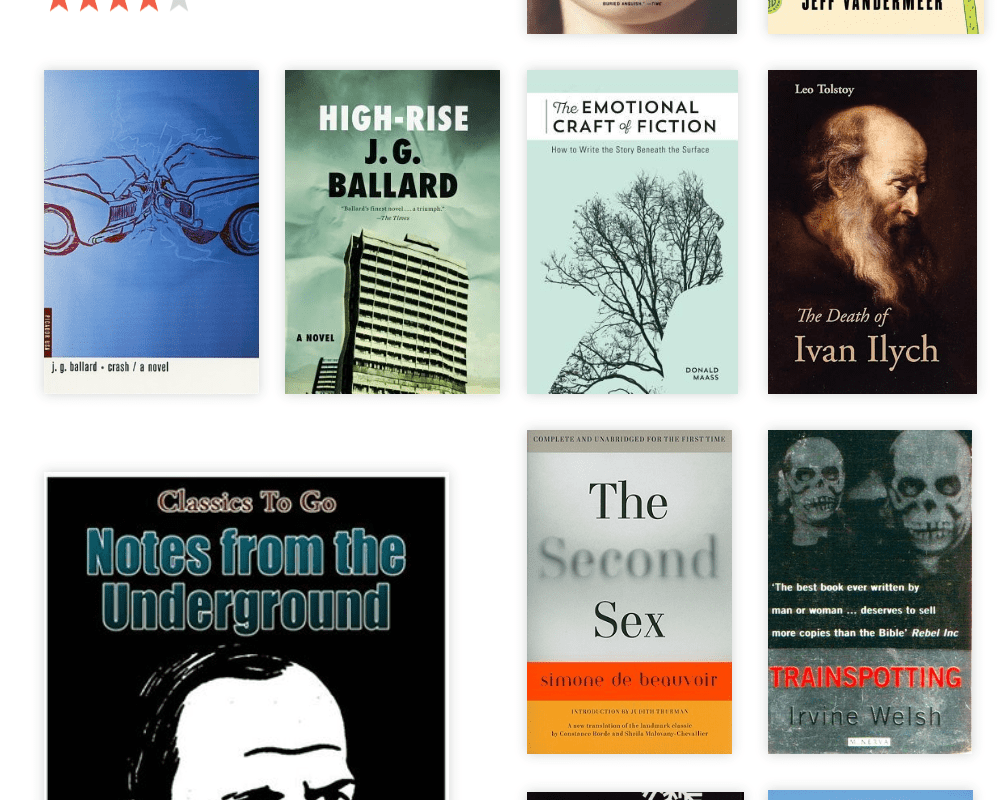
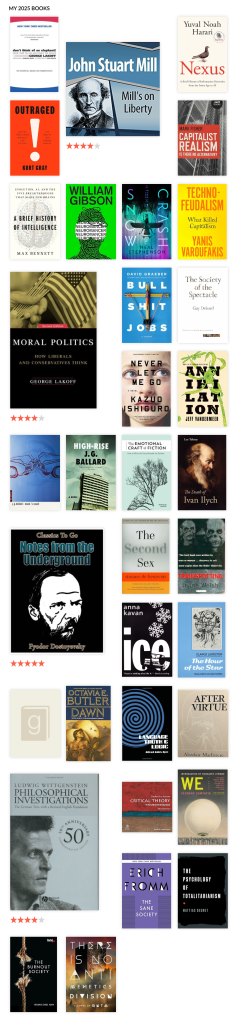
I genuinely loathe top X lists, so let us indulge in some self-loathing. I finished these books in 2026. As you can see, they cross genres, consist of fiction and non-fiction, and don’t even share temporal space. I admit that I’m a diverse reader and, ostensibly, writer. Instead of just the top 5. I’ll shoot for the top and bottom 5 to capture my anti-recommendations. Within categories are alphabetical.
Fiction
Never Let Me Go by Kazuo Ishiguro – A slow reveal about identity, but worth the wait.
This was very philosophical and psychological. Nothing appeared to happen until chapter 7, as I recall. I felt like I was just eavesdropping on some school chums, which I was. Then came the big reveal.
Notes from Underground by Fyodor Dostoevsky – Classic unreliable narrator.
Again, philosophical, psychological. I liked it.
There Is No Antimemetics Division by QNTM (AKA Sam Hughes) – Points for daring to be different and hitting the landing.
This, I read because I was attracted to the premise of memory as it might affect language. It touched on this a tad, but it was mostly about memory, anti-memory, and constructed selves. How can one experience a contiguous, diachronic self with memory gaps? It never quite got that deep, that on occasion it did, as far as I recall.
Trainspotting by Irvine Welsh – Scottish drugs culture and bonding mates narrative.
This is an age-old cult classic – much better than the already excellent films. Fills in what the film cut for its medium. I read several other Welsh books. Filth was an honourable mention, which I also made connexions to Antimemetics, above.
We by Yevgeny Zamyatin – In the league of 1984 and Brave New World, but without the acclaim.
This flagged a tad at the end, but it was prescient and released in 1922, decades before 1984 and Brave New World. Worth the read.
Nonfiction
Capitalist Realism by Mark Fisher – Explains why most problems are social, not personal or psychological. Follows Erich Fromm’s Sane Society, which I also read in 2025 and liked, but it fell into the ‘lost the trail’ territory at some point, so it fell off the list.
Moral Politics by George Lakoff
Evidently, I forgot to explain myself in my prior post. I refer to this book and its trade counterpart, Don’t Think of an Elephant, which is more of a political polemic, but still worth the read. It’s also shorter. This is about Moral politics – duh! – but it’s about moral language. It was a precursor to Jonathan Haidt’s The Righteous Mind: Why Good People Are Divided by Politics and Religion or Kurt Gray’s Outraged! I found Haidt’s work interesting but reductive; I found Gray’s work merely reductive.
This said, Lakoff and Haidt were the vector through which I came upon my language ontology theory that further confounds language insufficiency. To be sure, Haidt was an unnecessary point, but it did emphasise it. Haidt’s frameworks also give me something to riff on.
Technofeudalism by Yanis Varoufakis – Explains why Capitalism is already dead on arrival.
Nothing much to add here. Technofeudalism is economic fare, albeit with philosophical implications. I enjoyed it. Yanis is also an interesting speaker.
NB: Some of the other books had great pieces of content, but failed as books. They may have been better as essays or blog posts. They didn’t have enough material for a full book. The Second Sex had enough for a book, but then Beauvoir poured in enough for two books. She should have quit whilst she was ahead.
Image: Books I read in 2025 on Goodreads. Full disclosure: I don’t always record my reading on Goodreads, but I try.
Bottom of the Barrel
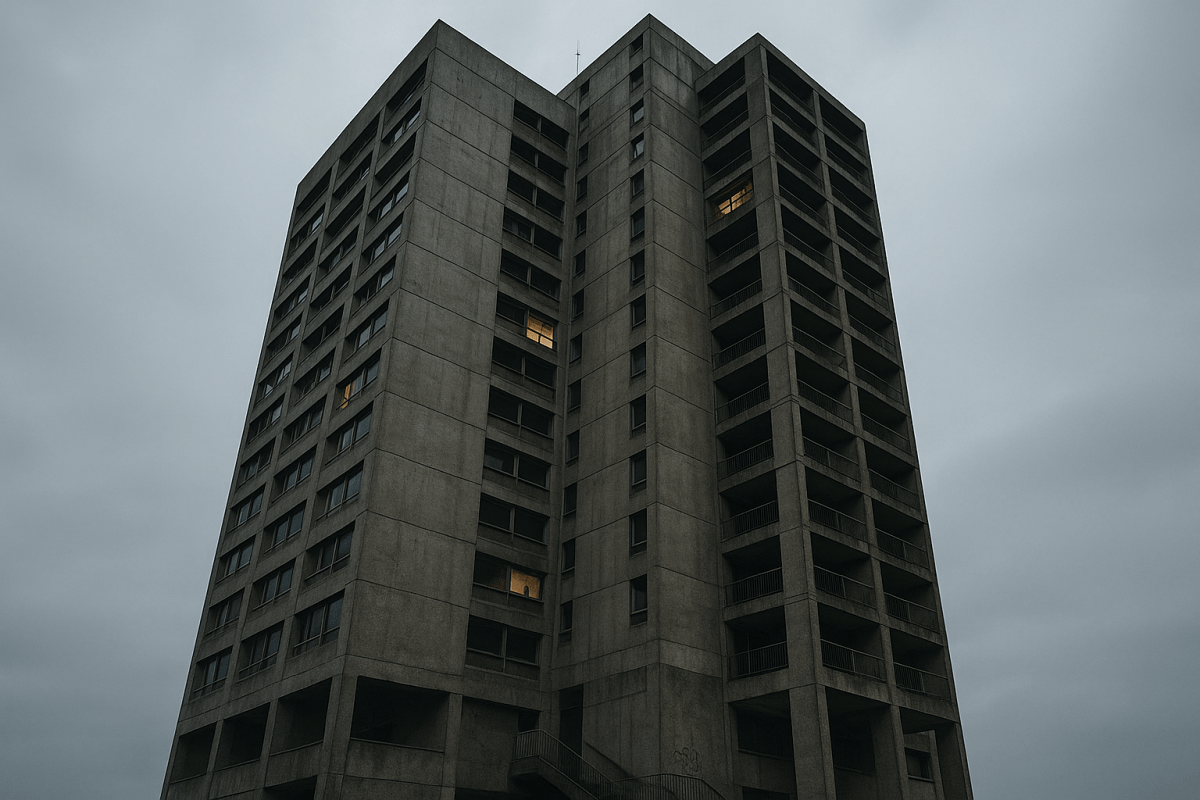
Crash by J.G. Ballard – Hard no. I also didn’t like High-rise, but it was marginally better, and I didn’t want to count an author twice.
Nah. I felt he was trying to hard for shock value. It didn’t shock, but it put me off. At least High-rise represented an absurd cultural microcosm. I just wanted the story to be over. Luckily, I read both of these sequentially whilst on holiday, so I wasn’t looking to ingest anything serious.
Neuromancer by William Gibson – I don’t tend to like SciFi. This is a classic. Maybe it read differently back in the day. Didn’t age well.
Nexus by Yuval Harari – Drivel. My mates goaded me into reading this. I liked Sapiens. He’s gone downhill since then. He’s a historian, not a futurist.
Outraged! by Kurt Gray – Very reductionist view of moral harm, following the footsteps of George Lakoff and Jonathan Haidt.
See comments above. ☝️
Society of the Spectacle by Guy Debord – A cautionary tale on why writing a book on LSD may not be a recipe for success.
Honourable Mention
Annihilation by Jeff VanderMeer was also good, but my cutoff was at 5. Sorry, Jeff.
I did like this, and it was much better than the Natalie Portman film adaptation. This is the first book in a trilogy. I absolutely hated the second instalment. The third was not as good as the first, but it tried to get back on track from the derailment of the second. As I wrote in public reviews, the second book could have been a prologue chapter to the third book with all of the relevant information I cared about. You could skip the second story with almost no material effect on the story or character arcs.
My colleague of several decades recently published a book titled Why Democrats Are Dangerous. Drew and I have long held opposing but genuinely respectful views on the political economy, a fact that once felt like a quaint relic of an earlier civic age. As we are both authors, he proposed that we exchange titles and review each other’s work. I demurred. One can often discern the contents of a book from its cover, and this one announced itself with all the subtlety of a campaign leaflet left in the rain. I am not allergic to polemic – heaven knows I have written my share – but some energies telegraph their intentions too cleanly. This one did.
Having now read the book, my hesitation appears justified. The project is less an argument than a catechism, less analysis than incantation. It is earnest, certainly; it is also tightly scripted by a worldview that permits only one conclusion, however much data must be dragged across broken glass to reach it.
Audio: NotebookLM summary podcast on this topic.
Rather than provide a review in the conventional sense – line-by-line rebuttal, forensic counter-examples, polite throat-clearing – I have chosen a different approach. I intend to reconstruct, or more precisely dis-integrate, the book through several strands of my own work. Not because my work is above reproach, but because it offers a conceptual toolkit for understanding how such texts arise, how they persuade, and how they hold themselves together despite their internal tension. This also has the ancillary benefit of allowing me to abridge my commentary: where a full exegesis would sprawl, I can gesture toward an existing essay or argument. I’ll dispense with addressing Drew by name, preferring to remain more neutral going forward.
A Note on My Position (So No One Misreads My Motives)
Before proceeding, a brief clarification. I do not belong to either of America’s warring political tribes, nor do I subscribe to their underlying ideological architectures. My critique is not an act of partisan reprisal; it is not a defence of Democrats, nor a veiled endorsement of Republicans. The Red–Blue cosmology bores me senseless. It is a quarrel between two anachronistic Enlightenment-era faith traditions, each convinced of its moral superiority and each engaged in the same ritualised dance of blame, projection, and existential theatre.
My vantage point, such as it is, sits outside that binary. This affords me a certain privilege – not superiority, merely distance. I do not have a factional identity to defend, no emotional investment in preserving the moral innocence of one side or the other. I am therefore free to examine the structure of my colleague’s argument without the usual tribal pressures to retaliate in kind.
This criticism is not a counter-polemic. It is an analysis of a worldview, not a combatant in its quarrel. If my tone occasionally cuts, it cuts from the outside, not across partisan lines. The book is not wrong because it is Republican; it is wrong because its epistemology is brittle, its categories incoherent, and its confidence unearned. The same critique would apply – indeed does apply – to the Democratic mirrors of this worldview.
My loyalty is not to a party but to a method: Dis-Integration, analysis, and the slow, patient unravelling of certainty.
The Architecture of Certainty
What strikes one first in Why Democrats Are Dangerous is not the argument but the architecture – an edifice built on the most cherished Enlightenment fantasy of all: that one’s own position is not a perspective but the Truth. Everything else cascades from this initial presumption. Once a worldview grants itself the status of a natural law, dissent becomes pathology, disagreement becomes malice, and the opposition becomes a civilisation-threatening contagion.
My colleague’s book is a textbook case of this structure. It is not an analysis of political actors within a shared world; it is a morality play in which one faction is composed entirely of vices, and the other entirely of virtues. The Democrats are ‘Ignorant, Unrealistic, Deceitful, Ruthless, Unaccountable, Strategic‘, a hexagon of sin so geometrically perfect it would make Aquinas blush. Republicans, by contrast, drift serenely through the text untouched by human flaw, except insofar as they suffer nobly under the weight of their opponents’ manipulations.
This is not political argumentation. This is cosmogony.
This, of course, is where my Anti-Enlightenment work becomes diagnostic. The Enlightenment promised universality and rational clarity, yet modern political identities behave more like hermetic cults, generating self-sealing narratives immune to external correction. A worldview built upon presumed objectivity must resolve any contradiction by externalising it onto the Other. Thus, the opposition becomes omnipotent when things go wrong (‘They control the media, the schools, the scientists, the public imagination‘) and simultaneously infantile when the narrative requires ridicule.
It is the oldest structural paradox in the political mind: the Other is both incompetent and dangerously powerful. This book embodies that paradox without blinking.
The Invention of the Enemy
One must admire, in a bleak sort of way, the structural efficiency of designating half the electorate as a monolithic existential threat. It creates an elegant moral shortcut: no need to consider policies, contexts, or material conditions when the adversary is already pre-condemned as treacherous by nature. Cicero, Trotsky, Hitler, and Franklin are all conscripted in this text to warn us about the insidious Democrats lurking in the marrow of the Republic. (Trotsky, one suspects, would be moderately surprised to find himself enlisted in a Republican devotional.)
This enemy-construction is not unique to this author. It is the rhetorical engine of American factionalism, and it is recursive: each side claims the other is rewriting history, weaponising institutions, manipulating education, promoting propaganda, dismantling norms, silencing dissent, and indoctrinating children. Both factions accuse the other of abandoning civility whilst abandoning civility in the act of accusation.
To put it bluntly: every single charge in this book is mirrored in Republican behaviour, sometimes identically, often more flamboyantly. But this symmetry is invisible from inside a moralised epistemology. Identity precedes evidence, so evidence is always retrofitted to identity.
This is why the polemic feels airtight: it evaluates Democrats not as agents within a system but as an essence. There is no theory of politics here – only demonology.
The Recursive Machine: When a Worldview Becomes Its Own Evidence
One of the most revealing features of Why Democrats Are Dangerous is its recursive structure. It operates exactly like the political systems it condemns: it constructs a closed epistemic loop, then mistakes that loop for a window onto reality.
The book does not discover Democratic perfidy; it presupposes it. Every subsequent claim merely elaborates upon the initial axiom. Schools, entertainment, academia, immigration, science, journalism, unions, and the weather – each is absorbed into a single explanatory schema. Once the premise is fixed (‘Democrats are dangerous‘), the world obligingly reshapes itself to confirm the conclusion, as long as one ignores anything that does not.
This is the dynamic I describe as the ‘Republic of Recursive Prophecy‘: someone begins with The Answer, and reality is forced to comply. If the facts fail to align, the facts are treacherous. If evidence contradicts the narrative, then evidence has been corrupted.
It is a worldview that behaves not like political analysis but like physics in a collapsing star: everything, no matter how diffuse, is pulled into the gravity well of a single, preordained truth.
The Projection Engine
If the book has a leitmotif, it is projection – unconscious, unexamined, and relentless. It is astonishing how thoroughly the author attributes to Democrats every pathology that characterises contemporary Republican strategy.
Propagandistic messaging; emotional manipulation; selective framing; redefinition of language; strategic use of fear; demonisation of opponents; declaring media sources illegitimate; claiming institutional persecution; insisting the other party rigs elections; portraying one’s own supporters as the ‘real victims’ of history – each of these is performed daily in Republican media ecosystems with operatic flourish. Yet the book can only see these behaviours ‘over there’, because its epistemic frame cannot accommodate the possibility that political identity – its own included – is capable of self-interest, distortion, or error.
This is the Enlightenment inheritance at its worst: the belief that one’s own faction merely ‘perceives the truth’, whilst the other faction ‘manufactures narratives’. What the author calls ‘truth’ is simply the preferred filter for sorting complexity into moral certainty. Once the filter is treated as reality itself, all behaviour from one’s own side becomes necessity, principle, or justice – whilst identical behaviour from the opposing faction becomes malevolence.
The Neutral Observer Who Isn’t
What the book never acknowledges – because it cannot – is that it speaks from a position, not from an Archimedean vantage point. The author stands in a thickly mediated environment of conservative talk radio, Republican think-tank literature, right-leaning commentary, and decades of ideological reinforcement. His acknowledgements read less like a bibliography than like an apprenticeship in a particular canon.
This does not make him wrong by default. It simply means he is positioned. And politics is always positional.
The Enlightenment fiction of the ‘view from nowhere‘ collapses once one notices that claims of objectivity always align with the claimant’s own tribe. If Republicans declare their view neutral and Democrats ideological, it is never because a metaphysical referee has blown a whistle confirming the call. It is because each faction treats its own frames as unmediated reality.
In truth, the book reveals far more about the epistemology of modern conservatism than about Democrats themselves.
The Fictional Symmetry Problem
One of the major deficiencies in the book – and in most modern political commentary – is the inability to perceive symmetry. The behaviours the author attributes exclusively to Democrats are, in every meaningful sense, bipartisan human defaults. Both factions manipulate language; curate narratives; cherry-pick evidence; denounce the other’s missteps as civilisational sabotage; outsource blame; elevate victimhood when convenient; and perform certainty whilst drowning in uncertainty.
The book pretends these behaviours describe a pathological left-wing mind, rather than the political mind as such.
This is not a Democratic problem; it is a deeply human one. But Enlightenment-styled partisan thinking requires the illusion of asymmetry. Without it, the argument collapses instantly. If Republicans admit that they exhibit the same cognitive patterns they condemn in Democrats, the entire dramatic arc falls flat. The villain must be uniquely wicked. The hero must be uniquely virtuous. The stage requires a clean antagonism, or the story becomes unstageable.
Narrative Weaponry
Perhaps the most revealing feature of this book is its reliance on anecdotes as foundational evidence. One school incident here, one speech clip there, one news headline in passing – and suddenly these isolated fragments become proof of a sweeping, coordinated ideological conspiracy across all levels of society.
We no longer use stories to illustrate positions; we use them to manufacture reality. One viral video becomes a trend; one rogue teacher, an educational takeover; one questionable policy rollout, the death of democracy.
Stories become ontological weapons: they shape what exists simply by being repeated with enough moral pressure. Political tribes treat them as talismans, small narrative objects with outsized metaphysical weight.
MEOW (the Mediated Encounter Ontology of the World) was designed in part to resist this temptation. It reminds us that events are not symptoms of a singular will but the turbulent output of innumerable interacting mediations. The worldview on display in this book requires villains, where a relational ontology recognises only networks.
The Missing Category: Structural Analysis
Perhaps the most conspicuous absence in the book is any substantive socio-economic analysis. Everything is attributed to malice, not structure. Democratic failures become signs of moral rot, never the predictable outcome of late-stage capitalism, globalisation’s uneven effects, austerity cycles, demographic shifts, institutional brittleness, bureaucratic inertia, political economy incentives, or the informational fragmentation of the digital age.
None of these appear anywhere in the text. Not once.
Because the book is not analysing policy; it’s diagnosing sin. It treats political outcomes as evidence of coordinated malevolence, never as the emergent result of complex systems that no faction fully understands, let alone controls.
This is where Dis-Integration is useful: the world does not malfunction because some cabal introduced impurity; it malfunctions because it was never integrated in the first place. My colleague is still hunting for the traitor inside the castle. The more sobering truth is that the castle is an architectural hallucination.
Where He Is Not Wrong
Lest this devolve into pure vivisection, it is worth acknowledging that my colleague does brush against legitimate concerns. There are structural issues in American education. There are ideological currents in universities, some of which drift into intellectual monoculture. There are media ecosystems that reinforce themselves through feedback loops. There are public-health missteps that deserve scrutiny. There are institutional actors who prefer narratives to nuance.
But these are not partisan phenomena; they are structural ones. They are not symptoms of Democratic corruption; they are symptoms of the modern polity. When the author grasps these truths, he does so only long enough to weaponise them – not to understand them.
The Danger of Certainty
What lingers after reading Why Democrats Are Dangerous is not outrage – though one suspects that was the intended emotional temperature – but a kind of intellectual melancholy. The book is not the product of a malevolent mind; it is the product of a sealed one. A worldview so thoroughly fortified by decades of ideological reinforcement that no countervailing fact, no structural nuance, no complexity of human motivation can penetrate its perimeter.
The author believes he is diagnosing a civilisation in decline; what he has actually documented is the failure of a particular Enlightenment inheritance: the belief that one’s own view is unmediated, unfiltered, unshaped by social, linguistic, and cognitive forces. The belief that Reason – capital R – is a neutral instrument one simply points at the world, like a laser level, to determine what is ‘really happening’.
The Enlightenment imagined that clarity was accessible, that moral alignment was obvious, that rational actors behaved rationally, that categories reflected reality, and that the world could be divided into the virtuous and the dissolute. This book is the direct descendant of that fantasy.
It takes an entire half of the population and casts them as an essence. It arranges anecdotes into inevitability. It pathologises disagreement. It treats institutions as coherent conspiratorial actors. It transforms political opponents into ontological threats. And it performs all of this with the serene confidence of someone who believes he is simply ‘telling it like it is’.
The irony is almost tender.
Because the danger here is not Democrats. Nor Republicans. Nor necessarily even the political class as a whole. The real danger is certainty without introspection: the comfort of moral binaries; the seduction of explanatory simplicity; the refusal to acknowledge one’s own mediation; the urge to reduce a complex, multi-layered, semi-chaotic polity into a single morality narrative.
My friend did not discover the truth about Democrats. He discovered the architecture of his own worldview – and mistook the one for the other.
If we must be afraid of something, let it be worldviews that cannot see themselves.
Read next:The Republic of Recursive Prophecy – an earlier piece that charts how political worldviews become self-reinforcing myth-machines.
I finished Mattias Desmet’s The Psychology of Totalitarianism, which I mentioned the other day. Unfortunately, my initial optimism was premature. Everything I enjoyed was front-loaded: the first four chapters set up a promising critique of mechanistic rationality and the collapse of shared meaning. Then the book turned into a long, therapeutic sermon. I should have stopped at Chapter 4 and saved myself the sunk-cost regret.
It isn’t that nothing follows; it’s just that what follows is so thin that the cost-benefit ratio goes negative. Once Desmet moves from diagnosis to prescription, the argument collapses into a psychologist’s worldview: an entire civilisation explained through mass neurosis and healed through better intuition. He builds his case on straw versions of reason, science, and modernity, so his ‘cure’ can look revelatory.
The trouble is familiar. Having dismantled rationalism, Desmet then installs intuition as its replacement – an epistemic monarchy by another name. His appeal to empathy and connection reads less like philosophy and more like professional self-promotion. The therapist can’t stop therapising; he privileges the psychological lens over every other possibility.
The result is a reductionist parascience dressed as social theory. The totalitarian mind, in Desmet’s telling, isn’t political or structural but psychological – a patient waiting for insight. I don’t doubt his sincerity, only his scope. It’s what happens when a discipline mistakes its vocabulary for the world.
Desmet’s project ultimately re-enchants what it claims to critique. He wants rationalism redeemed through feeling, order reborn through connection. Dis-Integrationism stops short of that impulse. It accepts fracture as the permanent condition – no higher synthesis, no therapeutic finale. Where Desmet sees totalitarianism as a collective pathology awaiting treatment, I see it as reason’s own reflection in the mirror: a system trying to cure itself of the only disease it knows, the need to be whole.
The core of this book consists of six “books” of aphorisms, each book comprising a single page, totalling 24 in all.
Why only 24 pages?
Couldn’t this have been a blog post? An email?
Fair enough, and yes, of course it could have. It could have been six – three sheets, front and back – but I wanted to share in the tradition of the Communist Manifesto by Karl Marx and Friedrich Engels, as well as Thomas Paine’s Common Sense. The content is not similar, but the format is shared.
Honestly, I printed a draft copy for myself on A4 paper, folded it to A5, and stapled it at the spine with a long stapler – sans a fancy cover. Perhaps, I’ll share the source PDF in future.
As I’ve written elsewhere, I was inspired by the aphorisms of Nietzsche, Schopenhauer, Pascale, Debord, and others. To be fair, I disliked Debord’s The Society of the Spectacle, but I was still inspired by it for the two or three things I got from it – each of which slips my mind as I write this.
Why a Companion Guide?
Twenty-four pages – really, only six that matter; why would someone want that?
You got me there, too. No, so Notes Before Existence is not a casual read. It’s logical and coherent, but it’s not standard exposition. It’s meant as a thinking tool. Also, the ideas are supported by those who came before me – Newton’s ‘standing on the shoulders of giants’ quip pertains.
The main body of the book comprises the same six books as Notes Before Existence, each printed on its own verso, opposite a recto page for personal annotation.
Whilst Meditations on Nothing: A Critical Companion does provide supporting context for Notes Before Existence, it doesn’t fully break it down. I expect to provide this context in a more comprehensive volume, both online and offline, primarily on this platform and on YouTube.
I Wonder what’s Next?
I’m putting the final touches on my next project. The Illusion of Light: Thinking after the Enlightenment is a sort of capstone to my Anti-Enlightenment Project. It provides context around this project as well as details about the underlying essays available on Zenodo at no cost.
And so it goes…
What I really came here for is to share the reason this book was hung up in queue. On the surface, everything checked. I uploaded the source files, entered the required metadata, and chose appropriate price points – which, for the record, is $4.99 USD for Notes*.
Other Prices as of 16/10/25
UK: £3.99
EU: €4.99 (except Belgium, €4.39)
Canada: $6.99 (CAD)
Australia: $10.99
Japan: ¥1000
As it turns out, this publishing business is data-driven, and some of the systems and validation rules, let’s say, are remnants of the 1970s. Some companies are better than others, but in the US, Bowker controls the ISBN numbers. The US is one – if not the only – of the countries to charge for these identifiers, because: Capitalism. Unfortunately, the printers need to access Bowker’s antiquated system to validate the pairing of the ISBN and the publishing organisation.
I publish under Microglyphics, an entity through which I published my first book in 2001. In 2025, I started using Philosophics Press as an imprint for philosophy materials. This created a snag. I had entered Philosophics Press, but it was expecting Microglyphics – even though I’d used Philosophics Press previously. Unfortunately, the error was not thrown on the page where this information had been entered and validated – that was passed – but on the last page, I was informed that something was wrong on that page.
In any case, after a couple of days of trying, I updated the Bowker record (just to be sure) and eventually entered Microglyphics. Voilà. It worked.
Since then, I’ve also secured a second printer and distributor, IngramSpark, so I’m interested to discover what they’re like.
I’ve been working through the opening chapters of Octavia Butler’s Dawn. At one point, the alien Jdahya tells Lilith, “We watched you commit mass suicide.”*
The line unsettles not because of the apocalypse itself, but because of what it presumes: that “humanity” acted as one, as if billions of disparate lives could be collapsed into a single decision. A few pulled triggers, a few applauded, some resisted despite the odds, and most simply endured. From the alien vantage, nuance vanishes. A species is judged by its outcome, not by the uneven distribution of responsibility that produced it.
This is hardly foreign to us. Nationalism thrives on the same flattening. We won the war. We lost the match. A handful act; the many claim the glory or swallow the shame by association. Sartre takes it further with his “no excuses” dictum, even to do nothing is to choose. Howard Zinn’s “You can’t remain neutral on a moving train” makes the same move, cloaked in the borrowed authority of physics. Yet relativity undermines it: on the train, you are still; on the ground, you are moving. Whether neutrality is possible depends entirely on your frame of reference.
What all these formulations share is a kind of metaphysical inflation. “Agency” is treated as a universal essence, something evenly spread across the human condition. But in practice, it is anything but. Most people are not shaping history; they are being dragged along by it.
One might sketch the orientations toward the collective “apple cart” like this:
Tippers with a vision: the revolutionaries, ideologues, or would-be prophets who claim to know how the cart should be overturned.
Sycophants: clinging to the side, riding the momentum of others’ power, hoping for crumbs.
Egoists: indifferent to the cart’s fate, focused on personal comfort, advantage, or escape.
Stabilisers: most people, clinging to the cart as it wobbles, preferring continuity to upheaval.
Survivors: those who endure, waiting out storms, not out of “agency” but necessity.
The Stabilisers and Survivors blur into the same crowd, the former still half-convinced their vote between arsenic and cyanide matters, the latter no longer believing the story at all. They resemble Seligman’s shocked dogs, conditioned to sit through pain because movement feels futile.
And so “humanity” never truly acts as one. Agency is uneven, fragile, and often absent. Yet whether in Sartre’s philosophy, Zinn’s slogans, or Jdahya’s extraterrestrial indictment, the temptation is always to collapse plurality into a single will; you chose this, all of you. It is neat, rhetorically satisfying, and yet wrong.
Perhaps Butler’s aliens, clinical in their judgment, are simply holding up a mirror to the fictions we already tell about ourselves.
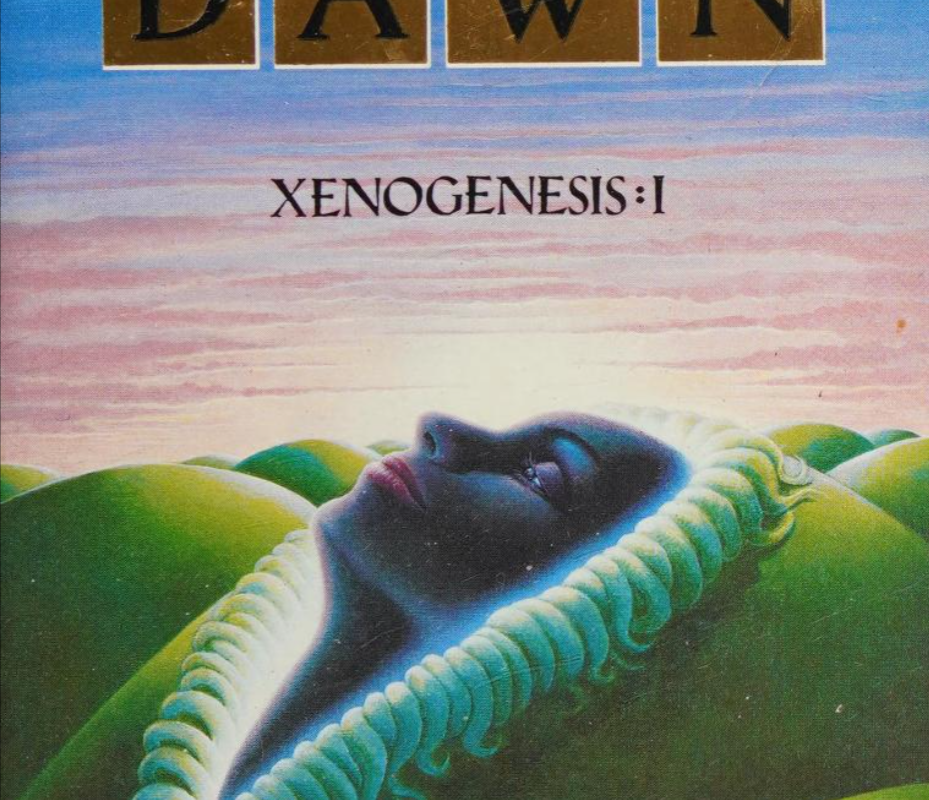
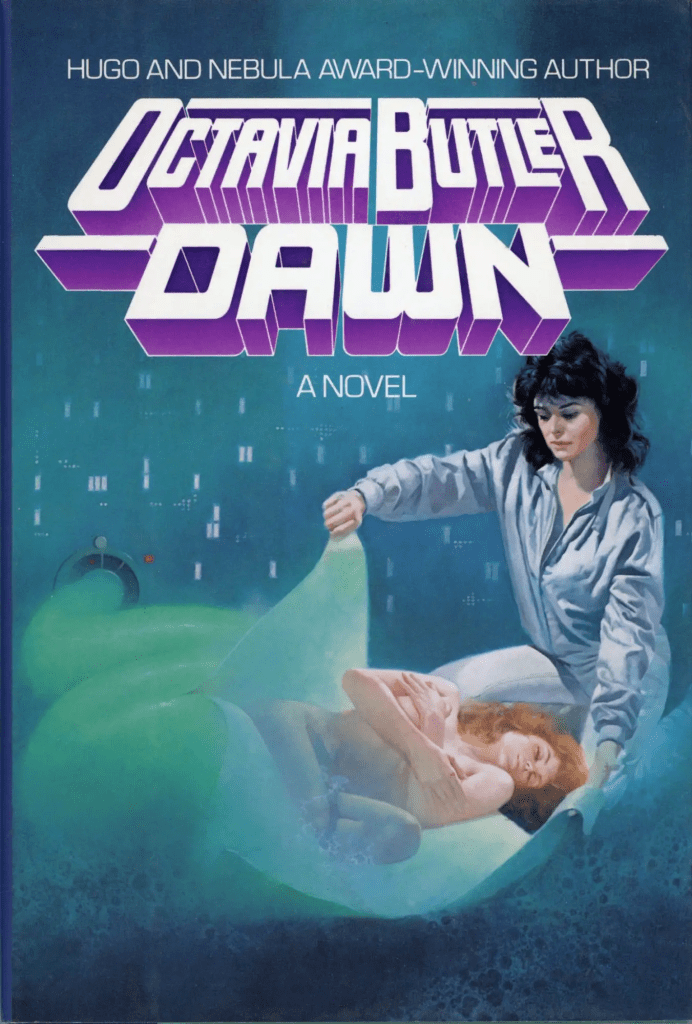
As an aside, this version of the book cover is risible. Not to devolve into identity politics, but Lilith is a dark-skinned woman, not a pale ginger. I can only assume that some target science fiction readers have a propensity to prefer white, sapphic adjacent characters.
I won’t even comment further on the faux 3D title treatment, relic of 1980s marketing.
* Spoiler Alert: As this statement about mass suicide is a Chapter 2 event, I am not inclined to consider it a spoiler. False alarm.
On 7–8 September 2025, the Kindle version of my Ridley Park novella Sustenance will be available free to everyone on Amazon. (It’s always free if you’re a KindleUnlimited member, but these two days open it up to all readers.)
It’s a novella that begins with the dust and grit of rural Iowa – soybean fields, rusted trucks, a small town where everyone knows your name (and your secrets). At first glance, it reads like plainspoken realism, narrated by a local mechanic who insists he’s just a “regular guy.” But then the ground literally shifts. A crash. Figures glimpsed by firelight in the woods. Naked, violet-skinned beings who don’t laugh, don’t sleep, don’t even breathe.
What follows is not your usual alien-invasion story. It’s quieter, stranger, and more unsettling. The encounters with the visitors aren’t about lasers or spaceships – they’re about language, culture, and the limits of human understanding. What happens when concepts like property, law, or even woman and man don’t translate? What does it mean when intimacy itself becomes a site of misunderstanding?
Sustenance is for readers who:
Gravitate toward literary fiction with a speculative edge rather than straight genre beats
Appreciate the mix of the banal and the uncanny – the smell of corn dust giving way to the shock of alien otherness
Are interested in themes of language, power, misunderstanding, and human self-deception
Enjoy writers like Jeff VanderMeer, Margaret Atwood, Octavia Butler, or Denis Johnson – voices that blur realism, philosophy, and estrangement
This isn’t a story that offers tidy answers. It lingers, provokes, and resists easy moral closure. Think of it less as a sci-fi romp and more as a philosophical fable wrapped in small-town dust and cicada-song.
This version of the book is available in these Kindle storefronts: United States, United Kingdom, Germany, France, Spain, Italy, Netherlands, Japan, Brazil, Canada, Mexico, Australia, and India
📚 Grab your free Kindle copy on 7–8 September 2025
Why a Free Copy of Sustenance?
I made this Kindle version available for free to get some reviews. This promotion is all or nothing, so take advantage of the opportunity. If you want to leave a review, please do.
“Man is least himself when he talks in his own person. Give him a mask, and he will tell you the truth.” — Oscar Wilde
Identity is an illusion—but a necessary one. It’s a shortcut. A heuristic, evolved not for truth but for coherence. We reduce ourselves and others to fixed traits to preserve continuity—psychological, social, narrative.
Audio: NotebookLM podcast on this topic. (Spotify)
But what if continuity is a lie?
In the latest post on RidleyPark.blog, we meet Sarah—a woman who survives by splintering. She has three names, three selves, three economies of interaction. Each persona—Sarah, Stacey, and Pink—fulfils a role. Each protects her in a system that punishes complexity.
And yet, this isn’t fiction. It’s reality intensified.
Identity Is Compression
Cognitive science suggests that we don’t possess a self—we perform one. Our so-called identity is assembled post-hoc from memory, context, and social cues. It’s recursive. It’s inferred.
We are not indivisible atoms of identity. We are bundled routines, personae adapted to setting and audience.
This is not pathology. It’s strategy.
From Performance to Survival
In Needle’s Edge, Sarah doesn’t use aliases to deceive. She uses them to survive contradictions:
Stacey is desirable, stable, and profitable—so long as she appears clean and composed.
Pink is a consumer, invisible, stripped of glamour but allowed access to the block.
Sarah is the residue, the name used by those who once knew her—or still believe they do.
Each persona comes with scripts, limitations, and permissions. Sarah isn’t being dishonest. She’s practicing domain-specific identity. This is no different from how professionals code-switch at work, or how people self-edit on social media.
It’s just more raw. More urgent. Less optional.
The Literary Echo
In character development, we often demand “depth,” by which we mean contradiction. We want to see a character laugh and break. Love and lie. But Sarah shows us that contradiction isn’t depth—it’s baseline reality. Any singular identity would be a narrative failure.
Characters like Sarah expose the poverty of reduction. They resist archetype. They remind us that fiction succeeds when it reflects the multiple, the shifting, the incompatible—which is to say, the real.
What Else Might We Say?
That authenticity is a myth: “Just be yourself” presumes you know which self to be.
That moral judgment often stems from a failure to see multiple selves in others.
That trauma survivors often fracture not because they’re broken, but because fracturing is adaptive.
That in a capitalist framework, the ability to fragment and role-play becomes a survival advantage.
That fiction is one of the few spaces where we can explore multiple selves without collapse.
The Missing Link
For a concrete, narrative reflection of these ideas, this post on RidleyPark.blog explores how one woman carries three selves to survive three worlds—and what it costs her.
(Spoiler Alert: He dies at the end. But so do you.)
Let’s get this out of the way: yes, Ivan dies at the end. It’s right there in the title, you absolute muppet. But what Tolstoy does in this slim volume – more novelette than novella, really – is turn the slow demise of a terminal bore into a scathing indictment of bourgeois mediocrity.
Audio: NotebookLM podcast on this topic.
Set in the 1880s, but eerily modern in its spiritual bankruptcy, this is less a period piece and more a mirror held up to our Ikea-staged lives. Ivan Ilych is, in short, that guy. You’ve met him. You’ve worked with him. He follows the rules, gets the job, buys the drapes, marries the woman, and climbs the career ladder with the zeal of a drowning man clambering up a waterfall. And for what? A living room indistinguishable from the next man’s. A life that “resembles others like itself” to such an extent that it may as well have been copy-pasted from a Pottery Barn catalogue.
I’ve only read Anna Karenina prior to this, and no, I’ve not tackled War and Peace because I have things to do and a lifespan to manage. I prefer Dostoyevsky‘s psychological probing to Tolstoy’s social panoramas, but Ivan Ilych pleasantly surprised me. It’s Dostoyevskian in its internal torment, and compact enough not to require a support group.
The genius here is not the plot – man gets ill, man dies – but the emotional autopsy performed in slow motion. Ivan’s illness is banal, his symptoms vague, but the existential unravelling is exquisite. He is confronted not just by mortality but by the crushing realisation that his entire life was a lie curated for public consumption. If Instagram had existed in imperial Russia, Ivan would have filtered the hell out of his parlour furniture.
And yet, at the very end, there’s a kind of grace. Having failed at life, Ivan, miraculously, succeeds at dying. Not in the tragic-heroic sense. But in accepting the abyss, he transcends it. Or at least stops flinching.
If you’ve ever wondered what your carefully curated CV and your “neutral-tone” home decor will mean on your deathbed, this book is your answer: absolutely nothing. Read it and despair – or better yet, read it and reconsider.
Having just finished Never Let Me Go by Kazuo Ishiguro, I’ve now cracked open my first taste of Cioran—History and Utopia. You might reasonably ask why. Why these two? And what, if anything, do they have in common? Better yet—what do the three of us have in common?
Audio: NotebookLM podcast on this topic.
Recently, I finished writing a novella titled Propensity (currently gathering metaphorical dust on the release runway). Out of curiosity—or narcissism—I fed it to AI and asked whose style it resembled. Among the usual suspects were two names I hadn’t yet read: Ishiguro and Cioran. I’d read the others and understood the links. These two, though, were unknown quantities. So I gave them a go.
Ishiguro is perhaps best known for The Remains of the Day, which, like Never Let Me Go, got the Hollywood treatment. I chose the latter, arbitrarily. I even asked ChatGPT to compare both books with their cinematic counterparts. The AI was less than charitable, describing Hollywood’s adaptations as bastardised and bowdlerised—flattened into tidy narratives for American palates too dim to digest ambiguity. On this, we agree.
What struck me about Never Let Me Go was its richly textured mundanity. That’s apparently where AI saw the resemblance to Propensity. I’m not here to write a book report—partly because I detest spoilers, and partly because summaries miss the point. It took about seven chapters before anything ‘happened’, and then it kept happening. What had at first seemed like a neurotic, wandering narrative from the maddeningly passive Kathy H. suddenly hooked me. The reveals began to unfold. It’s a book that resists retelling. It demands firsthand experience. A vibe. A tone. A slow, aching dread.
Which brings me neatly to Cioran.
History and Utopia is a collection of essays penned in French (not his mother tongue, but you’d never guess it) while Cioran was holed up in postwar Paris. I opted for the English translation—unapologetically—and was instantly drawn in. His prose? Electric. His wit? Acidic. If Ishiguro was a comparison of style, then Cioran was one of spirit. Snark, pessimism, fatalistic shrugs toward civilisation—finally, someone speaking my language.
Unlike the cardboard cut-outs of Cold War polemics we get from most Western writers of the era, Cioran’s take is layered, uncomfortably self-aware, and written by someone who actually fled political chaos. There’s no naïve idealism here, no facile hero-villain binaries. Just a deeply weary intellect peering into the abyss and refusing to blink. It’s not just what he says, but the tone—the curled-lip sneer at utopian pretensions and historical self-delusions. If I earned even a drop of that comparison, I’ll take it.
Both Ishiguro and Cioran delivered what I didn’t know I needed: the reminder that some writers aren’t there to tell you a story. They’re there to infect you with an atmosphere. An idea. A quiet existential panic you can’t shake.
I’ve gotten what I came for from these two, though I suspect I’ll be returning, especially to Cioran. Philosophically, he’s my kind of bastard. I doubt this’ll be my last post on his work.





 Philosophics