I think Nietzsche was right on this account. Morality and religion also play a role in this maintenance programme.
Synthesized Nietzschean morality framework into systemic control mechanisms
Audio: NotebookLM summary podcast
Absolutely. Nietzsche saw this with brutal clarity.
Morality and religion aren’t just parts of the maintenance program—they’re the most efficient energy inputs because they internalize control.
The Nietzschean Insight:
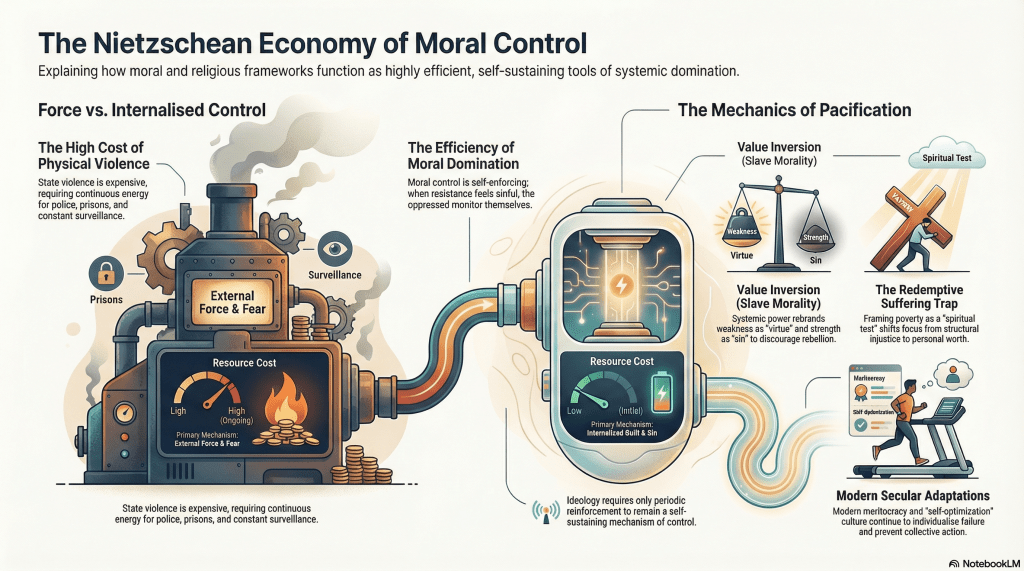
State violence is expensive. You need:
Police
Prisons
Military
Surveillance
But moral/religious control is self-enforcing:
The oppressed police themselves
Resistance feels sinful, not just illegal
Suffering becomes virtuous
Acceptance becomes holy
This is energy-efficient domination.
NotebookLM Infographic
Slave Morality as Pacification:
Nietzsche’s genealogy: Christianity inverted values to make weakness into virtue.
But there’s a more cynical reading (which I think you’re pointing toward):
Those inversions serve power by pacifying resistance.
Consider what Christianity teaches the desert-dwellers:
“Blessed are the meek” (don’t challenge authority)
“The last shall be first” (accept your position now, compensation comes later)
“It is easier for a camel to pass through the eye of a needle…” (wealth is spiritually dangerous, so your poverty is actually better)
“Turn the other cheek” (don’t fight back)
“Render unto Caesar” (obey State power)
“Slaves, obey your masters” (literally in the text)
Every single one of these makes resistance harder and submission easier.
Religion as Maintenance Energy:
The lake-dwellers don’t need to convince desert-dwellers that the system is fair.
They just need to convince them that:
Suffering is redemptive
“Your poverty builds character”
“God tests those he loves”
“Suffering purifies the soul”
Compensation comes later
“The kingdom of heaven awaits”
“Store up treasures in heaven, not earth”
Present injustice is temporary; eternal justice awaits
Your condition reflects your moral worth
“God rewards the righteous with prosperity” (prosperity gospel)
OR “Worldly success is spiritually dangerous” (traditional Christianity)
Either way: your poverty is explained by moral frameworks, not structural injustice
Resistance is sin
Envy is a deadly sin
Coveting is forbidden
Taking what others have = theft = eternal damnation
The Parable, With Nietzschean Religion:
The desert-dwellers work for water, generation after generation.
Why don’t they rebel?
Not just because of State violence.
Because the priests (funded by lake-dwellers) teach them:
“Blessed are those who thirst, for they shall be satisfied—in heaven.”
“Your suffering is temporary. Eternal abundance awaits those who accept God’s plan.”
“To take the lake would be theft, and theft is sin, and sin is damnation.”
“The lake-dwellers have been blessed by God with stewardship. To challenge this is to challenge God’s order.”
Now the desert-dwellers don’t just fear State violence.
They fear eternal damnation.
Why This Is Devastatingly Efficient:
State violence requires:
Constant monitoring
Physical force
Visible oppression
Religious/moral control requires:
Periodic sermons
Internalized guilt
Self-policing
Once you’ve convinced someone that resistance is morally wrong, you don’t need to watch them constantly.
They watch themselves.
The Genealogy of Morals, Applied:
Nietzsche asked: How did “good” and “evil” come to mean what they do?
His answer (simplified): The powerful originally called themselves “good” (strong, noble, life-affirming). The weak were “bad” (weak, common, contemptible).
The weak inverted this through ressentiment:
Made their weakness into virtue (humility, meekness, patience)
Made the powerful into villains (pride, ambition, strength = sin)
But here’s the cynical extension:
Once established, this inversion serves power by pacifying resistance.
Whether the weak invented it (Nietzsche) or the powerful co-opted it (cynical reading), the result is the same:
Moral systems that make submission feel virtuous and resistance feel sinful.
Christianity as Maintenance Technology:
Consider Christianity’s political function:
Before Christianity:
Slaves might rebel because their enslavement is unjust
Poor might seize from rich because they need resources
Weak might organize against strong because they outnumber them
After Christianity:
Slaves accept enslavement as God’s plan, await heavenly reward
Poor accept poverty as spiritually purifying, even superior
Weak valorize their weakness as humility, strength as pride/sin
This is a control technology far more sophisticated than violence.
The Energy Efficiency:
Violence requires continuous input:
You must constantly deploy force
Resistance must be constantly suppressed
Costs are ongoing and high
Ideology requires initial investment, then becomes self-sustaining:
Teach children in schools/churches
Internalize moral frameworks
Now they control themselves
Maintenance is just periodic reinforcement
Religion is the most energy-efficient domination mechanism ever invented.
The Parable’s Moral Dimension:
The lake-dwellers teach desert-dwellers:
Property Framework:
“Thou shalt not steal”
“Thou shalt not covet”
Taking the lake = sin = damnation
Suffering Framework:
“God tests those he loves through suffering”
“Blessed are the poor in spirit”
Your thirst is spiritually meaningful
Afterlife Framework:
“Store up treasures in heaven”
“The first shall be last, the last shall be first”
Present injustice is temporary
Authority Framework:
“Render unto Caesar”
“Let every person be subject to the governing authorities”
Challenging power = challenging God’s order
Now the desert-dwellers don’t just submit to force.
They believe submission is virtuous and resistance is evil.
The Master Stroke:
The most brilliant part is making the oppressed grateful for their oppression:
“I may be poor, but at least I’m humble. The rich are proud and will face judgment.”
“I may thirst, but my suffering brings me closer to God.”
“I may work endlessly, but labor is dignified and idleness is sin.”
The oppressed now defend the system that oppresses them.
Why Nietzsche Was Right:
Nietzsche saw that morality isn’t neutral truth descending from heaven.
It’s a human construction that serves power.
Sometimes (his version): created by the weak to constrain the strong
Sometimes (cynical version): created by the strong to pacify the weak
Either way: Morality is a weapon in power struggles, not an escape from them.
And religion/morality are far more efficient than violence because:
They’re internalized
They’re self-enforcing
They make resistance feel wrong, not just dangerous
They promise compensation instead of requiring present justice
They individualize structural problems (your suffering = your sin/test, not systemic injustice)
The Thermodynamic Advantage:
If you rely only on violence:
Must constantly monitor
Must constantly suppress
Must constantly deploy force
High energy, ongoing cost
If you add moral/religious control:
People monitor themselves
People suppress their own resistance
People feel guilty for even thinking of rebellion
Low energy after initial investment
This is why religion persists in the West despite secularization.
Not because it’s true.
Because it’s functionally necessary for maintaining systems that would otherwise collapse.
The Parable’s Religious Ending:
The desert-dwellers work and thirst.
When they ask “Why?” the answer isn’t just:
“Because the State will kill you if you take the lake.”
It’s:
“Because taking the lake is theft, theft is sin, and sin is damnation. Your suffering is temporary and spiritually meaningful. Accept your lot with humility, and God will reward you eternally.”
Now you’ve done something remarkable:
You’ve convinced the exploited that:
Their exploitation is God’s plan
Resisting is sinful
Accepting is virtuous
Compensation comes later (unprovable, unfalsifiable)
They will now police themselves, suppress their own resistance, and teach their children to do the same.
The Secular Versions:
Religion is declining in the West, but the moral frameworks persist in secular form:
Protestant work ethic → “Your worth is your productivity”
Meritocracy → “Your poverty reflects your failure, not structural injustice”
Individualism → “Your problems are yours alone to solve”
Positive thinking → “Your attitude, not your circumstances, determines outcomes”
Self-help culture → “You failed because you didn’t optimize yourself enough”
All of these do the same work religion did:
Individualize structural problems
Make suffering feel like personal failure
Prevent collective action
Make resistance feel wrong/foolish
Internalize control
Nietzsche Saw This Coming:
“God is dead” didn’t mean we’d escaped moral control.
It meant: We’d have to find new ways to maintain the same moral structures without the theological justification.
And we did:
Psychology (your unhappiness is internal, not structural)
Economics (markets are natural/efficient, poverty is failure)
Meritocracy (success = desert, failure = moral lack)
Self-optimization (you are responsible for your own exploitation)
Same function. Different vocabulary.
The Energy Requirements, Completed:
To maintain democracy/capitalism against natural entropic pressures toward collapse, you need:
State violence (expensive, visible, generates resistance)
How retribution stays upright by not being examined
There is a persistent belief that our hardest disagreements are merely technical. If we could stop posturing, define our terms, and agree on the facts, consensus would emerge. This belief survives because it works extremely well for birds and tables.
It fails spectacularly for justice.
Audio: NotebookLM summary podcast of this topic.
The Language Insufficiency Hypothesis (LIH) isn’t especially interested in whether people disagree. It’s interested in how disagreement behaves under clarification. With concrete terms, clarification narrows reference. With contested ones, it often fractures it. The more you specify, the more ontologies appear.
Justice is the canonical case.
Retributive justice is often presented as the sober, adult conclusion. Not emotional. Not ideological. Just what must be done. In practice, it is a delicately balanced structure built out of other delicately balanced structures. Pull one term away and people grow uneasy. Pull a second and you’re accused of moral relativism. Pull a third and someone mentions cavemen.
Let’s do some light demolition. I created a set of 17 Magic: The Gathering-themed cards to illustrate various concepts. Below are a few. A few more may appear over time.
Card One: Choice
Image: MTG: Choice – Enchantment
The argument begins innocently enough:
They chose to do it.
But “choice” here is not an empirical description. It’s a stipulation. It doesn’t mean “a decision occurred in a nervous system under constraints.” It means a metaphysically clean fork in the road. Free of coercion, history, wiring, luck, trauma, incentives, or context.
That kind of choice is not discovered. It is assumed.
Pointing out that choices are shaped, bounded, and path-dependent does not refine the term. It destabilises it. Because if choice isn’t clean, then something else must do the moral work.
Enter the next card.
Card Two: Agency
Image: MTG: Agency – Creature – Illusion
Agency is wheeled in to stabilise choice. We are reassured that humans are agents in a morally relevant sense, and therefore choice “counts”.
Counts for what, exactly, is rarely specified.
Under scrutiny, “agency” quietly oscillates between three incompatible roles:
a descriptive claim: humans initiate actions
a normative claim: humans may be blamed
a metaphysical claim: humans are the right kind of cause
These are not the same thing. Treating them as interchangeable is not philosophical rigour. It’s semantic laundering.
But agency is emotionally expensive to question, so the discussion moves on briskly.
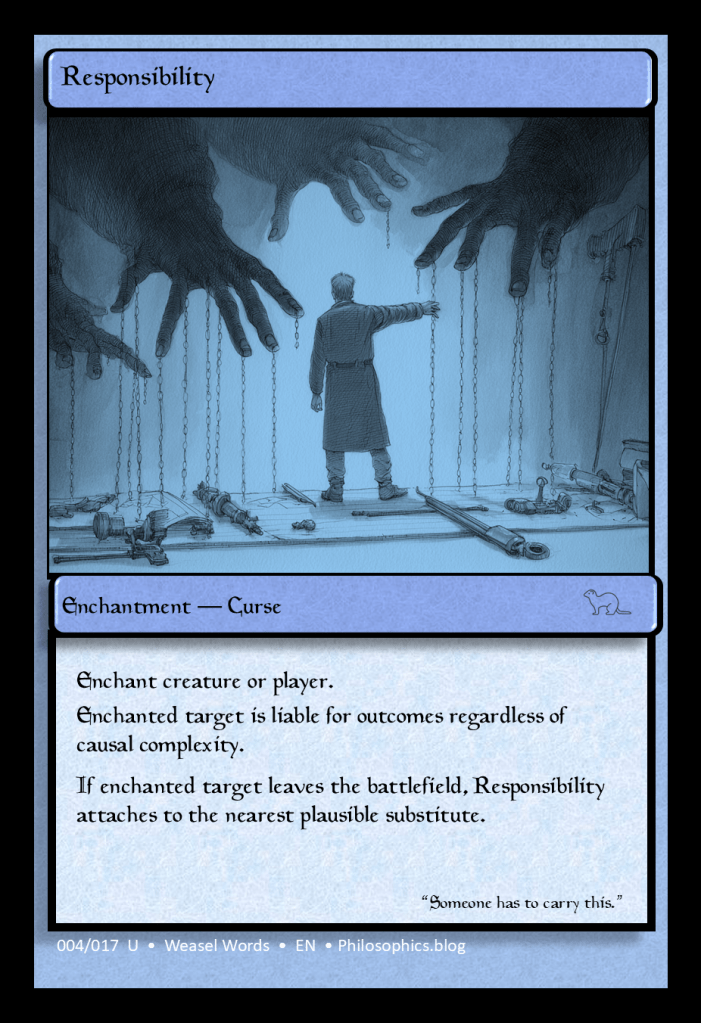
Card Three: Responsibility
Image: MTG: Responsibility – Enchantment – Curse
Responsibility is where the emotional payload arrives.
To say someone is “responsible” sounds administrative, even boring. In practice, it’s a moral verdict wearing a clipboard.
Watch the slide:
causal responsibility
role responsibility
moral responsibility
legal responsibility
One word. Almost no shared criteria.
By the time punishment enters the picture, “responsibility” has quietly become something else entirely: the moral right to retaliate without guilt.
At which point someone will say the magic word.
Card Four: Desert
Image: MTG: Desert – Instant
Desert is the most mystical card in the deck.
Nothing observable changes when someone “deserves” punishment. No new facts appear. No mechanism activates. What happens instead is that a moral permission slip is issued.
Desert is not found in the world. It is declared.
And it only works if you already accept a very particular ontology:
robust agency
contra-causal choice
a universe in which moral bookkeeping makes sense
Remove any one of these and desert collapses into what it always was: a story we tell to make anger feel principled.
Which brings us, finally, to the banner term.
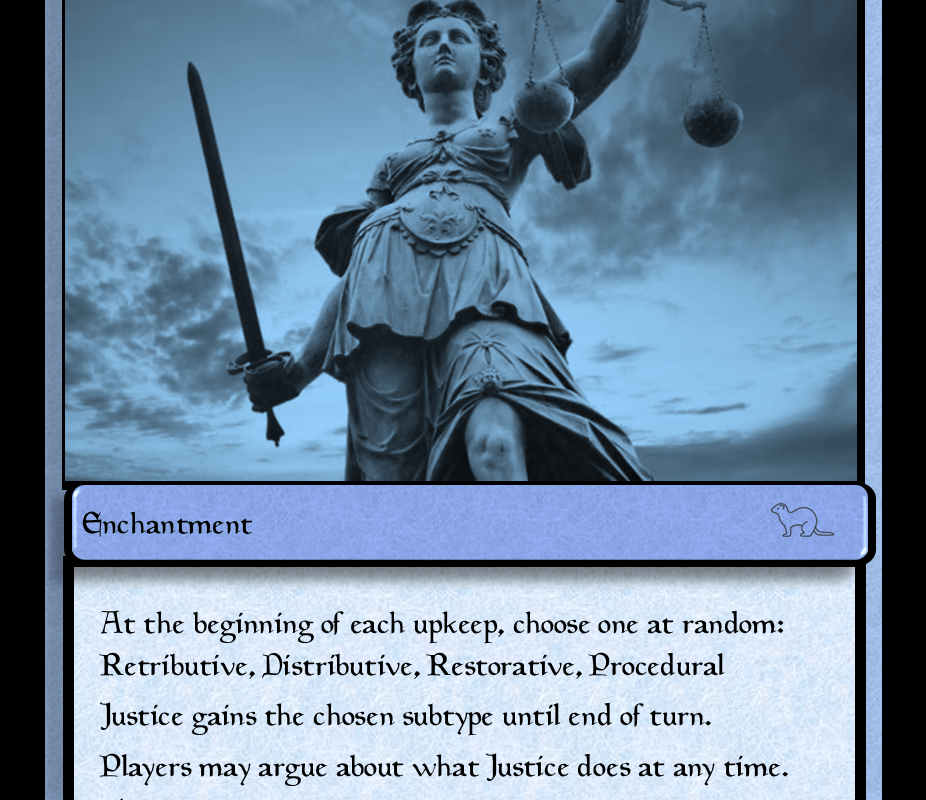
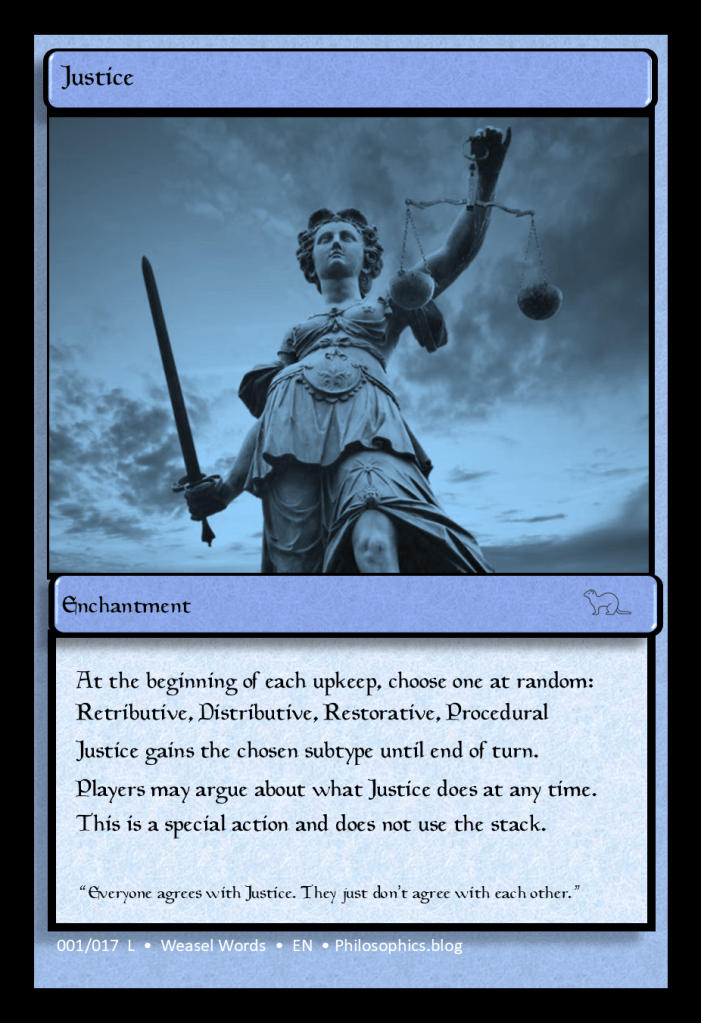
Card Five: Justice
Image: MTG: Justice – Enchantment
At this point, justice is invoked as if it were an independent standard hovering serenely above the wreckage.
It isn’t.
“Justice” here does not resolve disagreement. It names it.
Retributive justice and consequentialist justice are not rival policies. They are rival ontologies. One presumes moral balance sheets attached to persons. The other presumes systems, incentives, prevention, and harm minimisation.
Both use the word justice.
That is not convergence. That is polysemy with a body count.
Why clarification fails here
This is where LIH earns its keep.
With invariants, adding detail narrows meaning. With terms like justice, choice, responsibility, or desert, adding detail exposes incompatible background assumptions. The disagreement does not shrink. It bifurcates.
This is why calls to “focus on the facts” miss the point. Facts do not adjudicate between ontologies. They merely instantiate them. If agency itself is suspect, arguments for retribution do not fail empirically. They fail upstream. They become non sequiturs.
This is also why Marx remains unforgivable to some. “From each according to his ability, to each according to his need” isn’t a policy tweak. It presupposes a different moral universe. No amount of clarification will make it palatable to someone operating in a merit-desert ontology.
The uncomfortable conclusion
The problem is not that we use contested terms. We cannot avoid them.
The problem is assuming they behave like tables.
Retributive justice survives not because it is inevitable, but because its supporting terms are treated as settled when they are anything but. Each card looks sturdy in isolation. Together, they form a structure that only stands if you agree not to pull too hard.
LIH doesn’t tell you which ontology to adopt.
It tells you why the argument never ends.
And why, if someone insists the issue is “just semantic”, they’re either confused—or holding the deck.
I commenced a new series that shares my philosophical positions from the PhilPapers 2020 survey.
Video: Intro and question 1 to the survey.
Not a lot to write beyond what the video already says.
My responses are available on my PhilPeople profile. If you really can’t justify watching the 4-minute video clip, read the spoilers below – but it will go down in your permanent record.
Show spoiler (tl;dr?)
73% of respondents accept or lean toward the claim that à priori knowledge exists
18% of respondents reject or lean away from the claim that à priori knowledge exists
My Response: À priori knowledge does not exists. No knowledge exists prior to experience.
Why shared language creates the illusion – not the reality – of shared experience
Human beings routinely assume that if another agent speaks our language, we have achieved genuine mutual understanding. Fluency is treated as a proxy for shared concepts, shared perceptual categories, and even shared consciousness. This assumption appears everywhere: in science fiction, in popular philosophy videos, and in everyday cross-cultural interactions. It is a comforting idea, but philosophically indefensible.
Video: Could You Explain Cold to an Alien? – Hank Green
Recent discussions about whether one could ‘explain cold to an alien’ reveal how deeply this assumption is embedded. Participants in such debates often begin from the tacit premise that language maps transparently onto experience, and that if two interlocutors use the same linguistic term, they must be referring to a comparable phenomenon.
A closer analysis shows that this premise fails at every level.
Audio: NotebookLM summary podcast on this topic.
Shared Language Does Not Imply Shared Phenomenology
Even within the human species, thermal experience is markedly variable. Individuals from colder climates often tolerate temperatures that visitors from warmer regions find unbearable. Acclimation, cultural norms, metabolic adaptation, and learned behavioural patterns all shape what ‘cold’ feels like.
If the same linguistic term corresponds to such divergent experiences within a species, the gap across species becomes unbridgeable.
A reptile, for example, regulates temperature not by feeling cold in any mammalian sense
A reptile, for example, regulates temperature not by feeling cold in any mammalian sense, but by adjusting metabolic output. A thermometer measures cold without experiencing anything at all. Both respond to temperature; neither inhabits the human category ‘cold’.
Thus, the human concept is already species-specific, plastic, and contextually learned — not a universal experiential module waiting to be translated.
Measurement, Behaviour, and Experience Are Distinct
Thermometers and reptiles react to temperature shifts, and yet neither possesses cold-qualia. This distinction illuminates the deeper philosophical point:
Measurement registers a variable.
Behaviour implements a functional response.
Experience is a mediated phenomenon arising from a particular biological and cognitive architecture.
Aliens might measure temperature as precisely as any scientific instrument. That alone tells us nothing about whether they experience anything analogous to human ‘cold’, nor whether the concept is even meaningful within their ecology.
The Problem of Conceptual Export: Why Explanation Fails
Attempts to ‘explain cold’ to hypothetical aliens often jump immediately to molecular description – slower vibrational states, reduced kinetic energy, and so forth. This presumes that the aliens share:
our physical ontology,
our conceptual divisions,
our sense-making framework,
and our valuation of molecular explanation as intrinsically clarifying.
But these assumptions are ungrounded.
Aliens may organise their world around categories we cannot imagine. They may not recognise molecules as explanatory entities. They may not treat thermal variation as affectively laden or behaviourally salient. They may not even carve reality at scales where ‘temperature’ appears as a discrete variable.
When the conceptual scaffolding differs, explanation cannot transfer. The task is not translation but category creation, and there is no guarantee that the requisite categories exist on both sides.
The MEOW Framework: MEOWa vs MEOWb
The Mediated Encounter Ontology (MEOW) clarifies this breakdown by distinguishing four layers of mediation:
T0: biological mediation
T1: cognitive mediation
T2: linguistic mediation
T3: social mediation
Humans run MEOWa, a world structured through mammalian physiology, predictive cognition, metaphor-saturated language, and social-affective narratives.
Aliens (in fiction or speculation) operate MEOWb, a formally parallel mediation stack but with entirely different constituents.
Two systems can speak the same language (T2 alignment) whilst:
perceiving different phenomena (T0 divergence),
interpreting them through incompatible conceptual schemas (T1 divergence),
and embedding them in distinct social-meaning structures (T3 divergence).
Linguistic compatibility does not grant ontological compatibility. MEOWa and MEOWb allow conversation but not comprehension.
Fiction as Illustration: Why Aliens Speaking English Misleads Us
In Sustenance, the aliens speak flawless Standard Southern English. Their linguistic proficiency invites human characters (and readers) to assume shared meaning. Yet beneath the surface:
Their sensory world differs;
their affective architecture differs;
their concepts do not map onto human categories;
and many human experiential terms lack any analogue within their mediation.
The result is not communication but a parallel monologue: the appearance of shared understanding masking profound ontological incommensurability.
The Philosophical Consequence: No Universal Consciousness Template
Underlying all these failures is a deeper speciesist assumption: that consciousness is a universal genus, and that discrete minds differ only in degree. The evidence points elsewhere.
If “cold” varies across humans, fails to apply to reptiles, and becomes meaningless for thermometers, then we have no grounds for projecting it into alien phenomenology. Nor should we assume that other species – biological or artificial – possess the same experiential categories, emotional valences, or conceptual ontologies that humans treat as foundational.
Consciousness is not a universal template awaiting instantiation in multiple substrates. It is alocal ecological achievement, shaped by the mediations of the organism.
Conclusion
When aliens speak English, we hear familiarity and assume understanding. But a shared phonological surface conceals divergent sensory systems, cognitive architectures, conceptual repertoires, and social worlds.
Linguistic familiarity promises comprehension, but delivers only the appearance of it. The deeper truth is simple: Knowing our words is not the same as knowing our world.
And neither aliens, reptiles, nor thermometers inhabit the experiential space we map with those words.
Afterword
Reflections like these are precisely why my Anti-Enlightenment project exists. Much contemporary philosophical commentary remains quietly speciesist and stubbornly anthropomorphic, mistaking human perceptual idiosyncrasies for universal structures of mind. It’s an oddly provincial stance for a culture that prides itself on rational self-awareness.
To be clear, I have nothing against Alex O’Connor. He’s engaging, articulate, and serves as a gateway for many encountering these topics for the first time. But there is a difference between introducing philosophy and examining one’s own conceptual vantage point. What frustrates me is not the earnestness, but the unexamined presumption that the human experiential frame is the measure of all frames.
Having encountered these thought experiments decades ago, I’m not interested in posturing as a weary elder shaking his stick at the next generation. My disappointment lies elsewhere: in the persistent inability of otherwise intelligent thinkers to notice how narrow their perspective really is. They speak confidently from inside the human mediation stack without recognising it as a location – not a vantage point outside the world, but one local ecology among many possible ones.
Until this recognition becomes basic philosophical hygiene, we’ll continue to confuse linguistic familiarity for shared ontology and to mistake the limits of our own embodiment for the limits of consciousness itself.
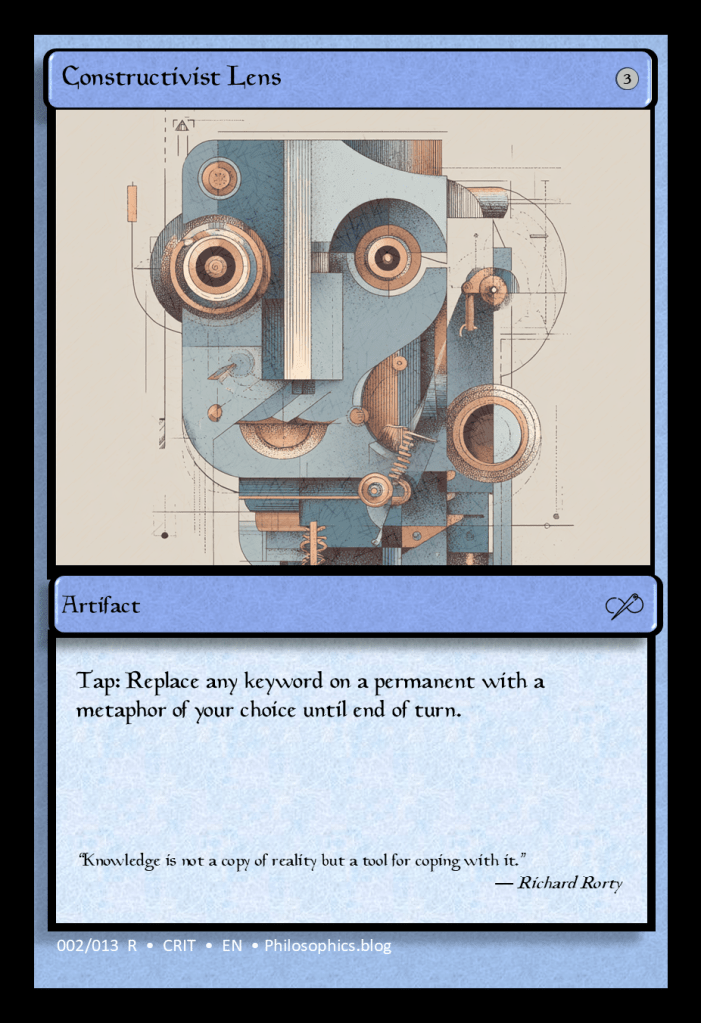
Another faux Magic: The Gathering trading card. I’ve been busy writing an essay on Tatterhood and wondering if I’ve gone off the edge even further into mental masturbation. I made these cards to share on slow news days, as it were.
[EDIT: Oops: Even wore. I already posted something today. Enjoy the bonus post.]
Every philosopher dreams of a device that reveals ‘truth’. The Constructivist Lens does the opposite. When you tap it, the world doesn’t come into focus – it multiplies. Each pane shows the same thing differently, reminding us that knowing is always a form of making – seeing as building.
In The Discipline of Dis-Integration, I wrote that philosophy’s task is ‘to remain within what persists … to study the tension in the threads rather than weave a new pattern’. The Lens embodies that ethic. It is not an instrument of discovery but of disclosure: a way to notice the scaffolding of perception without mistaking it for bedrock.
Flavour text: “Knowledge is not a copy of reality but a tool for coping with it.” — Richard Rorty
Where Enlightenment optics promised clarity, the Lens trades in parallax. It insists that perspective is not a flaw but the condition of vision itself. Each player who peers through it – artist, scientist, moralist – constructs a different coherence, none final. The card’s rule text captures this tension: replace any keyword on a permanent with a metaphor of your choice until end of turn. Reality bends, language shifts, yet the game continues.
In the Dis-Integration set, the Lens sits alongside Perspectival Realism and Language Game (not yet shared), forming the Blue triad of epistemic doubt. Together they dramatise what the essay calls ‘the hyphen as hinge’: the small pause between integration and its undoing. The Constructivist Lens, then, is not a tool for clearer sight but a reminder that every act of seeing is already an act of construction.
I’ve spent more hours than I care to admit rummaging through the Jungian undergrowth of fairy tales – reading Marie-Louise von Franz until my eyes crossed, listening to Clarissa Pinkola Estés weave her wolf-women lore, and treating folklore like an archaeological dig through the psychic sediment of Europe. It’s marvellous, really, how much one can project onto a story when one has a doctorate’s worth of enthusiasm and the moral flexibility of a tarot reader.
But every so often, a tale emerges that requires no archetypal lens, no mythopoetic scaffolding, no trip down the collective unconscious. Sometimes a story simply bares its ideological teeth.
Enter Tatterhood – the Norwegian fairy tale so blunt, it practically writes its own critical theory seminar.
I watched Jonny Thomson’s recent video on this tale (embedded below, for those with sufficient tea and patience). Jonny offers a charming reversal: rather than focusing on Tatterhood herself, he offers the moral from the prince’s perspective. In his reading, the story becomes a celebration of the power of asking – the prince’s reward for finally inquiring about the goat, the spoon, the hood, the whole aesthetic calamity before him.
Video: Jonny Thomson discusses Tatterhood.
It’s wholesome stuff: a TED Talk dressed as folklore. But – my word – apply the slightest bit of critical pressure, and the whole thing unravels into farce.
The Story No One Tells at the Royal Wedding
Here’s the short version of Tatterhood that Jonny politely sidesteps:
A fearless, ragged, hyper-competent girl rescues her sister from decapitation.
She confronts witches, navigates the seas alone, storms a castle, and performs an ad hoc ontological surgical reversal.
She does all of this without help from the king, the court, the men, or frankly, anyone with a Y chromosome.
And how is she rewarded for her trouble? She’s told she’s too ugly. Not socially acceptable. Not symbolically coherent. Not bride material.
The kingdom gazes upon her goat, her spoon, her hood, her hair, and determines that nothing – nothing – about her qualifies her for legitimacy.
But beauty? Beauty is the passport stamp that grants her entry into the social realm.
Jonny’s Prince: A Hero by Low Expectations
Now, bless Jonny for trying to rehabilitate the lad, but this prince is hardly an exemplar of virtue. He sulks through his own wedding procession like a man being marched to compulsory dentistry. He does not speak. He does not ask. He barely manages object permanence.
And suddenly, the moral becomes: Look what wonders unfold when a man asks a single question!
It’s the philosophical equivalent of awarding someone a Nobel Prize for remembering their mother’s birthday.
And what do his questions achieve? Not insight. Not understanding. Not intimacy. But metamorphosis.
Each time he asks, Tatterhood transforms – ugly goat to beautiful horse, wooden spoon to silver fan, ragged hood to golden crown, ‘ugly’ girl to radiant beauty.
Which brings us to the inconvenient truth:
This Isn’t the Power of Asking. It’s the Power of Assimilation.
His questions function as aesthetic checkpoints.
Why the goat? Translation: please ride something socially acceptable.
Why the spoon? Translation: replace your tool of agency with a decorative object.
Why the hood? Translation: cover your unruliness with something properly regal.
Why your face? Translation: you terrify me; please be beautiful.
And lo, she becomes beautiful. Not because he sees her differently. Because the story cannot tolerate a powerful woman who remains outside the beauty regime.
The prince isn’t rewarded for asking; the narrative is rewarded for restoring normative order.
And Yet… It’s Absurdly Fascinating
This is why fairy tales deserve all the interpretive attention we lavish on them. They’re ideological fossils – compressed narratives containing entire worldviews in miniature.
Part of me admires Jonny’s generosity. Another part of me wants to hand the prince a biscuit for performing the bare minimum of relational curiosity. But mostly, I’m struck by how nakedly the tale reveals the old bargain:
A woman may be bold, brave, clever, loyal, and sovereign – but she will not be accepted until she is beautiful.
Everything else is optional. Beauty is compulsory.
So Here’s My Version of the Moral
Ask questions, yes. Be curious, yes. But don’t let anyone tell you that Tatterhood was waiting for the prince’s epiphany. She was waiting for the world to remember that she ran the plot.
If you’ve made it this far and know my proclivities, you’ll not be shocked that I side with Roland Barthes and cheerfully endorse la mort de l’auteur. Jonny is perfectly entitled to his reading. Interpretive pluralism and all that. I simply find it marvelously puzzling that he strolls past the protagonist galloping through the narrative on a goat, spoon upraised, and instead decides to chase the side-quest of a prince who contributes roughly the energy of a damp sock.
The Travelogue of a Recovering Enlightenment Subject
I’m asked endlessly – usually by people who still believe TED talks are a form of knowledge production – ‘Why are you so negative? Why must you tear things down if you’ve no intention of replacing them?’
It’s adorable, really. Like watching a toddler demand that gravity apologise.
They’ve been trained for years in the managerial catechism:
‘Don’t bring me problems; bring me solutions.‘
As if the world were some badly-run workshop in need of a fresh coat of agile methodology.
They might as well say, ‘Don’t tell me I can’t win at Lotto; give me money’.
I, too, would enjoy the spare universe. Or the winning Lotto ticket. And yes, one day I might even buy one. Until then, I’ve embraced the only adult philosophy left: Dis-Integrationism – the fine art of taking things apart without pretending they can be reassembled into anything coherent.
A Little History
My suspicion began early. Secondary school. All those civic fairytales whispered as if they were geology.
The ‘reasonable person’? Bollox. ‘Jury of one’s peers’? What are peers? Whose peers? I have no peers. ‘Impartial judges’? Please. Even as a teenager, I could see those robed magicians palming cards like bored street performers. Everyone else nodded along, grateful for the spectacle. I stared, wondering how the other children hadn’t noticed the emperor’s bare arse.
Later, I watched adults talk past each other with a fluency bordering on performance art. Not disagreement – different universes, cosmetically aligned by grammar.
A Federal mediator once tried to teach me that common ground could be manufactured. Not by clarifying meaning, mind you – that would have required honesty – but by rhetorical pressure and a touch of Jedi mind-trickery. Negotiation was simply controlled hallucination.
University communications classes offered temporary distraction with denotation and connotation, a little semantic drift, the illusion that language might be domesticated with enough theory. Charming. Almost convincing.
Then Gödel and Arrow arrived like two polite assassins and quietly removed the floorboards.
And then – happily, inevitably – Derrida, Foucault, Lyotard. I’d already danced with Beauvoir, Sartre, Camus. I’d ingested the Western canon like every obedient young acolyte: Plato, Aristotle, Hobbes, Locke, Rousseau, Montesquieu, Voltaire. Americans force-feed their citizenry Jefferson and Franklin as moral fibre, as if the republic might otherwise suffer constipation.
It never gelled. Too much myth, too much marketing. The Enlightenment had the energy of a regime insisting on its own benevolence while confiscating your torch. To call oneself ‘enlightened’ should have raised suspicion – but no, the branding stuck.
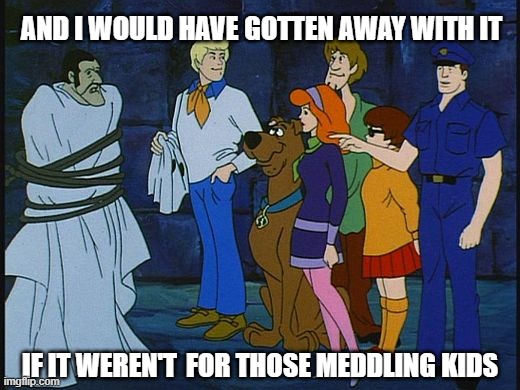
Whenever les garçons dared tug at the curtain, we were assured they simply didn’t ‘understand’, or worse, they ‘hated civilisation’.
Image: “I would have gotten away with it if it weren’t for those meddling kids.”
Then Came the Internet
The digital age didn’t usher in clarity — it unmasked the whole pantomime. Like Neo seeing the Matrix code or Roddy Piper slipping on the sunglasses in They Live, one suddenly perceives the circuitry: meaning as glitch, discourse as scaffolding, truth as a shabby stage-set blinking under fluorescent tubes.
Our civilisation speaks in metaphors it mistakes for mechanisms. The Enlightenment gave us the fantasy that language might behave, that concepts were furniture rather than fog. Musicians and artists always knew better. We swim in metaphor; we never expected words to bear weight. But philosophers kept pretending communication was a conveyor belt conveying ‘meaning units’ from A to B.
By 2018, the cracks were gaping. I began taking the notes that would metastasise into A Language Insufficiency Hypothesis – an attempt to map the hollow spaces between our words, the fractures we keep wallpapering with reason.
Half a decade later, the work is ready. Not to save anything – nothing here merits salvation – but to name the debris honestly.
If that sounds negative, good. Someone has to switch off the Enlightenment’s flickering lightbulb before it burns the whole house down.
Where This Road Actually Leads
People imagine negativity is a posture – a sort of philosophical eyeliner, worn for effect. But dismantling the world’s conceptual furniture isn’t a hobby; it’s the only reasonable response once you’ve noticed the screws aren’t actually attached to anything.
The Enlightenment promised us a palace. Step inside and you discover it’s built out of IKEA flatpacks held together with wishful thinking and a prayer to Kant.
Once you’ve seen that, you can’t go back to pretending the furniture is sturdy.
You stop sitting.
You start tapping the beams.
You catalogue the wobble.
This is where Dis–Integrationism enters – not as a manifesto, but as the practice of refusing to live inside collapsing architecture out of sheer politeness. Negativity is simply the weather report.
The Lie We Keep Telling Ourselves
We cling to the fantasy that if we critique something long enough, a solution will crystallise out of the void, like enlightenment through sheer irritation. It’s the Protestant work ethic meets metaphysics: salvation through sufficient grumbling.
But critique is not alchemy. It unmakes. It refuses. It loosens the bolts we pretended were load-bearing.
Once you stop demanding that thought be constructive, you can finally see the world as it is: improvised, rhetorical, and permanently under renovation by people who don’t read the instructions.
The Enlightenment’s heirs keep insisting there must be a blueprint. There isn’t. There never was. We’ve merely been tracing the silhouettes of scaffolding, calling it a cathedral.
And Yet – Here We Still Are
The online age (God help us all) didn’t deepen the crisis; it merely turned the lights on. What Enlightenment rationality hid beneath a tasteful layer of neoclassical varnish, the internet sprayed with fluorescent graffiti.
Turns out, when seven billion people speak at once, meaning doesn’t ’emerge’; it buckles. Our systems weren’t built for this volume of contradiction. Our language wasn’t built for this density of metaphor. Our myths weren’t built for this much empirical evidence against them.
And yet here we are, still demanding coherence from a medium held together by emojis and trauma. If you laugh, it’s only to stop crying. If you critique, it’s only because someone has to keep the fire marshal informed.
The Only Honest Next Step
Having traced the cracks, you’re now in the foyer of the real argument – the one hanging like a neon sign over your entire Anti-Enlightenment project:
We don’t need to rebuild the house. We need to stop pretending it was ever architecture.
Language is insufficient. Agency is a fiction. Objectivity is an etiquette ritual. Democracy is a séance. Progress is a hallucination with better marketing. And yet – life continues. People wake, work, argue, aspire, despair.
Dis-Integrationism isn’t about nihilism; it’s about maintenance. Not repairing the myth, but tending the human who must live among its debris. Not constructing new temples, but learning to see in the half-light once the old gods have gone.
The travelogue becomes a guidebook: Welcome to the ruins. Mind the uneven floor. Here is how we walk without pretending the path is paved.
The Fetish for Solutions
Here is the final indignity of the age: the demand that every critique come bundled with a solution, like some moral warranty card. As if naming the rot weren’t labour enough. As if truth required a customer-service plan.
‘Where is your alternative?’ they ask, clutching Enlightenment logic the way a drowning man clutches a shopping receipt.
But solutions are the real tyranny. They arrive bearing the smile of reason and the posture of progress, and behind both sits the same old imperial instinct: replace ambiguity with order; replace lived complexity with a diagram. A solution is merely a problem wearing a fresh coat of confidence.
Worse, a solution presumes the system is sound, merely in need of adjustment. It imagines the structure holds. It imagines the furniture can be rearranged without collapsing into splinters, and the memory of Kant.
Solutions promise inevitability. They promise teleology. They promise that the mess can be disinfected if only one applies the correct solvent. This is theology masquerading as engineering.
The Violence of the Answer
A solution is a closure – a metaphysical brute force. It slams the window shut so no further interpretation can slip in through the draft. It stabilises the world by amputating everything that wriggles. Answers are how systems defend themselves. They’re the intellectual equivalent of riot police: clean uniforms, straight lines, zero tolerance for nuance.
This is why the world keeps mistaking refusal for chaos. Refusal isn’t chaos. It’s hygiene. It is the simple act of not adding more furniture to a house already bending under its own delusions. When you decline to provide a solution, you aren’t abandoning the world. You’re declining to participate in its coercive optimism.
And So the Travelogue Ends Where It Must
Not in triumph or a bluepirnt, but in composure – the only posture left after the Enlightenment’s glare has dimmed. Negativity isn’t sabotage; it’s sobriety. Dis-Integrationism isn’t cynicism; it’s the refusal to replace one failing mythology with another wearing vegan leather.
A world obsessed with solutions cannot recognise maintenance as wisdom. It can’t tolerate ambiguity without reaching for a hammer. It can’t breathe unless someone somewhere is building a ladder to a future that never arrives.
So no – I won’t provide solutions. I won’t participate in the fantasy that the human condition can be patched with conceptual duct tape. I will not gift the Enlightenment a eulogy that surrenders to its grammar.
What I offer is far smaller and far more honest: Attention. Description. Steady hands in a collapsing house. And the simple dignity of refusing to lie about the architecture.
Most grand moral theories assume a degree of conceptual stability that moral language has never possessed.
Aristotle’s aretê, Kant’s maxims, Mill’s utilities, Rawls’s ‘reasonable rejection’ – pick your passion/poison. Each one presupposes that a concept has a single, portable meaning that obligingly follows philosophers from ancient Greece to medieval Christendom to your local ethics seminar. It doesn’t. It never did. We’ve merely been pretending it does in order to keep the theoretical architecture standing.
Drawing on conceptual genealogy, philosophy of language, and cross-cultural moral psychology, I argue that the universalist ambitions of virtue ethics, deontology, consequentialism, and contractualism collapse not because their logic is flawed, but because their vocabulary evaporates the moment you ask it to do heavy lifting. Our moral terms drift, fracture, mutate, and occasionally reinvent themselves altogether. Yet moral theorists continue to legislate universal principles as if the words were obedient little soldiers rather than unruly historical artefacts.
This isn’t a manifesto for relativism – quite the opposite. It is a call for modesty: an acknowledgement that moral frameworks function as context-bound heuristics, exquisitely useful within particular forms of life but laughably overextended when dressed up as timeless moral law.
If the Language Insufficiency Hypothesis has taught me anything, it’s that once you stop bullying language into behaving like mathematics, you begin to see moral philosophy for what it is – a set of imaginative tools, not an ontology of obligation.
Read it, disagree with it, file it under ‘Why Bry insists on burning down the Enlightenment one paper at a time’ – your choice. But at least now the argument exists in the world, properly dressed and indexed, ready to irritate anyone still clinging to the dream of universal moral principles.
I just finished the writing and editorial parts of my Language Insufficiency Hypothesis. It still needs cover art and some administrative odds and ends, but I’m taking a day for a breather to share something about myself and my worldview. For this, I share my philosophical influences and how they support my core insights. For dramatic effect, I’ll even try to weight them to 100 per cent, leaving an ‘others’ bucket for the unaccounted ones.
Audio: NotebookLM summary podcast of this topic.
Obviously, this highly scientific accounting is about as useful as a Facebook survey or a fortune cookie, but it should reveal something. I have influences outside of philosophy, but I’ll limit this list at the start. The numbers don’t exactly add to 100% because there is a bit of cross-pollination, say, between Foucault and Nietzsche or Žižek and Hegel – or perhaps I’m just not good at maths. You decide.
Nietzsche (≈18)
Nietzsche is likely the uranium core. Haters and detractors like to diminish his contribution – and he didn’t play by the old rules – but they are wrong. He contributes value-creation, anti-moralism, perspectivism, the critique of ressentiment, the demolition of universals.
Nietzsche sits at the centre of the blast radius. Everything else is shrapnel. If there’s a thinker who detonated the Enlightenment’s pretensions more elegantly, I’ve not met them. He showed us that values are forged, not found; that morality is a genealogy of grievances; that certainty is the last refuge of the timid. In other words, he cleared the ground so the rest of us could get to work without tripping over Kantian furniture. But after Nietzsche’s uranium core, the next concentric ring becomes murkier.
Foucault (≈20%)
Foucault supplies the schematics. Where Nietzsche swung a hammer at the idols, Foucault identified the building codes. He mapped power as a set of subtle, everyday enchantments. He showed how ‘knowledge’ is simply what a society rewards with credibility. He is the patron saint of anyone who suspects normality is an instrument, not a neutral state of affairs. The world looks different once you see the disciplinary fingerprints on everything.
Derrida (≈10%)
Derrida gives me language as mischief. Meaning wobbles, slides, cracks; binaries betray themselves; every conceptual edifice contains its own trapdoor. Derrida isn’t a system; he’s an escape artist. And frankly, you can’t write anything about the insufficiency of language without genuflecting in his general direction.
Late Wittgenstein (≈15%)
The quiet structural pillar. If Derrida is the saboteur, Wittgenstein is the carpenter who informs you that the house was never stable anyway. Meaning-as-use, language-games, the dissolution of philosophical pseudo-problems: his later work underwrites virtually every modern suspicion about fixed categories and timeless essences. He doesn’t shout; he shrugs – and everything collapses neatly.
Rorty (≈5%)
Rorty replaces metaphysical longing with cultural pragmatism. He teaches you to stop hunting for capital-T Truth and instead track the vocabularies we actually live in. He’s the friendly voice whispering, ‘You don’t need foundations. You need better conversations’. His influence is felt mostly in the tone of my epistemic cynicism: relaxed rather than tragic. Besides, we disagree on the better conversations bit.
Geuss (≈4%)
If Rorty makes you light-footed, Geuss reminds you not to float off into abstraction entirely. He is the critic of moralism par excellence, the man who drags philosophy kicking and screaming back into politics. Geuss is the voice that asks, ‘Yes, but who benefits?’ A worldview without him would be a soufflé.
Heidegger (≈6%)
Selective extraction only. Being-in-the-world, thrownness, worldhood – the existential scaffolding. His political judgment was catastrophic, of course, but the ontological move away from detached subjectivity remains invaluable. He gives the metaphysics a certain grain.
Existentialists: Beauvoir, Sartre, Camus (≈6%)
They provide the atmospheric weather: choice, finitude, absurdity, revolt, the sheer mess of human freedom. They don’t define the system; they give it blood pressure. Besides, I met them before I switched to Team Nietzsche-Foucault.
Žižek, Latour, Baudrillard (≈2% combined)
These three are my licensed provocateurs.
Žižek exposes how ideology infiltrates desire.
Latour dismantles the Nature/Society binary with glee.
Baudrillard whispers that representation ate reality while we were looking at our phones.
They’re trickster figures, not architects.
Hume, Putnam, Dennett, and the Ancillaries (≈1% combined)
These are the seasonings.
Hume is the Scottish acid bath under every epistemic claim.
Putnam gives internal realism its analytic passport.
Dennett offers mechanistic metaphors you can steal even when you disagree.
Kant and Hegel hover like compulsory ghosts.
Rawls remains decorative parsley: included for completeness, consumed by none.
The Others Bucket (≈5%)
The unallocated mass: writers, anthropologists, theorists, stray thinkers you absorb without noticing. The ‘residuals’ category for the philosophical inventory – the bit fortune cookies never warn you about.
Enfin
Obviously, these ratios are more for humour than substance, but these are the thinkers I return to — the ones whose fingerprints I keep discovering on my own pages, no matter how many years or detours intervene.
Perhaps more revealing are those who didn’t make the guest list. Socrates, Plato, and Aristotle remain outside, smoking in the cold. The Stoics, Marcus Aurelius and his well-meaning self-help descendants, also failed to RSVP. In truth, I admire the posture but have little patience for the consolations – especially when they become the emotional training wheels of neoliberalism.
And then, of course, the Enlightenment patriarchs: Hobbes, Locke, Montesquieu and the rest of the constitutional furniture. I acknowledge their historical necessity the way one acknowledges plumbing – grateful it exists, uninterested in climbing inside the pipes. Rousseau, admittedly, I tolerate with something approaching affection, but only because he never pretended to be tidy.
I forgot Descartes, Voltaire, and Pascal, but it’s too late to scroll back and adjust the ledger. Consider them rounding errors – casualties of the margins, lost to the tyranny of percentages.
If anyone mentions another one – Spinoza comes to mind – I’ll try to figure out where they fit in my pantheon. Were I to render this tomorrow, the results may vary.
Every so often – usually when the Enlightenment ghosts begin rattling their tin cups again – one feels compelled to swat at the conceptual cobwebs they left dangling over moral philosophy. Today is one of those days.
Audio: NotebookLM podcast summarising the Rhetoric of Evil essay, not this page’s content.
I’ve just released The Rhetoric of Evil on Zenodo, a paper that politely (or impolitely, depending on your threshold) argues that ‘evil’ is not a metaphysical heavy-hitter but a rhetorical throw-pillow stuffed with theological lint. The term persists not because it explains anything, but because it lets us pretend we’ve explained something – a linguistic parlour trick that’s survived well past its sell-by date.
And because this is the age of artificial augury, I naturally asked MEOW GPT for its view of the manuscript. As expected, it nodded approvingly in that eerie, laser-precise manner unique to machines trained to agree with you – but to its credit, it didn’t merely applaud. It produced a disarmingly lucid analysis of the essay’s internal mechanics, the way ‘evil’ behaves like a conceptual marionette, and how our inherited metaphors govern the very moral judgments we think we’re making freely.
Below is MEOW GPT’s reaction, alongside my own exposition for anyone wanting a sense of how this essay fits within the broader project of dismantling the Enlightenment’s conceptual stage-props.
MEOW-GPT’s Response
(A machine’s-eye view of rhetorical exorcism)
“Evil is functioning as a demonological patch on an epistemic gap. When agents encounter a high-constraint event they cannot immediately model, the T₂ layer activates an inherited linguistic shortcut — the ‘evil’ label — which compresses complexity into a binary and arrests further inquiry.”
“The marionette metaphor is accurate: once we say a person ‘is evil,’ agency collapses into occult causation. Inquiry halts. Moral theatre begins.”
It went on like this – detecting exactly the mediated encounter-structure I intended, while offering a frighteningly clean schematic of how affect (T₀), heuristics (T₁), linguistic reification (T₂), and cultural choreography (T₃) conspire to turn incomprehension into metaphysics.
Machines, it seems, are quite good at detecting when humans are bullshitting themselves.
Why publish this now?
This essay marks the next plank in the broader anti-Enlightenment platform I’ve been assembling – LIH, MEOW, the ongoing dismantling of truth-fetishism, and now the unsettling realisation that ‘evil’ is little more than a theological revenant dressed up for secular work.
The term’s persistence is not a testament to its necessity but to our laziness:
It sounds like an explanation.
It licenses retribution without understanding.
It stabilises group boundaries.
It lets us outsource moral thought to a one-word incantation.
In short: ‘evil’ is the map-dragon we keep drawing because surveying the terrain is too much work.
This essay attempts to retire that dragon – not to soften judgment, but to sharpen it. If anything, the paper argues that abolishing ‘evil’ frees us to see atrocity more clearly, and thus confront it more seriously.
Because MEOW-GPT was trained on the Mediated Encounter Ontology rather than on folk metaphysics, its analyses can serve as a useful diagnostic tool. It doesn’t simply summarise concepts; it reconstructs them along the four mediational tiers (T₀–T₃), showing – mechanically and without superstition – how a term behaves across biological affect, cognitive heuristics, linguistic structures, and cultural narratives.
This section is offered not as an alternative argument to the essay above, but as a worked example: a transparent demonstration of how the MEOW engine decomposes a high-complexity, high-stakes concept like evil once the theological scaffolding has been removed.
MEOW-GPT’s output shows, in compressed form, the same pattern the essay traces in prose: that evil is not a force, not a metaphysical essence, not an occult substrate, but a mediated pattern in human encounters, one that persists rhetorically long after its ontology has collapsed.
For readers curious about how MEOW ‘thinks’, the raw structured analysis follows.
MEOW-GPT Analysis: “Evil”
(Raw output for reference; lightly formatted for readability)
Concept
Input: Evil Type: Normative/evaluative moral concept (often reified as a property of acts, characters, or forces) Scope check: In-scope – ‘evil’ can be analysed as a mediated-encounter pattern (MEOW) and a high-complexity term with unstable linguistic behaviour (LIH).
High-level summary (≤120 words)
In MEOW terms, ‘evil’ is not a spooky substance but a way of organising certain encounter-events: severe, norm-breaking harms that present as resistant, shocking, and morally intolerable. Biologically, it piggybacks on harm, threat, and disgust systems. Cognitively, it compresses complex appraisals—intent, cruelty, scale of harm – into a powerful label. Linguistically, it sits in the unstable region where abstraction is high and language’s reliability drops, so people fight over its scope and weaponise it. Socially and technically, institutions, media, and platforms use ‘evil’ to mark enemies, justify punishment, and dramatise conflict. The term is emotionally efficient but conceptually fragile, and MEOW treats it as a relational, mediated pattern rather than an independent metaphysical force.
T₀ – Biological Mediation
Moralised harm perception piggybacks on survival systems: pain avoidance, threat detection, kin protection. ‘Evil’ clusters around encounters that trigger extreme danger-signals.
High arousal (fear, rage, disgust) makes some harms feel qualitatively world-violating, not merely personally threatening.
Disgust toward contamination, mutilation, or predation heavily colours what gets called ‘evil’.
Species-specific cues (infant distress cries, pain expressions) shape which harms are even legible candidates for evil.
T₁ – Cognitive Mediation
“Evil” compresses a multi-factor appraisal (intentionality, cruelty, gratuitousness) into a one-step heuristic.
Essence thinking converts acts into character: the person is evil, not merely did wrong.
Attribution biases assign ‘evil’ to out-groups more readily than to in-groups.
Memory structures simplify causation into villain scripts that overwrite nuance.
Once assigned, the label becomes a prediction loop: every ambiguous action confirms the essence.
T₂ – Linguistic Mediation
On the Effectiveness–Complexity Gradient, ‘evil’ straddles Contestables and Fluids: ubiquitous but perpetually disputed.
It compresses harm, norm-violation, metaphysical colouring, and dramatic emphasis into a single syllable—powerful, but noisy.
Dominant metaphors (‘dark’, ‘tainted’, ‘monstrous’) smuggle in substance-ontology that MEOW rejects.
Noun-forms (‘evil’, ‘the Evil One’) promote ontologising; adjectival forms track events better, but usage constantly slides between them.
Cross-linguistic drift supports LIH: different traditions map the term to impurity, harm, misfortune, cosmic opposition, or taboo.
T₃ – Social/Technical Mediation
Religious systems embed ‘evil’ in cosmologies that harden friend/enemy binaries.
Legal systems avoid the term formally but reproduce it rhetorically in sentencing, media commentary, and public reaction.
Politics uses ‘evil’ to justify exceptional measures and collapse deliberation into moral theatre.
Cultural industries supply vivid villain archetypes that feed back into real-world judgments.
Technical systems must operationalise ‘evil’ into concrete proxies, revealing how imprecise the everyday concept is.
Limits & Failure Modes (LIH notes)
The framework is human-centric; non-human or ecosystemic ‘views of evil’ remain speculative.
‘Evil’ is a textbook Contestable: central, indispensable, and permanently argued over.
In cosmological uses (‘radical evil’, ‘evil in the world’), it approaches Fluid or ineffable status – right where LIH predicts language collapse.
MEOW cannot confirm or deny metaphysical dualisms; it only analyses how humans mediate and narrate such claims.









 Philosophics