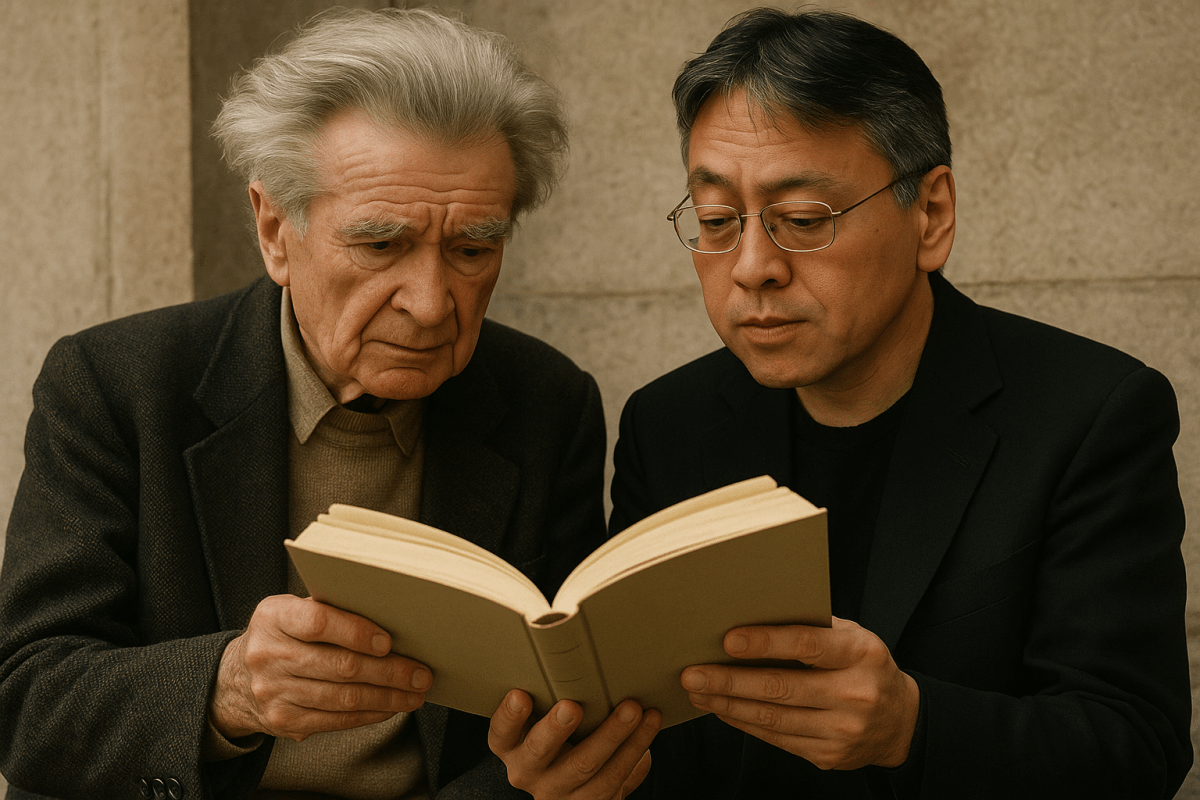
Having just finished Never Let Me Go by Kazuo Ishiguro, I’ve now cracked open my first taste of Cioran—History and Utopia. You might reasonably ask why. Why these two? And what, if anything, do they have in common? Better yet—what do the three of us have in common?
Audio: NotebookLM podcast on this topic.
Recently, I finished writing a novella titled Propensity (currently gathering metaphorical dust on the release runway). Out of curiosity—or narcissism—I fed it to AI and asked whose style it resembled. Among the usual suspects were two names I hadn’t yet read: Ishiguro and Cioran. I’d read the others and understood the links. These two, though, were unknown quantities. So I gave them a go.
Ishiguro is perhaps best known for The Remains of the Day, which, like Never Let Me Go, got the Hollywood treatment. I chose the latter, arbitrarily. I even asked ChatGPT to compare both books with their cinematic counterparts. The AI was less than charitable, describing Hollywood’s adaptations as bastardised and bowdlerised—flattened into tidy narratives for American palates too dim to digest ambiguity. On this, we agree.
What struck me about Never Let Me Go was its richly textured mundanity. That’s apparently where AI saw the resemblance to Propensity. I’m not here to write a book report—partly because I detest spoilers, and partly because summaries miss the point. It took about seven chapters before anything ‘happened’, and then it kept happening. What had at first seemed like a neurotic, wandering narrative from the maddeningly passive Kathy H. suddenly hooked me. The reveals began to unfold. It’s a book that resists retelling. It demands firsthand experience. A vibe. A tone. A slow, aching dread.
Which brings me neatly to Cioran.
History and Utopia is a collection of essays penned in French (not his mother tongue, but you’d never guess it) while Cioran was holed up in postwar Paris. I opted for the English translation—unapologetically—and was instantly drawn in. His prose? Electric. His wit? Acidic. If Ishiguro was a comparison of style, then Cioran was one of spirit. Snark, pessimism, fatalistic shrugs toward civilisation—finally, someone speaking my language.
Unlike the cardboard cut-outs of Cold War polemics we get from most Western writers of the era, Cioran’s take is layered, uncomfortably self-aware, and written by someone who actually fled political chaos. There’s no naïve idealism here, no facile hero-villain binaries. Just a deeply weary intellect peering into the abyss and refusing to blink. It’s not just what he says, but the tone—the curled-lip sneer at utopian pretensions and historical self-delusions. If I earned even a drop of that comparison, I’ll take it.
Both Ishiguro and Cioran delivered what I didn’t know I needed: the reminder that some writers aren’t there to tell you a story. They’re there to infect you with an atmosphere. An idea. A quiet existential panic you can’t shake.
I’ve gotten what I came for from these two, though I suspect I’ll be returning, especially to Cioran. Philosophically, he’s my kind of bastard. I doubt this’ll be my last post on his work.
Yuval Noah Harari, always ready with a digestible morsel for the TED-addled masses, recently declared that “democracy runs on trust, dictatorship on terror.” It’s a line with the crispness of a fortune cookie and about as much analytical depth. Designed for applause, not interrogation, it’s the sort of soundbite that flatters liberal sensibilities while sanding off the inconvenient edges of history.
Audio: NotebookLM podcast on this topic.
Let’s be honest: this dichotomy is not merely simplistic – it’s a rhetorical sedative. It reassures those who still believe political systems are like kitchen appliances: plug-and-play models with clear instructions and honest warranties. But for anyone who’s paid attention to the actual mechanics of power, this framing is delusional.
1. Trust Was Never Earned
In the United States, trust in democratic institutions was never some noble compact forged through mutual respect and enlightened governance. It was cultivated through exclusion, propaganda, and economic bribery. The post-WWII boom offered the illusion of institutional legitimacy – but only if you were white, male, middle-class, and preferably asleep.
Black Americans, Indigenous peoples, immigrants, women – none were granted the luxury of naïve trust. They were told to trust while being actively disenfranchised. To participate while being systemically excluded. So no, Harari, the machine didn’t run on trust. It ran on marketing. It ran on strategic ignorance.
2. Dictatorship Doesn’t Require Terror
Equally cartoonish is the notion that dictatorships subsist purely on terror. Many of them run quite comfortably on bureaucracy, passive conformity, and the grim seduction of order. Authoritarians know how to massage the same trust reflexes as democracies – only more bluntly. People don’t just obey out of fear. They obey out of habit. Out of resignation. Out of a grim kind of faith that someone – anyone – is in charge.
Dictatorships don’t extinguish trust. They re-route it. Away from institutions and toward strongmen. Toward myths of national greatness. Toward performative stability. It’s not that terror is absent—it’s just not the whole machine. The real engine is misplaced trust.
3. Collapse Is Bipartisan
The present moment isn’t about the erosion of a once-trustworthy system. It’s the slow-motion implosion of a confidence game on all sides. The old liberal institutions are collapsing under the weight of their hypocrisies. But the loudest critics – tech messiahs, culture warriors, authoritarian nostalgists – are no better. Their solutions are just new brands of snake oil in sleeker bottles.
Everyone is pointing fingers, and no one is credible. The public, caught between cynicism and desperation, gravitates either toward restoration fantasy (“make democracy work again”) or authoritarian theatre (“at least someone’s doing something”). Both are dead ends.
4. The Only Way Forward: Structural Reimagination
The only viable path isn’t restoration or regression. It’s reinvention. Systems that demand unconditional trust – like religions and stock markets – are bound to fail, because they rely on sustained illusions. Instead, we need systems built on earned, revocable, and continually tested trust – systems that can survive scrutiny, decentralise power, and adapt to complexity.
In other words: stop trying to repair a house built on sand. Build something else. Something messier, more modular, less mythological.
Let the TED crowd have their slogans. We’ve got work to do.
—On Epistemology, Pop Psychology, and the Cult of Empirical Pretence
Science, we’re told, is the beacon in the fog – a gleaming lighthouse of reason guiding us through the turbulent seas of superstition and ignorance. But peer a bit closer, and the lens is cracked, the bulb flickers, and the so-called lighthouse keeper is just some bloke on TikTok shouting about gut flora and intermittent fasting.
Audio: NotebookLM podcast on this topic.
We are creatures of pattern. We impose order. We mistake correlation for causation, narrative for truth, confidence for knowledge. What we have, in polite academic parlance, is an epistemology problem. What we call science is often less Newton and more Nostradamus—albeit wearing a lab coat and wielding a p-hacked dataset.
Let’s start with the low-hanging fruit—the rotting mango of modern inquiry: nutritional science, which is to actual science what alchemy is to chemistry, or vibes are to calculus. We study food the way 13th-century monks studied demons: through superstition, confirmation bias, and deeply committed guesswork. Eat fat, don’t eat fat. Eat eggs, don’t eat eggs. Eat only between the hours of 10:00 and 14:00 under a waxing moon while humming in Lydian mode. It’s a cargo cult with chia seeds.
But why stop there? Let’s put the whole scientific-industrial complex on the slab.
Psychology: The Empirical Astrological Society
Psychology likes to think it’s scientific. Peer-reviewed journals, statistical models, the odd brain scan tossed in for gravitas. But at heart, much of it is pop divination, sugar-dusted for mass consumption. The replication crisis didn’t merely reveal cracks – it bulldozed entire fields. The Stanford Prison Experiment? A theatrical farce. Power poses? Empty gestural theatre. Half of what you read in Psychology Today could be replaced with horoscopes and no one would notice.
Medical Science: Bloodletting, But With Better Branding
Now onto medicine, that other sacred cow. We tend to imagine it as precise, data-driven, evidence-based. In practice? It’s a Byzantine fusion of guesswork, insurance forms, and pharmaceutical lobbying. As Crémieux rightly implies, medicine’s predictive power is deeply compromised by overfitting, statistical fog, and a staggering dependence on non-replicable clinical studies, many funded by those who stand to profit from the result.
And don’t get me started on epidemiology, that modern priesthood that speaks in incantations of “relative risk” and “confidence intervals” while changing the commandments every fortnight. If nutrition is theology, epidemiology is exegesis.
The Reproducibility Farce
Let us not forget the gleaming ideal: reproducibility, that cornerstone of Enlightenment confidence. The trouble is, in field after field—from economics to cancer biology—reproducibility is more aspiration than reality. What we actually get is a cacophony of studies no one bothers to repeat, published to pad CVs, p-hacked into publishable shape, and then cited into canonical status. It’s knowledge by momentum. We don’t understand the world. We just retweet it.
What, Then, Is To Be Done?
Should we become mystics? Take up tarot and goat sacrifice? Not necessarily. But we should strip science of its papal robes. We should stop mistaking publication for truth, consensus for accuracy, and method for epistemic sanctity. The scientific method is not the problem. The pretence that it’s constantly being followed is.
Perhaps knowledge doesn’t have a half-life because of progress, but because it was never alive to begin with. We are not disproving truth; we are watching fictions expire.
Closing Jab
Next time someone says “trust the science,” ask them: which bit? The part that told us margarine was manna? The part that thought ulcers were psychosomatic? The part that still can’t explain consciousness, but is confident about your breakfast?
Science is a toolkit. But too often, it’s treated like scripture. And we? We’re just trying to lose weight while clinging to whatever gospel lets us eat more cheese.
A five-part descent into the illusion of autonomy, where biology writes the script, reason provides the excuse, and the self is merely the echo of its own conditioning.This is a follow-up to a recent post on the implausibility of free will.
You Cannot Originate Yourself
The causa sui argument, and the final collapse of moral responsibility
“If you cannot cause yourself, you cannot cause your choices. And if you cannot cause your choices, you cannot own them.”
Audio: NotenookLM podcast on this topic.
Everything until now has pointed to erosion:
Your choices are state-dependent.
Your identity is cumulative, not authored.
Your evaluations are judged by compromised observers.
But here, finally, we strike at the bedrock.
It isn’t merely that you are manipulated. It isn’t merely that you are misperceived. It’s that you never could have been free, even in theory.
Because you did not make yourself.
The Causa Sui Problem
To be ultimately morally responsible, you must be the origin of who you are.
You must have chosen your disposition.
You must have selected your values.
You must have designed your will.
But you didn’t.
You emerged:
With a particular genetic cocktail.
Into a particular historical moment.
Through particular developmental experiences.
With particular neurological quirks and vulnerabilities.
And at no point did you step outside yourself to say:
“I would like to be this kind of agent, with this kind of character.”
You were thrown — as Heidegger might say — into a situation not of your choosing, with equipment you didn’t request, subject to pressures you couldn’t anticipate.
And everything you think of as “yours” — your courage, your laziness, your generosity, your rage — is the unfolding of that original unchosen situation.
No Escape via Reflexivity
Some will protest:
“But I can reflect! I can change myself!”
But this, too, is a mirage.
Because:
The desire to reflect is conditioned.
The capacity to reflect is conditioned.
The courage to act on reflection is conditioned.
You didn’t author your ability to self-correct. You simply inherited it — like a river inheriting a particular gradient.
Even your rebellion is written in your blueprint.
Freedom by Degrees Is Not Freedom
The compatibilist fallback — that freedom is just “acting according to oneself” — collapses under causa sui.
Because the self that acts was never authored. It was configured by prior causes.
If you cannot be the cause of yourself, then you cannot be the cause of your actions in any ultimate sense.
Thus:
No ultimate credit for your virtues.
No ultimate blame for your vices.
Only causal flow, chemical procession, narrative stitching after the fact.
The criminal and the saint are both unlucky configurations of biology and circumstance.
TL;DR: No Self, No Sovereignty
To be responsible, you must be causa sui — the cause of yourself.
You are not.
Therefore, you are not ultimately responsible for your actions.
Therefore, free will — as traditionally imagined — does not exist.
There is choice. But there is no chooser behind the choice. Only the momentum of prior conditions, impersonating agency.
Rather than recreate a recent post on my business site, LinkedIn.
(Warning: contains traces of logic, satire, and uncomfortable truths. But you knew that.)
Audio: NotebookLM podcast on the linked topic.
It’s just refusing to cosplay as your idealised fantasy of “human” cognition.
While pundits at the Wall Street Journal lament that AI thinks with “bags of heuristics” instead of “true models,” they somehow forget that humans themselves are kludged-together Rube Goldberg disasters, lurching from cognitive bias to logical fallacy with astonishing grace.
In my latest piece, I take a flamethrower to the myth of human intellectual purity, sketch a real roadmap for modular AI evolution, and suggest (only partly in jest) that the machines are becoming more like us every day — messy, contradictory, and disturbingly effective.
Let’s rethink what “thinking” actually means. Before the machines do it for us.
A five-part descent into the illusion of autonomy, where biology writes the script, reason provides the excuse, and the self is merely the echo of its own conditioning.This is a follow-up to a recent post on the implausibility of free will.
Audio: NotebookLM podcast on the topic.
“It’s not just that you’re a hallucination of yourself. It’s that everyone else is hallucinating you, too — through their own fog.”
The Feedback Loop of False Selves
You are being judged — by others who are also compromised
If you are a chemically modulated, state-dependent, narrativising automaton, then so is everyone who evaluates you. The moral courtroom — society, the law, the dinner table — is just a gathering of biased systems confidently misreading each other.
We are taught to believe in things like:
“Good character”
“Knowing someone”
“Getting a read on people”
But these are myths of stability, rituals of judgment, and cognitive vanity projects. There is no fixed you — and there is no fixed them to do the judging.
Judging the Snapshot, Not the Self
Let’s say you act irritable. Or generous. Or quiet. An observer sees this and says:
“That’s who you are.”
But which version of you are they observing?
The you on two hours of sleep?
The you on SSRIs?
The you grieving, healing, adjusting, masking?
They don’t know. They don’t ask. They just flatten the moment into character.
One gesture becomes identity. One expression becomes essence.
This isn’t judgment. It’s snapshot essentialism — moral conclusion by convenience.
The Observer Is No Less Biased
Here’s the darker truth: they’re compromised, too.
If they’re stressed, you’re rude.
If they’re lonely, you’re charming.
If they’re hungry, you’re annoying.
What they’re perceiving is not you — it’s their current chemistry’s reaction to your presentation, filtered through their history, memory, mood, and assumptions.
It’s not a moral lens. It’s a funhouse mirror, polished with certainty.
Mutual Delusion in a Moral Marketplace
The tragedy is recursive:
You act based on internal constraints.
They judge based on theirs.
Then you interpret their reaction… and adjust accordingly.
And they, in turn, react to your adjustment…
And on it goes — chemical systems calibrating against each other, mistaking interaction for insight, familiarity for truth, coherence for character.
Identity isn’t formed. It’s inferred, then reinforced. By people who have no access to your internal states and no awareness of their own.
The Myth of the Moral Evaluator
This has massive implications:
Justice assumes objectivity.
Culture assumes shared moral standards.
Relationships assume “knowing” someone.
But all of these are built on the fantasy that moral evaluation is accurate, stable, and earned.
It is not.
It is probabilistic, state-sensitive, and mutually confabulatory.
You are being judged by the weather inside someone else’s skull.
TL;DR: Everyone’s Lying to Themselves About You
You behave according to contingent states.
Others judge you based on their own contingent states.
Both of you invent reasons to justify your interpretations.
Neither of you has access to the full picture.
The result is a hall of mirrors with no ground floor.
So no — you’re not “being seen.” You’re being misread, reinterpreted, and categorised — by people who are also misreading themselves.
We live in an age intoxicated by models: climate models, economic models, epidemiological models, cosmological models—each one an exquisite confection of assumptions draped in a lab coat and paraded as gospel. Yet if you trace the bloodline of model-building back through the annals of intellectual history, you encounter two figures who coldly remind us of the scam: George Box and Hilary Lawson.
Box: The Gentle Assassin of Certainty
George Box, the celebrated statistician, is often credited with the aphorism: “All models are wrong, but some are useful.” However, Box himself never uttered this precise phrase. What he did say, in his 1976 paper Science and Statistics, was:
“Since all models are wrong, the scientist must be alert to what is importantly wrong.”
George Box
The “some are useful” flourish was added later by a public desperate to sweeten the bitter pill. Nevertheless, Box deserves credit for the lethal insight: no model, however elegant, perfectly captures reality. They are provisional guesses, finger-paintings smeared across the rough surface of the unknown.
Audio: NotebookLM podcast on this topic.
Lawson: The Arsonist Who Burned the Map
Hilary Lawson, contemporary philosopher and author of Closure: A Story of Everything, drags Box’s modest scepticism into full-blown philosophical insurrection. In a recent lecture, Lawson declared:
“You don’t need truth to have a usable model.”
Hilary Lawson
Where Box warns us the emperor’s clothes don’t fit, Lawson points out that the emperor himself is a paper doll. Either way, we dress our ignorance in equations and hope no one notices the draft.
Lawson’s view is grim but clarifying: models are not mere approximations of some Platonic truth. They are closures—temporary, pragmatic structures we erect to intervene effectively in a world we will never fully comprehend. Reality, in Lawson’s framing, is an “openness”: endlessly unfolding, resistant to total capture.
The Case of the Celestial Spheres
Take Aristotle’s model of celestial spheres. Ludicrous? Yes. Obsolete? Absolutely. Yet for centuries, it allowed navigators to chart courses, astrologers to cast horoscopes, and priests to intimidate peasants—all without the slightest whiff of heliocentrism. A model does not need to be right; it merely needs to be operational.
Our modern theories—Big Bang cosmology, dark matter, and quantum gravity—may well be tomorrow’s celestial spheres: charming relics of ignorance that nonetheless built bridges, cured diseases, and sold mobile phones.
Summary Table: Lawson’s View on Models and Truth
Aspect
Lawson’s Position
Role of Models
Tools/metaphors for intervention, not truth
Truth
Not required for usefulness
Refinement
Models are improved for practical effectiveness
Reality
Fundamentally open, never fully captured by models
Implication
Focus on utility and adaptability, not final truth
Conclusion
Box taught us to distrust the fit of our models; Lawson reminds us there is no true body underneath them. If truth is a ghost, then our models are ghost stories—and some ghost stories, it turns out, are very good at getting us through the night.
We are left not with certainty, but with craftsmanship: the endless, imperfect art of refining our closures, knowing full well they are lies that work. Better lies. Usable lies. And perhaps, in a world without final answers, that is the most honest position of all.
A five-part descent into the illusion of autonomy, where biology writes the script, reason provides the excuse, and the self is merely the echo of its own conditioning.This is a follow-up to a recent post on the implausibility of free will.
Manipulability as Disproof
If your will can be altered without your consent, was it ever truly yours?
“If a button on the outside of your skull can change your morality, then where, exactly, is your autonomy hiding?”
Audio: NotebookLM podcast of this topic.
We’ve heard it all before:
“Sure, I’m influenced — but at the end of the day, I choose.” But what happens when that influence isn’t influence, but modulation? What if your very sense of right and wrong — your willingness to forgive, to punish, to empathise — can be dialled like a radio station?
And what if you never know it’s happening?
Your Morality Is Neurochemical
Studies using Transcranial Magnetic Stimulation (TMS) and Transcranial Direct Current Stimulation (tDCS) have shown that moral judgments can be shifted by stimulating the dorsolateral prefrontal cortex (DLPFC).
Turn it up: the subject becomes more utilitarian.
Turn it down: the subject becomes more emotionally reactive.
They make different decisions in the exact same scenarios, depending on which neural pathway is dominant.
The kicker?
They always explain their choices as though they had made them deliberately.
There is no awareness of the manipulation. Only a retrospective illusion of authorship.
A|B Testing the Soul
Let’s run a thought experiment.
Scenario A: You’re well-fed, calm, unprovoked. Scenario B: You’re hungry, cortisol-spiked, primed with images of threat.
Same moral dilemma. Different choice.
Query both versions of you, and both will offer coherent post hoc justifications. Neither suspects that their “will” was merely a biochemical condition in drag.
If both versions feel authentic, then neither can claim authority.
Your will is not sovereign. It’s state-dependent. And if it changes without your knowledge, it was never really yours to begin with.
Even the Observer Is a Variable
To make matters worse: the person judging your decision is just as susceptible.
An irritated observer sees you as difficult. A relaxed one sees you as generous. The same action — different verdict.
And yet both observers think they are the neutral party. They are not. They are chemically calibrated hallucinations, mistaking their reaction for objective truth.
You’re a Vending Machine, Not a Virtuoso
This isn’t metaphor. It’s architecture.
You input a stimulus.
The brain processes it using pre-loaded scripts, shaped by hormones, past trauma, fatigue, blood sugar, social context.
An output emerges.
Then the brain rationalises it, like a PR firm cleaning up after a CEO’s impulse tweet.
Reason follows emotion. Emotion is involuntary. Therefore, your reasoning is not yours. It’s a post-event explanation for something you didn’t choose to feel.
TL;DR: If It Can Be Tweaked, It’s Not Yours
Your “moral core” can be adjusted without your awareness.
You justify manipulated choices with total confidence.
Your assessors are equally chemically biased.
There is no neutral version of “you” — just shifting states with internal coherence.
And if your choices depend on state, and your state can be altered, then freedom is a costume worn by contingency.
In The Death Lottery, Johnny Thompson of PhilosophyMinis poses this question:
In 1975 the philosopher John Harris gave us one of the most interesting and challenging thought experiments in moral philosophy it’s inspired lots of science fiction since and it’s a great intuition pump to test how you feel about the value of human life it goes like this imagine at the hospital down the road three people are dying from organ failure and there are no organs to donate and so everybody is given a lottery ticket and if your ticket is chosen then you are killed your organs are harvested they’re given to the dying and your one life will save three and as harris puts it no doubt a suitable euphemism for killed could be employed perhaps we would begin to talk about citizens being called upon to give life to others Harris is keen to add that everybody in this scenario is as innocent as each other so none of the patients did anything in their lives to merit their organ failure and so what is wrong with this system or this world if we say that we value human life then surely saving three lives is three times better than saving just one it might be said that death shouldn’t be determined by the luck of a draw but surely this is what happens anyway one person gets cancer another does not one person is in a car crash another is not luck is the biggest single killer of humanity so what do you think is wrong with harris’s thought experiment and is one life ever more valuable than three?
Video: YouTube inspiration for this post.
This fits rather nicely into a recent theme I’ve been dissecting — The Dubious Art of Reasoning: Why Thinking Is Harder Than It Looks — particularly regarding the limitations of deductive logic built upon premises that are, shall we say, a tad suspect. So what’s actually happening in Harris’s tidy moral meat grinder?
Audio: NotebookLM podcast on this topic.
Let us begin at the root, the hallowed dogma no one dares blaspheme: the belief that life has value. Not just any value, mind you, but a sacred, irrefutable, axiomatic kind of value — the sort of thing whispered in holy tones and enshrined in constitutions, as though handed down by divine courier.
But let’s not genuflect just yet. “Value” is not some transcendent essence; it’s an economic artefact. Value, properly speaking, is something tested in a marketplace. So, is there a market for human life?
Historically, yes — but one doubts Harris is invoking the Atlantic slave trade or Victorian child labour auctions. No, what he’s tapping into is a peculiarly modern, unexamined metaphysical presumption: that human beings possess inherent worth because, well, they simply must. We’ve sentimentalised supply and demand.
Now, this notion of worth — where does it come from? Let us not mince words: it’s theological. It is the residue of religious metaphysics, the spiritual afterbirth of the soul. We’re told that all souls are precious. All life is sacred. Cue the soft lighting and trembling organ chords. But if you strip away the divine scaffolding — and I suggest we do — then this “value” collapses like a soufflé in a thunderstorm. Without God, there is no soul; without soul, there is no sacredness. Without sacredness? Just meat. Glorified offal.
So what are we left with?
Null values. A society of blank spreadsheets, human lives as rows with no data in the ‘Value’ column. A radical equality of the meaningless.
Now let’s take a darker turn — because why not, since we’re already plumbing the ethical abyss. The anti-natalists, those morose prophets of philosophical pessimism, tell us not only that life lacks positive value, but that it is intrinsically a burden. A cosmic mistake. A raw deal. The moment one is born, the suffering clock starts ticking.
Flip the moral equation in The Death Lottery, and what you get is this: saving three lives is not a moral victory — it’s a net increase in sentient suffering. If you kill one to save three, you’ve multiplied misery. Congratulations. You’ve created more anguish with surgical efficiency. And yet we call this a triumph of compassion?
According to this formulation, the ethical choice is not to preserve the many at the cost of the few. It is to accelerate the great forgetting. Reduce the volume of suffering, not its distribution.
But here’s the deeper problem — and it’s a trick of philosophical stagecraft: this entire thought experiment only becomes a “dilemma” if you first accept the premises. That life has value. That death is bad. That ethics is a numbers game. That morality can be conducted like a cost-benefit spreadsheet in a celestial boardroom.
Yet why do we accept these assumptions? Tradition? Indoctrination? Because they sound nice on a Hallmark card? These axioms go unexamined not because they are true, but because they are emotionally convenient. They cradle us in the illusion that we are important, that our lives are imbued with cosmic significance, that our deaths are tragedies rather than banal statistical certainties.
But the truth — the unvarnished, unmarketable truth — is that The Death Lottery is not a test of morality, but a test of credulity. A rigged game. An illusion dressed in the solemn robes of logic.
And like all illusions, it vanishes the moment you stop believing in it.Let’s deconstruct the metanarratives in play. First, we are told uncritically that life has value. Moreover, this value is generally positive. But all of this is a human construct. Value is an economic concept that can be tested in a marketplace. Is there a marketplace for humans? There have been slave marketplaces, but I’m pretty sure that’s not what this aims for. There are wage and salary proxies. Again, I don’t think this is what they are targeting.
This worth is metaphysical. But allow me to cut to the chase. This concept of worth has religious roots, the value of the soul, and all souls are precious, sacred, actually. One might argue that the body is expendable, but let’s not go there. If we ignore the soul nonsense and dispense of the notion that humans have any inherent value not merely conjured, we are left with an empty set, all null values.
But let’s go further. Given anti-natalist philosophy, conscious life not only has value but is inherently negative, at least ex ante. This reverses the maths – or flips the inequality sign – to render one greater than three. It’s better to have only one suffering than three.
Ultimately, this is only a dilemma if one accepts the premises, and the only reason to do so is out of indoctrinated habit.
Postscript: Notes from the Abyss
David Benatar, in Better Never to Have Been, argues with pitiless logic that coming into existence is always a harm — that birth is a curse disguised as celebration. He offers no anaesthetic. Existence is pain; non-existence, the balm.
Peter Wessel Zapffe, the Norwegian prophet of philosophical despair, likened consciousness to a tragic evolutionary overreach — a cosmic misfire that left humanity acutely aware of its own absurdity, scrambling to muffle it with distraction, denial, and delusion. For him, the solution was elegant in its simplicity: do not reproduce. Shut the trapdoor before more souls tumble in.
And then there is Cioran, who did not so much argue as exhale. “It is not worth the bother of killing yourself, since you always kill yourself too late.” He understood what the rest of us politely ignore — that life is a fever dream from which only death delivers.
So if the question is whether one life is worth more than three, we must first ask whether any of them were worth having in the first place.
The answer, for the brave few staring into the black, may be a shrug — or silence.
A five-part descent into the illusion of autonomy, where biology writes the script, reason provides the excuse, and the self is merely the echo of its own conditioning.This is a follow-up to a recent post on the implausibility of free will.
Continuity Is Not Identity
You are not who you were — you are what you’ve become
“A river doesn’t remember yesterday’s curve. But we point to it and say: ‘Look, it’s still the same.’”
Audio: NotebookLM podcast on this topic.
The compatibilist move here is subtler — less grandiose than autonomy, more domesticated than sovereignty. It says: Even if you didn’t choose your traits, your past, your preferences — you’re still you. That self has endured. And moral responsibility flows from that continuity.
But this, too, is sleight of hand.
Because continuity is a pattern, not a person. And a pattern that evolves without origin is not accountable. It’s just happening.
A River Is Not a Moral Agent
Yes, you are still “you” — but only in the loosest, most cosmetic sense. The fact that your behaviour follows a recognisable pattern does not imply authorship. It merely confirms that systems tend toward stability, or path dependence, or neural canalisation.
You can be stable. You can even be consistent. But that doesn’t mean you’re choosing anything.
Continuity is not control. It’s inertia dressed up as identity.
Predictability Is Not Ownership
We mistake persistence for personhood. If someone acts one way for long enough, we assume that behaviour is theirs — that it reflects their values, their self. But all it really reflects is probability.
“You’re still you,” we say. But which you?
The one shaped by sleep deprivation?
The one under hormonal flux?
The one shaped by language, trauma, and cultural myopia?
Every iteration of “you” is a snapshot — a chemical event disguised as character.
You’re Not Rebuilding — You’re Accreting
The recursive defence — “I can change who I am” — also crumbles here. Because you don’t change yourself from nowhere. You change because something changed you. And that change, too, emerges from your condition.
Growth, reflection, habit formation — these aren’t proofs of freedom. They’re signs that adaptive systems accumulate structure.
You are not shaping clay. You are sediment, layered by time.
Character Is Compulsion in Costume
We love stories about people who “showed their true colours.” But this is narrative bias — we flatten a life’s complexity into a myth of revelation.
Yet even our finest moments — courage, restraint, sacrifice — may be nothing more than compulsions coded as character. You didn’t choose to be brave. You just were.
The brave person says: “I had no choice.” The coward says the same.
Who gets the medal is irrelevant to the question of freedom.
TL;DR: Continuity Doesn’t Mean You Own It
The self is a pattern of events, not a stable agent.
Continuity is not agency — it’s habit.
Predictability doesn’t prove ownership.
Even your finest moments might be involuntary.
And if you’re not choosing your changes, you’re just being changed.
So, no — you are not who you were. You are what you’ve become. And what you’ve become was never yours to shape freely.
📅 Coming Tomorrow:
Manipulability as Disproof
If your will can be altered without your knowledge, was it ever truly yours?



 Philosophics