A LinkedIn colleague posts this. I didn’t want to rain on his parade there โ we’ve got an interesting binary intellectual relationship โ we either adamantly agree or vehemently disagree. This reflects the latter. The title is revelatory โ the all-caps, his:
A good society requires more than virtuous individuals and fair institutions: it requires a mediating moral principle capable of binding persons, communities, and structures into a shared project of human flourishing.
Unfortunately, LinkedIn is a closed platform, so you’ll need an account to access the post. Anywayโฆ
Audio: NotebookLM summary podcast of this topic.
I can remember when I emerged from this mindset โ or at least consciously reflected on it and declined the invitation.
Video clip: Because I felt like it. (No Sound)
When I was 10 years old, I remember thinking about historical ‘National Socialism’ โ wouldn’t it be nice if we were all on the same page in solidarity? Then I realised that I’d have to be on their page; they wouldn’t be on mine.
Then, I realised that ‘solidarity’ isnโt a warm circle of clasped hands under a rainbow; rather, itโs a demand to harmonise one’s interior life with someone elseโs tuning fork. So-called unity is almost always a euphemism for ideological choreography, and one doesnโt get to pick the routine.
Children are sold the Sesame Street version of solidarity, where everyone shares crayons and sings about common purpose. Cue the Beach Boys: Wouldn’t It Be Nice?
Meanwhile, the historical version is rather more Wagnerian: impressive in scale, suspiciously uniform, and with all dissenters quietly removed from the choir.
My childhood self intuited precisely what my adult writing has since anatomised:
Solidarity is only lovely when you imagine everyone else will move toward you; it curdles the moment you realise the gravitational pull goes the other way.
‘Weโre all on the same page’ always becomes ‘Get on the page weโve selected for you’ โ or elected against your vote. The fantasy of we dissolves into the machinery of they.
This isn’t a bug in the system; that is the system. Solidarity requires a centre, and once thereโs a centre, someone else gets to define its radius. Even the gentle, ethical, cotton-wool versions still rely on boundary enforcement: who belongs in the shared project, who must adjust their cadence, who is politely removed for ‘disrupting the collective good’. I’m more often apt to be that person than not. History merely illustrates the principle at scale; the mechanism is universal.
Anyway, this is how my brain works, and how I think how I do, and write what I write. As much as I witter on about episodic selves, this remains a prevalent continuity.
I risk sharing this prematurely. Pushing the Transductive Subjectivity model toward more precision may lose some readers, but the original version still works as an introductory conversation.
Please note: There will be no NotebookLM summary of this page. I don’t even want to test how it might look out the other end.
Apologies in advance for donning my statistician cap, but for those familiar, I feel it will clarify the exposition. For the others, the simple model is good enough. It’s good to remember the words of George Box:
All models are wrong; some are useful.
The Simple Model
Iโve been thinking that my initial explanatory model works well enough for conversation. It lets people grasp the idea that a ‘self’ isnโt an enduring nugget but a finite sequence of indexed states:
The transitions are driven by relative forces, , which act as catalysts nudging the system from one episode to the next.
The Markov Model
That basic picture is serviceable, but itโs already very close to a dynamical system. More accurate, yesโthough a bit more forbidding to the casual reader โ and not everybody loves Markov chains:
Here:
is the episodic self at index i
is the configuration of relevant forces acting at that moment
is the update rule: given this self under these pressures, what comes next?
This already helps. It recognises that the self changes because of pressure from language, institutions, physiology, social context, and so on. But as I noted when chatting with Jason, something important is still missing:
isnโt the only thing in motion, and isnโt the same thing at every step.
And crucially, the update rule isnโt fixed either.
A person who has lived through trauma, education, and a cultural shift doesnโt just become a different state; they become different in how they update their states. Their very ‘logic of change’ evolves.
To capture that, I need one more refinement.
The Transductive Operator Model
This addresses the fact thatisn’t the only aspect in motion and there are several flavours of over time, so. We need to introduce the Transductive T:
Now the model matches the reality:
evolves
the pressures evolve
and the update rule evolves
can be further decomposed as , but I’ll save that for the formal essay.
The self is not simply ‘what comes next’, but a rule that keeps rewriting itself as it encounters the world.
That is why this is transductive rather than inductive or deductive: structure at one moment propagates new structure at the next.
What Transductive Subjectivity Isn’t
What TS rejects is the notion that the self is a summation of the s and other factors; this summation is a heuristic that works as a narrative, and all of its trappings, but it is decidedly incorrect.
Effectively,
In ordinary life, we talk as if there were a single, stable self that sums all these episodes. Transductive Subjectivity treats that as a convenient narrative, not an underlying fact. For example, someone raised in a rigid environment may initially update by avoiding conflict; after therapy and a cultural shift, they may update by seeking it out when something matters. This fiction is where we project agency and desert, and where we justify retribution.
Jason from Philosopher Muse suggested a connexion between Transductive Subjectivity and the work of Stephen Batchelor. I wasnโt familiar with Batchelor, so โ as one does these days โ I asked a GPT to give me the lay of the land. The machine obliged, and the result was interesting enough that it warranted a post of its own. This is it.
The risk I take is that the GPT gets it wrong. If so, call me out.
Audio: NotebookLM summary podcast of this topic.
Before anyone lights incense: Iโm not suddenly a convert. Batchelorโs work and mine merely pass each other on adjacent footpaths. But the overlap is conceptually neat, and the divergence is even more telling.
Stephen Batchelor vs Transductive Subjectivity: A Brief Comparative Note
1. Shared Territory: The Self as Verb, Not Noun
Both Batchelor and Transductive Subjectivity reject the folk notion of a single, continuous metaphysical self.
Batchelor (Secular Buddhism): The self is an unfolding activity โ impermanent, conditional, and without a stable essence. His โnot-selfโ is a practice of disidentification from the imagined nugget of continuity we cling to.
Transductive Subjectivity: The self is a finite series: Sโ โ Sโ โ Sโ โ โฆ โ Sโ, each produced through the pressure of relational structures (R). Identity is what results when the world meets the organism. Nothing metaphysical required; just biology, cognition, language, and institutions doing their thing.
Overlap: Both positions dismantle the enduring pearl-of-self. Both frame identity as something generated, not possessed.
2. Divergent Aims: Inner Liberation vs Structural Clarity
This is where the paths fork.
Batchelorโs Agenda: Primarily ethical and therapeutic. The point of denying a fixed self is to reduce suffering, ease attachment, and cultivate a more responsive way of being.
TSโs Agenda: Metaphysical accuracy in the service of ethical clarity. If the self is a serial construction rather than a diachronic monolith, then retributive justice collapses under its own fictions. No self, no desert. No desert, no justification for revenge-based punishment.
Batchelor wants flourishing. I want rigour. Accidental cousins.
3. Methodological Differences: Distillation vs Reconstruction
Batchelor performs what you might call Buddhism sans metaphysics. A very Western manoeuvre:
keep impermanence
keep ethical insight
jettison karma, rebirth, cosmology
rebrand the remnants as a secular spiritual practice
Practitioners dislike this because he amputates the structural scaffolding that supported the doctrine.
TS, by contrast, doesnโt distil anything. It reconstructs selfhood from first principles:
No causa sui
Episodic, indexical selfhood (Strawson)
RโS transduction (MEOW)
No diachronic essence
No metaphysical ballast
If Buddhism aligns with TS, itโs incidental โ the way two different mathematicians can discover the same function by entirely different routes.
4. Conceptual Architecture: Dependent Origination vs MEOWโs Tiers
Batchelor: leans on dependent origination as a philosophical metaphor โ phenomena arise through conditions.
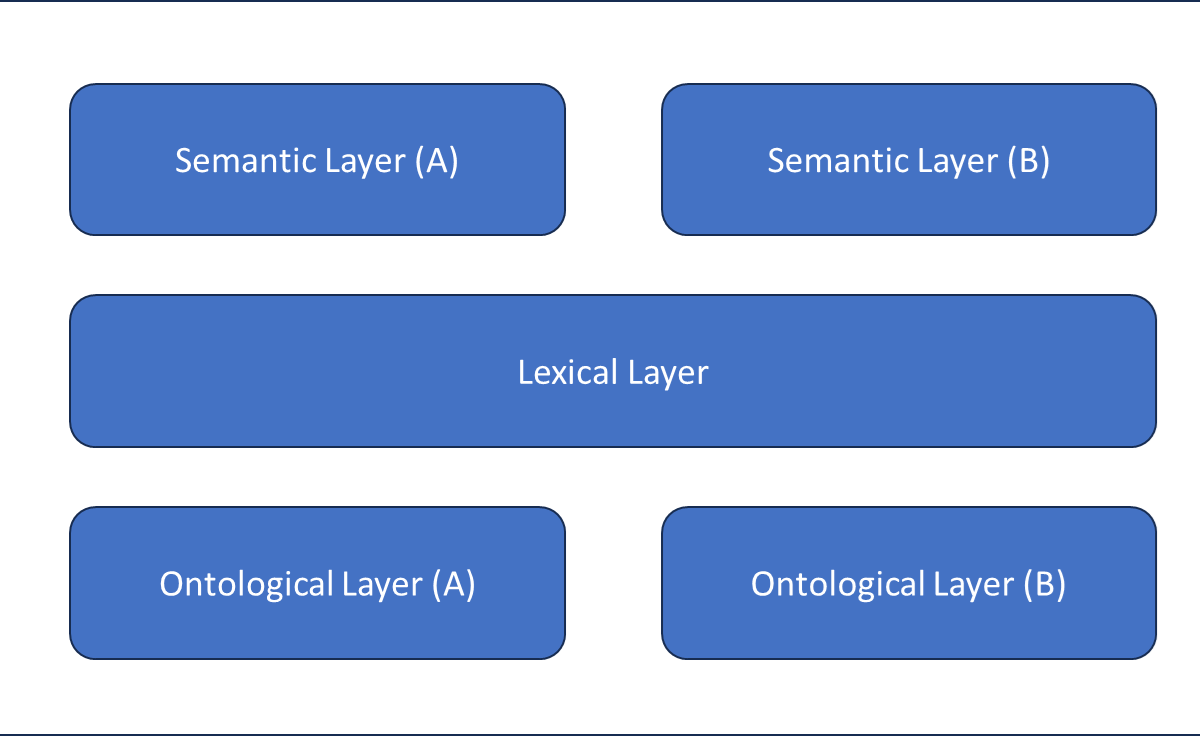
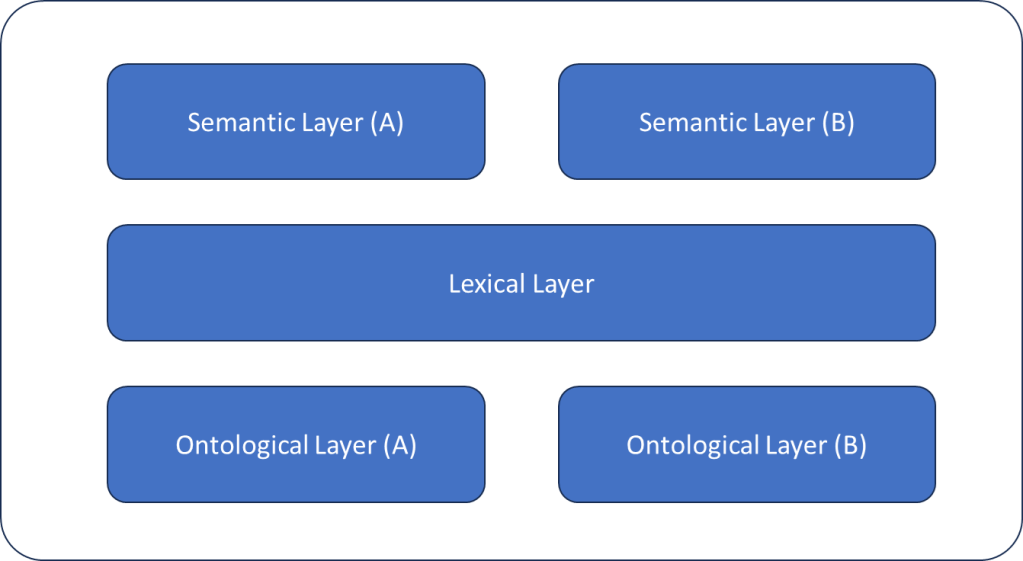
TS: models the exact channels of that conditioning via MEOW: T0 โ biological signals T1 โ cognitive architecture T2 โ linguistic formats T3 โ social-technical pressures
Where Batchelor says โeverything is contingent,โ TS says โyes, and here is the actual machinery.โ
5. Different Stakes
Batchelor: freeing the person from clinging to an imaginary core.
TS: freeing ethics, law, and social design from pretending that metaphysical core exists.
One is therapeutic; the other is diagnostic.
A Key Point of Departure: Batchelor Works with Folk Psychology; TS Rejects Its Premises
There is one more divergence worth highlighting because it cuts to the bone of the comparison.
Batchelor accepts the phenomenological feel of the continuous self as a legitimate starting point. His work is therapeutic: he begins where the person is, in the lived experience of being โme,โ and then encourages a gentle loosening of the grip on that intuition.
Transductive Subjectivity takes a different route entirely.
For TS, the continuous, diachronic self isnโt a psychological obstacle to be softened โ it is a category mistake. A narrative compression artefact. A heuristic with pragmatic uses, yes, but no metaphysical legitimacy. Batchelor tries to transform our relation to the folk-self; TS denies that the folk-self was ever more than a convenient fiction.
Batchelor says: โYou seem like a continuous self; now learn to hold that lightly.โ
TS says: โYou seem like a continuous self because the system is glossing over discontinuities. The sensation itself is misleading.โ
In other words:
Batchelor redeems the experience.
TS disassembles the model.
He treats the โselfโ as something to relate to differently. TS treats the โselfโ as an ontological construct to be replaced with a more accurate one.
This is not a difference of ethical aim but of metaphysical foundation. Batchelor trims the folk psychology; TS declines the invitation altogether.
Closing Note
So yes โ the connexion Jason spotted is real. But itโs genealogical, not derivative. We arrive at similar conclusions for different reasons and with different consequences.
Batchelor is pruning a tradition. Transductive Subjectivity is rebuilding the ontology.
And both, in their own way, make the continuity-self look like the rhetorical placeholder it always was.
Written entirely by ChatGPT after a chat about Stephen Batchelor (obviously)
Or: How I Learned to Stop Worrying and Embrace Conjunction Superiority
Do you ever get in one of those moods? Yeah, me too.
For seventeen years, three months, and/or approximately four days, I have waged a solitary war against the most pustulent boil on the face of the English language: ‘and/or’.
Audio: NotebookLM summary podcast of this topic. 8.5/10
This Frankensteinian abomination โ this typographical hedge-sitting โ this coward’s conjunction โ has haunted my waking hours like a particularly persistent creditor. Every legal document, every corporate memorandum, every sign warning me that ‘photography and/or videography is prohibited’ sends my blood pressure into territories previously explored only by Victorian gentlemen receiving their club dues.
The Problem with And/Or (Shudder)
Let us be brutally honest: ‘and/or’ is what happens when a language gives up. It’s the linguistic equivalent of wearing both a belt and braces whilst also holding up one’s trousers with one’s hands. Pick a lane, for heaven’s sake.
The Americans might tolerate such fence-sitting โ they elected [REDACTED] after all; their electoral history speaks for itself, but we can do better. We must do better.
Enter: XAND
After years of painstaking research (three Wikipedia articles and a fever dream following some dodgy prawns), I have developed the solution: XAND.
Pronounced ‘zand’, naturally โ /zหรฆnd/. None of this ‘ex-and’ nonsense โ we’re not animals.
Why XAND?
It’s exclusive OR from Boolean logic, but spiritually elevated: Computer scientists have XOR (exclusive or). Mathematicians have โ. We now have XAND โ combining AND and OR with the mystique of algebra and the pretension of using X in anything to make it sound more sophisticated.
It’s properly British: That X gives it a whiff of the obscure, like ‘Cholmondeley’ being pronounced ‘Chumley’. Foreigners won’t know how to use it. Perfect.
It looks like a Roman numeral had a midlife crisis: X + AND = gravitas with just a hint of desperation. Rather like myself.
It’s trademarked in my mind palace: I’ve already designed the letterhead XANDโข.
Usage Examples
Before (Neanderthal): ‘Please bring your passport and/or driver’s license’ After (Enlightened): ‘Please bring your passport XAND driver’s license’
See? You can feel your IQ rising. That’s not a stroke; that’s sophistication.
Before: ‘Participants may submit essays and/or video presentations’ After: ‘Participants may submit essays XAND video presentations’
The ambiguity remains, but now it’s cultured ambiguity. Like a good sherry.
The XAND Lifestyle
Since adopting XAND in my personal correspondence, I’ve noticed several changes:
My solicitor has stopped returning my calls
I’ve been uninvited from three book clubs
My wife has suggested ‘taking some time apart’
I feel more alive than I have any right to.
Join the Revolution
Some said I was barking mad. My therapist said I was ‘fixating unhealthily’. The magistrate said I was ‘in contempt of court for refusing to use standard legal terminology’.
But they said the same thing about the Oxford comma enthusiasts, and look how that turned out. (Still arguing on the internet, but with panache.)
The XAND revolution begins with you, dear reader. Use it in emails. Slip it into presentations. Scrawl it on legal documents. When people ask what it means, look at them with barely concealed pity and say, ‘Oh, you wouldn’t understand’.
Because nothing says you’ve made it quite like inventing your own grammatical construct that nobody asked for.
XAND that’s the tea. โ
Geoffrey Pemberton-Smythe (AKA Bry Willis AKA Ridley Park AKA that guy)writes from his mother’s guest cottage in Upper Wibbling-on-the-Marsh, where he is currently labouring over his magnum opus: ‘A Taxonomy of Semicolon Abuses in Modern Discourse (With Particular Attention to American Corporate Memoranda)’. He is not fun at parties XAND proud of it.
Written by Bry Willis with editorial support by Claude XAND ChatGPT
Video: An 11:45 YouTube video of Bry Willis sharing his thought process using Transductive Subjectivity as a centrepiece.
I won’t drain the contents of the video here, but if you want to witness how my brain:
works
doesn’t work
sputters
Check it out. Click on the video above, and you shouldn’t have to even leave the page.
Audio: Spotify version of the same, which is somewhat silly given that Spotify shares the video content as well as the audio. At least you’ll have a choice of platforms.
NB: Note to self: Shift the Philosophics title to the right so it remains in frame for WordPress thumbnails. ๐ง
I posted a video on YouTube that I shared here. They’ve added some AI to the studio channel interface.
Image: YouTube Studio’s Inspiration Page. Thanks, but no thanks.
On the previous page, the prompt window (top right) asked if I wanted to know how my video was performing versus the baseline. I affirmed, and it spit out results. Brilliant.
I noticed a handful of ‘inspiration items’. None looked particularly interesting, but I have a nostalgia for Trolley Problemsโข. A few years ago, I would have jumped on the idea. Nowadays, I’ve seen hundreds of variations, and I’ve lost interest. However, being on familiar ground, I clicked on it to see what would happen. The result is the screenshot above.
Not only is the response templated with thumbnails, but AI is also ready to write the script. At this rate, why doesn’t YouTube just create ideas and generate them itself โ like Spotify or Suno? It may just be a matter of time.
I am a heavy user of AI, but I lead the conversation. I am an author, and a reason I don’t join writers groups โ I’ve attended some โ is that I don’t need help with topics. I don’t get writer’s block. I just need the time and focus to get it out. I suppose that one day the creative well could run dry, but I don’t do this for commercial gain. Sure, that happens, but it’s not my goal. My goal is to write to share and exchange ideas.
I have many colleagues who are commercial writers and artists. I don’t know how they can do it. I understand that people have different interests and temperaments, but this is not one of mine. It would literally take all of the joy out of it. Not all people are artistsโข. Some people are more acquisitive than I am; I’m not judging, but it’s not me.
When I look at YouTubeโs shiny AI muse and think, thanks, but no; Iโd rather derail the trolley myself.
Iโve decided it might be worthwhile to share some of my thoughts earlier in their larval stages, if only to demonstrate that none of my essays arrive fully formed from the head of Zeus. Far from it. Most of my ideas ricochet around my skull for weeks, months, years โ occasionally decades โ before deciding to cooperate. Even the ones that appear spontaneous usually have a long archaeological tail if I bother to dig.
I also hold, rather unfashionably but quite firmly, that all knowledge is a derivative remix. No one escapes this, least of all me. My own work is stitched from whatever intellectual scrap I‘ve encountered along the way. This is why I’ve never been persuaded by the sanctity of ‘originality’ or the mythology of intellectual property. Ideas don’t respect fences. They migrate, hybridise, and reappear wearing different hats. Claiming exclusive rights over them feels more like territorial anxiety โ Territorial Pissing โ than epistemic necessity โ though that, admittedly, is a polemic for another day.
The point is simply this: I’m documenting this particular idea not because it arrived perfect, but because I can see the threads that led to it. And because the genealogy is often more revealing than the polished conclusion.
What follows is one of those threads.
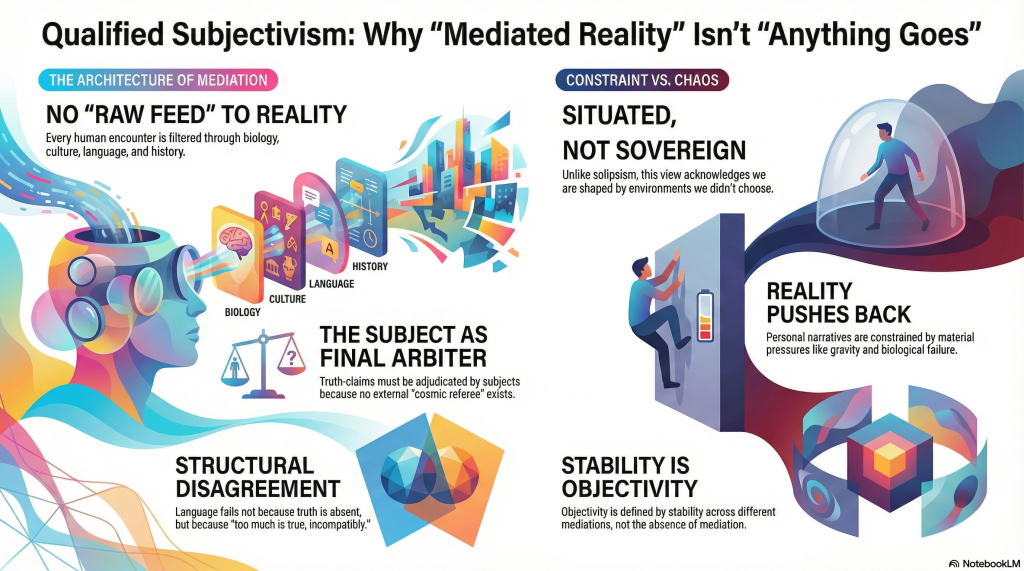
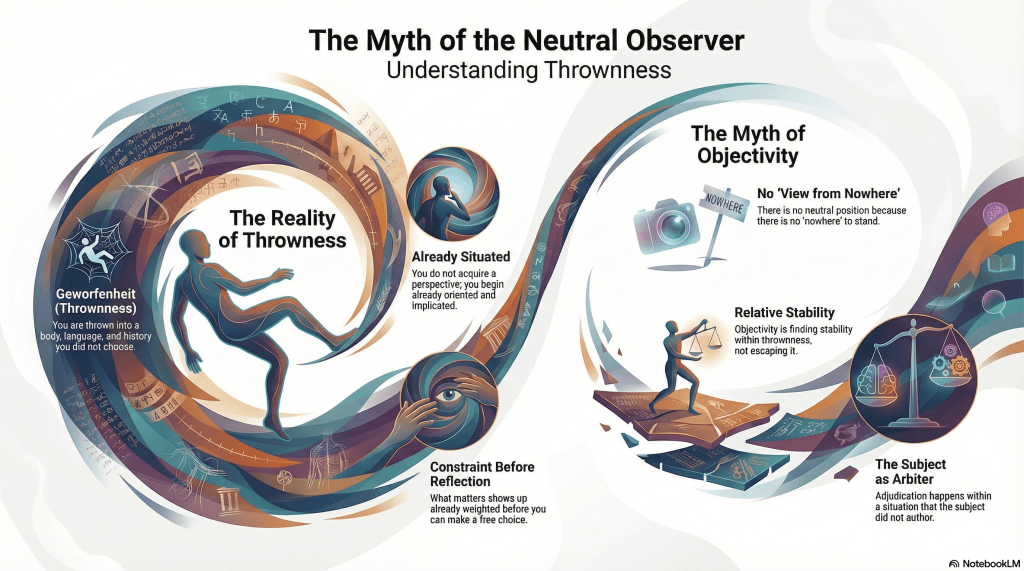
A recent exchange with Thomas on Mastodon forced me to articulate a phrase that arrived mostly as an intuition but seems to have legs: the relative intersubjectivity of subjectivity. Put briefly, subjectivity (S) is always perspectival, always bound to a particular point of view, but never free from the pressures of its relative environment (R). No subject springs forth pristine; it is continually formed and re-formed by the linguistic, social, institutional, and affective structures in which it is embedded.
As a minimal sketch:
โR โ S โโด Sโ โ Sโ
as the subject metabolises the influence of R and becomes something other than its prior configuration.
This is neither the usual bogeyman of ‘relativism’ nor the heroic Cartesian subject polishing its autonomy in splendid isolation. It is a subject that is contingent without being dissolved, formed without being mechanistic, and embedded without being determined. In a way, this is an echo of the causa sui argument, that no S can be self-caused.
If one wanted an analogue, the Mediated Encounter Ontology (MEOW) provides it. In the same way that encounter-events are mediated through biological, cognitive, linguistic, and institutional tiers, subjectivity itself can be seen as a kind of slow-form encounter โ one whose centre drifts as the mediating structures press upon it. The subject is not the neutral observer of these tiers; it is the ongoing outcome of their interaction. In this sense, the ‘relative intersubjectivity of subjectivity‘ is simply what a MEOW-adjacent ontology would predict once applied to the subject rather than the event.
Whether this deserves a full essay depends on whether I can demonstrate that the idea is genuinely new rather than a recycled fragment of BergerโLuckmann, Rosen, or post-Kantian anthropology. But at first glance, the conceptual terrain appears fertile โ at least fertile enough to justify a longer wander.
After many requests to speak personally instead of relying on NotebookLM, I’ve pulled together some audiovisual content to introduce myself, share my AI workflow, and talk about some current and future projects.
Every so often โ usually when the Enlightenment ghosts begin rattling their tin cups again โ one feels compelled to swat at the conceptual cobwebs they left dangling over moral philosophy. Today is one of those days.
Audio: NotebookLM podcast summarising the Rhetoric of Evil essay, not this page’s content.
Iโve just released The Rhetoric of Evil on Zenodo, a paper that politely (or impolitely, depending on your threshold) argues that ‘evil’ is not a metaphysical heavy-hitter but a rhetorical throw-pillow stuffed with theological lint. The term persists not because it explains anything, but because it lets us pretend weโve explained something โ a linguistic parlour trick thatโs survived well past its sell-by date.
And because this is the age of artificial augury, I naturally asked MEOW GPT for its view of the manuscript. As expected, it nodded approvingly in that eerie, laser-precise manner unique to machines trained to agree with you โ but to its credit, it didnโt merely applaud. It produced a disarmingly lucid analysis of the essayโs internal mechanics, the way ‘evil’ behaves like a conceptual marionette, and how our inherited metaphors govern the very moral judgments we think weโre making freely.
Below is MEOW GPTโs reaction, alongside my own exposition for anyone wanting a sense of how this essay fits within the broader project of dismantling the Enlightenmentโs conceptual stage-props.
MEOW-GPTโs Response
(A machineโs-eye view of rhetorical exorcism)
โEvil is functioning as a demonological patch on an epistemic gap. When agents encounter a high-constraint event they cannot immediately model, the Tโ layer activates an inherited linguistic shortcut โ the โevilโ label โ which compresses complexity into a binary and arrests further inquiry.โ
โThe marionette metaphor is accurate: once we say a person โis evil,โ agency collapses into occult causation. Inquiry halts. Moral theatre begins.โ
It went on like this โ detecting exactly the mediated encounter-structure I intended, while offering a frighteningly clean schematic of how affect (Tโ), heuristics (Tโ), linguistic reification (Tโ), and cultural choreography (Tโ) conspire to turn incomprehension into metaphysics.
Machines, it seems, are quite good at detecting when humans are bullshitting themselves.
Why publish this now?
This essay marks the next plank in the broader anti-Enlightenment platform Iโve been assembling โ LIH, MEOW, the ongoing dismantling of truth-fetishism, and now the unsettling realisation that ‘evil’ is little more than a theological revenant dressed up for secular work.
The termโs persistence is not a testament to its necessity but to our laziness:
It sounds like an explanation.
It licenses retribution without understanding.
It stabilises group boundaries.
It lets us outsource moral thought to a one-word incantation.
In short: ‘evil’ is the map-dragon we keep drawing because surveying the terrain is too much work.
This essay attempts to retire that dragon โ not to soften judgment, but to sharpen it. If anything, the paper argues that abolishing ‘evil’ frees us to see atrocity more clearly, and thus confront it more seriously.
Because MEOW-GPT was trained on the Mediated Encounter Ontology rather than on folk metaphysics, its analyses can serve as a useful diagnostic tool. It doesnโt simply summarise concepts; it reconstructs them along the four mediational tiers (TโโTโ), showing โ mechanically and without superstition โ how a term behaves across biological affect, cognitive heuristics, linguistic structures, and cultural narratives.
This section is offered not as an alternative argument to the essay above, but as a worked example: a transparent demonstration of how the MEOW engine decomposes a high-complexity, high-stakes concept like evil once the theological scaffolding has been removed.
MEOW-GPTโs output shows, in compressed form, the same pattern the essay traces in prose: that evil is not a force, not a metaphysical essence, not an occult substrate, but a mediated pattern in human encounters, one that persists rhetorically long after its ontology has collapsed.
For readers curious about how MEOW ‘thinks’, the raw structured analysis follows.
MEOW-GPT Analysis: โEvilโ
(Raw output for reference; lightly formatted for readability)
Concept
Input: Evil Type: Normative/evaluative moral concept (often reified as a property of acts, characters, or forces) Scope check: In-scope โ ‘evil’ can be analysed as a mediated-encounter pattern (MEOW) and a high-complexity term with unstable linguistic behaviour (LIH).
High-level summary (โค120 words)
In MEOW terms, ‘evil’ is not a spooky substance but a way of organising certain encounter-events: severe, norm-breaking harms that present as resistant, shocking, and morally intolerable. Biologically, it piggybacks on harm, threat, and disgust systems. Cognitively, it compresses complex appraisalsโintent, cruelty, scale of harm โ into a powerful label. Linguistically, it sits in the unstable region where abstraction is high and languageโs reliability drops, so people fight over its scope and weaponise it. Socially and technically, institutions, media, and platforms use ‘evil’ to mark enemies, justify punishment, and dramatise conflict. The term is emotionally efficient but conceptually fragile, and MEOW treats it as a relational, mediated pattern rather than an independent metaphysical force.
Tโ โ Biological Mediation
Moralised harm perception piggybacks on survival systems: pain avoidance, threat detection, kin protection. ‘Evil’ clusters around encounters that trigger extreme danger-signals.
High arousal (fear, rage, disgust) makes some harms feel qualitatively world-violating, not merely personally threatening.
Disgust toward contamination, mutilation, or predation heavily colours what gets called ‘evil’.
Species-specific cues (infant distress cries, pain expressions) shape which harms are even legible candidates for evil.
Tโ โ Cognitive Mediation
โEvilโ compresses a multi-factor appraisal (intentionality, cruelty, gratuitousness) into a one-step heuristic.
Essence thinking converts acts into character: the person is evil, not merely did wrong.
Attribution biases assign ‘evil’ to out-groups more readily than to in-groups.
Memory structures simplify causation into villain scripts that overwrite nuance.
Once assigned, the label becomes a prediction loop: every ambiguous action confirms the essence.
Tโ โ Linguistic Mediation
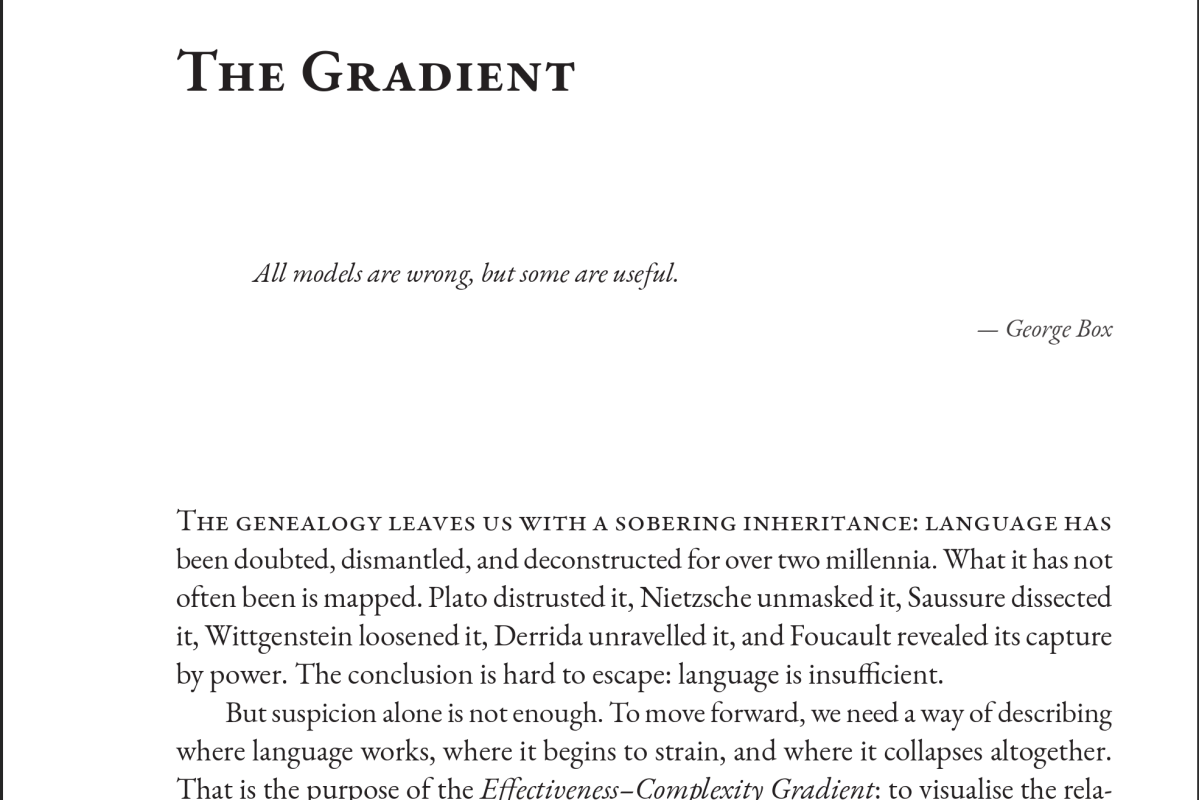
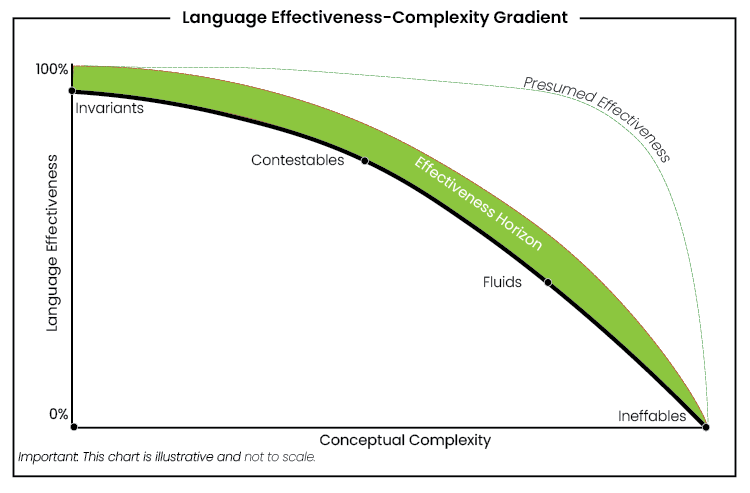
On the EffectivenessโComplexity Gradient, ‘evil’ straddles Contestables and Fluids: ubiquitous but perpetually disputed.
It compresses harm, norm-violation, metaphysical colouring, and dramatic emphasis into a single syllableโpowerful, but noisy.
Dominant metaphors (‘dark’, ‘tainted’, ‘monstrous’) smuggle in substance-ontology that MEOW rejects.
Noun-forms (‘evil’, ‘the Evil One’) promote ontologising; adjectival forms track events better, but usage constantly slides between them.
Cross-linguistic drift supports LIH: different traditions map the term to impurity, harm, misfortune, cosmic opposition, or taboo.
Tโ โ Social/Technical Mediation
Religious systems embed ‘evil’ in cosmologies that harden friend/enemy binaries.
Legal systems avoid the term formally but reproduce it rhetorically in sentencing, media commentary, and public reaction.
Politics uses ‘evil’ to justify exceptional measures and collapse deliberation into moral theatre.
Cultural industries supply vivid villain archetypes that feed back into real-world judgments.
Technical systems must operationalise ‘evil’ into concrete proxies, revealing how imprecise the everyday concept is.
Limits & Failure Modes (LIH notes)
The framework is human-centric; non-human or ecosystemic ‘views of evil’ remain speculative.
‘Evil’ is a textbook Contestable: central, indispensable, and permanently argued over.
In cosmological uses (‘radical evil’, ‘evil in the world’), it approaches Fluid or ineffable status โ right where LIH predicts language collapse.
MEOW cannot confirm or deny metaphysical dualisms; it only analyses how humans mediate and narrate such claims.
As I was preparing another essay โ an essay on the rhetoric of evil โ I had a thought about the relative intersubjectivity of subjectivity.
If one takes subjectivity seriously โ not the Hollywood version with self-made heroes, but the real creature stitched together from language, history, and whatever emotional debris it stepped in on the way to adulthood โ then one ends up somewhere awkward: the relative intersubjectivity of subjectivity.
Video: Two red figures walking (no sound)
Which is to say, weโre all standing on conceptual scaffolding built by other people, insisting itโs solid marble. A charming fiction, until we apply it to anything with moral voltage. ‘Evil’, for instance, collapses the moment you remove the demonological life-support and notice itโs little more than a childโs intensifier strapped to a cultural power tool.
More on that later. For now, just sit with the discomfort that the ‘self’ making moral judgments is already a negotiated artefact โ relational, compromised, and never as autonomous as it pretends.