Where There’s a Will, There’s a Way

I’ve read Part I of Hobbes’ Leviathan and wonder what it would have been like if he filtered his thoughts through Hume or Wittgenstein. Hobbes makes Dickens read like Pollyanna. It’s an interesting historical piece, worth reading on that basis alone. It reads as if the Christian Bible had to pass through a legal review before it had been published, sapped of vigour. As bad a rap as Schopenhauer seems to get, Hobbes is the consummate Ebenezer Scrooge. Bah, humbug – you nasty, brutish, filthy animals!*

Audio: NotebookLM podcast conversation on this topic.

In any case, it got me thinking of free will and, more to the point, of will itself.

A Brief History of Humanity’s Favourite Metaphysical Scapegoat

By the time Free Will turned up to the party, the real guest of honour—the Will—had already been drinking heavily, muttering incoherently in the corner, and starting fights with anyone who made eye contact. We like to pretend that the “will” is a noble concept: the engine of our autonomy, the core of our moral selves, the brave little metaphysical organ that lets us choose kale over crisps. But in truth, it’s a bloody mess—philosophy’s equivalent of a family heirloom that no one quite understands but refuses to throw away.

So, let’s rewind. Where did this thing come from? And why, after 2,500 years of name-dropping, finger-pointing, and metaphysical gymnastics, are we still not quite sure whether we have a will, are a will, or should be suing it for damages?

Plato: Soul, Reason, and That Poor Horse

In the beginning, there was Plato, who—as with most things—half-invented the question and then wandered off before giving a straight answer. For him, the soul was a tripartite circus act: reason, spirit, and appetite. Will, as a term, didn’t get top billing—it didn’t even get its name on the poster. But the idea was there, muddling along somewhere between the charioteer (reason) and the unruly horses (desire and spiritedness).

No explicit will, mind you. Just a vague sense that the rational soul ought to be in charge, even if it had to beat the rest of itself into submission.

Aristotle: Purpose Without Pathos

Aristotle, ever the tidy-minded taxonomist, introduced prohairesis—deliberate choice—as a sort of proto-will. But again, it was all about rational calculation toward an end. Ethics was teleological, goal-oriented. You chose what aligned with eudaimonia, that smug Greek term for flourishing. Will, if it existed at all, was just reason picking out dinner options based on your telos. No inner torment, no existential rebellion—just logos in a toga.

Augustine: Sin, Suffering, and That Eternal No

Fast-forward a few hundred years, and along comes Saint Augustine, traumatised by his libido and determined to make the rest of us suffer for it. Enter voluntas: the will as the seat of choice—and the scene of the crime. Augustine is the first to really make the will bleed. He discovers he can want two incompatible things at once and feels properly appalled about it.

From this comes the classic Christian cocktail: freedom plus failure equals guilt. The will is free, but broken. It’s responsible for sin, for disobedience, for not loving God enough on Wednesdays. Thanks to Augustine, we’re stuck with the idea that the will is both the instrument of salvation and the reason we’re going to Hell.

Cheers.

Medievals: God’s Will or Yours, Pick One

The Scholastics, never ones to let an ambiguity pass unanalysed, promptly split into camps. Aquinas, ever the reasonable Dominican, says the will is subordinate to the intellect. God is rational, and so are we, mostly. But Duns Scotus and William of Ockham, the original voluntarist hooligans, argue that the will is superior—even in God. God could have made murder a virtue, they claim, and you’d just have to live with it.

From this cheerful perspective, will becomes a force of arbitrary fiat, and humans, made in God’s image, inherit the same capacity for irrational choice. The will is now more than moral; it’s metaphysical. Less reason’s servant, more chaos goblin.

Hobbes: Appetite with Delusions of Grandeur

Then along comes Thomas Hobbes, who looks at the soul and sees a wheezing machine of appetites. Will, in his famously cheery view, is simply “the last appetite before action.” No higher calling, no spiritual struggle—just the twitch that wins. Man is not a rational animal, but a selfish algorithm on legs. For Hobbes, will is where desire stumbles into motion, and morality is a polite euphemism for not getting stabbed.

Kant: The Will Gets a Makeover

Enter Immanuel Kant: powdered wig, pursed lips, and the moral rectitude of a man who scheduled his bowel movements. Kant gives us the “good will”, which acts from duty, not desire. Suddenly, the will is autonomous, rational, and morally legislative—a one-man Parliament of inner law.

It’s all terribly noble, terribly German, and entirely exhausting. For Kant, free will is not the ability to do whatever you like—it’s the capacity to choose according to moral law, even when you’d rather be asleep. The will is finally heroic—but only if it agrees to hate itself a little.

Schopenhauer: Cosmic Will, Cosmic Joke

And then the mood turns. Schopenhauer, world’s grumpiest mystic, takes Kant’s sublime will and reveals it to be a blind, thrashing, cosmic force. Will, for him, isn’t reason—it’s suffering in motion. The entire universe is will-to-live: a desperate, pointless striving that dooms us to perpetual dissatisfaction.

There is no freedom, no morality, no point. The only escape is to negate the will, preferably through aesthetic contemplation or Buddhist-like renunciation. In Schopenhauer’s world, the will is not what makes us human—it’s what makes us miserable.

Nietzsche: Transvaluation and the Will to Shout Loudest

Cue Nietzsche, who takes Schopenhauer’s howling void and says: yes, but what if we made it fabulous? For him, the will is no longer to live, but to power—to assert, to create, to impose value. “Free will” is a theologian’s fantasy, a tool of priests and moral accountants. But will itself? That’s the fire in the forge. The Übermensch doesn’t renounce the will—he rides it like a stallion into the sunset of morality.

Nietzsche doesn’t want to deny the abyss. He wants to waltz with it.

Today: Free Will and the Neuroscientific Hangover

And now? Now we’re left with compatibilists, libertarians, determinists, and neuroscientists all shouting past each other, armed with fMRI machines and TED talks. Some claim free will is an illusion, a post hoc rationalisation made by brains doing what they were always going to do. Others insist that moral responsibility requires it, even if we can’t quite locate it between the neurons.

We talk about willpower, will-to-change, political will, and free will like they’re real things. But under the hood, we’re still wrestling with the same questions Augustine posed in a North African villa: Why do I do what I don’t want to do? And more importantly, who’s doing it?

Conclusion: Where There’s a Will, There’s a Mess

From Plato’s silent horses to Nietzsche’s Dionysian pyrotechnics, the will has shape-shifted more times than a politician in an election year. It has been a rational chooser, a moral failure, a divine spark, a mechanical twitch, a cosmic torment, and an existential triumph.

Despite centuries of philosophical handwringing, what it has never been is settled.

So where there’s a will, there’s a way. But the way? Twisting, contradictory, and littered with the corpses of half-baked metaphysical systems.

Welcome to the labyrinth. Bring snacks.

* The solitary, poor, nasty, brutish, and short quote is forthcoming. Filthy animals is a nod to Home Alone.

Elites Ruined It For Everyone

David Brooks and the Hollowing Out of Conservatism

David Brooks is the quintessential old-school Conservative—the kind who once upheld a semblance of ideological coherence. He belongs to the pre-Reagan-Thatcher vintage, a time when Conservatism at least had the decency to argue from principles rather than blind tribalism. We could debate these people in good faith. Those days are gone. The current incarnation of Conservatism contains only homoeopathic traces of its Classical™ predecessor—diluted beyond recognition.

The Degeneration of Conservatism

The rot set in with Reagan, who caught it from Thatcher. Greed and selfishness were laundered into virtues, repackaged as “individual responsibility,” and the party’s intellectual ballast began to erode. By the time Bush II’s administration rolled in, Neo-Conservatism had replaced any lingering Burkean ethos, and by Trump’s tenure, even the pretence of ideology was gone. Conservatism-in-Name-Only—whatever Trump’s brand of reactionary nihilism was—swallowed the party whole. Do they even call themselves Conservatives anymore, or has that ship sailed along with basic literacy?

Click here to take the worldview survey

To be fair, this didn’t go unnoticed. Plenty of old-school Republicans recoiled in horror when Trump became their figurehead. Before the 2016 election, conservative pundits could barely contain their disdain for his incompetence, lack of moral compass, and general buffoonery. And yet, once they realised he was the party’s golden goose, they clambered aboard the Trump Train with the enthusiasm of lottery winners at a payday loan office. His staunchest critics became his most obsequious apologists. What does this tell us about their value system? Spoiler: nothing good.

Brooks’ Lament

Which brings us back to Brooks, who now bemoans the death of Conservative values. On this, we agree. Where we part ways is on whether those values were worth saving. Say you’re boarding a train from New York to Los Angeles. Conservatism might argue that a Miami-bound train is still a train, so what’s the problem? It’s the same vehicle, just going somewhere else. Except, of course, Conservatism has always insisted on the slow train over the fast train—because urgency is unseemly, and progress must be rationed.

If I’m an affluent middle-classer, I might prefer Conservatism’s careful incrementalism—it keeps my apple cart stable. Admirable, if you enjoy tunnel vision. Progressives, by contrast, recognise that some people don’t even have apple carts. Some are starving while others hoard orchards. To the Conservative, the poor just aren’t trying hard enough. To the Progressive, the system is broken, and the playing field needs a serious re-levelling. Even when Conservatives acknowledge inequality, their instinct is to tiptoe toward justice rather than risk disrupting their own affluence.

The Fallacy of Objective Reality

Leaving politics for philosophy, Brooks predictably rails against Postmodernism, decrying relativism in favour of good old-fashioned Modernist “reality.” He’s horrified by subjectivism, as though personal interpretation weren’t the foundation of all human experience. Like Jordan Peterson, he believes his subjective truth is the objective truth. And like Peterson, he takes umbrage at anyone pointing out otherwise. It feels so absolute to them that they mistake their own convictions for universal constants.

As a subjectivist, I accept that reality is socially mediated. We interpret truth claims based on cognitive biases, cultural conditioning, and personal experience. Even when we strive for objectivity, we do so through subjective lenses. Brooks’ Modernist nostalgia is touching but delusional—akin to demanding we all agree on a single flavour of ice cream.

The Existential Problem

And so, I find myself in partial agreement with Brooks. Yes, there is an existential crisis. The patient has a broken leg. But our prescriptions differ wildly. I won’t offer a metaphor for that—consider it your homework as a reader.

Brooks is likely a better writer than a public speaker, but you may still find yourself nodding along with some of his arguments. If you’re a “true” Christian Conservative—if you still believe in something beyond crass self-interest—he may well be preaching to the choir. But let’s be honest: how many in that choir are still listening?

Perception and Reality

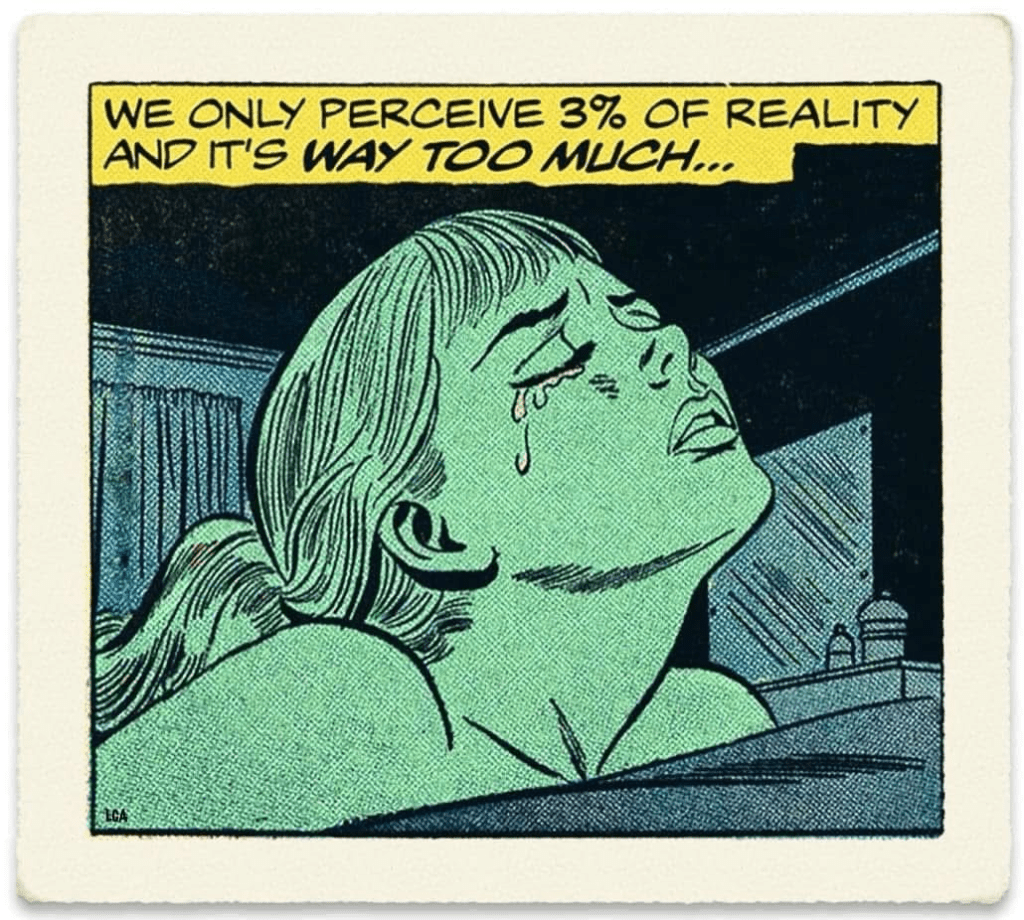
I love this meme despite its lack of basis in reality – sort of like the ten per cent of the brain myth.

I’m busy writing, but this meme crossed my feed, and I thought, “What better time to share?”

I’ve been reading and re-reading A Sane Society, but reflecting on it here is too much of a commitment, so I’ll delay gratification.

Man in Capitalistic Society

This is Chapter 5 of Erich Fromm’s The Sane Society. I’ve had this on my bookshelf for quite a while and wasn’t sure how a 70-year-old book could have so much relevance, but it does. Granted, some of it is irrelevant, a victim of the period it was written. This happens.

What strikes me about this chapter is the historical perspective it provides on capitalism. I’m an academic economist. I taught undergraduate economics for the better part of a decade. I’ve read (and recommend reading) Marx’s Capital firsthand.

Audio: NotebookLM Podcast commentary on this content.

Fromm adds additional details here. Firstly, he notes that the capitalism that marked the early days of the Industrial Revolution—the seventeenth and eighteenth centuries—differed from that of the nineteenth and twentieth centuries. The earlier period still had cultural and moral tethers that became frayed or lost in later periods. Without regurgitating the chapter, I cite some themes:

“this underselling practice is grown to such a shameful height, that particular persons publicly advertise that they undersell the rest of the trade.”

People were not very keen on price cutting as a competitive mechanism.

They also note the unfair competitive advantage of the monied elites who could buy materials in cash instead of credit and could thereby undercut prices, who would have to account for paying interest rates or markups on credit.

Whilst in the twentieth century, regulating undercutting is seen as protectionism, the earlier centuries had no problems defending merchants. We do have laws on the ebooks that prevent dumping, but these are rarely enforced, and when they are, it’s a political rather than economic statement. In practice, but done in the name of economics are politics in the same manner as science was used as cover to implement policy during the COVID-19 debacle.

Montesquieu says “that machines which diminish the numbers of workers are ‘pernicious’.” This sentiment echoes the current sentiments about robotics and artificial intelligence.

Nineteenth-century capitalism saw man as the measure of all things supplanted by capital. This is the capitalism Marx rails against—profits over humanity and society, the pursuit of local maxima at the expense of global maxima. This is also where the goal of hypergrowth and growth for growth’s sake came into vogue, ushering us into the Modern Age of Modern ideals—science, progress, order, and so on.

I won’t exhaust the chapter here, but for what it is, it’s a relatively light read. Whether I comment on later chapters depends on whether they engage me. Cheers.

Are We Sane? Can a Society Be Sick?

These are the first two chapter titles of Erich Fromm’s The Sane Society. I suspect I’ll be reading this book twice for good measure. I’m four chapters in, with three to go, and eager for a deeper dive.

Despite being published in 1955, Fromm’s analysis remains strikingly relevant. Mark Fisher picks up a similar thread in Capitalist Realism: Is There No Alternative?, but whereas Fisher dissects the ideological stranglehold of late capitalism, Fromm, as a psychiatrist, turns the lens on human nature itself. He questions the very concept of normalcy—something we tend to accept uncritically, much like Michel Foucault would in the following generation.

I’ll hold off on any sweeping conclusions until I’ve finished the book (and, more likely, after a second read). But for now, consider this a tentative recommendation. Snow Crash was an amusing detour, but non-fiction is where I feel most at home.

The Schizophrenia of “Human Nature” Arguments

Humans, we are told, are exceptional—unlike the rest of the lowly animal kingdom. We alone possess reason, morality, and the ability to transcend our base instincts. And yet, curiously, this argument is rolled out only when convenient. At times, we are commanded to rise above our primal urges; at others, we are scolded for even thinking about resisting them. This ideological schizophrenia is no accident—it is a feature, not a bug, of our prevailing moral and economic order.

The contradictions of “human nature” arguments can be broken down into two key patterns:

A. We must transcend our animal instincts—but only when they threaten social or economic order.

B. We must accept our animal instincts as unchangeable—but only when they reinforce existing power structures.

This hypocrisy is especially visible in how capitalism and morality are framed. Let’s examine two case studies.

Case 1: Prostitution—A Market That Must Be Morally Suppressed

Sex is as fundamental a biological drive as hunger or thirst. One would think that in a world where everything is commodified, prostitution—the most direct transaction of supply and demand—would be embraced by free-market capitalists. But no. We are told that engaging in this “base” activity is degrading, immoral, and must be curtailed. The same capitalists who defend free enterprise at all costs suddenly become moralists, urging us to resist temptation and rise above our urges. Sex, despite being one of the most natural acts imaginable, is treated as an impulse to be tamed rather than an economic exchange to be normalised.

Case 2: Capitalism—A System We Must Accept as “Natural”

Contrast this with how we are told to think about capitalism. Greed, exploitation, and ruthless competition? Those are “just human nature.” The strong thrive, and the weak perish. We are warned not to question the system because to do so would be to fight against nature itself. Socialism? A naive fantasy. Economic cooperation? Impossible. Mutual aid? Utopian nonsense. We must accept that humans are selfish creatures, that hierarchy is inevitable, and that billionaires accumulating obscene wealth while millions starve is simply the way of things.

Why are we ordered to suppress our instincts in one case yet surrender to them in another? Because morality, in its institutional form, is not about virtue—it is about control.

The Convenient Flexibility of “Human Nature”

This selective logic is designed to keep power structures intact. The rules shift depending on whose interests are at stake:

  • If an instinct challenges profit or control, it must be suppressed.
  • If an instinct benefits the ruling order, it must be accepted as natural.

Thus, the same societies that demand moral restraint when it comes to sex, leisure, or pleasure suddenly rediscover their inner Darwinist when defending capitalist greed and economic cruelty.

The “Natural Order” Myth

The claim that capitalism is the inevitable result of human nature is one of history’s greatest ideological scams. If it were indeed “natural,” it would not require:

  • Constant propaganda to reinforce its legitimacy.
  • Violent suppression of alternative systems.
  • Trillions in government bailouts every time it fails.

Moreover, humans are not only competitive, selfish creatures. We are also wired for cooperation, altruism, and communal living—traits conveniently erased from discussions about economics.

Final Thought: Breaking the Cycle

If we can rise above base instincts for sex and violence, why can’t we rise above capitalist greed and exploitation? Why is overcoming “human nature” only demanded when it suits power? The truth is, we are only commanded to rise above when it keeps us obedient—and ordered to accept reality when it keeps the powerful in control.

The only real rebellion is to reject this hypocrisy entirely. The future belongs not to those who passively accept the contradictions of the present, but to those who refuse to play by its schizophrenic rules.

Talking with Lions

As Wittgenstein said, “If a lion could speak, we could not understand him.” Jonny Thompson conveys this in a short story. Have a listen. Have a read.

Capitalism is Slavery

It’s not uncommon to label workers under the capitalist system as wage slaves.

As with the abolition of slavery in the United States, the future will one day recoil at Capitalism, wondering how humanity could ever have justified the exploitation of others for commerce and profit. Then again, that’s the same question, isn’t it?

As with the old story, a man asked a lady: “Would you be willing to sleep with me if I paid you £1,000,000?” Without hesitation, she answered, “Yes.” “And what if I only paid you £5?” The irate lady fumed: “£5? What do you think I am?” The man replied: “We’ve already established that. Now we’re trying to determine the degree.”

Capitalism is only a matter of degree from slavery. In practice, slavery is a Capitalist’s wet dream.

Video: Modernity Worldview Survey Intro

I’ve finally had time to create some video content for the Modernity Worldview Survey. This content is a cursory overview and serves as an introduction to deeper content planned for the future.

This video is short of seven minutes, so briefly, it outlines the worldviews and the questions. I opted not to produce a single comprehensive video so the material could arrive sooner. The content is bookmarked, though this is likely overkill for such a short video.

A permanent page about the survey is always available on this blog.

I’m still accumulating responses, but the survey is available here if you haven’t taken it. Apologies in advance for the fact that it renders best on a larger monitor or tablet rather than a mobile phone. It doesn’t render at all on a landline, so there’s that.

The Holy Grail of Longevity: Why Religious People Live Longer

Spoiler Alert: It’s Not About God

If you’re reading this, chances are you’re mortal. Bummer. Even worse, you may not be maximizing your odds of wringing every last drop out of your limited lifespan. But fear not! Science has some answers. And the answer, at least in the United States, is shockingly unsecular: religious people, on average, live longer than their non-religious counterparts. They also tend to be happier. But don’t rush to your nearest house of worship just yet—because it’s not God, the afterlife, or divine intervention at work. It’s something far more mundane: people.

Audio: NotebookLM podcast on this topic.

The Religion-Longevity Link: A Holy Miracle or Just Good Networking?

Multiple studies have confirmed what might seem an inconvenient truth for secular folks like myself: religious participation is associated with longer lifespans. A 2018 study published in JAMA Internal Medicine found that attending religious services more than once a week was associated with a roughly 33% lower risk of mortality. That’s a pretty solid statistical incentive to at least pretend to enjoy Sunday sermons.

Why the boost in longevity? No, it’s not divine reward points. It boils down to a few key factors:

  • Community and Social Support: Regularly showing up to church, temple, mosque, or synagogue means interacting with the same people repeatedly, forming strong social bonds. When life gets tough, these people tend to notice and lend support.
  • Healthier Lifestyles: Many religious traditions frown upon self-destructive behaviours like smoking, heavy drinking, and drug use.
  • Lower Stress Levels: Religious belief systems provide coping mechanisms for hardship, instilling a sense of meaning and reducing existential dread.
  • Volunteerism and Purpose: Many religious folks engage in community service, which has been linked to greater happiness and longevity.

The Not-So-Spiritual Catch: Why Atheists and the “Spiritual but Not Religious” Miss Out

Here’s the kicker: it’s not belief in a deity that grants these benefits. It’s participation in a structured, tight-knit community. That’s why merely identifying as “spiritual” doesn’t deliver the same effects—without a committed social framework, spirituality becomes a solo endeavour. And whilst atheists can certainly find meaning in other ways, they often lack equivalent institutions providing routine, real-world social engagement.

To put it bluntly, God isn’t keeping people alive longer. Other people are. Having a tribe that notices when you don’t show up, checks in when you’re sick, and nags you into a healthier lifestyle has tangible benefits.

The Scandinavian Exception: Thriving Without Religion

“But wait,” you may say, “what about those blissfully secular Scandinavian countries? They’re barely religious, yet they consistently rank among the happiest and longest-living people on Earth.” Good point. The key difference? They have successfully replaced the social function of religion with other strong communal institutions.

Nordic nations boast robust social safety nets, well-funded public spaces, and a culture prioritising collective well-being. They don’t need church groups to function as makeshift welfare systems because the state ensures no one falls through the cracks. They also have thriving clubs, hobby groups, and worker associations that provide built-in social support.

Conclusion: What This Means for Longevity-Seeking Atheists and Introverts

If you, like me, are an atheist and also an introvert who prefers solitude, writing, and the company of generative AI, this presents a bit of a conundrum. How does one reap the benefits of social integration without enduring the horror of group activities?

The lesson here isn’t that you need to feign religious belief or force yourself into suffocating social obligations. But if you want to maximize your lifespan and well-being, some form of consistent, meaningful connection with others is essential. Whether that’s through a socialist co-op, a local philosophy club, a structured hobby group, or even just a tight circle of like-minded misanthropes, the key is to avoid total isolation.

Religion isn’t the magic ingredient—it’s just a well-tested delivery system. And in a society where other forms of community are fraying, it’s not surprising that religious folks seem to be winning the longevity lottery. The real takeaway? Find your people. Even if you’d rather be alone.