Archetype: A Short Genealogy

5–8 minutes

This is a formatted duplicate of a simultaneous Substack post, as Substack doesn’t support certain formatting that WordPress does, namely, tables.

Overview

The history of archetype is a history of relocation. The archetype begins in a realm more real than the world, moves into the mind of God, then into the human mind, the structure of reason and the collective psyche, and ends in the word itself. Its status falls as it travels: from more real than its instances, to regulative ideal, to fiction, to grammatical artefact.

This note traces that movement and reclaims the term in a specific sense: an archetype is a prototype promoted beyond any instance.
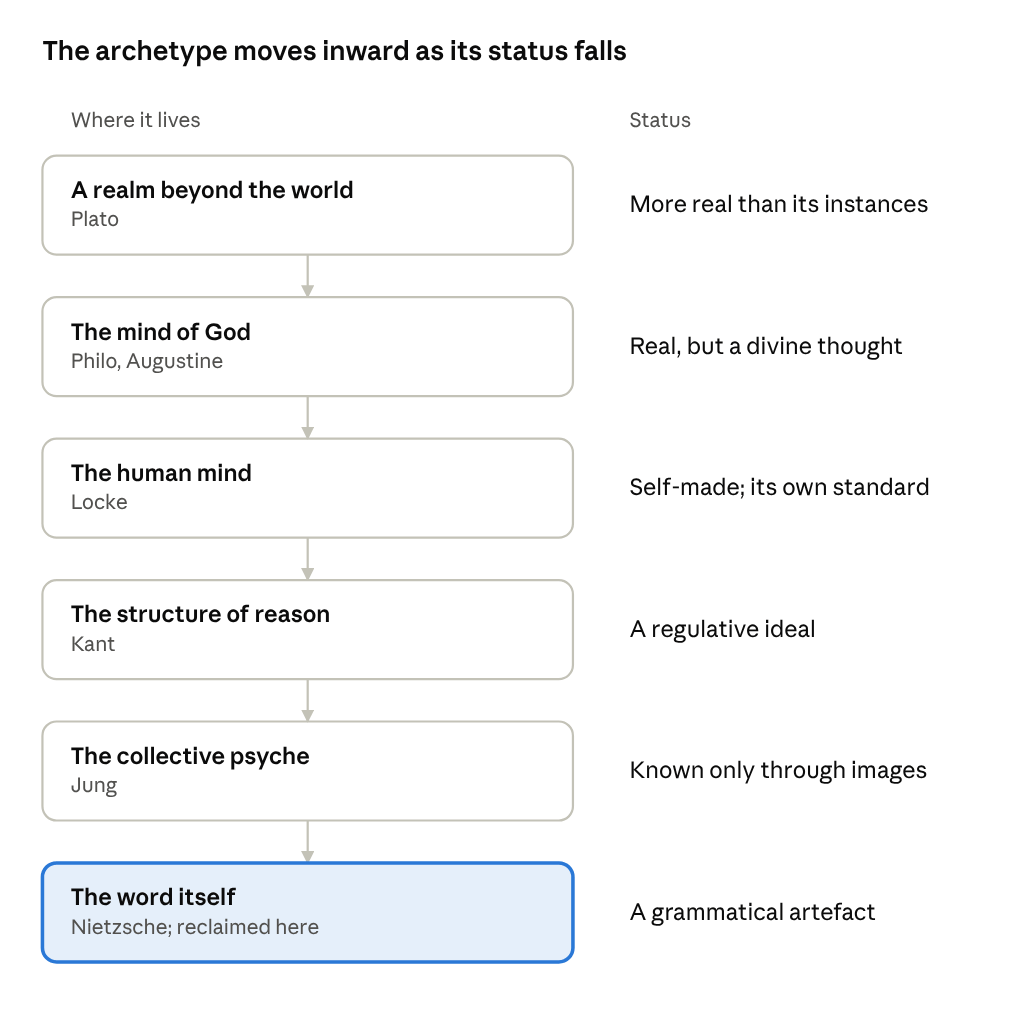
Each relocation lowers the archetype’s standing; the last leaves it in grammar.

Etymology

Greek arkhētypon joins arkhē (origin, first) and typos (a blow, and so the impression a seal leaves). An archetype is the original stamp from which copies are pressed. The image suits the reclaimed use: the archetype is the seal a word appears to carry, the certificate stamped on usage.
Real, divine, made

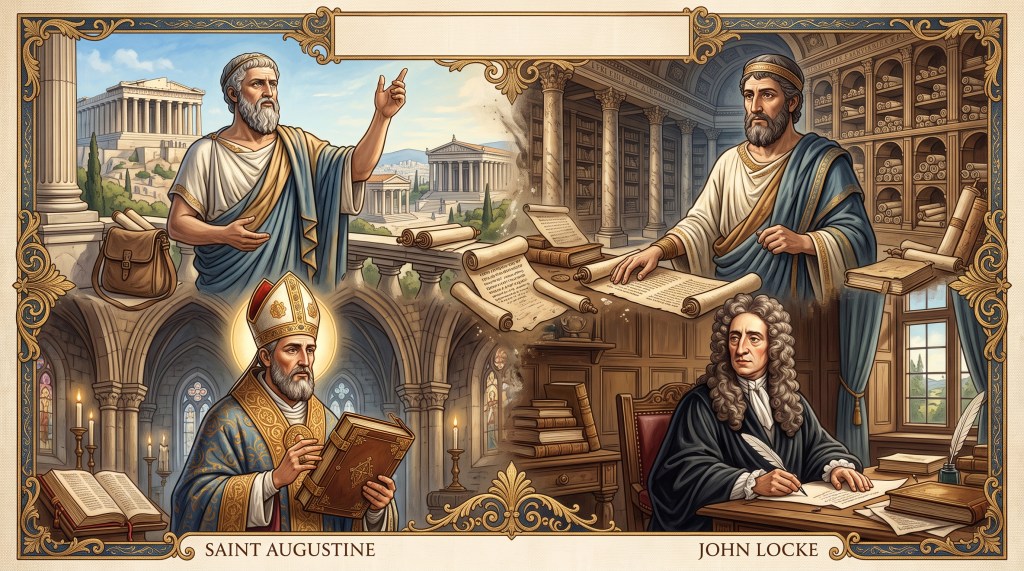
  • Plato. Plato’s own term is paradeigma, the model: in the Timaeus the craftsman fashions the cosmos by looking to an eternal pattern. The Forms are more real than their instances, which participate in them imperfectly. Calling the Forms “archetypes” is later Platonist usage.
  • Philo and Augustine. Philo of Alexandria uses archetype for the divine image after which humanity was moulded (De opificio mundi 69). Augustine does not use the word, but relocates the Forms as principal ideas contained in the divine understanding. The archetypes remain real and prior, but become divine thoughts rather than free-standing entities.
  • Locke. In the Essay (1690), ideas of substances are copies answerable to external things. Complex ideas of modes and relations, moral ideas among them, are “archetypes of the mind’s own making”: nothing outside them must conform. Locke infers that morality is capable of demonstration. The present account accepts his premise, that moral ideas are made rather than found, and reverses his conclusion: being self-made confers no anchor.
Ideal and fiction

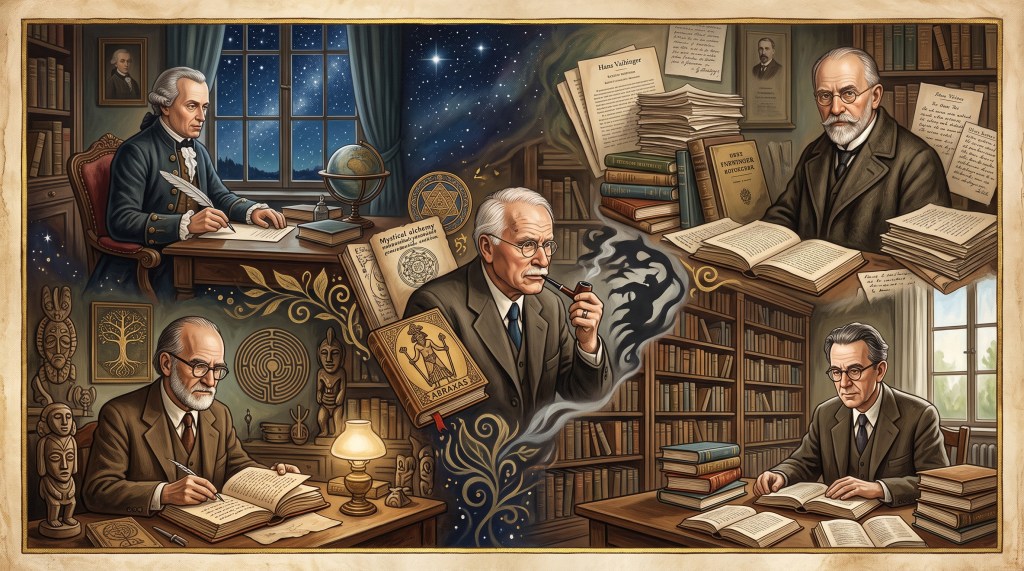
  • Kant. The Urbild is an ideal that reason necessarily generates, as in the idea of perfect virtue. Nothing in experience corresponds to it, yet it orients inquiry and conduct. Kant also contrasts our discursive understanding with a hypothetical intellectus archetypus, an intellect whose thinking would produce its objects. The archetype lives in reason’s structure: approachable as a regulative ideal, never reached.
  • Vaihinger. In The Philosophy of ‘As If’ (1911), ideal concepts are fictions adopted as though true, known to be false or empty, and retained because practice needs them. The archetype becomes a tool rather than a target.

Psyche and culture

  • Jung. From 1919, archetypes are inherited structures of the collective unconscious: the Shadow, the Mother, the Trickster. Jung distinguished the archetype in itself, never directly known, from the archetypal images through which it appears. It is psychological and universal, approachable only through its images.
  • Eliade and Frye. For Eliade, archetypes are the sacred models that myth expresses and ritual repeats. For Frye (Anatomy of Criticism, 1957), they are recurring symbols and conventions in literature. Both are cultural and descriptive rather than metaphysical, closer to genre than to essence.
Debunked and dissolved

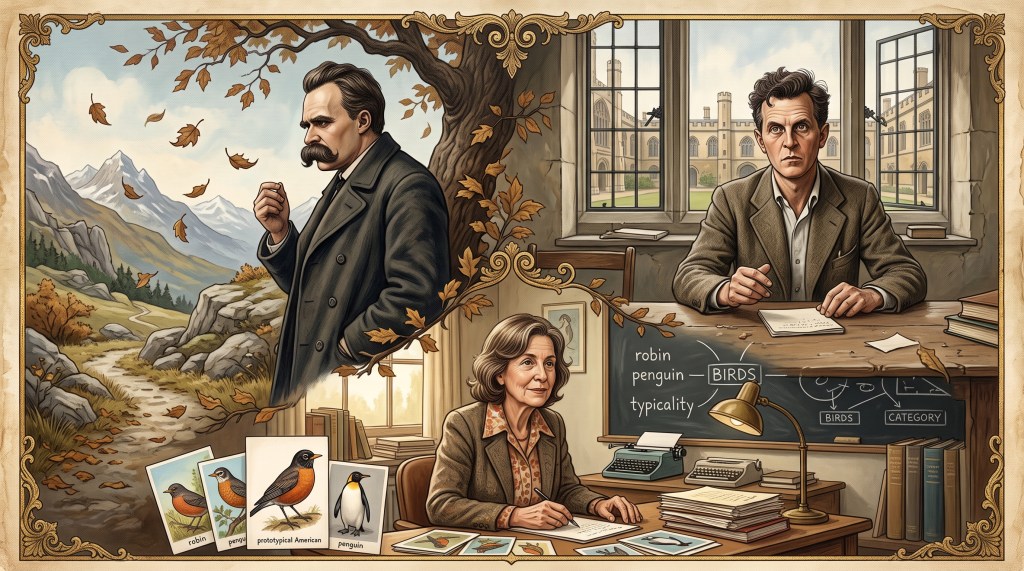
  • Nietzsche. He does not use the term but supplies the critique. In “On Truth and Lies in a Nonmoral Sense” (1873), the concept leaf drops every difference between actual leaves and so suggests a primal form, an Urform, after which all leaves were woven. The archetype is an artefact of concept formation, mistaken for its source.
  • Wittgenstein. The Philosophical Investigations (§§66–67) goes further: the concept never needed an archetype. Game has no common essence, only overlapping similarities, as among members of a family. Where Nietzsche debunks the archetype, Wittgenstein dissolves it.
  • Rosch. Prototype theory (Rosch and Mervis, 1975) turned family resemblance into empirical work. Categories are organised around central exemplars: a robin is a “better” bird than a penguin. The prototype is a statistical centre without essence, located in how judgements cluster.

Archetype, in my sense

The nomenclature is reclaimed. An archetype is a prototype promoted beyond any instance: a centre of usage mistaken for an ideal the usage aims at.

  • Against Rosch. A prototype is an exemplar, a real and typical member of its category. An archetype is what no member could be.
  • With Wittgenstein. Family-resemblance terms function without a centre; nobody fights over what a game really is. An archetype appears when speakers refuse to let a word be a family-resemblance term. Monadic grammar and institutional authority demand an essence, and the archetype supplies it.
  • Two kinds. Idealisations (Triangle; clock time) have a closed definition and no instance, and measurement can approach them asymptotically. Contestables (Truth, Justice, Love, God, wrong) have no closed definition, so there is no fixed limit to approach. “Not even asymptotically approachable” holds of Contestables only.
  • Usage. Readers will bring Plato or Jung to the word. Define it early, and write “archetype, in my sense” at first use.

Genealogy or happenstance?

Both, at different levels. The transmission of the word and its problem is genuinely genealogical; the trajectory is a vantage imposed in retrospect.

  • Real lineage. Philo and Augustine wrote within Platonism. Kant discusses Plato’s Ideas by name before redefining them as ideas of reason. Jung traced his term to Philo, Irenaeus, the Corpus Hermeticum and pseudo-Dionysius, and to Augustine’s principal ideas. Rosch and Mervis’s founding paper takes its title, “Family Resemblances”, from Wittgenstein.
  • Convergence, not descent. Locke’s self-made archetypes are not a step from Augustine to Kant in any direct sense, and nothing suggests Wittgenstein derived family resemblance from Nietzsche’s leaf. Jung himself, having cited his precedents, denied deriving the idea from them. Some neighbours on the line arrived independently.
  • The arc is mine. “Inward and downward” is a narrative that happens to end at the present position, which is the shape of a Whig history. Told as progress, it would install the very teleology it diagnoses.

The defensible framing is genealogy in Nietzsche’s and Foucault’s sense: not a pedigree culminating here, but a sequence of reappropriations, each reassigning the word to a new site and a new authority. On that framing the arc is a reading, offered as one, and the reclaimed sense is the latest reappropriation, not the truth the earlier ones were groping towards.

Summary

ThinkerWhere it livesStatusApproachable?
PlatoA realm beyond the worldMore real than its instancesImperfectly, through participation
Philo, AugustineThe mind of GodReal; a divine thoughtThrough divine illumination (Augustine)
LockeThe human mindSelf-made; its own standardAlready reached: it is its own archetype
KantThe structure of reasonRegulative idealApproached, never reached
VaihingerWorking assumptionsUseful fictionNot a target
JungThe collective psycheInherited structureOnly through its images
Eliade, FryeMyth and literatureCultural patternRepeated, not approached
NietzscheThe conceptArtefact of concept formationNothing to approach
WittgensteinNowhereUnneededNo archetype to approach
RoschClusters of judgementPrototype: a statistical centreInstantiated by exemplars
WillisThe wordPrototype promoted beyond any instanceIdealisations asymptotically; Contestables not at all

Sources

Jung’s attributions (Collected Works 9i, ¶5) were checked against secondary sources on 16 October 2026; other attributions are from general knowledge.
Language Insufficiency Hypothesis: The Genealogy of Language Failure

1–2 minutes

I published A Language Insufficiency Hypothesis this month, and this is one of a series of videos summarising the content. In this segment, I’m discussing Chapter 1: A Genealogy of Insufficiency

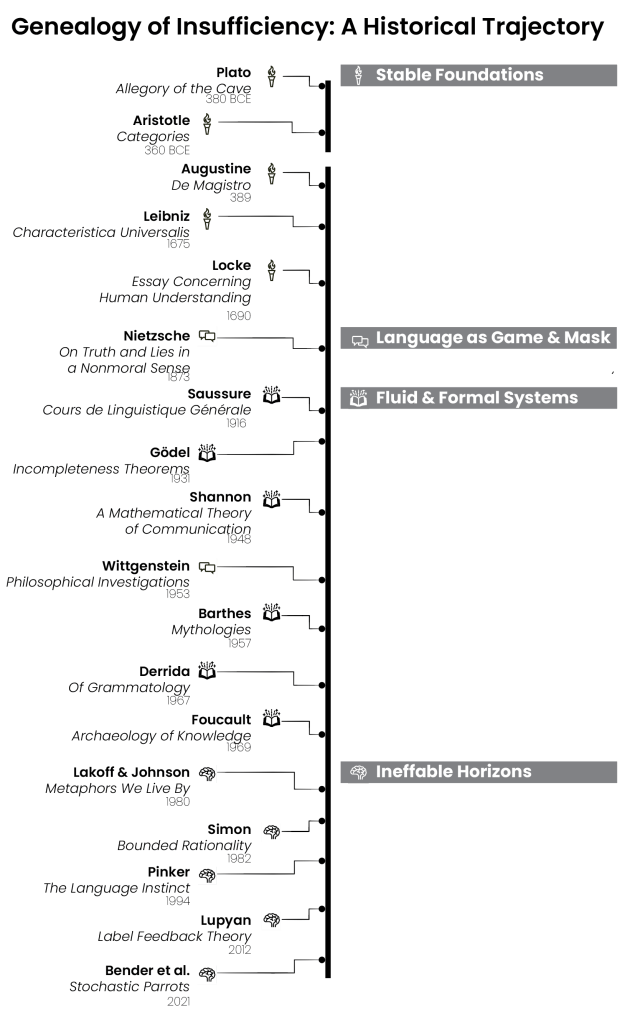
In this video, I touch on Plato to Barthes and Foucault. Derrida gets no love, and I mention bounded rationality, but not Simon. I discuss Steven Pinker’s dissent in more detail in a later chapter.

Below, I’ve included some artefacts from the book.

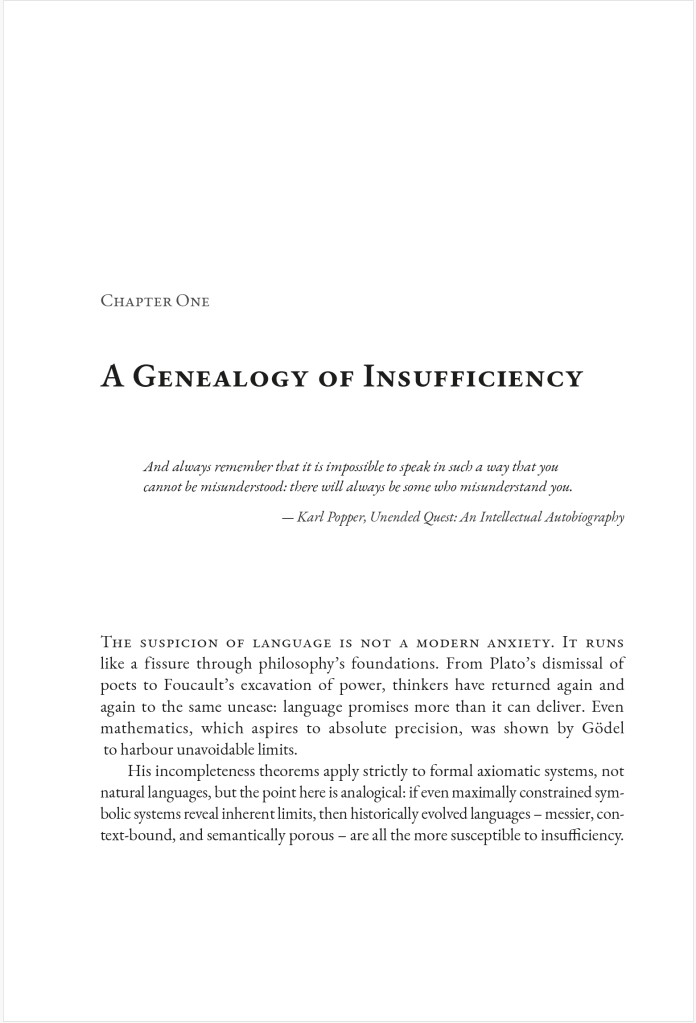
Image: Chapter 1: Page 1
Image: Genealogy of Insufficiency: A Historical Trajectory
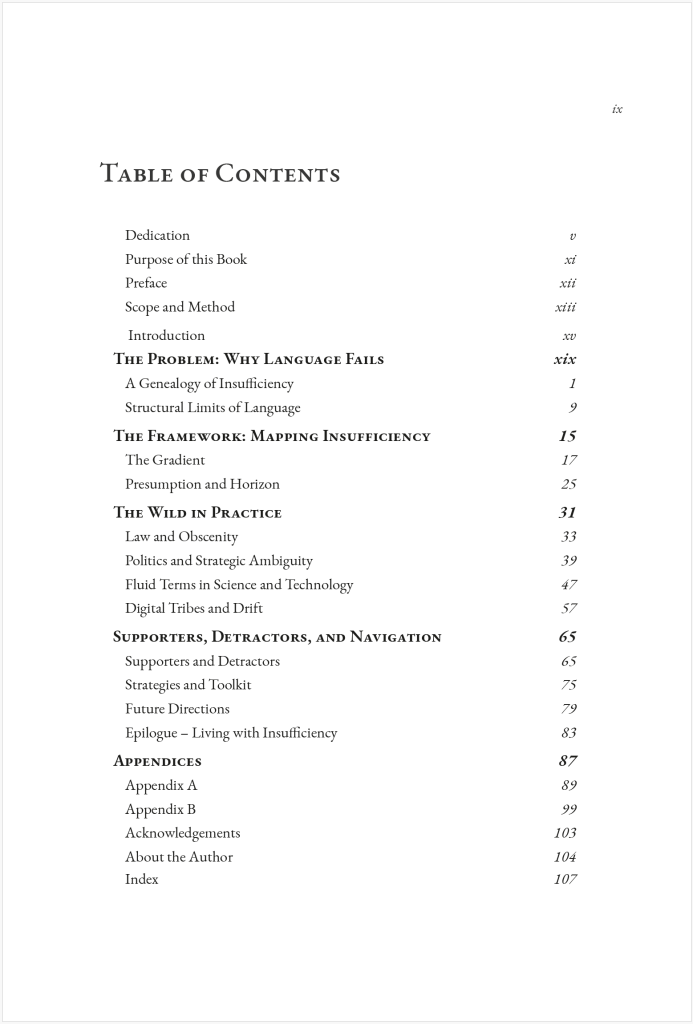
Image: Table of Contents

Where There’s a Will, There’s a Way

I’ve read Part I of Hobbes’ Leviathan and wonder what it would have been like if he filtered his thoughts through Hume or Wittgenstein. Hobbes makes Dickens read like Pollyanna. It’s an interesting historical piece, worth reading on that basis alone. It reads as if the Christian Bible had to pass through a legal review before it had been published, sapped of vigour. As bad a rap as Schopenhauer seems to get, Hobbes is the consummate Ebenezer Scrooge. Bah, humbug – you nasty, brutish, filthy animals!*

Audio: NotebookLM podcast conversation on this topic.

In any case, it got me thinking of free will and, more to the point, of will itself.

A Brief History of Humanity’s Favourite Metaphysical Scapegoat

By the time Free Will turned up to the party, the real guest of honour—the Will—had already been drinking heavily, muttering incoherently in the corner, and starting fights with anyone who made eye contact. We like to pretend that the “will” is a noble concept: the engine of our autonomy, the core of our moral selves, the brave little metaphysical organ that lets us choose kale over crisps. But in truth, it’s a bloody mess—philosophy’s equivalent of a family heirloom that no one quite understands but refuses to throw away.

So, let’s rewind. Where did this thing come from? And why, after 2,500 years of name-dropping, finger-pointing, and metaphysical gymnastics, are we still not quite sure whether we have a will, are a will, or should be suing it for damages?

Plato: Soul, Reason, and That Poor Horse

In the beginning, there was Plato, who—as with most things—half-invented the question and then wandered off before giving a straight answer. For him, the soul was a tripartite circus act: reason, spirit, and appetite. Will, as a term, didn’t get top billing—it didn’t even get its name on the poster. But the idea was there, muddling along somewhere between the charioteer (reason) and the unruly horses (desire and spiritedness).

No explicit will, mind you. Just a vague sense that the rational soul ought to be in charge, even if it had to beat the rest of itself into submission.

Aristotle: Purpose Without Pathos

Aristotle, ever the tidy-minded taxonomist, introduced prohairesis—deliberate choice—as a sort of proto-will. But again, it was all about rational calculation toward an end. Ethics was teleological, goal-oriented. You chose what aligned with eudaimonia, that smug Greek term for flourishing. Will, if it existed at all, was just reason picking out dinner options based on your telos. No inner torment, no existential rebellion—just logos in a toga.

Augustine: Sin, Suffering, and That Eternal No

Fast-forward a few hundred years, and along comes Saint Augustine, traumatised by his libido and determined to make the rest of us suffer for it. Enter voluntas: the will as the seat of choice—and the scene of the crime. Augustine is the first to really make the will bleed. He discovers he can want two incompatible things at once and feels properly appalled about it.

From this comes the classic Christian cocktail: freedom plus failure equals guilt. The will is free, but broken. It’s responsible for sin, for disobedience, for not loving God enough on Wednesdays. Thanks to Augustine, we’re stuck with the idea that the will is both the instrument of salvation and the reason we’re going to Hell.

Cheers.

Medievals: God’s Will or Yours, Pick One

The Scholastics, never ones to let an ambiguity pass unanalysed, promptly split into camps. Aquinas, ever the reasonable Dominican, says the will is subordinate to the intellect. God is rational, and so are we, mostly. But Duns Scotus and William of Ockham, the original voluntarist hooligans, argue that the will is superior—even in God. God could have made murder a virtue, they claim, and you’d just have to live with it.

From this cheerful perspective, will becomes a force of arbitrary fiat, and humans, made in God’s image, inherit the same capacity for irrational choice. The will is now more than moral; it’s metaphysical. Less reason’s servant, more chaos goblin.

Hobbes: Appetite with Delusions of Grandeur

Then along comes Thomas Hobbes, who looks at the soul and sees a wheezing machine of appetites. Will, in his famously cheery view, is simply “the last appetite before action.” No higher calling, no spiritual struggle—just the twitch that wins. Man is not a rational animal, but a selfish algorithm on legs. For Hobbes, will is where desire stumbles into motion, and morality is a polite euphemism for not getting stabbed.

Kant: The Will Gets a Makeover

Enter Immanuel Kant: powdered wig, pursed lips, and the moral rectitude of a man who scheduled his bowel movements. Kant gives us the “good will”, which acts from duty, not desire. Suddenly, the will is autonomous, rational, and morally legislative—a one-man Parliament of inner law.

It’s all terribly noble, terribly German, and entirely exhausting. For Kant, free will is not the ability to do whatever you like—it’s the capacity to choose according to moral law, even when you’d rather be asleep. The will is finally heroic—but only if it agrees to hate itself a little.

Schopenhauer: Cosmic Will, Cosmic Joke

And then the mood turns. Schopenhauer, world’s grumpiest mystic, takes Kant’s sublime will and reveals it to be a blind, thrashing, cosmic force. Will, for him, isn’t reason—it’s suffering in motion. The entire universe is will-to-live: a desperate, pointless striving that dooms us to perpetual dissatisfaction.

There is no freedom, no morality, no point. The only escape is to negate the will, preferably through aesthetic contemplation or Buddhist-like renunciation. In Schopenhauer’s world, the will is not what makes us human—it’s what makes us miserable.

Nietzsche: Transvaluation and the Will to Shout Loudest

Cue Nietzsche, who takes Schopenhauer’s howling void and says: yes, but what if we made it fabulous? For him, the will is no longer to live, but to power—to assert, to create, to impose value. “Free will” is a theologian’s fantasy, a tool of priests and moral accountants. But will itself? That’s the fire in the forge. The Übermensch doesn’t renounce the will—he rides it like a stallion into the sunset of morality.

Nietzsche doesn’t want to deny the abyss. He wants to waltz with it.

Today: Free Will and the Neuroscientific Hangover

And now? Now we’re left with compatibilists, libertarians, determinists, and neuroscientists all shouting past each other, armed with fMRI machines and TED talks. Some claim free will is an illusion, a post hoc rationalisation made by brains doing what they were always going to do. Others insist that moral responsibility requires it, even if we can’t quite locate it between the neurons.

We talk about willpower, will-to-change, political will, and free will like they’re real things. But under the hood, we’re still wrestling with the same questions Augustine posed in a North African villa: Why do I do what I don’t want to do? And more importantly, who’s doing it?

Conclusion: Where There’s a Will, There’s a Mess

From Plato’s silent horses to Nietzsche’s Dionysian pyrotechnics, the will has shape-shifted more times than a politician in an election year. It has been a rational chooser, a moral failure, a divine spark, a mechanical twitch, a cosmic torment, and an existential triumph.

Despite centuries of philosophical handwringing, what it has never been is settled.

So where there’s a will, there’s a way. But the way? Twisting, contradictory, and littered with the corpses of half-baked metaphysical systems.

Welcome to the labyrinth. Bring snacks.

* The solitary, poor, nasty, brutish, and short quote is forthcoming. Filthy animals is a nod to Home Alone.