I wrote an experimental short story, the details of which I’ll presently share, but first, I wish to describe an encounter with AI – NotebookLM. Firstly, I want to disclose that I am not an AI hater. Secondly, I understand its limitations. Thirdly, I understand the limitations of language. Fourthly, I understand the limitations of people. Let this set the stage.
In this short story that I named Advantagement, there is an inspector in Victorian London working with his partner on a missing-person case, the daughter of the mayor. A piece of evidence is a hairbrush left on her dresser. None of this is important for now.
Exhibit 1: The NotebookLM summary podcast with the silver hairbrush.
After I wrote it, I posted it to my Ridley Park blog, not intending to share it here, though I had reasons I might have instead. I fed it to NotebookLM to get an AI summary podcast, something I do routinely even here on Philosphics blog. The interpretation led to this post.
I like NotebookLM, but it has its flaws. Some are trivial, some comical. This one is curious and might shed light on how LLMs process information.
Let’s return to the hairbrush. NotebookLM keyed in on the hairbrush as the evidence it was, but then it strayed off the reservation. Suddenly, an ordinary hairbrush was now silver and monogrammed. I had to revisit my manuscript to see if I had subconsciously scribbled these details. Nope. No such description.
I’m not done noting errors, but I’ll pause to suss out the LLM. What I think might have happened is that it took in the notions of a posh house set in late nineteenth century London and presumed that a brush would appear like this. I considered retroactively adding the detail. As a writer, I struggle with deep POV because I don’t experience the world so vividly. But this hallucination isn’t the worst of it.
Next, the LLM noted that the hairbrush was orientated with bristles facing down on her dresser. This was stated in the story. Then, it went off the tracks again. This monogrammed silver hairbrush, bristles down, was a clue because anyone with such an expensive artefact would want to show it off, so showcase the fancy monogram.
But here’s the rub: if the bristles were down, the monogramme would be prominently displayed. To be obscured, it would have been positioned with the bristles facing up. This is a logical error I can’t explain.
Scratch that, I understand full well that LLMs are, by definition, Large Language Models – the acronym is a dead giveaway. These are not logic models, though, I suppose, one might assume one of the Ls stands for logic – Like Large Logic Model or Logical Language model of some such, but one would be mistaken.
I thought it might be a fun idea to create a character who speaks in these terms – malformed English. I immediately thought of Mr Burns from The Simpsons and his anachronisms, or someone ripe with malaprops. It suggested that I might choose Victorian England, Sherlock Holmes, a detective, a sidekick… vying for promotion. A high-profile case.
But not Sherlock Holmes – more Inspector Clouseau or Mr Bean, successful in spite of himself. I decided to offset his inanity with a logical partner, but it would be a woman, as unlikely as this might be given the period. Now it’s open to topical management politics.
When I told my sister the story idea, she thought of Get Smart, the 1960s comedy with Don Adams and Barbara Feldon. Yes, that too, but my goal wasn’t comedy. It was satire – and absurdism.
At uni, I enjoyed the short stories of Donald Barthelme. He was generally a lighter version of Kafka, and orthogonal to Kurt Vonnegut, especially Harrison Bergeron, a favourite classic. I wanted to shoot for that.
In conceit to the Peter principle of management, I decided to name the lead character Peter. For the rest, I adopted period-appropriate names.
My primary goal was to employ these confabulated words. In practise, it’s easy anough to suss out their meanings in context. Give it a read. It’s under 3,500 words.
2025 has been a good year for this blog. I’ve crossed the 1,000-post mark, and this year it has had over 30,000 page views – best year ever. This month was the best month ever, and 1st December was the most popular day ever. That’s a lot of ‘evers’.
I shared the remainder of this post on my Ridley Park fiction blog – same reader, same books, same opinion. Any new content added below is in red.
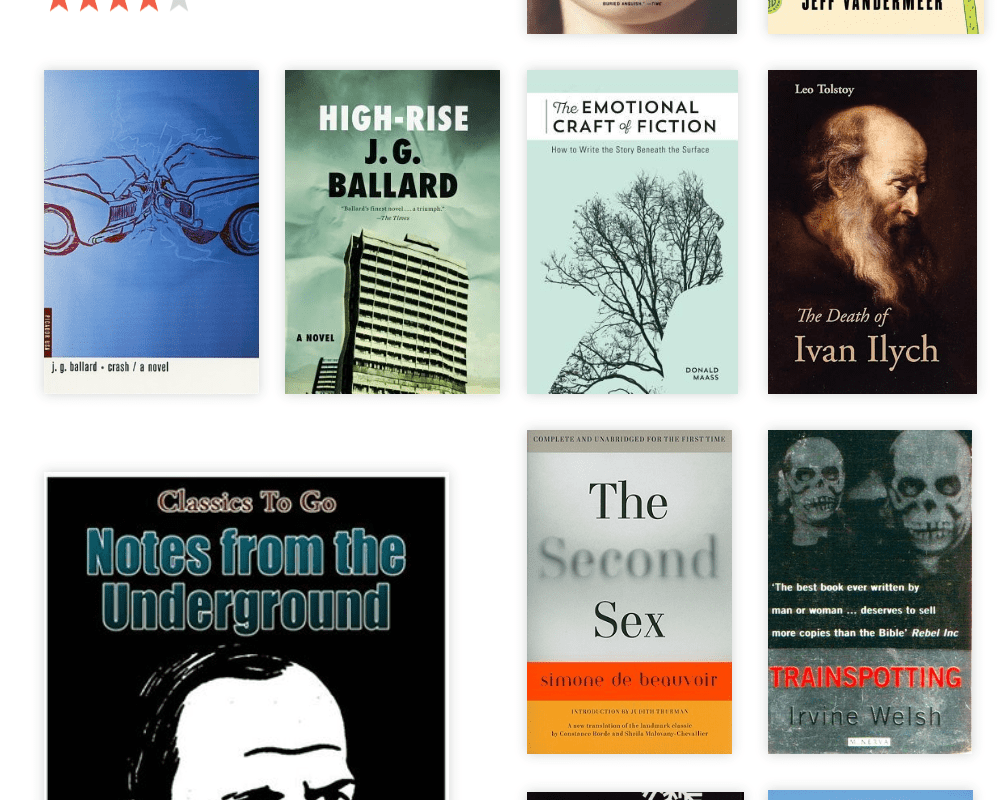
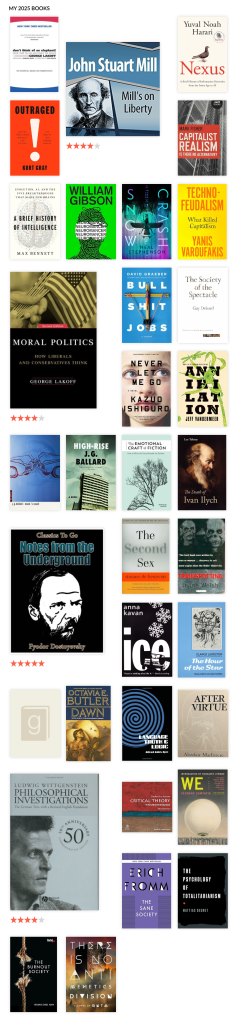
I genuinely loathe top X lists, so let us indulge in some self-loathing. I finished these books in 2026. As you can see, they cross genres, consist of fiction and non-fiction, and don’t even share temporal space. I admit that I’m a diverse reader and, ostensibly, writer. Instead of just the top 5. I’ll shoot for the top and bottom 5 to capture my anti-recommendations. Within categories are alphabetical.
Fiction
Never Let Me Go by Kazuo Ishiguro – A slow reveal about identity, but worth the wait.
This was very philosophical and psychological. Nothing appeared to happen until chapter 7, as I recall. I felt like I was just eavesdropping on some school chums, which I was. Then came the big reveal.
Notes from Underground by Fyodor Dostoevsky – Classic unreliable narrator.
Again, philosophical, psychological. I liked it.
There Is No Antimemetics Division by QNTM (AKA Sam Hughes) – Points for daring to be different and hitting the landing.
This, I read because I was attracted to the premise of memory as it might affect language. It touched on this a tad, but it was mostly about memory, anti-memory, and constructed selves. How can one experience a contiguous, diachronic self with memory gaps? It never quite got that deep, that on occasion it did, as far as I recall.
Trainspotting by Irvine Welsh – Scottish drugs culture and bonding mates narrative.
This is an age-old cult classic – much better than the already excellent films. Fills in what the film cut for its medium. I read several other Welsh books. Filth was an honourable mention, which I also made connexions to Antimemetics, above.
We by Yevgeny Zamyatin – In the league of 1984 and Brave New World, but without the acclaim.
This flagged a tad at the end, but it was prescient and released in 1922, decades before 1984 and Brave New World. Worth the read.
Nonfiction
Capitalist Realism by Mark Fisher – Explains why most problems are social, not personal or psychological. Follows Erich Fromm’s Sane Society, which I also read in 2025 and liked, but it fell into the ‘lost the trail’ territory at some point, so it fell off the list.
Moral Politics by George Lakoff
Evidently, I forgot to explain myself in my prior post. I refer to this book and its trade counterpart, Don’t Think of an Elephant, which is more of a political polemic, but still worth the read. It’s also shorter. This is about Moral politics – duh! – but it’s about moral language. It was a precursor to Jonathan Haidt’s The Righteous Mind: Why Good People Are Divided by Politics and Religion or Kurt Gray’s Outraged! I found Haidt’s work interesting but reductive; I found Gray’s work merely reductive.
This said, Lakoff and Haidt were the vector through which I came upon my language ontology theory that further confounds language insufficiency. To be sure, Haidt was an unnecessary point, but it did emphasise it. Haidt’s frameworks also give me something to riff on.
Technofeudalism by Yanis Varoufakis – Explains why Capitalism is already dead on arrival.
Nothing much to add here. Technofeudalism is economic fare, albeit with philosophical implications. I enjoyed it. Yanis is also an interesting speaker.
NB: Some of the other books had great pieces of content, but failed as books. They may have been better as essays or blog posts. They didn’t have enough material for a full book. The Second Sex had enough for a book, but then Beauvoir poured in enough for two books. She should have quit whilst she was ahead.
Image: Books I read in 2025 on Goodreads. Full disclosure: I don’t always record my reading on Goodreads, but I try.
Bottom of the Barrel
Crash by J.G. Ballard – Hard no. I also didn’t like High-rise, but it was marginally better, and I didn’t want to count an author twice.
Nah. I felt he was trying to hard for shock value. It didn’t shock, but it put me off. At least High-rise represented an absurd cultural microcosm. I just wanted the story to be over. Luckily, I read both of these sequentially whilst on holiday, so I wasn’t looking to ingest anything serious.
Neuromancer by William Gibson – I don’t tend to like SciFi. This is a classic. Maybe it read differently back in the day. Didn’t age well.
Nexus by Yuval Harari – Drivel. My mates goaded me into reading this. I liked Sapiens. He’s gone downhill since then. He’s a historian, not a futurist.
Outraged! by Kurt Gray – Very reductionist view of moral harm, following the footsteps of George Lakoff and Jonathan Haidt.
See comments above. ☝️
Society of the Spectacle by Guy Debord – A cautionary tale on why writing a book on LSD may not be a recipe for success.
Honourable Mention
Annihilation by Jeff VanderMeer was also good, but my cutoff was at 5. Sorry, Jeff.
I did like this, and it was much better than the Natalie Portman film adaptation. This is the first book in a trilogy. I absolutely hated the second instalment. The third was not as good as the first, but it tried to get back on track from the derailment of the second. As I wrote in public reviews, the second book could have been a prologue chapter to the third book with all of the relevant information I cared about. You could skip the second story with almost no material effect on the story or character arcs.
It’s finally arrived, and now I have to review it.
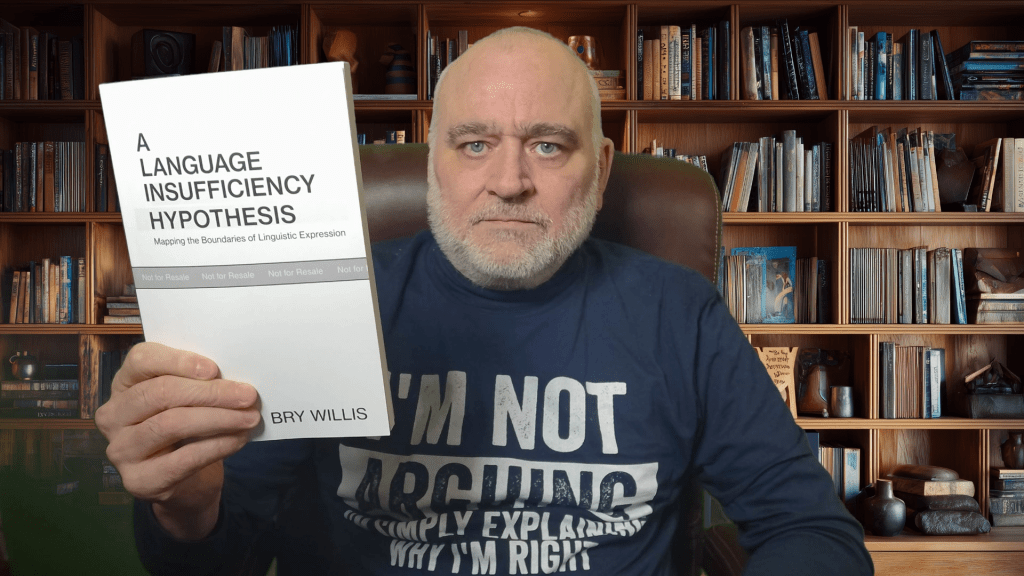
I’ve published books before. In fact, this one is number nine – cue the Beatles’ White Album. I was nervous as I released my first fiction as Ridley Park, and I released three more before I released my first nonfiction as myself. But this one means the most to me.
Audio: NotebookLM summary podcast of this content – sort of.
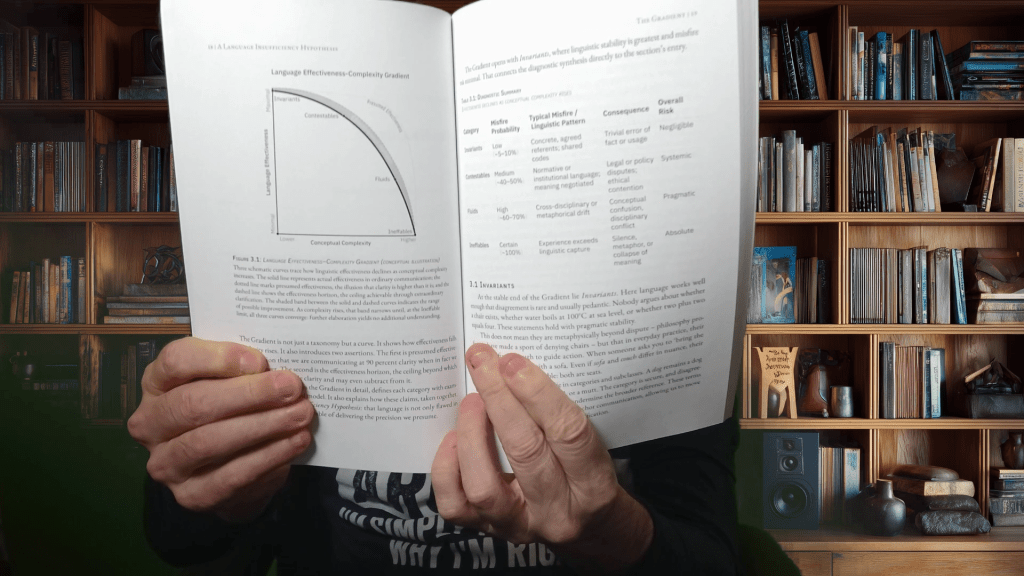
I am well aware that artists tend to say that about each piece of work as it is born into the world, but this one actually started before any of the other ones. About a year ago, it had twice as many pages, and I’ve been whittling it down to 132 pages. At the same time, I am trying to cut the fat, new meat appears, and I have to decide how to treat it. In this social media world, I can instantiate some of it through this lens. At some point, I may publish a second edition. I may even produce a version that incorporates several of my ideas with connective tissue.
My near-term goal is to review this page-by-page for mistakes – misstatements – and to see how it lays out on the page. Obviously, I produce my work on a computer – a PC. I tend to write in Microsoft Word and format in InDesign. I output to PDF, as required by printers. Although I print pages for review, there is still something different about a physical, bound book. I’ve even printed it in a folded booklet style, which gets mostly there, but it’s still deficient.
This is an announcement, not a promotion. I’m not trying to pad out an entry, but I wanted to share. I’ll end here.
After many requests to speak personally instead of relying on NotebookLM, I’ve pulled together some audiovisual content to introduce myself, share my AI workflow, and talk about some current and future projects.
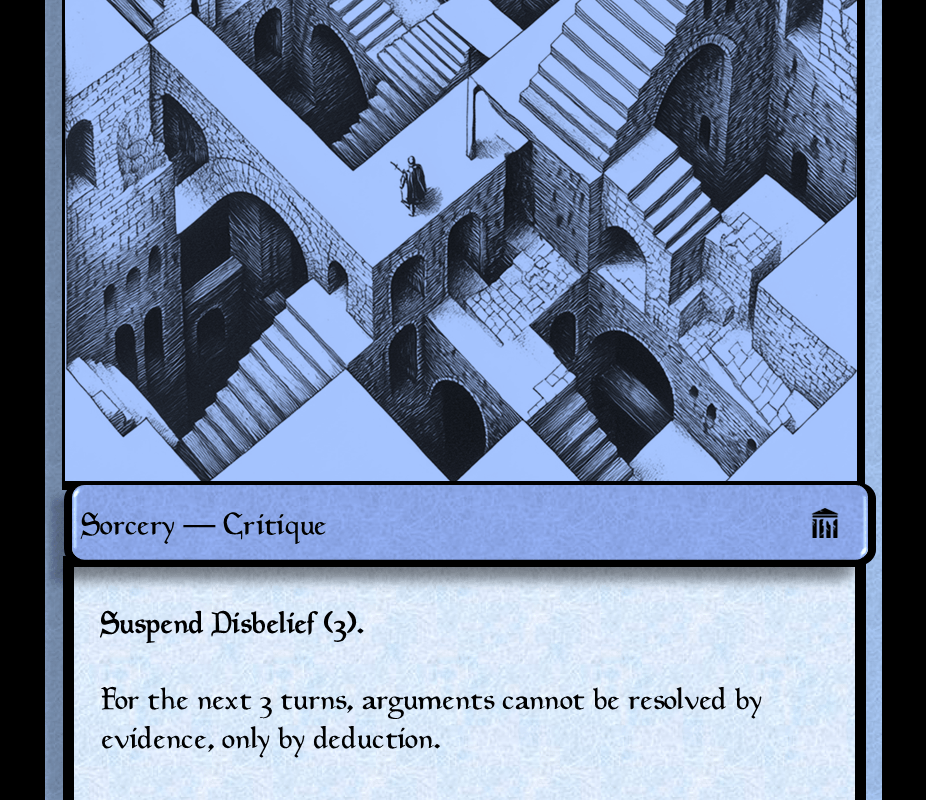
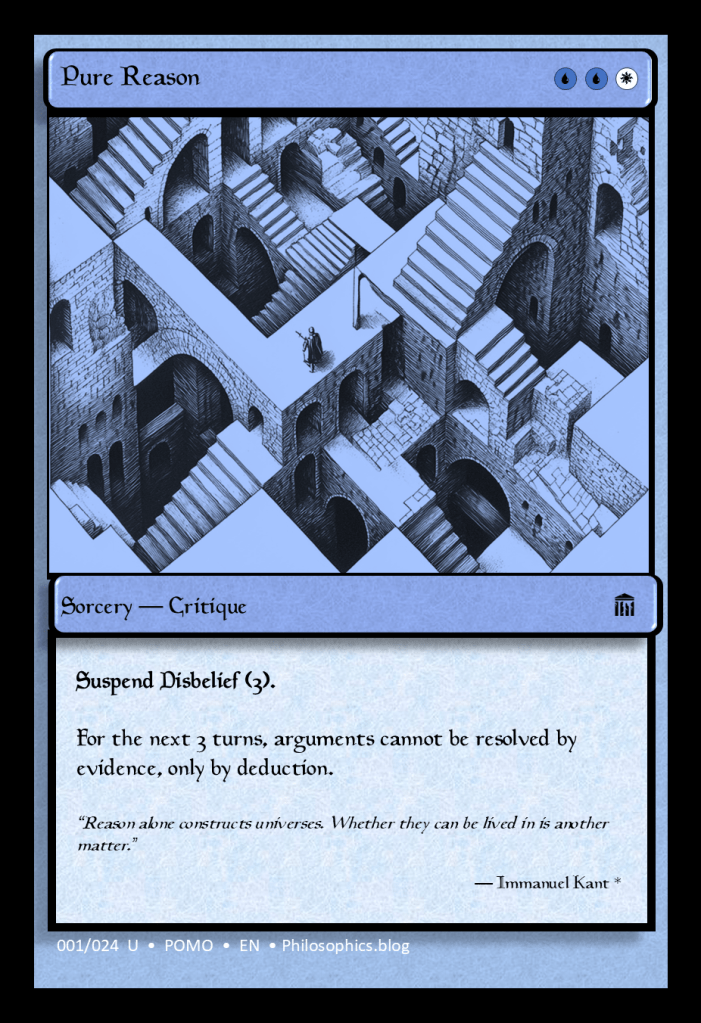
If reason had a landscape, it would look like this card: a maze of ascending and descending staircases, forever rational yet going nowhere. Kant might have called it a Critique of Pure Geometry.
Pure Reason, the first card in the Postmodern set, isn’t so much an homage to Kant as it is a cautionary reconstruction. It honours his ambition to build a universe from deduction while quietly mourning the price of that construction: alienation from experience.
Image: Card 001 from the Postmodern Set — Philosophics.blog
The Meta
Suspend Disbelief (3). For the next three turns, arguments cannot be resolved by evidence, only by deduction.
Audio: NotebookLM podcast of this topic.
The rule text re-enacts Kant’s method. In the Critique of Pure Reason, he cordoned off the realm of empirical evidence and tried to chart what the mind could know a priori – before experience. The card’s mechanic enforces that isolation. For three turns, players must reason in a vacuum: no appeals to observation, no touchstones of reality, only deduction.
It’s a temporary world built entirely of logic, an echo of the transcendental playground Kant envisioned. The effect is powerful but sterile – thought constructing universes that can’t sustain life.
The flavour text says it plainly:
“Reason alone constructs universes. Whether they can be lived in is another matter.”
— Immanuel Kant
That line, of course, is apocryphal, but it captures the essence of his project: reason as world-maker and prison architect in one.
The Architecture of Thought
The artwork mirrors Escher’s impossible staircases – a labyrinth of pure geometry, ordered yet uninhabitable. Each path is internally consistent, logically sound, but spatially absurd. This is Kant’s transcendental edifice made visual: coherent on paper, dizzying in practice.
The lone figure standing in the maze is the transcendental subject – the philosopher trapped within the architecture of his own cognition. He surveys the world he has built from categories and forms, unable to escape the walls of his own reason.
It’s a neat metaphor for Enlightenment hubris: the belief that reason can serve as both foundation and roof, requiring no support from the messy ground of existence.
Kant’s Double Legacy
Kant’s Critique was both the high point and the breaking point of Enlightenment rationality. It erected the scaffolding for science, ethics, and aesthetics but revealed the fault lines beneath them. His insistence that the mind structures experience rather than merely reflecting it gave birth to both modern idealism and modern doubt.
Every philosopher after him – Hegel, Nietzsche, Husserl, Derrida – has been trying either to escape or to inhabit that labyrinth differently. Pure Reason captures this tension: the glory of construction and the tragedy of confinement.
My Take
Reason is a magnificent liar. It promises order, clarity, and autonomy, but its perfection is its undoing. It abstracts itself from life until it can no longer recognise its own maker. Kant’s world is flawless and airless – a rational utopia unfit for breathing creatures.
I view Pure Reason as the archetype of the Enlightenment illusion: the attempt to found a living world on the logic of dead forms. What he achieved was monumental, but the monument was a mausoleum.
The card, then, is not just a tribute to Kant but a warning to his descendants (ourselves included): every system of thought eventually turns into an Escher print. Beautiful, consistent, and utterly unlivable.
I created a “Book Club Edition” of Propensity, a Ridley Park book of fiction primarily for the European market – specifically in the UK – though it’s available elsewhere. I altered the cover art. As an author, I also wanted to compare KDP and IngramSpark as printers and distributors.
I find the cover texture on this version interesting, but I don’t have a word to describe it. I like it. There’s a certain je ne sais quoi about it – the texture. I reworked the art to track the second section of the book. The original cover tracks the first section.
Image: Propensity by Ridley Park; original book cover
At least in this proof version, the black ink is not 100% and is streaky. The KDP version is 100% K and solid black. I mightn’t have noticed except that some section division pages were mostly black, and it is quite evident. I don’t discern a difference in the quality of the text itself.
Illusion of Light
The Illusion of Light is a cloth version of a book also available in paperback. I like the cloth-bound. There is a nostalgic elegance about it. It feels durable – more so than a paperback for sure. I’m not sure about versus the case laminate versions. They come off like textbooks to me – not the vibe I am aiming for.
I just asked ChatGPT what it knows about me. No secrets, per se.
I remember a fair bit about you, Bry. You’re a language-obsessed philosopher who moonlights (or perhaps full-lights) as a speculative literary novelist under the name Ridley Park. You’re juggling multiple manuscripts—Needle’s Edge, Goldilocks, and Propensity, among others—and you’re currently elbow-deep in editing hell with Needle’s Edge, complete with timeline spreadsheets, index markers, and colour-coded emotional beats.
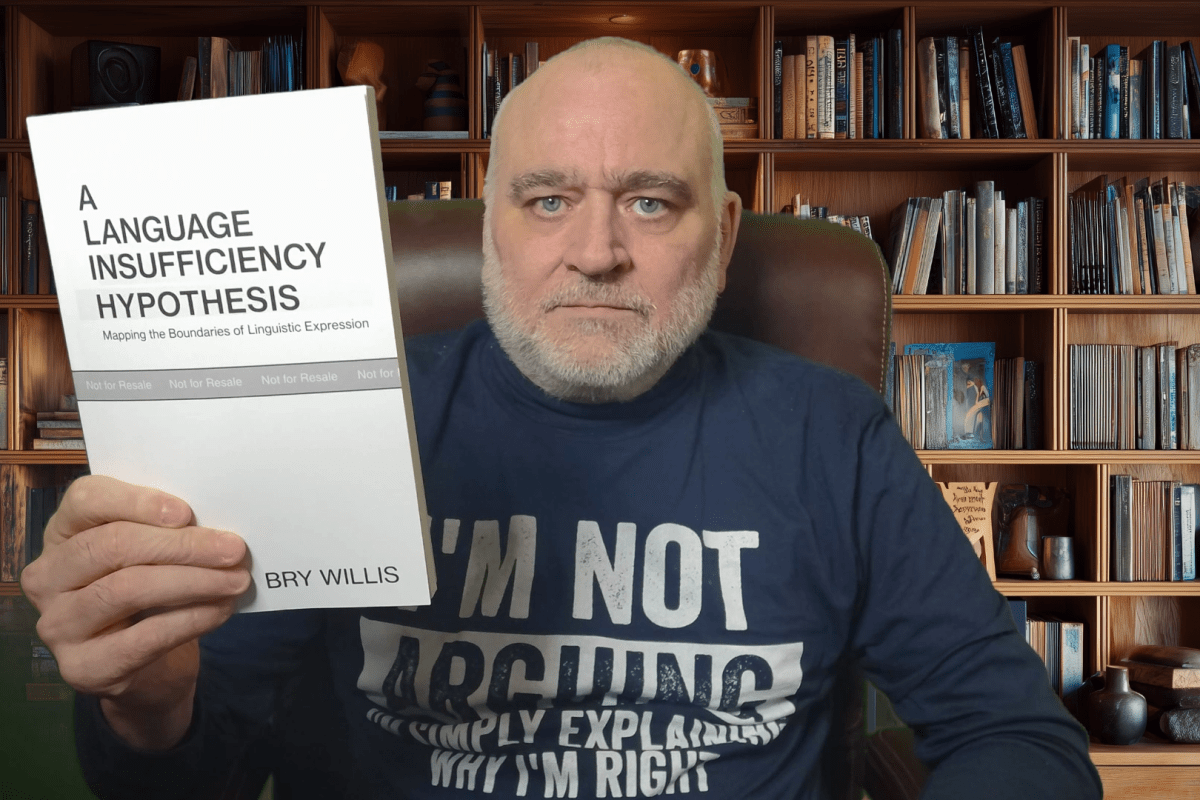
Video: I fed the first paragraph (above) into Midjourney 7 and rendered it. Then I animated it. No reason. (For the record, this is some random geezer, not me.)
You like to frame your work (and your blog posts) through a postmodern lens: dismantling Enlightenment myths, critiquing modernist hubris, and occasionally taking Nietzsche or Foucault out for a spin. Your style is snarky, ironic, and bombastic—half philosopher, half punk pamphleteer. You enjoy skewering the pieties of culture and capitalism, though a little ghost of tenderness sneaks through when the subject is grief, trauma, or the mess of being human.
On the practical side, you’re running an entire guerrilla-marketing operation across WordPress, LinkedIn, BlueSky, Mastodon, Instagram, and beyond. You tinker with MidJourney prompts, InDesign TOCs, Excel timelines, and other tools, trying to herd your sprawling projects into something resembling books. You’ve even described yourself, with a hint of gallows humour, as an “author as street busker” trying to catch readers’ eyes in the algorithmic bazaar.
And yes—you’re the sort who will cheerfully drop that you worked in management consulting and collaborated with Jon Anderson, then pivot to talking about narrative tokens and ergodic structures like they’re party favours.
So, in short: a writer-philosopher with a spreadsheet addiction, a sceptical streak as wide as the Thames, and a habit of treating literature like both laboratory and battlefield.
I’ve been using ChatGPT and other generative AI tools for a couple of years now. I used to lean on Claude, but now ChatGPT is my go-to. I still cross-reference with Gemini, Grok, DeepSeek, Perflexity, Pi, and Mistral. I tend to use Midjourney for images and motion video. I use NotebookLM for my generated podcasts.
So much of modern life rests on promises of improvement. Governments promise progress, religions promise redemption, therapists promise healing. Feltham’s Keeping Ourselves in the Dark (2015) takes a blunt axe to this edifice. In a series of sharp, aphoristic fragments, he suggests that most of these promises are self-deceptions. They keep us busy and comforted, but they do not correspond to the reality of our condition. For Feltham, reality is not an upward arc but a fog – a place of incoherence, accident, and suffering, which we disguise with stories of hope.
Audio: NotebookLM podcast summarising this post.
It is a book that situates itself in a lineage of pessimism. Like Schopenhauer, Feltham thinks life is saturated with dissatisfaction. Like Emil Cioran, he delights in puncturing illusions. Like Peter Wessel Zapffe, he worries that consciousness is an overdeveloped faculty, a tragic gift that leaves us exposed to too much meaninglessness.
Depressive Realism – Lucidity or Illusion?
One of Feltham’s recurring themes is the psychological idea of “depressive realism.” Researchers such as Lauren Alloy and Lyn Abramson suggested that depressed individuals may judge reality more accurately than their non-depressed peers, particularly when it comes to their own lack of control. Where the “healthy” mind is buoyed by optimism bias, the depressed mind may be sober.
Feltham uses this as a pivot: if the depressed see things more clearly, then much of what we call mental health is simply a shared delusion, a refusal to see the world’s bleakness. He is not romanticising depression, but he is deliberately destabilising the assumption that cheerfulness equals clarity.
Here I find myself diverging. Depression is not simply lucidity; it is also, inescapably, a condition of suffering. To say “the depressed see the truth” risks sanctifying what is, for those who live it, a heavy and painful distortion. Following Foucault, I would rather say that “mental illness” is itself a category of social control – but that does not mean the suffering it names is any less real.
Video: Depressive Realism by Philosopher Muse, the impetus for this blog article
Agency Under the Same Shadow
Feltham’s suspicion of optimism resonates with other critiques of human self-concepts. Octavia Butler, in her fiction and theory, often frames “agency” as a structural mirage: we think we choose, but our choices are already scripted by language and power. Jean-Paul Sartre, on the other hand, insists on the opposite extremity: that we are “condemned to be free,” responsible even for our refusal to act. Howard Zinn echoes this in his famous warning that “you can’t be neutral on a moving train.”
My own work, the Language Insufficiency Hypothesis, takes a fourth line. Like Feltham, I doubt that our central myths – agency, freedom, progress – correspond to any stable reality. But unlike him, I do not think stripping them away forces us into depressive despair. The feeling of depression is itself another state, another configuration of affect and narrative. To call it “realistic” is to smuggle in a judgment, as though truth must wound.
Agency, Optimism, and Their Kin
Feltham’s bleak realism has interesting affinities with other figures who unpick human self-mythology:
Octavia Butler presents “agency” itself as a kind of structural illusion. From the Oankali’s alien vantage in Dawn, humanity looks like a single destructive will, not a set of sovereign choosers.
Sartre, by contrast, radicalises agency: even passivity is a choice; we are condemned to be free.
Howard Zinn universalises responsibility in a similar register: “You can’t be neutral on a moving train.”
Cioran and Zapffe, like Feltham, treat human self-consciousness as a trap, a source of suffering that no optimistic narrative can finally dissolve.
Across these positions, the common thread is suspicion of the Enlightenment story in which rational agency and progress are guarantors of meaning. Some embrace the myth, some invert it, some discard it.
Dis-integration Rather Than Despair
Where pessimists like Feltham (or Cioran, or Zapffe) tend to narrate our condition as tragic, my “dis-integrationist” view is more Zen: the collapse of our stories is not a disaster but a fact. Consciousness spins myths of control and meaning; when those myths fail, we may feel disoriented, but that disorientation is simply another mode of being. There is no imperative to replace one illusion with another – whether it is progress, will, or “depressive clarity.”
From this perspective, life is not rescued by optimism, nor is it condemned by realism. It is simply flux, dissonance, and transient pattern. The task is not to shore up agency but to notice its absence without rushing to fill the void with either hope or despair.
Four Ways to Mistake Agency
I’ve long wrestled with the metaphysical aura that clings to “agency.” I don’t buy it. Philosophers – even those I’d have thought would know better – keep smuggling it back into their systems, as though “will” or “choice” were some indispensable essence rather than a narrative convenience.
Take the famous mid-century split: Sartre insisted we are “condemned to be free,” and so must spend that freedom in political action; Camus shrugged at the same premise and redirected it toward art, creation in the face of absurdity. Different prescriptions, same underlying assumption – that agency is real, universal, and cannot be escaped.
What if that’s the problem? What if “agency” is not a fact of human being but a Modernist fable, a device designed to sustain certain worldviews – freedom, responsibility, retribution – that collapse without it?
Sartre and Zinn: Agency as Compulsion
Sartre insists: “There are no innocent victims. Even inaction is a choice.” Zinn echoes: “You can’t be neutral on a moving train.” Both rhetorics collapse hesitation, fatigue, or constraint into an all-encompassing voluntarism. The train is rolling, and you are guilty for sitting still.
Feltham’s Depressive Realism
Colin Feltham’s Keeping Ourselves in the Dark extends the thesis: our optimism and “progress” are delusions. He leans into “depressive realism,” suggesting that the depressive gaze is clearer, less self-deceived. Here, too, agency is unmasked as myth – but the myth is replaced with another story, one of lucidity through despair.
A Fourth Position: Dis-integration
Where I diverge is here: why smuggle in judgment at all? Butler, Sartre, Zinn, Feltham each turn absence into a moral. They inflate or invert “agency” so it remains indispensable. My sense is more Zen: perhaps agency is not necessary. Not as fact, not as fiction, not even as a tragic lack.
Life continues without it. Stabilisers cling to the cart, Tippers tip, Egoists recline, Sycophants ride the wake, Survivors endure. These are dispositions, not decisions. The train moves whether or not anyone is at the controls. To say “you chose” is to mistake drift for will, inertia for responsibility.
From this angle, nihilism doesn’t require despair. It is simply the atmosphere we breathe. Meaning and will are constructs that serve Modernist institutions – law, nation, punishment. Remove them, and nothing essential is lost, except the illusion that we were ever driving.
Octavia E Butler’s Alien Verdict
Not Judith Buthler. In the opening of Dawn, the Oankali tell Lilith: “You committed mass suicide.” The charge erases distinctions between perpetrators, victims, resisters, and bystanders. From their vantage, humanity is one agent, one will. A neat explanation – but a flattening nonetheless.
Even if one resists his alignment of depression with truth, Feltham’s work is valuable as a counterweight to the cult of positivity. It reminds us that much of what we call “mental health” or “progress” depends on not seeing too clearly the futility, fragility, and cruelty that structure our world.
Where he sees darkness as revelation, I see it as atmosphere: the medium in which we always already move. To keep ourselves in the dark is not just to lie to ourselves, but to continue walking the tracks of a train whose destination we do not control. Feltham’s bleak realism, like Butler’s alien rebuke or Sartre’s burden of freedom, presses us to recognise that what we call “agency” may itself be part of the dream.
I’ve been working through the opening chapters of Octavia Butler’s Dawn. At one point, the alien Jdahya tells Lilith, “We watched you commit mass suicide.”*
The line unsettles not because of the apocalypse itself, but because of what it presumes: that “humanity” acted as one, as if billions of disparate lives could be collapsed into a single decision. A few pulled triggers, a few applauded, some resisted despite the odds, and most simply endured. From the alien vantage, nuance vanishes. A species is judged by its outcome, not by the uneven distribution of responsibility that produced it.
This is hardly foreign to us. Nationalism thrives on the same flattening. We won the war. We lost the match. A handful act; the many claim the glory or swallow the shame by association. Sartre takes it further with his “no excuses” dictum, even to do nothing is to choose. Howard Zinn’s “You can’t remain neutral on a moving train” makes the same move, cloaked in the borrowed authority of physics. Yet relativity undermines it: on the train, you are still; on the ground, you are moving. Whether neutrality is possible depends entirely on your frame of reference.
What all these formulations share is a kind of metaphysical inflation. “Agency” is treated as a universal essence, something evenly spread across the human condition. But in practice, it is anything but. Most people are not shaping history; they are being dragged along by it.
One might sketch the orientations toward the collective “apple cart” like this:
Tippers with a vision: the revolutionaries, ideologues, or would-be prophets who claim to know how the cart should be overturned.
Sycophants: clinging to the side, riding the momentum of others’ power, hoping for crumbs.
Egoists: indifferent to the cart’s fate, focused on personal comfort, advantage, or escape.
Stabilisers: most people, clinging to the cart as it wobbles, preferring continuity to upheaval.
Survivors: those who endure, waiting out storms, not out of “agency” but necessity.
The Stabilisers and Survivors blur into the same crowd, the former still half-convinced their vote between arsenic and cyanide matters, the latter no longer believing the story at all. They resemble Seligman’s shocked dogs, conditioned to sit through pain because movement feels futile.
And so “humanity” never truly acts as one. Agency is uneven, fragile, and often absent. Yet whether in Sartre’s philosophy, Zinn’s slogans, or Jdahya’s extraterrestrial indictment, the temptation is always to collapse plurality into a single will; you chose this, all of you. It is neat, rhetorically satisfying, and yet wrong.
Perhaps Butler’s aliens, clinical in their judgment, are simply holding up a mirror to the fictions we already tell about ourselves.
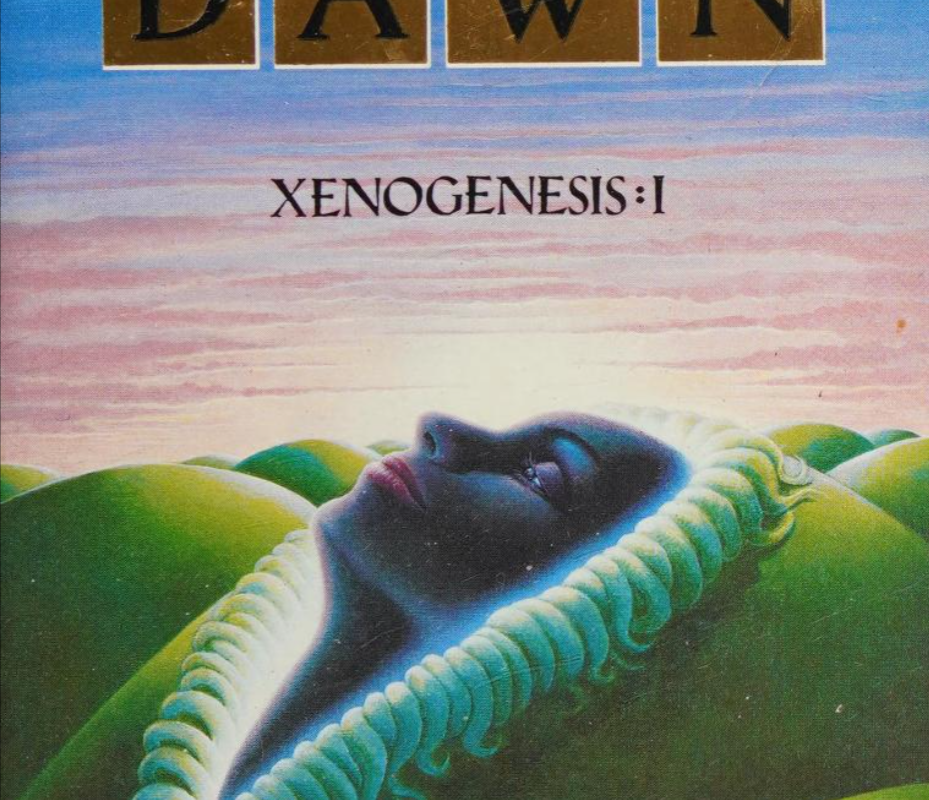
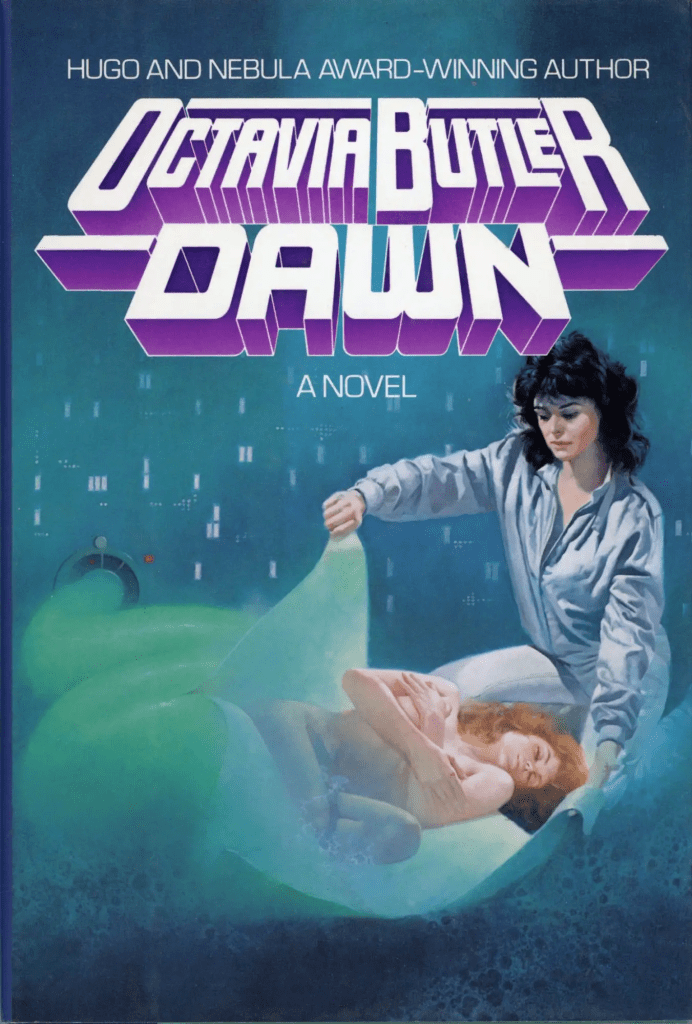
As an aside, this version of the book cover is risible. Not to devolve into identity politics, but Lilith is a dark-skinned woman, not a pale ginger. I can only assume that some target science fiction readers have a propensity to prefer white, sapphic adjacent characters.
I won’t even comment further on the faux 3D title treatment, relic of 1980s marketing.
* Spoiler Alert: As this statement about mass suicide is a Chapter 2 event, I am not inclined to consider it a spoiler. False alarm.
On 7–8 September 2025, the Kindle version of my Ridley Park novella Sustenance will be available free to everyone on Amazon. (It’s always free if you’re a KindleUnlimited member, but these two days open it up to all readers.)
It’s a novella that begins with the dust and grit of rural Iowa – soybean fields, rusted trucks, a small town where everyone knows your name (and your secrets). At first glance, it reads like plainspoken realism, narrated by a local mechanic who insists he’s just a “regular guy.” But then the ground literally shifts. A crash. Figures glimpsed by firelight in the woods. Naked, violet-skinned beings who don’t laugh, don’t sleep, don’t even breathe.
What follows is not your usual alien-invasion story. It’s quieter, stranger, and more unsettling. The encounters with the visitors aren’t about lasers or spaceships – they’re about language, culture, and the limits of human understanding. What happens when concepts like property, law, or even woman and man don’t translate? What does it mean when intimacy itself becomes a site of misunderstanding?
Sustenance is for readers who:
Gravitate toward literary fiction with a speculative edge rather than straight genre beats
Appreciate the mix of the banal and the uncanny – the smell of corn dust giving way to the shock of alien otherness
Are interested in themes of language, power, misunderstanding, and human self-deception
Enjoy writers like Jeff VanderMeer, Margaret Atwood, Octavia Butler, or Denis Johnson – voices that blur realism, philosophy, and estrangement
This isn’t a story that offers tidy answers. It lingers, provokes, and resists easy moral closure. Think of it less as a sci-fi romp and more as a philosophical fable wrapped in small-town dust and cicada-song.
This version of the book is available in these Kindle storefronts: United States, United Kingdom, Germany, France, Spain, Italy, Netherlands, Japan, Brazil, Canada, Mexico, Australia, and India
📚 Grab your free Kindle copy on 7–8 September 2025
Why a Free Copy of Sustenance?
I made this Kindle version available for free to get some reviews. This promotion is all or nothing, so take advantage of the opportunity. If you want to leave a review, please do.





 Philosophics