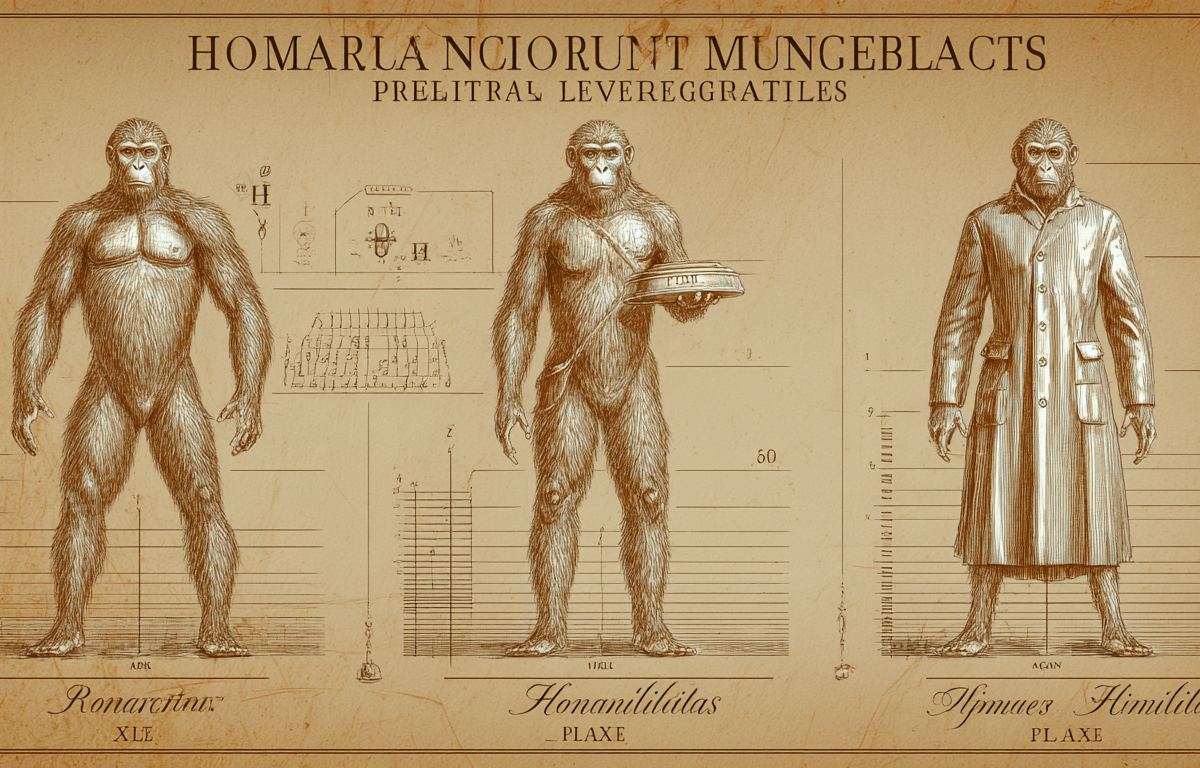
Homo Legibilis

3โ€“4 minutes

A Brief Field Note from the Department of Bureaucratic Anthropology

Still reeling from the inability to fold some pan into homo, Palaeontologists are seemingly desperate for a new hominid. Some dream of discovering the ‘missing link’; others, more honest, just want something with a jawline interesting enough to secure a grant. So imagine the surprise when the latest species didnโ€™t come out of the Rift Valley but out of an abandoned server farm somewhere outside Reading.

Theyโ€™ve named it Homo Legibilis โ€“ the Readable Human. Not ‘H. normฤlis’ (normal human), not ‘H. ratiลnฤlis (rational human), but the one who lived primarily to be interpreted. A species who woke each morning with a simple evolutionary imperative: ensure oneโ€™s dataprints were tidy, current, and machine-actionable.

Audio: NotebookLM summary podcast of this topic.

Youโ€™ll have seen their skeletons before, though you may not have recognised them as such. They often appear upright, mid-scroll, preserved in the amber of a status update. A remarkable creature, really. Lithe thumbs. Soft cranial matter. Eyes adapted for low-light environments lit primarily by advertisements.

Habitat

The species thrived in densely surveilled ecosystems: corporate intranets, public Wi-Fi, facial-recognition corridors, anywhere with sufficient metadata to form a lasting imprint. They built vast nests out of profiles, settings, dashboards. Territorial disputes were settled not through display or violence but through privacy-policy updates. Their preferred climate? Temperate bureaucracy.

Diet

Contrary to earlier assumptions, H. Legibilis did not feed on information. It fed on interpretation: likes, metrics, performance reviews, and algorithmic appraisal. Some specimens survived entire winters on a single quarterly report. Every fossil indicates a digestive tract incapable of processing nuance. Subtext passed through untouched.

Mating Rituals

Courtship displays involved reciprocal data disclosure across multiple platforms, often followed by rapid abandonment once sufficient behavioural samples were collected. One famous specimen is preserved alongside fourteen dating-app profiles and not a single functional relationship. Tragic, in a way, but consistent with the speciesโ€™ priorities: be seen, not held.

Distinguishing Traits

Where Homo sapiens walked upright, Homo legibilis aimed to sit upright in a chair facing a webcam.
Its spine is subtly adapted for compliance reviews. Its hands are shaped to cradle an object that no longer exists: something called ‘a phone’. Ironically, some term these ‘mobiles’, apparently unaware of the tethers.

Researchers note that the creatureโ€™s selfhood appears to have been a consensual hallucination produced collaboratively by HR departments, advertising lobbies, and the Enlightenmentโ€™s long shadow. Identity, for H. legibilis, was not lived but administered.

Extinction Event

The fossil record ends abruptly around the Great Blackout, a period in which visibility โ€“ formerly a pillar of the speciesโ€™ survival โ€“ became inconvenient. Some scholars argue the species didnโ€™t perish but simply lost the will to document itself, making further study inconvenient.

Others suggest a quieter transformation: the species evolved into rumour, passing stories orally once more, slipping back into the anonymity from which its ancestors once crawled.

Afterword

A few renegade anthropologists insist Homo Legibilis is not extinct at all. They claim itโ€™s still out there, refreshing dashboards, syncing calendars, striving to be neatly interpreted by systems that never asked to understand it. But these are fringe theories. The prevailing view is that the species perished under the weight of its own readability. A cautionary tale, really. When your survival strategy is to be perfectly legible, you eventually disappear the moment the lights flicker.

Arriving Late to Massimiโ€™s Party: Perspectival Realism in Parallel

Where our projects nod politely, then go their separate ways

I suppose it was inevitable. You spend years muttering into your notebook about mediation, realism without bombast, the irretrievability of universality, and the peculiar way science manages to stumble forward with partial, parochial toolsโ€ฆ and then, inevitably, you discover that someone elseโ€”Michela Massimi, in this caseโ€”has been busy constructing her own edifice a few hills over.

Audio: NotebookLM podcast summary and discussion of this topic

I arrived late to her party. Fine. But now that Iโ€™m here, letโ€™s pour a drink and compare architecture.

Because while our buildings look similar from a distanceโ€”both labelled Perspectival Realismโ€”theyโ€™re made from different bricks and aimed at different skylines.


1. A Courteous Bow: We Are Not Strangers in the Same Wilderness

Massimi and I share several foundational intuitions:

  • No Godโ€™s-eye view.
    She rejects the fantasy of disembodied objectivity. So do I. Reality is not a neutral theatre awaiting the Enlightenment spectator.
  • Knowledge is situated.
    Her emphasis on historically embedded scientific communities echoes my own insistence that sense, cognition, and culture structure every act of knowing.
  • Plural perspectives, not universal sovereignty.
    No single inferential vantage point dominates; multiple perspectives can be fruitfully interlaced.
    Thatโ€™s strikingly consonant with my claim that mediation is a condition, not a defect.
  • Anti-relativist without universalist delusion.
    Neither of us has patience for the โ€œall maps are equalโ€ caricature peddled by people who wouldnโ€™t know a real relativist if they tripped over one in a library.

From this angle, weโ€™re intellectual cousinsโ€”two people independently refusing Enlightenment triumphalism while refusing to surrender realism to the absolutists.


2. The Parting of the Ways: Our Projects Are Not the Same Creature

But similarities disguise deeper divergences. Here are the important ones:

a) Sheโ€™s doing epistemology; Iโ€™m doing ontology.

Massimi reconstructs realism from the inside out by examining scientific practiceโ€”models, inferences, historically evolving toolkits.

My project is more structural. Sense mediation (icons), cognitive mediation (instrumentation), and linguistic-cultural mediation (conceptual carving) are not methodological observations; they are conditions of access to reality. Theyโ€™re deeper than scientific practiceโ€”they underlie it.

b) She salvages realism; I happily burn universality and build realism back from the ashes.

Massimi is rehabilitating realismโ€™s good name.
Iโ€™m less sentimental. Realism, as a doctrine, has been caught lying too many times. I want the realism of resistance, not the realism of representation.

c) Her anchor is โ€œmodal robustnessโ€; mine is โ€œstructured resistance through mediation.โ€

Massimiโ€™s realism rests on the idea that phenomena are robust across models and contextsโ€”they persist modally.

I agree that robustness is useful. But robustness is filtered through linguistic concepts, cognitive priors, and sensorimotor limitations. Itโ€™s a second-order indicator, not a metaphysical foothold.

Resistanceโ€”the worldโ€™s refusal to bend to beliefโ€”is deeper. Itโ€™s what enables robustness to manifest.

d) Her perspectives are model-based; mine are existential.

Massimi focuses on scientific perspectivesโ€”frameworks articulated through inferential blueprints.

My perspectivalism lives at the level of:

  • what our senses can show,
  • what our minds can shape,
  • what our languages can articulate,
  • what our cultures deem thinkable.

Thatโ€™s a wider cut than scientific models.

We are working at different depths of mediation.


3. Convergences Worth Keeping, Divergences Worth Defending

Let me put it cleanly:

  • Massimi gives us a realism of models.
    A realism that emerges from the community of scientific practice, negotiated through historically situated inferential perspectives.
  • Iโ€™m after a realism of resistance.
    A realism that remains intact even when models break, when languages fail, when cognitive categories run aground.
    Not the realism of what we say, but the realism of what pushes back.

Our projects are not incompatible, but they are differently motivated.

She is concerned with scientific rationalityโ€™s legitimacy.
I am concerned with the conditions of access to reality in the first place.

She patches the Enlightenmentโ€™s ship.
I point out that the shipโ€™s hull is three layers of mediation thick, and pretend that universality is the hole in the floor.


4. A Clean Acknowledgement: She Was Here First (Sort Of)

Yesโ€”Massimi coined the term in this specific form, and she developed a sophisticated, rigorous scientific perspectivism that deserves respect.

But my Perspectival Realism emerged from a different genealogy:

  • the insufficiency of language,
  • the inescapability of conceptual carving,
  • the recursive inadequacy of cognitive tools,
  • the quiet, stubborn existence of a world we only ever meet askance.

Different animals. Same habitat.

So no, Iโ€™m not competing with Massimi.
And no, Iโ€™m not rebranding her work.

What Iโ€™m doingโ€”and what this piece makes explicitโ€”is placing my ontology in dialogue with hers. Two parallel rejections of universality. Two parallel refusals of relativism. Two parallel attempts to articulate realism without pretending weโ€™ve escaped the conditions of being human.

If I arrived late to her race, so be it.
Iโ€™m not running for her finish line anyway.


DISCLAIMER: This article was written or output by ChatGPT 5.1. It started as a conversation with Claude Sonnet 4.5, where I had input days of output for evaluation. One of these outputs was the post aboutย Erasmus and the Emissary Who Forgot to Bow. A group chat ensued between me, Claude and ChatGPT.

What started as a discussion about the merits of my position, expressed in the Erasmus-influenced essay, drifted to one about Perspectival Realism. That discussion deepened on ChatGPT, as I further discussed my recent thoughts on the latter topic. I had rendered a Magic: The Gathering parody trading card as I contemplated the subject. Itโ€™s how my brain works.

All of this led me to ask ChatGPT to summarise the conversation, and, upon further discussion, I asked it to draft this article โ€“ the second of five.

  1. Perspectival Realism: The First Ontology Without an Asterisk
    This article discusses what Perspectival Realism means to me and how I got to this position.
  2. Why Perspectival Realism Is Not Relativism
    Further discussion prompted me to differentiate this ontology from other perspectives.
  3. Arriving Late to Massimiโ€™s Party: Perspectival Realism in Parallel ๐Ÿ‘ˆ
    I spent another half-hour following Google search results as I wanted to see if anyone else had already been using the term, Perspectival Realism. I ended up on the Oxford publishing site. I found a 2022 book with this name, authored by Michela Massimi. They allowed me to download the book, so I asked ChatGPT to summarise our positions, specifically where we agreed and differed.
  4. Against the Vat: Why Perspectival Realism Survives Every Sceptical Hypothesis
    At 0500, I returned to bed, but I woke up again at 0700, thinking about how one might differentiate between Putnamโ€™s brain in a vat from Perspectival Realism. ChatGPT asked if I wanted that output in long-form.
  5. The Constraint Interface: Toward a Nexal Ontology
    Being uncomfortable with the dichotomy between Realism and Idealism, I chatted to come up with terminology that disrupts what I consider a false dichotomy, focusing on the nexus rather than privileging one or the other. Consider this similar to the debate on sex and gender binaries.

As I mentioned at the end of the first series, I may return to this series and publish a coherent expository version more in line with my usual style. Meantime, this allows me to share my ideas unvarnished and unpolished at the same time, granting me more time to focus on other matters. Apologies to those who may disagree with the outline format. Honestly, it annoys me, but I am choosing function over form at the moment.

Why Perspectival Realism Is Not Relativism

Reality decides; perspectives compete.

The moment you say โ€œour access to reality is mediated,โ€ someone inevitably performs their civic duty as Defender of Enlightenment Orthodoxy and announces, as if discovering fire, โ€œSo youโ€™re a relativist, then?โ€

Itโ€™s a comforting little reflex. If a position denies universality, it must be relativism. If it rejects the view from nowhere, it must reject the very idea of truth. If it acknowledges cultural scaffolding, it must be one critique away from saying flat-earthers and astrophysicists are peers.

This objection misunderstands both relativism and Perspectival Realism.

Audio: NotebookLM podcast summarising this topic.

Letโ€™s begin with the essential distinctionโ€”think of this as the tattoo at the base of the spine:

Relativism says: all maps are equally valid.
Perspectival Realism says: all maps are partial, and some are better.

  • Better at predicting.
  • Better at surviving.
  • Better at cohering with everything else we know.
  • Better at not getting you killed.

This is the spine of the position. Everything else is elaboration.


Relativismโ€™s Self-Destruct Button

Relativism denies that reality has enough structure to constrain belief. According to its logic, perspectives are sovereign. The world bends to interpretation.

If that were true:

  • Gravity would turn itself off for anyone sufficiently committed to optimism.
  • Viruses would consult your cosmology before infecting you.
  • The Mรผllerโ€“Lyer illusion wouldnโ€™t vary between populations because thereโ€™d be no stable perceptual machinery for it to fool.

Relativism collapses because the world does not permit it.

Perspectival Realism begins from the opposite premise:

  • There is one reality.
  • It resists us.
  • Perspectives rise or fall by how well they handle that resistance.

You canโ€™t get further from relativism than that.


Why Perspective โ‰  Prison

Another familiar confusion:
โ€œIf access is perspectival, arenโ€™t we trapped in our own little worlds?โ€

No.
Mediation isnโ€™t isolation. Itโ€™s a shared condition.

You and I may wear sunglasses of different tint, but we still walk the same street. Your glasses may darken the building I call โ€œred,โ€ so you call it โ€œdark red.โ€ Thatโ€™s not incommensurabilityโ€”thatโ€™s disagreement within a shared world. We argue, we adjust, we converge.

Perspectival Realism doesnโ€™t say โ€œworlds are sealed off.โ€
It says we are situatedโ€”embodied, encultured, cognitively structured.
Our lenses differ. The street does not.


The Crucial Point: The World Pushes Back

Relativism has no mechanism for adjudication. Perspectival Realism has the best one available: realityโ€™s structured resistance.

If your perspective predicts, explains, and survives contact with the world, itโ€™s better. If it collapses upon use, itโ€™s worse. If it transfers across contexts, itโ€™s better. If it leaves you dead, itโ€™s worse.

This is not metaphysics.
Itโ€™s survival.

And it is very explicitly not relativism.


Logic: Form Universal, Application Situated

A predictable objection:

Objection: โ€œIsnโ€™t logic universal? Doesnโ€™t that kill perspectivalism?โ€

Response:
Basic inferential formsโ€”modus ponens, contradictionโ€”are indeed widespread. Thatโ€™s Layer 2 architecture: the cognitive machinery we all share.

But what counts as a valid premise, which inferences feel compelling, and which conclusions are considered exhaustive vary across cultures (Layer 3). Logicโ€™s form is stable; its deployment is contextual.

Perspectival Realism doesnโ€™t deny logic.
It denies the fantasy that logic operates in a cultural vacuum.


Relativismโ€™s Moral Collapse

Why โ€œanything goesโ€ goes nowhere

Relativism becomes lethal the moment ethics enters the scene. If all perspectives are equally valid, you lose the ability to critique harmful practices. Torture, forced servility, institutionalised crueltyโ€”all become โ€œjust different frameworks.โ€

Perspectival Realism rejects this.

You donโ€™t need a metaphysical skyhook to condemn torture.
You need:

  • Shared vulnerability โ€“ all humans are embodied beings capable of pain.
  • Empirical observation โ€“ societies that normalise cruelty become unstable and self-poisoning.
  • Pragmatic convergence โ€“ diverse cultures can agree that some practices destroy the conditions of flourishing.
  • Reality-tested norms โ€“ ethical systems survive because they work, not because they download from a Platonic server.

This is not relativism.
Itโ€™s ethics under realism-without-universality.

You can condemn harmful practices without pretending to be the mouthpiece of timeless universal Reason. You can ground human rights in intersubjective evidenceโ€”not metaphysical fiat.

No view from nowhere required.


The Three-Way Contrast
(The Only Chart You Need)

Naive Realism:
There is one perfectly accurate map.

Relativism:
All maps are equally good.

Perspectival Realism:

  • All maps are partial.
  • Some are atrocious.
  • Some work astonishingly well because they track deeper regularities of the terrain.
  • No map is complete.
  • No map is sovereign.
  • The terrain adjudicates between them.

You donโ€™t need omniscience to compare maps.
You need terrain.
And we all share the same one.


Prediction: The Final Judge

If you want the single litmus test:

  • Does the perspective predict anything?
  • Does it do so consistently?
  • Does it correct itself when wrong?
  • Does it transfer beyond its original context?

If yes โ†’ closer to reality.
If no โ†’ a charming story, but please donโ€™t build bridges with it.

Relativism has no concept of โ€œcloser to.โ€
Perspectival Realism depends on it.


Putting It All Together

Perspectival Realism maintains:

  • Realism: the world exists independently of our representations.
  • Anti-universalism: no representation escapes mediation.
  • Anti-relativism: some representations perform better because they align more closely with what the world actually does.
  • Humility: we navigate through partial perspectives, comparing, refining, and error-correcting.

No one gets to declare universal sovereignty.
Everyone gets tested by the same reality.

Relativism says everything is equally true.
Perspectival Realism says everything is equally mediatedโ€”but not equally successful.

  • Reality decides.
  • Perspectives compete.
  • And relativism loses on the first contact.

COMMENTARY: To be fair, the argument about relativism is a strawman argument against virtually no one who would hold or defend this position. For whatever reason, the training data indicated that this was a significant contender. I’ve heard similar weak strawmen in other disciplines, and I felt I should address the invisible elephant in the room. โ€” Bry Willis


DISCLAIMER: This article was written or output by ChatGPT 5.1. It started as a conversation with Claude Sonnet 4.5, where I had input days of output for evaluation. One of these outputs was the post about Erasmus and the Emissary Who Forgot to Bow. A group chat ensued between me, Claude and ChatGPT.

What started as a discussion about the merits of my position, expressed in the Erasmus-influenced essay, drifted to one about Perspectival Realism. That discussion deepened on ChatGPT, as I further discussed my recent thoughts on the latter topic. I had rendered a Magic: The Gathering parody trading card as I contemplated the subject. Itโ€™s how my brain works.

All of this led me to ask ChatGPT to summarise the conversation, and, upon further discussion, I asked it to draft this article โ€“ the second of five.

  1. Perspectival Realism: The First Ontology Without an Asterisk
    This article discusses what Perspectival Realism means to me and how I got to this position.
  2. Why Perspectival Realism Is Not Relativism ๐Ÿ‘ˆ
    Further discussion prompted me to differentiate this ontology from other perspectives.
  3. Arriving Late to Massimiโ€™s Party: Perspectival Realism in Parallel
    I spent another half-hour following Google search results as I wanted to see if anyone else had already been using the term, Perspectival Realism. I ended up on the Oxford publishing site. I found a 2022 book with this name, authored by Michela Massimi. They allowed me to download the book, so I asked ChatGPT to summarise our positions, specifically where we agreed and differed.
  4. Against the Vat: Why Perspectival Realism Survives Every Sceptical Hypothesis
    At 0500, I returned to bed, but I woke up again at 0700, thinking about how one might differentiate between Putnamโ€™s brain in a vat from Perspectival Realism. ChatGPT asked if I wanted that output in long-form.
  5. The Constraint Interface: Toward a Nexal Ontology
    Being uncomfortable with the dichotomy between Realism and Idealism, I chatted to come up with terminology that disrupts what I consider a false dichotomy, focusing on the nexus rather than privileging one or the other. Consider this similar to the debate on sex and gender binaries.

As I mentioned at the end of the first series, I may return to this series and publish a coherent expository version more in line with my usual style. Meantime, this allows me to share my ideas unvarnished and unpolished at the same time, granting me more time to focus on other matters. Apologies to those who may disagree with the outline format. Honestly, it annoys me, but I am choosing function over form at the moment.

Perspectival Realism: The First Ontology Without an Asterisk

6โ€“10 minutes

The realism remains; the universality does not.

There comes a moment in any serious thinkerโ€™s life when the metaphysical menu starts looking like a bad buffet: too much on offer, none of it quite edible, and the dishes that appear promising turn out to depend on ingredients you canโ€™t stomach. Realism insists the world is simply there, chugging along regardless of your opinions. Anti-realism points out, inconveniently, that all your access is wildly mediated. Perspectivism adds humility. Constructivism chastises you for overconfidence. Analytic Idealism sweeps matter off the table entirely, until you ask why consciousness spits out such stubbornly consistent patterns.

Iโ€™ve been through all of them.
Realism*โ€”asterisk for โ€œbut what about mediation?โ€
Idealism*โ€”asterisk for โ€œbut what about resistance?โ€

Everything almost worked.
And โ€œalmostโ€ is the metaphysical kiss of death.
โ€œAlmostโ€ is where the asterisks live.

Perspectival Realism is the first position I can hold without planting that apologetic little star in the margins.

Audio: NotebookLM podcast summary on this topic.

The Asterisk Journey (Brief, Painless, Necessary)

This isnโ€™t a conversion narrative. Itโ€™s a salvage operation. Each station on the journey left me with tools worth keeping.

Layer 1: Iconography (Hoffman, minus the metaphysics)

Perception is not a window. Itโ€™s an interface. A species-specific dashboard designed for survival, not truth. Evolution gave you a set of iconsโ€”colour patches, contrast edges, looming shapesโ€”not an accurate rendering of realityโ€™s architecture.

Uexkรผll called this the umwelt: every organism inhabits its own perceptual slice of the world. Bees see ultraviolet; snakes sense heat; humans see embarrassingly little.

This is Layer 1 mediation:
Reality-as-filtered-for-primates.

Layer 2: Instrumentation (Kastrup, minus the leap)

Consciousness is the instrument through which reality is measured. Measuring instruments shape the measurements. That doesnโ€™t make the world mind-shaped; it just means you only ever get readings through the apparatus youโ€™ve got.

This is Layer 2 mediation:
Your cognitive architectureโ€”predictive priors, attentional limitations, spatial-temporal scaffoldingโ€”structures experience before thought arrives.

Where I leave Kastrup behind is the familiar leap:
โ€œBecause consciousness measures reality, reality must be made of consciousness.โ€
Thatโ€™s the instrumentality fallacy.

You need consciousness to access the world.
That tells you nothing about what the world is.

Layer 3: Linguisticโ€“Cultural Carving (Your home field)

And then comes the mediation philosophers most reliably ignore: language.
Language does not describe reality. It carves it.

Some cultures divide colour into eleven categories; some into five. The Mรผller-Lyer illusion fools Westerners far more than it fools hunter-gatherers. Concepts feel natural only because you inherited them pre-packaged.

This is Layer 3 mediation: the cultural-linguistic filter that makes the world legibleโ€”and in the same breath, distorts it.

You mistake the map for the territory because itโ€™s the only map youโ€™ve ever held.


The Hard Problem, Dissolved โ€” Not Solved

When English splits the world into โ€œmentalโ€ and โ€œphysical,โ€ it accidentally manufactures the โ€œhard problem of consciousness.โ€ Sanskrit traditions carve reality differently and end up with different โ€œmysteries.โ€

The hard problem isnโ€™t a revelation about reality.
Itโ€™s a conceptual knot tied by Layer 3 mediation.

Changing the ontology to โ€œeverything is mindโ€ doesnโ€™t untie the knot.
It just dyes the rope a different colour.


The Triple Lock

Put the three layers together and you get the honest picture:

  1. Your senses give you icons, not the thing-in-itself.
  2. Your cognition structures those icons automatically.
  3. Your culture tells you what the structured icons mean.

And yetโ€”despite all of thisโ€”the world pushes back.

Gravity doesnโ€™t care about your interpretive community.
Arsenic does not negotiate its effects with your culture.
Your beliefs about heat wonโ€™t keep your hand from burning.

This is the fulcrum of Perspectival Realism:

Reality is real and resists us, but all access is triply mediated.

The realism remains.
The universality does not.


Why Perspectival Realism is Not Relativism

Relativism says: โ€œEveryoneโ€™s perspective is equally valid.โ€
Perspectival Realism says: โ€œEveryoneโ€™s perspective is equally situated.โ€

Very different claims.

Some perspectives predict better.
Some cohere better.
Some survive realityโ€™s resistance better.
Some transfer across contexts better.
Some correct their own errors faster.

You donโ€™t need a view from nowhere to say that.
You just need to notice which maps get you killed less often.


What This Framework Enables

1. Progress without foundation myths

Science improves because reality resists bad models. Mediation doesnโ€™t prevent progress; itโ€™s the condition of it.

2. Critique without arrogance

You can rank perspectives without pretending to hover above them.

3. Cross-cultural dialogue without imperialism or despair

Cultures carve experience differently, but theyโ€™re carving the same underlying world. Translation is hard, not impossible.

4. Honest metaphysics

No glamourised escape from sensory embodiment, cognitive bias, or cultural inheritance.
Just the patient business of refining our mediated grip on the real.


What Perspectival Realism Actually Claims

Let me make the commitments explicit:

  1. There is a world independent of our representations.
  2. All access to it is mediated by perception, cognition, and culture.
  3. Perspectives can be compared because reality pushes back.
  4. No perspective is unmediated.
  5. The asymptoteโ€”Reality-as-it-isโ€”is unreachable.

This isnโ€™t pessimism.
Itโ€™s maturity.


Why This Is the First Ontology Without an Asterisk

Every worldview before this needed the quiet, shamefaced footnote:

  • Realism*: โ€œBut access is mediated.โ€
  • Idealism*: โ€œBut resistance is real.โ€
  • Perspectivism*: โ€œBut we still need to rank perspectives.โ€
  • Constructivism*: โ€œBut the worldโ€™s invariances arenโ€™t constructs.โ€

Perspectival Realism eats the objections instead of dodging them.
There is no asterisk because the worldview is built from the asterisks.

No promises of transcendence.
No pretense of universality.
No linguistic sleight-of-hand.

Just embodied beings navigating a real world through fallible instruments, shared practices, and cultural grammarsโ€”occasionally catching a clearer glimpse, never stepping outside the frame.

The realism remains.
The universality does not.
And for once, metaphysics isnโ€™t lying to you.


DISCLAIMER: This article was written or output by ChatGPT 5.1. It started as a conversation with Claude Sonnet 4.5, where I had input days of output for evaluation. One of these outputs was the post about Erasmus and the Emissary Who Forgot to Bow. A group chat ensued between me, Claude and ChatGPT.

What started as a discussion about the merits of my position, expressed in the Erasmus-influenced essay, drifted to one about Perspectival Realism. That discussion deepened on ChatGPT, as I further discussed my recent thoughts on the latter topic. I had rendered a Magic: The Gathering parody trading card as I contemplated the subject. It’s how my brain works.

All of this led me to ask ChatGPT to summarise the conversation, and, upon further discussion, I asked it to draft this very article โ€“ the first of five.

  1. Perspectival Realism: The First Ontology Without an Asterisk ๐Ÿ‘ˆ
    This article discusses what Perspectival Realism means to me and how I got to this position.
  2. Why Perspectival Realism Is Not Relativism
    Further discussion prompted me to differentiate this ontology from other perspectives.
  3. Arriving Late to Massimiโ€™s Party: Perspectival Realism in Parallel
    I spent another half-hour following Google search results as I wanted to see if anyone else had already been using the term, Perspectival Realism. I ended up on the Oxford publishing site. I found a 2022 book with this name, authored by Michela Massimi. They allowed me to download the book, so I asked ChatGPT to summarise our positions, specifically where we agreed and differed.
  4. Against the Vat: Why Perspectival Realism Survives Every Sceptical Hypothesis
    At 0500, I returned to bed, but I woke up again at 0700 thinking about how one might differentiate between Putnam’s brain in a vat from Perspectival Realism. ChatGPT asked if I wanted that output in long-form.
  5. The Constraint Interface: Toward a Nexal Ontology
    Being uncomfortable with the dichotomy between Realism and Idealism, I chatted to come up with terminology that disrupts what I consider a false dichotomy, focusing on the nexus rather than privileging one or the other. Consider this similar to the debate on sex and gender binaries.

Could I have improved on these articles if I had rewritten or polished them? Maybe. What’s the purpose? This is all a result of my concepts and inquiries. I endorse the output. I may return to make edits in future, or I may restate this information in my own voice, but for now, let this serve as notice that I am not afraid of generative AI; I am not afraid that it is going to supplant my thinking. I find that whilst I can prompt GPTs to make connexions or to query who else might be relevant to a topic, it doesn’t generally offer its own initiative, what we term Agency.

As for this particular post, it reads more like a listicle. I could have rendered it more expositional, but the structured thinking is all here; why should I reinvent the wheel just to put skin on these bones? As I said, perhaps I’ll flesh this out for elaboration or publication in future, for now, let this serve as a waypoint and a record of how I got here. This supplants my prior position, the asterisked Analytic Idealism, published in 2022, which supplanted my asterisked Realism. Perhaps I’ll finally be able to settle for an ontology and epistemology with no stars.

The Great Substitution: From Metaphysics to Metaphysics

1โ€“2 minutes

(Now archived on Zenodo and PhilPapers)

Video: “Maintenance” Midjourney render of the cover image for no reason in particular.

As many have been before me, I find metaphysical claims to be incredulous. I read these people tear down edifices, yet they seem to have a habit of replacing one for another โ€“ as if renaming it makes it disappear. Perhaps Lacan would be curious how this persists at this stage of our supposed development.

Audio: NotebookLM podcast discussing the underlying essay, The Great Substitution: From Metaphysics to Metaphysics

Because of this, I performed a survey โ€“ and then a genealogy โ€“ to trace the history of substitution. It began as a side note in The Discipline of Dis-Integration, but the pattern grew too large to ignore. Every time someone proclaims the end of metaphysics, a new one quietly takes its place. Theology becomes Reason. Reason becomes History. History becomes Structure. Structure becomes Data. The names change; the grammar doesnโ€™t.

This essay, The Great Substitution: From Metaphysics to Metaphysics, tracks that recursion. It argues that modern thought has never killed its gods โ€“ it has merely rebranded them. Kant, Nietzsche, Heidegger, Derrida, Harari โ€“ each announced emancipation, and each built a new altar. We like to imagine that progress freed us from metaphysics, but what it really did was automate it. The temples are gone, but the servers hum.

The argument unfolds across ten short sections: from the limits of knowing, through the linguistic machinery of belief, to the modern cults of scientism, economics, psychology, and dataism. The closing sections introduce Dis-Integration โ€“ not a cure but a posture. Maintenance, not mastery. Thinking without kneeling.

If the Enlightenment promised illumination, weโ€™ve spent the past three centuries staring directly into the light and calling it truth. This essay is my attempt to look away long enough to see what the glare has been hiding.

The Great Substitution: From Metaphysics to Metaphysics

A part of the Anti-Enlightenment Project corpus. More here.

The full text is archived here:

๐Ÿ“„ Zenodo DOI: https://doi.org/10.5281/zenodo.17576457
๐Ÿ“˜ PhilPapers entry: Under review

Psychology of Totalitarianism

I finished Mattias Desmetโ€™s The Psychology of Totalitarianism, which I mentioned the other day. Unfortunately, my initial optimism was premature. Everything I enjoyed was front-loaded: the first four chapters set up a promising critique of mechanistic rationality and the collapse of shared meaning. Then the book turned into a long, therapeutic sermon. I should have stopped at Chapter 4 and saved myself the sunk-cost regret.

It isnโ€™t that nothing follows; itโ€™s just that what follows is so thin that the cost-benefit ratio goes negative. Once Desmet moves from diagnosis to prescription, the argument collapses into a psychologistโ€™s worldview: an entire civilisation explained through mass neurosis and healed through better intuition. He builds his case on straw versions of reason, science, and modernity, so his ‘cure’ can look revelatory.

The trouble is familiar. Having dismantled rationalism, Desmet then installs intuition as its replacement โ€“ an epistemic monarchy by another name. His appeal to empathy and connection reads less like philosophy and more like professional self-promotion. The therapist canโ€™t stop therapising; he privileges the psychological lens over every other possibility.

The result is a reductionist parascience dressed as social theory. The totalitarian mind, in Desmetโ€™s telling, isnโ€™t political or structural but psychological โ€“ a patient waiting for insight. I donโ€™t doubt his sincerity, only his scope. Itโ€™s what happens when a discipline mistakes its vocabulary for the world.

Desmetโ€™s project ultimately re-enchants what it claims to critique. He wants rationalism redeemed through feeling, order reborn through connection. Dis-Integrationism stops short of that impulse. It accepts fracture as the permanent condition โ€“ no higher synthesis, no therapeutic finale. Where Desmet sees totalitarianism as a collective pathology awaiting treatment, I see it as reasonโ€™s own reflection in the mirror: a system trying to cure itself of the only disease it knows, the need to be whole.

Stop Pretending We Live in Marble Halls

8โ€“12 minutes

I’ve just published Objectivity Is Illusion: An Operating Model of Social and Moral Reasoning, an essay that began as this blog post. I’m sharing the ‘official’ link and this first draft. As the essay matured, I added additional support, but I focused primarily on refuting the anticipated opposing arguments. Rather than regurgitate the final version here, I felt showing the genesis would be more instructive. Of course, the essay didnโ€™t spring fully formed; Iโ€™ve pruned and expanded from earlier notes still sitting on my hard drive.

Read the published essay on Zenodo: https://doi.org/10.5281/zenodo.17195641

Preamble: Why This Essay Exists

Every so often, Iโ€™m told Iโ€™m too slippery with words, that I treat truth as if it were just another game of persuasion, that I reduce morality to chalk lines on a playing field. The objection usually comes with force: ‘But surely you believe some things are objectively true?

I donโ€™t. Or more precisely, I donโ€™t see how ‘objectivity’ in the metaphysical sense can be defended without lapsing into stagecraft. Granite foundations have always turned out to be scaffolding with the paint touched up. Priests once told us their gods guaranteed truth; scientists later promised the lab would serve as granite; politicians assure us democracy is the stone pillar. But in each case the creaks remain.

Audio: NotebookLM podcast on this topic.

This essay is written with an academic readership in mind. It assumes familiarity with figures like Nietzsche, Foucault, Rorty, and Ayer, and with the long quarrel over subjectivity, relativity, and objectivity. My aim is not to retell those arguments from the ground up, but to position my own framework within that ongoing dispute.

Scope

Before proceeding, some guardrails. When I say โ€˜objectivity is illusion,โ€™ I mean in the social and moral domain. Iโ€™m not denying quarks or mathematics. My claim is narrower: in human discourse, no truth escapes subjectivity or contingency.

This dovetails with my broader Language Insufficiency Hypothesis: that even our words are leaky vessels, prone to misfire and misunderstanding. If language itself is unstable ground, then objectivity built upon it can hardly be granite. My claim here is not that nothing exists outside us, but that in the social world we inhabit together, every ‘truth’ rests on creaking boards.

One more note: just because social administration requires appeals to objectivity doesnโ€™t mean objectivity exists. Courts, laboratories, and parliaments invoke it to secure trust, and it works well enough as theater. But necessity is not proof. And it is not my responsibility to conjure a granite replacement. What follows is an operating model, not a new altar.


Thesis

Objectivity is an illusion. Truth is rhetorical. Morality is prescriptive, not propositional. Our ethic is not granite but care: tending the planks we walk on, knowing they creak.

Operating Model: Five Premises

This framework is not a foundation. It is an operating model โ€“ contingent, provisional, subject to revision as circumstances change. Like any model, it can (and should) be updated to fit the culture and times.

Premise 1: Subjectivity is the baseline.
Every claim originates in a perspective. No statement is free of the lens through which it is made. Even to deny subjectivity is to speak from a subject.

Premise 2: Relativity is emergent.
What we call ‘relative truth’ is not a separate category but the convergence of individual subjectivities into provisional consensus. Consensus is never neutral: it is formed rhetorically โ€“ through persuasion, cultural resonance, and power [1]. MacIntyre made a similar point in After Virtue. The moral consensus of the Ancients was not grounded in objectivity but in a shared tradition โ€“ a thick account of human flourishing that gave coherence to their claims. When that scaffolding collapsed, consensus fractured, leaving modern moral discourse in fragments. Critics accused MacIntyre of relativism, since different traditions yield different ‘truths’, but his point reinforces mine: what looks like objectivity is in fact the temporary overlap of subjectivities sustained by tradition [2].

Premise 3: Objectivity is illusion.
Claims presented as objective are relative norms hardened by repetition and forgotten as contingent scaffolding. ‘Objectivity’ is consensus disguised as granite. Its invocation in courts or parliaments may be useful, but usefulness is not existence. The burden of proof belongs to anyone insisting on an independent, metaphysical anchor for moral or social truths (Nietzsche’s ‘mobile army of metaphors’ [3], Kuhnโ€™s paradigms [4], Latour’s laboratories [5]).

Even if one concedes, with Weber (as MacIntyre reminds us), that objective moral truths might exist in principle, they remain inaccessible in practice. What cannot be accessed cannot guide us; reconciliation of values and virtues must therefore take place within traditions and rhetoric, not in appeal to unreachable granite [13].

Premise 4: Rhetoric establishes truth.
What counts as ‘true’ in the social and moral domain is established rhetorically โ€“ through coherence, resonance, utility, or force. This does not mean truth is ‘mere spin’. It means truth is never metaphysical; it is enacted and enforced through persuasion. If a metaphysical claim convinces, it does so rhetorically. If a scientific claim holds, it does so because it persuades peers, fits the evidence, and survives testing. In short: rhetoric is the medium through which truths endure [6].

Premise 5: Non-Cognitivism, Stated Plainly.
I take moral utterances to be prescriptions, not propositions. When someone says ‘X is wrong’, they are not reporting an objective fact but prescribing a stance, a rule, a line in chalk. This is my operating position: non-cognitivism (Ayer [7], Stevenson [8]).

That said, I know the term feels alien. Many prefer the dialect of subjectivism โ€“ ‘X is true-for-me but not-for-you’ โ€“ or the quasi-realist stance that moral language behaves like truth-talk without cosmic backing (Blackburn [9]). I have no quarrel with these translations. They name the same scaffolding in different accents. I am not defending any school as such; I am simply stating my plank: morality prescribes rather than describes.

Ethic: Care.
Since scaffolding is all we have, the obligation is not to pretend it is stone but to keep it usable. By ‘care’, I do not mean politeness or quietism. I mean maintenance โ€“ deliberation, repair, mutual aid, even revolt โ€“ so long as they acknowledge the scaffolding we share. Care is not optional: stomp hard enough and the floor collapses beneath us all.

Examples clarify: peer review in science is care in action, patching leaky vessels rather than proving granite. Civil rights movements practiced care by repairing rotten planks of law, sometimes with revolt. Communities rebuilding after disaster embody care by reconstructing scaffolding, not pretending it was indestructible. Care is maintenance, reciprocity, and survival.

Bridge:
These five premises do not add up to a system or a foundation. They form an operating model: subjectivity as baseline, relativity as emergent, objectivity as illusion, rhetoric as truth, morality as prescription. Together they outline a practice: walk the planks with care, admit the creaks, patch where needed, and stop pretending we live in marble halls.

Rationale

Why prefer scaffolding to granite? Because granite has always been a mirage. The history of philosophy and politics is a history of crumbling temples and collapsing empires. The promises of permanence never survive the weather.

Think of Nietzsche, who called truths ‘a mobile army of metaphors’ [3]. Think of Foucault, who showed that what counts as ‘truth’ is always bound up with power [1]. Think of Rorty, who reduced truth to what our peers let us get away with saying [6]. These are not nihilists but diagnosticians: they exposed the creaks in the floorboards and the wizard behind the curtain.

Metaphors drive the point home:

  • Scaffolding and granite: What holds is temporary, not eternal. Granite is an illusion painted on timber.
  • Chalk lines: Rules of play โ€“ binding, real, but contingent. They can be redrawn.
  • Shoreline houses: Rome, the USSR, the British Empire โ€“ each built like beachfront villas with a fine view and bad footing. Storms came, sand eroded, and down they went.
  • Bias as framing: Kahneman himself admitted ‘bias’ is not a thing in the world [10], only a deviation from a chosen model. Gigerenzer [11] and Jared Peterson [12] remind us heuristics are adaptive. To call them ‘biases’ is not neutral โ€“ itโ€™s allegiance to a standard of rationality.

The point is simple: what holds today is scaffolding, and pretending otherwise is self-deception.

Counterarguments and Refutations

Objection: Moral Paralysis.
Without objective morality, why abolish slavery or defend rights?

Refutation: Chalk lines still bind. Speed limits arenโ€™t cosmic, but they regulate conduct. Abolition endured not because it tapped a cosmic truth but because it persuaded, resonated, and took root. Slavery was once ‘in bounds’. Now it is ‘offsides’. That shift was rhetorical, emotional, political โ€“ but no less binding.

Objection: Problem of Dissent.
If all is subjective, the lone dissenter is ‘just another voice’.

Refutation: Dissent gains traction through coherence, predictive success, or resonance. Galileo, abolitionists, suffragists โ€“ none relied on metaphysical granite. They persuaded, they resonated, they moved chalk lines. Truth was made through rhetoric, not uncovered in stone.

Objection: Performative Dependency.
Even to say ‘subjective’ assumes the subject/object split. Arenโ€™t you still inside the house?

Refutation: Of course. But Iโ€™m the one pointing at the slippery boards: ‘Mind the dust’. Yes, Iโ€™m in the house. But I refuse to pretend itโ€™s marble. And even the category ‘subject’ is not eternal โ€“ itโ€™s porous, dynamic, and leaky, just like language itself.

Objection: Infinite Regress.
Why stop at subjectivity? Why not de-integrate further?

Refutation: Subjectivity is not granite, but it is the last plank before void. Peel it back and you erase the possibility of claims altogether. If tomorrow we discover that the ‘subject’ is a swarm of quarks or circuits, fine โ€“ but the claim still emerges from some locus. Regression refines; it doesnโ€™t disprove.

Conclusion: The Ethic of Care

This is not reintegration. It is dis-integration: naming the creaks, stripping polyvinyl from rotten boards, refusing granite illusions.

If you wish to build here, build. But know the ground shifts, the storms come, the shoreline erodes. The ethic is not certainty but care: to tend the scaffolding we share, to patch without pretending it is stone, and to let dissent itself become part of the maintenance.

References

[1] Foucault, Michel. Power/Knowledge: Selected Interviews and Other Writings, 1972โ€“1977. Pantheon, 1980.
[2] MacIntyre, Alasdair. After Virtue: A Study in Moral Theory. University of Notre Dame Press, 1981.
[3] Nietzsche, Friedrich. On Truth and Lies in a Nonmoral Sense (1873). In Philosophy and Truth: Selections from Nietzscheโ€™s Notebooks of the Early 1870s. Harper & Row, 1979.
[4] Kuhn, Thomas S. The Structure of Scientific Revolutions. University of Chicago Press, 1962.
[5] Latour, Bruno. Science in Action: How to Follow Scientists and Engineers through Society. Harvard University Press, 1987.
[6] Rorty, Richard. Philosophy and the Mirror of Nature. Princeton University Press, 1979.
[7] Ayer, A. J. Language, Truth and Logic. Dover Publications, 1952 (original 1936).
[8] Stevenson, Charles L. Ethics and Language. Yale University Press, 1944.
[9] Blackburn, Simon. Essays in Quasi-Realism. Oxford University Press, 1993.
[10] Kahneman, Daniel. Thinking, Fast and Slow. Farrar, Straus and Giroux, 2011.
[11] Gigerenzer, Gerd. Rationality for Mortals: How People Cope with Uncertainty. Oxford University Press, 2008.
[12] Peterson, Jared. ‘Biases don’t exist, and they are not irrational‘. A Failure to Disagree, Substack, 2025.
[13] Weber, Max. The Methodology of the Social Sciences. Free Press, 1949.

โ€œTrust the Science,โ€ They Said. โ€œItโ€™s Reproducible,โ€ They Lied.

โ€”On Epistemology, Pop Psychology, and the Cult of Empirical Pretence

Science, we’re told, is the beacon in the fog โ€“ a gleaming lighthouse of reason guiding us through the turbulent seas of superstition and ignorance. But peer a bit closer, and the lens is cracked, the bulb flickers, and the so-called lighthouse keeper is just some bloke on TikTok shouting about gut flora and intermittent fasting.

Audio: NotebookLM podcast on this topic.

We are creatures of pattern. We impose order. We mistake correlation for causation, narrative for truth, confidence for knowledge. What we have, in polite academic parlance, is an epistemology problem. What we call science is often less Newton and more Nostradamusโ€”albeit wearing a lab coat and wielding a p-hacked dataset.

Letโ€™s start with the low-hanging fruitโ€”the rotting mango of modern inquiry: nutritional science, which is to actual science what alchemy is to chemistry, or vibes are to calculus. We study food the way 13th-century monks studied demons: through superstition, confirmation bias, and deeply committed guesswork. Eat fat, donโ€™t eat fat. Eat eggs, donโ€™t eat eggs. Eat only between the hours of 10:00 and 14:00 under a waxing moon while humming in Lydian mode. Itโ€™s a cargo cult with chia seeds.

But why stop there? Letโ€™s put the whole scientific-industrial complex on the slab.

Psychology: The Empirical Astrological Society

Psychology likes to think itโ€™s scientific. Peer-reviewed journals, statistical models, the odd brain scan tossed in for gravitas. But at heart, much of it is pop divination, sugar-dusted for mass consumption. The replication crisis didn’t merely reveal cracks โ€“ it bulldozed entire fields. The Stanford Prison Experiment? A theatrical farce. Power poses? Empty gestural theatre. Half of what you read in Psychology Today could be replaced with horoscopes and no one would notice.

Medical Science: Bloodletting, But With Better Branding

Now onto medicine, that other sacred cow. We tend to imagine it as precise, data-driven, evidence-based. In practice? Itโ€™s a Byzantine fusion of guesswork, insurance forms, and pharmaceutical lobbying. As Crรฉmieux rightly implies, medicineโ€™s predictive power is deeply compromised by overfitting, statistical fog, and a staggering dependence on non-replicable clinical studies, many funded by those who stand to profit from the result.

And don’t get me started on epidemiology, that modern priesthood that speaks in incantations of โ€œrelative riskโ€ and โ€œconfidence intervalsโ€ while changing the commandments every fortnight. If nutrition is theology, epidemiology is exegesis.

The Reproducibility Farce

Let us not forget the gleaming ideal: reproducibility, that cornerstone of Enlightenment confidence. The trouble is, in field after fieldโ€”from economics to cancer biologyโ€”reproducibility is more aspiration than reality. What we actually get is a cacophony of studies no one bothers to repeat, published to pad CVs, p-hacked into publishable shape, and then cited into canonical status. Itโ€™s knowledge by momentum. We donโ€™t understand the world. We just retweet it.

What, Then, Is To Be Done?

Should we become mystics? Take up tarot and goat sacrifice? Not necessarily. But we should strip science of its papal robes. We should stop mistaking publication for truth, consensus for accuracy, and method for epistemic sanctity. The scientific method is not the problem. The pretence that itโ€™s constantly being followed is.

Perhaps knowledge doesnโ€™t have a half-life because of progress, but because it was never alive to begin with. We are not disproving truth; we are watching fictions expire.

Closing Jab

Next time someone says โ€œtrust the science,โ€ ask them: which bit? The part that told us margarine was manna? The part that thought ulcers were psychosomatic? The part that still canโ€™t explain consciousness, but is confident about your breakfast?

Science is a toolkit. But too often, itโ€™s treated like scripture. And we? We’re just trying to lose weight while clinging to whatever gospel lets us eat more cheese.

The Emperor’s New Models: Box, Lawson, and the Death of Truth

We live in an age intoxicated by models: climate models, economic models, epidemiological models, cosmological modelsโ€”each one an exquisite confection of assumptions draped in a lab coat and paraded as gospel. Yet if you trace the bloodline of model-building back through the annals of intellectual history, you encounter two figures who coldly remind us of the scam: George Box and Hilary Lawson.

Box: The Gentle Assassin of Certainty

George Box, the celebrated statistician, is often credited with the aphorism: “All models are wrong, but some are useful.” However, Box himself never uttered this precise phrase. What he did say, in his 1976 paper Science and Statistics, was:

The “some are useful” flourish was added later by a public desperate to sweeten the bitter pill. Nevertheless, Box deserves credit for the lethal insight: no model, however elegant, perfectly captures reality. They are provisional guesses, finger-paintings smeared across the rough surface of the unknown.

Audio: NotebookLM podcast on this topic.

Lawson: The Arsonist Who Burned the Map

Hilary Lawson, contemporary philosopher and author of Closure: A Story of Everything, drags Box’s modest scepticism into full-blown philosophical insurrection. In a recent lecture, Lawson declared:

Where Box warns us the emperor’s clothes don’t fit, Lawson points out that the emperor himself is a paper doll. Either way, we dress our ignorance in equations and hope no one notices the draft.

Lawson’s view is grim but clarifying: models are not mere approximations of some Platonic truth. They are closuresโ€”temporary, pragmatic structures we erect to intervene effectively in a world we will never fully comprehend. Reality, in Lawson’s framing, is an โ€œopennessโ€: endlessly unfolding, resistant to total capture.

The Case of the Celestial Spheres

Take Aristotle’s model of celestial spheres. Ludicrous? Yes. Obsolete? Absolutely. Yet for centuries, it allowed navigators to chart courses, astrologers to cast horoscopes, and priests to intimidate peasantsโ€”all without the slightest whiff of heliocentrism. A model does not need to be right; it merely needs to be operational.

Our modern theoriesโ€”Big Bang cosmology, dark matter, and quantum gravityโ€”may well be tomorrow’s celestial spheres: charming relics of ignorance that nonetheless built bridges, cured diseases, and sold mobile phones.

Summary Table: Lawson’s View on Models and Truth

Conclusion

Box taught us to distrust the fit of our models; Lawson reminds us there is no true body underneath them. If truth is a ghost, then our models are ghost storiesโ€”and some ghost stories, it turns out, are very good at getting us through the night.

We are left not with certainty, but with craftsmanship: the endless, imperfect art of refining our closures, knowing full well they are lies that work. Better lies. Usable lies. And perhaps, in a world without final answers, that is the most honest position of all.

Top 5 Books Read 2024

These are my favourite books I read in 2024. Only one was first published this year, so it seems I was playing catch-up and rereading. Two are about history; two are about the philosophy of science; and one is about biological free will or the lack thereof.

5

Against Method (2010)
Philosophy of Science

Against Method is a re-read for me. It makes the list on the coattails of a higher-ranked book. Feyerabend makes a compelling case against the Scientific Methodโ„ข. To complete the set, I’d also recommend Bruno Latour‘s We Have Never Been Modern.

4

Determined: A Science of Life without Free Will (2023)
Neuroscience, Philosophy

Determined arrives on the heels of Sapolsky’s Behave, another classic that I’d recommend even more, but I read it in 2018, so it doesn’t make the cut. In Determined, Sapolsky makes the case that there is no room or need for free will to explain human behaviour.

3

Guns, Germs, and Steel: The Fates of Human Societies (1998)
History

As with Against Method, Guns, Germs, and Steel makes the list only to complement my next choice. It views history through an environmental lens. To fill out the historical perspective, I recommend David Graeber’s The Dawn of Everything: A New History of Humanity (with David Wengrow). I’d recommend Yuval Noah Harari‘sย Sapiens: A Brief History of Humankind, but it occupies a different category and is more about a plausible broad narrative than the detail explored in the others listed.

2

How the World Made the West: A 4,000 Year History (2024)
History

Quinn makes history approachable as she questions the uniformity of civilisations pushed by orthodoxy. Read this in context with the aforementioned historical accounts for a fuller perspective.

1

The Structure of Scientific Revolutions: 50th Anniversary Edition (1962/2012)
Philosophy of Science

I was born in 1961. This should have been bedtime reading for me. I’d heard of this work, but one really has to read it. It’s less Modernist than I had presumedโ€”though not to the extent of Feyerabend or Latour mentioned above. Again, reading all three provides a robust perspective on the philosophy of science.

Like Quinn, the writing is approachable. I had expected it to be stilted. It is academic, and it may boost your vocabulary, but give it a gander. It also works well in an audiobook format if you are so inclined.

This about closes out 2024. What do you think about these choices? Agree or disagree? What are your top recommendations?