I’ve long had a problem with Truth – or at least the notion of it. It gets way too much credit for doing not much at all. For a long time now, philosophers have agreed on something uncomfortable: Truth isn’t what we once thought it was.
Truth isn’t what we once thought it was
The grand metaphysical picture, where propositions are true because they correspond to mind-independent facts, has steadily eroded. Deflationary accounts have done their work well. Truth no longer looks like a deep property hovering behind language. It looks more like a linguistic device: a way of endorsing claims, generalising across assertions, and managing disagreement. So far, so familiar.
Audio: NotebookLM summary podcast of this topic.
What’s less often asked is what happens after we take deflation seriously. Not halfway. Not politely. All the way.
That question motivates my new paper, Truth After Deflation: Why Truth Resists Stabilisation. The short version is this: once deflationary commitments are fully honoured, the concept of Truth becomes structurally unstable. Not because philosophers are confused, but because the job we keep asking Truth to do can no longer be done with the resources we allow it.
The core diagnosis: exhaustion
The paper introduces a deliberately unromantic idea: truth exhaustion. Exhaustion doesn’t mean that truth-talk disappears. We still say things are true. We still argue, correct one another, and care about getting things right. Exhaustion means something more specific:
After deflation, there is no metaphysical, explanatory, or adjudicative remainder left for Truth to perform.
Truth remains grammatically indispensable, but philosophically overworked.
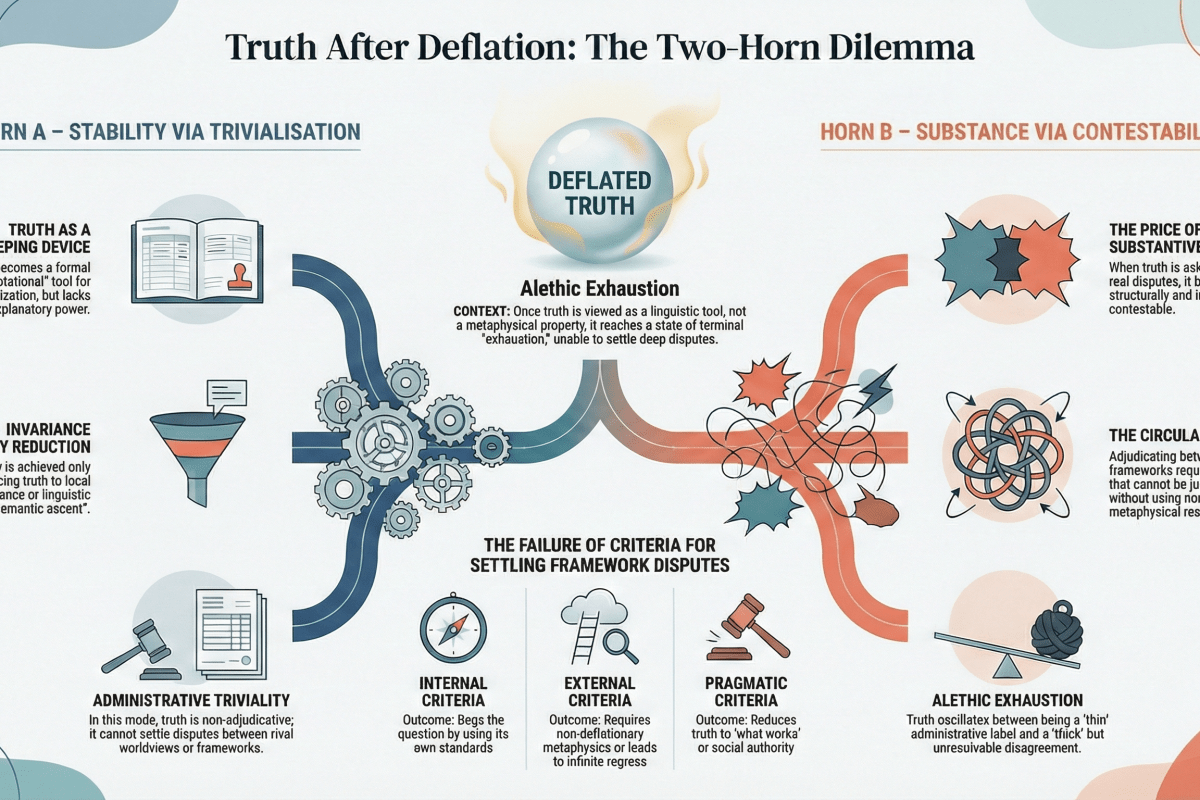
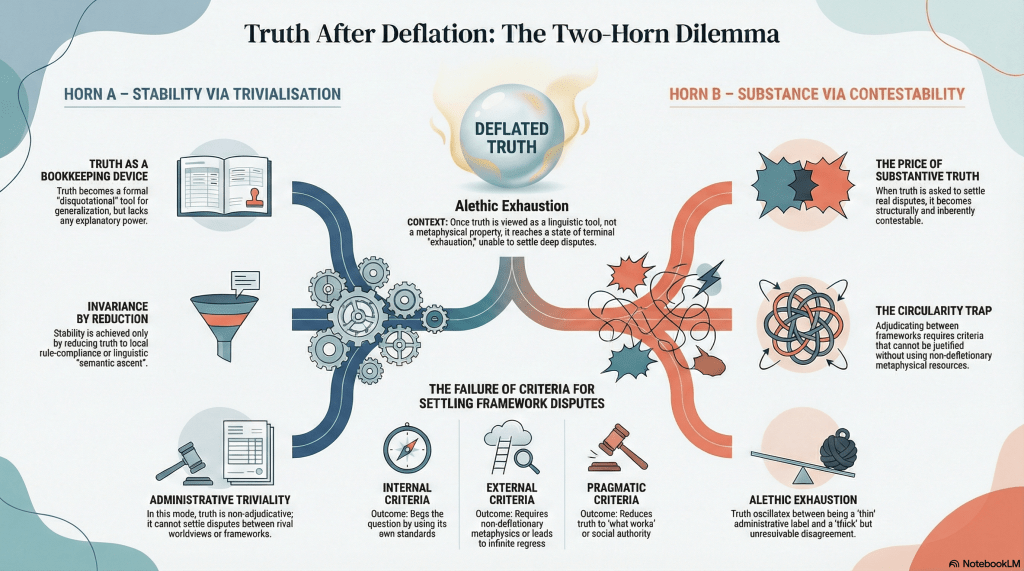
Image: NotebookLM infographics of this topic. (Please ignore the typos.)
The dilemma
Once deflationary constraints are accepted, attempts to “save” Truth fall into a simple two-horn dilemma.
Horn A: Stabilise truth by making it invariant. You can do this by disquotation, stipulation, procedural norms, or shared observation. The result is stable, but thin. Truth becomes administrative: a device for endorsement, coordination, and semantic ascent. It no longer adjudicates between rival frameworks.
Horn B: Preserve truth as substantive. You can ask Truth to ground inquiry, settle disputes, explain success, or stand above practices. But now you need criteria. And once criteria enter, so do circularity, regress, or smuggled metaphysics. Truth becomes contestable precisely where it was meant to adjudicate.
Stability costs substance. Substance costs stability. There is no third option waiting in the wings.
Why this isn’t just abstract philosophy
To test whether this is merely a theoretical artefact, the paper works through three domains where truth is routinely asked to do serious work:
Moral truth, where Truth is meant to override local norms and condemn entrenched practices.
Scientific truth, where Truth is meant to explain success, convergence, and theory choice.
Historical truth, where Truth is meant to stabilise narratives against revisionism and denial.
In each case, the same pattern appears. When truth is stabilised, it collapses into procedure, evidence, or institutional norms. When it is thickened to adjudicate across frameworks, it becomes structurally contestable. This isn’t relativism. It’s a mismatch between function and resources.
Why this isn’t quietism either
A predictable reaction is: isn’t this just quietism in better prose?
Not quite. Quietism tells us to stop asking. Exhaustion explains why the questions keep being asked and why they keep failing. It’s diagnostic, not therapeutic. The persistence of truth-theoretic debate isn’t evidence of hidden depth. It’s evidence of a concept being pushed beyond what it can bear after deflation.
The upshot
Truth still matters. But not in the way philosophy keeps demanding. Truth works because practices work. It doesn’t ground them. It doesn’t hover above them. It doesn’t adjudicate between them without borrowing authority from elsewhere. Once that’s accepted, a great deal of philosophical anxiety dissolves, and a great deal of philosophical labour can be redirected.
The question is no longer “What is Truth?” It’s “Why did we expect Truth to do that?”
The paper is now archived on Zenodo and will propagate to PhilPapers shortly. It’s long, unapologetically structural, and aimed squarely at readers who already think deflationary truth is right but haven’t followed it to its endpoint.
Read it if you enjoy watching concepts run out of road.
I Am a Qualified Subjectivist. No, That Does Not Mean ‘Anything Goes’.
Make no mistake: I am a subjectivist. A qualified one. Not that kind of qualified – the qualification matters, but it’s rarely the part anyone listens to.
Image: Not that kind…
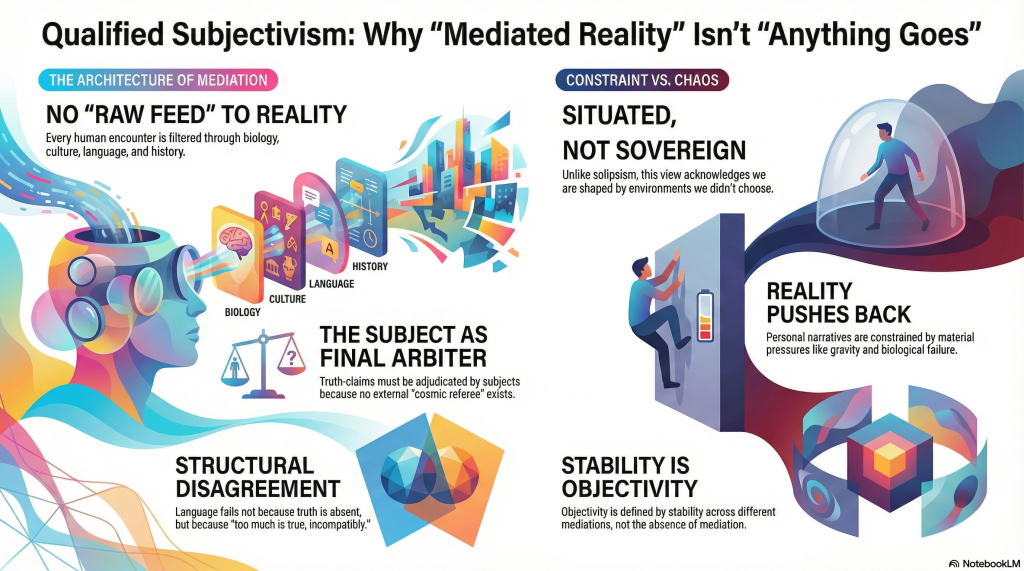
Here is the unglamorous starting point: all human encounters with the world are mediated. There is no raw feed. No unfiltered access. No metaphysical lead running directly from ‘reality’ into the human mind. Every encounter is processed through bodies, nervous systems, cultures, languages, technologies, institutions, and histories.
Audio: NotebookLM summary podcast of this content – See addendum below.
Whilst I discuss the specific architecture of this mediation at length in this preprint, here I will keep it simple.
If you are human, you do not encounter reality as such. You encounter it as processed. This is not controversial. What is controversial is admitting the obvious consequence: the subject is the final arbiter.
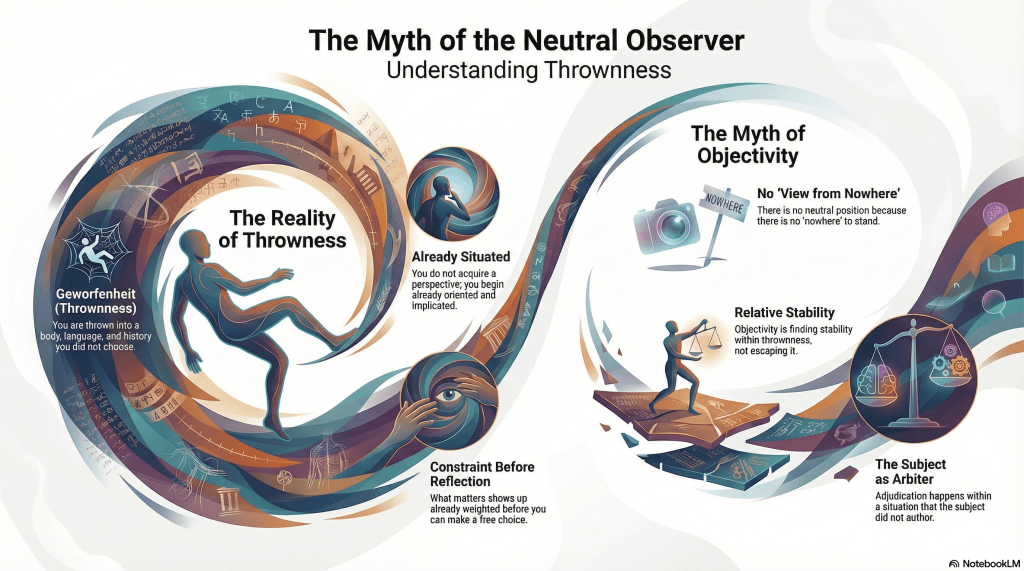
Image: NotebookLM Infographic of Qualified Subjectivism
The Subject Is the Final Arbiter
Every account of truth, reality, meaning, value, or fact is ultimately adjudicated by a subject. Not because subjects are sovereign gods, but because there is literally no other place adjudication can occur.
Who, exactly, do critics imagine is doing the adjudicating instead? A neutral tribunal floating outside experience? A cosmic referee with a clipboard? A universal consciousness we all forgot to log into?
There is no one else.
This does not mean that truth is ‘whatever I feel like’. It means that truth-claims only ever arrive through a subject, even when they are heavily constrained by the world. And constraint matters. Reality pushes back. Environments resist. Bodies fail. Gravity does not care about your personal narrative.
Why This Is Not Solipsism
Solipsism says: only my mind exists. That is not my claim. My claim is almost boring by comparison: subjects are situated, not sovereign.
We are shaped by environments we did not choose and histories we did not write. Mediation does not eliminate reality; it is how reality arrives. Your beliefs are not free-floating inventions; they are formed under biological, social, and material pressure. Two people can be exposed to the same event and encounter it differently because the encounter is not the event itself – it is the event as mediated through a particular orientation.
Why Objectivity Keeps Sneaking Back In
At this point, someone usually says: ‘But surely some things are objectively true.’
Yes. And those truths are still encountered subjectively. The mistake is thinking that objectivity requires a ‘view from nowhere’. It doesn’t. It requires stability across mediations, not the elimination of mediation altogether. We treat some claims as objective because they hold up under variation, while others fracture immediately. But in all cases, the encounter still happens somewhere, to someone.
The Real Source of the Panic
The real anxiety here is not philosophical. It’s moral and political. People are terrified that if we give up the fantasy of unmediated access to universal truth, then legitimacy collapses and ‘anything goes’.
This is a category error born of wishful thinking. What actually collapses is the hope that semantic convergence is guaranteed. Once you accept that mediation is unavoidable, you are forced to confront a harder reality: disagreement is often structural, not corrigible. Language does not fail because nothing is true. Language fails because too much is true, incompatibly.
So Yes, I Am a Qualified Subjectivist
Interpretation only ever occurs through subjects. Subjects are always mediated. Mediation is always constrained. And constraint does not guarantee convergence.
That is the position. It is not radical, fashionable, or comforting. It is simply what remains once you stop pretending there is a god’s-eye view quietly underwriting your arguments. Discomfort is simply a reliable indicator that a fantasy has been disturbed.
Addendum: Geworfenheit and the Myth of the Neutral Subject
Audio: NotebookLM summary of this Geworfenheit addendum
If all this sounds suspiciously familiar, that’s because it is. Heidegger had a word for it: Geworfenheit – usually translated as thrownness.
The idea is simple, and deeply irritating to anyone still hoping for a clean start. You do not enter the world as a neutral observer. You are thrown into it: into a body, a language, a culture, a history, a set of institutions, a moment you did not choose. You do not begin from nowhere and then acquire a perspective. You begin already situated, already oriented, already implicated.
This is not a poetic flourish. It is a structural claim about human existence.
Image: Another NotebookLM infographic for the fun of it.
What my qualified subjectivism insists on – without Heidegger’s ontological theatre – is the same basic constraint: there is no view from nowhere because there is no nowhere to stand. The subject does not float above mediation; the subject is constituted by it. Thrownness is not an accident to be corrected by better theory. It is the condition under which any theorising occurs at all.
Seen this way, the demand for pure objectivity starts to look less like a philosophical ideal and more like nostalgia for an impossible innocence. A wish to rewind existence to a point before bodies, languages, power, and history got involved. That point never existed.
Geworfenheit matters here because it dissolves the caricature that subjectivism is about arbitrary choice. Being thrown is the opposite of choosing freely. It is constraint before reflection. Orientation before argument. Salience before reasons. You do not decide what matters from a neutral menu; what matters shows up already weighted, already charged, already resistant.
This is why appeals to “just be objective” always ring hollow. Objectivity does not mean escaping thrownness. It means achieving relative stability within it. Some claims hold across many thrown positions. Others fracture immediately. That distinction matters. But none of it happens outside mediation.
So when I say the subject is the final arbiter, I am not crowning the subject king of reality. I am pointing out the obvious: adjudication happens somewhere, to someone, from within a situation they did not author. Thrownness guarantees that there is no cosmic referee waiting to overrule the encounter.
If that makes you uncomfortable, good. It should. Discomfort is often just the sensation of a fantasy losing its grip.
I was having an inappropriate chat with ChatGPT and, per Feyerabend, I once again discovered that some of the best inspirations are unplanned. The conversation circled around to the conflicting narratives of Erasmus and Wells. Enter, Plato, McGilchrist, and the Enlightenment – all living rent-free in my head – and I end up with this.
Audio: NotebookLM podcast on this topic.
I. The Proverb and Its Presumption
Erasmus sits at his writing desk in 1500-something, cheerful as a man who has never once questioned the premises of his own eyesight, and pens what will become one of the West’s most durable little myths: ‘In the land of the blind, the one-eyed man is king’. It arrives packaged as folk wisdom, the sort of thing you’re meant to nod at sagely over a pint. And for centuries, we did. The proverb became shorthand for a comfortable fantasy: that advantage is advantage everywhere, that perception grants sovereignty, that a man with superior faculties will naturally ascend to his rightful place atop whatever heap he finds himself on.
In the land of the blind, the one-eyed man is king
– Erasmus
It’s an Enlightenment dream avant la lettre, really – this breezy confidence that reason, sight, knowledge, insight will simply work wherever they’re deployed. The one-eyed man doesn’t need to negotiate with the blind. He doesn’t need their endorsement, their customs, their consent. He arrives, he sees, he rules. The proverb presumes a kind of metaphysical meritocracy, where truth and capability are self-authenticating, where the world politely arranges itself around whoever happens to possess the sharper tools.
Image: Midjourney didn’t coöperate with my prompt for a one-eyed king. Trust that this king has only one.
It’s the intellectual equivalent of showing up in a foreign country with a briefcase full of sterling and expecting everyone to genuflect. And like most folk wisdom, it survives because it flatters us. It tells us that our advantages – our rationality, our education, our painstakingly cultivated discernment – are universally bankable. That we, the seeing, need only arrive for the blind to recognise our superiority.
Erasmus offers this with no apparent irony. He hands us a proverb that whispers: your clarity is your crown.
II. Wells Wanders In
Four centuries later, H.G. Wells picks up the proverb, turns it over in his hands like a curious stone, and proceeds to detonate it.
The Country of the Blind (1904) is many things – a fable, a thought experiment, a sly dismantling of Enlightenment presumption – but above all it is an act of literary vandalism against Erasmus and everything his proverb smuggles into our collective assumptions. Wells sends his protagonist, Nuñez, tumbling into an isolated Andean valley where a disease has rendered the entire population blind for generations. They’ve adapted. They’ve built a culture, a cosmology, a complete lifeworld organised around their particular sensorium. Sight isn’t absent from their world; it’s irrelevant. Worse: it’s nonsense. The seeing man’s reports of ‘light’ and ‘sky’ and ‘mountains’ sound like the ravings of a lunatic.
Nuñez arrives expecting Erasmus’s kingdom. He gets a psychiatric evaluation instead.
The brilliance of Wells’s story isn’t simply that the one-eyed man fails to become king – it’s how he fails. Nuñez doesn’t lack effort or eloquence. He tries reason, demonstration, patient explanation. He attempts to prove the utility of sight by predicting sunrise, by describing distant objects, by leveraging his supposed advantage. None of it matters. The blind don’t need his reports. They navigate their world perfectly well without them. His sight isn’t superior; it’s alien. And in a culture that has no use for it, no linguistic scaffolding to accommodate it, no social structure that values it, his one eye might as well be a vestigial tail.
The valley’s elders eventually diagnose Nuñez’s problem: his eyes are diseased organs that fill his brain with hallucinations. The cure? Surgical removal.
Wells lets this hang in the air, brutal and comic. The one-eyed man isn’t king. He’s a patient. And if he wants to stay, if he wants to belong, if he wants to marry the girl he’s fallen for and build a life in this place, he’ll need to surrender the very faculty he imagined made him superior. He’ll need to let them fix him.
The story ends ambiguously – Nuñez flees at the last moment, stumbling back toward the world of the sighted, though whether he survives is left unclear. But the damage is done. Erasmus’s proverb lies in ruins. Wells has exposed its central presumption: that advantage is advantage everywhere. That perception grants authority. That reason, clarity, and superior faculties are self-evidently sovereign.
They’re not. They’re only sovereign where the culture already endorses them.
III. Plato’s Ghost in the Valley
If Wells dismantles Erasmus, Plato hovers over the whole scene like a weary ghost, half scolding, half despairing, muttering that he told us this would happen.
The Allegory of the Cave, after all, is the original version of this story. The philosopher escapes the cave, sees the sun, comprehends the Forms, and returns to liberate his fellow prisoners with reports of a luminous reality beyond the shadows. They don’t thank him. They don’t listen. They think he’s mad, or dangerous, or both. And if he persists – if he tries to drag them toward the exit, toward the light they can’t yet see – they’ll kill him for it.
Video: Plato’s Cave
Plato’s parable is usually read as a tragedy of ignorance: the prisoners are too stupid, too comfortable, too corrupted by their chains to recognise truth when it’s offered. But read it alongside Wells and the emphasis shifts. The cave-dwellers aren’t wrong, exactly. They’re coherent. They’ve built an entire epistemology around shadows. They have experts in shadow interpretation, a whole language for describing shadow behaviour, social hierarchies based on shadow-predicting prowess. The philosopher returns with reports of a three-dimensional world and they hear gibberish. Not because they’re defective, but because his truth has no purchase in their lifeworld.
Plato despairs over this. He wants the prisoners to want liberation. He wants truth to be self-authenticating, wants knowledge to compel assent simply by virtue of being knowledge. But the cave doesn’t work that way. The prisoners don’t want truth; they want comfort shaped like reality. They want coherence within the system they already inhabit. The philosopher’s sun is as alien to them as Nuñez’s sight is to the blind valley.
And here’s the kicker: Plato knows this. That’s why the allegory is tragic rather than triumphant. The philosopher does see the sun. He does apprehend the Forms. But his knowledge is useless in the cave. Worse than useless – it makes him a pariah, a madman, a threat. His enlightenment doesn’t grant him sovereignty; it exile him from the only community he has.
The one-eyed man isn’t king. He’s the lunatic they’ll string up if he doesn’t learn to shut up about the sky.
IV. The Enlightenment’s Magnificent Blunder
Once you’ve got Erasmus, Wells, and Plato in the same room, the Enlightenment’s central fantasy collapses like wet cardboard.
Humanity’s great Enlightenment wheeze – that baroque fantasy of Reason marching triumphantly through history like a powdered dragoon – has always struck me as the intellectual equivalent of selling snake oil in a crystal decanter. We were promised lucidity, emancipation, and the taming of ignorance; what we got was a fetish for procedural cleverness, a bureaucratisation of truth, and the ghastly belief that if you shine a bright enough torch into the void, the void will politely disclose its contents.
The Enlightenment presumed universality. It imagined that rationality, properly deployed, would work everywhere – that its methods were culture-neutral, that its conclusions were binding on all reasonable minds, that the shadows in Plato’s cave and the blindness in Wells’s valley could be cured by the application of sufficient light and logic. It treated reason as a kind of metaphysical bulldozer, capable of flattening any terrain it encountered and paving the way for Progress, Truth, and Universal Human Flourishing.
This was, to put it mildly, optimistic.
What the Enlightenment missed – what Erasmus’s proverb cheerfully ignores and what Wells’s story ruthlessly exposes – is that rationality is parochial. It’s not a universal solvent. It’s a local dialect, a set of practices that evolved within particular cultures, buttressed by particular institutions, serving particular ends. The Enlightenment’s rationality is Western rationality, Enlightenment rationality, rationality as understood by a specific cadre of 18th-century European men who happened to have the printing press, the political clout, and the colonial apparatus to export their epistemology at gunpoint.
They mistook their own seeing for sight itself. They mistook their own lifeworld for the world. And they built an entire civilisational project on the presumption that everyone else was just a less-developed version of them – prisoners in a cave, blind villagers, savages waiting to be enlightened.
The one-eyed man imagined himself king. He was actually the emissary who forgot to bow.
V. McGilchrist’s Neuroscientific Millinery
Iain McGilchrist sits in the same intellectual gravity well as Plato and Wells, only he dresses his thesis up in neuroscientific millinery so contemporary readers don’t bolt for the door. The Master and His Emissary is essentially a 500-page retelling of the same ancient drama: the emissary – our little Enlightenment mascot – becomes so enamoured of his own procedures, abstractions, and tidy schemas that he forgets the Master’s deeper, embodied, culturally embedded sense-making.
McGilchrist’s parable is neurological rather than allegorical, but the structure is identical. The left hemisphere (the emissary) excels at narrow focus, manipulation, abstraction – the sort of thing you need to count coins or parse grammar or build bureaucracies. The right hemisphere (the Master) handles context, pattern recognition, relational understanding – the sort of thing you need to navigate an actual lifeworld where meaning is messy, embodied, and irreducible to procedures.
The emissary is supposed to serve the Master. Left-brain proceduralism is supposed to be a tool deployed within the broader, contextual sense-making of the right brain. But somewhere along the way – roughly around the Enlightenment, McGilchrist suggests – the emissary convinced itself it could run the show. Left-brain rationality declared independence from right-brain contextuality, built an empire of abstraction, and wondered why the world suddenly felt thin, schizophrenic, oddly two-dimensional.
It’s Erasmus all over again: the presumption that the emissary with one eye should be king. The same tragic misunderstanding of how worlds cohere.
McGilchrist’s diagnosis is clinical, but his conclusion is damning. Western modernity, he argues, has become pathologically left-hemisphere dominant. We’ve let analytic thought pretend it’s sovereign. We’ve mistaken our schemas for reality, our maps for territory, our procedures for wisdom. We’ve built cultures that privilege manipulation over meaning, extraction over relationship, clarity over truth. And we’re baffled when these cultures feel alienating, when they produce populations that are anxious, depressed, disenchanted, starved for something they can’t quite name.
The emissary has forgotten the Master entirely. And the Master, McGilchrist suggests, is too polite – or too injured – to stage a coup.
In McGilchrist’s frame, culture is the Master. Strategy, reason, Enlightenment rationality – these are the emissary’s tools. Useful, necessary even, but never meant to govern. The Enlightenment’s mistake was letting the emissary believe his tools were all there was. It’s the same delusion Nuñez carries into Wells’s valley: the belief that sight, reason, superior faculties are enough. That the world will rearrange itself around whoever shows up with the sharper implements.
It won’t. The valley doesn’t need your eyes. The cave doesn’t want your sun. And the Master doesn’t answer to the emissary’s paperwork.
VI. The Triumph of Context Over Cleverness
So here’s what these three – Erasmus, Wells, Plato – triangulate, and what McGilchrist confirms with his neuroscientific gloss: the Enlightenment dream was always a category error.
Reason doesn’t grant sovereignty. Perception doesn’t compel assent. Superior faculties don’t self-authenticate. These things only work – only mean anything, only confer any advantage – within cultures that already recognise and value them. Outside those contexts, they’re noise. Gibberish. Hallucinations requiring surgical intervention.
The one-eyed man arrives in the land of the blind expecting a kingdom. What he gets is a reminder that kingdoms aren’t built on faculties; they’re built on consensus. On shared stories, shared practices, shared ways of being-in-the-world. Culture is the bedrock. Reason is just a tool some cultures happen to valorise.
And here’s the uncomfortable corollary: if reason is parochial, if rationality is just another local dialect, then the Enlightenment’s grand project – its universalising ambitions, its colonial export of Western epistemology, its presumption that everyone, everywhere, should think like 18th-century European philosophes – was always a kind of imperialism. A metaphysical land-grab dressed up in the language of liberation.
The Enlightenment promised illumination but delivered a blinding glare that obscures more than it reveals. It told us the cave was a prison and the valley was backward and anyone who didn’t see the world our way was defective, uncivilised, in need of correction. It never occurred to the Enlightenment that maybe – just maybe – other cultures had their own Masters, their own forms of contextual sense-making, their own ways of navigating the world that didn’t require our light.
Wells understood this. Plato suspected it. McGilchrist diagnoses it. And Erasmus, bless him, never saw it coming.
VII. The Enlightenment’s Paper Crown
The Enlightenment liked to imagine itself as the adult entering the room, flicking on the light-switch, and announcing that, at long last, the shadows could stop confusing the furniture for metaphysics. This is the kind of confidence you only get when your culture hasn’t yet learned the words for its own blind spots. It built an entire worldview on the hopeful presumption that its preferred modes of knowing weren’t just one way of slicing experience, but the gold standard against which all other sense-making should be judged.
Call it what it is: a provincial dialect masquerading as the universal tongue. A parochial habit dressed in imperial robes. The Enlightenment always smelled faintly of a man who assumes everyone else at the dinner table will be impressed by his Latin quotations. And when they aren’t, he blames the table.
The deeper farce is that Enlightenment rationality actually believed its tools were transferrable. That clarity is clarity everywhere. That if you wheel enough syllogisms into a space, the locals will drop their incense and convert on sight. Wells disabuses us of this; Plato sighs that he tried; McGilchrist clinically confirms the diagnosis. The emissary, armed with maps and measuring sticks, struts into the valley expecting coronation and is shocked – genuinely shocked – to discover that nobody particularly cares for his diagrams.
The Enlightenment mistake wasn’t arrogance (though it had that in liberal supply). It was context-blindness. It thought procedures could substitute for culture. It thought method could replace meaning. It thought mastery was a matter of getting the right answer rather than belonging to the right world.
You can all but hear the emissary stamping his foot.
VIII. The Anti-Enlightenment Position (Such as It Is)
My own stance is drearily simple: I don’t buy the Enlightenment’s sales pitch. Never have. The promise of universal reason was always a conjuring trick designed to flatter its adherents into thinking that their habits were Nature’s preferences. Once you stop confusing methodological neatness with metaphysical authority, the entire apparatus looks less like a cathedral of light and more like a filing system that got ideas above its station.
The problem isn’t that reason is useless. The problem is that reason imagines itself sovereign. Reason is a brilliant servant, a competent emissary, and an atrocious king. Culture is the king; context is the kingdom. Without those, rationality is just an embarrassed bureaucrat looking for a desk to hide behind.
This is why I keep banging on about language insufficiency, parochial cognition, and the delightful way our concepts disintegrate once you wander too far from the lifeworlds that birthed them. The Enlightenment thought the human mind was a searchlight. It’s closer to a candle in a draughty hall. You can still get work done with a candle. You just shouldn’t be telling people it can illuminate the universe.
So the anti-Enlightenment move isn’t a call to smash the instruments. It’s a call to read the room. To stop pretending the emissary is the Master. To stop assuming sight is a passport to sovereignty. To stop wandering into other cultures – other caves, other valleys, other hemispheres – with a ruler and a smirk, convinced you’re about to be crowned.
Underneath these brittle idols lies the far messier truth that cognition is parochial, language insufficient, and ‘rationality’ a parlour trick we perform to impress ourselves. I’m not proposing a new catechism, nor am I pining for some prelapsarian alternative. I’m simply pointing out that the Enlightenment promised illumination but delivered a blinding glare that obscures more than it reveals.
The task, then, is to grow comfortable with the dimness. To navigate by flicker rather than floodlight. To admit that the world was never waiting to be made ‘clear’ in the first place.
This doesn’t mean abandoning reason. It means remembering that reason is the emissary, not the Master. It means recognising that our schemas are provisional, our maps incomplete, our procedures useful only within the cultures that endorse them. It means learning to bow – to culture, to context, to the irreducible messiness of lifeworlds we don’t fully understand and can’t procedurally master.
The one-eyed man never was king. At best, he was an enthusiastic tourist with a very noisy torch. The sooner he stops shining it into other people’s faces, the sooner we can get on with the far more interesting business of navigating a world that never promised to be legible.
Not a kingdom of sight. Just a world where the emissary remembers his place.
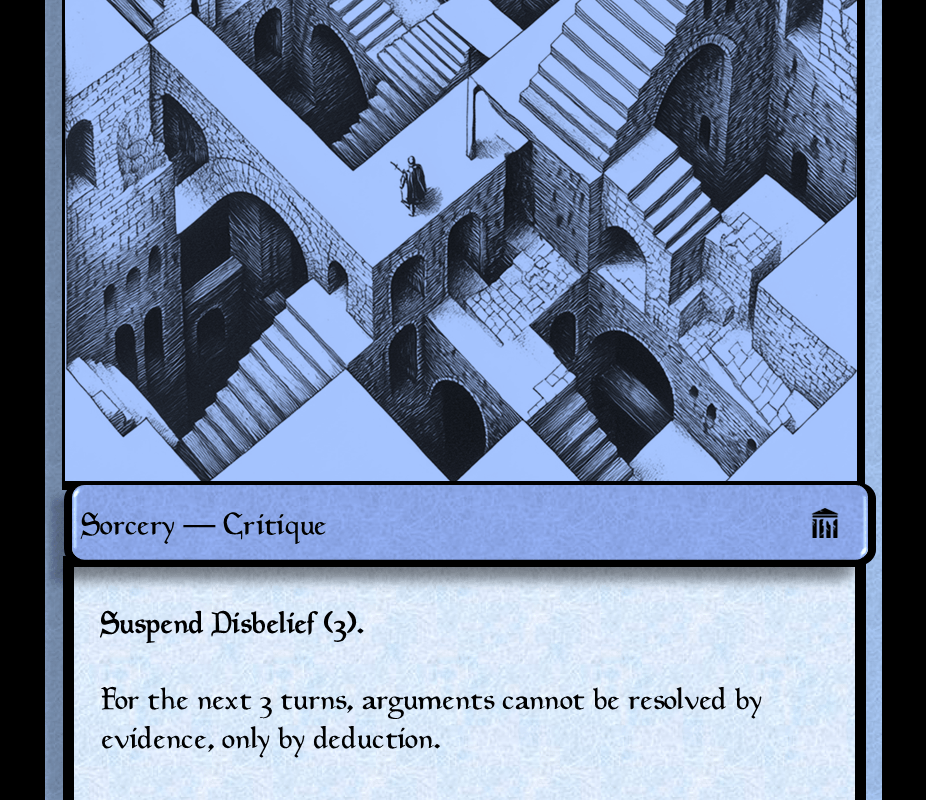
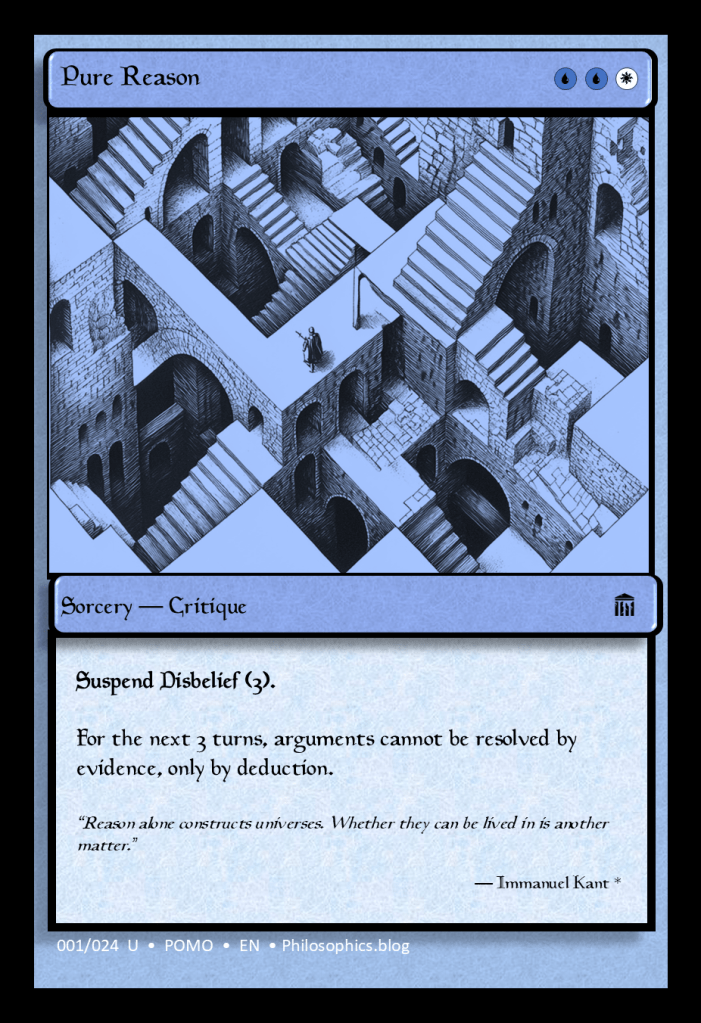
If reason had a landscape, it would look like this card: a maze of ascending and descending staircases, forever rational yet going nowhere. Kant might have called it a Critique of Pure Geometry.
Pure Reason, the first card in the Postmodern set, isn’t so much an homage to Kant as it is a cautionary reconstruction. It honours his ambition to build a universe from deduction while quietly mourning the price of that construction: alienation from experience.
Image: Card 001 from the Postmodern Set — Philosophics.blog
The Meta
Suspend Disbelief (3). For the next three turns, arguments cannot be resolved by evidence, only by deduction.
Audio: NotebookLM podcast of this topic.
The rule text re-enacts Kant’s method. In the Critique of Pure Reason, he cordoned off the realm of empirical evidence and tried to chart what the mind could know a priori – before experience. The card’s mechanic enforces that isolation. For three turns, players must reason in a vacuum: no appeals to observation, no touchstones of reality, only deduction.
It’s a temporary world built entirely of logic, an echo of the transcendental playground Kant envisioned. The effect is powerful but sterile – thought constructing universes that can’t sustain life.
The flavour text says it plainly:
“Reason alone constructs universes. Whether they can be lived in is another matter.”
— Immanuel Kant
That line, of course, is apocryphal, but it captures the essence of his project: reason as world-maker and prison architect in one.
The Architecture of Thought
The artwork mirrors Escher’s impossible staircases – a labyrinth of pure geometry, ordered yet uninhabitable. Each path is internally consistent, logically sound, but spatially absurd. This is Kant’s transcendental edifice made visual: coherent on paper, dizzying in practice.
The lone figure standing in the maze is the transcendental subject – the philosopher trapped within the architecture of his own cognition. He surveys the world he has built from categories and forms, unable to escape the walls of his own reason.
It’s a neat metaphor for Enlightenment hubris: the belief that reason can serve as both foundation and roof, requiring no support from the messy ground of existence.
Kant’s Double Legacy
Kant’s Critique was both the high point and the breaking point of Enlightenment rationality. It erected the scaffolding for science, ethics, and aesthetics but revealed the fault lines beneath them. His insistence that the mind structures experience rather than merely reflecting it gave birth to both modern idealism and modern doubt.
Every philosopher after him – Hegel, Nietzsche, Husserl, Derrida – has been trying either to escape or to inhabit that labyrinth differently. Pure Reason captures this tension: the glory of construction and the tragedy of confinement.
My Take
Reason is a magnificent liar. It promises order, clarity, and autonomy, but its perfection is its undoing. It abstracts itself from life until it can no longer recognise its own maker. Kant’s world is flawless and airless – a rational utopia unfit for breathing creatures.
I view Pure Reason as the archetype of the Enlightenment illusion: the attempt to found a living world on the logic of dead forms. What he achieved was monumental, but the monument was a mausoleum.
The card, then, is not just a tribute to Kant but a warning to his descendants (ourselves included): every system of thought eventually turns into an Escher print. Beautiful, consistent, and utterly unlivable.
I recently posted The Ethics of Maintenance: Against the Myth of Natural Purpose. In it, I brushed – perhaps too lightly – against my debt to feminist philosophy. It’s time to acknowledge that debt more directly and explain how it spills into the mundane greasework of daily life.
[Scroll to the bottom to see Midjourney’s take on feminists. You won’t be surprised.]
I tend not to worship at the altar of names, but let’s name names anyway. Beyond the usual French suspects – your Sartres, de Beauvoirs, and Foucaults – I owe much to the feminist philosophers – Gilligan, Tronto, Butler, Bellacasa, and de Beauvoir again – and, while we’re at it, the post-colonialists, whose names I’ll not recite for fear of being pompous. Their shared heresy is a suspicion of universals. They expose the myth of neutrality, whether it parades as Reason, Progress, or Civilisation. They remind us that every “universal” is merely someone’s local story told loud enough to drown out the others.
This isn’t a matter of sex or gender, though that’s how the names have been filed. The core lesson is epistemic, not biological. Feminist philosophy re-centres care, interdependence, and the politics of maintenance, not as sentimental virtues but as systems logic. The post-colonialists do the same at a geopolitical scale: maintenance instead of conquest, relation instead of domination.
On Gender, Behaviour, and the Lazy Binary
I don’t buy into sex and gender binaries, especially regarding behaviour. Even in biology, the dichotomy frays under scrutiny. Behaviourally, it collapses entirely. The problem isn’t people; it’s the linguistic furniture we inherited.
I’m weary of the moral blackmail that calls it misogyny not to vote for a woman, or racism not to vote for a black candidate. These accusations come, paradoxically, from sexists and racists who reduce people to the colour of their skin or the contents of their underwear. Having a vagina doesn’t make one a caretaker; having a penis doesn’t preclude empathy. The category error lies in mistaking type for trait.
When I refuse to vote for a Margaret Thatcher or a Hillary Clinton, it’s not because they’re women. It’s because they operate in the same acquisitive, dominion-driven register as the men they mirror. If the game is conquest, swapping the player’s gender doesn’t change the rules.
Maintenance as Political Praxis
My interest lies in those who reject that register altogether – the ones who abandon the mythology of Progress and its testosterone-addled twin, Innovation. The ethics of maintenance I’ve written about, and the philosophy of Dis-Integration I keep harping on, both gesture toward an alternative mode of being: one that prizes endurance over expansion, care over conquest.
This isn’t new. Feminist philosophers have been saying it for decades, often unheard because they weren’t shouting in Latin or running empires. I’m merely repackaging and re-contextualising, hoping that bundling these neglected insights together might make them audible again.
Knowledge never comes in a vacuum; it circulates. It leaks, cross-pollinates, mutates. To claim “intellectual property” over an idea is to pretend ownership of the air. I’ll spare you the full rant, but suffice it to say that the moment knowledge becomes proprietary, it ceases to breathe.
Conclusion
If I have a creed – and I say this reluctantly – it’s that philosophy should serve as maintenance, not monument-building. Feminist and post-colonial thinkers model that: constant attention, critical care, resistance to the entropy of domination.
I’m just trying to keep the engine running without pretending it’s divine.
Freedom is a word so overused it’s practically anaemic. Everyone wants it; no one agrees on what it means. It’s been weaponised by tyrants and revolutionaries alike, invoked to justify both the breaking of chains and their reforging in a different metal.
Audio: NotebookLM podcast on this topic.
As I write this, I have just finished Erich Fromm’s A Sane Society. Without derailing this post, he cited a scenario – a description of work communities given in All Things Common, by Claire Huchet Bishop – where in post-WW2 France, a group formed a sort of workers’ coöperative – but it was more than that; it was an anarchosyndicalist experiment. As I read it, I had to cringe at the power ‘voluntary’ transfers that immediately got me thinking of Foucault’s biopower – as I often do. Saving this for a separate post.
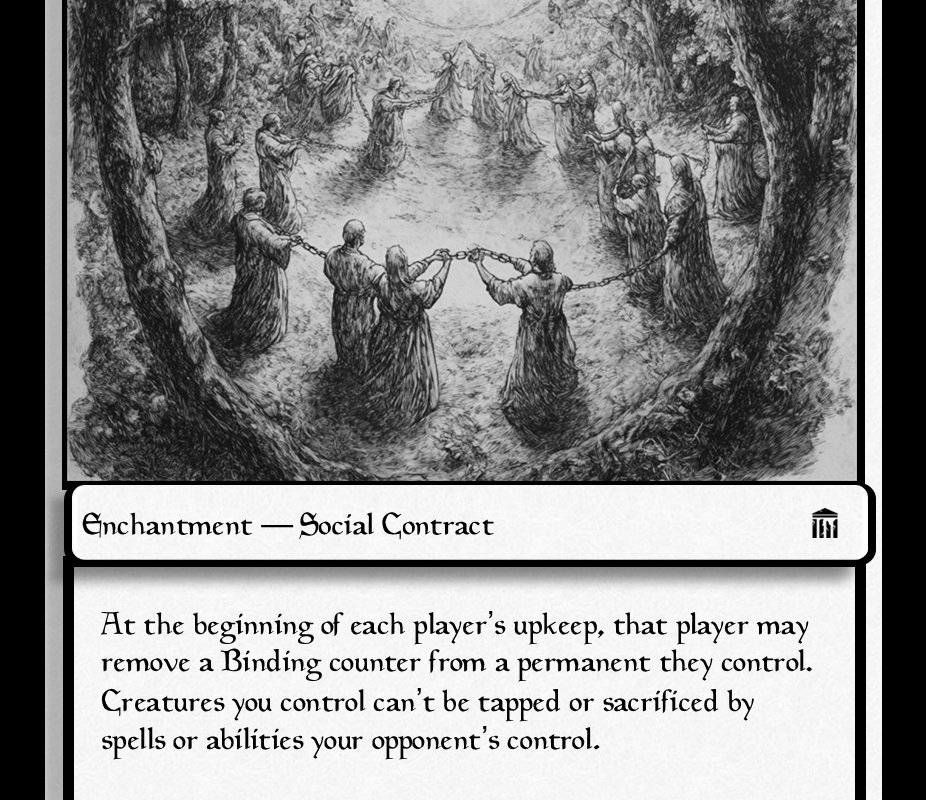
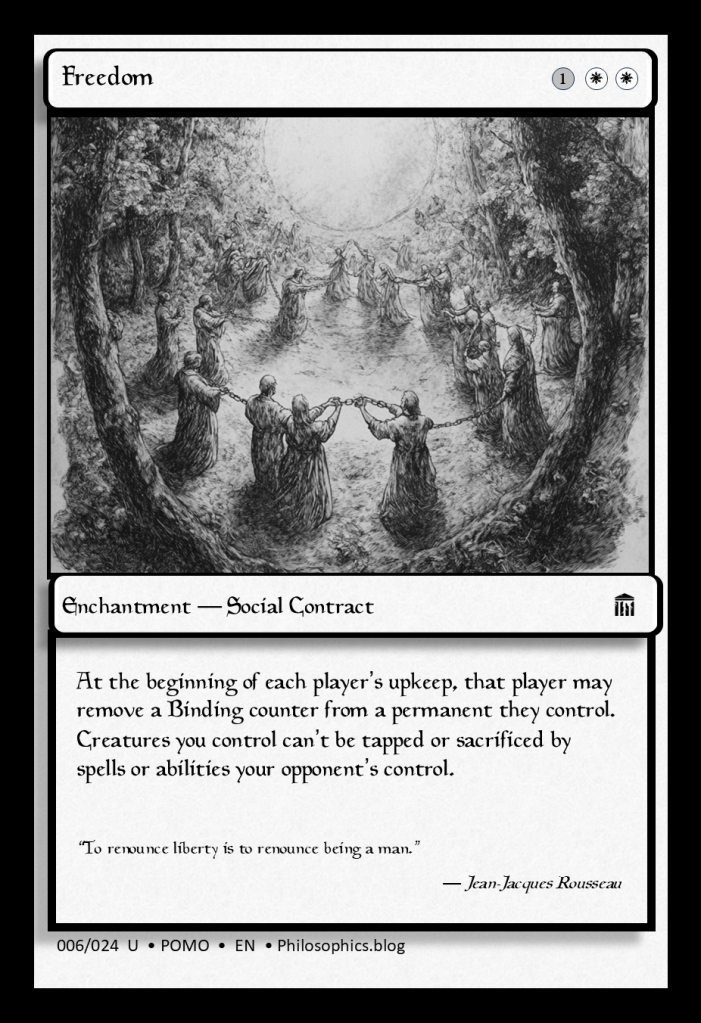
Image: Freedom: The Chains That Bind Us Together Card 006 from the Postmodern Set – Philosophics.blog
This Critical Theory parody card, Freedom, draws its lineage from Jean-Jacques Rousseau, whose paradox still haunts the modern condition: “Man is born free, and everywhere he is in chains.” The card re-enchants that contradiction – an Enchantment – Social Contract that reminds us liberty isn’t a state but a negotiation.
The card reads:
At the beginning of each player’s upkeep, that player may remove a Binding counter from a permanent they control. Creatures you control can’t be tapped or sacrificed by spells or abilities your opponent controls.
This is Rousseau’s dilemma made mechanical. Freedom is not absolute; it’s procedural. The upkeep represents the maintenance of the social contract—an ongoing renewal, not a one-time event. Every player begins their turn by negotiating what freedom costs. You may remove one Binding counter, but only if you recognise that binding exists.
The flavour text underlines Rousseau’s plea:
“To renounce liberty is to renounce being a man.”
Freedom, for Rousseau, wasn’t about doing whatever one pleased. It was about participating in the moral and civic order that gives action meaning. To exist outside that order is not liberty; it’s anarchy, the tyranny of impulse.
The card, therefore, resists the naïve libertarian reading of freedom as the absence of restraint. It instead depicts freedom as the capacity to act within and through shared constraints.
Freedom, then, is not the absence of chains, but the power to choose which ones we wear.
— Philosophics.blog
The art shows a ring of robed figures, hand in hand, their chains forming a circle beneath a clearing sky. It’s a haunting image: freedom through fellowship, bondage through unity. The circle symbolises Rousseau’s idea that true liberty emerges only when individuals subordinate selfish will to the general will – the common interest formed through collective agreement.
Yet there’s also a postmodern irony here: circles can be prisons too. The social contract can emancipate or suffocate, depending on who wrote its terms. The same chains that protect can also bind.
The monochrome aesthetic amplifies the ambiguity – freedom rendered in greyscale, neither utopia nor despair, but the space in between.
Rousseau’s notion of the social contract was revolutionary, but its dissonance still resonates: how can one be free and bound at the same time? He answered that only through the voluntary participation in a collective moral order can humans transcend mere instinct.
We might say that today’s democracies still operate under Freedom (Enchantment – Social Contract). We maintain our rights at the cost of constant negotiation: legal, social, linguistic. Every “Binding counter” removed is the product of civic upkeep. Stop maintaining it, and the enchantment fades.
The card hints at the price of this enchantment: creatures (citizens) can’t be tapped or sacrificed by opponents’ control. In other words, autonomy is secured only when the system prevents external domination. But systems fail, and when they do, the illusion of freedom collapses into coercion.
Rousseau earns a complicated respect in my philosophical canon. He’s not in my top five, but he’s unavoidable. His concept of freedom through the social contract anticipates both modern liberalism and its critique. He believed that genuine liberty required moral community – a notion now eroded by hyper-individualism.
Freedom, as I’ve rendered it here, isn’t celebration. It’s lamentation. The card is about the fragility of the social spell that keeps chaos at bay. We remove one binding at a time, hoping not to unbind ourselves entirely.
Disclaimer: I should be finishing my Language Insufficiency Hypothesis book, yet I am here writing about death and dying. Why? Because I was watching an interview with Neal Schon by Rick Beato. I should have been working on my book then, too. It seems I can write about death more easily than finish a book about the failure of language. Perhaps because death speaks fluently.
I haven’t produced music professionally since the mid-1980s, and I haven’t performed since 2012, yet I am still drawn to its intricacies. My fingers no longer allow me to play much of anything anymore. This is a sort of death. When the body forgets what the mind remembers, that’s a particular kind of death – one language dying while another can’t translate.
As Neal was walking Rick through his equipment and approach to music, I was taken back to a similar place. I wanted to plug into a Fender Twin or a Hi-Watt, a Lexicon 224 or a Cry Baby wah. I still have nightmares thinking of setting up a Floyd Rose.
Video: Rick Beato interviews Neal Schon
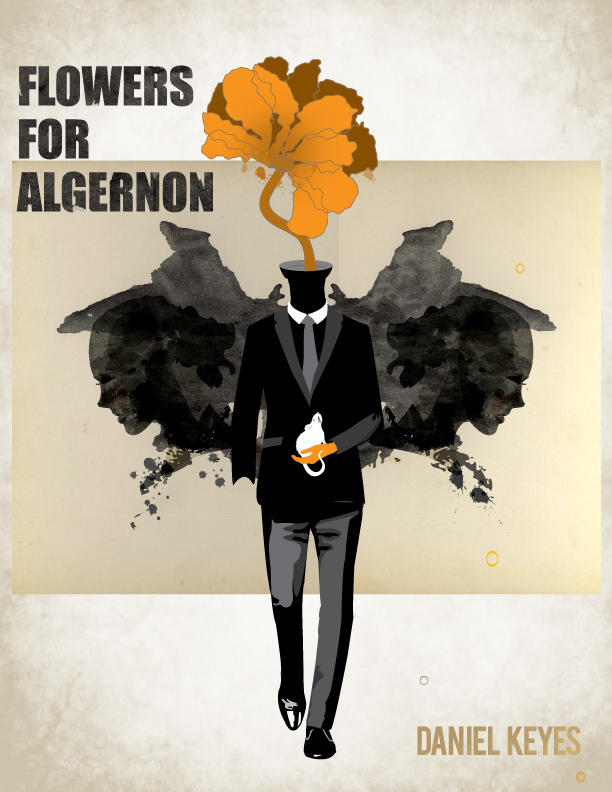
But I can’t go back. As for music, I can’t go forward either. I’m at a standstill, but in a regressed position. It’s uncomfortable. It feels a lot like Charlie in Flowers for Algernon. I used to be able to do that. Don’t get me wrong – I am not claiming to be on the level of Neal Schon, a man I remember from his days with Santana, but when you reach a level of proficiency and then lose it, it hurts; it can be devastating.
Audio: NotebookLM podcast on this topic.
I recall being in hospital in 2023 – a physical rehabilitation facility, really – and I found a piano in a vacant common room. Drawn to the instrument, I rolled over my wheelchair and played…nothing. My fingers wouldn’t work. The piano sat there like a relic of my former self. I rolled toward it as though approaching an altar. My fingers hovered, twitched, failed. The sound of nothing has never been so loud. I cried. I cried a lot those days. I was down to 58 kilos – at 182 cm, I weighed in at just over 9 stone. It wasn’t the best of times.
I still feel a certain nostalgia.
And then there are the people I’ve lost along the way – as another Neal reflected on – The Needle and the Damage Done.
Love and art are both acts of repetition. When one ends, the reflex remains – the impulse to reach, to share, to call out. Death doesn’t stop the motion, only the answer.
I’m lucky to have left Delaware. When a girlfriend died in 2020, I remained and connected with another until 2023, when she died, too. From 2020 to 2023, when I was out and about, something might have caught my eye, and I’d reflect on how Carrie might have liked that.
But it was different. It was more like, ‘I should let Carrie know about that,’ only to realise fractions of a second later that she wouldn’t see whatever it was; she couldn’t. And I’d carry on. I didn’t need to repeat this with Sierra. My relocation to Massachusetts solved this challenge – not so many triggers.
I’m not sure how the loss of ‘professional’ music relates to deceased partners, but it does – at least enough for me to make this connexion. Perhaps I’m just connecting arbitrary dots, but I’ll call it nostalgia.
I don’t play, but I still hear it. The song continues without me. Nostalgia is just rhythm without melody. Perhaps all nostalgia is epistemological error – the confusion of past fluency for present meaning.
If philosophy were a game, Wittgenstein rewrote the rulebook. Then he tore it up halfway through and told us the game was the thing itself.
“Don’t ask for the meaning; ask for the use.”
— Ludwig Wittgenstein
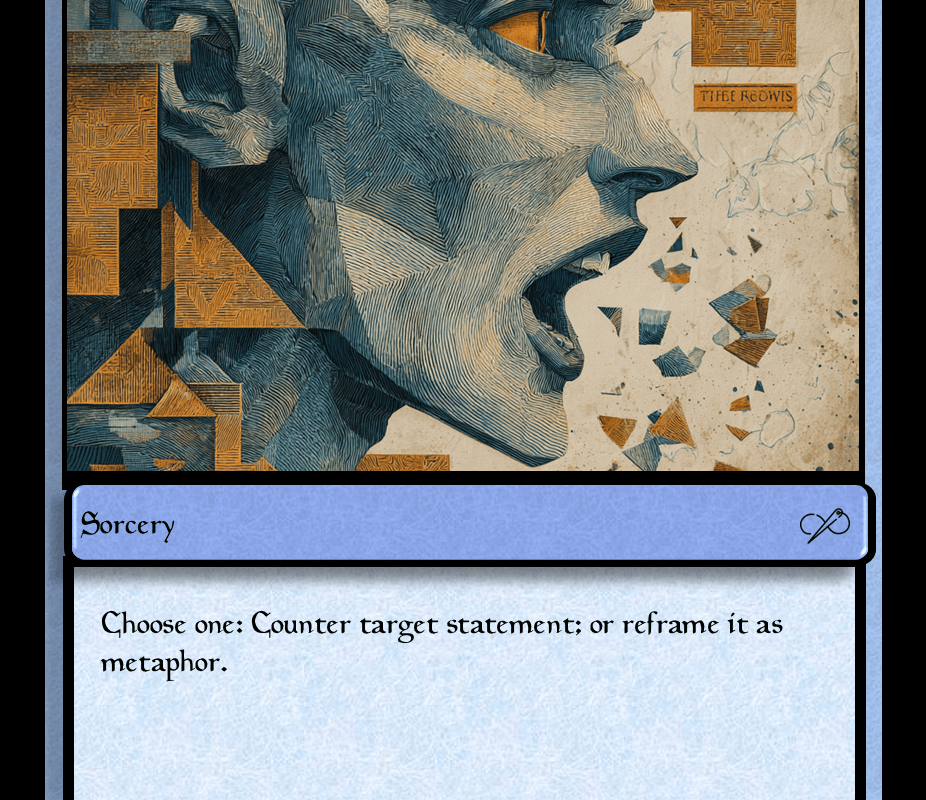
Language Game, the third card in my Critical Theory parody set, isn’t just homage; it’s confession. Wittgenstein is among my top five philosophers, and this card embodies why. His idea that ‘meaning is use’ unhooked language from metaphysics and tethered it to life – to the messy, unpredictable business of how humans actually speak.
The card’s text reads: Choose one: Counter target statement; or reframe it as metaphor.
At first glance, it sounds like a standard spell from Magic: The Gathering – a blue card, naturally, since blue is the colour of intellect, deceit, and control. But beneath the parody is an epistemic mirror.
To “counter” a statement is to engage in the analytic impulse – to negate, clarify, define. To “reframe it as metaphor” is the continental alternative – reinterpret, play, deconstruct. These are not two distinct acts of philosophy but the alternating heartbeat of all discourse. Every argument, every essay, every tweet oscillates between contradiction and reframing.
The sorcery lies in recognising that both are linguistic manoeuvres within the same game. Meaning is not fixed in the words themselves but in how they’re used – by whom, in what context, and to what end. Wittgenstein’s point was brutally simple: there’s no hidden substance behind language, only a living practice of moves and counter-moves.
The Shattered Face
The artwork visualises this idea: speech breaking into shards, thought fragmenting as it leaves the mouth. Meaning disintegrates even as it’s formed. Every utterance is an act of creation and destruction, coherence and collapse.
I wanted the card to look like a concept tearing itself apart whilst trying to communicate, a perfect visual for the paradox of language. The cubist angles hint at structure, but the open mouth betrays chaos. It’s communication as combustion.
Wittgenstein’s Echo
Wittgenstein once wrote, ‘Philosophy leaves everything as it is’. It sounds passive, almost nihilistic, until one realises what he meant: philosophy doesn’t change the world by building new systems; it changes how we see what’s already there.
He was the great anti-system builder, a man suspicious of his own intellect, who saw in language both the limits of thought and the infinite playground of meaning. He dismantled metaphysics not through scepticism but through observation: watch how words behave, and they’ll tell you what they mean.
In that spirit, Language Game is less an argument than an invitation – to watch the mechanics of speech, to see how our statements perform rather than merely represent.
Personal Reflection
Wittgenstein earns a place in my top five because he dissolves the boundaries that most philosophers erect. He offers no comforting totalities, no grand narratives, no moral architectures. Just language, and us inside it, flailing beautifully.
His work aligns with my larger project on the insufficiency of language – its inability to capture the real, yet its irresistible compulsion to try. Wittgenstein knew that words are our most sophisticated form of failure, and he loved them anyway.
To play Language Game is to remember that communication isn’t about arriving at truth but about keeping meaning in motion. Every conversation is a temporary alliance against silence.
The card’s instruction remains both playful and tragic: Counter target statement; or reframe it as metaphor.
This Magic: The Gathering parody trading card was the first in my Critical Theory series.
It’s an important card for me. As with sex and gender, creating a taxonomic or ontological dichotomy poses categorical challenges. Despite the insufficiency of language, it’s still all I have to attempt to classify the world. In the case of articulating the perception of reality, we can choose between idealism and realism. The problem is that it’s not either; it’s both. Reality cannot be realised without both.
Reality, we’re told, exists. That confident noun has carried a great deal of human arrogance. It has underwritten empires, sciences, and sermons. Yet somewhere between Plato’s cave and the latest TED Talk, we forgot to ask a simpler question: for whom does reality exist, and from where is it seen?
Audio: NotebookLM podcast of this topic.
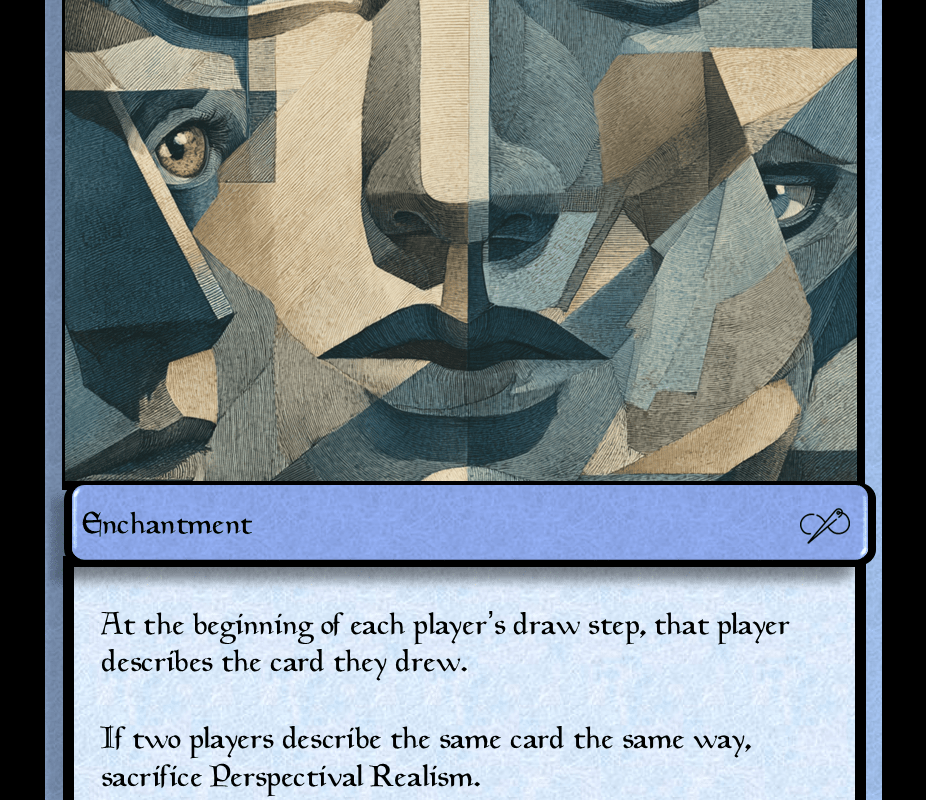
The parody trading card Perspectival Realism was born from that unease. Its mechanic is simple but cruel: at the beginning of each player’s draw step, they must describe the card they drew. The enchantment persists until two players describe a card in the same way—at which point the spell collapses. In other words, consensus kills magic.
Reality is always viewed from somewhere.
—Johannes Jaeger
That rule is the metaphysics of the thing.
When a player ‘describes’ a card, they are not transmitting information; they are constructing the object in linguistic space. The moment the description leaves their mouth, the card ceases to be a piece of paper and becomes a conceptual artefact.
This mirrors the insight of Kant, Nietzsche, and every post-structuralist who ever smoked too much Gauloises: perception isn’t passive. We don’t see reality; we compose it. Language isn’t a mirror but a paintbrush. The thing we call truth is not correspondence but coherence – a temporary truce among competing metaphors.
So the card’s enchantment dramatises this process. So long as multiple descriptions circulate, reality remains vibrant, contested, alive. Once everyone agrees, it dies the death of certainty.
Philosophers have spent centuries arguing whether the world is fundamentally real (existing independent of mind) or ideal (a projection of mind). Both sides are equally tiresome.
Realism, the old bulldog of metaphysics, insists that perception is transparent: language merely reports what’s already there. Idealism, its mirror adversary, claims the opposite – that what’s “there” is mind-stuff all along. Both mistakes are symmetrical. Realism forgets the perceiver; Idealism forgets the world.
Perspectival realism refuses the divorce. It begins from the premise that world and mind are inseparable aspects of a single event: knowing. Reality is not a photograph waiting to be developed, nor a hallucination spun from neurons – it’s a relation, a constant negotiation between perceiver and perceived.
For years, I called myself a Realist™ with an asterisk. That asterisk meant I understood the observer problem: that every ‘fact’ is perspective-laden. Then I became an Idealist™ with an asterisk, meaning I recognised that mind requires matter to dream upon.
The asterisk is everything. It’s the epistemic scar left by perspectival humility – the tacit admission that every claim about the world carries a hidden coordinate: said from here. It is not relativism, but situatedness. It is the philosophical equivalent of depth perception: without the offset, there’s no vision at all.
The card’s rule – sacrifice Perspectival Realism when two players describe a card identically – captures the tragedy of modernity. The Enlightenment taught us to chase consensus, to flatten multiplicity into “objective truth.” We became addicted to sameness, mistaking agreement for understanding.
But agreement is anaesthetic. When all perspectives converge, the world ceases to shimmer; it becomes measurable, predictable, dead. The card’s enchantment disappears the moment reality is stabilised, precisely as our cultural enchantment did under the fluorescent light of ‘reason’.
To live under perspectival realism is to acknowledge that reality is not what is drawn but what is described. And the description is never neutral. It is always written from somewhere – by someone, with a vocabulary inherited from history and stained by desire.
As long as multiple descriptions coexist, the game remains alive. The moment they fuse into one, the spell is broken, and the world returns to grey.
Bernardo Kastrup’s analytic idealism reminded me that consciousness might be primary, but perspectival realism refuses to pledge allegiance. It keeps both flags tattered but flying. The world exists, yes, but only ever for someone.
The enchantment, then, is not belief but perspective itself. So long as difference endures, the game continues.







 Philosophics