I’ve commenced a new series in support of my new book. First, I’m building a glossary.
Video: Bry – Architecture of Encounter
On the docket in this segment are affordance, salience, and valence as they relate to the book. I selected these terms from the glossary in the appendix.
Over the next few weeks, I plan to produce videos on other terms and additional videos explaining key concepts. This one is straightforward and academic. Others will be less formal, hoping to accommodate different learning styles.
Does anyone subscribe to Kindle Unlimited? I may take time to create Kindle and eBook versions.
My fiction books had some formatting issues with Kindle, but these titles are more standard – no fancy layouts or fonts, and not too many images.
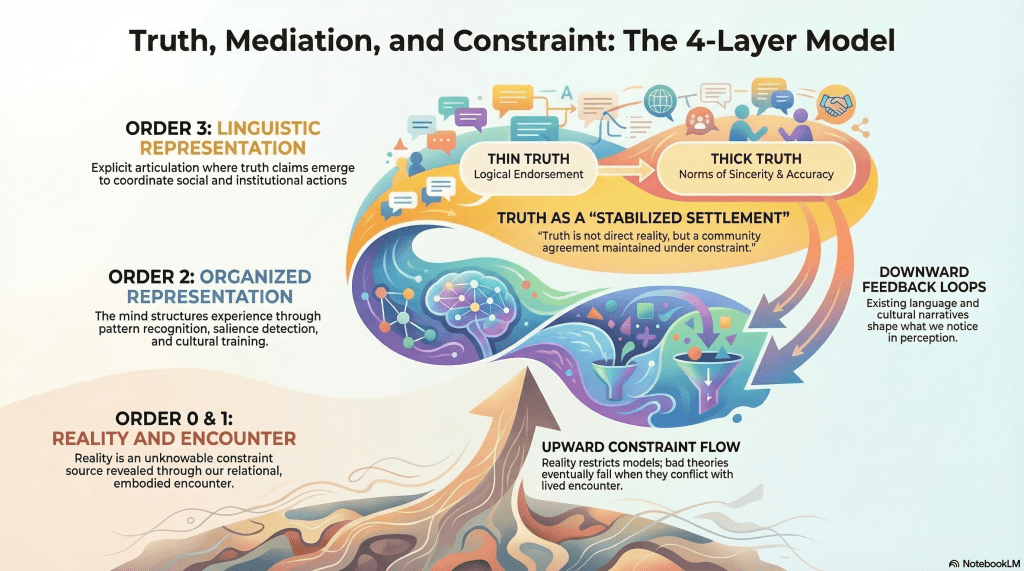
The first step is to stop pretending that ‘truth’ names a single thing.
Philosopher Bernard Williams helpfully distinguished between thin and thick senses of truth in Truth and Truthfulness. The distinction is simple but instructive.
In its thin sense, truth is almost trivial. Saying ‘it is true that p’ typically adds nothing beyond asserting p. The word ‘true’ functions as a logical convenience: it allows endorsement, disquotation, and generalisation. Philosophically speaking, this version of truth carries very little metaphysical weight. Most arguments about truth, however, are not about this thin sense.
In practice, truth usually appears in a thicker social sense. Here, truth is embedded in practices of inquiry and communication. Communities develop norms around sincerity, accuracy, testimony, and credibility. These norms help stabilise claims so that people can coordinate action and share information.
At this level, truth becomes something like a social achievement. A statement counts as ‘true’ when it can be defended, circulated, reinforced, and relied upon within a shared framework of interpretation. Evidence matters, but so do rhetoric, persuasion, institutional authority, and the distribution of power. This is the sense in which truth is rhetorical, but rhetoric is not sovereign.
NotebookLM Infographic on this topic. I prompted NotebookLM to illustrate a 4-layered model that shows how removed language is from encounter, attention, conception, and representation of what we normally consider to be reality. This view is supported by both MEOW and LIH.
Human beings can imagine almost anything about the world, yet the world has a stubborn habit of refusing certain descriptions. Gravity does not yield to persuasion. A bridge designed according to fashionable rhetoric rather than sound engineering will collapse regardless of how compelling its advocates may have been.
This constraint does not disappear in socially constructed domains. Institutions, identities, norms, and laws are historically contingent and rhetorically stabilised, but they remain embedded within material, biological, and ecological conditions. A social fiction can persist for decades or centuries, but eventually it encounters pressures that force revision.
Subjectivity, therefore, doesn’t imply that ‘anything goes’. It simply means that all human knowledge is mediated.
We encounter the world through perception, language, culture, and conceptual frameworks. Every description is produced from a particular standpoint, using particular tools, within particular historical circumstances. Language compresses experience and inevitably loses information along the way. No statement captures reality without distortion. This is the basic insight behind the Language Insufficiency Hypothesis.
At the same time, our descriptions remain answerable to the constraints of the world we inhabit. Some descriptions survive repeated encounters better than others.
In domains where empirical constraint is strong – engineering, physics, medicine – bad descriptions fail quickly. In domains where constraint is indirect – ethics, politics, identity, aesthetics – multiple interpretations may remain viable for long periods. In such cases, rhetoric, institutional authority, and power often function as tie-breakers, stabilising one interpretation over others so that societies can coordinate their activities. These settlements are rarely permanent.
What appears to be truth in one era may dissolve in another. Concepts drift. Institutions evolve. Technologies reshape the landscape of possibility. Claims that once seemed self-evident may later appear parochial or incoherent.
In this sense, many truths in human affairs are best understood as temporally successful settlements under constraint.
Even the most stable arrangements remain vulnerable to change because the conditions that sustain them are constantly shifting. Agents change. Environments change. Expectations change. The very success of a social order often generates the tensions that undermine it. Change, in other words, is the only persistence.
The mistake of traditional realism is to imagine truth as a mirror of reality – an unmediated correspondence between statement and world. The mistake of crude relativism is to imagine that language and power can shape reality without limit. Both positions misunderstand the situation.
We do not possess a final language that captures reality exactly as it is. But neither are we free to describe the world however we please. Truth is not revelation, and it is not mere invention.
It is the provisional stabilisation of claims within mediated encounter, negotiated through language, rhetoric, and institutions, and continually tested against a world that never fully yields to our descriptions. We don’t discover Truth with a capital T. We negotiate survivable descriptions under pressure.
Lucy V. Hay posted this on LinkedIn… and then stopped allowing comments, so I figured I’d recycle it here for comment.
Unpopular opinion (that shouldn’t be unpopular):
The term “Mary Sue” is inherently s3xist 🎯
The phrase comes from a 1973 parody story by Paula Smith called A Trekkie’s Tale. It mocked the self-insert characters appearing in Star Trek fanfiction.
Those writers? Mostly teenage girls 😡
That matters, because culturally we have a long history of treating teenage girls – and the things they create – with contempt. Their fandoms, their stories, their passions are routinely framed as embarrassing, shallow or ridiculous.
Sometimes that ridicule even comes from older women punching down.
And no, the fact Smith was a woman doesn’t magically make the term neutral. Internalised misogyny exists.
Here’s what happened next …
For the last 50+ years, the label “Mary Sue” has been used against practically every female protagonist who shows competence, power or narrative importance.
Meanwhile, male characters with identical arcs are celebrated.
An inexperienced boy who turns out to be the chosen one? Hero.
A woman who discovers she has unusual power or talent? “Mary Sue.”
Same narrative structure … Different reaction 😡
Also, it’s worth noticing something interesting: I hadn’t seen the term “Mary Sue” on my timeline for yeeeeeeaars. Now, every time I post something about female characters, there it is again. In 2026 🤮
Given the current climate around women’s rights and the growing attacks on women and girls globally, that resurgence doesn’t feel accidental. Language shapes culture. Storytelling shapes culture.
And here’s another truth many people don’t realise:
The professional writing industry does not use the term “Mary Sue.”
Not in publishing. Not in development notes. Not in writers’ rooms.
If you’re using it as critique, you’re not signalling professional insight. You’re signalling that you learned storytelling discourse from internet flame wars.
If we want better conversations about character, we need better vocabulary than a 1970s insult aimed at teenage girls writing fanfic.
If you want to explore how bias shapes the way we write and judge characters, that’s exactly what I unpack in my book Writing Diverse Characters For Fiction, TV Or Film (Creative Essentials) 👇 👇 👇
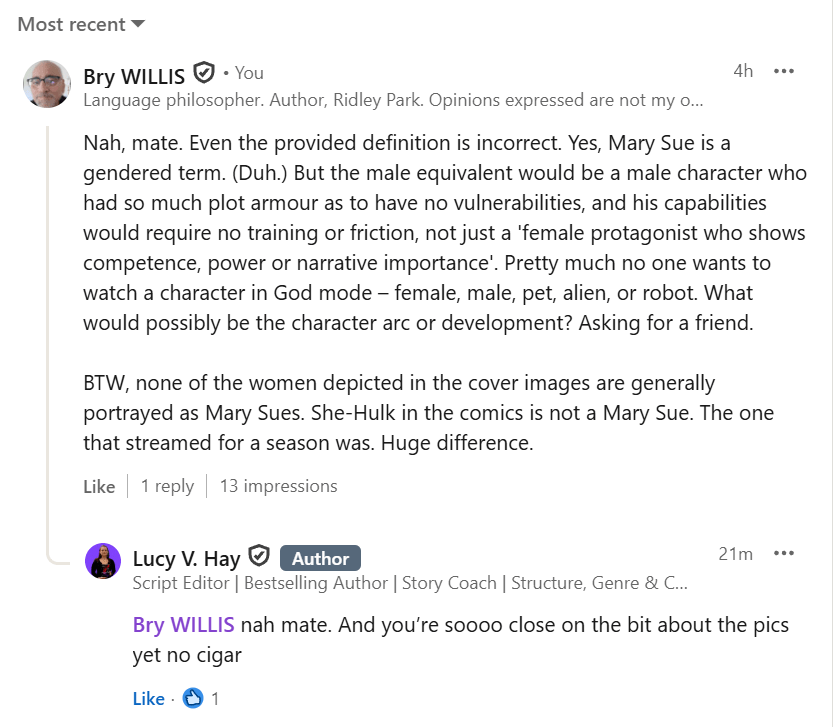
Nah, mate. Even the provided definition is incorrect. Yes, Mary Sue is a gendered term. (Duh.) But the male equivalent would be a male character who had so much plot armour as to have no vulnerabilities, and his capabilities would require no training or friction, not just a ‘female protagonist who shows competence, power or narrative importance’. Pretty much no one wants to watch a character in God mode – female, male, pet, alien, or robot. What would possibly be the character arc or development? Asking for a friend.
BTW, none of the women depicted in the cover images are generally portrayed as Mary Sues. She-Hulk in the comics is not a Mary Sue. The one that streamed for a season was. Huge difference.
Her response was flippant and contained no useful information. I can only imagine she’s trolling.
Obviously, I understand that language is an imperfect vehicle, but it doesn’t have to be this abused. And, obviously, she provided her definition, but it doesn’t comport with any definitions I’m aware of.
As far as the Mary Sue argument goes, ‘no one’ in that space berates all female roles, not even past heroes like Wonderwoman, Spiderwoman, Batwoman, or Ripley from Alien, Terminator’s Sarah Connor, and so on. No one (except Lucy) categorises them as Mary Sue.
This is convenient for an argument, but it’s really tilting at windmills. I understand she’s likely trying to drum up publicity for her book. Good on her. She’ll attract people sympathetic to her message. As for me, I don’t trust a disingenuous source.
An Architecture of Encounter will be available in the next few days. I’ll make an announcement when it is, but I want to talk about pricing.
Audio: NotebookLM summary podcast of this topic.
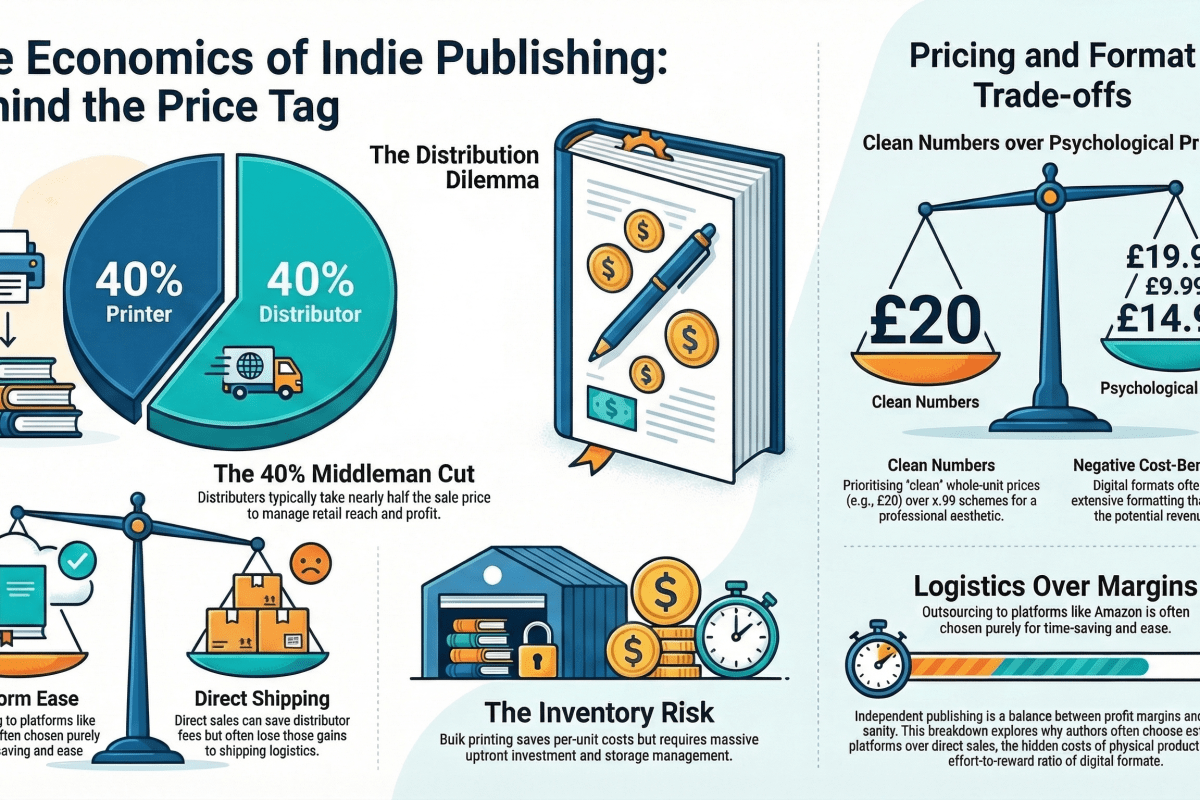
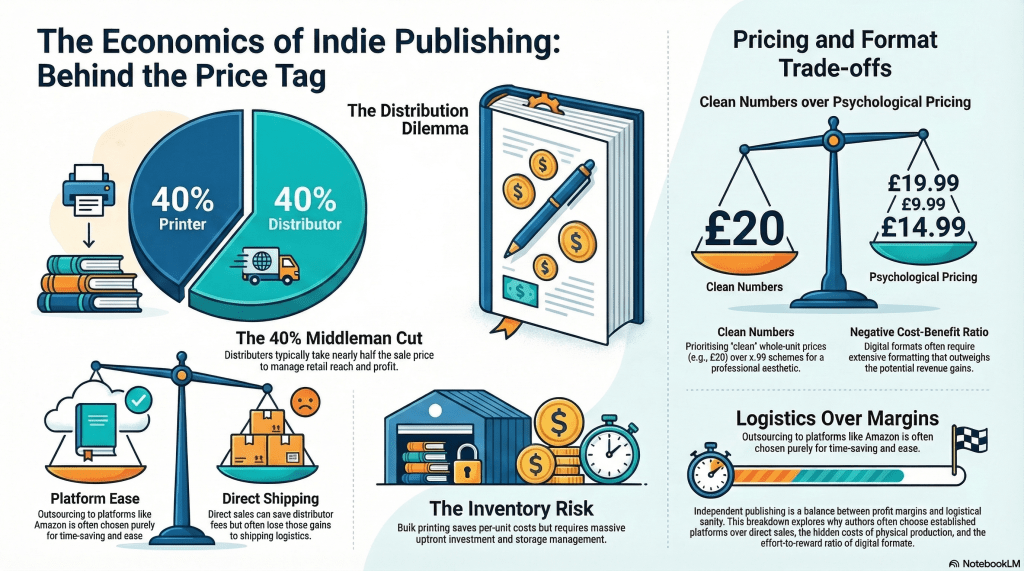
Firstly, books cost money to print. This much is obvious. Hardcovers cost more than paperbacks. The ones with dust jackets cost more still. From a financial/economics perspective, one needs to charge more for hardcovers to compensate for the costs.
Secondly, distributors take a cut. They aren’t in business without a profit interest.
Of course, one might offer directly to the customer to cut out the distribution cost and maybe pocket all or some of the difference, which might be 40-odd per cent of the sale price – 8 from a book priced at 20, where the printer already takes, say, 8. This leaves 4 for the author.
If I were to cut out the middleman to take all of the 8 in this example, I’d likely lose most of it in shipping and handling. (I know because I’ve done this before). Of course, I could pass this expense to the buyer, but this jacks up the price from 20 to 28.
Some sellers offer free shipping, whether by exceeding some minimum order amount or through a programme such as Amazon Prime.
If I am going to eat the 8, I might as well give it to Amazon and let them handle the logistics. Business 101. Barnes and Noble has an even less favourable model as far as publishing is concerned, but they provide different offerings, so I still use them via IngramSpark.
For the record, I’ve used and considered other printers and distribution methods, but they are all more expensive to me from a total cost perspective. Part of this is simply the incremental pricing facility. I don’t want to purchase and manage inventory for 1,000 books at a time. In this case, I’d be out 8K up front. Perhaps I could get a deal and print the books at 6K for committing to a print run, but I’d still have to manage the inventory and logistics, which then takes away from my writing time. I’ve outsourced this before, but I had to pay for warehousing and a handling fee to someone to package the book – and pay for shipping (pass-through or otherwise). Amazon (KDP) is just easier, so it’s my go-to.
As for pricing, I’ve decided that my default prices will be 20 USD for paperback and 30 for hardcover. This is in contrast to a x.99 pricing scheme. I usually set my ex-US prices lower, but honestly, it depends. I try to set prices in each market with no fractional units. If the price had been £14.97, I’ll up it to £15, Sorry. In most cases, it will drop from £15.23 to an even £15. In most markets, I’ll lose margin to provide a clean-looking sales price.
As an economist, I could see that one might arbitrage (in a manner of speaking) and order from Belgium instead of France or vice versa, but I don’t expect the shekels saved would be worth the added effort.
As for bookstores, they can still purchase my titles wholesale from whatever distributor (even Amazon), so you can still support your local bookstore if that’s your ethos.
Anyway, I know I’m just wittering on, but I felt that transparency into the process might be appreciated.
NotebookLM Infographic on this topic. (Ignore the pie chart. lol)
Kindle and other eBook formats
One might think that offering a digital version would be simple, but it’s not as easy as uploading a PDF. A lot of formatting is required to fit the format. An ordinary EPUB is easier than Kindle, which relies on old technology to support its legacy devices. It doesn’t always handle images, charts, and tables nicely, and doesn’t support all fonts, so that creates more work.
Because of this, ebooks are a low priority for me, though I admit they do sell well. It’s up in the air as to whether the increased sales justify the cannibalisation of the physical media.
Audiobooks
I’ve made available a few audiobook versions. I’ve heard that these are a decent portion of many independent authors’ revenue sources, but I haven’t found this to be true. Because of this, offering them is a low priority for me. I’m not anti-digital so much as anti-negative-cost-benefit.
I mentioned recently that I create audio versions for me to review, but these are not necessarily ready for the public. Additional time must be invested in correcting pronunciation, prosody, and odd digital glitches.
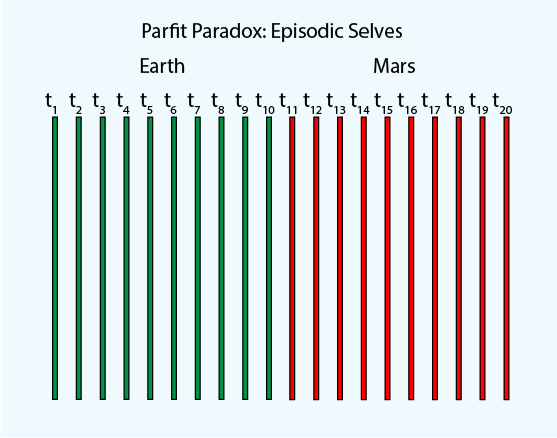
A thought experiment by Derek Parfit, here’s the setup: ostensibly, a human is cloned, but they aren’t so much cloned as teleported to Mars, à la Star Trek – there, not here, particle by particle.
The question and seeming paradox is whether the reconstructed person and the original are the same, identical.
In deference to my upcoming book, The Architecture of Encounter, I want to revisit this problem and show how there is no paradox. Let’s take a look.
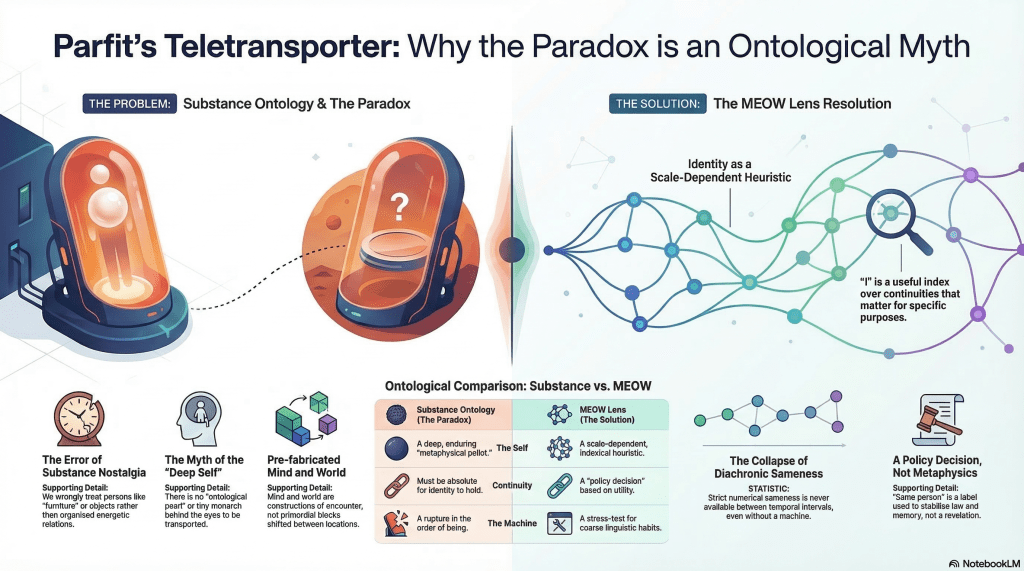
Audio: NotebookLM summary podcast of this topic.
Parfit’s Teletransporter Is Not a Paradox. It Is a Hangover.
Derek Parfit’s teletransporter thought experiment has become one of philosophy’s favourite parlour tricks. A person steps into a machine on Earth. The machine records their physical structure in total detail, destroys the original body, and reconstructs an exact counterpart on Mars from local matter. The person on Mars wakes with the same memories, the same character, the same projects, and the same unearned confidence that philosophers are asking sensible questions. Parfit uses such cases to press the thought that personal identity may not be what matters; psychological continuity may matter more.
The supposed paradox is familiar enough: is the person on Mars the same person, or has the original died and been replaced by a copy?
My answer is that there is no paradox here, unless one insists on dragging in precisely the assumptions that ought to be under suspicion.
This is where my forthcoming book, The Architecture of Encounter, becomes relevant. The teletransporter puzzle only looks deep if one begins with a poor ontology and a clumsy model of selfhood. Once those are withdrawn, the mystery evaporates.
The first mistake: substance nostalgia
The teletransporter story is framed as though a human being were fundamentally a thing made of parts, a self-identical object that might either persist through rearrangement or fail to do so. We are invited to imagine a body atomised here and recomposed there, then asked whether the ‘same person’ has survived. But this framing already cheats.
If substance ontology is not basic, then there is no hidden metaphysical pellet of selfhood waiting to be shepherded from Earth to Mars. On a relational picture, what is fundamental is not a stockpile of little self-identical things but organised relation, structured energetic differentiation, constraint, response, and persistence-pattern. The old metaphysics of enduring stuff survives mostly because grammar flatters it.
So the first reason the teletransporter is not paradoxical is that it begins by treating persons as though they were furniture.
The second mistake: reifying the self
The second assumption is just as dubious. The problem presumes that there must be a deep self, some enduring owner of experience, whose fate the machine must settle. I don’t grant that either.
I am much closer here to Galen Strawson’s episodic flavour than to the pious diachronic picture in which one’s life forms a single, extended inner possession. Strawson’s distinction is useful because it reminds us that not everyone experiences themselves as a long, narratively unified entity stretching robustly across time. An episodic self need not deny practical continuity, memory, or biography; it simply refuses to inflate them into a metaphysical core.
That is also how I think identity should be understood more generally: as a scale-dependent heuristic.
The self is not nothing. But neither is it an ontological pearl. It is a compression. A convenience. A useful index over continuities that matter for some purposes and not others. At one grain, sameness appears stable enough. At another, it dissolves into drift, revision, replacement, and selective narrative smoothing.
The “I” is not a tiny monarch enthroned behind the eyes. It is an indexical function within organised experience.
The third mistake: treating mind and world as pre-fabricated blocks
The teletransporter story also inherits a bad picture of mind and world. It imagines a ready-made mind confronting a ready-made external world, then asks whether one of those ready-made minds has been shifted from one location in the world to another. I reject that framing, too.
Mind and world, on my view, are post hoc constructions of mediated interface. Encounter comes first. Organisation comes first. Constraint comes first. Only later do we abstract “mind” on one side and “world” on the other as though these were primordial blocks of reality instead of conceptual products of a deeper relation.
Once one starts there, the question changes. We are no longer asking whether some occult owner-substance has been preserved. We are asking what kind of continuity, if any, is being tracked across interruption, re-instantiation, and resumed encounter. That is a very different matter.
Under episodic time, the paradox collapses immediately
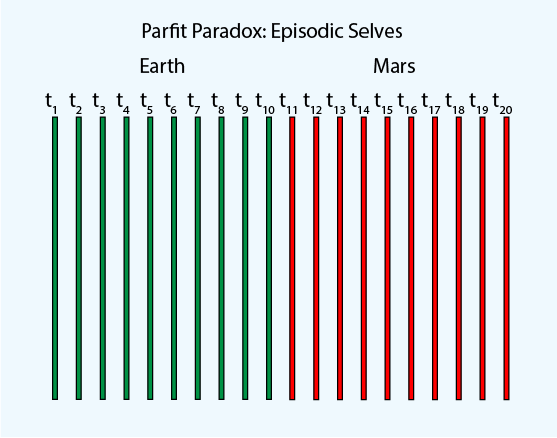
Image: Notice that if we reject the diachronic self in favour of an episodic self, when the ‘self’ migrates from Earth to Mars, it just carries on indexing, so the paradox vaporates.
If one takes the episodic view seriously, Parfit’s machine is mostly theatre.
Why? Because strict numerical sameness was never available between temporal intervals in the first place. The self at one interval and the self at the next are not joined by a metaphysical thread hidden beneath change. They are linked, where linked, by organised continuity, practical function, memory inheritance, bodily persistence, and narrative convenience.
The teletransporter does not introduce some unprecedented rupture into an otherwise pristine metaphysical order. It merely exaggerates what was true all along: selfhood is not an invariant core but a heuristic over organised succession.
That means the Mars person is not paradoxical. They are simply a case in which our ordinary identity-compression is being stress-tested.
Call them the same person if your explanatory threshold is coarse enough. Refuse the label if your threshold is stricter. There is no further hidden fact trembling in the wings.
Even under diachronic time, the issue is still heuristic
Suppose, however, that one relaxes the episodic commitment and grants a diachronic self. Even then, the machine does not resurrect a deep identity problem. It only relocates the issue to threshold-setting.
How much continuity is enough?
Enough for legal identity? Enough for moral responsibility? Enough for marriage? Enough for debt? Enough for grief? Enough for survival?
These are not one question. They never were one question. Philosophy often gets itself into trouble by pretending that practical, phenomenological, ethical, and metaphysical criteria must all cash out in the same currency. They do not.
Parfit himself is famous precisely for pressing the thought that what matters may be psychological continuity and connectedness rather than some further fact of identity. My complaint is that one can go further still. Once identity is treated as a heuristic rather than a metaphysical absolute, the need for a single all-purpose answer begins to look like a bad demand rather than an unsolved mystery.
Why the duplicate case makes the illusion obvious
The variant with duplication makes the point even more brutally. If one person enters on Earth and two successors emerge elsewhere, both inheriting the same memories and both insisting “I am the original,” then the problem is no longer whether identity has become spooky. The problem is that our ordinary identity-talk has finally been pushed beyond its comfort zone.
Once there are two successors, the inherited continuity-profile has branched. That does not produce metaphysical magic. It produces two loci of encounter with the same initial macro-organisation.
At time-nought, perhaps we may stipulate identical configuration for the sake of the thought experiment. Fine. Humans adore their stipulations. At the first non-zero interval thereafter, they are already different. Different position, different sensory input, different salience, different bodily relation, different thermal and spatial microconditions, different affordances. Their trajectories begin to separate immediately. So even there, no paradox. Only the collapse of a coarse heuristic under finer scrutiny.
The real lesson
Parfit’s teletransporter is often presented as though it reveals some terrible instability in personal identity. I think it reveals something duller and more devastating. It reveals that our language of identity was never as deep as we pretended.
We say “same person” because it is useful. We use it to stabilise law, memory, blame, love, property, and biography. Fair enough. But utility should not be mistaken for metaphysical revelation. The thought experiment merely embarrasses that confusion.
So when asked whether the reconstructed person on Mars is really the same person, my answer is:
Under an episodic model, strict sameness was never on offer across temporal intervals anyway. Under a diachronic model, sameness is still a heuristic judgement about acceptable continuity. In neither case is there a paradox. There is only an old habit of substance-thinking refusing to die.
The shorter version
The teletransporter does not expose a contradiction in selfhood. It exposes the poverty of the ontology brought to the problem.
If selves are indexical, scale-dependent heuristics arising from organised encounter, then the machine does not pose a metaphysical puzzle about whether some hidden essence made it to Mars. It only asks how much continuity we are willing to treat as enough.
That is not a paradox. That is a policy decision disguised as metaphysics.
As a writer, I have a kind of workflow in mind. It differs for fiction and nonfiction, though there are similarities. The main differences are indexes, references, and footnotes. I thought I was nearly finished with my latest book.
Audio: NotebookLM summary podcast of this topic.
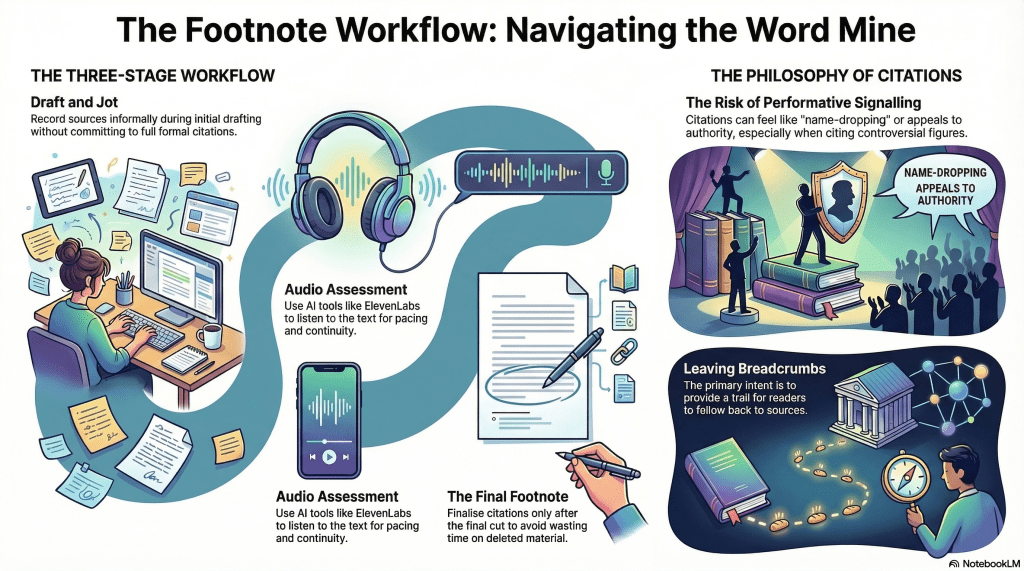
I rendered the first couple of chapters in ElevenLabs so I could listen to the text. It helps me assess pacing, continuity, and the like. It also gives me one more thing to fix, since the digital voices occasionally pronounce things differently from the way I’d prefer. Usually, choosing a voice that sounds roughly like Standard Southern British English helps, though not always. In any case, I survive.
While listening and following along in the manuscript, I discovered that I still haven’t fully footnoted the book.
When I write, I tend to jot down sources and references as I go, but I leave the footnoting until the final revision. There is little point in spending time drafting footnotes for material that may not survive the cut. So here I am, drafting footnotes.
I am of two minds about footnotes and citations, especially in academic work. On the one hand, they can feel performative, a way of signalling that one has incorporated so-and-so, a kind of name-dropping appeal to authority. As a heterodox writer, this is risky anyway, because I am liable to cite one of the approved villains. God forbid a Nietzsche, a Heidegger, or a Foucault. Analytic philosophers, in my experience, can be remarkably thin-skinned.
On the other hand, I do want to acknowledge those whose ideas I have borrowed. Even that, of course, is also a signal. Perhaps it all comes down to intent. As I mean it, I want to leave breadcrumbs for anyone who feels inclined to follow them back to the source.
I’ll let you decide where I’ve landed.
I’ve procrastinated long enough. Time to get back into the word mine.
I’m a philosopher of language, which sometimes veers off the reservation into philosophies of science and even metaphilosophy, but I am not a physicist. I don’t pretend to be. I do try to remain abreast of the goings-on in physics and science just because. Still, I view most affairs first through a philosophical lens.
I watch a decent amount of science videos on YouTube, and I’ve been following Rovelli for years, but I hadn’t engaged with his work directly until I was researching for my current book, The Architect of Encounter. First, I read The Order of Time, followed by Reality Is Not What It Seems.
Rovelli published these books around 2017, but I am only reading them now. We are travelling in the same neighbourhood, but we occupy different residences and have different orientations.
Surveying the marketplace, quite a few physicists and science educators make some of the same points I and Rovelli make. In fact, these things appear to occur as trends. When I wanted to write about agency and free will over five years ago, I noticed a slew of books on the topics, and I had nothing more to add, so I shelved the idea.
In this case, the trend appears to have been between 2017 and 2018. I’m sure this is where I absorbed some of my knowledge, opinions, and grammar, but my thesis goes further and comes from a different perspective, so I feel this manuscript is worth publishing.
Getting back to Rovelli, his books are very well written – very approachable and light on the academics. I hope mine lands somewhere in the middle. As I continue to write my book, I will lean on Rovelli for the perspective on quantum theory. If he’s wrong or it’s wrong, then we fall together. That’s what happens when you borrow a foundational commitment. It’s a risk I am willing to take.
As much as I want to share more of what I am working on, it turns out I still need to work on it if I want to complete it. I am aiming for April this year, if not sooner. At least I’ve got some of the administrative stuff out of the way. Here’s a quick glimpse, title and copyright pages.
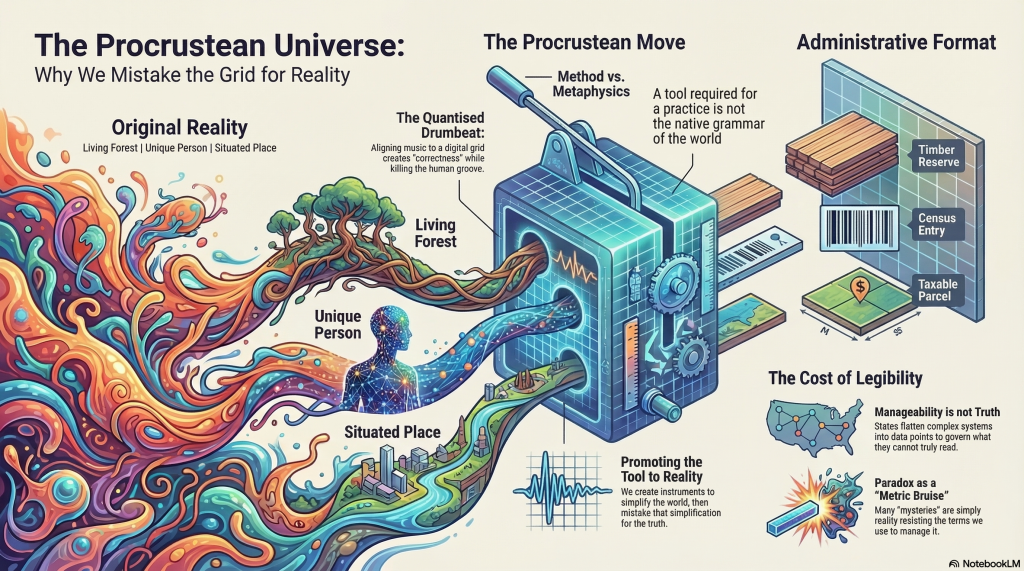
How Modern Thought Mistakes Its Own Grid for Reality
Modern thought has a peculiar habit.
It builds a measuring device, forces the world through it, and then congratulates itself for discovering what the world is really like.
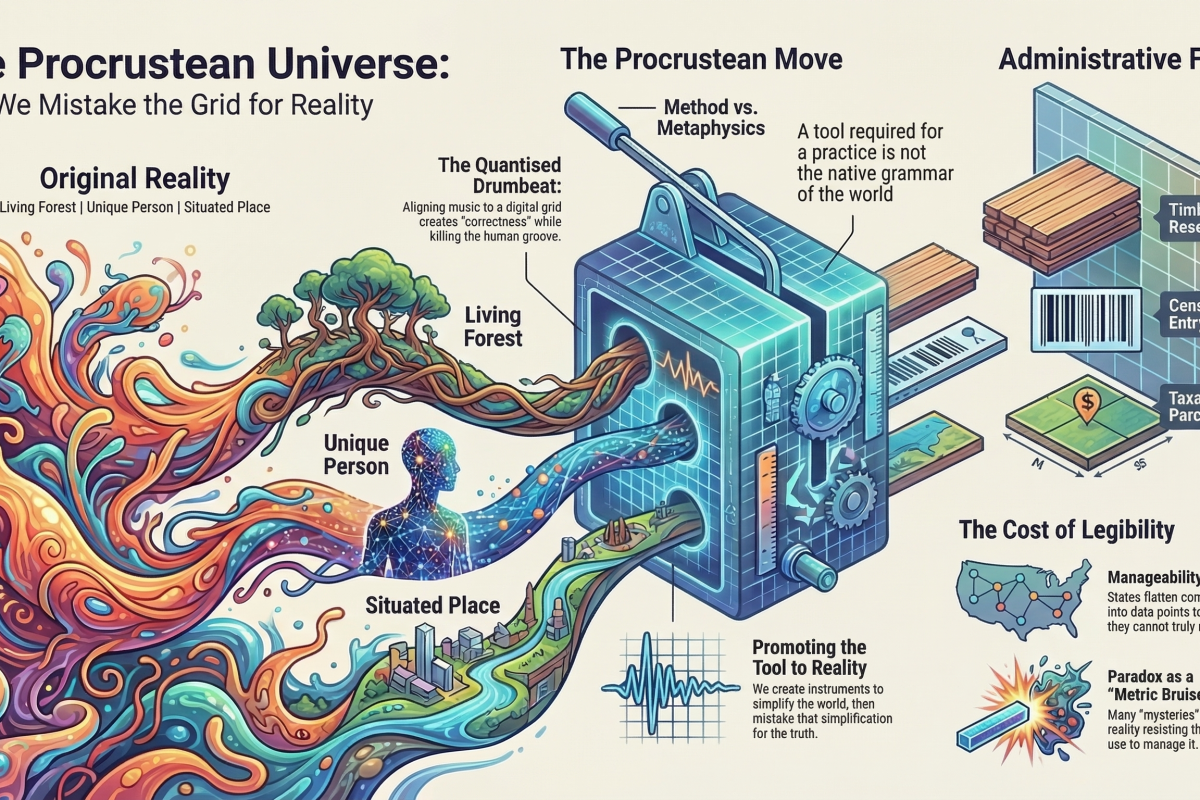
This is not always called scientism. Sometimes it is called rigour, precision, formalism, standardisation, operationalisation, modelling, or progress. The names vary. The structure does not. First comes the instrument. Then comes the simplification. Then comes the quiet metaphysical sleight of hand by which the simplification is promoted into reality itself.
Consider music.
A drummer lays down a part with slight drag, push, looseness, tension. It breathes. It leans. It resists the metronome just enough to sound alive. Then someone opens Pro Tools and quantises it. The notes snap to grid. The beat is now ‘correct’. It is also, very often, dead.
This is usually treated as an aesthetic dispute between old romantics and modern technicians. It is more than that. It is a parable.
Quantisation is not evil because it imposes structure. Every recording process imposes structure. The problem is what happens next. Once the grid has done its work, people begin to hear the grid not as a tool, but as truth. Timing that exceeds it is heard as error. The metric scaffold becomes the criterion of reality.
Audio: NotebookLM summary podcast of this topic.
A civilisation can live like this.
It can begin with a convenience and end with an ontology.
Carlo Rovelli’s The Order of Time is useful here precisely because it unsettles the fantasy that time is a single smooth substance flowing uniformly everywhere like some celestial click-track. It is not. Time frays. It dilates. It varies by frame, relation, and condition. Space, too, loses its old role as passive container. The world begins to look less like a neat box of coordinates and more like an unruly field of relations that only reluctantly tolerates our diagrams.
This ought to induce some modesty. Instead, modern disciplines often respond by doubling down on the diagram.
That is where James C. Scott arrives, carrying the whole argument in a wheelbarrow. Seeing Like a State is not merely about states. It is about the administrative desire to make the world legible by reducing it to formats that can be counted, organised, compared, and controlled. Forests become timber reserves. People become census entries. Places become parcels. Lives become cases. The simplification is not wholly false. It is simply tailored to the needs of governance rather than to the fullness of what is governed.
That’s the key.
The state does not need the world in its density. It needs the world in a format it can read.
And modern disciplines are often no different. They require stable units, repeatable measures, abstract comparability, portable standards. Fair enough. No one is conducting physics with incense and pastoral reverie. But then comes the familiar conceit: what was required for the practice quietly becomes what reality is said to be. The discipline first builds the bed for its own survival, then condemns the world for failing to lie down properly.
Cut off what exceeds the frame. Stretch what falls short. Call the result necessity.
Many supposed paradoxes begin here. Not in reality itself, but in the overreach of a measuring grammar.
I use a ruler to measure temperature, and I am surprised when it does not comport.
The example is absurd, which is why it is helpful. The absurdity is not in the temperature. It’s in the category mistake. Yet much of modern thought survives by committing more sophisticated versions of precisely this error. We use tools built for extension to interpret process. We use spatial metaphors to capture time. We use statistical flattening to speak of persons. We use administrative categories to speak of communities. We use computational tractability to speak of mind. Then the thing resists, and we call the resistance mysterious.
Sometimes it is not mysterious at all. Sometimes it is merely refusal.
The world declines to be exhausted by the terms under which we can most easily manage it.
That refusal then returns to us under grander names: paradox, irrationality, inconsistency, noise, anomaly. But what if the anomaly is only the residue of what our instruments were built to exclude? What if paradox is often the bruise left by an ill-fitted measure?
This is where realism, at least in its chest-thumping modern form, begins to look suspicious. Not because there is no world. There is clearly something that resists us, constrains us, embarrasses us, punishes bad maps, and ruins bad theories. The issue is not whether there is a real. The issue is whether what we call “the real” is too often just what our current apparatus can stabilise.
That is not realism.
That is successful compression mistaken for ontology.
Space and time, in this light, begin to look less like the universe’s native grammar and more like the interface through which a certain kind of finite creature renders the world tractable. Useful, yes. Necessary for us, perhaps. Final? hardly.
The same applies everywhere. We do not merely measure the world. We reshape it, conceptually and institutionally, until it better fits our preferred methods of seeing. Then we forget we did this.
Scott’s lesson is that states fail when they confuse legibility with understanding. Our broader civilisational lesson may be that disciplines fail in much the same way. They flatten in order to know, and then mistake the flattening for disclosure. What exceeds the frame is dismissed until it returns as contradiction.
None of this requires anti-scientific melodrama. Science is powerful. Measurement is indispensable. Standardisation is often the price of cumulative knowledge. The problem is not the existence of the grid. The problem is the promotion of the grid into metaphysics. A tool required for a practice is not therefore the native structure of the world. That should be obvious. It rarely is.
Scientism, in its most irritating form, begins precisely where this obviousness ends. It is not disciplined inquiry but disciplinary inflation: the belief that whatever can be rendered formally legible is most real, and whatever resists is merely awaiting capture by better instruments, finer models, sharper equations, more obedient categories. It is the provincial fantasy that the universe must ultimately speak in the accent of our methods.
Perhaps it doesn’t.
Perhaps our great achievement is not that we have discovered reality’s final language, but that we have become unusually good at mistaking our translations for the original.
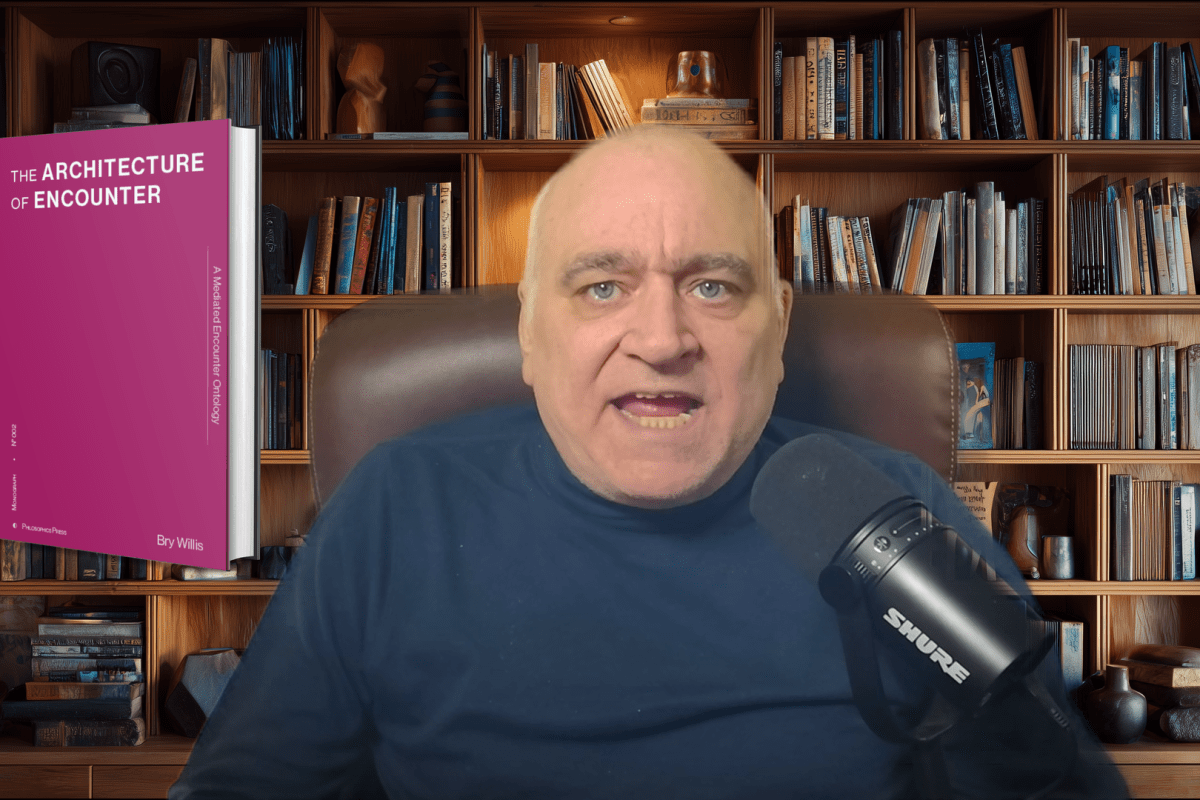
I’ve been writing. In fact, I’ve been clarifying A Mediated Encounter Ontology of the World (MEOW) and expanding and extending it into a book with a broader remit. This might well be the cover, following the monograph layout for Philosophics Press.
Image: Mockup of cover art.
As shown, the working title is The Architecture of Encounter: A Mediate Encounter Ontology. I’ve swapped the slate cover for a magenta in this volume.
So what’s it all about?
I’m not going to summarise the book here, but I’ll share some tidbits. I’ve settled on these chapter names:
The Mediated Encounter Ontology
Ontology
Subjecthood
Logic
Epistemology
Perception and Affordances
Language
Social Ontology
Realism
Application
The Normativity Frontier
Conclusion
Chapter 1, The Mediated Encounter Ontology, is a summary and update of the original essay, which will be included in full as an appendix item for reference, but this update will become canonical.
Chapter 2, Ontology: Interaction, Constraint, and the Rejection of Substance, will describe what I mean by ontology and what my proposed ontology looks like.
Chapter 3, Subjecthood: Modal Differentiation Within the Field, will explain how the subject-object relationship changes, and what a subject is in the first place.
Chapter 4, Logic: Coherence Grammar Under Constraint, will explain what logic is and how it operates in this paradigm.
Chapter 5, Epistemology: Convergence, Error, and the Structure of Justification, will describe what knowledge looks like. IYKYK.
Chapter 6, Perception and Affordances: Encounter as Orientation, extends Gibson’s work to comport with MEOW 2.0 (or 1.1).
Chapter 7, Language: Synchronisation, Ontological Grammar, and Structural Limits, explains how language works and how it limits our perception. We’re not talking Sapir-Whorf here, but what respectable language philosopher wouldn’t reserve a chapter for language?
Chapter 8, Social Ontology: Second-Order Constraint Systems. MEOW has a lot to say about first-order constraints, but there are higher-order considerations. I discuss them here.
Chapter 9, Realism: Cross-Perspectival Convergence and the Invariant Anchor, talks about the real elephant in the room. Since MEOW challenges both realism and idealism, we need to talk about it.
Chapter 10, Application: The Apophatic Mind, is mostly an observation on artificial intelligence as it relates to the mind-consciousness debate, primarily scoped around LLMs and similar machine processes.
Chapter 11. The Normativity Frontier, doesn’t yet have a subtitle, but this is where I discuss issues like normative ethics and morality.
I probably don’t need to tell you how Conclusion chapters work.
I expect to have 3 appendices.
Summary of commitments, which will summarise and distil key topics – so like a cheat sheet for reference – a bit more robust than a glossary.
Bibliography of reference material. As this is not an essay, it won’t be chock-full of citations – only a few, where I feel they are necessary. Much of this work represents years of thinking, and in many cases, the attribution has been lost; I remember the contents and not necessarily the attribution. I will prompt AI to fill in some missing pieces, but that’s that. The bibliography attempts to capture the general flavour.
The original MEOW essay. This is already freely available on several platforms, including Zenodo. Download it here if you haven’t already – or wait for the book.
The rest of the story
This book not only extends MEOW, but it also ties in concepts from A Language Insufficiency Hypothesis and other of my already published and yet unpublished work.
I expect to produce a decent amount of explanatory and support material, though to be fair, I tell myself that every time until I get distracted by the next project. I need a producer to manage these affairs.
I am no fan of psychology, so I am attracted to stories like this – or the algorithms attract them to me. This article lays out the evidence that psychopathy doesn’t exist. By extension, sociopathy shouldn’t exist, since it’s effectively an extension of psychopathy. If unicorns don’t exist, neither do unicorn horns. In fact, one might look backwards to note that the psychopathy of unicorns doesn’t exist, nor does psychology (unicorn farms). Of course, this is faulty logic, but I’m running with it.








 Philosophics