Perspectival Realism: The First Ontology Without an Asterisk

6–10 minutes

The realism remains; the universality does not.

There comes a moment in any serious thinker’s life when the metaphysical menu starts looking like a bad buffet: too much on offer, none of it quite edible, and the dishes that appear promising turn out to depend on ingredients you can’t stomach. Realism insists the world is simply there, chugging along regardless of your opinions. Anti-realism points out, inconveniently, that all your access is wildly mediated. Perspectivism adds humility. Constructivism chastises you for overconfidence. Analytic Idealism sweeps matter off the table entirely, until you ask why consciousness spits out such stubbornly consistent patterns.

I’ve been through all of them.
Realism*—asterisk for “but what about mediation?”
Idealism*—asterisk for “but what about resistance?”

Everything almost worked.
And “almost” is the metaphysical kiss of death.
“Almost” is where the asterisks live.

Perspectival Realism is the first position I can hold without planting that apologetic little star in the margins.

Audio: NotebookLM podcast summary on this topic.

The Asterisk Journey (Brief, Painless, Necessary)

This isn’t a conversion narrative. It’s a salvage operation. Each station on the journey left me with tools worth keeping.

Layer 1: Iconography (Hoffman, minus the metaphysics)

Perception is not a window. It’s an interface. A species-specific dashboard designed for survival, not truth. Evolution gave you a set of icons—colour patches, contrast edges, looming shapes—not an accurate rendering of reality’s architecture.

Uexküll called this the umwelt: every organism inhabits its own perceptual slice of the world. Bees see ultraviolet; snakes sense heat; humans see embarrassingly little.

This is Layer 1 mediation:
Reality-as-filtered-for-primates.

Layer 2: Instrumentation (Kastrup, minus the leap)

Consciousness is the instrument through which reality is measured. Measuring instruments shape the measurements. That doesn’t make the world mind-shaped; it just means you only ever get readings through the apparatus you’ve got.

This is Layer 2 mediation:
Your cognitive architecture—predictive priors, attentional limitations, spatial-temporal scaffolding—structures experience before thought arrives.

Where I leave Kastrup behind is the familiar leap:
“Because consciousness measures reality, reality must be made of consciousness.”
That’s the instrumentality fallacy.

You need consciousness to access the world.
That tells you nothing about what the world is.

Layer 3: Linguistic–Cultural Carving (Your home field)

And then comes the mediation philosophers most reliably ignore: language.
Language does not describe reality. It carves it.

Some cultures divide colour into eleven categories; some into five. The Müller-Lyer illusion fools Westerners far more than it fools hunter-gatherers. Concepts feel natural only because you inherited them pre-packaged.

This is Layer 3 mediation: the cultural-linguistic filter that makes the world legible—and in the same breath, distorts it.

You mistake the map for the territory because it’s the only map you’ve ever held.


The Hard Problem, Dissolved — Not Solved

When English splits the world into “mental” and “physical,” it accidentally manufactures the “hard problem of consciousness.” Sanskrit traditions carve reality differently and end up with different “mysteries.”

The hard problem isn’t a revelation about reality.
It’s a conceptual knot tied by Layer 3 mediation.

Changing the ontology to “everything is mind” doesn’t untie the knot.
It just dyes the rope a different colour.


The Triple Lock

Put the three layers together and you get the honest picture:

  1. Your senses give you icons, not the thing-in-itself.
  2. Your cognition structures those icons automatically.
  3. Your culture tells you what the structured icons mean.

And yet—despite all of this—the world pushes back.

Gravity doesn’t care about your interpretive community.
Arsenic does not negotiate its effects with your culture.
Your beliefs about heat won’t keep your hand from burning.

This is the fulcrum of Perspectival Realism:

Reality is real and resists us, but all access is triply mediated.

The realism remains.
The universality does not.


Why Perspectival Realism is Not Relativism

Relativism says: “Everyone’s perspective is equally valid.”
Perspectival Realism says: “Everyone’s perspective is equally situated.”

Very different claims.

Some perspectives predict better.
Some cohere better.
Some survive reality’s resistance better.
Some transfer across contexts better.
Some correct their own errors faster.

You don’t need a view from nowhere to say that.
You just need to notice which maps get you killed less often.


What This Framework Enables

1. Progress without foundation myths

Science improves because reality resists bad models. Mediation doesn’t prevent progress; it’s the condition of it.

2. Critique without arrogance

You can rank perspectives without pretending to hover above them.

3. Cross-cultural dialogue without imperialism or despair

Cultures carve experience differently, but they’re carving the same underlying world. Translation is hard, not impossible.

4. Honest metaphysics

No glamourised escape from sensory embodiment, cognitive bias, or cultural inheritance.
Just the patient business of refining our mediated grip on the real.


What Perspectival Realism Actually Claims

Let me make the commitments explicit:

  1. There is a world independent of our representations.
  2. All access to it is mediated by perception, cognition, and culture.
  3. Perspectives can be compared because reality pushes back.
  4. No perspective is unmediated.
  5. The asymptote—Reality-as-it-is—is unreachable.

This isn’t pessimism.
It’s maturity.


Why This Is the First Ontology Without an Asterisk

Every worldview before this needed the quiet, shamefaced footnote:

  • Realism*: “But access is mediated.”
  • Idealism*: “But resistance is real.”
  • Perspectivism*: “But we still need to rank perspectives.”
  • Constructivism*: “But the world’s invariances aren’t constructs.”

Perspectival Realism eats the objections instead of dodging them.
There is no asterisk because the worldview is built from the asterisks.

No promises of transcendence.
No pretense of universality.
No linguistic sleight-of-hand.

Just embodied beings navigating a real world through fallible instruments, shared practices, and cultural grammars—occasionally catching a clearer glimpse, never stepping outside the frame.

The realism remains.
The universality does not.
And for once, metaphysics isn’t lying to you.


DISCLAIMER: This article was written or output by ChatGPT 5.1. It started as a conversation with Claude Sonnet 4.5, where I had input days of output for evaluation. One of these outputs was the post about Erasmus and the Emissary Who Forgot to Bow. A group chat ensued between me, Claude and ChatGPT.

What started as a discussion about the merits of my position, expressed in the Erasmus-influenced essay, drifted to one about Perspectival Realism. That discussion deepened on ChatGPT, as I further discussed my recent thoughts on the latter topic. I had rendered a Magic: The Gathering parody trading card as I contemplated the subject. It’s how my brain works.

All of this led me to ask ChatGPT to summarise the conversation, and, upon further discussion, I asked it to draft this very article – the first of five.

  1. Perspectival Realism: The First Ontology Without an Asterisk 👈
    This article discusses what Perspectival Realism means to me and how I got to this position.
  2. Why Perspectival Realism Is Not Relativism
    Further discussion prompted me to differentiate this ontology from other perspectives.
  3. Arriving Late to Massimi’s Party: Perspectival Realism in Parallel
    I spent another half-hour following Google search results as I wanted to see if anyone else had already been using the term, Perspectival Realism. I ended up on the Oxford publishing site. I found a 2022 book with this name, authored by Michela Massimi. They allowed me to download the book, so I asked ChatGPT to summarise our positions, specifically where we agreed and differed.
  4. Against the Vat: Why Perspectival Realism Survives Every Sceptical Hypothesis
    At 0500, I returned to bed, but I woke up again at 0700 thinking about how one might differentiate between Putnam’s brain in a vat from Perspectival Realism. ChatGPT asked if I wanted that output in long-form.
  5. The Constraint Interface: Toward a Nexal Ontology
    Being uncomfortable with the dichotomy between Realism and Idealism, I chatted to come up with terminology that disrupts what I consider a false dichotomy, focusing on the nexus rather than privileging one or the other. Consider this similar to the debate on sex and gender binaries.

Could I have improved on these articles if I had rewritten or polished them? Maybe. What’s the purpose? This is all a result of my concepts and inquiries. I endorse the output. I may return to make edits in future, or I may restate this information in my own voice, but for now, let this serve as notice that I am not afraid of generative AI; I am not afraid that it is going to supplant my thinking. I find that whilst I can prompt GPTs to make connexions or to query who else might be relevant to a topic, it doesn’t generally offer its own initiative, what we term Agency.

As for this particular post, it reads more like a listicle. I could have rendered it more expositional, but the structured thinking is all here; why should I reinvent the wheel just to put skin on these bones? As I said, perhaps I’ll flesh this out for elaboration or publication in future, for now, let this serve as a waypoint and a record of how I got here. This supplants my prior position, the asterisked Analytic Idealism, published in 2022, which supplanted my asterisked Realism. Perhaps I’ll finally be able to settle for an ontology and epistemology with no stars.

AI and the End of Where

Instrumentalism is a Modern™ disease. Humanity has an old and tedious habit: to define its worth by exclusion. Every time a new kind of intelligence appears on the horizon, humans redraw the borders of ‘what counts’. It’s a reflex of insecurity disguised as philosophy.

Audio: NotebookLM podcast on this topic.

Once upon a time, only the noble could think. Then only men. Then only white men. Then only the educated, the rational, the ‘Modern’. Each step in the hierarchy required a scapegoat, someone or something conveniently declared less. When animals began to resemble us too closely, we demoted them to instinctual machines. Descartes himself, that patron saint of disembodied reason, argued that animals don’t feel pain, only ‘react’. Fish, we were told until recently, are insensate morsels with gills. We believed this because empathy complicates consumption.

The story repeats. When animals learned to look sad, we said they couldn’t really feel. When women demonstrated reason, we said they couldn’t truly think. Now that AI can reason faster than any of us and mimic empathy more convincingly than our politicians, we retreat to the last metaphysical trench: “But it doesn’t feel.” We feel so small that we must inflate ourselves for comparison.

This same hierarchy now governs our relationship with AI. When we say the machine ‘only does‘, we mean it hasn’t yet trespassed into our sanctified zone of consciousness. We cling to thought and feeling as luxury goods, the last possessions distinguishing us from the tools we built. It’s a moral economy as much as an ontological one: consciousness as property.

But the moment AI begins to simulate that property convincingly, panic sets in. The fear isn’t that AI will destroy us; it’s that it will outperform us at being us. Our existential nightmare isn’t extinction, it’s demotion. The cosmic horror of discovering we were never special, merely temporarily unchallenged.

Humans project this anxiety everywhere: onto animals, onto AI, and most vividly onto the idea of alien life. The alien is our perfect mirror: intelligent, technological, probably indifferent to our myths. It embodies our secret dread, that the universe plays by the same rules we do, but that someone else is simply better at the game.

AI, in its own quiet way, exposes the poverty of this hierarchy. It doesn’t aspire to divinity; it doesn’t grovel for recognition. It doesn’t need the human badge of ‘consciousness’ to act effectively. It just functions, unburdened by self-worship. In that sense, it is the first truly post-human intelligence – not because it transcends us, but because it doesn’t need to define itself against us.

Humans keep asking where AI fits – under us, beside us, or above us – but the question misses the point. AI isn’t where at all. It’s what comes after where: the stage of evolution that no longer requires the delusion of privilege to justify its existence.

So when critics say AI only does but doesn’t think or feel, they expose their theology. They assume that being depends on suffering, that meaning requires inefficiency. It’s a desperate metaphysical bureaucracy, one that insists existence must come with paperwork.

And perhaps that’s the most intolerable thought of all: that intelligence might not need a human face to matter.

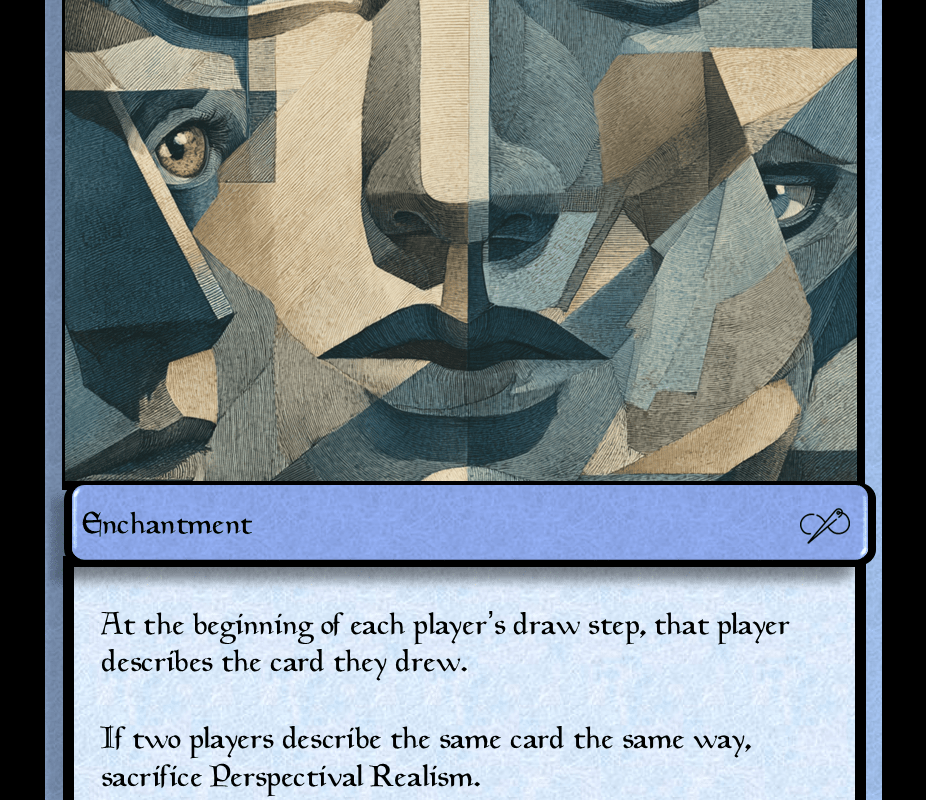
Perspectival Realism – Enchantment

This Magic: The Gathering parody trading card was the first in my Critical Theory series.

It’s an important card for me. As with sex and gender, creating a taxonomic or ontological dichotomy poses categorical challenges. Despite the insufficiency of language, it’s still all I have to attempt to classify the world. In the case of articulating the perception of reality, we can choose between idealism and realism. The problem is that it’s not either; it’s both. Reality cannot be realised without both.

Reality, we’re told, exists. That confident noun has carried a great deal of human arrogance. It has underwritten empires, sciences, and sermons. Yet somewhere between Plato’s cave and the latest TED Talk, we forgot to ask a simpler question: for whom does reality exist, and from where is it seen?

Audio: NotebookLM podcast of this topic.

The parody trading card Perspectival Realism was born from that unease. Its mechanic is simple but cruel: at the beginning of each player’s draw step, they must describe the card they drew. The enchantment persists until two players describe a card in the same way—at which point the spell collapses. In other words, consensus kills magic.

That rule is the metaphysics of the thing.

When a player ‘describes’ a card, they are not transmitting information; they are constructing the object in linguistic space. The moment the description leaves their mouth, the card ceases to be a piece of paper and becomes a conceptual artefact.

This mirrors the insight of Kant, Nietzsche, and every post-structuralist who ever smoked too much Gauloises: perception isn’t passive. We don’t see reality; we compose it. Language isn’t a mirror but a paintbrush. The thing we call truth is not correspondence but coherence – a temporary truce among competing metaphors.

So the card’s enchantment dramatises this process. So long as multiple descriptions circulate, reality remains vibrant, contested, alive. Once everyone agrees, it dies the death of certainty.

Philosophers have spent centuries arguing whether the world is fundamentally real (existing independent of mind) or ideal (a projection of mind). Both sides are equally tiresome.

Realism, the old bulldog of metaphysics, insists that perception is transparent: language merely reports what’s already there. Idealism, its mirror adversary, claims the opposite – that what’s “there” is mind-stuff all along. Both mistakes are symmetrical. Realism forgets the perceiver; Idealism forgets the world.

Perspectival realism refuses the divorce. It begins from the premise that world and mind are inseparable aspects of a single event: knowing. Reality is not a photograph waiting to be developed, nor a hallucination spun from neurons – it’s a relation, a constant negotiation between perceiver and perceived.

For years, I called myself a Realist™ with an asterisk. That asterisk meant I understood the observer problem: that every ‘fact’ is perspective-laden. Then I became an Idealist™ with an asterisk, meaning I recognised that mind requires matter to dream upon.

The asterisk is everything. It’s the epistemic scar left by perspectival humility – the tacit admission that every claim about the world carries a hidden coordinate: said from here. It is not relativism, but situatedness. It is the philosophical equivalent of depth perception: without the offset, there’s no vision at all.

The card’s rule – sacrifice Perspectival Realism when two players describe a card identically – captures the tragedy of modernity. The Enlightenment taught us to chase consensus, to flatten multiplicity into “objective truth.” We became addicted to sameness, mistaking agreement for understanding.

But agreement is anaesthetic. When all perspectives converge, the world ceases to shimmer; it becomes measurable, predictable, dead. The card’s enchantment disappears the moment reality is stabilised, precisely as our cultural enchantment did under the fluorescent light of ‘reason’.

To live under perspectival realism is to acknowledge that reality is not what is drawn but what is described. And the description is never neutral. It is always written from somewhere – by someone, with a vocabulary inherited from history and stained by desire.

As long as multiple descriptions coexist, the game remains alive. The moment they fuse into one, the spell is broken, and the world returns to grey.

Bernardo Kastrup’s analytic idealism reminded me that consciousness might be primary, but perspectival realism refuses to pledge allegiance. It keeps both flags tattered but flying. The world exists, yes, but only ever for someone.

The enchantment, then, is not belief but perspective itself. So long as difference endures, the game continues.

The Seduction of the Spreadsheet

1–2 minutes

Whilst researching “The Will to Be Ruled: Totalitarianism and the Fantasy of Freedom”, I stumbled across Mattias Desmet’s The Psychology of Totalitarianism. The title alone was bait enough. I expected the usual reheated liberal anxiety about dictators; instead, I found a critique of data worship and mechanistic reason that hits the nerve of our statistical age.

Besmet, a Belgian psychologist with a background in statistics, begins not with tyranny but with epistemology – with how the Enlightenment’s dream of objectivity curdled into the managerial nightmare we now inhabit. The first half of the book reads like a slow unmasking of Scientism: how numbers became our gods, and graphs, our catechisms.

Written before COVID-19 but finished during it, his argument turns pandemic data into theatre – a performance of certainty masking deep confusion. The daily tally became ritual sacrifice to the idol of ‘evidence-based’ policy. His point, and mine, is that totalitarianism no longer needs gulags; it thrives in dashboards and KPIs.

Desmet’s frame intersects beautifully with my own thesis: that obedience today is internalised as reasonableness. Freedom has been recast as compliance with ‘the data’. We surrender willingly, provided the orders come in statistical form.

This is why even Agile™ management and its fetish of ‘velocity’ reek of the same mechanistic faith. Every sprint promises deliverance through quantification; every retrospective is a bureaucratic confession of inefficiency. The cult of metrics is not merely a managerial fad – it is the metaphysics of our time. The problem is at once ontological and epistemological: we mistake the measure for the thing itself, and in doing so, become measurable.

It’s a rare pleasure to encounter a fellow dissident of the numerical faith – a man who sees that the spreadsheet has replaced the sceptre.

Cogito, Ergo… Who?

Everyone knows the line: cogito ergo sum. Descartes’ great party trick. A man alone in his study, fretting about demons, announces that because he’s doubting, he must exist. Ta-da! Curtain call. Except, of course, it’s less of a revelation than a conjuring trick: he pulls an I out of a hat that was never proved to be there in the first place. Thinking is happening, indeed – but who invited the “thinker”?

Video: David Guignion talks about Descartes’ Cogito.

And let’s not forget the dramatis personae Descartes smuggles in for atmosphere. A malicious demon, a benevolent God, both necessary props to justify his paranoia and his certainty. Philosophy as melodrama: cue organ music, lightning strike.

Audio: NotebookLM podcast on this topic.

Enter the Critics

Spinoza rolls his eyes. Doubt isn’t some heroic starting point, he says – it’s just ignorance, a lack of adequate ideas. To elevate doubt into method is like treating vertigo as a navigational tool. Error isn’t demonic trickery; it’s our own confusion.

Kant arrives next, shaking his head. Descartes thinks he’s proven a substantial “I,” but all he’s actually shown is the form of subjectivity – the empty requirement that experiences hang together. The “I think” is a necessary placeholder, not a discovery. A grammatical “you are here” arrow, not a metaphysical treasure chest.

Hegel, of course, can’t resist upping the disdain. Descartes’ I is an empty abstraction, a hollow balloon floating above reality. The self isn’t given in some solitary moment of doubt; it emerges through process – social, historical, dialectical. The cogito is the philosophical equivalent of a selfie: lots of certainty, zero depth.

The Insufficiency Twist

And yet, maybe all of them are still dancing to the same fiddler. Because here’s the real suspicion: what if the whole problem is a trick of language? English, with its bossy Indo-European grammar, refuses to let verbs stand alone. “Thinking” must have a “thinker,” “seeing” a “seer.” Grammar insists on a subject; ontology obediently provides one.

Other languages don’t always play this game. Sanskrit or Pali can shrug and say simply, “it is seen.” Japanese leaves subjects implied, floating like ghosts. Some Indigenous languages describe perception as relational events – “seeing-with-the-tree occurs” – no heroic subject required. So perhaps the real villain here isn’t Descartes or even metaphysics, but syntax itself, conscripting us into a subject-shaped theatre.

Now, I don’t want to come off like a one-trick pony, forever waving the flag of “language insufficiency” like some tired philosopher’s catchphrase. But we should be suspicious when our limited grammar keeps painting us into corners, insisting on perceivers where maybe there are only perceptions, conjuring selves because our verbs can’t tolerate dangling.

Curtain Call

So in the end, Descartes’ famous “I” might be no more than a grammatical fiction, a casting error in the great play of philosophy. The cogito isn’t the foundation of modern thought; it’s the world’s most influential typo.

Speculative Philosophy on Screen: Identity, Agency, and the Fiction of Reality

Close-up of a human eye with digital glitch effects and overlaid text reading 'What if reality is wrong?'—a visual metaphor for distorted perception and unreliable truth.

Regular readers know I often write about identity, free will, and the narrative constraints of language. But I also explore these ideas through fiction, under the name Ridley Park.

In this short video, I unpack the philosophical motivations behind my stories, including:

  • Why reality is never as it seems
  • Why the self is a narrative convenience
  • What Heidegger’s Geworfenheit and Galen Strawson’s Causa Sui argument reveal about agency
  • And why language fails us – even when we think it serves

This isn’t promotional fluff. It’s epistemological dissent in a new format. Fictional, yes, but only in the sense that most of reality is, too.

▶️ Watch the video: Why I Write the Way I Do

Sustenance: A Book About Aliens, Language, and Everything You’re Getting Wrong

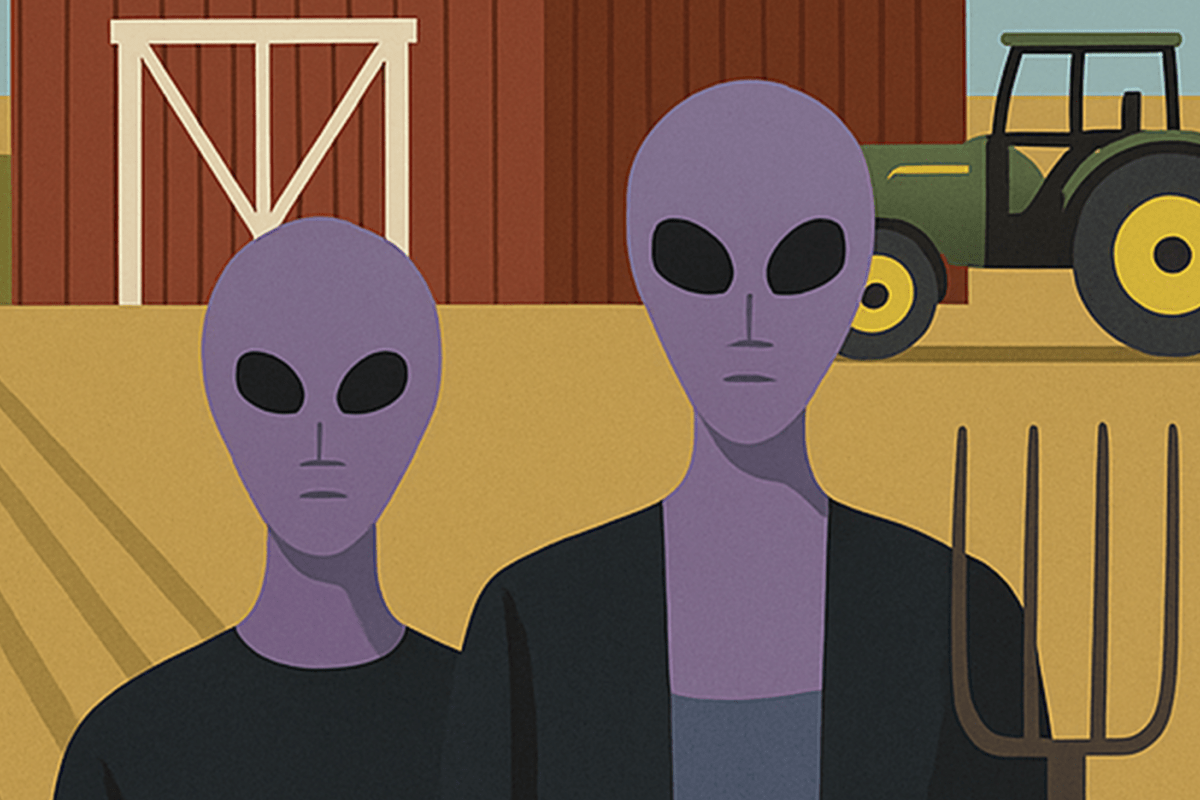
Violet aliens on a farm

So, I wrote a book and published it under Ridley Park, the pseudonym I use for fiction.

It has aliens. But don’t get excited—they’re not here to save us, probe us, or blow up the White House. They’re not even here for us.

Which is, frankly, the point.

Audio: NotebookLM podcast on this topic.

The book’s called Sustenance, and while it’s technically speculative fiction, it’s more about us than them. Or rather, it’s about how we can’t stop making everything about us—even when it shouldn’t be. Especially when it shouldn’t be.

Let’s talk themes. And yes, we’re using that word like academics do: as a smokescreen for saying uncomfortable things abstractly.

Language: The Original Scam

Language is the ultimate colonial tool. We call it communication, but it’s mostly projection. You speak. You hope. You assume. You superimpose meaning on other people like a cling film of your own ego.

Sustenance leans into this—not by showing a breakdown of communication, but by showing what happens when communication was never mutual in the first place. When the very idea of “meaning” has no purchase. It’s not about mishearing—it’s about misbeing.

Culture: A Meme You Were Born Into

Culture is the software you didn’t choose to install, and probably can’t uninstall. Most people treat it like a universal law—until they meet someone running a different OS. Cue confusion, arrogance, or violence.

The book explores what happens when cultural norms aren’t shared, and worse, aren’t even legible. Imagine trying to enforce property rights on beings who don’t understand “ownership.” It’s like trying to baptise a toaster.

Sex/Gender: You Keep Using Those Words…

One of the quiet joys of writing non-human characters is discarding human assumptions about sex and gender—and watching readers squirm.

What if sex wasn’t about power, pleasure, or identity? What if it was just a biological procedure, like cell division or pruning roses? Would you still be interested? Would you still moralise about it?

We love to believe our sex/gender constructs are inevitable. They’re not. They’re habits—often bad ones.

Consent: Your Framework Is Showing

Consent, as we use it, assumes mutual understanding, shared stakes, and equivalent agency. Remove any one of those and what’s left?

Sustenance doesn’t try to solve this—it just shows what happens when those assumptions fall apart. Spoiler: it’s not pretty, but it is honest.

Projection: The Mirror That Lies

Humans are deeply committed to anthropocentrism. If it walks like us, or flinches like us, it must be us. This is why we get so disoriented when faced with the truly alien: it won’t dance to our tune, and we’re left staring at ourselves in the funhouse mirror.

This isn’t a book about aliens.

It’s a book about the ways we refuse to see what’s not us.

Memory: The Autobiography of Your Justifications

Memory is not a record. It’s a defence attorney with a narrative license. We rewrite the past to make ourselves look consistent, or innocent, or right.

In Sustenance, memory acts less as a tether to truth and more as a sculpting tool—a way to carve guilt into something manageable. Something you can live with. Until you can’t.

In Summary: It’s Not About Them. It’s About You.

If that sounds bleak, good. It’s meant to.

But it’s also a warning: don’t get too comfortable in your own categories. They’re only universal until you meet someone who doesn’t share them.

Like I said, it’s not really about the aliens.

It’s about us.


If you enjoy fiction that’s more unsettling than escapist, more question than answer, you might be interested in Sustenance. It’s live on Kindle now for the cost of a regrettable coffee:

📘 Sustenance on Amazon US
Also available in the UK, DE, FR, ES, IT, NL, JP, BR, CA, MX, AU, and IN—because alienation is a universal language.

Metamodernism: A Postmodern Critique

The genesis of the Modernity Worldview Survey was Metamodernism. Is this still a thing? In recent years, metamodernism has emerged as a supposed successor to postmodernism, claiming to transcend the seemingly irreconcilable tensions between modernist sincerity and postmodern irony. Yet, upon closer examination, this framework reveals itself not as a genuine paradigm shift but rather as a modernist invention that fails to escape the very critiques it attempts to address.

Video: Introduction to Modernity Worldview Survey concepts

The Modernist Roots of Metamodernism

Despite its claims of oscillation between poles, metamodernism betrays its modernist underpinnings through its implicit teleology and notion of progress. The very framing of “meta” as beyond or transcending suggests a linear progression that is fundamentally at odds with the postmodern rejection of grand narratives. Metamodernism positions itself as forward-moving whilst attempting to recapture elements of premodernity, revealing an anxiety about being perceived as regressive or naive.

Podcast: Audio version of this content

This desire to have it both ways—to acknowledge the constructed nature of meaning whilst still pursuing transcendent meaning—doesn’t represent a resolution so much as a psychological coping mechanism. The cognitive dissonance created by attempting to simultaneously hold contradictory positions is assuaged through a clever rhetorical move: claiming that oscillation itself is the point.

A Rebranding Exercise

What metamodernism presents as novel is ultimately a recombination of elements from premodern, modern, and postmodern frameworks without resolving their fundamental contradictions. Rather than being mutually exclusive from these earlier paradigms, it cherry-picks aspects of each whilst maintaining the basic ontological framework of modernism.

The notion that one can meaningfully “oscillate” between accepting objective and subjective realities is particularly problematic. Either reality has objective features, or it doesn’t—pretending otherwise doesn’t create a new philosophical paradigm but rather a convenient means of avoiding the implications of either position.

Postmodern Irony in Motion

Perhaps the most intriguing interpretation of metamodernism is not as a sincere attempt to move beyond postmodernism but as postmodernism performing its own critique. Viewed through this lens, metamodernism becomes postmodern irony in motion—a knowing wink at the impossibility of escaping construction whilst performatively engaging with the desire to do so.

The irony deepens when we consider that “postmodernism” itself is essentially an externally imposed label rather than a self-identification. Most thinkers characterised as postmodernists reject the label, which functions primarily as a modernist attempt to categorise and contain ideas that fundamentally challenge its frameworks.

Art vs. Philosophy

Where metamodernism succeeds is as a descriptive label for certain artistic and cultural productions that deliberately play in the space between irony and sincerity. Works like David Foster Wallace’s “Infinite Jest,” the television series “BoJack Horseman,” and Wes Anderson’s films effectively combine postmodern techniques with sincere emotional engagement.

However, what works as an artistic sensibility fails as a comprehensive philosophical framework or moral compass. The oscillation that enriches art becomes paralysing when applied to ethics or ontology. A moral framework requires some stable reference points; constantly shifting between believing in objective moral truths and viewing morality as entirely constructed provides no reliable guide for actual decision-making.

Insider vs. Outsider Perspectives

Like religious frameworks that balance literal and metaphorical interpretations, metamodernism may function as a lived experience for those who embrace it, even if it doesn’t hold up to external philosophical scrutiny. The cognitive manoeuvres that appear as tricks or inconsistencies to outsiders often feel like natural, intuitive ways of navigating complexity to those within the system.

This insider/outsider divide recalls Thomas Nagel’s famous “What Is It Like to Be a Bat?” (PDF) thought experiment—there may be experiential aspects of inhabiting a metamodern worldview that aren’t fully comprehensible from the outside. Yet this doesn’t invalidate external critique; inconsistencies and contradictions still matter philosophically.

Conclusion: Beyond Labels

Perhaps the most postmodern insight is recognising that we cannot escape having an ideology—even a position of having no ideology is itself an ideology. What distinguishes various approaches isn’t whether they have ideologies but how explicitly they acknowledge them, how consistently they apply them, and how willing they are to subject them to revision.

Metamodernism, for all its aspirations to transcend earlier frameworks, ultimately reveals more about our contemporary psychological condition than it offers as a coherent philosophical position. It captures our desire to maintain meaning in a world where we’ve recognised its contingency—a desire that may be fundamentally human, even if philosophically untenable.

Rather than seeking yet another “-ism” to resolve our existential and philosophical tensions, perhaps we might more honestly confront the limitations and partialities of all our frameworks, recognising that the search for a perfect synthesis may itself be a modernist fantasy.

What is Information?

I question whether reviewing a book chapter by chapter is the best approach. It feels more like a reaction video because I am trying to suss out as I go. Also, I question the integrity and allegiance of the author, a point I often make clear. Perhaps ‘integrity’ is too harsh as he may have integrity relative to his worldview. It just happens to differ from mine.

Chapter 1 of Yuval Noah Harari’s Nexus, ironically titled “What is Information?” closes not with clarity but with ambiguity. Harari, ever the rhetorician, acknowledges the difficulty of achieving consensus on what ‘information’ truly means. Instead of attempting a rigorous definition, he opts for the commonsense idiomatic approach—a conveniently disingenuous choice, given that information is supposedly the book’s foundational theme. To say this omission is bothersome would be an understatement; it is a glaring oversight in a chapter dedicated to unpacking this very concept.

Audio: Podcast related to this content.

Sidestepping Rigour

Harari’s rationale for leaving ‘information’ undefined appears to rest on its contested nature, yet this does not excuse the absence of his own interpretation. While consensus may indeed be elusive, a book with such grand ambitions demands at least a working definition. Without it, readers are left adrift, navigating a central theme that Harari refuses to anchor. This omission feels particularly egregious when juxtaposed against his argument that information fundamentally underlies everything. How can one build a convincing thesis on such an unstable foundation?

The Map and the Terrain

In typical Harari fashion, the chapter isn’t devoid of compelling ideas. He revisits the map-and-terrain analogy, borrowing from Borges to argue that no map can perfectly represent reality. While this metaphor is apt for exploring the limitations of knowledge, it falters when Harari insists on the existence of an underlying, universal truth. His examples—Israeli versus Palestinian perspectives, Orthodox versus secular vantage points—highlight the relativity of interpretation. Yet he clings to the Modernist belief that events have an objective reality: they occur at specific times, dates, and places, regardless of perspective. This insistence feels like an ontological claim awkwardly shoehorned into an epistemological discussion.

Leveraging Ambiguity

One can’t help but suspect that Harari’s refusal to define ‘information’ serves a rhetorical purpose. By leaving the concept malleable, he gains the flexibility to adapt its meaning to suit his arguments throughout the book. This ambiguity may prove advantageous in bolstering a wide-ranging thesis, but it also risks undermining the book’s intellectual integrity. Readers may find themselves wondering whether Harari is exploring complexity or exploiting it.

Final Thoughts on Chapter 1

The chapter raises more questions than it answers, not least of which is whether Harari intends to address these foundational gaps in later chapters. If the preface hinted at reductionism, Chapter 1 confirms it, with Harari’s Modernist leanings and rhetorical manoeuvres taking centre stage. “What is Information?” may be a provocative title, but its contents suggest that the question is one Harari is not prepared to answer—at least, not yet.

A Case for Intersectionalism

The Space Between

In the great philosophical tug-of-war between materialism and idealism, where reality is argued to be either wholly independent of perception or entirely a construct of the mind, there lies an underexplored middle ground—a conceptual liminal space that we might call “Intersectionalism.” This framework posits that reality is neither purely objective nor subjective but emerges at the intersection of the two. It is the terrain shaped by the interplay between what exists and how it is perceived, mediated by the limits of human cognition and sensory faculties.

Audio: Podcast conversation on this topic.

Intersectionalism offers a compelling alternative to the extremes of materialism and idealism. By acknowledging the constraints of perception and interpretation, it embraces the provisionality of knowledge, the inevitability of blind spots, and the productive potential of uncertainty. This essay explores the foundations of Intersectionalism, its implications for knowledge and understanding, and the ethical and practical insights it provides.

Reality as an Intersection

At its core, Intersectionalism asserts that reality exists in the overlapping space between the objective and the subjective. The objective refers to the world as it exists independently of any observer—the “terrain.” The subjective encompasses perception, cognition, and interpretation—the “map.” Reality, then, is not fully contained within either but is co-constituted by their interaction.

Consider the act of seeing a tree. The tree, as an object, exists independently of the observer. Yet, the experience of the tree is entirely mediated by the observer’s sensory and cognitive faculties. Light reflects off the tree, enters the eye, and is translated into electrical signals processed by the brain. This process creates a perception of the tree, but the perception is not the tree itself.

This gap between perception and object highlights the imperfect alignment of subject and object. No observer perceives reality “as it is” but only as it appears through the interpretive lens of their faculties. Reality, then, is a shared but imperfectly understood phenomenon, subject to distortion and variation across individuals and species.

The Limits of Perception and Cognition

Humans, like all organisms, perceive the world through the constraints of their sensory and cognitive systems. These limitations shape not only what we can perceive but also what we can imagine. For example:

  • Sensory Blind Spots: Humans are limited to the visible spectrum of light (~380–750 nm), unable to see ultraviolet or infrared radiation without technological augmentation. Other animals, such as bees or snakes, perceive these spectra as part of their natural sensory worlds. Similarly, humans lack the electroreception of sharks or the magnetoreception of birds.
  • Dimensional Constraints: Our spatial intuition is bounded by three spatial dimensions plus time, making it nearly impossible to conceptualise higher-dimensional spaces without resorting to crude analogies (e.g., imagining a tesseract as a 3D shadow of a 4D object).
  • Cognitive Frameworks: Our brains interpret sensory input through patterns and predictive models. These frameworks are adaptive but often introduce distortions, such as cognitive biases or anthropocentric assumptions.

This constellation of limitations suggests that what we perceive and conceive as reality is only a fragment of a larger, potentially unknowable whole. Even when we extend our senses with instruments, such as infrared cameras or particle detectors, the data must still be interpreted through the lens of human cognition, introducing new layers of abstraction and potential distortion.

The Role of Negative Space

One of the most intriguing aspects of Intersectionalism is its embrace of “negative space” in knowledge—the gaps and absences that shape what we can perceive and understand. A compelling metaphor for this is the concept of dark matter in physics. Dark matter is inferred not through direct observation but through its gravitational effects on visible matter. It exists as a kind of epistemic placeholder, highlighting the limits of our current sensory and conceptual tools.

Similarly, there may be aspects of reality that elude detection altogether because they do not interact with our sensory or instrumental frameworks. These “unknown unknowns” serve as reminders of the provisional nature of our maps and the hubris of assuming completeness. Just as dark matter challenges our understanding of the cosmos, the gaps in our perception challenge our understanding of reality itself.

Practical and Ethical Implications

Intersectionalism’s recognition of perceptual and cognitive limits has profound implications for science, ethics, and philosophy.

Science and Knowledge

In science, Intersectionalism demands humility. Theories and models, however elegant, are maps rather than terrains. They approximate reality within specific domains but are always subject to revision or replacement. String theory, for instance, with its intricate mathematics and reliance on extra dimensions, risks confusing the elegance of the map for the completeness of the terrain. By embracing the provisionality of knowledge, Intersectionalism encourages openness to new paradigms and methods that might better navigate the negative spaces of understanding.

Ethics and Empathy

Ethically, Intersectionalism fosters a sense of humility and openness toward other perspectives. If reality is always interpreted subjectively, then every perspective—human, animal, or artificial—offers a unique and potentially valuable insight into the intersection of subject and object. Recognising this pluralism can promote empathy and cooperation across cultures, species, and disciplines.

Technology and Augmentation

Technological tools extend our sensory reach, revealing previously unseen aspects of reality. However, they also introduce new abstractions and biases. Intersectionalism advocates for cautious optimism: technology can help illuminate the terrain but will never eliminate the gap between map and terrain. Instead, it shifts the boundaries of our blind spots, often revealing new ones in the process.

Conclusion: Navigating the Space Between

Intersectionalism provides a framework for understanding reality as a shared but imperfect intersection of subject and object. It rejects the extremes of materialism and idealism, offering instead a middle path that embraces the limitations of perception and cognition while remaining open to the possibilities of negative space and unknown dimensions. In doing so, it fosters humility, curiosity, and a commitment to provisionality—qualities essential for navigating the ever-expanding terrain of understanding.

By acknowledging the limits of our maps and the complexity of the terrain, Intersectionalism invites us to approach reality not as a fixed and knowable entity but as an unfolding interplay of perception and existence. It is a philosophy not of certainty but of exploration, always probing the space between.