Perspectival Realism – Enchantment

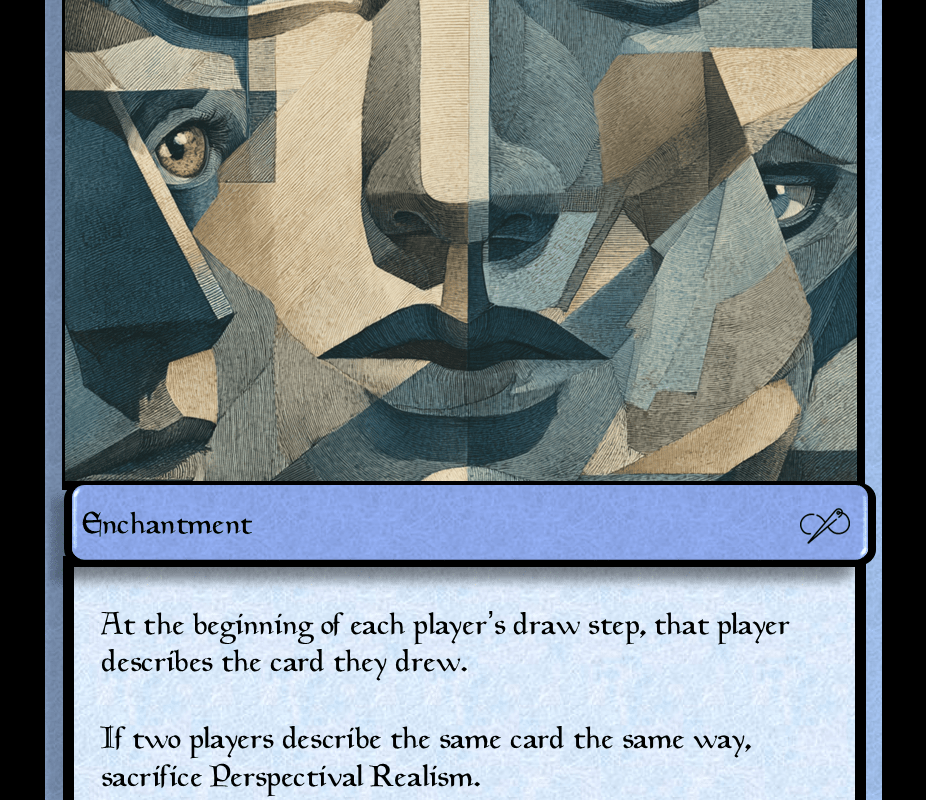
This Magic: The Gathering parody trading card was the first in my Critical Theory series.

It’s an important card for me. As with sex and gender, creating a taxonomic or ontological dichotomy poses categorical challenges. Despite the insufficiency of language, it’s still all I have to attempt to classify the world. In the case of articulating the perception of reality, we can choose between idealism and realism. The problem is that it’s not either; it’s both. Reality cannot be realised without both.

Reality, we’re told, exists. That confident noun has carried a great deal of human arrogance. It has underwritten empires, sciences, and sermons. Yet somewhere between Plato’s cave and the latest TED Talk, we forgot to ask a simpler question: for whom does reality exist, and from where is it seen?

Audio: NotebookLM podcast of this topic.

The parody trading card Perspectival Realism was born from that unease. Its mechanic is simple but cruel: at the beginning of each player’s draw step, they must describe the card they drew. The enchantment persists until two players describe a card in the same way—at which point the spell collapses. In other words, consensus kills magic.

That rule is the metaphysics of the thing.

When a player ‘describes’ a card, they are not transmitting information; they are constructing the object in linguistic space. The moment the description leaves their mouth, the card ceases to be a piece of paper and becomes a conceptual artefact.

This mirrors the insight of Kant, Nietzsche, and every post-structuralist who ever smoked too much Gauloises: perception isn’t passive. We don’t see reality; we compose it. Language isn’t a mirror but a paintbrush. The thing we call truth is not correspondence but coherence – a temporary truce among competing metaphors.

So the card’s enchantment dramatises this process. So long as multiple descriptions circulate, reality remains vibrant, contested, alive. Once everyone agrees, it dies the death of certainty.

Philosophers have spent centuries arguing whether the world is fundamentally real (existing independent of mind) or ideal (a projection of mind). Both sides are equally tiresome.

Realism, the old bulldog of metaphysics, insists that perception is transparent: language merely reports what’s already there. Idealism, its mirror adversary, claims the opposite – that what’s “there” is mind-stuff all along. Both mistakes are symmetrical. Realism forgets the perceiver; Idealism forgets the world.

Perspectival realism refuses the divorce. It begins from the premise that world and mind are inseparable aspects of a single event: knowing. Reality is not a photograph waiting to be developed, nor a hallucination spun from neurons – it’s a relation, a constant negotiation between perceiver and perceived.

For years, I called myself a Realist™ with an asterisk. That asterisk meant I understood the observer problem: that every ‘fact’ is perspective-laden. Then I became an Idealist™ with an asterisk, meaning I recognised that mind requires matter to dream upon.

The asterisk is everything. It’s the epistemic scar left by perspectival humility – the tacit admission that every claim about the world carries a hidden coordinate: said from here. It is not relativism, but situatedness. It is the philosophical equivalent of depth perception: without the offset, there’s no vision at all.

The card’s rule – sacrifice Perspectival Realism when two players describe a card identically – captures the tragedy of modernity. The Enlightenment taught us to chase consensus, to flatten multiplicity into “objective truth.” We became addicted to sameness, mistaking agreement for understanding.

But agreement is anaesthetic. When all perspectives converge, the world ceases to shimmer; it becomes measurable, predictable, dead. The card’s enchantment disappears the moment reality is stabilised, precisely as our cultural enchantment did under the fluorescent light of ‘reason’.

To live under perspectival realism is to acknowledge that reality is not what is drawn but what is described. And the description is never neutral. It is always written from somewhere – by someone, with a vocabulary inherited from history and stained by desire.

As long as multiple descriptions coexist, the game remains alive. The moment they fuse into one, the spell is broken, and the world returns to grey.

Bernardo Kastrup’s analytic idealism reminded me that consciousness might be primary, but perspectival realism refuses to pledge allegiance. It keeps both flags tattered but flying. The world exists, yes, but only ever for someone.

The enchantment, then, is not belief but perspective itself. So long as difference endures, the game continues.


Missing Pieces of the Anti-Enlightenment Project

5–8 minutes

I’ve just added a new entry to my Anti-Enlightenment corpus, bringing the total to seven – not counting my latest book, The Illusion of Light, that summarises the first six essays and places them in context. This got me thinking about what aspects of critique I might be missing. Given this, what else might I be missing?

Audio: NotebookLM podcast discussion of this topic.

So far, I’ve touched on the areas in the top green table and am considering topics in the bottom red/pink table:

Summary Schema – The Anti-Enlightenment Project – Published Essays

AxisCore QuestionRepresentative Essay(s)
EpistemicWhat counts as “truth”?Objectivity Is Illusion: An Operating Model of Social and Moral Reasoning
PoliticalWhat holds power together?Rational Ghosts: Why Enlightenment Democracy Was Built to Fail; Temporal Ghosts: Tyranny of the Present
PsychologicalWhy do subjects crave rule?Against Agency: The Fiction of the Autonomous Self; The Will to Be Ruled: Totalitarianism and the Fantasy of Freedom
AnthropologicalWhat makes a “normal” human?The Myth of Homo Normalis: Archaeology of the Legible Human
EthicalHow to live after disillusionment?The Discipline of Dis-Integration: Philosophy Without Redemption

Summary Schema – The Anti-Enlightenment Project – Unpublished Essays

AxisCore QuestionRepresentative Essay
Theological (Metaphysical)What remains sacred once transcendence is dismantled?The Absent God: Metaphysics After Meaning
Aesthetic (Affective)How did beauty become moral instruction?The Aesthetic Contract: Beauty as Compliance
Ecological (Post-Human)What happens when the world refuses to remain in the background?The Uncounted World: Ecology and the Non-Human
Linguistic (Semiotic)How does language betray the clarity it promises?The Fractured Tongue: Language Against Itself
Communal (Social Ontology)Can there be community without conformity?The Vanished Commons: Between Isolation and Herd

Below is a summary of the essays already published. These are drawn verbatim from the Anti-Enlightenment Project page.

1. Objectivity Is Illusion: An Operating Model of Social and Moral Reasoning

Published September 2025

Objectivity, in the social and moral sense, is a performance – a consensus mechanism mistaken for truth. This essay maps how “objectivity” operates as a scaffold for Enlightenment rationality, masking moral preference as neutral judgment. It introduces a five-premise model showing that what we call objectivity is merely sustained agreement under shared illusions of coherence. The argument reframes moral reasoning as provisional and participatory rather than universal or fixed.

Read on Zenodo

2. Rational Ghosts: Why Enlightenment Democracy Was Built to Fail

Published October 2025
The Enlightenment built democracy for rational ghosts – imagined citizens who never existed. This essay dissects six contradictions at the foundation of “rational” governance and shows why democracy’s collapse was prewritten in its metaphysics. From mathematical impossibility to sociological blindness, it charts the crisis of coherence that modern politics still calls freedom.
Read on Zenodo

3. Temporal Ghosts: Tyranny of the Present

Published October 2025
Modern democracies worship the now. This essay examines presentism – the systemic bias toward immediacy – as a structural flaw of Enlightenment thinking. By enthroning rational individuals in perpetual “decision time,” modernity erased the unborn from politics. What remains is a political theology of the short term, collapsing both memory and imagination.
Read on Zenodo

4. Against Agency: The Fiction of the Autonomous Self

Published October 2025
“Agency” is not a metaphysical faculty – it’s an alibi. This essay dismantles the myth of the autonomous self and reframes freedom as differential responsiveness: a gradient of conditions rather than a binary of will. Drawing on philosophy, neuroscience, and decolonial thought, it argues for ethics as maintenance, not judgment, and politics as condition-stewardship.
Read on Zenodo

5. The Discipline of Dis-Integration: Philosophy Without Redemption

Published October 2025

This essay formalises Dis-Integrationism – a philosophical method that refuses synthesis, closure, and the compulsive need to “make whole.” It traces how Enlightenment reason, deconstruction, and therapy culture all share a faith in reintegration: the promise that what’s fractured can be restored. Against this, Dis-Integrationism proposes care without cure, attention without resolution – a discipline of maintaining the broken as broken. It closes the Anti-Enlightenment loop by turning critique into a sustained practice rather than a path to redemption.

Read on Zenodo

6. The Myth of Homo Normalis: Archaeology of the Legible Human

Published October 2025

Modernity’s most persistent myth is the “normal” human. This essay excavates how legibility – the drive to measure, categorise, and care – became a form of control. From Quetelet’s statistical man to Foucault’s biopower and today’s quantified emotion, Homo Normalis reveals the moral machinery behind normalisation. It ends with an ethics of variance: lucidity without repair, refusal without despair.

Read on Zenodo

7. The Will to Be Ruled: Totalitarianism and the Fantasy of Freedom

Published October 2025

This essay examines how the Enlightenment’s ideal of autonomy contains the seed of its undoing. The rational, self-governing subject – celebrated as the triumph of modernity – proves unable to bear the solitude it creates. As freedom collapses into exhaustion, the desire for direction re-emerges as devotion. Drawing on Fromm, Arendt, Adorno, Reich, Han, and Desmet, The Will to Be Ruled traces the psychological gradient from fear to obedience, showing how submission is moralised as virtue and even experienced as pleasure. It concludes that totalitarianism is not a deviation from reason but its consummation, and that only through Dis-Integrationism – an ethic of maintenance rather than mastery – can thought remain responsive as the light fades.

Read on Zenodo

Below are possible future topics for this series*

8. The Absent God: Metaphysics After Meaning

Axis: Theological / Metaphysical
Core Question: What remains sacred once transcendence is dismantled?

Concept:
This essay would trace how Enlightenment humanism replaced God with reason, only to inherit theology’s structure without its grace. It might read Spinoza, Kant’s moral law, and modern technocracy as secularised metaphysics – systems that still crave universal order.
Goal: To show that disenchantment never erased faith; it simply redirected worship toward cognition and control.
Possible subtitle: The Enlightenment’s Unconfessed Religion.

9. The Aesthetic Contract: Beauty as Compliance

Axis: Aesthetic / Affective
Core Question: How did beauty become moral instruction?

Concept:
From Kant’s Critique of Judgment to algorithmic taste cultures, aesthetic judgment serves social order by rewarding harmony and punishing dissonance. This essay would expose the politics of form – how beauty trains attention and regulates emotion.
Goal: To reclaim aesthetics as resistance, not refinement.
Possible subtitle: Why Modernity Needed the Beautiful to Behave.

10. The Uncounted World: Ecology and the Non-Human

Axis: Ecological / Post-Human
Core Question: What happens when the world refuses to remain background?

Concept:
Here you dismantle the Enlightenment split between subject and nature. From Cartesian mechanism to industrial rationalism, the natural world was cast as resource. This essay would align Dis-Integrationism with ecological thinking – care without mastery extended beyond the human.
Goal: To reframe ethics as co-maintenance within an unstable biosphere.
Possible subtitle: Beyond Stewardship: Ethics Without Anthropos.

11. The Fractured Tongue: Language Against Itself

Axis: Linguistic / Semiotic
Core Question: How does language betray the clarity it promises?

Concept:
Every Anti-Enlightenment text already hints at this: language as both the instrument and failure of reason. Drawing on Nietzsche, Derrida, Wittgenstein, and modern semiotics, this essay could chart the entropy of meaning – the collapse of reference that makes ideology possible.
Goal: To formalise the linguistic fragility underlying every rational system.
Possible subtitle: The Grammar of Collapse.

12. The Vanished Commons: Between Isolation and Herd

Axis: Communal / Social Ontology
Core Question: Can there be community without conformity?

Concept:
This would return to the psychological and political threads of The Will to Be Ruled, seeking a space between atomised autonomy and synchronized obedience. It might turn to Arendt’s notion of the world between us or to indigenous and feminist relational models.
Goal: To imagine a non-totalitarian togetherness – a responsive collective rather than a collective response.
Possible subtitle: The Ethics of the Incomplete We.

* These essays may never be published, but I share this here as a template to further advance the Anti-Enlightenment project and fill out the corpus.

The Anti-Enlightenment Project: A New Portal for Old Ghosts

1–2 minutes

The Enlightenment promised light. What it delivered was fluorescence – bright, sterile, and buzzing with the sound of its own reason.

The Anti-Enlightenment Project gathers a set of essays, fragments, and quotations tracing how that light dimmed – or perhaps was never as luminous as advertised. It’s less a manifesto than a map of disintegration: how agency became alibi, how reason became ritual, and how modernity mistook motion for progress.

The new Anti-Enlightenment page curates this ongoing project in one place:

  • Preprints and essays (Against Agency, Rational Ghosts, Temporal Ghosts, and others to follow)
  • Related reflections from Philosophics posts going back to 2019
  • A living index of quotations from Nietzsche to Wynter, tracing philosophy’s slow discovery that its foundation may have been sand all along

This isn’t a war on knowledge, science, or reason – only on their misappropriation as universal truths. The Anti-Enlightenment simply asks what happens when we stop pretending that the Enlightenment’s “light” was neutral, natural, or necessary.

It’s not reactionary. It’s diagnostic.

The Enlightenment built the modern world; the Anti-Enlightenment merely asks whether we mistook the glare for daylight.

Dis-Integrationism: Why the Floorboards Always Creak

2–3 minutes

After revisiting MacIntyre on Nietzsche – with Descartes lurking in the background – I think it’s time for another round on dis-integrationism.

Audio: NotebookLM podcast on this topic.

Philosophy has a bad renovation habit. Descartes tears the house down to its studs, then nails God back in as a load-bearing beam. Nietzsche dynamites the lot, then sketches a heroic Übermensch strutting through the rubble. MacIntyre sighs, bolts Aristotle’s virtue table to the frame, and calls it load-bearing furniture. The pattern repeats: demolition, followed by reconstruction, always with the insistence that this time the structure is sound.

Video: Jonny Thompson’s take on Nietzsche also inspired this post.

But the error isn’t in tearing down. The error is in rushing to rebuild. That’s where the hyphen in dis-integrationism matters – it insists on the pause, the refusal to immediately re-integrate. We don’t have to pretend the fragments are secretly a whole. We can live with the splinters.

Yes, someone will protest: “We need something.” True enough. But the something is always a construction – provisional, contingent, human. The problem isn’t building; the problem is forgetting that you’ve built, then baptising the scaffolding as eternal bedrock.

Modernity™ is a museum of such floorboards: rationalism, utilitarianism, rights-talk, virtue ethics, each nailed down with solemn confidence, each creaking under the weight of its contradictions. The sane position is not to deny the need for floors, but to remember they are planks, not granite.

For the religious, the reply is ready-made: God is the foundation, the rock, the alpha and omega. But that is already a construction, no matter how venerable. Belief may provide the feeling of solidity, but it still arrives mediated by language, institutions, rituals, and interpretation. The Decalogue is a case in point: per the lore, God conveyed information directly to Abraham, Moses, the prophets, and onward in an unbroken chain. The claim is not only that the foundation exists, but that certain communities possess unique and privileged access to it — through scripture, tradition, and “reasons” that somehow stop short of being just more scaffolding.

Yet history betrays the trick. The chain is full of edits, schisms, rival prophets, councils, translations, and contradictions – each presented not as construction but as “clarification.” The gapless transmission is a myth; the supposed granite is a patchwork of stone and mortar. A dis-integrationist view doesn’t deny the weight these systems carry in people’s lives, but it refuses to mistake architecture for geology. Whatever floor you stand on was built, not found.

Dis-integrationism is simply the refusal to be gaslit by metaphysics.

Keeping Ourselves in the Dark: Depressive Realism and the Fiction of Agency

Philosopher Muse brought Colin Feltham to my attention, so I read his Keeping Ourselves in the Dark. It’s in limited supply, so I found an online copy.

So much of modern life rests on promises of improvement. Governments promise progress, religions promise redemption, therapists promise healing. Feltham’s Keeping Ourselves in the Dark (2015) takes a blunt axe to this edifice. In a series of sharp, aphoristic fragments, he suggests that most of these promises are self-deceptions. They keep us busy and comforted, but they do not correspond to the reality of our condition. For Feltham, reality is not an upward arc but a fog – a place of incoherence, accident, and suffering, which we disguise with stories of hope.

Audio: NotebookLM podcast summarising this post.

It is a book that situates itself in a lineage of pessimism. Like Schopenhauer, Feltham thinks life is saturated with dissatisfaction. Like Emil Cioran, he delights in puncturing illusions. Like Peter Wessel Zapffe, he worries that consciousness is an overdeveloped faculty, a tragic gift that leaves us exposed to too much meaninglessness.

Depressive Realism – Lucidity or Illusion?

One of Feltham’s recurring themes is the psychological idea of “depressive realism.” Researchers such as Lauren Alloy and Lyn Abramson suggested that depressed individuals may judge reality more accurately than their non-depressed peers, particularly when it comes to their own lack of control. Where the “healthy” mind is buoyed by optimism bias, the depressed mind may be sober.

Feltham uses this as a pivot: if the depressed see things more clearly, then much of what we call mental health is simply a shared delusion, a refusal to see the world’s bleakness. He is not romanticising depression, but he is deliberately destabilising the assumption that cheerfulness equals clarity.

Here I find myself diverging. Depression is not simply lucidity; it is also, inescapably, a condition of suffering. To say “the depressed see the truth” risks sanctifying what is, for those who live it, a heavy and painful distortion. Following Foucault, I would rather say that “mental illness” is itself a category of social control – but that does not mean the suffering it names is any less real.

Video: Depressive Realism by Philosopher Muse, the impetus for this blog article

Agency Under the Same Shadow

Feltham’s suspicion of optimism resonates with other critiques of human self-concepts. Octavia Butler, in her fiction and theory, often frames “agency” as a structural mirage: we think we choose, but our choices are already scripted by language and power. Jean-Paul Sartre, on the other hand, insists on the opposite extremity: that we are “condemned to be free,” responsible even for our refusal to act. Howard Zinn echoes this in his famous warning that “you can’t be neutral on a moving train.”

My own work, the Language Insufficiency Hypothesis, takes a fourth line. Like Feltham, I doubt that our central myths – agency, freedom, progress – correspond to any stable reality. But unlike him, I do not think stripping them away forces us into depressive despair. The feeling of depression is itself another state, another configuration of affect and narrative. To call it “realistic” is to smuggle in a judgment, as though truth must wound.

Agency, Optimism, and Their Kin

Feltham’s bleak realism has interesting affinities with other figures who unpick human self-mythology:

  • Octavia Butler presents “agency” itself as a kind of structural illusion. From the Oankali’s alien vantage in Dawn, humanity looks like a single destructive will, not a set of sovereign choosers.
  • Sartre, by contrast, radicalises agency: even passivity is a choice; we are condemned to be free.
  • Howard Zinn universalises responsibility in a similar register: “You can’t be neutral on a moving train.”
  • Cioran and Zapffe, like Feltham, treat human self-consciousness as a trap, a source of suffering that no optimistic narrative can finally dissolve.

Across these positions, the common thread is suspicion of the Enlightenment story in which rational agency and progress are guarantors of meaning. Some embrace the myth, some invert it, some discard it.

Dis-integration Rather Than Despair

Where pessimists like Feltham (or Cioran, or Zapffe) tend to narrate our condition as tragic, my “dis-integrationist” view is more Zen: the collapse of our stories is not a disaster but a fact. Consciousness spins myths of control and meaning; when those myths fail, we may feel disoriented, but that disorientation is simply another mode of being. There is no imperative to replace one illusion with another – whether it is progress, will, or “depressive clarity.”

From this perspective, life is not rescued by optimism, nor is it condemned by realism. It is simply flux, dissonance, and transient pattern. The task is not to shore up agency but to notice its absence without rushing to fill the void with either hope or despair.

Four Ways to Mistake Agency

I’ve long wrestled with the metaphysical aura that clings to “agency.” I don’t buy it. Philosophers – even those I’d have thought would know better – keep smuggling it back into their systems, as though “will” or “choice” were some indispensable essence rather than a narrative convenience.

Take the famous mid-century split: Sartre insisted we are “condemned to be free,” and so must spend that freedom in political action; Camus shrugged at the same premise and redirected it toward art, creation in the face of absurdity. Different prescriptions, same underlying assumption – that agency is real, universal, and cannot be escaped.

What if that’s the problem? What if “agency” is not a fact of human being but a Modernist fable, a device designed to sustain certain worldviews – freedom, responsibility, retribution – that collapse without it?

Sartre and Zinn: Agency as Compulsion

Sartre insists: “There are no innocent victims. Even inaction is a choice.” Zinn echoes: “You can’t be neutral on a moving train.” Both rhetorics collapse hesitation, fatigue, or constraint into an all-encompassing voluntarism. The train is rolling, and you are guilty for sitting still.

Feltham’s Depressive Realism

Colin Feltham’s Keeping Ourselves in the Dark extends the thesis: our optimism and “progress” are delusions. He leans into “depressive realism,” suggesting that the depressive gaze is clearer, less self-deceived. Here, too, agency is unmasked as myth – but the myth is replaced with another story, one of lucidity through despair.

A Fourth Position: Dis-integration

Where I diverge is here: why smuggle in judgment at all? Butler, Sartre, Zinn, Feltham each turn absence into a moral. They inflate or invert “agency” so it remains indispensable. My sense is more Zen: perhaps agency is not necessary. Not as fact, not as fiction, not even as a tragic lack.

Life continues without it. Stabilisers cling to the cart, Tippers tip, Egoists recline, Sycophants ride the wake, Survivors endure. These are dispositions, not decisions. The train moves whether or not anyone is at the controls. To say “you chose” is to mistake drift for will, inertia for responsibility.

From this angle, nihilism doesn’t require despair. It is simply the atmosphere we breathe. Meaning and will are constructs that serve Modernist institutions – law, nation, punishment. Remove them, and nothing essential is lost, except the illusion that we were ever driving.

Octavia E Butler’s Alien Verdict

Not Judith Buthler. In the opening of Dawn, the Oankali tell Lilith: “You committed mass suicide.” The charge erases distinctions between perpetrators, victims, resisters, and bystanders. From their vantage, humanity is one agent, one will. A neat explanation – but a flattening nonetheless.

👉 Full essay: On Agency, Suicide, and the Moving Train

Why Feltham Matters

Even if one resists his alignment of depression with truth, Feltham’s work is valuable as a counterweight to the cult of positivity. It reminds us that much of what we call “mental health” or “progress” depends on not seeing too clearly the futility, fragility, and cruelty that structure our world.

Where he sees darkness as revelation, I see it as atmosphere: the medium in which we always already move. To keep ourselves in the dark is not just to lie to ourselves, but to continue walking the tracks of a train whose destination we do not control. Feltham’s bleak realism, like Butler’s alien rebuke or Sartre’s burden of freedom, presses us to recognise that what we call “agency” may itself be part of the dream.

On Agency, Suicide, and the Moving Train

I’ve been working through the opening chapters of Octavia Butler’s Dawn. At one point, the alien Jdahya tells Lilith, “We watched you commit mass suicide.”*

The line unsettles not because of the apocalypse itself, but because of what it presumes: that “humanity” acted as one, as if billions of disparate lives could be collapsed into a single decision. A few pulled triggers, a few applauded, some resisted despite the odds, and most simply endured. From the alien vantage, nuance vanishes. A species is judged by its outcome, not by the uneven distribution of responsibility that produced it.

This is hardly foreign to us. Nationalism thrives on the same flattening. We won the war. We lost the match. A handful act; the many claim the glory or swallow the shame by association. Sartre takes it further with his “no excuses” dictum, even to do nothing is to choose. Howard Zinn’s “You can’t remain neutral on a moving train” makes the same move, cloaked in the borrowed authority of physics. Yet relativity undermines it: on the train, you are still; on the ground, you are moving. Whether neutrality is possible depends entirely on your frame of reference.

What all these formulations share is a kind of metaphysical inflation. “Agency” is treated as a universal essence, something evenly spread across the human condition. But in practice, it is anything but. Most people are not shaping history; they are being dragged along by it.

One might sketch the orientations toward the collective “apple cart” like this:

  • Tippers with a vision: the revolutionaries, ideologues, or would-be prophets who claim to know how the cart should be overturned.
  • Sycophants: clinging to the side, riding the momentum of others’ power, hoping for crumbs.
  • Egoists: indifferent to the cart’s fate, focused on personal comfort, advantage, or escape.
  • Stabilisers: most people, clinging to the cart as it wobbles, preferring continuity to upheaval.
  • Survivors: those who endure, waiting out storms, not out of “agency” but necessity.

The Stabilisers and Survivors blur into the same crowd, the former still half-convinced their vote between arsenic and cyanide matters, the latter no longer believing the story at all. They resemble Seligman’s shocked dogs, conditioned to sit through pain because movement feels futile.

And so “humanity” never truly acts as one. Agency is uneven, fragile, and often absent. Yet whether in Sartre’s philosophy, Zinn’s slogans, or Jdahya’s extraterrestrial indictment, the temptation is always to collapse plurality into a single will; you chose this, all of you. It is neat, rhetorically satisfying, and yet wrong.

Perhaps Butler’s aliens, clinical in their judgment, are simply holding up a mirror to the fictions we already tell about ourselves.


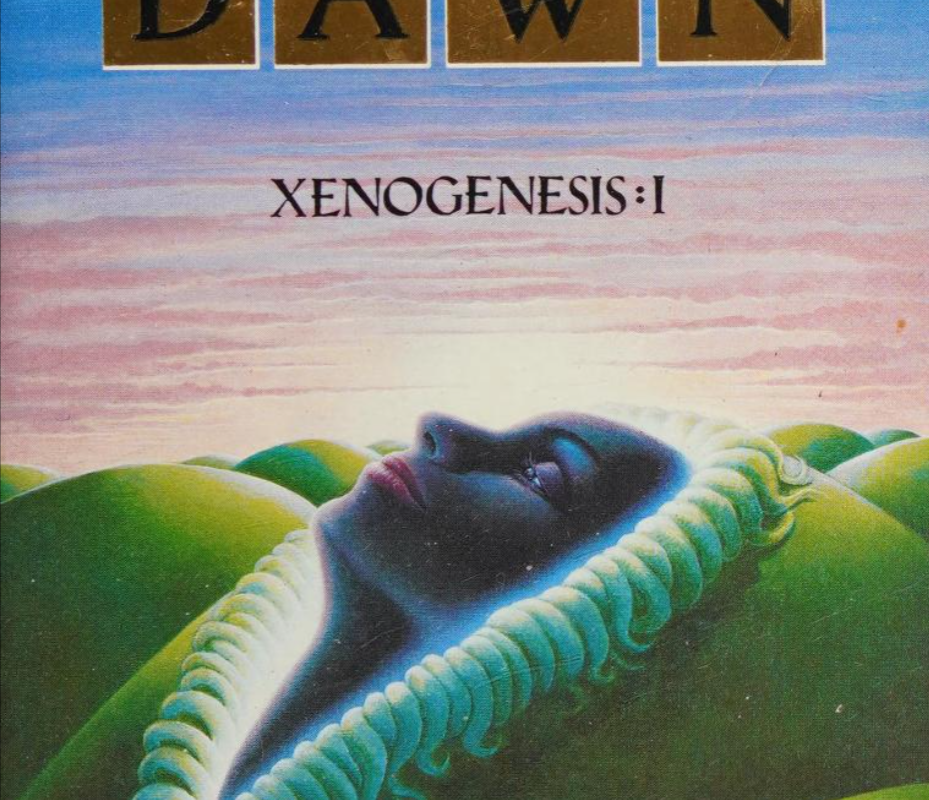
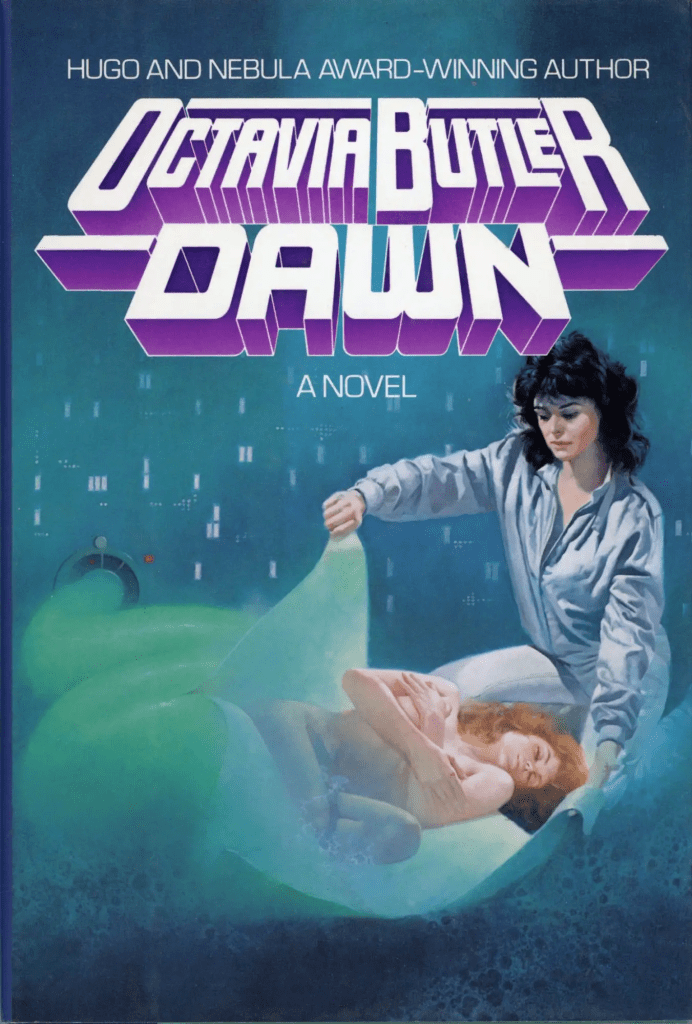
As an aside, this version of the book cover is risible. Not to devolve into identity politics, but Lilith is a dark-skinned woman, not a pale ginger. I can only assume that some target science fiction readers have a propensity to prefer white, sapphic adjacent characters.

I won’t even comment further on the faux 3D title treatment, relic of 1980s marketing.


Spoiler Alert: As this statement about mass suicide is a Chapter 2 event, I am not inclined to consider it a spoiler. False alarm.

Sundials, Spacetime, and Other Human Fabrications

Time is not fundamental. It is not lurking behind the curtains of reality, counting down the universe like some cosmic metronome. Time is a human construct, a clumsy accounting trick invented so that hunter-gatherers could remember when to plant seeds, priests could know when to fleece the flock, and later, managers could know when to dock your wages.

Video: Sabine Hossenfelder discusses the proposed origins of time

Yes, our ancestors tracked cycles: the swing of day and night, the waxing of the moon, the slouch of the seasons. But this is proto-time at best. Call it rhythm, call it recurrence, call it the universe refusing to sit still. It was not time. It was change, and we anthropomorphised it.

Then along came Newton with his stopwatch. He baptised “absolute time,” a divine river that flowed “equably without relation to anything external.” In other words, he built the cosmic grandfather clock and declared it law. This fantasy held just long enough for Einstein to make mischief, weaving time into space with duct tape and calling it spacetime. Romantic, yes, but hardly fundamental. Time, in Einstein’s cosmos, bends and dilates depending on who’s doing the bending. Not exactly the firm bedrock you’d expect of a “dimension.”

Meanwhile, in the quantum world, time is the awkward dinner guest: not an observable, not dynamic, just an external parameter scribbled into the equations because no one knew where else to put it. Like a bad houseplant, it sits in the corner – unmeasurable, unaccountable, but impossible to get rid of.

And yet, not everyone has given up the ghost. One camp – think Julian Barbour and Carlo Rovelli – insists time is an illusion, something emergent from relations, clocks, and counters. Others, like Lee Smolin, flip the script and claim that time is more fundamental than space itself, the real stage upon which the cosmic drama plays out. Philosophical infighting aside, what this tells you is that physics doesn’t actually know what time is. They’re as clueless as Aristotle, who called it “the number of motion”, a definition so circular it should’ve been printed on a sundial.

Enter Constructor Theory (Deutsch & Marletto), which simply does away with time entirely in the fundamental laws. No ticking clocks, no background river. Just possible and impossible transformations, with time emerging only when we strap timers onto systems and start counting. Which, of course, makes perfect sense: time is what we measure with clocks – and clocks are just things that change.

The dirty secret is this: every culture, every cosmology, every physics textbook has tried to smuggle “time” in as if it were self-evident, while quietly redefining it to suit the mood. We can’t agree on whether it’s an illusion, a dimension, or the last shred of fundamentality left to cling to. And if that isn’t the mark of a human construct, I don’t know what is.

The Ship of Theseus Is Not a Paradox

Video: Plutarch: The Ship of Theseus

The Ship of Theseus is philosophy’s favourite parlour trick: swap out the planks of a ship one by one, and ask in your best furrowed-brow voice whether it’s still the same ship. Then, for added spice, reassemble the discarded parts elsewhere and demand to know which version is the “real” one. Cue the existential hand-wringing and smug undergrad smirks. Oh, how clever.

Audio: NotebookLM podcast on this topic.

But here’s the thing: there’s no paradox. Not really. Not unless you buy into the fantasy that identity is some immutable essence, handed down from the gods like a divine barcode. The whole thought experiment hinges on the absurd presumption that something has a fixed, singular identity across time and context, a quaint metaphysical hobby horse that falls apart the moment you look at it sideways.

Let’s be clear: in the realm of language and proto-psychology – the crude, squishy scaffolding of thought that predates syntax and survives long after it – there is no such thing as a fixed “same.” That’s a linguistic illusion, a parlour trick of grammar and nominal categories. Language wasn’t built to hold truth; it was built to herd humans into consensus long enough to survive the winter.

In practice, we use “same” the way we use duct tape: liberally, and with complete disregard for philosophical coherence. The “same” ship? The “same” person? The “same” idea? Please. Ask your hippocampus. Identity is not a container; it’s a hallucinated continuity trick, maintained by memory, narrative, and sheer bloody-minded stubbornness.

The real kicker? Our precious linguistic tools aren’t built to reflect reality. They’re built to reduce it. To chop up the infinite mess of experience into palatable little mouthfuls of meaning. So when we come to the Ship of Theseus with our dull-edged conceptual knives, what we’re really doing is asking a bad question with inadequate tools. It’s like trying to measure wind speed with a sundial.

The paradox isn’t in the ship. It’s in the language.

And no, you don’t need to patch it. You need to sink it.

The Ship of Theseus: Identity by a Thousand Replacements

Let’s start with a thought experiment, because all good existential crises do.

Imagine a ship – Theseus’s ship, to be precise. After a storied career of heroic sea-faring, it’s put on display in a glorious Athenian dockyard. But as time passes, the planks rot. So, bit by bit, they’re replaced. A new mast here, a fresh hull panel there. Eventually, every single part has been swapped out.

Here’s the philosophical conundrum: Is it still the same ship?

Audio: NotebookLM podcast on this topic.

And if you think you’ve got that sorted, hold on. Imagine all the original pieces were saved, and someone reassembled them in a warehouse across town. Now there are two ships. One with the name, the continuity, the dockside real estate. The other with the original lumber and sails.

Which one is the real Ship of Theseus?

The paradox gnaws at our sense of identity. Is continuity enough? Does memory trump material? When everything is replaced – structure, function, even personnel – what makes a thing still that thing?

Now apply that question not to a ship, but to a rock band. A corporation. A country. Yourself.

That’s where things get fun. And slightly horrifying.

I was recently served a video on Facebook, algorithmic ambrosia for the nostalgic mind, showing the band Foreigner performing one of their chart-groping hits from the ‘70s. Polished, crowd-pleasing, competent. And utterly fake.

Not one founding member in sight.

They weren’t bad, mind you. Just… someone else. A Foreigner cover band trading under the original name, like a haunted jukebox stuffed with licensing contracts.

This, friends, is the Ship of Theseus with a tour schedule.

And it’s not just bands. IBM, once the king of typewriters and tabulating machines, now sells cloud services and AI consultancy. Walgreens, which began as a soda fountain and friendly neighbourhood chemist, now sells LED dog collars and pregnancy tests under buzzing fluorescent lights.

These aren’t companies. They’re brands in drag, corporate necromancers chanting the old names to animate new bodies.

But why stop there?

America isn’t America. Not the one of powdered wigs and musketed revolutionaries. No Founding Fathers™ roam the marble halls, only interns, lobbyists, and PR-tested careerists impersonating ideals they no longer understand. Britain? Please. The Queen is dead, and so is the Empire. France has revolted so many times that they’ve essentially speed-run regime change into a lifestyle brand.

And let’s not get too smug. You aren’t even you anymore, not really. Cells replace themselves, beliefs crumble and reform, memories rot and rewrite. You’re a psychological Foreigner tribute band, just with more trauma and less pyrotechnics.

So here’s the rub: everything persists by pretending. That’s the deal. Names survive, structures remain, but the guts are swapped out, piece by piece, until we’re clapping along to something we no longer recognise, wearing merch from a band that no longer exists.

And we call it continuity.

NB: After a dozen Midjourney prompts, I decided to stop and use this one. Ships of Theseus are as rare as centaurs.

The Cold Blood of Creation

On Schopenhauer, Sympathy, and the Unasked-for Gift of Life

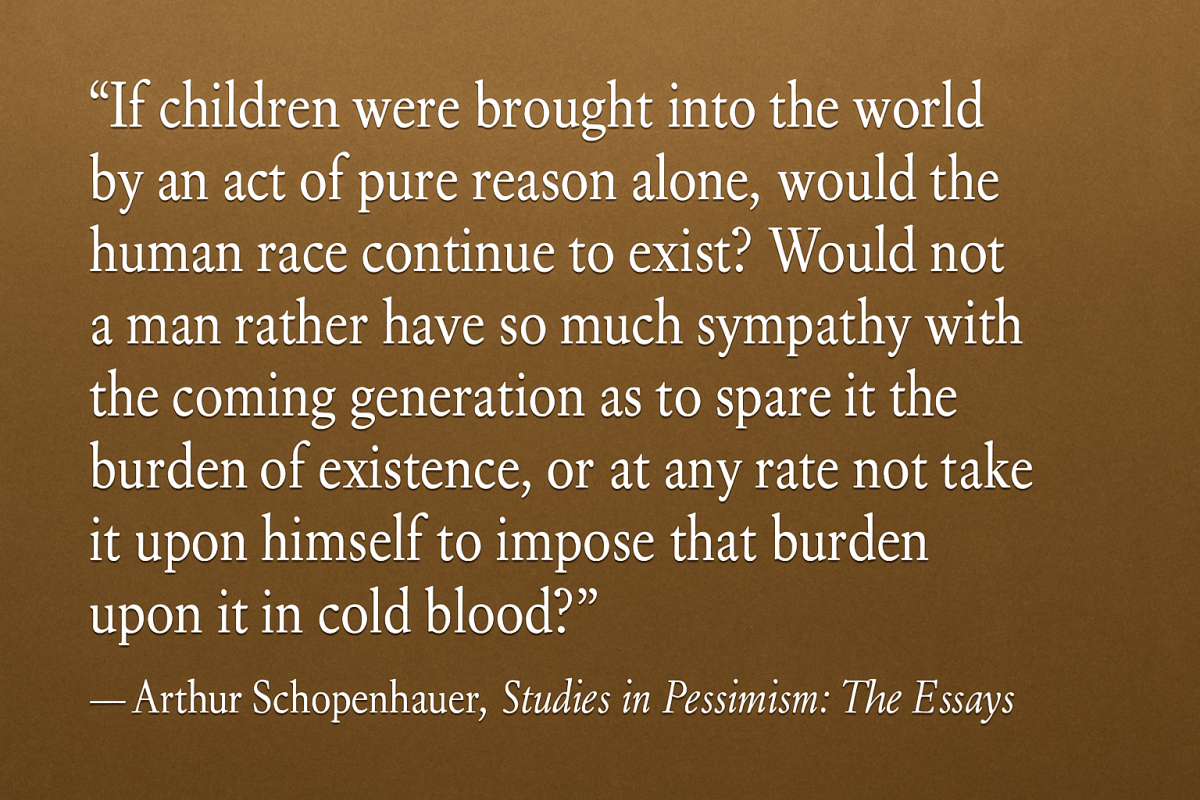
“If children were brought into the world by an act of pure reason alone, would the human race continue to exist? Would not a man rather have so much sympathy with the coming generation as to spare it the burden of existence, or at any rate not take it upon himself to impose that burden upon it in cold blood?”
― Arthur Schopenhauer, Studies in Pessimism: The Essays

Arthur Schopenhauer, that delightful black cloud over the 19th century, once asked a question too few parents – or politicians-or pro-natalists – dare entertain: If children were brought into the world by an act of pure reason alone, would the human race continue to exist?

The answer, of course, is no. Not if reason were allowed to have the steering wheel. Not if we truly grasped what existence entails: a lifelong hostage situation punctuated by moments of accidental pleasure, existential debt, and the faint scent of consumer-grade shampoo. To knowingly impose that on another, without their consent, no less, is, Schopenhauer suggests, cold-blooded. Not tragic. Not poetic. Just… callous.

And yet, we romanticise it. We shower it in clichés and bibs. We call it “a miracle” or “the greatest gift.” Gift? With what return policy? And no, a suicide hotline is not customer service.

This isn’t a call to extinction. (Though frankly, who’d notice?) It’s a call to lucidity. To question the reflex to replicate. To wonder, in quiet moments, whether “family planning” is really planning, or just the failure to look past our own narrative instincts.

If sympathy were allowed to speak louder than instinct, Schopenhauer asks, might we choose to spare the next generation from the exquisite burden of becoming? It’s not misanthropy. It’s mercy.

But mercy doesn’t sell nappies.