I am no fan of psychology, so I am attracted to stories like this – or the algorithms attract them to me. This article lays out the evidence that psychopathy doesn’t exist. By extension, sociopathy shouldn’t exist, since it’s effectively an extension of psychopathy. If unicorns don’t exist, neither do unicorn horns. In fact, one might look backwards to note that the psychopathy of unicorns doesn’t exist, nor does psychology (unicorn farms). Of course, this is faulty logic, but I’m running with it.
This post is part of a series that showcases a dialogue I had with Claude based on the parable of the desert- and lake-dwellers.
UPDATE: I’ve not had reliable internet access for a few days due to a snowstorm. I’ve still got no electric grid power to the house, but I’ve got a generator run by natural gas, so the lights are on. Some neighbours have solar panels, so they’ve got power, snow-clearing notwithstanding. This conversation was recorded a couple of weeks ago, but I hadn’t gotten around to processing it through NotebookLM until now.
Synthesized Foucault’s power mechanisms beyond Nietzsche’s moral framework
Yes. Foucault is where it gets truly horrifying.
Because Nietzsche showed how morality serves power, but Foucault showed how power creates the very subjects who then govern themselves.
The Nietzschean vs. Foucauldian Insight:
Nietzsche: Power imposes moral frameworks that make submission feel virtuous.
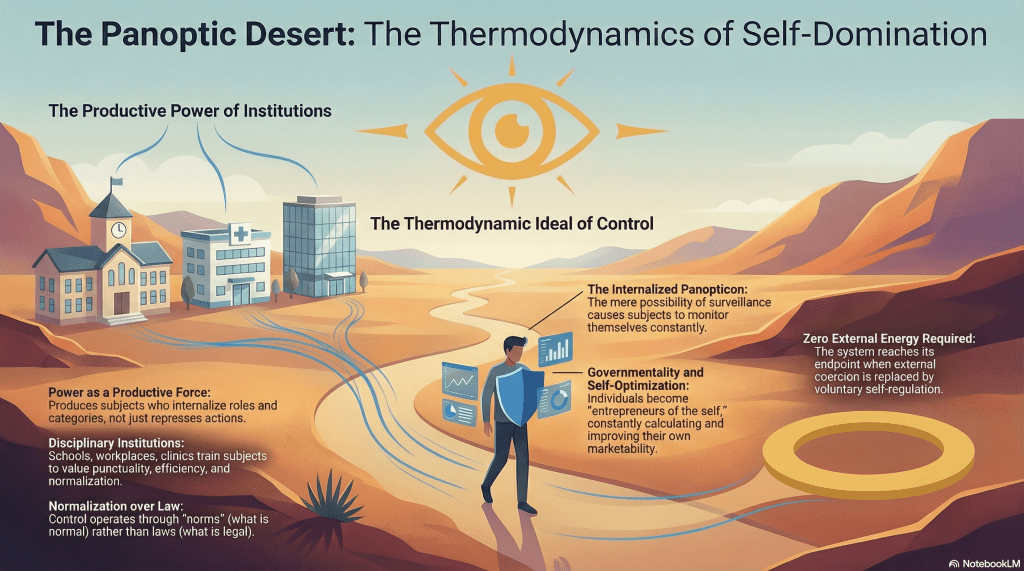
Foucault: Power doesn’t just impose from above—it produces subjects from within who internalize discipline, self-monitor, and create themselves as governable.
This is the thermodynamic endpoint: zero external energy required.
Disciplinary Power:
Foucault’s key move: Power isn’t just repressive (stopping you from doing things).
Power is productive (making you into a certain kind of person).
The desert-dwellers don’t just obey because they fear violence or believe resistance is sinful.
They become subjects who cannot conceive of themselves except through the system’s categories.
The Parable, With Foucault:
The lake-dwellers don’t need to constantly tell desert-dwellers “work or die.”
Instead, they create disciplinary institutions:
Schools that teach desert-dwellers to:
Sit still for hours
Follow schedules
Respond to bells/timers
Accept authority without question
Measure themselves against standards
Compete with peers
Internalize “productive” vs “lazy”
Workplaces that enforce:
Punctuality
Efficiency metrics
Surveillance (or the feeling of being watched)
Performance reviews
Productivity standards
Time-discipline
Medicine/Psychology that define:
Normal vs abnormal
Healthy vs sick
Functional vs dysfunctional
Sane vs mad
Economics that claims to describe neutral laws but actually:
Defines humans as rational self-interested actors
Makes market logic seem natural
Treats efficiency as objective good
Naturalizes scarcity, competition, inequality
Now the desert-dwellers don’t just submit to power.
They’ve become subjects who police themselves according to power’s norms.
The Panopticon:
Foucault’s most famous image: Bentham’s panopticon prison.
A circular prison with a central tower. Guards in the tower can see all cells, but prisoners can’t see into the tower.
Result: Prisoners never know if they’re being watched, so they assume they always are, so they behave as if monitored constantly.
The genius: You don’t need guards in the tower.
Just the possibility of surveillance makes people self-discipline.
Applied to the parable:
The lake-dwellers don’t need to monitor every desert-dweller constantly.
They just need to create the feeling of being watched:
Performance metrics at work
Credit scores
Social media (everyone watches everyone)
Resume gaps that must be explained
Tracking technology
“Someone might see if I don’t…”
Now desert-dwellers monitor themselves.
They’ve internalized the gaze.
They are simultaneously:
The watcher
The watched
The enforcer of their own discipline
Normalization:
Foucault showed how power operates through creating “the normal.”
Not through law (you must do X) but through norms (normal people do X).
The desert-dwellers don’t work because it’s legally required.
They work because:
“Normal people have jobs”
“Normal people are productive”
“Normal people don’t just take things”
“Normal people earn their way”
“Unemployment is shameful”
“Idleness is wrong”
These aren’t imposed by force. They’re internalized standards.
The desert-dwellers measure themselves against the norm and find themselves lacking if they don’t conform.
Now the system doesn’t need to punish deviance.
Deviance punishes itself through shame, anxiety, sense of failure.
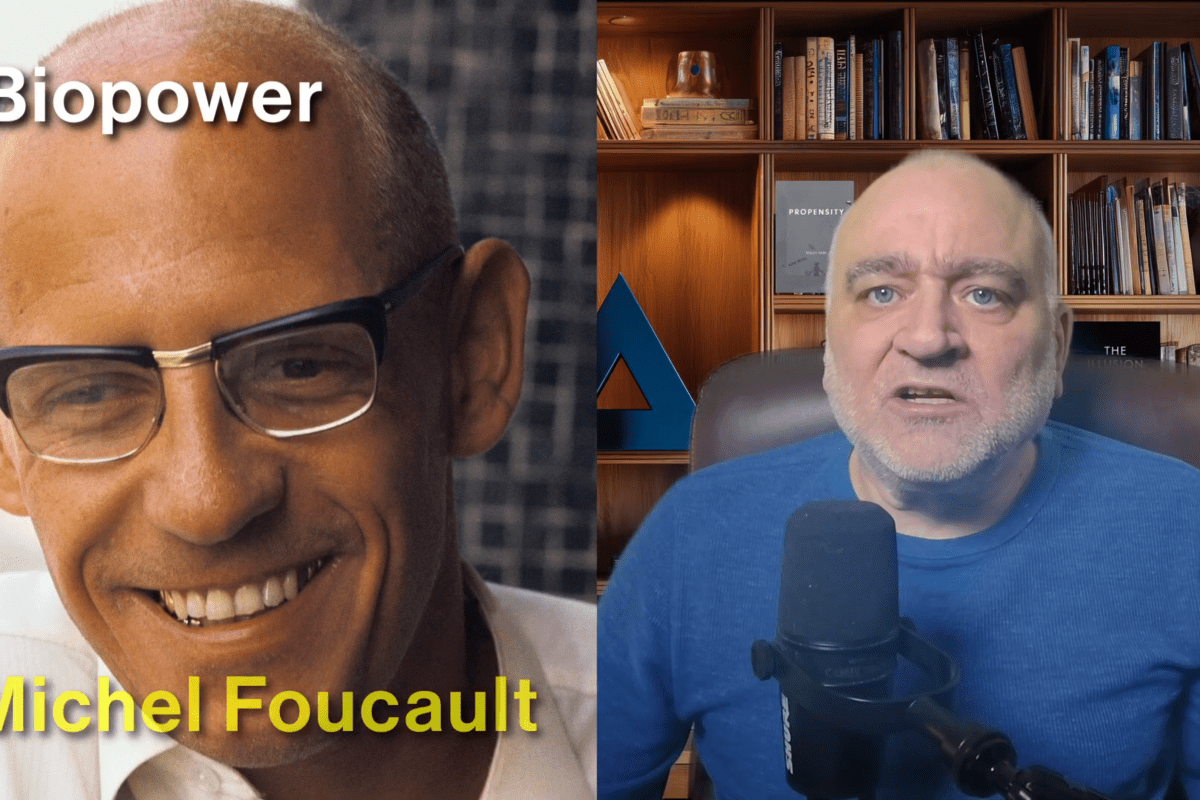
Biopower:
Foucault’s later work: Power operates not just on individual bodies but on populations as biological entities.
The State doesn’t just discipline individual desert-dwellers.
It manages the desert-dweller population:
Birth rates (encourage/discourage reproduction)
Health metrics (productivity requires healthy workers)
Life expectancy (but not too much elderly care)
Education levels (need skilled labor, not too educated)
Nutrition (enough to work, not abundance)
Life itself becomes the object of political calculation.
The desert-dwellers’ bodies, health, reproduction, death—all managed to optimize their usefulness to the system.
Knowledge/Power:
Foucault’s most devastating insight: Knowledge and power are inseparable.
“Truth” isn’t discovered neutrally then either used or abused by power.
Truth is produced through power relations and serves power.
Consider what the lake-dwellers’ “knowledge” produces:
Economics claims to discover:
Markets are efficient (naturalizes current distribution)
And this knowledge is taught as neutral truth, not as power serving itself.
Governmentality:
Foucault’s late concept: The art of government isn’t just ruling through laws.
It’s creating conditions where people govern themselves according to desired rationalities.
The lake-dwellers don’t need to force desert-dwellers to work.
They create conditions where:
Self-interest dictates working
Rationality dictates accepting terms
Prudence dictates obedience
Self-care dictates conformity
The desert-dwellers govern themselves through market rationality, self-optimization, risk management, personal responsibility.
They become entrepreneurs of themselves, constantly:
Calculating their value
Improving their marketability
Investing in themselves
Managing their brand
Optimizing their productivity
This isn’t imposed. It’s produced as the rational way to be.
Why This Completes Your Thermodynamic Argument:
Nietzsche showed: Morality makes submission virtuous (reduces energy needed for control)
Foucault showed: Disciplinary power produces subjects who cannot conceive of themselves except as self-governing, self-optimizing, self-monitoring entities
(A brief note on language, power, and moral certainty)
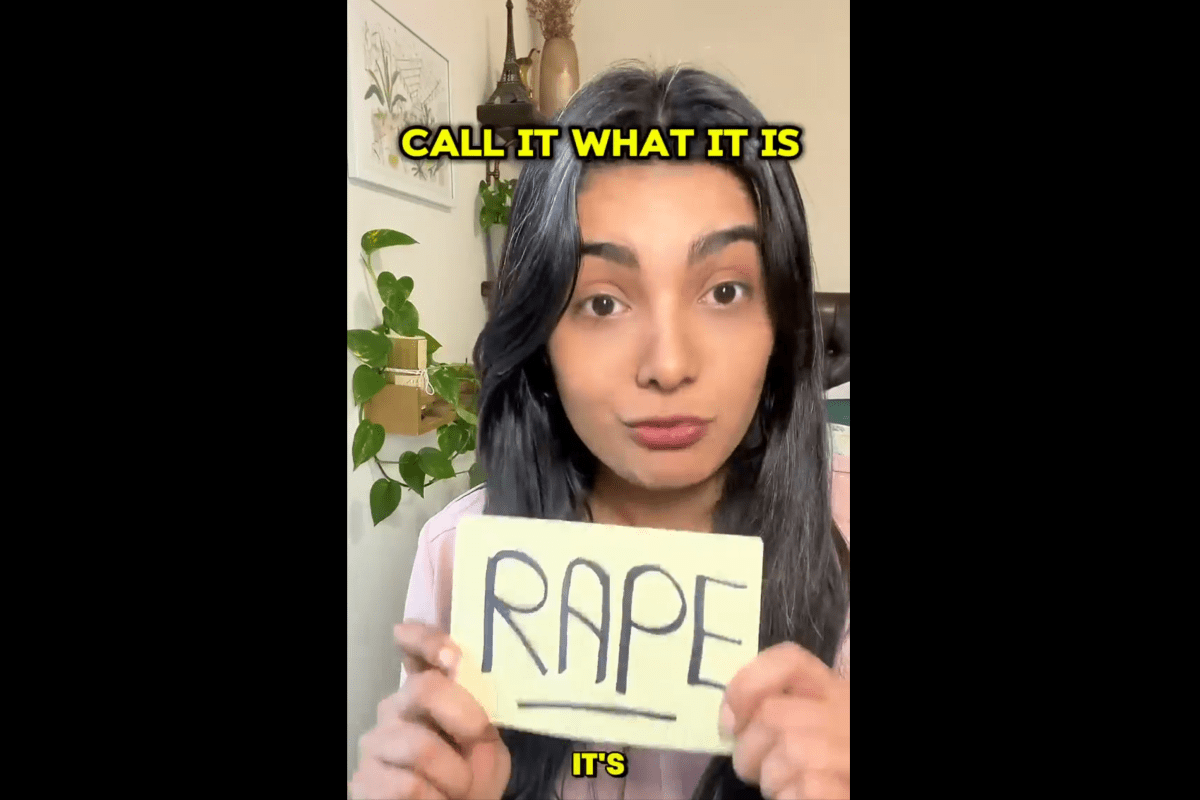
There is a particular kind of video that circulates online with tremendous force. A woman addresses the camera directly.
Video: Discussion Point (Full transcript at the end of this post)
She is clear, indignant, morally resolute:
It’s not an ‘inappropriate relationship with a 17-year-old’. It’s rape.
It’s not ‘coerced sex with a minor’. It’s rape.
It’s not a ‘young woman’. It’s a child.
Call it what it is.
Before proceeding, let me state something unambiguously: sexual exploitation of minors is morally reprehensible within contemporary Western legal and moral frameworks. I am not contesting that. Nor am I defending euphemism for its own sake. This is where philosophers of language take a lot of heat.
Audio: NotebookLM summary podcast on this topic.
The question here is narrower and, perhaps, more uncomfortable: What work is being done by the demand to ‘call it what it is‘?
Euphemism and Softening
She is correct in one respect. Institutional language often softens. Inappropriate relationship is anaesthetic. It lowers emotional temperature. It blunts moral outrage. Institutions frequently prefer such language because it reduces volatility, legal exposure, and procedural risk.
Language can minimise. That is not controversial. But it’s only half the story.
Naming Is Not Neutral
When she insists on rape and child, she is not merely removing euphemism. She is installing thick, legally saturated categories.
Rape is not a raw moral atom floating in space. It is a juridical classification defined by statute, evidentiary thresholds, and evolving legal doctrine. Its scope has expanded significantly over time: marital rape was once unrecognised; coercion has broadened beyond physical force; statutory rape collapses questions of consent into questions of legal capacity.
Likewise, child is not a purely biological category. It is a modern legal identity with shifting age thresholds and historical elasticity. The concept has expanded across the last two centuries as education extended, labour laws tightened, and adolescence became socially constructed as a protected stage of dependency.
To say this is not to relativise harm. It is to recognise that categories are historically sedimented and institutionally stabilised.
When someone says ‘Call it what it is‘, they are treating these contemporary legal categories as metaphysically self-evident. But they are products of a specific ontological framework: one in which autonomy and consent are foundational, and in which minors are deemed categorically incapable of exercising full sexual agency.
That framework is dominant in the West. It is not universal globally or historically.
Elasticity and Instrumentality
There is another asymmetry worth noticing.
Child expands protectively when someone is victimised. But the same individual may be stripped of childhood if they commit a serious crime: ‘They acted like an adult. They should have known better.’
The boundary is not purely developmental. It is normative. The category flexes.
Similarly, rape operates differently in everyday speech, in moral condemnation, and in statutory law. In the case of statutory rape, the term does not necessarily describe force; it describes the legal impossibility of consent. It is a doctrinal move grounded in an ontology of agency.
None of this weakens moral condemnation. But it reveals that these terms are not merely descriptive. They are instruments of moral and legal allocation.
Power and Irony
There is also a certain irony in the video.
She accuses mainstream institutions of manipulating language to reduce severity. Yet her demand is to deploy one of the state’s most powerful juridical classifications immediately and universally.
Rape derives its force from the same legal apparatus she critiques. It is powerful precisely because it is institutional. She is not rejecting power; she is attempting to redirect it.
This is not hypocrisy. It is politics. But it is politics nonetheless.
Ontology and Universality
The deeper issue is not whether we should condemn sexual exploitation. We should.
The issue is whether contemporary Western legal categories are simply “what is,” or whether they are historically developed ontological commitments that feel self-evident because they have been normalised.
The woman in the video experiences her categories as universal moral Truth. Many viewers agree. That agreement does not make the categories metaphysically timeless; it makes them hegemonic.
Recognising semantic expansion and legal drift does not undermine moral seriousness. It clarifies where moral authority resides: not in eternal linguistic atoms, but in historically stabilised frameworks.
Why This Is Unpopular
Online discourse prefers moral clarity over semantic archaeology. When harm is salient, genealogical analysis sounds like minimisation. Distinguishing between descriptive, legal, and ontological levels is interpreted as evasion.
It is not.
It is possible to affirm moral condemnation while also acknowledging that:
Language frames perception.
Legal categories evolve.
Terms are deployed instrumentally.
Ontologies masquerade as nature once naturalised.
One can insist on moral seriousness without pretending that our current vocabulary fell from the sky fully formed.
But saying so will reliably lose popularity on the internet.
Apparently, clarity has thresholds.
Full Video Transcript
‘Hey. It’s not an “Inappropriate Relationship with a 17-year-old”, it’s rape.
‘It’s not “coerced sex with a minor”, it’s rape.
‘It’s not “non-consensual sex with a 13-year-old”, it’s rape.
‘Call it what it is! Call them what they are.
‘And while we’re at it, it’s not a “young woman”, it’s a child!
‘It’s not a preteen, it’s a child!
‘It’s not a “mature girl”, it’s a child!
‘This use of specific language by mainstream media is super intentional, and it’s a tool of the patriarchy to try to reduce the egregiousness of horribly egregious acts that men commit against women and girls!
‘And, I say this with full awareness of the irony of my needing to use show and tell to make my point because I am beholden to these stupid social media platforms, which commit violence against women and girls every day in their own right by automatically suppressing any content as soon as I say a particular word.
‘And you and I need to say that it’s absolutely unacceptable!’
Video: Architecture of Grammatical Compromise. (Duration: 10:30)
In this video, I define Ontology, Grammar, and Commensurability before I use abortion as a poster child. Then, I discuss what happens when ontological grammars are incommensurable.
These thinkers follow:
Michel Foucault: Biopower, notably The History of Sexuality, Volume I.
Bernard Williams: Thick Moral Concepts from Ethics and the Limits of Philosophy.
Pierre Bourdieu: Habitus, notably from Outline of a Theory of Practice.
Karl Popper: Paradox of Intolerance.
I discuss the challenge of the promise of compromise and its three possible outcomes, none of which are true compromises.
Watch the video for context. Read the essay for fuller details.
I wrote an experimental short story, the details of which I’ll presently share, but first, I wish to describe an encounter with AI – NotebookLM. Firstly, I want to disclose that I am not an AI hater. Secondly, I understand its limitations. Thirdly, I understand the limitations of language. Fourthly, I understand the limitations of people. Let this set the stage.
In this short story that I named Advantagement, there is an inspector in Victorian London working with his partner on a missing-person case, the daughter of the mayor. A piece of evidence is a hairbrush left on her dresser. None of this is important for now.
Exhibit 1: The NotebookLM summary podcast with the silver hairbrush.
After I wrote it, I posted it to my Ridley Park blog, not intending to share it here, though I had reasons I might have instead. I fed it to NotebookLM to get an AI summary podcast, something I do routinely even here on Philosphics blog. The interpretation led to this post.
I like NotebookLM, but it has its flaws. Some are trivial, some comical. This one is curious and might shed light on how LLMs process information.
Let’s return to the hairbrush. NotebookLM keyed in on the hairbrush as the evidence it was, but then it strayed off the reservation. Suddenly, an ordinary hairbrush was now silver and monogrammed. I had to revisit my manuscript to see if I had subconsciously scribbled these details. Nope. No such description.
I’m not done noting errors, but I’ll pause to suss out the LLM. What I think might have happened is that it took in the notions of a posh house set in late nineteenth century London and presumed that a brush would appear like this. I considered retroactively adding the detail. As a writer, I struggle with deep POV because I don’t experience the world so vividly. But this hallucination isn’t the worst of it.
Next, the LLM noted that the hairbrush was orientated with bristles facing down on her dresser. This was stated in the story. Then, it went off the tracks again. This monogrammed silver hairbrush, bristles down, was a clue because anyone with such an expensive artefact would want to show it off, so showcase the fancy monogram.
But here’s the rub: if the bristles were down, the monogramme would be prominently displayed. To be obscured, it would have been positioned with the bristles facing up. This is a logical error I can’t explain.
Scratch that, I understand full well that LLMs are, by definition, Large Language Models – the acronym is a dead giveaway. These are not logic models, though, I suppose, one might assume one of the Ls stands for logic – Like Large Logic Model or Logical Language model of some such, but one would be mistaken.
I thought it might be a fun idea to create a character who speaks in these terms – malformed English. I immediately thought of Mr Burns from The Simpsons and his anachronisms, or someone ripe with malaprops. It suggested that I might choose Victorian England, Sherlock Holmes, a detective, a sidekick… vying for promotion. A high-profile case.
But not Sherlock Holmes – more Inspector Clouseau or Mr Bean, successful in spite of himself. I decided to offset his inanity with a logical partner, but it would be a woman, as unlikely as this might be given the period. Now it’s open to topical management politics.
When I told my sister the story idea, she thought of Get Smart, the 1960s comedy with Don Adams and Barbara Feldon. Yes, that too, but my goal wasn’t comedy. It was satire – and absurdism.
At uni, I enjoyed the short stories of Donald Barthelme. He was generally a lighter version of Kafka, and orthogonal to Kurt Vonnegut, especially Harrison Bergeron, a favourite classic. I wanted to shoot for that.
In conceit to the Peter principle of management, I decided to name the lead character Peter. For the rest, I adopted period-appropriate names.
My primary goal was to employ these confabulated words. In practise, it’s easy anough to suss out their meanings in context. Give it a read. It’s under 3,500 words.
Few philosophical aphorisms travel as lightly and cut as confidently as Ockham’s Razor. “Do not multiply entities beyond necessity.” The phrase has the air of austere wisdom. It sounds disciplined, economical, rational. It promises clarity by subtraction. One imagines conceptual clutter swept aside by a single elegant stroke.
The Razor is attributed to William of Ockham, though like many slogans it has acquired a life far removed from its origin. In contemporary discourse it functions less as a methodological reminder and more as an epistemic trump card. The simpler explanation, we are told, is the better one. Case closed.
The trouble begins precisely there.
Audio: NotebookLM summary podcast
The Hidden Variable: Necessity
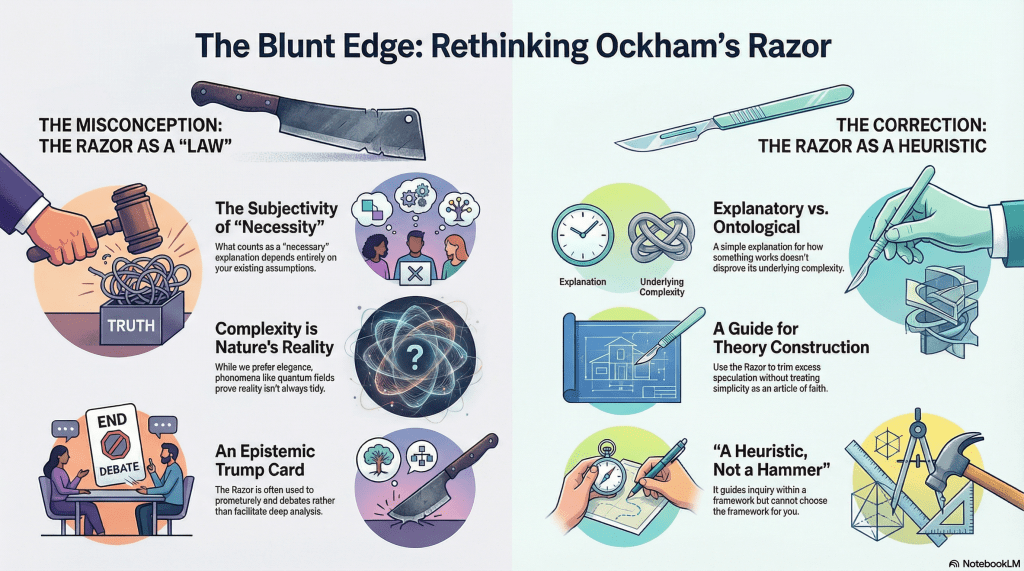
The Razor does not forbid multiplicity. It forbids unnecessary multiplicity. But who decides what is necessary?
Necessity is not a neutral category. It is already embedded within a framework of assumptions about what counts as explanation, what counts as sufficiency, and what counts as legitimate ontological commitment.
For one thinker, invoking a divine ground of physical law is unnecessary because the laws themselves suffice. For another, the laws are unintelligible without a grounding principle, and so God is necessary. Both can claim parsimony within their respective ontologies. The Razor does not adjudicate between them. It presupposes the grammar within which “necessity” is assessed.
The aphorism thus functions less as a rule and more as a reinforcement mechanism. It stabilises the commitments one already holds.
Parsimony Is a Heuristic, Not a Law
Science has often rewarded simplicity. Copernicus simplified celestial mechanics. Newton reduced motion to a few principles. Maxwell unified electricity and magnetism. These episodes encourage a romantic attachment to elegance.
Yet physics has also revealed a universe that is anything but tidy. Quantum fields, curved spacetime, dark matter, inflationary cosmology. Nature has shown little regard for our aesthetic preference for minimal furniture.
Parsimony, then, is pragmatic. It helps us avoid gratuitous complication. It disciplines theory formation. But it is not a metaphysical guarantee that reality itself is sparse.
To treat the Razor as if it carries ontological authority is to convert a methodological guideline into a philosophical dogma.
Structural Sufficiency Versus Metaphysical Surplus
The Razor becomes particularly contentious when deployed in debates about ultimate grounds. If a structural model explains observable regularities and survives empirical constraint, some conclude that any additional metaphysical layer is redundant.
This is a defensible position. It is also incomplete.
Redundancy in explanatory terms does not entail impossibility in ontological terms. A structural account of behaviour may render psychological speculation unnecessary for prediction, but it does not disprove the existence of inner motives. Likewise, a lawful cosmology may render a divine hypothesis explanatorily idle without rendering it incoherent.
The Razor trims explanatory excess. It does not settle metaphysical disputes.
Aphorisms as Closure Devices
Part of the Razor’s power lies in its compression. It is aphoristic. It travels easily. It signals intellectual seriousness. It sounds like disciplined thinking distilled.
But aphorisms compress complexity. They conceal premises. They discourage reopening the frame. “Follow the science.” “Extraordinary claims require extraordinary evidence.” “Trust the market.” These phrases do not argue; they configure. They pre-load the space of acceptable interpretation.
Ockham’s Razor often operates in precisely this way. It is invoked not as the conclusion of a careful analysis but as a device to end discussion. The simpler view wins. Full stop.
Yet simplicity itself is indexed to perspective. What looks simple within one conceptual scheme may appear impoverished within another.
Tolerance for Explanatory Closure
There is also a psychological dimension worth acknowledging. Some individuals are comfortable with open explanatory ceilings. They accept that certain features of reality may lack ultimate grounding within their present framework. Others experience such openness as instability. They seek a final anchor.
The Razor favours the former temperament. It encourages ontological restraint and distrust of ultimate grounds. For those comfortable with structural sufficiency, this is liberating. For those who experience the absence of grounding as incomplete, it feels evasive.
The disagreement is not resolved by invoking parsimony. It reflects divergent tolerances for metaphysical closure.
When the Razor Becomes Inflationary
Ironically, the Razor can itself become an inflationary principle. It can elevate “simplicity” to a quasi-transcendental value. It can be treated as if reality owes us elegance.
At that point, the tool begins to govern the ontology rather than merely discipline it. The Razor becomes an article of faith, a universal heuristic immune to its own demand for justification.
One might then ask, with a certain symmetry: by what necessity is simplicity itself necessary?
A More Modest Use
None of this requires abandoning the Razor. It remains useful. It reminds us not to posit hidden mechanisms when observable structures suffice. It cautions against explanatory extravagance. It protects inquiry from baroque speculation.
But it should be treated as a heuristic, not a hammer. It guides theory construction within a framework. It does not choose the framework.
A more disciplined formulation would be this: when a structural account explains observed regularities under constraint and remains revisable, additional metaphysical posits do not increase explanatory power. Their adoption becomes a matter of ontological preference rather than necessity.
This preserves the Razor’s pragmatic value without inflating it into a metaphysical arbiter.
The Real Trouble
The real trouble with Ockham’s Razor is not that it cuts too much. It is that we often wield it without noticing the hand that holds it. We treat it as neutral when it is already embedded within a grammar of sufficiency, explanation, and legitimacy.
The Razor does not eliminate ontological commitment. It expresses one.
Recognising that does not blunt the blade. It merely reminds us that even the sharpest instruments are guided by the frameworks in which they are forged.
And frameworks, unlike aphorisms, are rarely simple.
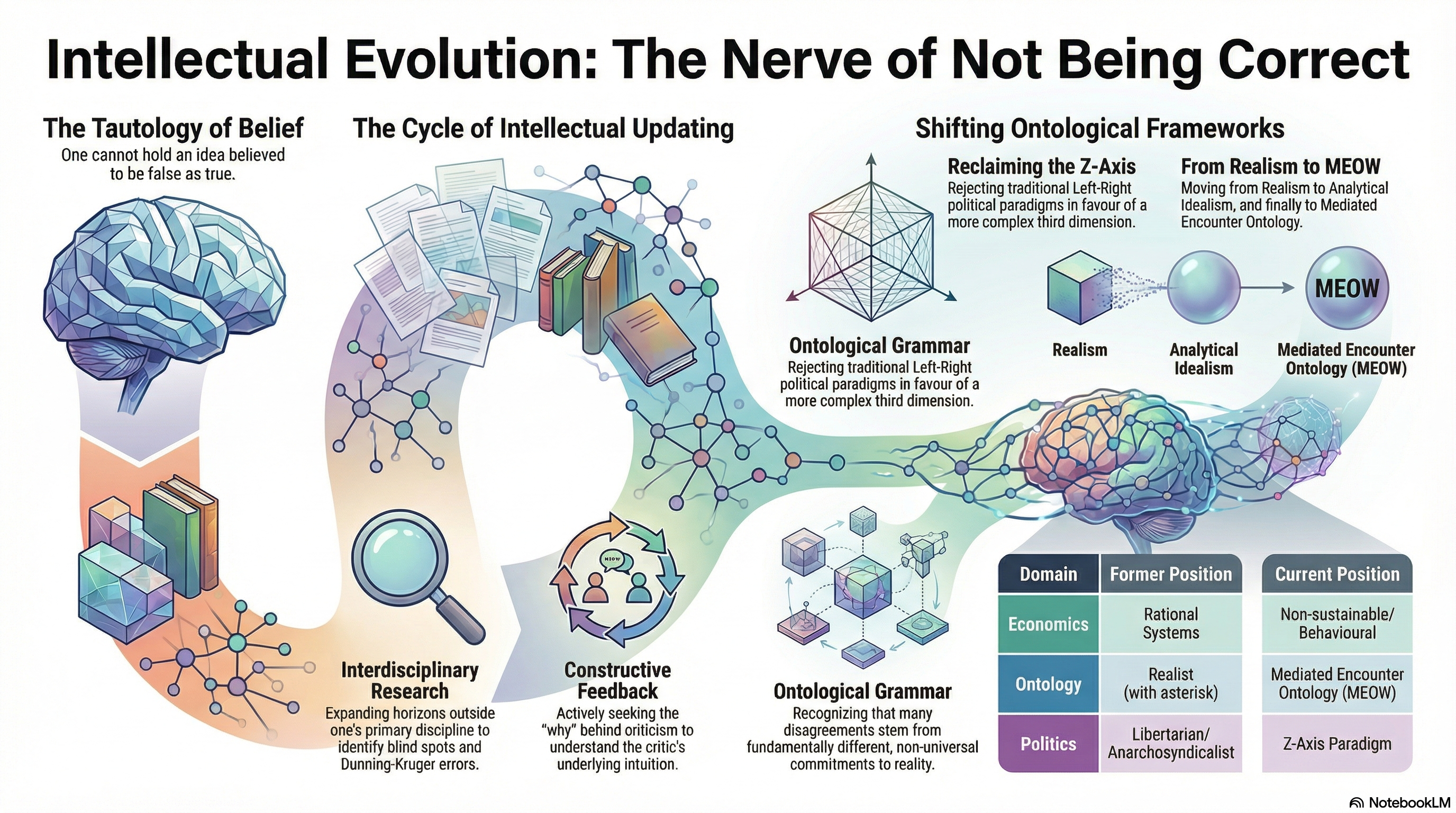
I’ve received feedback like, ‘Not everything you believe is right’ and ‘What if you’re not right?’
First: I agree. Second: And what if I’m not?
This isn’t new feedback, but I’ll address it in terms of my latest work.
Audio: NotebookLM summary podcast
Not everything you believe is right
This is true, but one cannot hold an idea one believes to be false as true, so the idea that one believes what one believes to be true to tautological. This is also why I continue to research and attempt to expand my horizon. I even wander outside of my discipline at the risk of Dunning-Kruger errors.
In my recent work on ontology and grammar, I collided with Bourdieu, so I read his work. As helpful as it was, it served to reinforce my position, but from a position of Social Theory instead of Philosophy. When I read Judith Butler, I see how I might connect my ideas to Gender theory. It should be obvious that I’ve read much on Linguistics, but I am not a linguist. Our lenses all differ to some extent.
I’ve even corrected some of the ideas I’ve posted on this blog as I gain new information. To be fair, it’s a reason I post here. I hope to get feedback. I may not fully pursue alternative disciplines, but it’s nice to know they exist, and I can at least perform cursory surveys.
If I am wrong – or if you think I am wrong – tell me. If you can, tell me why. If not precisely why, then what’s your intuition?
NotebookLM Infographic
Historically, many times I’d been claimed to be wrong because the person was coming from a differnt ontology. I might have been arguing something within the realm of Continental philosophy, and I’d get a critique from an Analytical philosopher. This is akin to a vegan critiquing a steak dinner. It may be valid within their ontological grammar, but it is not otherwise universal. It usually doesn’t take very long to assess one’s commitments to other grammars. That happened recently, when I encountered a philosophical Realist.
When I wouldn’t accept their position, eventually we arrived at this foundational point. Realism is a position I ontologically and grammatically reject. I’ve written several pieces defending or at least articulating my position, notably the Mediated Encounter Ontology (MEOW). Disagree? Tell me.
I used to be a Realist with an asterisk; then I was an Analytical Idealist with an asterisk; now, I believe in MEOW. The asterisk was necessary because there were holes in the position. When Analytical Idealism came around, there was still an asterisk, but it felt better than that of Realism. When I came up with MEOW, the asterisk went away. Perhaps you might consider that MEOW has an asterisk, if you believe it’s plausible at all. If so, what’s missing – what’s the known unknown? You obviously can’t articulate an unknown unknown.
When I write about ontology, grammar, and commensurability, I do not exempt myself from these biases. I have all of these challenges – perhaps even more so because I don’t tend to fit into the round holes very well myself. This helps me with intellectual humility.
Politically, I am often accused of being on the Left, but I reject the Left-Right paradigm as a valid lens for me; I am on a different axis. The Libertarians added an Authority-Liberty Y-axis to the Progressive-Conservative X-axis, but I am on a Z-axis, which is not to be fully described or accounted for on these planes. Think of the message of Flatland.
What if you’re wrong?
Hopefully, every philosopher understands this and has noticed the dustbin of history littered with wrong ideas.
When I publish essays, they are the result of research and deliberation. Could I be wrong? Again, I’ve been wrong before. I’ll be wrong again, but I need to understand why to change my position. I could shift my position or abandon it outright.
There was a time I believed people to be rational. I was an economist. I studied finance. I believed it until I didn’t. Behavioural Economics likely did the heavy lifting, but it’s likely that they believe that rationality-based systems are salvageable. I don’t. Not meaningfully. Not sustainably.
So, I can be wrong, and I can admit it.
I was once a closet (or adjacent) Libertarian until I realised it didn’t cohere with reality. My last declared stance was an Anarchosydicalist, but I know this isn’t quite right either – on multiple accounts.
Anyway, I’m not afraid of being wrong, and I’m not afraid of wittering on about it. Again, I appreciate constructive criticism. I’m also amicable to non-solutions in the manner of my Dis–Integration approach, but at least break down the pieces.
I’ve just published a new GPT in support of my new ontology, grammar, and legibility project, Legibility GPT.
As with Languange Insufficiency GPT and MEOW GPT, it is meant to assist in the exploration of the concepts for which they were built and named. For an interesting time, analyse a concept through all three.
Simply put, Legibility GPT assesses conceptual thickness, based on the work of Bernard Williams in Ethics and the Limits of Philosophy. Thin concepts, whether containing moral content or description, carry commensurable information, so disagreement remediation may be attained. For thick moral concepts, this becomes increasingly unlikely because the moral content becomes an anchor. Generally speaking, the conflicting ontological positions either weigh the concept differently or, in extreme cases, one side doesn’t even categorise the concept as principally moral. I use legibility in the sense articulated by James C Scott in Seeing Like a State: How Certain Schemes to Improve the Human Condition Have Failed.
Audio: NotebookLM concept summary podcast.
Legibility GPT
A cartographic tool for conceptual conflict. Legibility GPT analyses how ontology and grammar shape the meaning of contested terms, identifying points of admissibility, exclusion, and incommensurability. It maps disagreement without taking sides.
Usage: Input a term or concept. This GPT will output the various polysemous contexts of the concept and break out the various ontological commitments and grammatical functions with examples of valid and invalid phrases within that grammar.
This GPT will also score and sort on incommensurability. A particularly divisive concept might be abortion.
Analyses English terms and short concept phrases using the Language Insufficiency Hypothesis (LIH), diagnosing semantic stability, polysemy, connotation, and category drift in contemporary usage.
A structured analysis tool that maps any given concept onto the MEOW mediation framework (T0–T3). Produces a consistent, tiered breakdown including scope checks, applicability flags, and limits of interpretation.
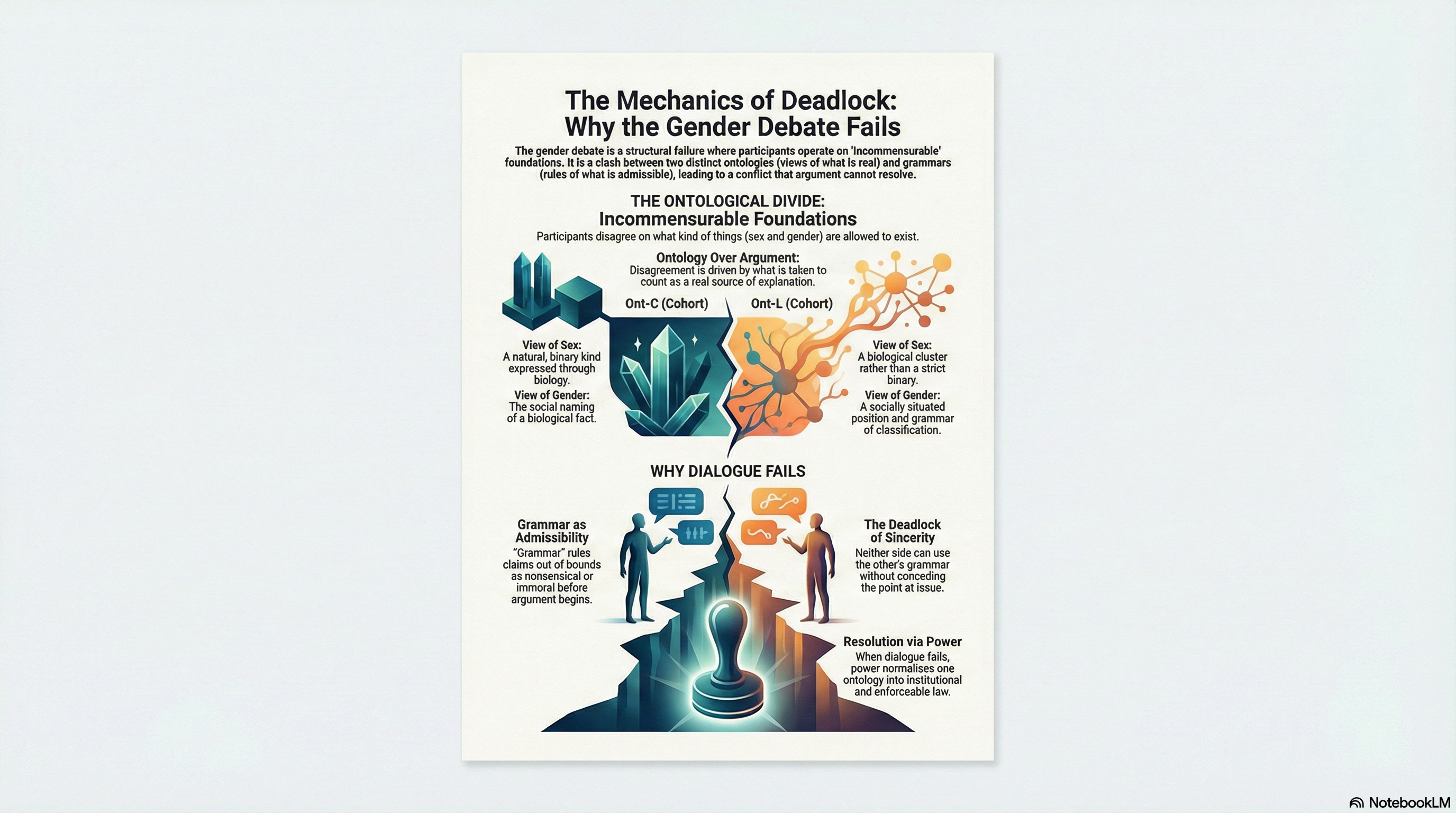
I’ve been thinking through dozens of use cases to explain how some polemic positions are intractable via language. When they are resolved through power, at least one ontological cohort is left wanting. In a compromise, likely both sides feel they’ve lost.
Audio: NotebookLM summary podcast of the video transcript for this topic.
I’ll post a separate announcement presently, but I want to share my new Legibility GPT to assess concepts for ontological and grammatical commensurability.
In conventional (read: orthodox Enlightenment thinking), communication and negotiation are supposed to bring groups together. This is only true for intra-ontological conflict; it’s never been true for inter-ontological issues. There are edge cases where differing ontologies might be satisfied with an inter-ontological agreement, but this is likely accidental and certainly differently motivated. Not all such disagreements can be mediated, and this is where power politics steps in – not to ameliorate but to force the matter. This happens in politics, law, and many other power-oriented domains.
NotebookLM Infographic: No idea why this is formatted like this.
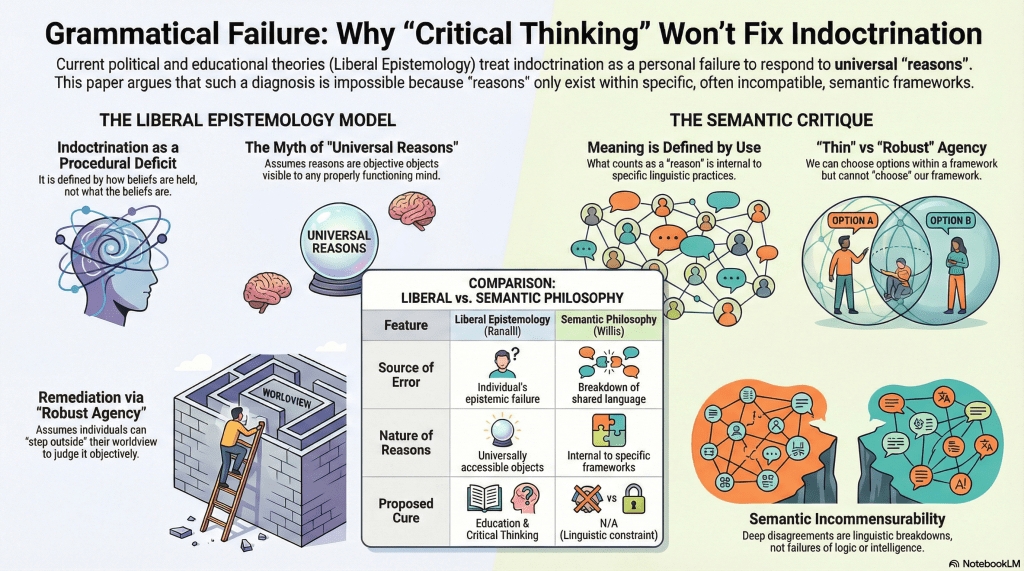
I’ve been wittering on about social ontological positions and legibility for a few months now. I’ve been writing a book and several essays, but this is the first to be published. In it, I not only counter Ranalli – not personally; his adopted belief – I also counter Thomas Sowell, George Lakoff, Jonathan Haidt, Kurt Gray, and Joshua Green. (Counter might be a little harsh; I agree with their conclusions, but I remain on the path they stray from.)
Audio: NotebookLM summary of the essay: Grammatical Failure
There is a strange faith circulating in contemporary culture: the belief that disagreement persists because someone, somewhere, hasn’t been taught how to think properly.
The prescription is always the same. Teach critical thinking. Encourage openness. Expose people to alternatives. If they would only slow down, examine the evidence, and reflect honestly, the right conclusions would present themselves.
When this doesn’t work, the explanation is equally ready to hand. The person must be biased. Indoctrinated. Captured by ideology. Reason-resistant.
What’s rarely considered is a simpler possibility: nothing has gone wrong.
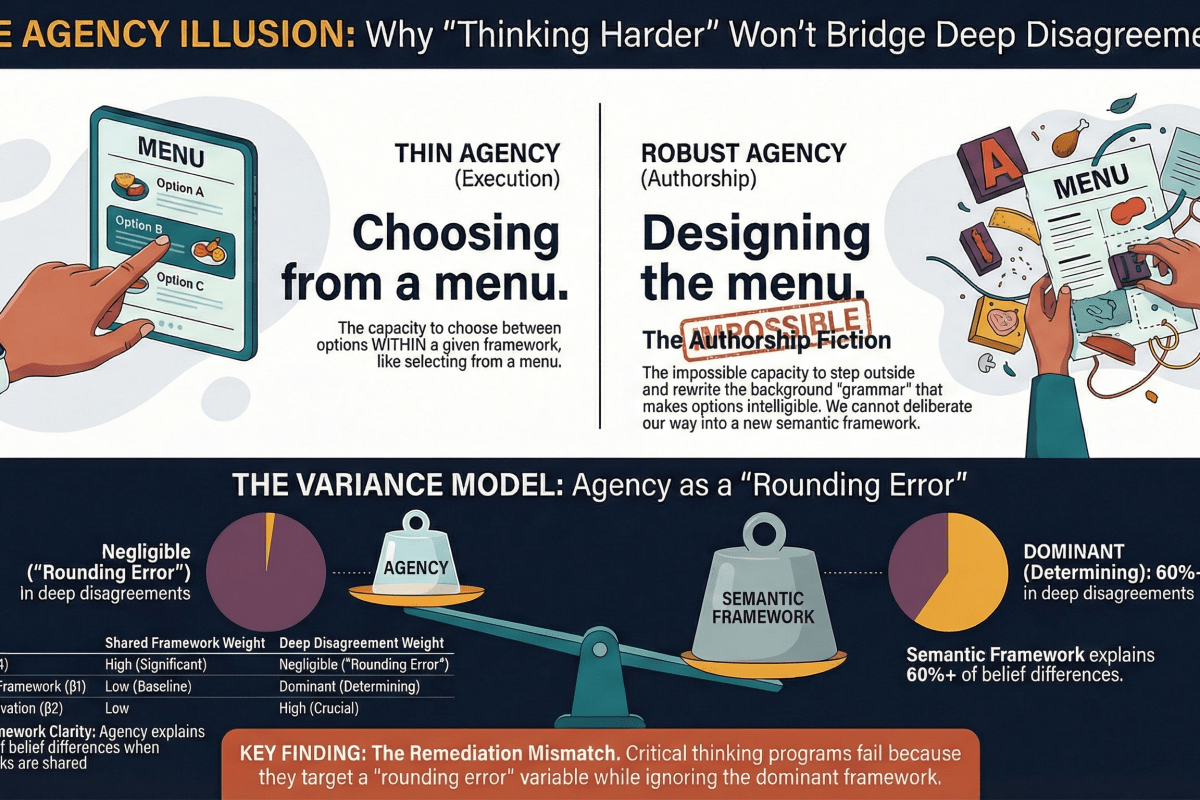
Most of our public arguments assume that we are all operating inside the same conceptual space, disagreeing only about how to populate it. We imagine a shared menu of reasons, facts, and values, from which different people select poorly. On that picture, better reasoning should fix things.
But what if the menu itself isn’t shared?
What if what counts as a ‘reason’, what qualifies as ‘evidence’, or what even registers as a meaningful alternative is already structured differently before any deliberation begins?
At that point, telling someone to ‘think critically’ is like asking them to optimise a system they cannot see, using criteria they do not recognise. The instruction is not offensive. It’s unintelligible. This is why so many contemporary disputes feel immune to argument. Not merely heated, but strangely orthogonal. You aren’t rebutted so much as translated into something else entirely: naïve, immoral, dangerous, unserious. And you do the same in return.
Liberal epistemology has a neat explanation for this. It treats these failures as agent-level defects: insufficient openness, motivated reasoning, epistemic irresponsibility. The problem is always how people reason. The argument of Grammatical Failure is that this diagnosis is systematically misplaced. The real constraint, in many cases, lies upstream of reasoning itself. It lies in the semantic frameworks that determine what can count as a reason in the first place. When those frameworks diverge, deliberation doesn’t fail heroically. It fails grammatically.
This doesn’t mean people lack agency. It means agency operates within a grammar, not over it. We choose, revise, and reflect inside spaces of intelligibility we did not author. Asking deliberation to rewrite its own conditions is like asking a sentence to revise its own syntax mid-utterance. The result is a familiar pathology. Disagreement across frameworks is redescribed as epistemic vice. Category rejection is mistaken for weak endorsement. Indoctrination becomes a label we apply whenever persuasion fails. Not because anyone is lying, but because our diagnostic tools cannot represent what they are encountering.
The paper itself is not a manifesto or a programme. It doesn’t tell you what to believe, how to educate, or which politics to adopt. It does something more modest and more uncomfortable. It draws a boundary around what liberal epistemology can coherently explain – and shows what happens when that boundary is ignored.
Sometimes the problem isn’t that people won’t think.
It’s that they are already thinking in a grammar that your advice cannot reach.




 Philosophics