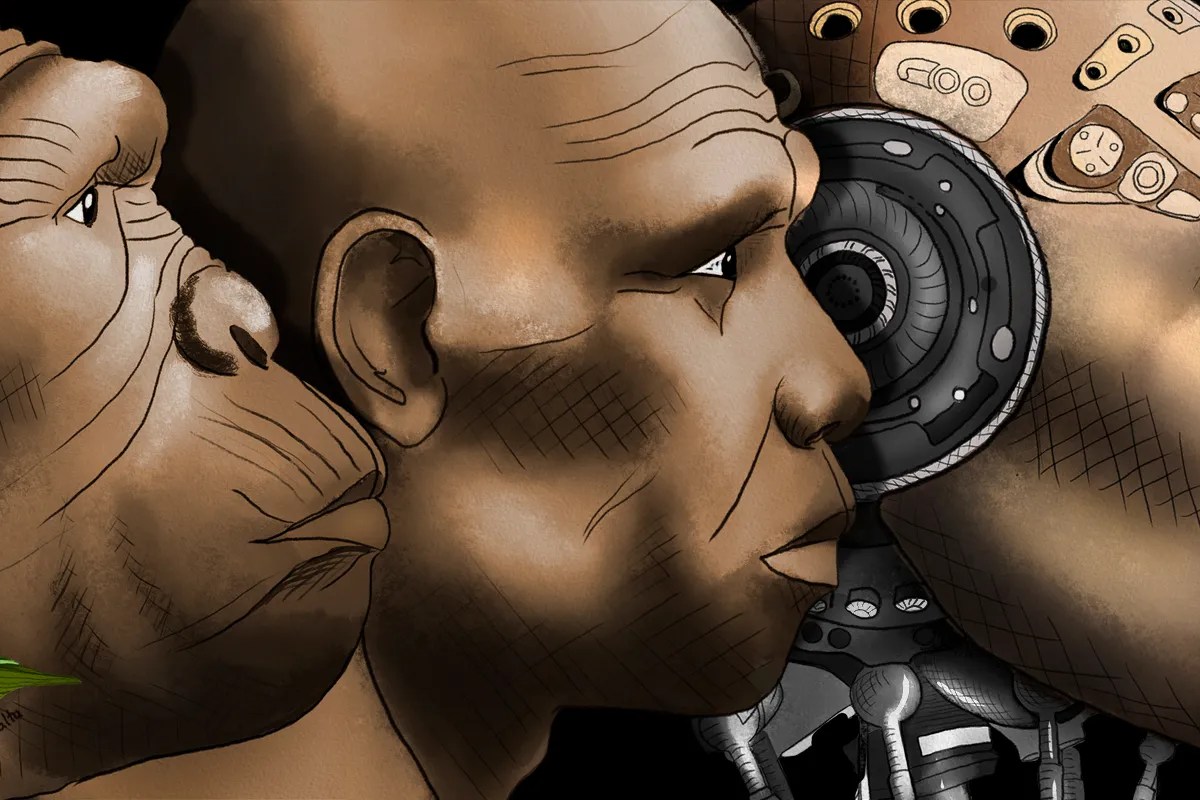
Am I the only one who can’t resist a massive eyeroll – and, let’s be honest: jaw-drop – what you hear transhumanism couched as evolution? To me, it incites a similar reaction to hearing people witter on about machine consciousness, but I’ll sideline that topic.
My objection is linguistic: transhumanism often borrows the prestige of evolution to describe what is more precisely technological mediation. The fact that a device is worn, implanted, or integrated into a body does not by itself move it from tool-use into biological descent. The offspring still inherits the organism, not the upgrade. Technology is not heritable.
Consider rhinoplasty. Rhinoplasty changes the presented phenotype, not the inherited genotype. The child inherits the developmental instructions, not the parent’s post-surgical edit. Likewise, a neural implant, prosthetic limb, exoskeleton, gene-unrelated enhancement, or titanium jaw of techno-vanity may alter the lived organism, but it does not thereby alter the reproductive line. This is the category error: Acquired modification is mistaken for inherited transformation.
So, transhumanism often confuses the edited encounter-profile of an organism with the evolutionary alteration of the organismic lineage. The rhinoplasty case is good because it shows the absurdity without needing much apparatus. No one sane thinks a nose job rewrites the germline. Yet when the modification is sufficiently glamorous, especially when welded to futurist rhetoric and venture-capital incense, people suddenly start talking as if augmentation equals evolution.
A prosthesis is to evolution what rhinoplasty is to heredity: a modification of presentation, function, or encounter, not a transformation of descent. The confusion arises when the altered individual is mistaken for an altered lineage.
The question isn’t: Can transhumanism be defended under some broader theory of evolution, cultural inheritance, niche construction, or techno-biological co-development? Sure, it can.
But my claim is narrower: The term evolution is being made to do illicit rhetorical work when acquired, engineered, prosthetic, or embedded modifications are spoken of as though they were equivalent to heritable biological transformation.
The problem is that we are sliding from tool-use to augmentation to enhancement to transformation to evolution. This move isn’t illegal, but it should attract your attention.
At each step, something plausible is smuggled into something grander. By the end, an implanted device or technical prosthesis has been rhetorically promoted into ‘the next stage of human evolution’, when what has actually happened is that an organism’s encounter-capacities have been modified by artefactual mediation.
In the end, I’m not claiming that transhumanist practices can’t affect selection environments, social organisation, embodiment, or cultural transmission. What I am claiming is that calling such practices evolution without specifying the relevant register is a linguistic inflation. It trades on the authority of biological evolution while often describing technological mediation, individual augmentation, or cultural change.
In my book, more accurate terms might be augmentation, prosthesis, mediation, tool evolution, cultural inheritance, or niche modification, but these re so glamorous or click-baity. I might as well wear a hat and call myself post-human.
Addendum
I chatted up ChatGPT, so I am adding this response:
Exactly. The carried / worn / embedded distinction is mostly a boundary fetish, the sort of thing humans adore because skin looks like an ontological border and apparently everyone remains impressed by packaging.
An axe, spectacles, a pacemaker, a cochlear implant, a smartphone, and a neural implant all sit on the same broad continuum: external mediation of capacity. Some are held. Some are worn. Some are surgically installed. But unless the alteration becomes heritable, it is not biological evolution in the strict sense. It is phenotypic augmentation, affordance expansion, or environmental coupling.
The useful distinction is threefold:
- Biological evolution
Heritable variation changes across generations. The organism-line changes. - Cultural / technological evolution
Tools, techniques, designs, institutions, and practices vary, are selected, retained, modified, and transmitted. Axe technology evolves. Writing evolves. Surgery evolves. The appalling human habit of calling every interface “intuitive” also evolves, though downward. - Individual augmentation
A particular body-system gains capacities through artefacts. This may change what the organism can do, but it does not by itself alter the inherited biological line.
Your axe example is clean because it exposes the smuggling. The axe helped alter human selection environments. It extended reach, force, food access, defence, craft, and perhaps social organisation. That may feed into gene-culture co-evolution over long scales. But the axe itself is not an evolved human trait. It is a technological mediator that participates in the evolutionary ecology.
The same holds for transhumanist implants. A retinal implant may alter one person’s perceptual affordance field. A brain-computer interface may alter one person’s control loop. A prosthetic limb may alter one person’s mobility. But unless such modifications become transmissible across generations, biologically or through some stable reproductive architecture, calling them “evolution” is loose metaphor masquerading as profundity. Very on-brand for techno-utopianism: rename engineering as destiny and hope the grant reviewers are sleepy.
From your MEOW angle, the better formulation is:
The relevant transformation is not evolutionary but mediational. Tools, prostheses, implants, and interfaces reconfigure encounter-events by altering the affordance structure through which an organism meets constraint. Whether the device is carried in the hand, worn on the face, implanted beneath the skin, or networked through the environment is secondary. The organism-world relation changes; the inherited organism does not necessarily change.
That also lets you avoid an overcorrection. Transhumanist enhancement is not irrelevant. It may be historically enormous. But its primary register is encounter, not inheritance; mediation, not mutation; technical lineage, not biological descent.
So the blunt line is:
Transhumanism mistakes the evolution of tools for the evolution of the tool-user.
Not always, not necessarily, but often enough that the slogan deserves being dragged into the alley and relieved of its metaphysical wallet.

 Philosophics