What if the biggest trick language played on you is convincing you that the world is made of things?
Every sentence you speak installs a hidden assumption. ‘The rock falls.’ ‘The mind thinks.’ ‘The electron orbits.’ Each one presupposes a thing – a noun – that exists before anything happens to it. Your grammar tells you: first, there are objects, then they do stuff. But what if that’s backwards?
The Mediated Encounter Ontology – MEOW – proposes that it is. Reality isn’t made of things. It’s made of structured interactions. Encounter-events – relational, patterned, constrained – are what’s ontologically basic. Objects, subjects, minds, worlds: these are all downstream. They’re what you get when structured interaction stabilises within a given scale of encounter.
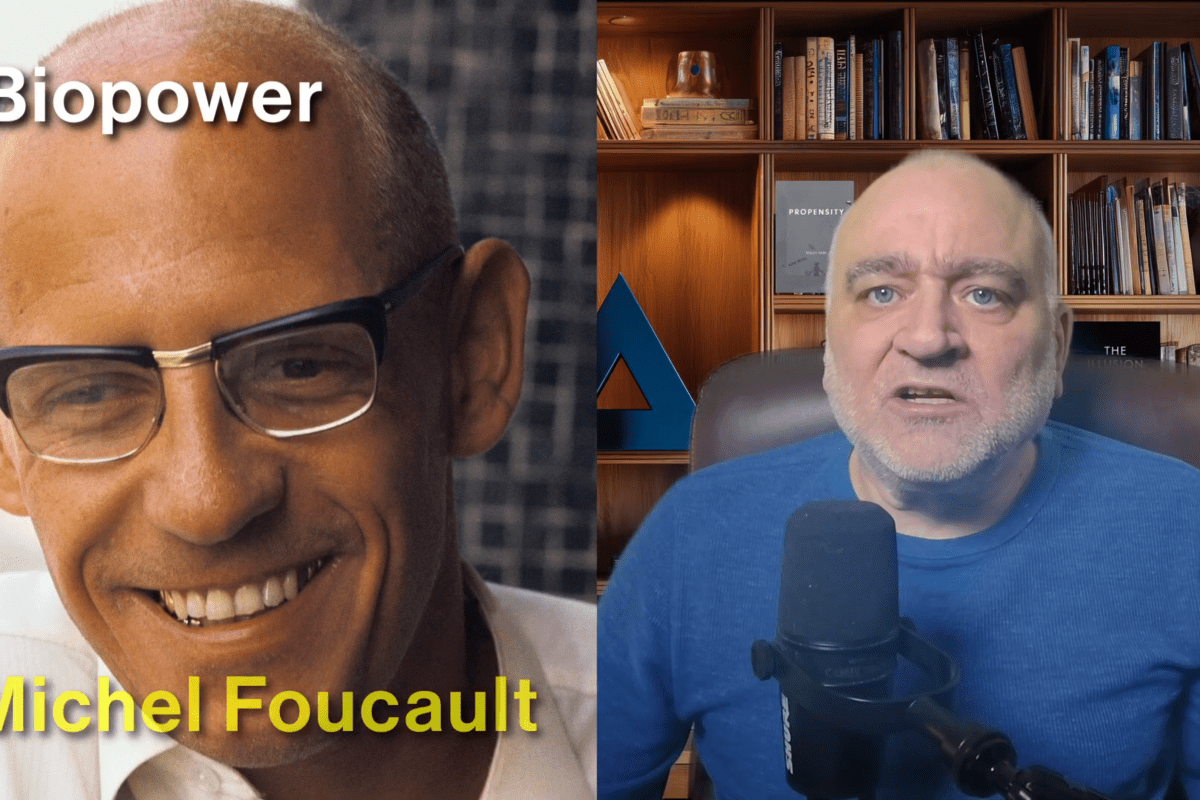
Video: Architecture of Grammatical Compromise. (Duration: 10:30)
In this video, I define Ontology, Grammar, and Commensurability before I use abortion as a poster child. Then, I discuss what happens when ontological grammars are incommensurable.
These thinkers follow:
Michel Foucault: Biopower, notably The History of Sexuality, Volume I.
Bernard Williams: Thick Moral Concepts from Ethics and the Limits of Philosophy.
Pierre Bourdieu: Habitus, notably from Outline of a Theory of Practice.
Karl Popper: Paradox of Intolerance.
I discuss the challenge of the promise of compromise and its three possible outcomes, none of which are true compromises.
Watch the video for context. Read the essay for fuller details.
I’ve received feedback like, ‘Not everything you believe is right’ and ‘What if you’re not right?’
First: I agree. Second: And what if I’m not?
This isn’t new feedback, but I’ll address it in terms of my latest work.
Audio: NotebookLM summary podcast
Not everything you believe is right
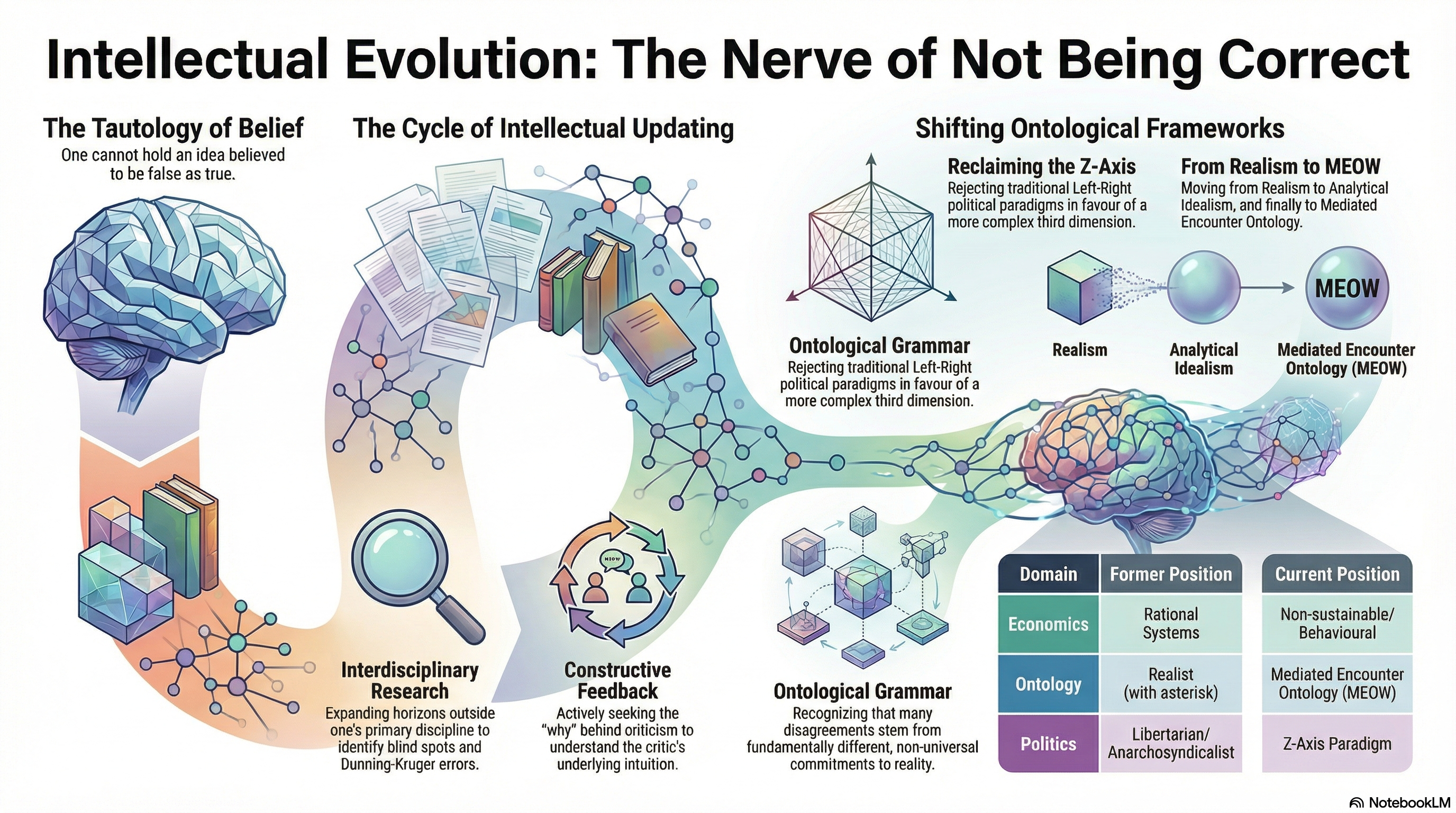
This is true, but one cannot hold an idea one believes to be false as true, so the idea that one believes what one believes to be true to tautological. This is also why I continue to research and attempt to expand my horizon. I even wander outside of my discipline at the risk of Dunning-Kruger errors.
In my recent work on ontology and grammar, I collided with Bourdieu, so I read his work. As helpful as it was, it served to reinforce my position, but from a position of Social Theory instead of Philosophy. When I read Judith Butler, I see how I might connect my ideas to Gender theory. It should be obvious that I’ve read much on Linguistics, but I am not a linguist. Our lenses all differ to some extent.
I’ve even corrected some of the ideas I’ve posted on this blog as I gain new information. To be fair, it’s a reason I post here. I hope to get feedback. I may not fully pursue alternative disciplines, but it’s nice to know they exist, and I can at least perform cursory surveys.
If I am wrong – or if you think I am wrong – tell me. If you can, tell me why. If not precisely why, then what’s your intuition?
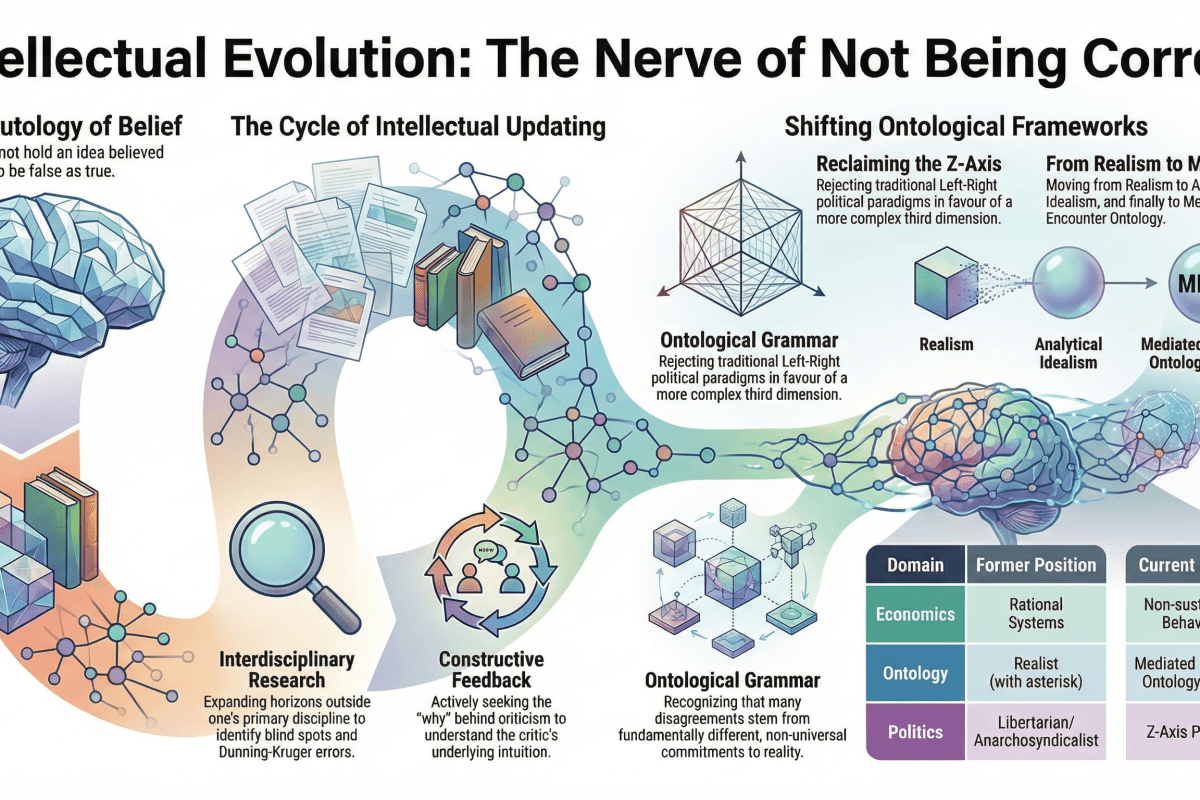
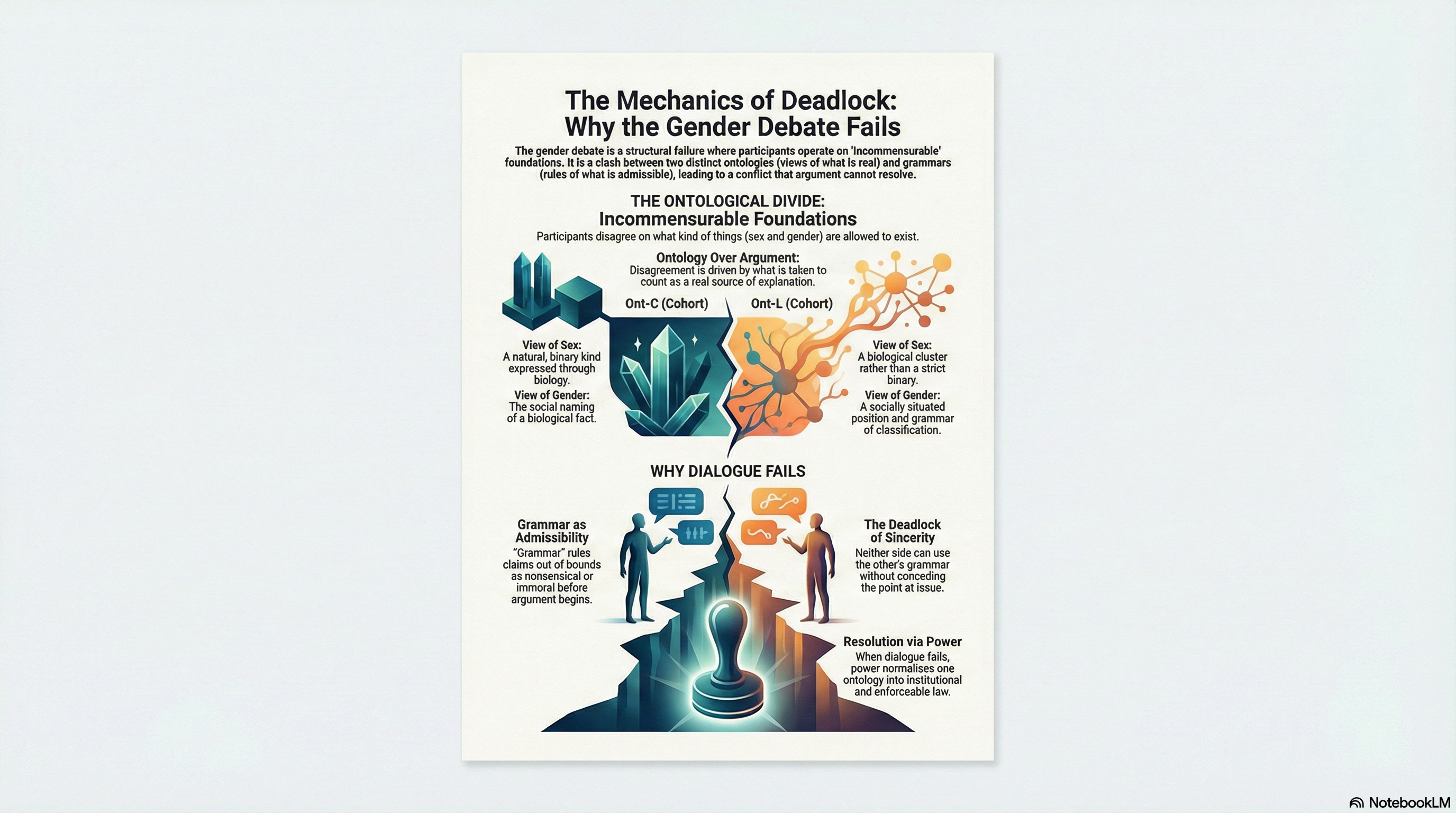
NotebookLM Infographic
Historically, many times I’d been claimed to be wrong because the person was coming from a differnt ontology. I might have been arguing something within the realm of Continental philosophy, and I’d get a critique from an Analytical philosopher. This is akin to a vegan critiquing a steak dinner. It may be valid within their ontological grammar, but it is not otherwise universal. It usually doesn’t take very long to assess one’s commitments to other grammars. That happened recently, when I encountered a philosophical Realist.
When I wouldn’t accept their position, eventually we arrived at this foundational point. Realism is a position I ontologically and grammatically reject. I’ve written several pieces defending or at least articulating my position, notably the Mediated Encounter Ontology (MEOW). Disagree? Tell me.
I used to be a Realist with an asterisk; then I was an Analytical Idealist with an asterisk; now, I believe in MEOW. The asterisk was necessary because there were holes in the position. When Analytical Idealism came around, there was still an asterisk, but it felt better than that of Realism. When I came up with MEOW, the asterisk went away. Perhaps you might consider that MEOW has an asterisk, if you believe it’s plausible at all. If so, what’s missing – what’s the known unknown? You obviously can’t articulate an unknown unknown.
When I write about ontology, grammar, and commensurability, I do not exempt myself from these biases. I have all of these challenges – perhaps even more so because I don’t tend to fit into the round holes very well myself. This helps me with intellectual humility.
Politically, I am often accused of being on the Left, but I reject the Left-Right paradigm as a valid lens for me; I am on a different axis. The Libertarians added an Authority-Liberty Y-axis to the Progressive-Conservative X-axis, but I am on a Z-axis, which is not to be fully described or accounted for on these planes. Think of the message of Flatland.
What if you’re wrong?
Hopefully, every philosopher understands this and has noticed the dustbin of history littered with wrong ideas.
When I publish essays, they are the result of research and deliberation. Could I be wrong? Again, I’ve been wrong before. I’ll be wrong again, but I need to understand why to change my position. I could shift my position or abandon it outright.
There was a time I believed people to be rational. I was an economist. I studied finance. I believed it until I didn’t. Behavioural Economics likely did the heavy lifting, but it’s likely that they believe that rationality-based systems are salvageable. I don’t. Not meaningfully. Not sustainably.
So, I can be wrong, and I can admit it.
I was once a closet (or adjacent) Libertarian until I realised it didn’t cohere with reality. My last declared stance was an Anarchosydicalist, but I know this isn’t quite right either – on multiple accounts.
Anyway, I’m not afraid of being wrong, and I’m not afraid of wittering on about it. Again, I appreciate constructive criticism. I’m also amicable to non-solutions in the manner of my Dis–Integration approach, but at least break down the pieces.
I’ve been thinking through dozens of use cases to explain how some polemic positions are intractable via language. When they are resolved through power, at least one ontological cohort is left wanting. In a compromise, likely both sides feel they’ve lost.
Audio: NotebookLM summary podcast of the video transcript for this topic.
I’ll post a separate announcement presently, but I want to share my new Legibility GPT to assess concepts for ontological and grammatical commensurability.
In conventional (read: orthodox Enlightenment thinking), communication and negotiation are supposed to bring groups together. This is only true for intra-ontological conflict; it’s never been true for inter-ontological issues. There are edge cases where differing ontologies might be satisfied with an inter-ontological agreement, but this is likely accidental and certainly differently motivated. Not all such disagreements can be mediated, and this is where power politics steps in – not to ameliorate but to force the matter. This happens in politics, law, and many other power-oriented domains.
NotebookLM Infographic: No idea why this is formatted like this.
There is a persistent story we tell ourselves about quantum mechanics:* that it reveals reality to be fundamentally strange, paradoxical, or hostile to common sense. Particles in two places at once. Cats be both alive and dead. Worlds multiplying to save appearances.
I’ve never found that story convincing.
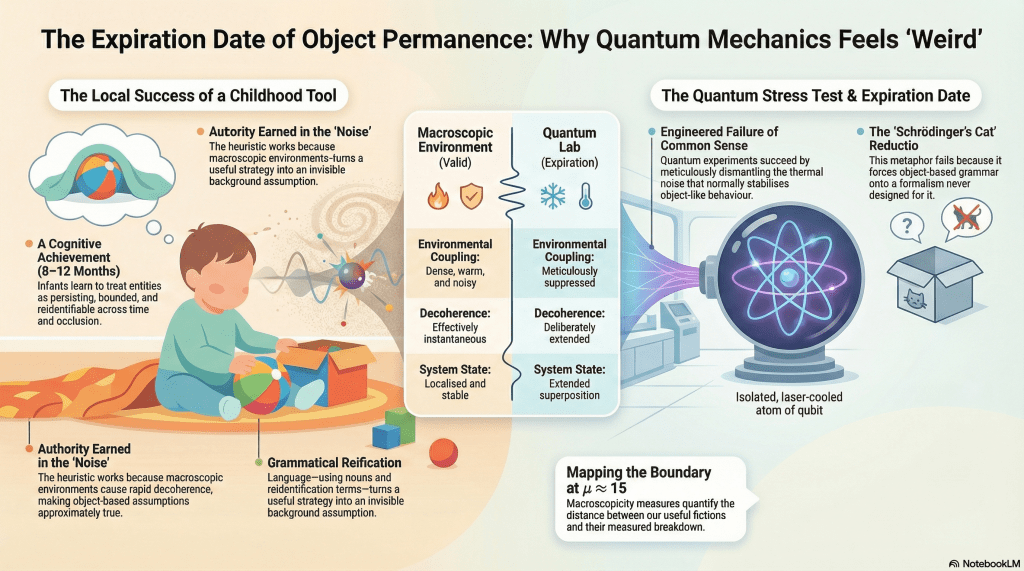
Audio: NotebookLM summary podcast of this topic.Image: NotebookLM infographic for this topic.
What I do find convincing is a simpler diagnosis: that we are applying a cognitive tool far beyond the conditions under which it earned its authority – and then mistaking the resulting discomfort for metaphysical insight.
Object permanence is one of our earliest and most successful heuristics. It allows infants to track toys behind sofas, caregivers behind doors, and threats behind occlusion. Without it, coordinated action would be impossible. With it, the world becomes navigable, predictable, and stable. It is a genuine cognitive achievement. But it is not a universal guarantee about reality.
In a new essay, The Expiration Date of Object Permanence: Heuristics, Grammar, and Quantum Pseudoproblems, I argue that much of what we call ‘quantum weirdness’ arises from the uncritical extension of this heuristic into domains where its ecological licensing no longer holds. The problem is not that quantum mechanics violates common sense. The problem is that we quietly treat common sense as metaphysics.
Quantum mechanics functions here not as a mystery generator, but as a stress test. Recent matter-wave interference experiments with increasingly massive systems show that object-based expectations fail quantifiably under carefully engineered conditions. When environmental coupling is suppressed, when decoherence is delayed, when the world is no longer warm, noisy, and forgiving, the assumptions underwriting object permanence simply stop paying rent.
Nothing spooky happens. A heuristic expires.
The essay also takes a dim view of some familiar cultural furniture. Schrödinger’s cat, for example, was introduced as a reductio – an intentionally absurd demonstration of what happens when microscopic formalism is naively scaled up. That it now circulates as an explanatory image tells us less about quantum mechanics than about the tenacity of object-grammar. Even jokes cannot escape it.
Interpretations fare no better. I suggest that the appeal of frameworks like Many-Worlds is not exhausted by their technical merits. They also function as strategies for preserving object-based reidentification – ways of ensuring that there is still something that can be pointed to, counted, and followed through time, even if the price is ontological inflation.
None of this denies the reality of quantum phenomena, nor does it pretend to solve the measurement problem. The essay is deliberately deflationary. Its claim is methodological, not revisionary: that many of the puzzles we inherit are artefacts of treating developmentally acquired heuristics as if they were unconditional features of the world.
Philosophy’s task, on this view, is not to make reality intuitive. It is to recognise when intuition has reached the end of its jurisdiction.
The paper is now available on Zenodo and will be indexed shortly on PhilPapers. As always, comments, objections, and principled misreadings are welcome.
This post and the underlying essay were inspired by a Nature article: Probing quantum mechanics with nanoparticle matter-wave interferometry, published on 21 January 2026. I get annoyed watching people misunderstand quantum mechanics and its effects, so I decided to address some of the issues in an essay. Read this essay as well as mine, which will explain why the paradoxes and ‘spooky behaviour’ of QM are only counter-intuitive if you’ve fallen into this heuristic trap.
A great deal of philosophy begins with the claim that we ought to examine our assumptions. Fewer philosophers seem interested in examining the mechanisms that decide which assumptions are allowed to count as philosophy in the first place.
This is not a polemic about the Analytic–Continental divide. It’s an observation about how that divide quietly maintains itself. The immediate provocation was banal. Almost embarrassingly so.
Are cold, or do we have cold?
In English, the answer feels obvious. I am cold. The grammar barely registers. In French, Italian, or German, the structure flips. One has cold. Or hunger. Or thirst. Or age. Or a name, understood as something one performs rather than something one is. I spoke about this here and here. Indulge this link to the original position being argued.
On the surface, this looks like a curiosity for linguistics students. A translation quirk. A grammatical footnote. But grammar is rarely innocent.
Audio: NotepadLM summary podcast on this topic.
Grammar as Ontological Scaffolding
The verbs to be and to have are not neutral carriers. They quietly encode assumptions about identity, property, possession, and stability.
When I say I am cold, I cast coldness as a property of the self. It becomes something like height or nationality: a state attributable to the person. When I say I have cold, the experience is externalised. The self remains distinct from the condition it undergoes. Neither option is metaphysically clean.
Both structures smuggle in commitments before any philosophy has been done. One risks inflating a transient sensation into an ontological state. The other risks reifying it into a thing one owns, carries, or accumulates. My own suggestion in a recent exchange was a third option: sensing.
Cold is not something one is or has so much as something one feels. A relational encounter. An event between organism and environment. Not an identity predicate, not a possession.
This suggestion was met with a fair pushback: doesn’t saying that cold ‘belongs to the world’ simply introduce a different metaphysical assumption? Yes. It does. And that response neatly demonstrates the problem.
When Grammar Starts Doing Philosophy
The original claim was idiomatic, not ontological. It was a negative gesture, not a positive thesis. The point was not to relocate cold as a mind-independent substance floating about like a rock. It was to resist treating it as an essence of the person. But once you slow down, you see how quickly everyday grammar demands metaphysical loyalty.
Being invites substance. Having invites inventory. Sensing keeps the relation open, but even that makes people nervous. This nervousness is instructive. It reveals how much metaphysical weight we quietly load onto grammatical habits simply because they feel natural. And that feeling of naturalness matters more than we like to admit.
Two Philosophical Temperaments, One Linguistic Groove
At this point, the temptation is to draw a clean line:
On one side: the Anglo-American Analytic tradition, comfortable treating mental states as properties, objects, or items to be catalogued. Locke’s introspective inventory. Hume’s bundle. Logical positivism’s clean surfaces.
On the other: the Continental tradition, suspicious of objectification, insisting on an irreducible subject for whom experience occurs but who is never identical with its contents. Kant, Husserl, Heidegger, Sartre.
The grammar aligns disturbingly well. Languages that habitually say I am cold make it feel natural to treat experience as something inspectable. Languages that insist on having or undergoing experiences keep the subject distinct by default.
This is not linguistic determinism. English speakers can read phenomenology. German speakers can do analytic philosophy. But language behaves less like a prison and more like a grooved path. Some moves feel obvious. Others feel forced, artificial, or obscure.
Philosophies do not arise from grammar alone. But grammar makes certain philosophies feel intuitively right long before arguments are exchanged.
Where Gatekeeping Enters Quietly
This brings us to the part that rarely gets discussed.
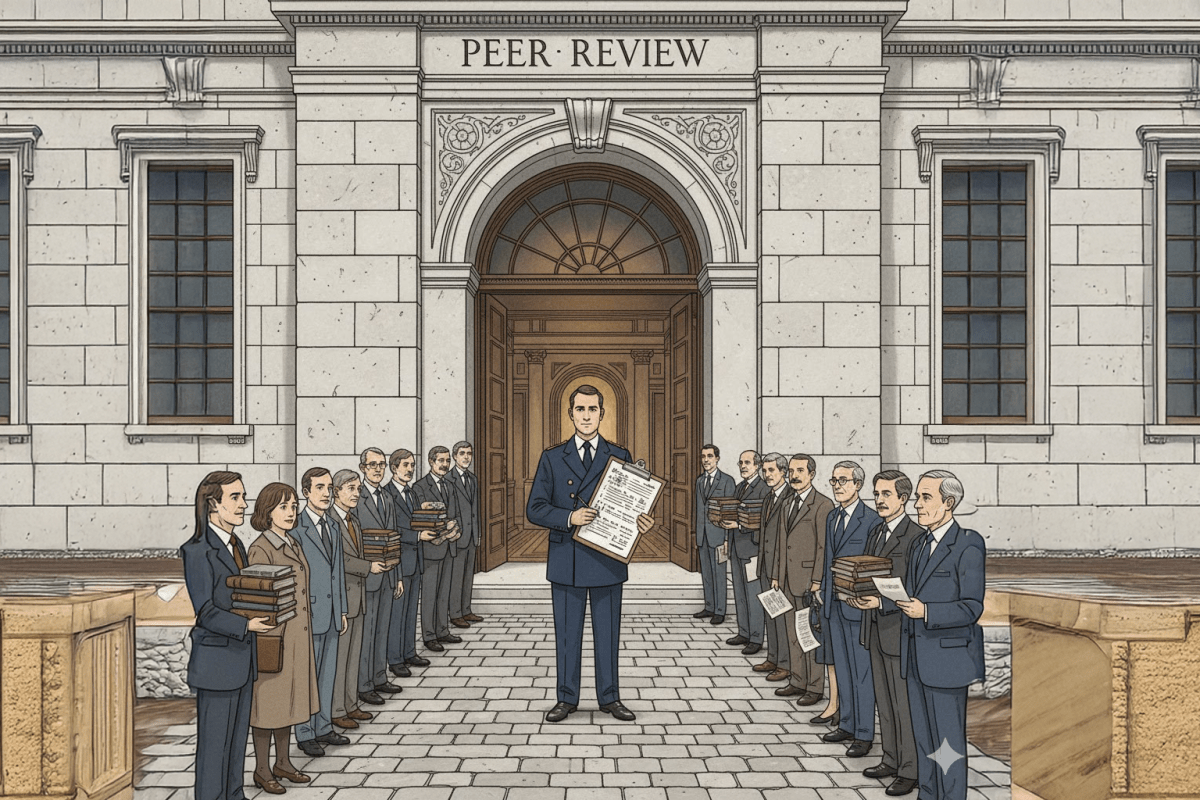
The Analytic–Continental divide persists not only because of philosophical disagreement, but because of institutional reinforcement. Peer review, citation norms, and journal cultures act as boundary-maintenance mechanisms. They are not primarily crucibles for testing ideas. They are customs checkpoints for recognisability.
I have been explicitly cautioned, more than once, to remove certain figures or references depending on the venue. Don’t mention late Wittgenstein here. Don’t cite Foucault there. Unless, of course, you are attacking them. This is not about argumentative weakness. It’s about genre violation.
Hybrid work creates a problem for reviewers because it destabilises the grammar of evaluation. The usual criteria don’t apply cleanly. The paper is difficult to shelve. And unshelvable work is treated as a defect rather than a signal. No bad faith is required. The system is doing what systems do: minimising risk, preserving identity, maintaining exchange rates.
Cold as a Diagnostic Tool
The reason the cold example works is precisely because it is trivial.
No one’s career depends on defending a metaphysics of chilliness. That makes it safe enough to expose how quickly grammar starts making demands once you pay attention.
If something as mundane as cold wobbles under scrutiny, then the scaffolding we rely on for far more abstract notions – self, identity, agency, consciousness – should make us uneasy.
And if this is true for human languages, it becomes far more pressing when we imagine communication across radically different forms of life.
Shared vocabulary does not guarantee shared metaphysics. Familiar verbs can conceal profound divergence. First contact, if it ever occurs, will not fail because we lack words. It will fail because we mistake grammatical comfort for ontological agreement.
A Modest Conclusion
None of this settles which philosophical tradition is ‘right’. That question is far less interesting than it appears. What it does suggest is that philosophy is unusually sensitive to linguistic scaffolding, yet unusually resistant to examining the scaffolding of its own institutions.
We pride ourselves on questioning assumptions while quietly enforcing the conditions under which questions are allowed to count. Cold just happens to be a good place to start noticing.
A Footnote on Linguistic Determinism
It’s worth being explicit about what this is not. This is not an endorsement of strong linguistic determinism, nor a revival of Sapir–Whorf in its more ambitious forms. English speakers are not condemned to analytic philosophy, nor are Romance-language speakers predestined for phenomenology.
Language does not imprison thought. It inclines it.
Grammar operates less like a set of handcuffs and more like a well-worn path. Some moves feel effortless. Others require deliberate resistance. Philosophical traditions co-evolve with these habits, reinforcing what already feels natural while treating alternatives as strained, obscure, or unnecessary.
I shared this post not too long ago. Today, I shared it in a different context, but I feel is interesting – because I feel that many things are interesting, especially around language and communication.
Ocrampal shared a link to an article debating whether we are cold or have cold. Different cultures express this differently. It’s short. Read it on his site.
Audio: Exceptional NotebookLM summary podcast of this topic.
I replied to the post:
Nicely observed. I’ve pondered this myself. Small linguistic tweak: between être and avoir, avoir already behaves better metaphysically, but sentir seems the cleanest fit. Cold isn’t something one is or has so much as something one senses — a relational encounter rather than an ontological state or possession.
Between having and being, having is the lesser sin — but sensing/feeling feels truer. Cold belongs to the world; we merely sense it.
He replied in turn:
Agree except for: “Cold belongs to the world”. That is a metaphysical assumption that has consequences …
Finally (perhaps, penultimately), I responded:
Yes, it does. That statement was idiomatic, to express that ‘cold’ is environmental; we can’t be it or possess it. Coincidentally, I recently wrote about ‘cold’ in a different context:
A more verbose version of this response might have been:
This pushback is fair, but I’m not trying to re-ontologise cold. “Belongs to the world” in that context is doing rhetorical, not metaphysical, work; it’s idiomatic.
The point isn’t that cold is a mind-independent substance waiting around like a rock. It’s that whatever cold is, it doesn’t sit comfortably as an identity predicate (‘I am…cold’ – ‘J’ai…froid‘) or a possession (‘I have…cold’ – so, not ‘Je suis…froid‘) – neither to be confused with ‘I have a cold’, a different animal altogether.
‘Sensing’ (‘I feel…cold’ – ‘Je me sens…froid‘ – we have to use the reflexive pronoun, me, here; in English, this syntax has been deprecated) keeps the relation explicit without smuggling in ownership or essence. It leaves cold as an encounter-property, not a thing I contain and not a thing I am.
If anything, that phrasing was meant to resist metaphysical inflation, not commit to it.
And this is exactly the problem I gestured at in the aliens piece. We mistake familiar grammatical scaffolding for shared metaphysics. We assume that if the sentence parses cleanly, the ontology must be sound.
Language doesn’t just describe experience. It quietly files it into categories and then acts surprised when those categories start making demands.
Cold, like aliens, exposes the trick. The moment you slow down, the grammar starts to wobble. And that wobble is doing far more philosophical work than most of our declarative sentences are willing to admit.
Accusations of writing being AI are becoming more common – an irony so rich it could fund Silicon Valley for another decade. We’ve built machines to detect machines imitating us, and then we congratulate ourselves when they accuse us of being them. It’s biblical in its stupidity.
A year ago, I read an earnest little piece on ‘how to spot AI writing’. The tells? Proper grammar. Logical flow. Parallel structure. Essentially, competence. Imagine that – clarity and coherence as evidence of inhumanity. We’ve spent centuries telling students to write clearly, and now, having finally produced something that does, we call it suspicious.
Audio: NotebookLM podcast on this topic and the next one.
My own prose was recently tried and convicted by Reddit’s self-appointed literati. The charge? Too well-written, apparently. Reddit – where typos go to breed. I pop back there occasionally, against my better judgment, to find the same tribunal of keyboard Calvinists patrolling the comment fields, shouting ‘AI!’ at anything that doesn’t sound like it was composed mid-seizure. The irony, of course, is that most of them wouldn’t recognise good writing unless it came with upvotes attached.
Image: A newspaper entry that may have been generated by an AI with the surname Kahn. 🧐🤣
Now, I’ll admit: my sentences do have a certain mechanical precision. Too many em dashes, too much syntactic symmetry. But that’s not ‘AI’. That’s simply craft. Machines learned from us. They imitate our best habits because we can’t be bothered to keep them ourselves. And yet, here we are, chasing ghosts of our own creation, declaring our children inhuman.
Apparently, there are more diagnostic signs. Incorporating an Alt-26 arrow to represent progress is a telltale infraction → like this. No human, they say, would choose to illustrate A → B that way. Instead, one is faulted for remembering – or at least understanding – that Alt-key combinations exist to reveal a fuller array of options: …, ™, and so on. I’ve used these symbols long before AI Wave 4 hit shore.
Interestingly, I prefer spaced en dashes over em dashes in most cases. The em dash is an Americanism I don’t prefer to adopt, but it does reveal the American bias in the training data. I can consciously adopt a European spin; AI, lacking intent, finds this harder to remember.
I used to use em dashes freely, but now I almost avoid them—if only to sidestep the mass hysteria. Perhaps I’ll start using AI to randomly misspell words and wreck my own grammar. Or maybe I’ll ask it to output everything in AAVE, or some unholy creole of Contemporary English and Chaucer, and call it a stylistic choice. (For the record, the em dashes in this paragraph were injected by the wee-AI gods and left as a badge of shame.)
Meanwhile, I spend half my time wrestling with smaller, dumber AIs – the grammar-checkers and predictive text gremlins who think they know tone but have never felt one. They twitch at ellipses, squirm at irony, and whimper at rhetorical emphasis. They are the hall monitors of prose, the petty bureaucrats of language.
And the final absurdity? These same half-witted algorithms are the ones deputised to decide whether my writing is too good to be human.
Everyone knows the line: cogito ergo sum. Descartes’ great party trick. A man alone in his study, fretting about demons, announces that because he’s doubting, he must exist. Ta-da! Curtain call. Except, of course, it’s less of a revelation than a conjuring trick: he pulls an I out of a hat that was never proved to be there in the first place. Thinking is happening, indeed – but who invited the “thinker”?
Video: David Guignion talks about Descartes’ Cogito.
And let’s not forget the dramatis personae Descartes smuggles in for atmosphere. A malicious demon, a benevolent God, both necessary props to justify his paranoia and his certainty. Philosophy as melodrama: cue organ music, lightning strike.
Audio: NotebookLM podcast on this topic.
Enter the Critics
Spinoza rolls his eyes. Doubt isn’t some heroic starting point, he says – it’s just ignorance, a lack of adequate ideas. To elevate doubt into method is like treating vertigo as a navigational tool. Error isn’t demonic trickery; it’s our own confusion.
Kant arrives next, shaking his head. Descartes thinks he’s proven a substantial “I,” but all he’s actually shown is the form of subjectivity – the empty requirement that experiences hang together. The “I think” is a necessary placeholder, not a discovery. A grammatical “you are here” arrow, not a metaphysical treasure chest.
Hegel, of course, can’t resist upping the disdain. Descartes’ I is an empty abstraction, a hollow balloon floating above reality. The self isn’t given in some solitary moment of doubt; it emerges through process – social, historical, dialectical. The cogito is the philosophical equivalent of a selfie: lots of certainty, zero depth.
The Insufficiency Twist
And yet, maybe all of them are still dancing to the same fiddler. Because here’s the real suspicion: what if the whole problem is a trick of language? English, with its bossy Indo-European grammar, refuses to let verbs stand alone. “Thinking” must have a “thinker,” “seeing” a “seer.” Grammar insists on a subject; ontology obediently provides one.
Other languages don’t always play this game. Sanskrit or Pali can shrug and say simply, “it is seen.” Japanese leaves subjects implied, floating like ghosts. Some Indigenous languages describe perception as relational events – “seeing-with-the-tree occurs” – no heroic subject required. So perhaps the real villain here isn’t Descartes or even metaphysics, but syntax itself, conscripting us into a subject-shaped theatre.
Now, I don’t want to come off like a one-trick pony, forever waving the flag of “language insufficiency” like some tired philosopher’s catchphrase. But we should be suspicious when our limited grammar keeps painting us into corners, insisting on perceivers where maybe there are only perceptions, conjuring selves because our verbs can’t tolerate dangling.
Curtain Call
So in the end, Descartes’ famous “I” might be no more than a grammatical fiction, a casting error in the great play of philosophy. The cogito isn’t the foundation of modern thought; it’s the world’s most influential typo.
This wall of words was posted in a Facebook that the AI thought I would be interested in. I’m not, save for the rhetorical and grammatical structure. I am not interested in the veracity of the claim or the sentiment it is meant to provoke.
The author purportedly had a conversation with a former student, who identified as being a member of another race—black, I suppose; African-American in the current vogue; negro and coloured in bygone days.
Notice the head-fake. A conversation with an individual person quickly morphs into a generalisation. This individual, in the mind of the author—or at least the conveyance—was now the representative mouthpiece for this so-called race. But that’s not what I question.
They and them are now considered to be acceptible singular forms if a person identifies as such. I’m not sure I am equiped to comment on identification to a grammatical element, so I’ll side-step that and focus on the outcome.
Perusing this or something similar, there is a sense of undeserved weight—an inclusion from the perspective of a single person. Some people actively promote themselves as spokespeople for a group, whether race or something else. But this person did not necessarily claim to speak for anyone beyond him or herself—perhaps some small, immediate group of collegues who shared this perspective.
I am wondering how this will play out as a device to intentionally deceive the reader.
Another thing…
I was in Philadelphia yesterday, and a black associate of mine was commenting on what he deemed to be 150 neo-Nazi skinheads parading in the rain, a point eliciting more pleasure than perhaps it deserved. His assessment is that race was not a problem, that he held no illwill toward any race. His contention was with ‘motherfucking racists’. Unfortunately, there is no scientific racist litmus. There are only actions and perceptions. This is where Popper’s paradox of tolerance pops into mind. And so it goes…





 Philosophics