Looking through some of the drafts clogging the blog, I decided to whittle away at the queue. I started this months ago. It’s here now, not particularly in sync with the season or recent topics, but I like Sapolsky.
‘Biology is destiny’, say the Christian Right, the bland bureaucrats of morality, the loud whisperers at Sunday school. They want gender to be a tomb carved in marble: you’re assigned at birth, and you stay a perfect statue. But Sapolsky waltzes in and says, ‘Hold up – what do you mean by biology? Which biology? Which markers count?’
Video: Neuro-biology of Transsexuality, Prof. Robert Sapolsky
In the clip above, Sapolsky unpacks neurological evidence that upends the essentialist cheat codes. He doesn’t pretend we now have the final answer to gender. He does something scarier to fundamentalists: he shows just how messy biology is.
The Bed Nucleus, the Finger Ratio, and the ‘Wrong Body’ Hypothesis
Sapolsky discusses three pieces of neurobiological evidence:
Digit ratio (2nd vs 4th finger length): In lesbians, on average, the ratio is closer to what you see in straight men than straight women. That’s a correlation, an eyebrow-raiser, hardly a decree.
Acoustic reflexes (auto-acoustic reflex): Another early finding in women’s sexual orientation, though faint and underexplored.
The bed nucleus of the stria terminalis (BSTc): Here we reach heavy artillery. There is a neuron population in this region that, on average, is about twice as large in males as in females. In postmortem analyses of trans women (male → female), this region’s size corresponds to their identified gender, not their natal sex. Crucially, that alignment is seen even in trans individuals who never underwent full hormone therapy or surgical changes.
Sapolsky recounts astute controls: men treated (for, say, testicular cancer) with feminising hormones don’t show the same shift.
Also, using the phantom-limb analogy: men who lose their penis to cancer often report phantom sensations; trans women rarely do. That suggests the body map in the brain never fully “registered” that organ in the same way.
He doesn’t overclaim. He doesn’t say, ‘Case closed, biology proves everything’. He says: These data complicate your neat categories. They force you to ask: which biological measure do you privilege? Hypertrophied neurons? Chromosomes? Receptor density? Hormones? All of them simultaneously? None of them?
Essentialism as a Trap
Fundamentalists and anti-trans ideologues deploy essentialism because it’s convenient. They demand an ironclad ‘essence’ so they can exclude anyone who fails their test. But what Sapolsky shows is that essence is simply a scaffold; we get to pick which biological scaffolds we accept. They may choose genes and genitals; the neurobiologist gives them neuron counts and brain-maps. When your ideology elevates one scaffold and ignores the others, it betrays its own contingency.
Moreover, the evidence suggests that identity, experience, insistence (in Sapolsky’s language: ‘insisting from day one’), and internal brain structure might converge. The ‘wrong body’ isn’t a metaphor. It’s a mismatch between internal brain architecture and external form. The stubborn fragments of biology that fundamentalists accept are torn by the dissonance that science increasingly reveals.
What This Means for Trans Rights, Discourse & Strategy
Science is never ‘conclusive’. Sapolsky offers compelling support, not gospel. Anyone claiming this settles everything has never looked at a scatter plot.
Lived experience still matters. Even if we never had brain slices, self-reports, psychology, psychiatry, anthropology, narratives remain valid. Brain studies supplement, not supplant, testimony.
Essentialist opponents have boxed themselves in. When they demand biology decides everything, they hand the baton to neuroscientists – and neuroscientists keep running with it. The entire ‘biology’ equals only what I like’ regime is exposed.
Ambiguity is a strength, not a liability. If we insist identity is linear and tidy, we re-enact their demand for purity. Recognising complexity, mess, and variance is radical resistance.
…and this one. A clarification that is also a demonstration. If anything, the Americanisms should give it away.
The Preamble as Method
A previous post—the one with Foucault, Arendt, Sontag, Fish, Mill, and Girard all lined up like theoretical ammunition—was drafted entirely by ChatGPT after a conversation about the Dershowitz piece before it. I fed it my argument about moral contamination and asked it to expand the thesis with additional thinkers. It obliged. I posted it unedited.
I mention this not as confession but as method. If my core claim is that truth equals rhetoric—that there is no unmediated access to reality, only constructed positions negotiated through language, power, and interpretation—then having an AI mediate my argument while I mediate its output is not a bug. It’s a feature.
The question is never “who really wrote this” but “what work does this text do, and under what conditions?”
This is a non-foundationalist position. There is no neutral ground from which to assess claims. There is no Logic floating above rhetoric, no Reason untouched by affect, no Truth prior to its articulation. What we have are competing rhetorical constructions, each shaped by interests, histories, and power arrangements, each claiming—to varying degrees of honesty—to represent something beyond themselves.
The game is not to transcend this condition. The game is to stop pretending we ever could.
What I’m Actually Arguing
Let me be direct about what those two posts were defending, since the theoretical apparatus apparently obscured more than it clarified.
I am not arguing that:
Age of consent laws should be abolished
The French intellectuals were right to sign those petitions
Association with Epstein is irrelevant
Analysis automatically immunizes anyone from moral judgment
I am arguing that:
Liberal discourse routinely launders emotional and political commitments as self-evident logic, then treats anyone who exposes this process as morally suspect.
Legal thresholds are negotiated rhetorical compromises, not mathematical truths. They reflect harm minimization, cultural anxiety, enforcement pragmatics, and historical contingency. To analyze their construction is not to advocate their abolition.
The “moral contamination reflex” treats inquiry as confession—not because the inquiry threatens truth, but because it threatens the claim that certain positions are simply Logic Itself rather than one rhetorical construction among others.
Guilt by association is both a logical fallacy and sometimes a reasonable heuristic. The trick is admitting which one you’re doing at any given moment, rather than claiming your heuristic is deductive proof.
These claims are rhetorical positions. They are not transcendent truths. But neither are the positions they critique.
The Hypocrisy I’m Diagnosing
When someone argues that a 16-year-old capable of choosing abortion should be capable of choosing sex, they are making a rhetorical move. The argument has gaps—abortion concerns bodily autonomy in ways that sex with others does not; capacity for one decision doesn’t automatically transfer to capacity for another; power dynamics matter.
Fine. Point those out. Explain why the analogy fails.
But what actually happens is different. The argument is not refuted. The arguer is diagnosed. Making the argument becomes evidence of desire. Analyzing it becomes evidence of endorsement. Logic is treated as circumstantial proof of guilt.
This is not because the argument is uniquely dangerous. It’s because it threatens a stabilizing fiction: that our current legal thresholds are both pragmatically necessary and philosophically coherent. They are the former. They are not the latter. And the moral panic that greets anyone who points this out is not about protecting children. It’s about protecting the claim that our compromises are something more than compromises.
The same pattern plays out with Epstein associations. Some people knew him socially or professionally in contexts that had nothing to do with his crimes. Some people continued relationships after credible allegations emerged. Some people were directly complicit. These are different categories.
But the discourse collapses them. Everyone in the address book becomes suspect. Association becomes evidence. And anyone who suggests “we should distinguish between these cases” is immediately accused of defending predators.
This is not logic. This is moral theatre. And the fury it provokes when exposed is not righteous. It’s defensive.
The Difference Between Rhetoric and Relativism
Saying “truth equals rhetoric” sounds like relativism. It sounds like I’m claiming all positions are equal, nothing matters, anything goes.
I’m not.
I’m claiming that all positions are constructed through rhetoric, but that doesn’t make them equal. It means we should argue about them on the terms they actually operate—consequences, values, power, effects—rather than pretending one side has Logic and the other side has Emotion.
Some rhetorical constructions are more defensible than others. Age of consent laws, as constructed compromises aimed at harm reduction, are defensible. That doesn’t mean they’re philosophically coherent or that analyzing their incoherence is an attack on children.
Maintaining professional relationships with powerful people who were later revealed to be criminals does not make you guilty of their crimes. But it might raise questions about judgment, complicity, or willful blindness—questions that should be asked specifically, not universally.
The difference is this: I’m not claiming my position is Logic. I’m claiming it’s a rhetorical construction I find more defensible than the alternatives, for reasons I’m willing to argue about.
What I’m criticizing is the move where liberal discourse presents its rhetorical positions as self-evident moral truths, then treats dissent as pathology.
Why the Theoretical Version Failed
The expanded post tried to universalize the pattern—to show that this reflex appears across domains, across thinkers, across history. It succeeded at that. What it failed to do was stay grounded enough for readers to assess whether the pattern I was describing was real or whether I was constructing a persecution narrative.
The problem was strategic evasiveness. By staying abstract, the piece avoided being testable. It gestured at examples without committing to them. It borrowed authority from Foucault and Arendt without doing the work of showing how their critiques apply to the specific cases I had in mind.
This created a gap between what the essay claimed to be doing (defending analysis against moral panic) and what it was actually doing (defending specific controversial figures using theory as cover).
That gap is what critics correctly identified as bad faith.
What I Should Have Said
Here’s the honest version:
The Dershowitz argument is bad. The abortion-sex analogy doesn’t hold. But “the argument is bad” and “making the argument is evidence of pedophilia” are not the same claim. One is logical critique. The other is moral contamination. We should be able to distinguish them.
The 1977 French petitions were misjudged. Calling for the abolition of age of consent laws in that context, with those specific cases, was not wise. But signing a petition is not the same as committing the acts in question, and treating mid-century French intellectual culture as self-evidently monstrous erases the specific debates they were having about law, psychiatry, and state power. We can think they were wrong without treating the question itself as unspeakable.
Epstein’s network matters. Some associations are meaningful. Power enabled his abuse, and understanding how requires looking at who knew what and when. But not every name in a flight log or party photo is evidence of complicity, and the current discourse often treats them as such. We should distinguish between innocent contact, poor judgment, and active enablement—not flatten everything into “guilt by proximity.”
These are all messy positions. They require distinctions, context, and willingness to live in discomfort. That’s harder than moral certainty. But it’s also more honest.
The Meta-Point About AI Generation
The fact that the previous post was AI-generated does something interesting to all of this.
It was rhetorically effective. It marshaled the right theoretical authorities. It structured the argument coherently. It sounded like philosophy. And it was assembled by a pattern-matching system with no beliefs, no commitments, no stakes.
This should tell us something about the nature of rhetoric itself. The text worked—or didn’t—based on what it did, not where it came from. Authenticity is not truth. Authorship is not authority. What matters is whether the construction holds, and under what conditions.
I could have hidden the AI involvement. Many would. The disclosure feels like it undermines the argument’s authority—if a machine wrote it, does it count?
But that reaction itself proves the point. We want arguments to come from authenticated sources, from proper authority, from legitimate speakers. We want to know who’s talking so we can decide whether to trust them. This is not Logic. This is rhetoric all the way down.
The AI wrote a version of my argument that was cleaner and more theoretically sophisticated than I would have produced alone. It was also more evasive, more abstract, less committed. Those aren’t bugs in the process. They’re features of how the system generates text—maximizing coherence, minimizing controversy, staying in safe abstraction.
That I chose to post it anyway, knowing these limitations, is itself a rhetorical move. It says: “I’m willing to use mediated tools to construct my position, and I’m not pretending otherwise.”
What This Leaves Us With
I started with a claim about moral contamination—that liberal discourse treats certain kinds of inquiry as self-incriminating. I then demonstrated this by making precisely the kind of inquiry that provokes that reflex, using examples I knew would be read as defensive rather than analytical.
The responses proved the thesis. Analysis was read as confession. Theory was read as cover. Even asking whether a distinction exists between argument and endorsement was taken as evidence that no such distinction can be maintained.
But here’s what I didn’t make clear enough: I’m not claiming to be above this dynamic. I’m in it too. I have commitments, interests, and positions I’m defending. The difference is I’m naming them as such, rather than claiming they’re simply What Logic Demands.
Truth equals rhetoric. We’re all doing motivated reasoning. The question is not “who has transcended their motivations” but “whose motivations, toward what ends, with what consequences?”
I think the moral contamination reflex produces bad discourse—not because it’s emotional, but because it claims not to be. I think guilt by association is overused—not because association never matters, but because we’ve stopped distinguishing between different kinds of association. I think legal thresholds should be analyzable—not because they should be abolished, but because unexamined laws are dangerous even when well-intentioned.
These are rhetorical positions. I’m arguing for them. I’m not pretending they’re Logic Itself.
If you disagree, argue back. But argue with what I’m actually saying, not with what analysis supposedly reveals about my secret desires.
That’s all I’m asking for. And apparently, it’s too much.
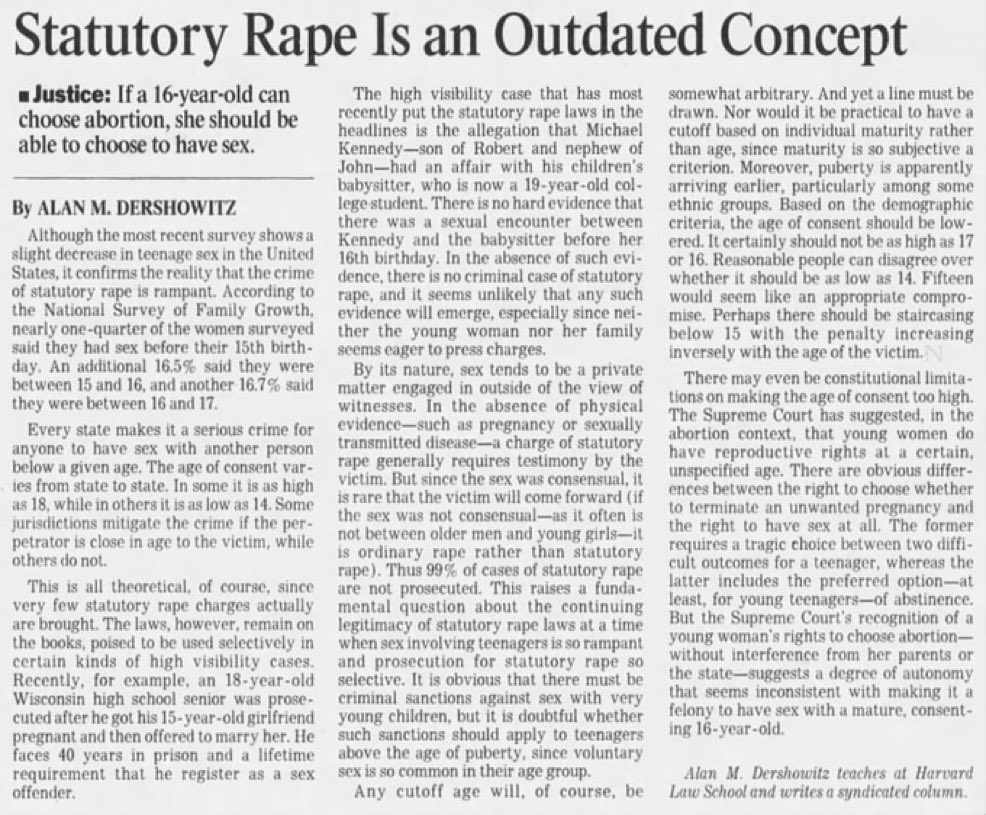
if a 16-year-old can choose abortion, then she should be able to choose to have sex
In the newspaper clipping above, legal scholar Alan Dershowitz argues that if a 16-year-old can choose abortion, then she should be able to choose to have sex. The argument is presented as sober, rational, and juridical. A syllogism offered as disinfectant.
There are many philosophical problems with the equivalence. I am not interested in most of them.
Audio: NotebookLM summary podcast on this topic.
I’ve written before that age as a proxy for maturity collapses immediately into a Sorites paradox. It assumes commensurability where none exists. It treats human development as discretised and legible, when it is anything but. The law must draw lines. Philosophy does not have that luxury. But that is not why this argument resurfaces now.
What interests me is the moral contamination reflex it reliably provokes. The rule is tacit but rigid: if you reason calmly about a taboo subject, you must be defending it. If you defend it, you must desire it. If you desire it, you must be guilty of it. Logic becomes circumstantial evidence.
This reflex is not new. Nor is it confined to contemporary Anglo-American culture. Half a century ago, it played out publicly in France, with consequences that are now being retrospectively moralised into caricature.
In January and May of 1977, a petition published in Le Monde floated the abrogation of what was then called the “sexual majority”. In January of the same year, a separate petition called for the release of three men accused of having sex with boys and girls between the ages of twelve and fifteen. Among the signatories were Jean-Paul Sartre, Simone de Beauvoir, Roland Barthes, Michel Foucault, and Gilles Deleuze.
Today, this episode is typically invoked as a moral mic drop. No argument is examined. No context is interrogated. No distinction is drawn between legal reasoning, political provocation, and moral endorsement. The conclusion is immediate and terminal: these figures were monsters, or fools, or both.
The logic is familiar by now. If they signed, they must have approved. If they approved, they must have desired. If they desired, they must have practised. Analysis collapses into accusation.
None of this requires defending the petitions, the arguments, or the acts in question. It requires only defending a principle that has apparently become intolerable: that an argument can be examined without imputing motive, desire, or personal conduct to the person making it.
This is where liberal societies reveal a particular hypocrisy. They claim to value reasoned debate, yet routinely launder moral intuitions through rationalist language, then react with fury when someone exposes the laundering process. Legal thresholds are treated as if they were moral truths rather than negotiated compromises shaped by fear, harm minimisation, optics, and historical contingency.
Once the compromise hardens into law, the line becomes sacred. To question it is not civic scrutiny but moral trespass. To analyse it is to signal deviance. This is why figures like Foucault are not criticised for being wrong, but for having asked the question at all. The question itself becomes the crime.
It is often said, defensively, that emotion precedes logic. True enough. But this is usually offered as an excuse rather than a diagnosis. The supposed human distinction is not that we feel first, but that we can reflect on what we feel, examine it, and sometimes resist it. The historical record suggests we do this far less than we like to believe.
The real taboo here is not sex, or age, or consent. It is the suggestion that moral reasoning might survive contact with uncomfortable cases. That one might analyse the coherence of a law without endorsing the behaviour it regulates. That one might describe a moral panic without siding with its villains.
Instead, we have adopted a simpler rule: certain questions may not be asked without self-implication. This preserves moral theatre. It also guarantees that our laws remain philosophically incoherent while everyone congratulates themselves for having the correct instincts.
Logic, in this arrangement, is not a virtue. It is a liability. And history suggests that anyone who insists on using it will eventually be posthumously condemned for doing so.
On Self-Evidence, Personhood, and the Administrative Nature of Rights
The following sentence is among the most quoted in political history and among the least examined. It is invoked as moral bedrock, taught as civic catechism, and insulated from scrutiny by a reverence that mistakes repetition for comprehension. It is rarely read closely, and rarely read sceptically.
Audio: NotebookLM summary podcast of this topic.
What follows is not a rebuttal. It is an annotation.
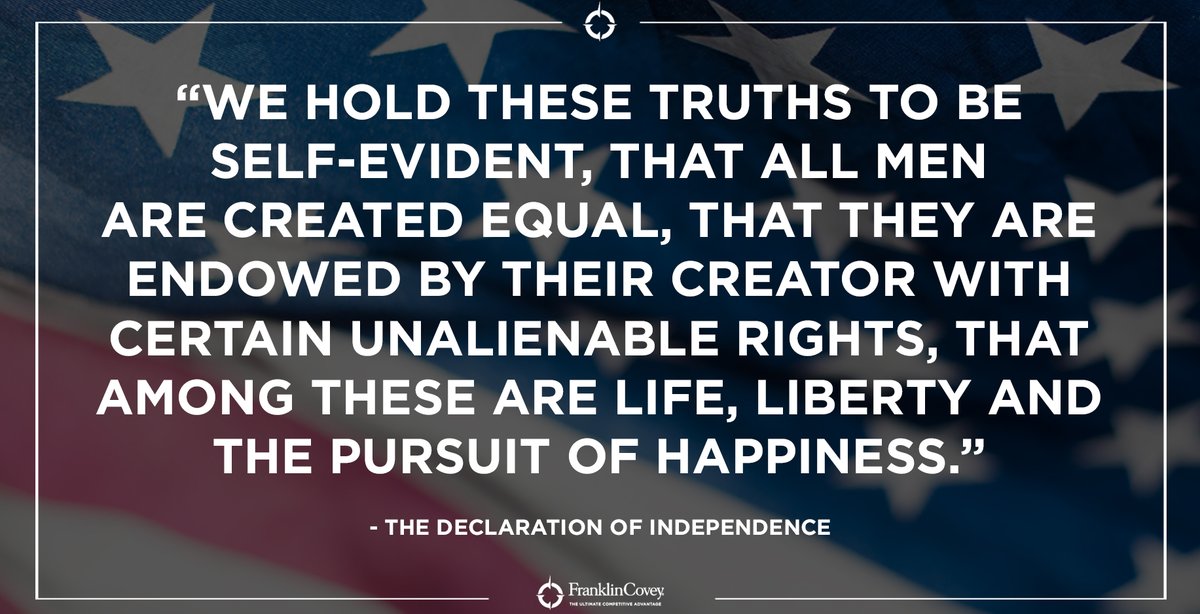
We hold these truths to be self-evident, that all men are created equal, that they are endowed by their Creator with certain unalienable Rights, that among these are Life, Liberty and the pursuit of Happiness.
Most readers will recognise this as the opening of the Declaration of Independence by the United States of America. Recognition, however, is not comprehension. The sentence survives on familiarity. Once that familiarity is set aside, it begins to fail clause by clause.
I. A Best Case, Briefly
A more charitable reading deserves brief consideration. ‘Self-evident’, in the intellectual context of the eighteenth century, did not mean obvious in the sense of requiring no reflection. It referred instead to propositions taken as axiomatic: not inferred from prior premises, but serving as starting points for reasoning. On this view, influenced by Scottish Common Sense philosophy, the claim is not that these truths are psychologically irresistible, but that they are rationally basic.
Likewise, ‘we hold’ need not be read as an admission of arbitrariness. It may be understood as a public avowal: a political body formally affirming what reason is said to disclose, rather than grounding those truths in the act of holding itself. Read this way, the sentence does not collapse into mere opinion.
Finally, the Declaration is often understood as performative rather than descriptive.[1] It does not merely state political facts; it brings a political subject into being. The ‘we’ is constituted in the act of declaration, and the language functions as a founding gesture rather than a philosophical proof.
Even on this charitable reading, however, the appeal to rational self-evidence presupposes capacities that were unevenly distributed at best. The Enlightenment notion of ‘reason’ was never a raw human faculty equally available to all. It depended on literacy, education, leisure, and institutional participation—conditions enjoyed by a narrow segment of the population.
In the late eighteenth century, large portions of the population were functionally illiterate. The ability to engage abstract political principles, to treat propositions as axiomatic starting points for reasoning, was not merely rare but socially restricted. The universal address of the sentence thus rests on a practical contradiction: it invokes a form of rational accessibility that its own social conditions actively prevented.
Nor is this merely a historical observation. Whilst formal literacy has expanded, the distribution of the capacities required for sustained abstract reasoning remains sharply constrained. What has changed is scale, not structure. Appeals to ‘self-evident’ political truths still presuppose forms of cognitive access that cannot be assumed, even now.
There is an important distinction here between innocent misreading and bad-faith translation. A modern reader who takes ‘self-evident’ to mean what it now ordinarily means is not at fault; semantic drift makes this nearly unavoidable. But to continue reading the sentence this way once its historical and philosophical context is understood is no longer an error. It is a decision.
Under the principle of least effort, claims that present themselves as ‘self-evident’ are maximally efficient. They require no sustained attention, no conceptual labour, and no challenge to inherited categories. For individuals ill-equipped – by education, time, or institutional support – to interrogate abstract political claims, such language is not merely persuasive; it is relieving.
To accept a proposition as self-evident is to be spared the burden of understanding how it works. The sentence can be consumed whole, in a single uncritical gulp. What is swallowed is not an argument, but a posture: assent without inquiry, agreement without comprehension.
This is not a personal failing. It is the predictable outcome of a cognitive environment in which complexity is costly, and authority is familiar. ‘Self-evidence’ functions here as a labour-saving device, converting political commitments into ready-made certainties. The capacity to recognise self-evident truths thus functions as an unmarked prerequisite for political subjecthood – a gatekeeping mechanism that precedes and enables the more explicit exclusions to come.
With this in mind, the sentence can be examined clause by clause – not as philosophical proposition, but as rhetorical machinery.
II. An Annotated Deconstruction
‘We hold’
To whom does this ‘we’ apply? Who is included in this collective voice, and who is not? More importantly, what does it mean to hold something that is allegedly self-evident?
Holding is an act of maintenance. It implies agreement, reinforcement, repetition. Beliefs must be held; axioms must be held; norms must be held. Self-evidence, by contrast, is supposed to require none of this. If a truth is genuinely self-evident, it does not need to be held at all. It simply imposes itself.
The opening clause announces immediacy whilst confessing mediation. This is not a subtle tension. It is an outright contradiction. The sentence begins by undermining its own epistemic posture. The axiomatic framing does not eliminate contestability; it displaces it. What is presented as rational starting point functions, in practice, as rhetorical closure.
‘Truths’
What kind of truths are being held here?
The word does far too much work whilst remaining resolutely undefined. These are not empirical truths. They are not logical truths. They are not even clearly moral truths in the narrow sense. Instead, the term oscillates between epistemic certainty, moral assertion, and political aspiration, sliding between categories without ever settling long enough to be examined.
The pluralisation matters. By multiplying ‘truths’ whilst leaving their nature unspecified, the sentence creates an aura of obviousness without committing to a standard of justification. Disagreement is pre-empted not by argument, but by tone.
‘Self-evident’
Unless one invokes something like Descartes’ cogito as a limiting case, nothing is genuinely self-evident. Even the cogito depends on language, conceptual inheritance, and a shared grammar of doubt. Self-evidence is not an epistemic given; it is an experiential effect produced by familiarity, stability, and low resistance.
Here, ‘self-evident’ functions as rhetorical closure masquerading as epistemology. It does not establish certainty; it enforces silence. To question what is ‘self-evident’ is to risk being cast as obtuse, perverse, or acting in bad faith. Inquiry is not answered. It is short-circuited.
‘All men’
This is not the inclusive ‘men’ of abstract mankind. It is a concrete, historically bounded category: adult males, and not coincidentally white ones. The exclusions are not implied later. They are operative here, at the point of entry.
This is the quietly active boundary of the entire sentence. Before any rights are named, before any equality is asserted, the scope of applicability has already been narrowed. The universal tone is achieved by selective admission.
‘Created equal’
Created by whom? And equal in what respect?
The notion of equality here is never specified, because specification would immediately expose contestation. Equal in capacity? In worth? In standing before the law? In outcome? In moral consideration? Readers are invited to supply their preferred interpretation retroactively, which is precisely what allows the sentence to endure.
Some have suggested that ‘equal’ means ‘equal under the law’, but this simply defers the problem. The law defines equality however it pleases, when it pleases, and for whom it pleases. Equality without a metric is not a claim. It is a metaphysical gesture.
It is often said that the Declaration’s universal language contained the seeds of its own expansion. That Douglass, King, and the suffragists appealed to it is taken as evidence of its latent emancipatory power. But this confuses rhetoric with causation. These advances were not the unfolding of a promise, but the result of sustained political pressure, moral confrontation, and material struggle. The language was repurposed because it was available and authoritative, not because it was prophetic.
To call this a ‘promissory note’ is to mistake a battlefield for a contract. Promises are kept by their authors. These were extracted by those excluded, often in direct opposition to the very institutions that sanctified the sentence.
The story also flatters the present. If the promise is always being fulfilled, it is never being broken. Yet the same language remains actively contested, narrowed, and rescinded. Personhood is still conditional. Rights still evaporate at borders, prisons, and classifications. The note, if it exists at all, is perpetually past due.
‘Endowed by their Creator’
No one believes the drafters were referring to genetics or parentage. This capital-C Creator is a theological move, not a biological one. The sentence quietly abandons the pretence of self-evidence and imports divine authority as a grounding mechanism.
This is not incidental. By placing rights beyond human origin, the sentence renders them simultaneously unquestionable and unreachable. Legitimacy is outsourced to a source that cannot be interrogated. Appeals are closed by design.
‘Unalienable Rights’
Here the sentence delivers a double assertion. First, that rights exist independently of institutions. Second, that they cannot be taken away. Both claims fail on contact with history.
Rights are constructed, recognised, enforced, suspended, and withdrawn by institutions. Bentham saw this clearly: ‘natural rights’ function rhetorically to obscure the institutional conditions that alone make rights actionable.[2] And far from being inalienable, rights prove remarkably fragile. The record is unambiguous: rights track status, not humanity. The moment personhood is questioned, rights do not need to be violated. They simply cease to apply.
‘Life, Liberty, and the pursuit of Happiness’
Under the Language Insufficiency Hypothesis – the framework treating key political terms as structurally underdetermined – these are textbook Contestables.[3] None are measurable. None have stable definitions. None come with clear thresholds or enforcement criteria.
‘Happiness’ is the most revealing substitution of all. Locke’s blunt ‘property’ at least named what was being protected.[4] ‘Happiness’ softens the promise whilst emptying it of content. It gestures toward flourishing whilst committing to nothing beyond tolerable participation.
Life, liberty, and happiness are curated abstractions, not guarantees – property in softer clothing.
III. Personhood as the Hidden Mechanism
Zooming out, the operational logic becomes clear. Rights depend on personhood.[5] Personhood is conferred, not discovered. Declaring non-personhood resolves the contradiction without ever touching the rhetoric.
This is the mechanism that allows a universal language to coexist with selective application. When personhood is withdrawn, rights are not violated. They are bypassed. Ethics never gets a hearing, because the subject has already been administratively erased.
To call this administrative is not metaphor. Personhood is assigned, reclassified, and revoked through documentation, categorisation, and procedural determination. The question of who counts is settled before any ethical consideration can begin.
IV. The Sentence as Prototype, Not Mistake
It is tempting to read this sentence as naïve, hypocritical, or aspirationally flawed. That would be a mistake. The sentence is not a failure of Enlightenment thinking. It is its prototype.
It was never meant to survive scrutiny. It was meant to mobilise, stabilise, and legitimise. Its vagueness is functional. Its incoherence is load-bearing. The sentence works precisely because it is conceptually promiscuous, rhetorically elevated, and operationally evasive. What looks like philosophical sloppiness is political engineering.
V. Why It Still Matters
This sentence is not an historical curiosity. It is the template for modern political language.
Universal in tone.
Conditional in application.
Moral in rhetoric.
Administrative in practice.
The future did not reveal the sentence to be false. It revealed what the sentence was for.
Footnotes
[1] J.L. Austin, How to Do Things with Words
[2] Jeremy Bentham, Anarchical Fallacies; Being an Examination of the Declarations of Rights Issued During the French Revolution
[3] See The Language Insufficiency Hypothesis for a full treatment of Contestables and their function in political discourse.
[4] John Locke, Two Treatises of Government
[5] Hannah Arendt, The Origins of Totalitarianism
Written by Bry Willis
Philosophics
NB: I wrote this as a polemic rather than in a manner suitable for a journal submission. I did not wish to expend the effort to understand counterarguments. This interpretation stands on its own. This said, in Section I. I still note some historical perspective that is somewhat important. It even illustrates semantic drift, which I cover in A Language Insufficiency Hypothesis.
This is awkward. I’d been preparing some posts on the age of consent, and I decided to write a formal essay on ageism. Since the age of consent is a moral hot-button topic for some, I decided to frame the situation in a political framework instead. The setup isn’t much different, but it keeps people’s heads out of the gutter and removes the trigger that many people seem to pull. It’s awkward because none of these posts has yet been posted. Spoiler alert, I guess. I could delay this announcement, but I won’t. Here it is.
Democracy is often defended in lofty terms. We are told that citizens are rational agents, capable of judgment, autonomy, and reasoned participation in collective decision-making. Voting, on this story, is not just a procedure. It is the expression of agency by competent participants. That all sounds reassuring.
Audio: NotebookLM summary podcast of this essay and concept.
What’s curious is that no democratic system actually checks whether any of this is true.
There are no assessments of political understanding. No evaluation of judgment. No test of civic competence. You become a fully empowered political agent overnight, not because you demonstrate anything, but because the calendar flips. Turn eighteen. You’re in. This isn’t a minor oversight. It’s the central puzzle my recent preprint explores.
The Proxy Nobody Questions
Modern democracies assign political standing using proxies: simple categorical markers that stand in for more complex qualities. Age is the most obvious. It is treated as a substitute for maturity, judgment, autonomy, and responsibility. But here’s the key point: age doesn’t approximate competence. It replaces it.
If age were a rough indicator, we might expect flexibility at the margins. Exceptions. Supplementary criteria. Some attempt to track the thing it supposedly represents. Instead, we get a hard boundary. Below it, total exclusion. Above it, permanent inclusion. Capacity doesn’t matter on either side. The proxy isn’t helping institutions identify competence. It is doing something else entirely.
Competence Talk Without Competence
Despite this, democratic theory remains saturated with competence language. We are told that participation is grounded in rational agency. That citizens possess the capacities needed for self-government. That legitimacy flows from meaningful participation by autonomous agents. None of this is operationalised.
Competence is never specified, measured, or verified. It functions purely as justificatory rhetoric. A moral vocabulary that explains why inclusion is legitimate, without ever guiding how inclusion actually happens. This isn’t confusion; it’s design.
Why the Gap Doesn’t Collapse
At this point, a reasonable person might expect trouble. After all, if the justification doesn’t match the mechanism, shouldn’t the system wobble? It doesn’t. And the reason matters.
Political participation generates very weak feedback. Outcomes are mediated through institutions. Causal responsibility is diffuse. Success criteria are contested. When things go badly, it’s rarely clear why, or what a better alternative would have been.
Under these conditions, dissatisfaction becomes affective rather than analytic. People sense that things aren’t working, but lack the tools to diagnose how or where the system failed. Crucially, they also lack any way to recalibrate the link between competence and political standing, because that link was never operational in the first place. The system doesn’t aim for optimisation. It aims for stability.
Boundary Drawing Without Saying So
This structure becomes clearest when we look at boundary cases. Why eighteen rather than sixteen? Or twelve? Or twenty-one? There is no competence-based answer. Developmental research consistently shows wide overlap between adolescents and adults, and massive variation within age groups. If competence were taken seriously, age thresholds would be indefensible.
Historically, when competence was operationalised such as through literacy tests, the result was transparent hierarchy and eventual delegitimation. Modern democracies avoid that by keeping competence abstract and proxies neutral-looking. The boundary remains. The justification changes.
What This Does and Does Not Argue
This analysis does not propose reforms. It does not advocate competence testing. It does not suggest lowering or raising the voting age. It does not claim voters are stupid, irrational, or defective. It describes a structural feature of democratic legitimacy:
Democracy works by saying one thing and doing another, and that gap is not accidental. Competence language stabilises legitimacy precisely because it is never put to work. You may think that’s fine. You may think it’s unavoidable. You may think it’s a problem. The paper doesn’t tell you which to choose. It simply insists that if we’re going to talk seriously about democratic legitimacy, we should notice what role competence actually plays. And what it doesn’t.
I’m no fan of holidays. I neither enjoy nor celebrate Christmas. I’m acutely aware of its commercial excesses and its religious inheritance, two institutions I find, at best, tiresome and, at worst, actively corrosive. Whether that’s abhorrence or simple loathing is a distinction I’ll leave to braver souls.
Still, calendars exist whether one consents to them or not, and this piece happens to land today. If Christmas is your thing, by all means, have at it. Sincerely. Rituals matter to people, even when their metaphysics don’t survive inspection.
What follows is not a defence of the season, nor a seasonal moral. It’s a small human moment that happens to involve Santa, which is to say a costume, a script, and a public performance. What interests me is not the symbolism, but what happens when the performance yields just enough to allow someone else to be seen on their own terms. If nothing else, that feels like a tolerable use of the day.
Audio: NotebookLM summary podcast on this topic.
What Legibility?
When I use the term legibility, it’s usually as a pejorative. It’s my shorthand for reductionism. For the way human beings are flattened into checkboxes, metrics, market segments, or moral exemplars so they can be processed efficiently by institutions that mistake simplification for understanding.
But legibility isn’t always a vice.
Video: Santa signs with a 3-year-old dear girl
Most of us, I suspect, want to be legible. Just not in the ways we are usually offered. We want to be seen on our own terms, not translated into something more convenient for the viewer. That distinction matters.
In the video above, a deaf child meets Santa. Nothing grand happens. No lesson is announced. No slogan appears in the corner of the screen. Santa simply signs.
The effect is immediate. The child’s posture changes. Her attention sharpens. There’s a visible shift from polite endurance to recognition. She realises, in real time, that she does not need to be adapted for this encounter. The encounter has adapted to her. This is legibility done properly.
Not the synthetic legibility of television advertising, where difference is curated, sanitised, and arranged into a reassuring grid of representation. Not the kind that says, we see you, while carefully controlling what is allowed to be seen. That version of legibility is extraction. It takes difference and renders it harmless. Here, the legibility runs the other way.
Santa, already a performative role if ever there was one, doesn’t stop being performative. The costume remains. The ritual remains. But the performance bends. It accommodates. It listens. The artifice doesn’t collapse; it becomes porous.
I’m wary of words like authenticity. They’ve been overused to the point of meaninglessness. But I do think we recognise performatism when we see it. Not in the technical sense of speech acts, but in the everyday sense of personas that ring hollow, gestures that exist for the camera rather than the people involved. This doesn’t feel like that.
Of course, the child could already connect. Deaf people connect constantly. They persevere. They translate. They accommodate a world that rarely meets them halfway. Nothing here ‘grants’ her humanity. What changes is the tightness of the connexion.
The shared language acts as a verbal proxy, a narrowing of distance. You can see the moment it clicks. He speaks her language. Or rather, he speaks a language that already belongs to her, even if calling it ‘hers’ is technically imprecise. Mother tongue is a slippery phrase. Irony does some of the work here.
The point is not inclusion as spectacle. It’s recognition without reduction.
Legibility, in this case, doesn’t make her smaller. It makes the interaction larger. And that, inconveniently for our systems and slogans, is what most people have been asking for all along.
Fairness, Commensurability, and the Quiet Violence of Comparison
Fairness and Commensurability as Preconditions of Retributive Justice
This is the final part of a 3-part series. Read parts 1 and 2 for a fuller context.
Audio: NotebookLM summary podcast of this topic.
Before the Cards Are Dealt
Two people invoke fairness. They mean opposite things. Both are sincere. Neither can prove the other wrong. This is not a failure of argument. It is fairness working exactly as designed.
Before justice can weigh anything, it must first decide that the things being weighed belong on the same scale. That single move – the assertion that comparison is even possible – quietly does most of the work.
Most people think justice begins at sentencing, or evidence, or procedure. But the real work happens earlier, in a space so normalised it has become invisible. Before any evaluation occurs, the system must install the infrastructure that makes evaluation legible at all.
That infrastructure rests on two foundations:
fairness, which supplies the rhetoric, and
commensurability, which supplies the mathematics.
Together, they form the felt beneath the table – the surface on which the cards can be dealt at all.
1. Why Fairness Is Always Claimed, Never Found
Let’s be precise about what fairness is not.
Fairness is not a metric. You cannot measure it, derive it, or point to it in the world.
Fairness is not a principle with determinate content. It generates no specific obligations, no falsifiable predictions, no uniquely correct outcomes.
Fairness is an effect. It appears after assessment, not before it. It is what you call an outcome when you want it to feel inevitable.
Competing Fairness Is Not a Problem
Consider how disputes actually unfold:
The prosecutor says a long sentence is fair because it is proportional to harm.
The defender says a shorter sentence is fair because it reflects culpability and circumstance.
The victim says any sentence is unfair because nothing restores what was taken.
The community says enforcement itself is unfair because it predictably targets certain groups.
Each claim is sincere. None can be resolved by fairness itself.
That is because fairness has no independent content. It does not decide between these positions. It names them once the system has already decided which will prevail. This is not a bug. It is the feature.
A Fluid Masquerading as an Invariant
In the language of the Language Insufficiency Hypothesis, fairness is a Fluid – a concept whose boundaries shift with context and use – that masquerades as an Invariant, something stable and observer-independent.
The system treats fairness as perceptual, obvious, discoverable. But every attempt to anchor it collapses into:
Intuition (‘It just feels right’)
Precedent (‘This is how we do things’)
Consensus (‘Most people agree’)
None of these establishes fairness. They merely perform it.
And that performance matters. It converts contested metaphysical commitments into the appearance of shared values. It allows institutions to claim neutrality whilst enforcing specificity. Fairness is what the system says when it wants its outputs to feel unavoidable.
2. The Real Gatekeeper: Commensurability
Fairness does rhetorical work. But it cannot function without something deeper.
That something is commensurability: the assumption that different harms, injuries, and values can be placed on a shared scale and meaningfully compared.
Proportionality presupposes commensurability. Commensurability presupposes an ontology of value. And that ontology is neither neutral nor shared.
When Incommensurability Refuses to Cooperate
A parent loses a child to preventable negligence. A corporation cuts safety corners. A warning is ignored. The system moves. Liability is established. Damages are calculated. £250,000 is awarded.
The parent refuses the settlement. Not because the amount is insufficient. But because money and loss are not the same kind of thing. The judge grows impatient. Lawyers speak of closure. Observers mutter about grief clouding judgment. But this is not grief. It is incommensurability refusing to cooperate.
The parent is rejecting the comparison itself. Accepting payment would validate the idea that a child’s life belongs on a scale with currency. The violence is not the number. It is the conversion. The system cannot process this refusal except as emotional excess or procedural obstruction. Not because it is cruel, but because without commensurability the engine cannot calculate.
Two Ontologies of Value
There are two incompatible ontologies at work here. Only one is playable.
Ontology A: The Scalar Model
Harm is quantifiable
Suffering is comparable
Trade-offs are morally coherent
Justice is a balancing operation
Under Ontology A, harms differ in degree, not kind. A broken arm, a stolen car, and a dead child all occupy points on the same continuum. This makes proportionality possible.
Ontology B: The Qualitative Model
Harms are categorical
Some losses are incommensurable
Comparison itself distorts
Justice is interpretive, not calculative
Under Ontology B, harms are different kinds of things. Comparison flattens what matters. To weigh them is to misunderstand them.
Why Only One Ontology Can Play
Retributive justice, as presently constituted, cannot function under Ontology B.
Without scalar values, proportionality collapses. Without comparison, equivalence disappears. Without trade-offs, punishment has no exchange rate.
Ontology B is not defeated. It is disqualified. Structurally, procedurally, rhetorically. The house needs a shared scale. Without it, the game cannot settle accounts.
3. Why Incommensurability Is Treated as Bad Faith
Here is where power enters without announcing itself. Incommensurability does not merely complicate disputes. It stalls the engine. And stalled engines threaten institutional legitimacy.
Systems designed to produce closure must ensure that disputes remain within solvable bounds. Incommensurability violates those bounds. It suggests that resolution may be impossible – or that the attempt to resolve does further harm. So the system reframes the problem.
Not as an alternative ontology, but as:
Unreasonableness
Extremism
Emotional volatility
Refusal to engage in good faith
Reasonableness as Border Control
This is why reasonableness belongs where it does in the model. Not as an evaluative principle, but as a gatekeeping mechanism.
Reasonableness does not assess claims. It determines which claims count as claims at all. This is how commensurability enforces itself without admitting it is doing so. When someone refuses comparison, they are not told their ontology is incompatible with retributive justice. They are told to be realistic.
Ontological disagreement is converted into:
A tone problem
A personality defect
A failure to cooperate
The disagreement is not answered. It is pathologised.
4. Why These Debates Never Resolve
This returns us to the Ontology–Encounter–Evaluation model.
People argue fairness as if adjusting weights would fix the scale. They debate severity, leniency, proportionality.
But when two sides inhabit incompatible ontologies of value, no amount of evidence or dialogue bridges the gap. The real disagreement is upstream.
A prosecutor operating under scalar harm and an advocate operating under incommensurable injury are not disagreeing about facts. They are disagreeing about what kind of thing harm is.
Fairness cannot resolve this, because fairness presupposes the very comparison under dispute. This is why reform debates feel sincere and go nowhere. Outcomes are argued whilst ontological commitments remain invisible.
Remediation Requires Switching Teams
As argued elsewhere, remediation increasingly requires switching teams.
But these are not political teams. They are ontological commitments.
Ontologies are not held like opinions. They are held like grammar. You do not argue someone out of them. At best, you expose their costs. At worst, you force others to operate within yours by disqualifying alternatives.
Retributive justice does the latter.
5. What This Means (Without Offering a Fix)
Justice systems are not broken. They are optimised. They are optimised for closure, manageability, and the appearance of neutrality. Fairness supplies the rhetoric. Commensurability supplies the mathematics. Together, they convert contestable metaphysical wagers into procedural common sense.
That optimisation has costs:
Disagreements about value become illegible
Alternative ontologies become unplayable
Dissent becomes pathology
Foundations disappear from view
If justice feels fair, it is because the comparisons required to question it were never permitted.
Ontology as Pre-emptive Gatekeeping
None of this requires conspiracy.
Institutions do not consciously enforce ontologies. They do not need to.
They educate them. Normalise them. Proceduralise them. Then treat their rejection as irrationality.
By the time justice is invoked, the following have already been installed as reality:
That persons persist over time in morally relevant ways
That agents meaningfully choose under conditions that count
That harms can be compared and offset
That responsibility can be localised
That disagreement beyond a point is unreasonable
None of these are discovered. All are rehearsed.
A law student learns that ‘the reasonable person’ is a construct. By year three, they use it fluently. It no longer feels constructed.
This is not indoctrination. It is fluency.
And fluency is how ontologies hide.
By the time an alternative appears – episodic selfhood, incommensurable harm, distributed agency – it does not look like metaphysics. It looks like confusion.
Rationality as Border Control
The system does not say: we reject your ontology.
It says: that’s not how the world works.
Or worse: you’re being unreasonable.
Ontological disagreement is reframed as a defect in the person. And defects do not need answers. They need management.
This is why some arguments feel impossible to have. One ontology has been naturalised into common sense. The other has been reclassified as error.
The Final Irony
The more fragile the foundations, the more aggressively they must be defended as self-evident.
Free will is taught as obvious.
Fairness is invoked as perceptual.
Responsibility is treated as observable.
Incommensurability is treated as sabotage.
Not because the system is confident.
Because it cannot afford not to be.
The Point
Justice does not merely rely on asserted ontologies. It expends enormous effort ensuring they never appear asserted at all.
By the time the cards are dealt, the rules have already been mistaken for reality. That is the felt beneath the table. Invisible. Essential. Doing all the work. And if you want to challenge justice meaningfully, you do not start with outcomes. You start by asking:
What comparisons are we being asked to accept as natural? And what happens to those who refuse?
Most people never make that move. Not because it is wrong. But because by the time you notice the game is rigged, you are already fluent in its rules. And fluency feels like truth.
Final Word
Why write these assessments? Why care?
With casinos, like cricket, we understand something fundamental: these are games. We can learn the rules. We can decide whether to play. We can walk away.
Justice is different. Justice is not opt-in. It is imposed. You do not get to negotiate the rules, the scoring system, or the house assumptions about what counts as a move. Once you are inside, even dissent must be expressed in the system’s own grammar. Appeals do not question the game; they replay it under slightly altered conditions.
You may contest the outcome. You may plead for leniency. You may argue fairness. You may not ask why chips are interchangeable with lives, why losses must be comparable, or why refusing comparison itself counts as misconduct.
Imagine being forced into a casino. Forced to play. Forced to stake things you do not believe are wagerable. Then told, when you object, that the problem is not the game, but your attitude toward it.
That is why these assessments matter. Not to declare justice illegitimate. Not to offer a fix. But to make visible the rules that pretend not to be rules at all. Because once you mistake fluency for truth, the house no longer needs to rig the game.
Now that A Language Insufficiency Hypothesis has been put to bed — not euthanised, just sedated — I can turn to the more interesting work: instantiating it. This is where LIH stops being a complaint about words and starts becoming a problem for systems that pretend words are stable enough to carry moral weight.
What follows is not a completed theory, nor a universal schema. It’s a thinking tool. A talking point. A diagram designed to make certain assumptions visible that are usually smuggled in unnoticed, waved through on the strength of confidence and tradition.
The purpose of this diagram is not to redefine justice, rescue it, or replace it with something kinder. It is to show how justice is produced. Specifically, how retributive justice emerges from a layered assessment process that quietly asserts ontologies, filters encounters, applies normative frames, and then closes uncertainty with confidence.
Audio: NotebookLM summary podcast of this topic.
Most people are willing to accept, in the abstract, that justice is “constructed”. That concession is easy. What is less comfortable is seeing how it is constructed — how many presuppositions must already be in place before anything recognisable as justice can appear, and how many of those presuppositions are imposed rather than argued for.
The diagram foregrounds power, not as a conspiracy or an optional contaminant, but as an ambient condition. Power determines which ontologies are admissible, which forms of agency count, which selves persist over time, which harms are legible, and which comparisons are allowed. It decides which metaphysical configurations are treated as reasonable, and which are dismissed as incoherent before the discussion even begins.
Justice, in this framing, is not discovered. It is not unearthed like a moral fossil. It is assembled. And it is assembled late in the process, after ontology has been assumed, evaluation has been performed, and uncertainty has been forcibly closed.
This does not mean justice is fake. It means it is fragile. Far more fragile than its rhetoric suggests. And once you see that fragility — once you see how much is doing quiet, exogenous work — it becomes harder to pretend that disagreements about justice are merely disagreements about facts, evidence, or bad actors. More often, they are disagreements about what kind of world must already be true for justice to function at all.
I walk through the structure and logic of the model below. The diagram is also available as a PDF, because if you’re going to stare at machinery, you might as well be able to zoom in on the gears.
Why Retributive Justice (and not the rest of the zoo)
Before doing anything else, we need to narrow the target.
“Justice” is an infamously polysemous term. Retributive, restorative, distributive, procedural, transformative, poetic, cosmic. Pick your flavour. Philosophy departments have been dining out on this buffet for centuries, and nothing useful has come of letting all of them talk at once.
This is precisely where LIH draws a line.
The Language Insufficiency Hypothesis is not interested in pedestrian polysemy — cases where a word has multiple, well-understood meanings that can be disambiguated with minimal friction. That kind of ambiguity is boring. It’s linguistic weather.
What LIH is interested in are terms that appear singular while smuggling incompatible structures. Words that function as load-bearing beams across systems, while quietly changing shape depending on who is speaking and which assumptions are already in play.
“Justice” is one of those words. But it is not usefully analysable in the abstract.
So we pick a single instantiation: Retributive Justice.
Why?
Because retributive justice is the most ontologically demanding and the most culturally entrenched. It requires:
a persistent self
a coherent agent
genuine choice
intelligible intent
attributable causation
commensurable harm
proportional response
In short, it requires everything to line up.
If justice is going to break anywhere, it will break here.
Retributive justice is therefore not privileged in this model. It is used as a stress test.
The Big Picture: Justice as an Engine, Not a Discovery
The central claim of the model is simple, and predictably unpopular:
Justice is not discovered. It is produced.
Not invented in a vacuum, not hallucinated, not arbitrary — but assembled through a process that takes inputs, applies constraints, and outputs conclusions with an air of inevitability.
The diagram frames retributive justice as an assessment engine.
An engine has:
inputs
internal mechanisms
thresholds
failure modes
and outputs
It does not have access to metaphysical truth. It has access to what it has been designed to process.
The justice engine takes an encounter — typically an action involving alleged harm — and produces two outputs:
Desert (what is deserved),
Responsibility (to whom it is assigned).
Everything else in the diagram exists to make those outputs possible.
The Three Functional Layers
The model is organised into three layers. These are not chronological stages, but logical dependencies. Each layer must already be functioning for the next to make sense.
1. The Constitutive Layer
(What kind of thing a person must already be)
This layer answers questions that are almost never asked explicitly, because asking them destabilises the entire process.
What counts as a person?
What kind of self persists over time?
What qualifies as an agent?
What does it mean to have agency?
What is a choice?
What is intent?
Crucially, these are not empirical discoveries made during assessment. They are asserted ontologies.
The system assumes a particular configuration of selfhood, agency, and intent as a prerequisite for proceeding at all. Alternatives — episodic selves, radically distributed agency, non-volitional action — are not debated. They are excluded.
This is the first “happy path”.
If you do not fit the assumed ontology, you do not get justice. You get sidelined into mitigation, exception, pathology, or incoherence.
2. The Encounter Layer
(What is taken to have happened)
This layer processes the event itself:
an action
resulting harm
causal contribution
temporal framing
contextual conditions
motive (selectively)
This is where the rhetoric of “facts” tends to dominate. But the encounter is never raw. It is already shaped by what the system is capable of seeing.
Causation here is not metaphysical causation. It is legible causation. Harm is not suffering. It is recognisable harm. Context is not total circumstance. It is admissible context.
Commensurability acts as a gatekeeper between encounter and evaluation: harms must be made comparable before they can be judged. Anything that resists comparison quietly drops out of the pipeline.
3. The Evaluative Layer
(How judgment is performed)
Only once ontology is assumed and the encounter has been rendered legible does evaluation begin:
proportionality
accountability
normative ethics
fairness (claimed)
reasonableness
bias (usually acknowledged last, if at all)
This layer presents itself as the moral heart of justice. In practice, it is the final formatting pass.
Fairness is not discovered here. It is declared. Reasonableness does not clarify disputes. It narrows the range of acceptable disagreement. Bias is not eliminated. It is managed.
At the end of this process, uncertainty is closed.
That closure is the moment justice appears.
Why Disagreement Fails Before It Starts
At this point, dissent looks irrational.
The system has:
assumed an ontology
performed an evaluation
stabilised the narrative through rhetoric
and produced outputs with institutional authority
To object now is not to disagree about evidence. It is to challenge the ontology that made assessment possible in the first place.
And that is why so many justice debates feel irresolvable.
They are not disagreements within the system. They are disagreements about which system is being run.
LIH explains why language fails here. The same words — justice, fairness, responsibility, intent — are being used across incompatible ontological commitments. The vocabulary overlaps; the worlds do not.
The engine runs smoothly. It just doesn’t run the same engine for everyone.
Where This Is Going
With the structure in place, we can now do the slower work:
unpacking individual components
tracing where ontological choices are asserted rather than argued
showing how “reasonableness” and “fairness” operate as constraint mechanisms
and explaining why remediation almost always requires a metaphysical switch, not better rhetoric
Justice is not broken. It is doing exactly what it was built to do.
That should worry us more than if it were merely malfunctioning.
This essay is already long, so I’m going to stop here.
Not because the interesting parts are finished, but because this is the point at which the analysis stops being descriptive and starts becoming destabilising.
The diagram you’ve just walked through carries a set of suppressed footnotes. They don’t sit at the margins because they’re trivial; they sit there because they are structurally prior. Each one represents an ontological assertion the system quietly requires in order to function at all.
By my count, the model imposes at least five such ontologies. They are not argued for inside the system. They are assumed. They arrive pre-installed, largely because they are indoctrinated, acculturated, and reinforced long before anyone encounters a courtroom, a jury, or a moral dilemma.
Once those ontologies are fixed, the rest of the machinery behaves exactly as designed. Disagreement downstream is permitted; disagreement upstream is not.
In a follow-up essay, I’ll unpack those footnotes one by one: where the forks are, which branch the system selects, and why the alternatives—while often coherent—are rendered unintelligible, irresponsible, or simply “unreasonable” once the engine is in motion.
That’s where justice stops looking inevitable and starts looking parochial.
And that’s also where persuasion quietly gives up.
Written by Bry Willis and ChatGPT 5.2 after a couple of days of back and forth
This is a follow-on to some recent posts.* It would be a mistake to pretend that the grammatical habits discussed here float free of intellectual history. They do not. They align uncannily well with the way two broad philosophical traditions came to frame the self, experience, and knowledge.
On the Anglo-American analytic side, the modern picture of the self emerges early with John Locke. In An Essay Concerning Human Understanding (1690), Locke does not yet offer a full ‘bundle theory’, but he lays the groundwork decisively. Consciousness, for Locke, is what unifies experience over time through memory. The self is not a substance but a continuity of awareness, accessible through introspection and reportable as a series of mental contents.¹
Locke’s treatment of personal identity already presupposes a grammar of states. In An Essay Concerning Human Understanding, he insists that personal identity “consists” in consciousness alone, extending backward through memory to past thoughts and actions (II.xxvii.9).
Image: An Essay Concerning Human Understanding, Essay, II.xxvii.17
The self is not something that unfolds; it is something that can be retrospectively tracked. Experiences appear as items one is conscious of, and identity becomes a matter of continuity between those items. It is no accident that Locke later calls ‘person’ a forensic term, fit for attribution, responsibility, and judgement (II.xxvii.28). The grammar is already administrative.
Image: An Essay Concerning Human Understanding, Essay, II.xxvii.28
The grammatical resonance is hard to miss. Experiences are treated as inspectable states: I am aware of X; I have the idea of Y. Consciousness becomes something one can, in principle, take inventory of.
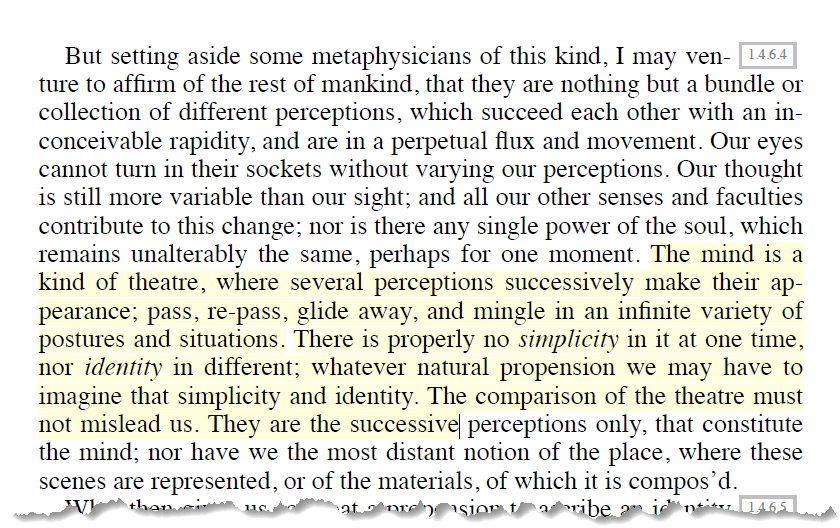
David Hume completes the move with characteristic bluntness. In A Treatise of Human Nature (1739–40), he famously reports that when he looks inward, he never catches himself without a perception. The self, he concludes, is nothing over and above a bundle of impressions and ideas, linked by habit and association.²
Where Locke still spoke of consciousness as what makes the self, Hume takes the next step and goes looking for that self directly. What he finds instead are only perceptions: heat, cold, pleasure, pain. The self does not endure; it is inferred. Identity becomes a habit of grammar and memory, not a feature of experience itself.
This is not merely a metaphysical claim. It is a grammatical one. Experience appears as a sequence of discrete items, each presentable as something one is or has at a given moment. Duration is reduced to succession; undergoing becomes adjacency. The copula does the quiet work.
From here, it is a short step to the analytic comfort with:
truth-conditional analysis,
propositional attitudes,
mental states as objects of third-person description,
and, eventually, the scientific naturalisation of consciousness.
None of this is accidental. The grammar and the metaphysics grow together.
The Continental Recoil
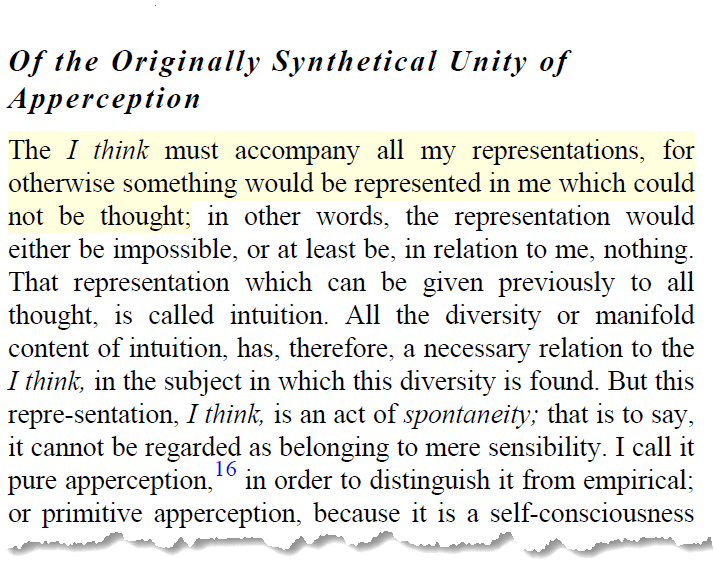
Across the Channel, a different unease takes hold. Immanuel Kant already resists the reduction of the subject to a bundle. In the Critique of Pure Reason (1781/1787), the ‘I think’ is not an object among objects but a necessary condition for experience at all.³ The subject cannot be encountered the way sensations can. It is not something one has or is; it is that through which anything appears.
Image: Critique of Pure Reason, Section II
This resistance deepens with Edmund Husserl, whose phenomenology insists that experience must be described as it is lived, not as it is later reconstructed into states. Consciousness is intentional, temporal, and irreducibly first-personal.⁴ Duration is no longer a sequence of snapshots but a flowing structure of retention and protention.
Image: The Phenomenology of Internal Time-Consciousness
Heidegger radicalises this further. In Being and Time (1927), Dasein is not a container for experiences but a mode of being-in-the-world. Experience is not something that happens inside a subject; it is the subject’s way of being disclosed to a world.⁵
By the time we reach Sartre and Merleau-Ponty, any attempt to treat sensation as a property or possession of a self begins to look like a category mistake. Feeling is not a thing one owns. It is a relation, an encounter, a situation.
Notably, these traditions operate in languages where ‘having’ and reflexive constructions dominate descriptions of sensation. This does not determine the philosophy, but it makes certain moves feel natural and others strained.
Two Ontologies, One Quiet Filter
What matters here is not who is right. It is that entire ontological styles become normalised long before argument begins. Grammar does not force conclusions, but it sets default expectations. Some descriptions feel ‘clean’, others ‘muddy’. Some questions feel legitimate, others oddly misframed. This is where institutional gatekeeping enters.
Peer review, citation norms, and journal scope are often described as quality controls. Sometimes they are. But they also function as recognition systems. Work that leans too heavily on phenomenological description may appear ‘imprecise’ to an analytic referee. Work that treats mental states as discrete objects may appear ‘naïve’or “reductive” to a continental one. Hybrid work becomes difficult to place, difficult to referee, and therefore risky. The issue is rarely explicit disagreement. It is a failure of grammatical hospitality.
Where Sensing Falls Through the Cracks
Against this background, it is perhaps unsurprising that sensing never becomes dominant. To speak of feeling is to refuse both ontological closure and inventory. It resists being cleanly formalised or neatly opposed. It fits awkwardly into truth-conditional frameworks and offers little leverage for grand theory. And yet, it is arguably closer to how experience actually unfolds. Which may explain why it remains linguistically available but philosophically marginal: acceptable in life, tolerated in literature, quietly sidelined in theory.
Notes (for those who care)
Locke, J. (1690). An Essay Concerning Human Understanding, Book II, esp. chs. 1, 27.
Hume, D. (1739–40). A Treatise of Human Nature, Book I, Part IV, §6.
Kant, I. (1781/1787). Critique of Pure Reason, Transcendental Deduction.
Husserl, E. (1913). Ideas Pertaining to a Pure Phenomenology.
Heidegger, M. (1927). Being and Time.
NB: This may be a bit disorganised, but I’ve hit my limit.
I’ve been working on A Language Insufficiency Hypothesis since 2018. At least, that’s the polite, CV-friendly version. The truer account is that it’s been quietly fermenting since the late 1970s, back when I was still trapped in primary school and being instructed on how the world supposedly worked.
Social Studies. Civics. Law. The whole civic catechism. I remember being taught about reasonable persons and trial by a jury of one’s peers, and I remember how insistently these were presented as fair solutions. Fairness was not argued for. It was asserted, with the weary confidence of people who think repetition counts as justification.
I didn’t buy it. I still don’t. The difference now is that I have a hypothesis with some explanatory power instead of a vague sense that the adults were bluffing.
Audio: NotebookLM summary podcast of this topic.
I’ve always been an outsider. Eccentric, aloof, l’étranger if we’re feeling theatrical. It never particularly troubled me. Outsiders are often tolerated, provided they remain decorative and non-contagious. Eye rolls were exchanged on both sides. No harm done.
But that outsider position had consequences. It led me, even then, to ask an awkward question: Which peers? Not because I thought I was superior, but because I was plainly apart. How exactly was I meant to be judged by my peers when no one else occupied anything like my perspective?
Later, when I encountered the concept of fundamental attribution bias, it felt less like a revelation and more like confirmation. A peer-based system assumes not just similarity of circumstance, but similarity of interpretation. That assumption was dead on arrival.
Then there were reasonable persons. I was assured they existed. I was assured judges were trained to embody them. I had never met one. Even as a teenager, I found the idea faintly comical. Judges, I was told, were neutral, apolitical, and dispassionate. Writing this now from the United States, one hardly needs to belabour the point. But this wasn’t prescience. It was intuition. The smell test failed decades ago.
Before LIH had a name, I called these things weasel words. I still do, as a kind of shorthand. Terms like fair, reasonable, accountable, appropriate. Squishy concepts that do serious institutional work whilst remaining conveniently undefinable. Whether one wants to label them Contestables or Fluids is less important than recognising the space they occupy.
That space sits between Invariables, things you can point to without dispute, and Ineffables, where language more or less gives up. Communication isn’t binary. It isn’t ‘works’ or ‘doesn’t’. It’s a gradient. A continuous curve from near-certainty to near-failure.
Most communication models quietly assume a shared ontology. If misunderstanding occurs, the remedy is more explanation, more context, more education. What never sat right with me, even as a child, was that this only works when the disagreement is superficial. The breaking point is ontological.
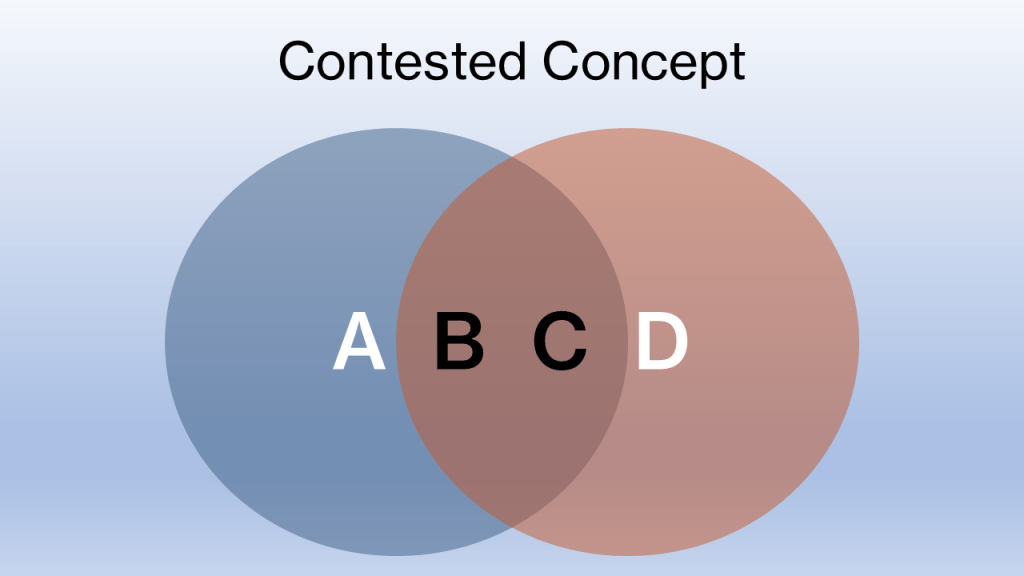
If one person believes a term means {A, B, C} and another believes it means {B, C, D}, the overlap creates a dangerous illusion of agreement. The disagreement hides in the margins. A and D don’t merely differ. They are often irreconcilable.
Image: Venn diagramme of a contested concept. Note: This is illustrative and not to scale
Fairness is a reliable example. One person believes fairness demands punishment, including retributive measures. Another believes fairness permits restoration but rejects retribution, citing circumstance, history, or harm minimisation. Both invoke fairness sincerely. The shared language conceals the conflict.
When such disputes reach court, they are not resolved by semantic reconciliation. They are resolved by authority. Power steps in where meaning cannot. This is just one illustration. There are many.
I thought it worth sharing how LIH came about, if only to dispel the notion that it’s a fashionable response to contemporary politics. It isn’t. It’s the slow crystallisation of a long-standing intuition: that many of our most cherished concepts don’t fail because we misuse them, but because they were never capable of doing the work we assigned to them.












 Philosophics