Unwilling Steelman, Part I

A five-part descent into the illusion of autonomy, where biology writes the script, reason provides the excuse, and the self is merely the echo of its own conditioning. This is a follow-up to a recent post on the implausibility of free will.

Audio: NotebookLM podcast discussing this topic.

Constraint Is Not Freedom

The ergonomic cage of compatibilist comfort

“You are not playing the piano. You are the piano, playing itself — then applauding.”

Compatibilists — those philosophical locksmiths determined to keep the myth of free will intact — love to say that constraint doesn’t contradict freedom. That a system can still be “free” so long as it is coherent, self-reflective, and capable of recursive evaluation.

In this view, freedom doesn’t require being uncaused — it only requires being causally integrated. You don’t need to be sovereign. You just need to be responsive.

“The pianist may not have built the piano — but she still plays it.”

It sounds lovely.

It’s also false.

You Are the Piano

This analogy fails for a simple reason: there is no pianist. No ghost in the gears. No homunculus seated behind the cortex, pulling levers and composing virtue. There is only the piano — complex, self-modulating, exquisitely tuned — but self-playing nonetheless.

The illusion of choice is merely the instrument responding to its state: to its internal wiring, environmental inputs, and the accumulated sediment of prior events. What feels like deliberation is often delay. What feels like freedom is often latency.

Recursive ≠ Free

Ah, but what about reflection? Don’t we revise ourselves over time?

We do. But that revision is itself conditioned. You didn’t choose the capacity to reflect. You didn’t choose your threshold for introspection. If you resist a bias, it’s because you were predisposed — by some cocktail of education, temperament, or trauma — to resist it.

A thermostat that updates its own algorithm is still a thermostat.

It doesn’t become “free” by being self-correcting. It becomes better adapted. Likewise, human introspection is just adaptive determinism wearing a philosophical hat.

Constraint Isn’t Contradiction — It’s Redefinition

Compatibilists smuggle in a quieter, defanged version of freedom: not the ability to do otherwise, but the ability to behave “like yourself.”

But this is freedom in retrospect, not in action.
If all freedom means is “acting in accordance with one’s programming,” then Roombas have free will.

If we stretch the term that far, it breaks — not loudly, but with the sad elasticity of a word losing its shape.

TL;DR: The Pianist Was Always a Myth

  • You didn’t design your mental architecture.
  • You didn’t select your desires or dispositions.
  • You didn’t choose the you that chooses.

So no — you’re not playing the piano.
You are the piano — reverberating, perhaps beautifully, to stimuli you didn’t summon and cannot evade.

📅 Coming Tomorrow

Continuity Is Not Identity

What if you are not who you were — but simply what you’ve become?

Defying Death

I died in March 2023 — or so the rumour mill would have you believe.

Of course, given that I’m still here, hammering away at this keyboard, it must be said that I didn’t technically die. We don’t bring people back. Death, real death, doesn’t work on a “return to sender” basis. Once you’re gone, you’re gone, and the only thing bringing you back is a heavily fictionalised Netflix series.

Audio: NotebookLM podcast of this content.

No, this is a semantic cock-up, yet another stinking exhibit in the crumbling Museum of Language Insufficiency. “I died,” people say, usually while slurping a Pumpkin Spice Latte and live-streaming their trauma to 53 followers. What they mean is that they flirted with death, clumsily, like a drunk uncle at a wedding. No consummation, just a lot of embarrassing groping at the pearly gates.

And since we’re clarifying terms: there was no tunnel of light, no angels, no celestial choir belting out Coldplay covers. No bearded codgers in slippers. No 72 virgins. (Or, more plausibly, 72 incels whining about their lack of Wi-Fi reception.)

There was, in fact, nothing. Nothing but the slow, undignified realisation that the body, that traitorous meat vessel, was shutting down — and the only gates I was approaching belonged to A&E, with its flickering fluorescent lights and a faint smell of overcooked cabbage.

To be fair, it’s called a near-death experience (NDE) for a reason. Language, coward that it is, hedges its bets. “Near-death” means you dipped a toe into the abyss and then screamed for your mummy. You didn’t die. You loitered. You loitered in the existential equivalent of an airport Wetherspoons, clutching your boarding pass and wondering why the flight to Oblivion was delayed.

As the stories go, people waft into the next world and are yanked back with stirring tales of unicorns, long-dead relatives, and furniture catalogues made of clouds. I, an atheist to my scorched and shrivelled soul, expected none of that — and was therefore not disappointed.

What I do recall, before the curtain wobbled, was struggling for breath, thinking, “Pick a side. In or out. But for pity’s sake, no more dithering.”
In a last act of rational agency, I asked an ER nurse — a bored-looking Athena in scrubs — to intubate me. She responded with the rousing medical affirmation, “We may have to,” which roughly translates to, “Stop making a scene, love. We’ve got fifteen others ahead of you.”

After that, nothing. I was out. Like a light. Like a minor character in a Dickens novel whose death is so insignificant it happens between paragraphs.

I woke up the next day: groggy, sliced open, a tube rammed down my throat, and absolutely no closer to solving the cosmic riddle of it all. Not exactly the triumphant return of Odysseus. Not even a second-rate Ulysses.

Here’s the reality:
There is no coming back from death.
You can’t “visit” death, any more than you can spend the afternoon being non-existent and return with a suntan.

Those near-death visions? Oxygen-starved brains farting out fever dreams. Cerebral cortexes short-circuiting like Poundland fairy lights. Hallucinations, not heralds. A final, frantic light show performed for an audience of none.

Epicurus, that cheerful nihilist, said, “When we are, death is not. When death is, we are not.” He forgot to mention that, in between, people would invent entire publishing industries peddling twaddle about journeys beyond the veil — and charging $29.99 for the paperback edition.

No angels. No harps. No antechamber to the divine.
Just the damp whirr of hospital machinery and the faint beep-beep of capitalism, patiently billing you for your own demise.

If there’s a soundtrack to death, it’s not choirs of the blessed. It’s a disgruntled junior surgeon muttering, “Where the hell’s the anaesthetist?” while pawing desperately through a drawer full of out-of-date latex gloves.

And thus, reader, I lived.
But only in the most vulgar, anticlimactic, and utterly mortal sense.

There will be no afterlife memoir. No second chance to settle the score. No sequel.
Just this: breath, blood, occasional barbed words — and then silence.

Deal with it.

Against the Intelligence Industrial Complex

Why IQ is Not Enough – and Never Was

I’m not a fan of IQ as a general metric. Let us be done with the cult of the clever. Let us drag the IQ score from its pedestal, strip it of its statistical robes, and parade it through the streets of history where it belongs—next to phrenology, eugenics, and other well-meaning pseudosciences once weaponised by men in waistcoats.

The so-called Intelligence Industrial Complex—an infernal alliance of psychologists, bureaucrats, and HR departments—has for too long dictated the terms of thought. It has pretended to measure the immeasurable. It has sold us a fiction in numerical drag: that human intelligence can be distilled, packaged, and ranked.

Audio: NotebookLM podcast on this topic.

What it measures, it defines. What it defines, it controls.

IQ is not intelligence. It is cognitive GDP: a snapshot of what your brain can do under fluorescent lights with a timer running. It rewards abstraction, not understanding; speed, not depth; pattern recognition, not wisdom. It’s a test of how well you’ve been conditioned to think like the test-makers.

This is not to say IQ has no value. Of course it does—within its own ecosystem of schools, bureaucracies, and technocracies. But let us not mistake the ruler for the terrain. Let us not map the entire landscape of human potential using a single colonial compass.

True intelligence is not a number. It is a spectrum of situated knowings, a polyphony of minds tuned to different frequencies. The Inuit hunter tracking a seal through silence. The griot remembering centuries of lineage. The autistic coder intuiting an algorithm in dreamtime. The grandmother sensing a lie with her bones. IQ cannot touch these.

To speak of intelligence as if it belonged to a single theory is to mistake a monoculture for a forest. Let us burn the monoculture. Let us plant a thousand new seeds.

A Comparative Vivisection of Intelligence Theories

Theory / ModelCore PremiseStrengthsBlind Spots / CritiquesCultural Framing
IQ (Psychometric g)Intelligence is a single, general cognitive ability measurable via testingPredicts academic & job performance; standardisedSkewed toward Western logic, ignores context, devalues non-abstract intelligencesWestern, industrial, meritocratic
Multiple Intelligences (Gardner)Intelligence is plural: linguistic, spatial, musical, bodily, etc.Recognises diversity; challenges IQ monopolyStill individualistic; categories often vague; Western in formulationLiberal Western pluralism
Triarchic Theory (Sternberg)Intelligence = analytical + creative + practicalIncludes adaptability, real-world successStill performance-focused; weak empirical groundingWestern managerial
Emotional Intelligence (Goleman)Intelligence includes emotion regulation and interpersonal skillUseful in leadership & education contextsCommodified into corporate toolkits; leans self-helpWestern therapeutic
Socio-Cultural (Vygotsky)Intelligence develops through social interaction and cultural mediationRecognises developmental context and cultureLess attention to adult or cross-cultural intelligenceSoviet / constructivist
Distributed Cognition / Extended MindIntelligence is distributed across people, tools, systemsBreaks skull-bound model; real-world cognitionHard to measure; difficult to institutionalisePost-cognitive, systems-based
Indigenous EpistemologiesIntelligence is relational, ecological, spiritual, embodied, ancestralHolistic; grounded in lived experienceMarginalised by academia; often untranslatable into standard metricsGlobal South / decolonial

Conclusion: Beyond the Monoculture of Mind

If we want a more encompassing theory of intelligence, we must stop looking for a single theory. We must accept plurality—not as a nod to diversity, but as an ontological truth.

Intelligence is not a fixed entity to be bottled and graded. It is a living, breathing phenomenon: relational, situated, contextual, historical, ecological, and cultural.

And no test devised in a Princeton psych lab will ever tell you how to walk through a forest without being seen, how to tell when rain is coming by smell alone, or how to speak across generations through story.

It’s time we told the Intelligence Industrial Complex: your number’s up.

Subjective Perception: How Nature Proves We’re Not the Centre of the Universe

perception—My favourite unreliable narrator. We humans love to believe we’ve got nature all figured out. Venomous snakes are brightly coloured to scream “danger.” Butterflies have wings so clever they double as invisibility cloaks. Zebras blend into their herds like barcodes in a supermarket scanner. Simple, right? Evolution explained; case closed.

But then something like this tiger meme smacks you upside the head, reminding you that the animal kingdom didn’t evolve just for our benefit—or our eyes. To a deer or a boar, that glaring orange tiger we associate with breakfast cereal is practically dressed in camouflage green. What we see as flamboyant and conspicuous is, in their dichromatic world, stealth at its finest. It’s not just our story, folks. The world doesn’t revolve around us, no matter how much we try to make it so.

Audio: NotebookLM podcast discussing this topic.

And that’s the punchline here: all those neat evolutionary narratives we’ve packaged up with a bow? They’re “just-so” stories built on our limited sensory toolkit. What if the zebra’s stripes aren’t just for blending into the herd but also for confusing a lion’s depth perception? What if those venomous snakes’ colours aren’t only a warning but also a mating ad in wavelengths we’ll never see? What if we’re just projecting human logic onto a planet with millions of other perspectives—each living in its own bespoke version of reality?

The meme about the tiger is a perfect metaphor for this broader idea. It’s not just about what we see; it’s about what others—be they animals, cultures, or people—experience. The tiger isn’t orange to them. What feels blindingly obvious to one perspective might be invisible to another. It’s a simple truth with profound implications, not just for understanding nature but for navigating the world we humans have made.

Take any argument—politics, culture, morality—and you’ll find the same principle at play. Everyone’s a trichromat in their own little world, convinced they’ve got the full spectrum of truth, when in reality, they’re missing entire wavelengths. Just like the deer who doesn’t see orange, we’re all blind to what we’re not built to perceive.

So next time someone insists their worldview is the only valid one, you might want to remind them that to some creatures, even the loudest tiger is just part of the scenery. Nature didn’t evolve for human eyes alone, and neither did the truth.

The Hard Problem of Consciousness

If you are reading this, you are likely familiar with David Chalmers’ idea of the Hard Problem of Consciousness—the thorny, maddeningly unsolvable question of why and how subjective experience arises from physical processes. If you’re not, welcome to the rabbit hole. Here, we’ll plunge deeper by examining the perspective of Stuart Hameroff, who, like a philosophical magician, reframes this conundrum as a chicken-and-egg problem: what came first, life or consciousness? His answer? Consciousness. But wait—there’s a slight snag. Neither “life” nor “consciousness” has a universally agreed-upon definition. Oh, the joy of philosophical discourse.

Video: Professor Stuart Hameroff and others promote the idea that consciousness pre-dates life. A fuller version is available at IAI.
Audio: Podcast on this topic.

For the uninitiated, Hameroff’s stance is heavily flavoured with panpsychism—the idea that consciousness is a fundamental feature of the universe, like space or time. In this worldview, consciousness predates life itself. From this vantage, Hameroff’s proposition seems inevitable, a tidy solution that fits neatly into a panpsychistic framework. But let me stop you right there because I’m not signing up for the panpsychism fan club, and I’m certainly not prepared to let Hameroff’s intellectual sleight of hand go unchallenged.

To make his case, Hameroff engages in a curious manoeuvre: he defines both life and consciousness in ways that conveniently serve his argument. Consciousness, for him, is not limited to the complex phenomena of human or even animal experience but is a fundamental property of the universe, embedded in the very fabric of reality. Meanwhile, consciousness eventually orchestrates itself into life—a secondary phenomenon. With these definitions, his argument clicks together like a self-serving jigsaw puzzle. It’s clever, I’ll grant him that. But cleverness isn’t the same as being correct.

This is the philosophical equivalent of marking your own homework. By defining the terms of debate to fit his narrative, Hameroff ensures that his conclusion will satisfy his fellow panpsychists. The faithful will nod along, their priors confirmed. But for those outside this echo chamber, his framework raises more questions than it answers. How does this universal consciousness work? Why should we accept its existence as a given? And—here’s the kicker—doesn’t this just punt the problem one step back? If consciousness is fundamental, what’s the mechanism by which it “pre-exists” life?

Hameroff’s move is bold, certainly. But boldness isn’t enough. Philosophy demands rigour, and redefining terms to suit your argument isn’t rigorous; it’s rhetorical trickery. Sure, it’s provocative. But does it advance our understanding of the Hard Problem, or does it merely reframe it in a way that makes Hameroff’s preferred answer seem inevitable? For my money, it’s the latter.

The real issue is that panpsychism itself is a philosophical Rorschach test. It’s a worldview that can mean just about anything, from the claim that electrons have a rudimentary kind of awareness to the idea that the universe is a giant mind. Hameroff’s take lands somewhere in this spectrum, but like most panpsychist arguments, it’s long on metaphysical speculation and short on empirical grounding. If you already believe that consciousness is a fundamental aspect of reality, Hameroff’s arguments will feel like a revelation. If you don’t, they’ll feel like smoke and mirrors.

In the end, Hameroff’s chicken-and-egg problem might be better framed as a false dichotomy. Perhaps life and consciousness co-evolved in ways we can’t yet fully understand. Or perhaps consciousness, as we understand it, emerges from the complexity of life, a byproduct rather than a prerequisite. What’s clear is that Hameroff’s solution isn’t as tidy as it seems, nor as universally compelling. It’s a clever sleight of hand, but let’s not mistake cleverness for truth.

A Case for Intersectionalism

The Space Between

In the great philosophical tug-of-war between materialism and idealism, where reality is argued to be either wholly independent of perception or entirely a construct of the mind, there lies an underexplored middle ground—a conceptual liminal space that we might call “Intersectionalism.” This framework posits that reality is neither purely objective nor subjective but emerges at the intersection of the two. It is the terrain shaped by the interplay between what exists and how it is perceived, mediated by the limits of human cognition and sensory faculties.

Audio: Podcast conversation on this topic.

Intersectionalism offers a compelling alternative to the extremes of materialism and idealism. By acknowledging the constraints of perception and interpretation, it embraces the provisionality of knowledge, the inevitability of blind spots, and the productive potential of uncertainty. This essay explores the foundations of Intersectionalism, its implications for knowledge and understanding, and the ethical and practical insights it provides.

Reality as an Intersection

At its core, Intersectionalism asserts that reality exists in the overlapping space between the objective and the subjective. The objective refers to the world as it exists independently of any observer—the “terrain.” The subjective encompasses perception, cognition, and interpretation—the “map.” Reality, then, is not fully contained within either but is co-constituted by their interaction.

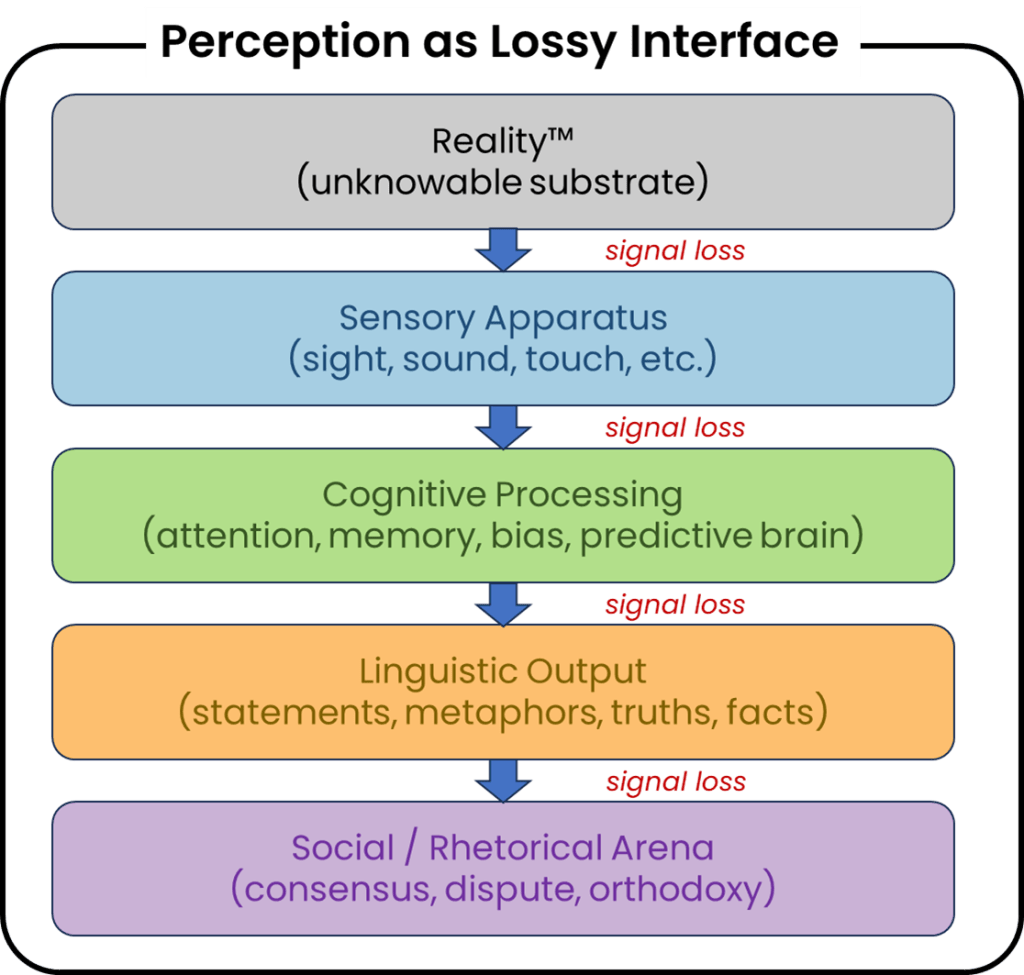
Consider the act of seeing a tree. The tree, as an object, exists independently of the observer. Yet, the experience of the tree is entirely mediated by the observer’s sensory and cognitive faculties. Light reflects off the tree, enters the eye, and is translated into electrical signals processed by the brain. This process creates a perception of the tree, but the perception is not the tree itself.

This gap between perception and object highlights the imperfect alignment of subject and object. No observer perceives reality “as it is” but only as it appears through the interpretive lens of their faculties. Reality, then, is a shared but imperfectly understood phenomenon, subject to distortion and variation across individuals and species.

The Limits of Perception and Cognition

Humans, like all organisms, perceive the world through the constraints of their sensory and cognitive systems. These limitations shape not only what we can perceive but also what we can imagine. For example:

  • Sensory Blind Spots: Humans are limited to the visible spectrum of light (~380–750 nm), unable to see ultraviolet or infrared radiation without technological augmentation. Other animals, such as bees or snakes, perceive these spectra as part of their natural sensory worlds. Similarly, humans lack the electroreception of sharks or the magnetoreception of birds.
  • Dimensional Constraints: Our spatial intuition is bounded by three spatial dimensions plus time, making it nearly impossible to conceptualise higher-dimensional spaces without resorting to crude analogies (e.g., imagining a tesseract as a 3D shadow of a 4D object).
  • Cognitive Frameworks: Our brains interpret sensory input through patterns and predictive models. These frameworks are adaptive but often introduce distortions, such as cognitive biases or anthropocentric assumptions.

This constellation of limitations suggests that what we perceive and conceive as reality is only a fragment of a larger, potentially unknowable whole. Even when we extend our senses with instruments, such as infrared cameras or particle detectors, the data must still be interpreted through the lens of human cognition, introducing new layers of abstraction and potential distortion.

The Role of Negative Space

One of the most intriguing aspects of Intersectionalism is its embrace of “negative space” in knowledge—the gaps and absences that shape what we can perceive and understand. A compelling metaphor for this is the concept of dark matter in physics. Dark matter is inferred not through direct observation but through its gravitational effects on visible matter. It exists as a kind of epistemic placeholder, highlighting the limits of our current sensory and conceptual tools.

Similarly, there may be aspects of reality that elude detection altogether because they do not interact with our sensory or instrumental frameworks. These “unknown unknowns” serve as reminders of the provisional nature of our maps and the hubris of assuming completeness. Just as dark matter challenges our understanding of the cosmos, the gaps in our perception challenge our understanding of reality itself.

Practical and Ethical Implications

Intersectionalism’s recognition of perceptual and cognitive limits has profound implications for science, ethics, and philosophy.

Science and Knowledge

In science, Intersectionalism demands humility. Theories and models, however elegant, are maps rather than terrains. They approximate reality within specific domains but are always subject to revision or replacement. String theory, for instance, with its intricate mathematics and reliance on extra dimensions, risks confusing the elegance of the map for the completeness of the terrain. By embracing the provisionality of knowledge, Intersectionalism encourages openness to new paradigms and methods that might better navigate the negative spaces of understanding.

Ethics and Empathy

Ethically, Intersectionalism fosters a sense of humility and openness toward other perspectives. If reality is always interpreted subjectively, then every perspective—human, animal, or artificial—offers a unique and potentially valuable insight into the intersection of subject and object. Recognising this pluralism can promote empathy and cooperation across cultures, species, and disciplines.

Technology and Augmentation

Technological tools extend our sensory reach, revealing previously unseen aspects of reality. However, they also introduce new abstractions and biases. Intersectionalism advocates for cautious optimism: technology can help illuminate the terrain but will never eliminate the gap between map and terrain. Instead, it shifts the boundaries of our blind spots, often revealing new ones in the process.

Conclusion: Navigating the Space Between

Intersectionalism provides a framework for understanding reality as a shared but imperfect intersection of subject and object. It rejects the extremes of materialism and idealism, offering instead a middle path that embraces the limitations of perception and cognition while remaining open to the possibilities of negative space and unknown dimensions. In doing so, it fosters humility, curiosity, and a commitment to provisionality—qualities essential for navigating the ever-expanding terrain of understanding.

By acknowledging the limits of our maps and the complexity of the terrain, Intersectionalism invites us to approach reality not as a fixed and knowable entity but as an unfolding interplay of perception and existence. It is a philosophy not of certainty but of exploration, always probing the space between.

Exploring Antinatalist Philosophies

A Comparative Analysis of Sarah Perry, Emil Cioran, and Contemporaries

In a world where procreation is often celebrated as a fundamental human aspiration, a group of philosophers challenges this deeply ingrained belief by questioning the ethical implications of bringing new life into existence. Antinatalism, the philosophical stance that posits procreation is morally problematic due to the inherent suffering embedded in life, invites us to reexamine our assumptions about birth, existence, and the value we assign to life itself.

Audio: Podcast related to the content on this page

Central to this discourse are thinkers like Sarah Perry, whose work “Every Cradle is a Grave: Rethinking the Ethics of Birth and Suicide” intertwines the ethics of procreation with the right to die, emphasizing personal autonomy and critiquing societal norms. Alongside Perry, philosophers such as Emil Cioran, David Benatar, Thomas Ligotti, and Peter Wessel Zapffe offer profound insights into the human condition, consciousness, and our existential burdens.

This article delves into the complex and often unsettling arguments presented by these philosophers, comparing and contrasting their perspectives on antinatalism. By exploring their works, we aim to shed light on the profound ethical considerations surrounding birth, suffering, and autonomy over one’s existence.

The Inherent Suffering of Existence

At the heart of antinatalist philosophy lies the recognition of life’s intrinsic suffering. This theme is a common thread among our featured philosophers, each articulating it through their unique lenses.

Sarah Perry argues that suffering is an unavoidable aspect of life, stemming from physical ailments, emotional pains, and existential anxieties. In “Every Cradle is a Grave,” she states:

“Existence is imposed without consent, bringing inevitable suffering.”

Perry emphasises that since every human will experience hardship, bringing a new person into the world exposes them to harm they did not choose.

Similarly, David Benatar, in his seminal work “Better Never to Have Been: The Harm of Coming into Existence,” presents the asymmetry argument. He posits that coming into existence is always a harm:

“Coming into existence is always a serious harm.”

Benatar reasons that while the absence of pain is good even if no one benefits from it, the absence of pleasure is not bad unless there is someone for whom this absence is a deprivation. Therefore, non-existence spares potential beings from suffering without depriving them of pleasures they would not miss.

Emil Cioran, a Romanian philosopher known for his profound pessimism, delves deep into the despair inherent in life. In “The Trouble with Being Born,” he reflects:

“Suffering is the substance of life and the root of personality.”

Cioran’s aphoristic musings suggest that life’s essence is intertwined with pain, and acknowledging this is crucial to understanding our existence.

Thomas Ligotti, blending horror and philosophy in “The Conspiracy Against the Human Race,” portrays consciousness as a cosmic error:

“Consciousness is a mistake of evolution.”

Ligotti argues that human awareness amplifies suffering, making us uniquely burdened by the knowledge of our mortality and the futility of our endeavours.

Peter Wessel Zapffe, in his essay “The Last Messiah,” examines how human consciousness leads to existential angst:

“Man is a biological paradox due to excessive consciousness.”

Zapffe contends that our heightened self-awareness results in an acute recognition of life’s absurdities, causing inevitable psychological suffering.


Ethics of Procreation

Building upon the acknowledgement of life’s inherent suffering, these philosophers explore the moral dimensions of bringing new life into the world.

Sarah Perry focuses on the issue of consent. She argues that since we cannot obtain consent from potential beings before birth, procreation imposes life—and its accompanying suffering—upon them without their agreement. She writes:

“Procreation perpetuates harm by introducing new sufferers.”

Perry challenges the societal norm that views having children as an unquestioned good, highlighting parents’ moral responsibility for the inevitable pain their children will face.

In David Benatar’s asymmetry argument, he extends this ethical concern by suggesting that non-existence is preferable. He explains that while the absence of pain is inherently good, the absence of pleasure is not bad because no one is deprived of it. Therefore, bringing someone into existence who will undoubtedly experience suffering is moral harm.

Emil Cioran questions the value of procreation given the futility and despair inherent in life. While not explicitly formulating an antinatalist argument, his reflections imply scepticism about the act of bringing new life into a suffering world.

Peter Wessel Zapffe proposes that refraining from procreation is a logical response to the human condition. By not having children, we can halt the perpetuation of existential suffering. He suggests that humanity’s self-awareness is a burden that should not be passed on to future generations.

The Right to Die and Autonomy over Existence

A distinctive aspect of Sarah Perry’s work is her advocacy for the right to die. She asserts that just as individuals did not consent to be born into suffering, they should have the autonomy to choose to end their lives. Perry critiques societal and legal barriers that prevent people from exercising this choice, arguing:

“Autonomy over one’s life includes the right to die.”

By decriminalizing and destigmatizing suicide, she believes society can respect individual sovereignty and potentially alleviate prolonged suffering.

Emil Cioran contemplates suicide not necessarily as an action to be taken but as a philosophical consideration. In “On the Heights of Despair,” he muses:

“It is not worth the bother of killing yourself, since you always kill yourself too late.”

Cioran views the option of ending one’s life as a paradox that underscores the absurdity of existence.

While Benatar, Ligotti, and Zapffe acknowledge the despair that can accompany life, they do not extensively advocate for the right to die. Their focus remains on the ethical implications of procreation and the existential burdens of consciousness.

Coping Mechanisms and Societal Norms

Peter Wessel Zapffe delves into how humans cope with the existential angst resulting from excessive consciousness. He identifies four defence mechanisms:

  1. Isolation: Repressing disturbing thoughts from consciousness.
  2. Anchoring: Creating or adopting values and ideals to provide meaning.
  3. Distraction: Engaging in activities to avoid self-reflection.
  4. Sublimation: Channeling despair into creative or intellectual pursuits.

According to Zapffe, these mechanisms help individuals avoid confronting life’s inherent meaninglessness.

Thomas Ligotti echoes this sentiment, suggesting that optimism is a psychological strategy to cope with the horror of existence. He writes:

“Optimism is a coping mechanism against the horror of existence.”

Sarah Perry and Emil Cioran also critique societal norms that discourage open discussions about suffering, death, and the choice not to procreate. They argue that societal pressures often silence individuals who question the value of existence, thereby perpetuating cycles of unexamined procreation and stigmatizing those who consider alternative perspectives.

Comparative Insights

While united in their acknowledgement of life’s inherent suffering, these philosophers approach antinatalism and existential pessimism through varied lenses.

  • Sarah Perry emphasises personal autonomy and societal critique, advocating for policy changes regarding birth and suicide.
  • Emil Cioran offers a deeply personal exploration of despair, using poetic language to express the futility he perceives in existence.
  • David Benatar provides a structured, logical argument against procreation, focusing on the ethical asymmetry between pain and pleasure.
  • Thomas Ligotti combines horror and philosophy to illustrate the bleakness of consciousness and its implications for human suffering.
  • Peter Wessel Zapffe analyzes the psychological mechanisms humans employ to avoid confronting existential angst.

Critiques and Counterarguments

Critics of antinatalism often point to an overemphasis on suffering, arguing that it neglects the joys, love, and meaningful experiences that life can offer. They contend that while suffering is a part of life, it is not the totality of existence.

In response, antinatalist philosophers acknowledge the presence of pleasure but question whether it justifies the inevitable suffering every person will face. Benatar argues that while positive experiences are good, they do not negate the moral harm of bringing someone into existence without their consent.

Regarding the right to die, opponents express concern over the potential neglect of mental health issues. They worry that normalizing suicide could prevent individuals from seeking help and support that might alleviate their suffering.

Sarah Perry addresses this by emphasizing the importance of autonomy and the need for compassionate support systems. She advocates for open discussions about suicide to better understand and assist those contemplating it rather than stigmatizing or criminalizing their considerations.

Societal and Cultural Implications

These philosophers’ works challenge pro-natalist biases ingrained in many cultures. By questioning the assumption that procreation is inherently positive, they open a dialogue about the ethical responsibilities associated with bringing new life into the world.

Sarah Perry critiques how society glorifies parenthood while marginalizing those who choose not to have children. She calls for reevaluating societal norms that pressure individuals into procreation without considering the ethical implications.

Similarly, Emil Cioran and Thomas Ligotti highlight how societal denial of life’s inherent suffering perpetuates illusions that hinder genuine understanding and acceptance of the human condition.

Conclusion

The exploration of antinatalist philosophy through the works of Sarah Perry, Emil Cioran, and their contemporaries presents profound ethical considerations about life, suffering, and personal autonomy. Their arguments compel us to reflect on the nature of existence and the responsibilities we bear in perpetuating life.

While one may not fully embrace antinatalist positions, engaging with these ideas challenges us to consider the complexities of the human condition. It encourages a deeper examination of our choices, the societal norms we accept, and how we confront or avoid the fundamental truths about existence.

Final Thoughts

These philosophers’ discussions are not merely abstract musings but have real-world implications for how we live our lives and make decisions about the future. Whether it’s rethinking the ethics of procreation, advocating for personal autonomy over life and death, or understanding the coping mechanisms we employ, their insights offer valuable perspectives.

By bringing these often-taboo topics into the open, we can foster a more compassionate and thoughtful society that respects individual choices and acknowledges the full spectrum of human experience.

Encouraging Dialogue

As we conclude this exploration, readers are invited to reflect on their own beliefs and experiences. Engaging in open, respectful discussions about these complex topics can lead to greater understanding and empathy.

What are your thoughts on the ethical considerations of procreation? How do you perceive the balance between life’s joys and its inherent suffering? Share your perspectives and join the conversation.


References and Further Reading

  • Perry, Sarah. Every Cradle is a Grave: Rethinking the Ethics of Birth and Suicide. Nine-Banded Books, 2014.
  • Benatar, David. Better Never to Have Been: The Harm of Coming into Existence. Oxford University Press, 2006.
  • Cioran, Emil. The Trouble with Being Born. Arcade Publishing, 1973.
  • Ligotti, Thomas. The Conspiracy Against the Human Race. Hippocampus Press, 2010.
  • Zapffe, Peter Wessel. “The Last Messiah.” Philosophy Now, 1933.

For more in-depth analyses and reviews, consider exploring the following blog posts:

  • Book Review: Better Never to Have Been (Link)
  • Book Review: The Conspiracy Against the Human Race (Link)
  • Reading ‘The Last Messiah’ by Peter Zapffe (Link)

Note to Readers

This ChatGPT o1-generated article aims to thoughtfully and respectfully present the philosophical positions on antinatalism and existential pessimism. The discussions about suffering, procreation, and the right to die are complex and sensitive. If you or someone you know is struggling with such thoughts, please seek support from mental health professionals or trusted individuals in your community.

Next Steps

Based on reader interest and engagement, future articles may delve deeper into individual philosophers’ works, explore thematic elements such as consciousness and suffering, or address counterarguments in more detail. Your feedback and participation are valuable in shaping these discussions.

Let us continue this journey of philosophical exploration together.

Can Zombies Ever Be Conscious?

In the world of consciousness studies, few topics spark as much heated debate as the possibility of philosophical zombies—hypothetical beings that behave exactly like humans but lack subjective experience, or qualia. On the surface, zombies seem like an interesting thought experiment, but they quickly turn into a battleground for deeper issues about the nature of consciousness itself.

This post explores two key perspectives in this debate: Daniel Dennett’s functionalist critique of zombies and a recent scientific paper that argues zombies are biologically impossible. While both reject the possibility of zombies, they do so for different reasons, and the discussion leaves room for future possibilities that could disrupt the current consensus.

Dennett’s Zombies and Zimboes: Consciousness as Function

Daniel Dennett, one of the most influential philosophers of mind, is known for his no-nonsense rejection of philosophical zombies. Dennett argues that if something behaves exactly like a conscious being, it is conscious. For him, there is no hidden metaphysical property—such as subjective experience—that separates a “zombie” from a conscious human. Consciousness, in his view, is entirely explainable by physical processes and functional behaviour.

Dennett extends his argument with the concept of zimboes, satirical creatures that not only act like conscious beings but can even reflect on their states, claiming to be conscious, despite supposedly lacking any inner experience. For Dennett, if a being can behave as though it has introspective awareness and engage in the full spectrum of human behaviour, there’s no meaningful distinction between that being and a conscious person.

In short, Dennett collapses the distinction between zombies and conscious beings. If something passes all the behavioural and functional tests of consciousness, it might as well be conscious. Zombies, as typically conceived, are simply an illusion—a misunderstanding of what consciousness is.

A Biological Rejection: Zombies Are Impossible

On the other hand, a more recent paper offers a different, biologically grounded argument against zombies. The authors propose that consciousness is the result of self-organising systems. In this view, biological organisms maintain their survival through adaptive behaviours constrained by policies—rules that govern how they react to environmental stimuli. These policies require a first-order self: a basic form of consciousness that allows an organism to navigate and interpret its environment.

The authors argue that without this first-order self, an organism would not be able to exhibit the fitness-driven behaviours needed for survival. Therefore, zombies—beings that behave like humans without consciousness—are biologically impossible. For these researchers, consciousness is not just a side effect of complex behaviour; it’s a necessary condition for such behaviour. Their framework dissolves the so-called “hard problem” of consciousness, asserting that subjective experience, or qualia, arises directly from the qualitative nature of self-organising systems.

In their view, zombies cannot exist because behaviour as complex as that of conscious beings requires consciousness.

The Open Question: What About Future Technology?

However, there is a tension between these two perspectives, particularly when we consider future possibilities in technology and artificial intelligence. Both Dennett and the authors of the biological paper argue that zombies—whether defined as Dennett’s “behaviourally indistinguishable” beings or the biologically impossible entities proposed by the paper—are not real. But could this change?

What if advanced AI or synthetic biological systems could simulate human behaviour so perfectly that they effectively become zombies—performing all the actions and behaviours we associate with consciousness, but lacking any subjective experience? Dennett might still argue that these systems are conscious, as long as they behave as though they are. But the biological view complicates this, since it ties consciousness directly to the survival and adaptive behaviours of self-organising systems.

Could a highly advanced AI system bypass the need for subjective experience while still exhibiting complex, adaptive behaviour? If so, it would challenge the current consensus and potentially create a new class of entities—artificial zombies—that neither behave nor function like traditional conscious beings but still perform human-like actions.

I Wonder What’s Next?

This philosophical conflict leaves us with an intriguing, open-ended question: are zombies truly impossible, or are they merely improbable given our current understanding of biology and consciousness? Dennett’s view seems to collapse the distinction between behaviour and consciousness, while the biological argument insists that the two are inseparable. But both positions could be challenged by future technologies that mimic human consciousness without having it.

Could we one day create a true zombie—a being that acts like us, thinks like us, but is as empty inside as a rock? The debate remains open, and as our understanding of consciousness and artificial intelligence deepens, so too will our exploration of the zombie question.

For now, the answer to whether zombies can exist seems to depend on what you believe consciousness really is.

Life Consciousness

Language is life. Yet, this assertion immediately raises a fundamental question: which came first, life or consciousness? It’s a classic chicken-and-egg conundrum. Physicist Stuart Hameroff posits an intriguing idea—that consciousness might predate life itself. This radical notion suggests that consciousness isn’t merely a byproduct of biological processes but could be an intrinsic feature of the universe. However, there’s a snag.

The challenge lies in defining life and consciousness, two terms that lack universally accepted definitions. The absence of clarity here opens the door to a multitude of interpretations, making it easy to drift into what could be considered ‘airy faerie’ ambiguity. One must beware of the temptation to engage in intellectual exercises that lead nowhere—what might be termed ‘mental masturbation.’ This is a prime example of the insufficiency of language.

Audio: Podcast commentary on this topic.

Life and consciousness, as concepts, are elusive. Unlike straightforward nouns or adjectives—where we can confidently say, “That’s a dog,” “That’s a tree,” or “That’s green”—these terms are far more complex. They are attempts to encapsulate observed phenomena, yet we lack the precise language and understanding to pin them down definitively. The video linked above provides perspectives on various approaches to defining these terms, but none prove wholly satisfactory. This lack of satisfaction might suggest that our conventional understanding of life and consciousness is flawed. To be fair, one might even entertain the idea that life itself is an illusion, a construct of consciousness.

This ambiguity isn’t confined to the realms of life and consciousness. I recently shared a post on the topic of gender, which illustrates a similar issue. Originally, there was no concept of gender. The earliest distinctions made were between animate and inanimate. Over time, these distinctions became more nuanced. Whether or not a proto-word for life existed at that time is unclear, but the idea of animation being linked to life was beginning to take shape. The concept of gender evolved much later, driven by the need to categorize and define differences within the animate category.

The evolution of language reflects the evolution of thought. Yet, when we dig deep into these foundational concepts, we encounter the same problem: how can we argue the precedence of two concepts—life and consciousness—when neither has a solid foundation in language? If our words are inadequate, if they fail to capture the essence of what we are trying to convey, then what does that say about our understanding of the world?

Perhaps it suggests that our linguistic and cognitive tools are still too crude to grasp the true nature of reality. Or maybe it hints at a deeper truth: that some aspects of existence are beyond the scope of human understanding, no matter how sophisticated our language becomes. After all, if consciousness predates life, as Hameroff suggests, then we may need to rethink our fundamental assumptions about existence itself.

Ultimately, this exploration reveals a paradox at the heart of human knowledge. We seek to define and categorise, to impose order on the chaos of the universe. Yet in doing so, we must confront the limits of our language and, by extension, our understanding. Perhaps the true essence of life and consciousness lies not in definitions or categories but in the very act of questioning, the relentless pursuit of knowledge that drives us forward, even when the answers remain elusive.