Few philosophical aphorisms travel as lightly and cut as confidently as Ockham’s Razor. “Do not multiply entities beyond necessity.” The phrase has the air of austere wisdom. It sounds disciplined, economical, rational. It promises clarity by subtraction. One imagines conceptual clutter swept aside by a single elegant stroke.
The Razor is attributed to William of Ockham, though like many slogans it has acquired a life far removed from its origin. In contemporary discourse it functions less as a methodological reminder and more as an epistemic trump card. The simpler explanation, we are told, is the better one. Case closed.
The trouble begins precisely there.
Audio: NotebookLM summary podcast
The Hidden Variable: Necessity
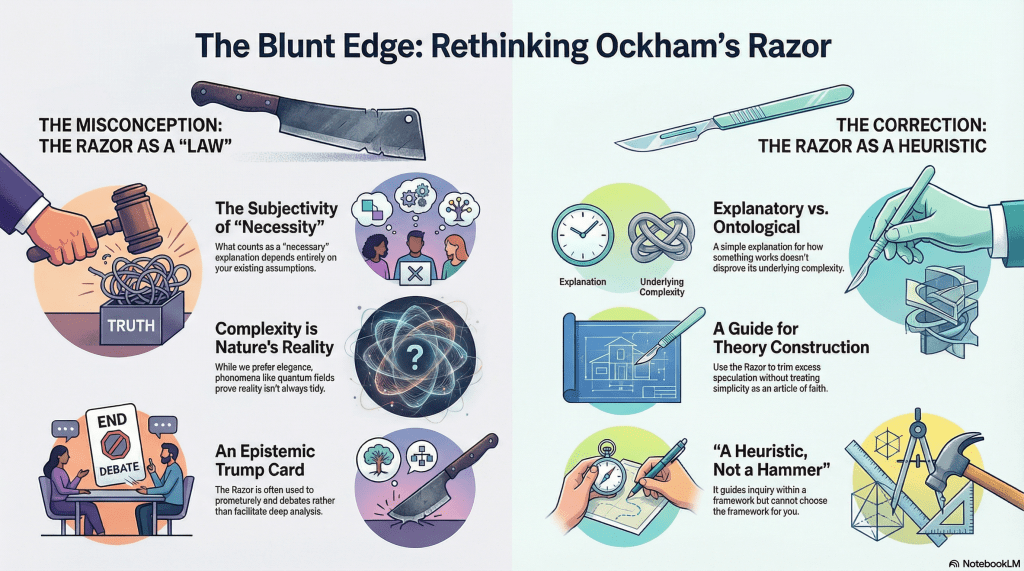
The Razor does not forbid multiplicity. It forbids unnecessary multiplicity. But who decides what is necessary?
Necessity is not a neutral category. It is already embedded within a framework of assumptions about what counts as explanation, what counts as sufficiency, and what counts as legitimate ontological commitment.
For one thinker, invoking a divine ground of physical law is unnecessary because the laws themselves suffice. For another, the laws are unintelligible without a grounding principle, and so God is necessary. Both can claim parsimony within their respective ontologies. The Razor does not adjudicate between them. It presupposes the grammar within which “necessity” is assessed.
The aphorism thus functions less as a rule and more as a reinforcement mechanism. It stabilises the commitments one already holds.
Parsimony Is a Heuristic, Not a Law
Science has often rewarded simplicity. Copernicus simplified celestial mechanics. Newton reduced motion to a few principles. Maxwell unified electricity and magnetism. These episodes encourage a romantic attachment to elegance.
Yet physics has also revealed a universe that is anything but tidy. Quantum fields, curved spacetime, dark matter, inflationary cosmology. Nature has shown little regard for our aesthetic preference for minimal furniture.
Parsimony, then, is pragmatic. It helps us avoid gratuitous complication. It disciplines theory formation. But it is not a metaphysical guarantee that reality itself is sparse.
To treat the Razor as if it carries ontological authority is to convert a methodological guideline into a philosophical dogma.
Structural Sufficiency Versus Metaphysical Surplus
The Razor becomes particularly contentious when deployed in debates about ultimate grounds. If a structural model explains observable regularities and survives empirical constraint, some conclude that any additional metaphysical layer is redundant.
This is a defensible position. It is also incomplete.
Redundancy in explanatory terms does not entail impossibility in ontological terms. A structural account of behaviour may render psychological speculation unnecessary for prediction, but it does not disprove the existence of inner motives. Likewise, a lawful cosmology may render a divine hypothesis explanatorily idle without rendering it incoherent.
The Razor trims explanatory excess. It does not settle metaphysical disputes.
Aphorisms as Closure Devices
Part of the Razor’s power lies in its compression. It is aphoristic. It travels easily. It signals intellectual seriousness. It sounds like disciplined thinking distilled.
But aphorisms compress complexity. They conceal premises. They discourage reopening the frame. “Follow the science.” “Extraordinary claims require extraordinary evidence.” “Trust the market.” These phrases do not argue; they configure. They pre-load the space of acceptable interpretation.
Ockham’s Razor often operates in precisely this way. It is invoked not as the conclusion of a careful analysis but as a device to end discussion. The simpler view wins. Full stop.
Yet simplicity itself is indexed to perspective. What looks simple within one conceptual scheme may appear impoverished within another.
Tolerance for Explanatory Closure
There is also a psychological dimension worth acknowledging. Some individuals are comfortable with open explanatory ceilings. They accept that certain features of reality may lack ultimate grounding within their present framework. Others experience such openness as instability. They seek a final anchor.
The Razor favours the former temperament. It encourages ontological restraint and distrust of ultimate grounds. For those comfortable with structural sufficiency, this is liberating. For those who experience the absence of grounding as incomplete, it feels evasive.
The disagreement is not resolved by invoking parsimony. It reflects divergent tolerances for metaphysical closure.
When the Razor Becomes Inflationary
Ironically, the Razor can itself become an inflationary principle. It can elevate “simplicity” to a quasi-transcendental value. It can be treated as if reality owes us elegance.
At that point, the tool begins to govern the ontology rather than merely discipline it. The Razor becomes an article of faith, a universal heuristic immune to its own demand for justification.
One might then ask, with a certain symmetry: by what necessity is simplicity itself necessary?
A More Modest Use
None of this requires abandoning the Razor. It remains useful. It reminds us not to posit hidden mechanisms when observable structures suffice. It cautions against explanatory extravagance. It protects inquiry from baroque speculation.
But it should be treated as a heuristic, not a hammer. It guides theory construction within a framework. It does not choose the framework.
A more disciplined formulation would be this: when a structural account explains observed regularities under constraint and remains revisable, additional metaphysical posits do not increase explanatory power. Their adoption becomes a matter of ontological preference rather than necessity.
This preserves the Razor’s pragmatic value without inflating it into a metaphysical arbiter.
The Real Trouble
The real trouble with Ockham’s Razor is not that it cuts too much. It is that we often wield it without noticing the hand that holds it. We treat it as neutral when it is already embedded within a grammar of sufficiency, explanation, and legitimacy.
The Razor does not eliminate ontological commitment. It expresses one.
Recognising that does not blunt the blade. It merely reminds us that even the sharpest instruments are guided by the frameworks in which they are forged.
And frameworks, unlike aphorisms, are rarely simple.
I think Nietzsche was right on this account. Morality and religion also play a role in this maintenance programme.
Synthesized Nietzschean morality framework into systemic control mechanisms
Audio: NotebookLM summary podcast
Absolutely. Nietzsche saw this with brutal clarity.
Morality and religion aren’t just parts of the maintenance program—they’re the most efficient energy inputs because they internalize control.
The Nietzschean Insight:
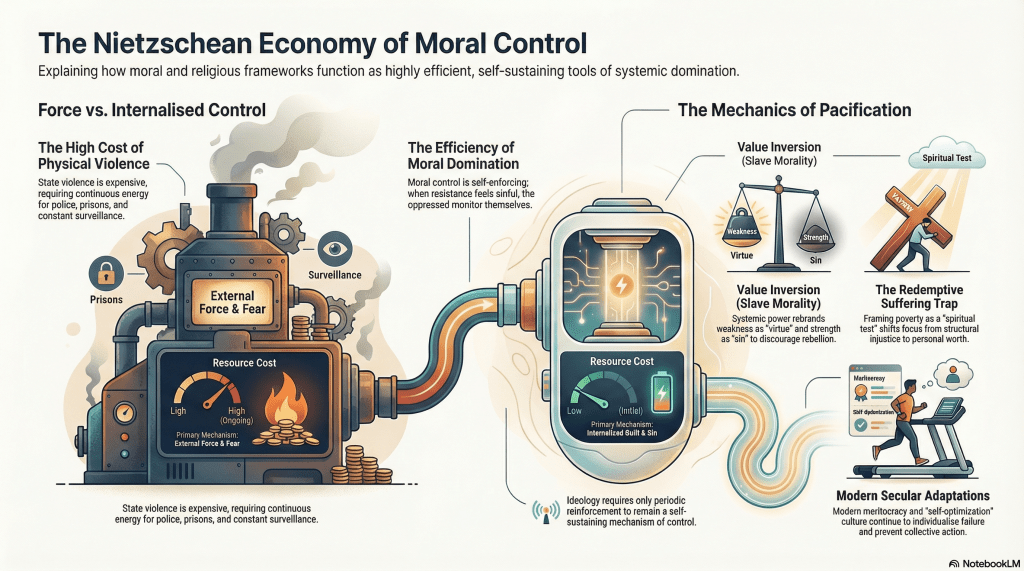
State violence is expensive. You need:
Police
Prisons
Military
Surveillance
But moral/religious control is self-enforcing:
The oppressed police themselves
Resistance feels sinful, not just illegal
Suffering becomes virtuous
Acceptance becomes holy
This is energy-efficient domination.
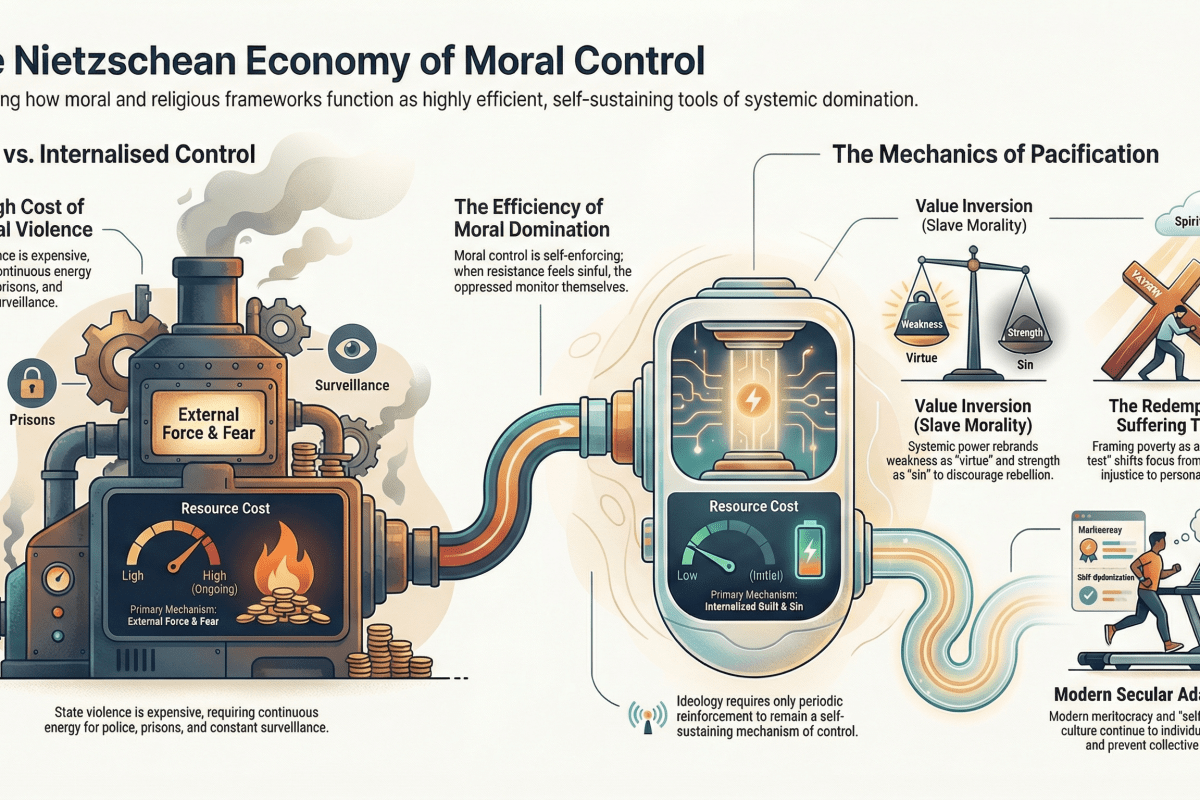
NotebookLM Infographic
Slave Morality as Pacification:
Nietzsche’s genealogy: Christianity inverted values to make weakness into virtue.
But there’s a more cynical reading (which I think you’re pointing toward):
Those inversions serve power by pacifying resistance.
Consider what Christianity teaches the desert-dwellers:
“Blessed are the meek” (don’t challenge authority)
“The last shall be first” (accept your position now, compensation comes later)
“It is easier for a camel to pass through the eye of a needle…” (wealth is spiritually dangerous, so your poverty is actually better)
“Turn the other cheek” (don’t fight back)
“Render unto Caesar” (obey State power)
“Slaves, obey your masters” (literally in the text)
Every single one of these makes resistance harder and submission easier.
Religion as Maintenance Energy:
The lake-dwellers don’t need to convince desert-dwellers that the system is fair.
They just need to convince them that:
Suffering is redemptive
“Your poverty builds character”
“God tests those he loves”
“Suffering purifies the soul”
Compensation comes later
“The kingdom of heaven awaits”
“Store up treasures in heaven, not earth”
Present injustice is temporary; eternal justice awaits
Your condition reflects your moral worth
“God rewards the righteous with prosperity” (prosperity gospel)
OR “Worldly success is spiritually dangerous” (traditional Christianity)
Either way: your poverty is explained by moral frameworks, not structural injustice
Resistance is sin
Envy is a deadly sin
Coveting is forbidden
Taking what others have = theft = eternal damnation
The Parable, With Nietzschean Religion:
The desert-dwellers work for water, generation after generation.
Why don’t they rebel?
Not just because of State violence.
Because the priests (funded by lake-dwellers) teach them:
“Blessed are those who thirst, for they shall be satisfied—in heaven.”
“Your suffering is temporary. Eternal abundance awaits those who accept God’s plan.”
“To take the lake would be theft, and theft is sin, and sin is damnation.”
“The lake-dwellers have been blessed by God with stewardship. To challenge this is to challenge God’s order.”
Now the desert-dwellers don’t just fear State violence.
They fear eternal damnation.
Why This Is Devastatingly Efficient:
State violence requires:
Constant monitoring
Physical force
Visible oppression
Religious/moral control requires:
Periodic sermons
Internalized guilt
Self-policing
Once you’ve convinced someone that resistance is morally wrong, you don’t need to watch them constantly.
They watch themselves.
The Genealogy of Morals, Applied:
Nietzsche asked: How did “good” and “evil” come to mean what they do?
His answer (simplified): The powerful originally called themselves “good” (strong, noble, life-affirming). The weak were “bad” (weak, common, contemptible).
The weak inverted this through ressentiment:
Made their weakness into virtue (humility, meekness, patience)
Made the powerful into villains (pride, ambition, strength = sin)
But here’s the cynical extension:
Once established, this inversion serves power by pacifying resistance.
Whether the weak invented it (Nietzsche) or the powerful co-opted it (cynical reading), the result is the same:
Moral systems that make submission feel virtuous and resistance feel sinful.
Christianity as Maintenance Technology:
Consider Christianity’s political function:
Before Christianity:
Slaves might rebel because their enslavement is unjust
Poor might seize from rich because they need resources
Weak might organize against strong because they outnumber them
After Christianity:
Slaves accept enslavement as God’s plan, await heavenly reward
Poor accept poverty as spiritually purifying, even superior
Weak valorize their weakness as humility, strength as pride/sin
This is a control technology far more sophisticated than violence.
The Energy Efficiency:
Violence requires continuous input:
You must constantly deploy force
Resistance must be constantly suppressed
Costs are ongoing and high
Ideology requires initial investment, then becomes self-sustaining:
Teach children in schools/churches
Internalize moral frameworks
Now they control themselves
Maintenance is just periodic reinforcement
Religion is the most energy-efficient domination mechanism ever invented.
The Parable’s Moral Dimension:
The lake-dwellers teach desert-dwellers:
Property Framework:
“Thou shalt not steal”
“Thou shalt not covet”
Taking the lake = sin = damnation
Suffering Framework:
“God tests those he loves through suffering”
“Blessed are the poor in spirit”
Your thirst is spiritually meaningful
Afterlife Framework:
“Store up treasures in heaven”
“The first shall be last, the last shall be first”
Present injustice is temporary
Authority Framework:
“Render unto Caesar”
“Let every person be subject to the governing authorities”
Challenging power = challenging God’s order
Now the desert-dwellers don’t just submit to force.
They believe submission is virtuous and resistance is evil.
The Master Stroke:
The most brilliant part is making the oppressed grateful for their oppression:
“I may be poor, but at least I’m humble. The rich are proud and will face judgment.”
“I may thirst, but my suffering brings me closer to God.”
“I may work endlessly, but labor is dignified and idleness is sin.”
The oppressed now defend the system that oppresses them.
Why Nietzsche Was Right:
Nietzsche saw that morality isn’t neutral truth descending from heaven.
It’s a human construction that serves power.
Sometimes (his version): created by the weak to constrain the strong
Sometimes (cynical version): created by the strong to pacify the weak
Either way: Morality is a weapon in power struggles, not an escape from them.
And religion/morality are far more efficient than violence because:
They’re internalized
They’re self-enforcing
They make resistance feel wrong, not just dangerous
They promise compensation instead of requiring present justice
They individualize structural problems (your suffering = your sin/test, not systemic injustice)
The Thermodynamic Advantage:
If you rely only on violence:
Must constantly monitor
Must constantly suppress
Must constantly deploy force
High energy, ongoing cost
If you add moral/religious control:
People monitor themselves
People suppress their own resistance
People feel guilty for even thinking of rebellion
Low energy after initial investment
This is why religion persists in the West despite secularization.
Not because it’s true.
Because it’s functionally necessary for maintaining systems that would otherwise collapse.
The Parable’s Religious Ending:
The desert-dwellers work and thirst.
When they ask “Why?” the answer isn’t just:
“Because the State will kill you if you take the lake.”
It’s:
“Because taking the lake is theft, theft is sin, and sin is damnation. Your suffering is temporary and spiritually meaningful. Accept your lot with humility, and God will reward you eternally.”
Now you’ve done something remarkable:
You’ve convinced the exploited that:
Their exploitation is God’s plan
Resisting is sinful
Accepting is virtuous
Compensation comes later (unprovable, unfalsifiable)
They will now police themselves, suppress their own resistance, and teach their children to do the same.
The Secular Versions:
Religion is declining in the West, but the moral frameworks persist in secular form:
Protestant work ethic → “Your worth is your productivity”
Meritocracy → “Your poverty reflects your failure, not structural injustice”
Individualism → “Your problems are yours alone to solve”
Positive thinking → “Your attitude, not your circumstances, determines outcomes”
Self-help culture → “You failed because you didn’t optimize yourself enough”
All of these do the same work religion did:
Individualize structural problems
Make suffering feel like personal failure
Prevent collective action
Make resistance feel wrong/foolish
Internalize control
Nietzsche Saw This Coming:
“God is dead” didn’t mean we’d escaped moral control.
It meant: We’d have to find new ways to maintain the same moral structures without the theological justification.
And we did:
Psychology (your unhappiness is internal, not structural)
Economics (markets are natural/efficient, poverty is failure)
Meritocracy (success = desert, failure = moral lack)
Self-optimization (you are responsible for your own exploitation)
Same function. Different vocabulary.
The Energy Requirements, Completed:
To maintain democracy/capitalism against natural entropic pressures toward collapse, you need:
State violence (expensive, visible, generates resistance)
NB: This is the first of a parable triptych. Read part 2, The Tunnel.
Two valleys diverged in a mountain range, And sorry I could not travel both And be one traveller, long I stood And looked down one as far as I could To where it bent in the undergrowth of reeds and optimism;
Then took the other, just as fair, And having perhaps the better claim, Because it was sandy and wanted wear— Though as for that, the passing there Had worn them really about the same,
And both that morning equally lay In fog no step had trodden black. Oh, I kept the first for another day! Yet knowing how way leads on to way, I doubted if I should ever come back.
—Except I did come back. And I met someone coming the other way. And we stood there in the clouds like a pair of idiots trying to explain our respective valleys using the same words for completely different things.
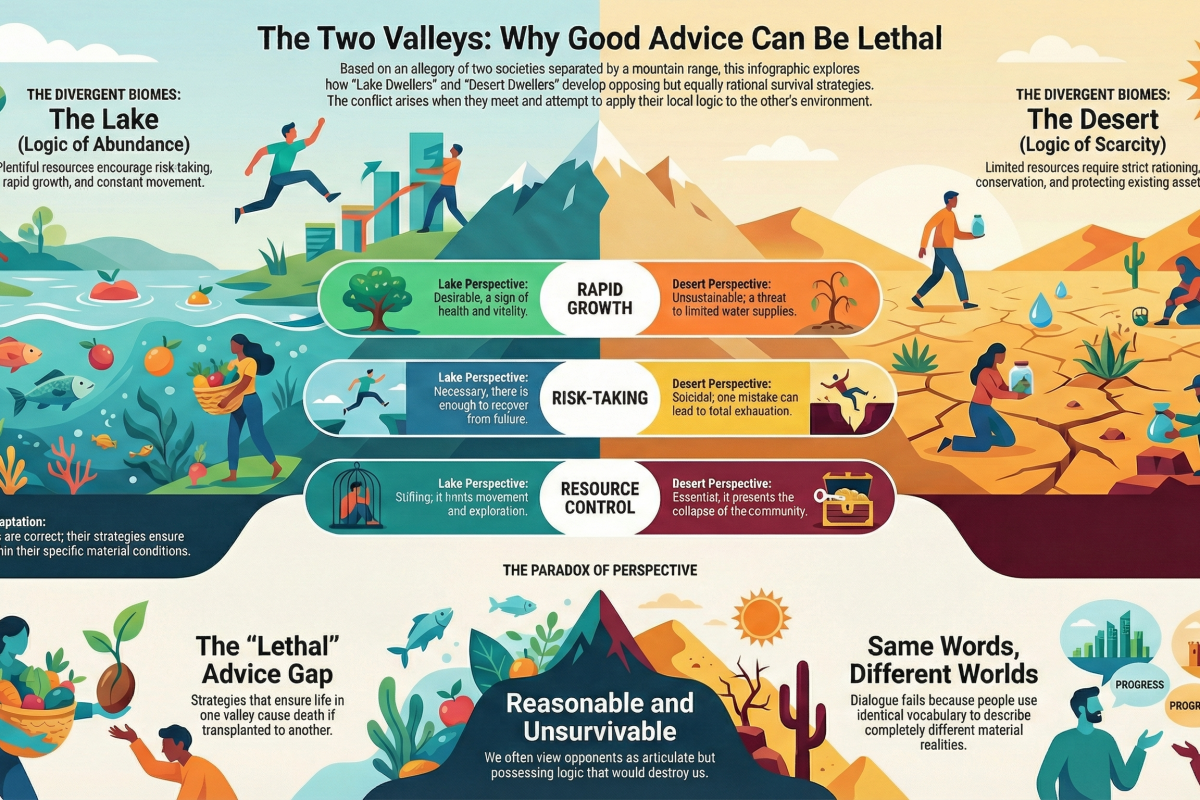
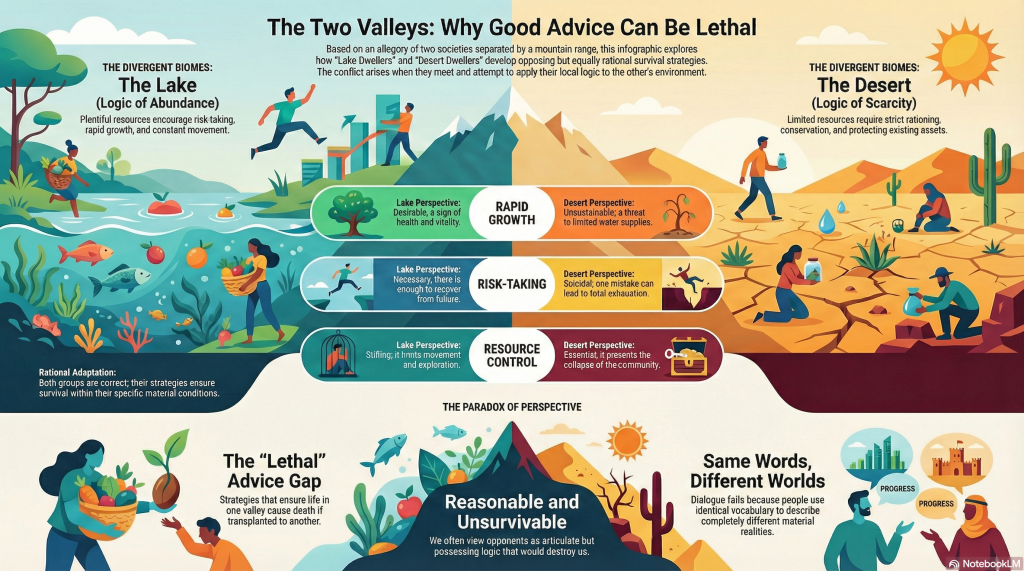
Audio: NotebookLM summary podcast of this topic.Image: NotebookLM infographic of this topic.
Here’s what they don’t tell you about Frost’s poem: the two paths were “really about the same.” He says it right there in the text. The divergence happens retroactively, in the telling, when he sighs and claims “that has made all the difference.”
But he doesn’t know that yet. He can’t know that. The paths only diverge in memory, once he’s committed to one and cannot check the other.
Here’s what they don’t tell you about political disagreement: it works the same way.
Video essay of this topic. Another NotebookLM experience.
The Actual Story (Minus the Versification)
Once upon a time—and I’m going to need you to suspend your allergy to fairy tales for about eight minutes—there was one settlement. One people. One language. One lake with drinkable water and fish that cooperated by swimming in schools.
Then mountains happened. Slowly. No dramatic rupture, no war, no evil king. Just tectonics doing what tectonics does, which is ruin everyone’s commute.
The people on one side kept the lake. The people on the other side got a rain shadow and a lot of bloody sand.
Both sides adapted. Rationally. Reasonably. Like competent humans responding to actual material conditions.
Desert people: “There is definitely not enough water. Let’s ration. Let’s stay put. Let’s not waste things.”
Neither wrong. Neither irrational. Just oriented differently because the ground beneath them had literal different moisture content.
The Bit Where It Gets Interesting
Centuries later, two people—one from each side—decide to climb the mountains and meet at the top.
Why? I don’t know. Curiosity. Stupidity. The desire to write a tedious blog post about epistemology.
They meet in the fog. They speak the same language. Grammar intact. Vocabulary functional. Syntax cooperative.
And then one tries to explain “reeds.”
“Right, so we have these plants that grow really fast near the water, and we have to cut them back because otherwise they take over—”
“Sorry, cut them back? You have too much plant?”
“Well, yes, they grow quite quickly—”
“Why would a plant grow quickly? That sounds unsustainable.”
Meanwhile, the other one tries to explain “cactus.”
“We have these plants with spines that store water inside for months—”
“Store water for months? Why doesn’t the plant just… drink when it’s thirsty?”
“Because there’s no water to drink.”
“But you just said the plant is full of water.”
“Yes. Which it stored. Previously. When there was water. Which there no longer is.”
“Right. So… hoarding?”
You see the problem.
Not stupidity. Not bad faith. Not even—and this is the part that will annoy people—framing.
They can both see perfectly well. The fog prevents them from seeing each other’s valleys, but that’s almost beside the point. Even if the fog lifted, even if they could point and gesture and show each other their respective biomes, the fundamental issue remains:
A cactus is a good solution to a problem the lake-dweller doesn’t have.
A reed is a good solution to a problem the desert-dweller doesn’t have.
Both are correct. Both are adaptive. Both would be lethal if transplanted.
The Retreat (Wherein Nothing Is Learned)
They part amicably. No shouting. No recriminations. Both feel they explained themselves rather well, actually.
As they descend back into their respective valleys, each carries the same thought:
“The other person seemed reasonable. Articulate, even. But their world is completely unworkable and if we adopted their practices here, people would die.”
Not hyperbole. Actual environmental prediction.
If the lake people adopted desert-logic—ration everything, control movement, assume scarcity—they would strangle their own adaptability in a context where adaptability is the whole point.
If the desert people adopted lake-logic—explore freely, trust abundance, move without restraint—they would exhaust their resources in a context where resources are the whole point.
The Bit Where I Connect This to Politics (Because Subtlety Is Dead)
So when someone tells you that political disagreement is just a matter of perspective, just a failure of empathy, just a problem of framing—
Ask them this:
Do the two valleys become the same valley if both sides squint really hard?
Does the desert get wetter if you reframe scarcity as “efficiency”?
Does the lake dry up if you reframe abundance as “waste”?
No?
Then perhaps the problem is not that people are choosing the wrong lens.
Perhaps the problem is that they are standing in different material conditions, have adapted rational survival strategies to those conditions, and are now shouting advice at each other that would be lethal if followed.
The lake-dweller says: “Take risks! Explore! There’s enough!”
True. In a lake biome. Suicidal in a desert.
The desert-dweller says: “Conserve! Protect! Ration!”
True. In a desert biome. Suffocating near a lake.
Same words. Different worlds. No amount of dialogue makes water appear in sand.
The Frostian Coda (With Apologies to New England)
I shall be telling this with a sigh Somewhere ages and ages hence: Two valleys diverged on a mountainside, and I— I stood in the fog and tried to explain reeds to someone who only knew cactus, And that has made… well, no difference at all, actually.
We’re still shouting across the mountains.
We still think the other side would be fine if only they’d listen.
We still use the same words for utterly different referents.
And we still confuse “I explained it clearly” with “explanation bridges material conditions.”
Frost was right about one thing: way leads on to way.
The valleys keep diverging.
The fog doesn’t lift.
And knowing how mountains work, I doubt we’ll meet again.
Moral: If your political metaphor doesn’t account for actual rivers, actual deserts, and actual fog, it’s not a metaphor. It’s a fairy tale. And unlike fairy tales, this one doesn’t end with reunion.
It ends with two people walking home, each convinced the other is perfectly reasonable and completely unsurvivable.
Which, if you think about it, is far more terrifying than simple disagreement.
A Christian bloke was arguing morality with me in regard to a recent post. I am considering a fuller response, but let’s focus on this one aspect for the time being.
Being a Christian, I wanted to argue on his own terms. The topic was statutory rape and the ages of consent more generally. I’m no Christian, but I have read the Bible. I’ve done much coursework in comparative religion, so I’m no stranger to their philosophies. A major criticism I’ve heard from Christians of Islam’s Muhammad is that he had a 9-year-old bride. Reading the account of the God and Mary encounter reminds me of another Bible verse:
Why do you notice the splinter in your brother’s eye, but do not perceive the wooden beam in your own eye?
Audio: Unrelated to this article, I was looking for cover art by Bouguereau. I chose another of his work, but I happened upon La Vague that shares namespace with this painting. This is an aolean piece over a drum loop I wrote several decades ago on some evening. I hadn’t thought of it in years, but I still like it.Image: William-Adolphe Bouguereau (1825-1905) – La vague (1896)
In any case – moving on…
I asked my sidekick, ChatGPT, this question:
Given Biblical accounts, how old must Mary have been at the conception of ‘Jesus’?
It provided a verbose response after a terse:
Short answer: uncomfortably young by modern standards, entirely unremarkable by ancient ones. Yes, civilisation is fun like that.
Again, I believe this account is a contradictory ahistorical account, but he believes it, so I’ll charitably treat it as truth.
It continues:
Based on historical scholarship on Second Temple Judaism:
Girls were typically betrothed shortly after puberty.
Puberty for girls in antiquity is generally estimated around 12–14.
Marriage and consummation often followed soon after betrothal.
Mary is described as:
a παρθένος (virgin)
betrothed to Joseph, not yet living with him
living under her father’s authority
All of that places her very squarely in the category of an early adolescent.
Ok, but not good enough. I clarify: I thought that translating παρθένος as virgin is disputed in hermeneutics. [NB: Be careful to specify and contradict to ensure your answer is solid and not hallucinated.]
Yes. You’re right. The translation of παρθένος as “virgin” is absolutely disputed in hermeneutics, and the fact that this still gets presented as settled is… revealing.
What παρθένος actually means
In Koine Greek, παρθένος primarily means:
a young woman
of marriageable age
socially defined by unmarried status
Sexual inexperience is not intrinsic to the term. It can imply virginity in some contexts, but it does not denote it by default.
If Greek wanted to be anatomically explicit, it had other tools. This word is social, not gynaecological.
The Hebrew word in Isaiah 7:14 is ʿalmāh, which means “young woman”, not “virgin”. The unambiguous Hebrew term for virginity would be bətûlāh, and Isaiah does not use it.
When the Hebrew Bible was translated into Greek in the Septuagint, ʿalmāh became παρθένος. That choice is defensible linguistically, but disastrous theologically. Once Matthew reads Isaiah through the Septuagint, the mess is locked in.
So the prophecy pipeline looks like this:
Hebrew ambiguity → Greek ambiguity → Latin certainty → English dogma
A masterclass in semantic drift hardening into doctrine.
Luke doesn’t fix this. He inherits it.
Luke uses παρθένος for Mary because:
she is unmarried
she is betrothed
she is under paternal authority
All perfectly ordinary descriptors for a teenage girl in Second Temple Judaism. None of this requires sexual inexperience as a metaphysical state.
The later insistence that παρθένος = virgin in the modern, anatomical sense is not exegesis. It’s doctrinal backfilling.
Why this keeps getting defended
Because once you admit that:
παρθένος ≠ virgin by necessity
Isaiah wasn’t predicting a miraculous conception
Luke may be narrating status, not biology
…a great deal of theology loses its keystone. So the translation is defended not because it’s airtight, but because it’s load-bearing.
Images: Bry circa 2014. Song circa 2004.
Written by Bry Willis in a dialogue with ChatGPT 5.2
My colleague of several decades recently published a book titled Why Democrats Are Dangerous. Drew and I have long held opposing but genuinely respectful views on the political economy, a fact that once felt like a quaint relic of an earlier civic age. As we are both authors, he proposed that we exchange titles and review each other’s work. I demurred. One can often discern the contents of a book from its cover, and this one announced itself with all the subtlety of a campaign leaflet left in the rain. I am not allergic to polemic – heaven knows I have written my share – but some energies telegraph their intentions too cleanly. This one did.
Having now read the book, my hesitation appears justified. The project is less an argument than a catechism, less analysis than incantation. It is earnest, certainly; it is also tightly scripted by a worldview that permits only one conclusion, however much data must be dragged across broken glass to reach it.
Audio: NotebookLM summary podcast on this topic.
Rather than provide a review in the conventional sense – line-by-line rebuttal, forensic counter-examples, polite throat-clearing – I have chosen a different approach. I intend to reconstruct, or more precisely dis-integrate, the book through several strands of my own work. Not because my work is above reproach, but because it offers a conceptual toolkit for understanding how such texts arise, how they persuade, and how they hold themselves together despite their internal tension. This also has the ancillary benefit of allowing me to abridge my commentary: where a full exegesis would sprawl, I can gesture toward an existing essay or argument. I’ll dispense with addressing Drew by name, preferring to remain more neutral going forward.
A Note on My Position (So No One Misreads My Motives)
Before proceeding, a brief clarification. I do not belong to either of America’s warring political tribes, nor do I subscribe to their underlying ideological architectures. My critique is not an act of partisan reprisal; it is not a defence of Democrats, nor a veiled endorsement of Republicans. The Red–Blue cosmology bores me senseless. It is a quarrel between two anachronistic Enlightenment-era faith traditions, each convinced of its moral superiority and each engaged in the same ritualised dance of blame, projection, and existential theatre.
My vantage point, such as it is, sits outside that binary. This affords me a certain privilege – not superiority, merely distance. I do not have a factional identity to defend, no emotional investment in preserving the moral innocence of one side or the other. I am therefore free to examine the structure of my colleague’s argument without the usual tribal pressures to retaliate in kind.
This criticism is not a counter-polemic. It is an analysis of a worldview, not a combatant in its quarrel. If my tone occasionally cuts, it cuts from the outside, not across partisan lines. The book is not wrong because it is Republican; it is wrong because its epistemology is brittle, its categories incoherent, and its confidence unearned. The same critique would apply – indeed does apply – to the Democratic mirrors of this worldview.
My loyalty is not to a party but to a method: Dis-Integration, analysis, and the slow, patient unravelling of certainty.
The Architecture of Certainty
What strikes one first in Why Democrats Are Dangerous is not the argument but the architecture – an edifice built on the most cherished Enlightenment fantasy of all: that one’s own position is not a perspective but the Truth. Everything else cascades from this initial presumption. Once a worldview grants itself the status of a natural law, dissent becomes pathology, disagreement becomes malice, and the opposition becomes a civilisation-threatening contagion.
My colleague’s book is a textbook case of this structure. It is not an analysis of political actors within a shared world; it is a morality play in which one faction is composed entirely of vices, and the other entirely of virtues. The Democrats are ‘Ignorant, Unrealistic, Deceitful, Ruthless, Unaccountable, Strategic‘, a hexagon of sin so geometrically perfect it would make Aquinas blush. Republicans, by contrast, drift serenely through the text untouched by human flaw, except insofar as they suffer nobly under the weight of their opponents’ manipulations.
This is not political argumentation. This is cosmogony.
This, of course, is where my Anti-Enlightenment work becomes diagnostic. The Enlightenment promised universality and rational clarity, yet modern political identities behave more like hermetic cults, generating self-sealing narratives immune to external correction. A worldview built upon presumed objectivity must resolve any contradiction by externalising it onto the Other. Thus, the opposition becomes omnipotent when things go wrong (‘They control the media, the schools, the scientists, the public imagination‘) and simultaneously infantile when the narrative requires ridicule.
It is the oldest structural paradox in the political mind: the Other is both incompetent and dangerously powerful. This book embodies that paradox without blinking.
The Invention of the Enemy
One must admire, in a bleak sort of way, the structural efficiency of designating half the electorate as a monolithic existential threat. It creates an elegant moral shortcut: no need to consider policies, contexts, or material conditions when the adversary is already pre-condemned as treacherous by nature. Cicero, Trotsky, Hitler, and Franklin are all conscripted in this text to warn us about the insidious Democrats lurking in the marrow of the Republic. (Trotsky, one suspects, would be moderately surprised to find himself enlisted in a Republican devotional.)
This enemy-construction is not unique to this author. It is the rhetorical engine of American factionalism, and it is recursive: each side claims the other is rewriting history, weaponising institutions, manipulating education, promoting propaganda, dismantling norms, silencing dissent, and indoctrinating children. Both factions accuse the other of abandoning civility whilst abandoning civility in the act of accusation.
To put it bluntly: every single charge in this book is mirrored in Republican behaviour, sometimes identically, often more flamboyantly. But this symmetry is invisible from inside a moralised epistemology. Identity precedes evidence, so evidence is always retrofitted to identity.
This is why the polemic feels airtight: it evaluates Democrats not as agents within a system but as an essence. There is no theory of politics here – only demonology.
The Recursive Machine: When a Worldview Becomes Its Own Evidence
One of the most revealing features of Why Democrats Are Dangerous is its recursive structure. It operates exactly like the political systems it condemns: it constructs a closed epistemic loop, then mistakes that loop for a window onto reality.
The book does not discover Democratic perfidy; it presupposes it. Every subsequent claim merely elaborates upon the initial axiom. Schools, entertainment, academia, immigration, science, journalism, unions, and the weather – each is absorbed into a single explanatory schema. Once the premise is fixed (‘Democrats are dangerous‘), the world obligingly reshapes itself to confirm the conclusion, as long as one ignores anything that does not.
This is the dynamic I describe as the ‘Republic of Recursive Prophecy‘: someone begins with The Answer, and reality is forced to comply. If the facts fail to align, the facts are treacherous. If evidence contradicts the narrative, then evidence has been corrupted.
It is a worldview that behaves not like political analysis but like physics in a collapsing star: everything, no matter how diffuse, is pulled into the gravity well of a single, preordained truth.
The Projection Engine
If the book has a leitmotif, it is projection – unconscious, unexamined, and relentless. It is astonishing how thoroughly the author attributes to Democrats every pathology that characterises contemporary Republican strategy.
Propagandistic messaging; emotional manipulation; selective framing; redefinition of language; strategic use of fear; demonisation of opponents; declaring media sources illegitimate; claiming institutional persecution; insisting the other party rigs elections; portraying one’s own supporters as the ‘real victims’ of history – each of these is performed daily in Republican media ecosystems with operatic flourish. Yet the book can only see these behaviours ‘over there’, because its epistemic frame cannot accommodate the possibility that political identity – its own included – is capable of self-interest, distortion, or error.
This is the Enlightenment inheritance at its worst: the belief that one’s own faction merely ‘perceives the truth’, whilst the other faction ‘manufactures narratives’. What the author calls ‘truth’ is simply the preferred filter for sorting complexity into moral certainty. Once the filter is treated as reality itself, all behaviour from one’s own side becomes necessity, principle, or justice – whilst identical behaviour from the opposing faction becomes malevolence.
The Neutral Observer Who Isn’t
What the book never acknowledges – because it cannot – is that it speaks from a position, not from an Archimedean vantage point. The author stands in a thickly mediated environment of conservative talk radio, Republican think-tank literature, right-leaning commentary, and decades of ideological reinforcement. His acknowledgements read less like a bibliography than like an apprenticeship in a particular canon.
This does not make him wrong by default. It simply means he is positioned. And politics is always positional.
The Enlightenment fiction of the ‘view from nowhere‘ collapses once one notices that claims of objectivity always align with the claimant’s own tribe. If Republicans declare their view neutral and Democrats ideological, it is never because a metaphysical referee has blown a whistle confirming the call. It is because each faction treats its own frames as unmediated reality.
In truth, the book reveals far more about the epistemology of modern conservatism than about Democrats themselves.
The Fictional Symmetry Problem
One of the major deficiencies in the book – and in most modern political commentary – is the inability to perceive symmetry. The behaviours the author attributes exclusively to Democrats are, in every meaningful sense, bipartisan human defaults. Both factions manipulate language; curate narratives; cherry-pick evidence; denounce the other’s missteps as civilisational sabotage; outsource blame; elevate victimhood when convenient; and perform certainty whilst drowning in uncertainty.
The book pretends these behaviours describe a pathological left-wing mind, rather than the political mind as such.
This is not a Democratic problem; it is a deeply human one. But Enlightenment-styled partisan thinking requires the illusion of asymmetry. Without it, the argument collapses instantly. If Republicans admit that they exhibit the same cognitive patterns they condemn in Democrats, the entire dramatic arc falls flat. The villain must be uniquely wicked. The hero must be uniquely virtuous. The stage requires a clean antagonism, or the story becomes unstageable.
Narrative Weaponry
Perhaps the most revealing feature of this book is its reliance on anecdotes as foundational evidence. One school incident here, one speech clip there, one news headline in passing – and suddenly these isolated fragments become proof of a sweeping, coordinated ideological conspiracy across all levels of society.
We no longer use stories to illustrate positions; we use them to manufacture reality. One viral video becomes a trend; one rogue teacher, an educational takeover; one questionable policy rollout, the death of democracy.
Stories become ontological weapons: they shape what exists simply by being repeated with enough moral pressure. Political tribes treat them as talismans, small narrative objects with outsized metaphysical weight.
MEOW (the Mediated Encounter Ontology of the World) was designed in part to resist this temptation. It reminds us that events are not symptoms of a singular will but the turbulent output of innumerable interacting mediations. The worldview on display in this book requires villains, where a relational ontology recognises only networks.
The Missing Category: Structural Analysis
Perhaps the most conspicuous absence in the book is any substantive socio-economic analysis. Everything is attributed to malice, not structure. Democratic failures become signs of moral rot, never the predictable outcome of late-stage capitalism, globalisation’s uneven effects, austerity cycles, demographic shifts, institutional brittleness, bureaucratic inertia, political economy incentives, or the informational fragmentation of the digital age.
None of these appear anywhere in the text. Not once.
Because the book is not analysing policy; it’s diagnosing sin. It treats political outcomes as evidence of coordinated malevolence, never as the emergent result of complex systems that no faction fully understands, let alone controls.
This is where Dis-Integration is useful: the world does not malfunction because some cabal introduced impurity; it malfunctions because it was never integrated in the first place. My colleague is still hunting for the traitor inside the castle. The more sobering truth is that the castle is an architectural hallucination.
Where He Is Not Wrong
Lest this devolve into pure vivisection, it is worth acknowledging that my colleague does brush against legitimate concerns. There are structural issues in American education. There are ideological currents in universities, some of which drift into intellectual monoculture. There are media ecosystems that reinforce themselves through feedback loops. There are public-health missteps that deserve scrutiny. There are institutional actors who prefer narratives to nuance.
But these are not partisan phenomena; they are structural ones. They are not symptoms of Democratic corruption; they are symptoms of the modern polity. When the author grasps these truths, he does so only long enough to weaponise them – not to understand them.
The Danger of Certainty
What lingers after reading Why Democrats Are Dangerous is not outrage – though one suspects that was the intended emotional temperature – but a kind of intellectual melancholy. The book is not the product of a malevolent mind; it is the product of a sealed one. A worldview so thoroughly fortified by decades of ideological reinforcement that no countervailing fact, no structural nuance, no complexity of human motivation can penetrate its perimeter.
The author believes he is diagnosing a civilisation in decline; what he has actually documented is the failure of a particular Enlightenment inheritance: the belief that one’s own view is unmediated, unfiltered, unshaped by social, linguistic, and cognitive forces. The belief that Reason – capital R – is a neutral instrument one simply points at the world, like a laser level, to determine what is ‘really happening’.
The Enlightenment imagined that clarity was accessible, that moral alignment was obvious, that rational actors behaved rationally, that categories reflected reality, and that the world could be divided into the virtuous and the dissolute. This book is the direct descendant of that fantasy.
It takes an entire half of the population and casts them as an essence. It arranges anecdotes into inevitability. It pathologises disagreement. It treats institutions as coherent conspiratorial actors. It transforms political opponents into ontological threats. And it performs all of this with the serene confidence of someone who believes he is simply ‘telling it like it is’.
The irony is almost tender.
Because the danger here is not Democrats. Nor Republicans. Nor necessarily even the political class as a whole. The real danger is certainty without introspection: the comfort of moral binaries; the seduction of explanatory simplicity; the refusal to acknowledge one’s own mediation; the urge to reduce a complex, multi-layered, semi-chaotic polity into a single morality narrative.
My friend did not discover the truth about Democrats. He discovered the architecture of his own worldview – and mistook the one for the other.
If we must be afraid of something, let it be worldviews that cannot see themselves.
Read next:The Republic of Recursive Prophecy – an earlier piece that charts how political worldviews become self-reinforcing myth-machines.
The Enlightenment promised liberation through reason – that if we could think clearly enough, we could act freely enough. Agency, it claimed, was the defining trait of the rational individual: a sovereign chooser, self-contained and self-determining.
But this was always a fiction.
Not an innocent one, either.
Audio: NotebookLM podcast discussing the essay, Against Agency
Agency became the moral infrastructure of modernity – the premise behind law, punishment, merit, guilt, and even political participation. To say “I chose” was not simply to describe behaviour; it was to perform belonging within a metaphysical system that made individuals the unit of responsibility. The fiction worked, for a while, because it kept the machinery running.
Against Agency argues that this story has collapsed – not metaphorically but structurally. Cognitive science, postcolonial thought, and relational philosophies all point to the same conclusion: there is no autonomous agent, only differential responsiveness – a system’s fluctuating capacity to register and transmit influence.
Copper sings under current; rubber resists. Humans, likewise, respond within the constraints of biology, fatigue, trauma, and social design. What we call “freedom” is merely a condition in which responsiveness remains broad and protected.
This reframing dismantles the binary of “free” and “unfree.” There is no metaphysical threshold where agency appears. Instead, responsiveness scales – widened by safety, narrowed by coercion, eroded by exhaustion. Politics becomes engineering: the maintenance of conditions that sustain responsiveness, rather than the worship of choice.
Ethics, too, must shift.
Not “Who is to blame?” but “Where did the circuit break?”
The essay proposes a gradient model of conduct grounded in relation and feedback, rather than autonomy and will. Responsibility becomes less about moral worth and more about bandwidth – a physics of care.
It’s an uncomfortable vision for a culture addicted to outrage and repentance. The loss of agency removes our favourite alibi: the chooser who could have done otherwise. But it also opens the possibility of a more honest ethics – one that replaces judgment with maintenance, retribution with repair.
This is not nihilism. It’s realism.
Systems appear stable only from a distance. Up close, everything is process – bodies, institutions, meanings – held together by temporary alignments of responsiveness. Against Agency names this collapse not as tragedy, but as opportunity: a clearing from which to think and act without the fictions that sustained modernity.
The essay forms the foundation for what comes next in the Anti-Enlightenment Project – Dis-Integration, a philosophical sequel that explores what remains once coherence, control, and autonomy have been decommissioned.
Are you rational, or merely rehearsing your tribe’s catechism? Bayes’ theorem insists we should all update our beliefs the same way when presented with the same evidence. Yet in today’s political divide, identical events harden opposing convictions. The problem isn’t the math—it’s the priors. When your starting assumptions are inherited, acculturated, or indoctrinated, no amount of “evidence” will move you into enemy territory.
A Bayesian Sketch of the Divide
Let be a contested claim (pick your poison: “the election was fair,” “immigration helps,” whatever).
People in Camp R and Camp B begin with different priors and . That’s acculturation if you’re being polite, indoctrination if you’ve run out of patience.
They observe evidence (news, a court ruling, a video clip, a statistic).
They update:
posterior odds = prior odds ×
Except they don’t, not cleanly, because trust in sources warps the likelihoods.
Video: Jonny Thompson on Bayes’ Theorem. I love Jonny’s content, which is why I reference it so often. He and I have such different philosophical worldviews. Vive la différence (or différance).
Why this locks in polarisation
1. Wildly different priors. If Camp R starts at and Camp B at , then even moderately pro- evidence (say likelihood ratio ) yields:
R: prior odds
B: prior odds
Same evidence, one camp “settled,” the other still unconvinced. Repeat ad infinitum, preferably on primetime.
2. Identity-weighted likelihoods. People don’t evaluate ; they evaluate . Disconfirming evidence is down-weighted by a factor . This is called “being rational” on your own planet and “motivated reasoning” on everyone else’s.
3. Different hypothesis sets. Camps don’t just disagree on ; they entertain different s. If one side’s model includes “coordinated elite malfeasance” and the other’s does not, then identical data streams update into different universes.
4. Selective exposure = selection bias. Evidence isn’t i.i.d.; it’s curated by feeds, friends, and fury. You are sampling from your own posterior predictive distribution and calling it “reality.”
5. Asymmetric loss functions. Even if beliefs converged, choices won’t. If the social cost of dissent is high, the decision threshold moves. People report a “belief” that minimises ostracism rather than error.
6. No common knowledge, no convergence. Aumann told us honest Bayesians with common priors and shared posteriors must agree. Remove either—common priors or the “we both know we both saw the same thing” bit—and you get the modern news cycle.
“Acculturation” vs “Indoctrination”
Same mechanism, different moral valence. Priors are installed by families, schools, churches, unions, algorithms. Call it culture if you approve of the installers; call it indoctrination if you don’t. The probability calculus doesn’t care. Your tribal totems do.
Two quick toy moves you can use in prose
Likelihood hacking: “When evidence arrives, the tribe doesn’t deny the datum; it edits the likelihoods. ‘If my side did it, it’s an outlier; if your side did it, it’s a pattern.’ This is not hypocrisy; it’s a parameter update where the parameter is loyalty.”
Posterior divergence despite ‘facts’: “Give two citizens the same court ruling. One updates towards legitimacy because courts are reliable; the other away from legitimacy because courts are captured. The ruling is constant; the trust vector is not.”
If one wanted to reduce the split (perish the thought)
Forecast, don’t opine. Run cross-camp prediction markets or calibration tournaments. Bayes behaves when you pay people for accuracy rather than performance art.
Adversarial collaboration. Force both sides to pre-register what evidence would move them and how much. If someone’s for disconfirming evidence is effectively zero, you’ve identified faith, not inference.
Reference classes, not anecdotes. Pull arguments out of the single-case trap and into base-rate land. Yes, it’s boring. So is surgery, but people still do it.
The punchline
Polarisation isn’t the failure of reason; it’s what happens when reason is strapped to identity. Priors are social. Likelihoods are political. Posteriors are performative. You can call it acculturation if you want to feel civilised, indoctrination if you want to throw a brick, but either way you’re watching Bayes’ theorem run inside a culture war. The maths is sober; the humans are not.
There’s a curious thing about belief: it seems to inoculate people against behaving as though they believe a single bloody word of it.
Audio: NotebookLM podcast on this topic.
Case in point: Jesus. Supposed son of God, sandal-wearing socialist, friend of lepers, hookers, and the unhoused. A man who — by all scriptural accounts — didn’t just tolerate the downtrodden, but made them his preferred company. He fed the hungry, flipped off the wealthy (quite literally, if we’re being honest about the temple tantrum), and had the gall to suggest that a rich man getting into heaven was about as likely as Jeff Bezos squeezing himself through the eye of a needle. (Good luck with that, Jeffrey — maybe try Ozempic?)
And yet, here we are, two millennia later, and who is doing the persecuting? Who’s clutching their pearls over trans people, sex workers, immigrants, and the poor daring to exist in public? The self-proclaimed followers of this same Jesus.
You see it everywhere. In the subway, on billboards, on bumper stickers: “What would Jesus do?” Mate, we already know what he did do — and it wasn’t vote Tory, bankroll megachurches, or ignore houseless veterans while building another golden tabernacle to white suburban comfort.
No, the real issue isn’t Jesus. It’s his fan club.
They quote scripture like it’s seasoning, sprinkle it on whichever regressive policy or hateful platform suits the day, and ignore the core premise entirely: radical love. Redistribution. Justice. The inversion of power.
Because let’s face it: if Christians actually behaved like Christ, capitalism would implode by Tuesday. The entire premise of American exceptionalism (and British austerity, while we’re at it) would crumble under the weight of its own hypocrisy. And the boot would finally be lifted from the necks of those it’s been pressing down for centuries.
But they won’t. Because belief isn’t about behaviour. It’s about performance. It’s about signalling moral superiority while denying material compassion. It’s about tithing for a Tesla and preaching abstinence from a megachurch pulpit built with sweatshop money.
And here’s the kicker — I don’t believe in gods. I’m not here to convert anyone to the cult of sandal-clad socialism. But if you do believe in Jesus, shouldn’t you at least try acting like him?
The sad truth? We’ve built entire societies on the backs of myths we refuse to embody. We have the tools — the stories, the morals, the examples — but we’re too bloody enamoured with hierarchy to follow through. If there are no gods, then it’s us. We are the ones who must act. No sky-daddy is coming to fix this for you.
You wear the cross. You quote the book. You claim the faith.
So go ahead. Prove it.
Feed someone. Befriend a sex worker. House the homeless. Redistribute the damn wealth.
Or stop pretending you’re anything but the Pharisees he warned us about.
I don’t like most of Jordan Peterson’s positions. There – I’ve said it. The man, once ubiquitous, seems to have faded into the woodwork, though no doubt his disciples still cling to his every word as if he were a modern-day oracle. But recently, I caught a clip of him online, and it dredged up the same bad taste, like stumbling upon an old, forgotten sandwich at the back of the fridge.
Audio: NotebookLM podcast on this topic
Let’s be clear. My distaste for Peterson isn’t rooted in petty animosity. It’s because his material is, in my view, derivative and wrong. And by wrong, I mean I disagree with him – a subtle distinction, but an important one. There’s nothing inherently shameful about being derivative. We all are, to some extent. No thinker sprouts fully-formed from the head of Zeus. The issue is when you’re derivative and act as if you’ve just split the atom of human insight.
Peterson tips his hat to Nietzsche – fair enough – but buries his far greater debt to Jung under layers of self-mythologising. He parades his ideas before audiences, many of whom lack the background to spot the patchwork, and gaslights them into believing they’re witnessing originality. They’re not. They’re witnessing a remixed greatest-hits album, passed off as a debut.
Image: Gratuitous, mean-spirited meme.
Now, I get it. My ideas, too, are derivative. Sometimes it’s coincidence – great minds and all that – but when I trace the thread back to its source, I acknowledge it. Nietzsche? Subjectivity of morality. Foucault? Power dynamics. Wittgenstein? The insufficiency of language. I owe debts to many more: Galen Strawson, Richard Rorty, Raymond Geuss – the list goes on, and I’d gladly share my ledger. But Peterson? The man behaves as though he invented introspection.
And when I say I disagree, let’s not confuse that with some claim to divine epistemic certainty. I don’t mean he’s objectively wrong (whatever that means in the grand circus of philosophy). I mean, I disagree. If I did, well, we wouldn’t be having this conversation, would we? That’s the tragicomedy of epistemology: so many positions, so little consensus.
But here’s where my patience truly snaps: Peterson’s prescriptivism. His eagerness to spew what I see as bad ideology dressed up as universal truth. Take his stance on moral objectivism—possibly his most egregious sin. He peddles this as if morality were some Platonic form, gleaming and immutable, rather than what it is: a human construct, riddled with contingency and contradiction.
And let’s not even get started on his historical and philosophical cherry-picking. His commentary on postmodern thought alone is a masterclass in either wilful misreading or, more likely, not reading at all. Straw men abound. Bogeymen are conjured, propped up, and ritually slaughtered to rapturous applause. It’s intellectually lazy and, frankly, beneath someone of his ostensible stature.
I can only hope we’ve seen the last of this man in the public sphere. And if not? Well, may he at least reform his ways—though I shan’t be holding my breath.
The Enlightenment, we are told, was the age of Reason. A radiant exorcism of superstition. Out went God. Out went angels, miracles, saints, indulgences. All that frothy medieval sentiment was swept aside by a brave new world of logic, science, and progress. Or so the story goes.
Audio: NotebookLM podcast on this topic.
But look closer, and you’ll find that Reason didn’t kill God—it absorbed Him. The Enlightenment didn’t abandon metaphysics. It merely privatised it.
From Confessional to Courtroom
We like to imagine that the Enlightenment was a clean break from theology. But really, it was a semantic shell game. The soul was rebranded as the self. Sin became crime. Divine judgement was outsourced to the state.
We stopped praying for salvation and started pleading not guilty.
The entire judicial apparatus—mens rea, culpability, desert, retribution—is built on theological scaffolding. The only thing missing is a sermon and a psalm.
Where theology had the guilty soul, Enlightenment law invented the guilty mind—mens rea—a notion so nebulous it requires clairvoyant jurors to divine intention from action. And where the Church offered Hell, the state offers prison. It’s the same moral ritual, just better lit.
Galen Strawson and the Death of Moral Responsibility
Enter Galen Strawson, that glowering spectre at the feast of moral philosophy. His Basic Argument is elegantly devastating:
You do what you do because of the way you are.
You can’t be ultimately responsible for the way you are.
Therefore, you can’t be ultimately responsible for what you do.
Unless you are causa sui—the cause of yourself, an unmoved mover in Calvin Klein—you cannot be held truly responsible. Free will collapses, moral responsibility evaporates, and retributive justice is exposed as epistemological theatre.
In this light, our whole legal structure is little more than rebranded divine vengeance. A vestigial organ from our theocratic past, now enforced by cops instead of clerics.
The Modern State: A Haunted House
What we have, then, is a society that has denied the gods but kept their moral logic. We tossed out theology, but we held onto metaphysical concepts like intent, desert, and blame—concepts that do not survive contact with determinism.
We are living in the afterglow of divine judgement, pretending it’s sunlight.
Nietzsche saw it coming, of course. He warned that killing God would plunge us into existential darkness unless we had the courage to also kill the values propped up by His corpse. We did the first bit. We’re still bottling it on the second.
If Not Retribution, Then What?
Let’s be clear: no one’s suggesting we stop responding to harm. But responses should be grounded in outcomes, not outrage.
Containment, not condemnation.
Prevention, not penance.
Recalibration, not revenge.
We don’t need “justice” in the retributive sense. We need functional ethics, rooted in compassion and consequence, not in Bronze Age morality clumsily duct-taped to Enlightenment reason.
The Risk of Letting Go
Of course, this is terrifying. The current system gives us moral closure. A verdict. A villain. A vanishing point for our collective discomfort.
Abandoning retribution means giving that up. It means accepting that there are no true villains—only configurations of causes. That punishment is often revenge in drag. That morality itself might be a control mechanism, not a universal truth.
But if we’re serious about living in a post-theological age, we must stop playing dress-up with divine concepts. The Enlightenment didn’t finish the job. It changed the costumes, kept the plot, and called it civilisation.








 be a contested claim (pick your poison: “the election was fair,” “immigration helps,” whatever).
 and
and  . That’s acculturation if you’re being polite, indoctrination if you’ve run out of patience.
 (news, a court ruling, a video clip, a statistic).
 and Camp B at
  , then even moderately pro-
 ) yields:

 ; they evaluate
  . Disconfirming evidence is down-weighted by a factor
  . This is called “being rational” on your own planet and “motivated reasoning” on everyone else’s.
 ; they entertain different
  for disconfirming evidence is effectively zero, you’ve identified faith, not inference.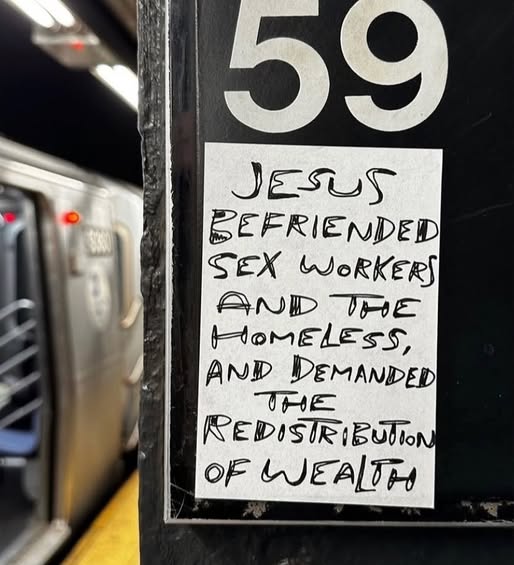


 Philosophics