Accusations of writing being AI are becoming more common – an irony so rich it could fund Silicon Valley for another decade. We’ve built machines to detect machines imitating us, and then we congratulate ourselves when they accuse us of being them. It’s biblical in its stupidity.
A year ago, I read an earnest little piece on ‘how to spot AI writing’. The tells? Proper grammar. Logical flow. Parallel structure. Essentially, competence. Imagine that – clarity and coherence as evidence of inhumanity. We’ve spent centuries telling students to write clearly, and now, having finally produced something that does, we call it suspicious.
Audio: NotebookLM podcast on this topic and the next one.
My own prose was recently tried and convicted by Reddit’s self-appointed literati. The charge? Too well-written, apparently. Reddit – where typos go to breed. I pop back there occasionally, against my better judgment, to find the same tribunal of keyboard Calvinists patrolling the comment fields, shouting ‘AI!’ at anything that doesn’t sound like it was composed mid-seizure. The irony, of course, is that most of them wouldn’t recognise good writing unless it came with upvotes attached.
Image: A newspaper entry that may have been generated by an AI with the surname Kahn. 🧐🤣
Now, I’ll admit: my sentences do have a certain mechanical precision. Too many em dashes, too much syntactic symmetry. But that’s not ‘AI’. That’s simply craft. Machines learned from us. They imitate our best habits because we can’t be bothered to keep them ourselves. And yet, here we are, chasing ghosts of our own creation, declaring our children inhuman.
Apparently, there are more diagnostic signs. Incorporating an Alt-26 arrow to represent progress is a telltale infraction → like this. No human, they say, would choose to illustrate A → B that way. Instead, one is faulted for remembering – or at least understanding – that Alt-key combinations exist to reveal a fuller array of options: …, ™, and so on. I’ve used these symbols long before AI Wave 4 hit shore.
Interestingly, I prefer spaced en dashes over em dashes in most cases. The em dash is an Americanism I don’t prefer to adopt, but it does reveal the American bias in the training data. I can consciously adopt a European spin; AI, lacking intent, finds this harder to remember.
I used to use em dashes freely, but now I almost avoid them—if only to sidestep the mass hysteria. Perhaps I’ll start using AI to randomly misspell words and wreck my own grammar. Or maybe I’ll ask it to output everything in AAVE, or some unholy creole of Contemporary English and Chaucer, and call it a stylistic choice. (For the record, the em dashes in this paragraph were injected by the wee-AI gods and left as a badge of shame.)
Meanwhile, I spend half my time wrestling with smaller, dumber AIs – the grammar-checkers and predictive text gremlins who think they know tone but have never felt one. They twitch at ellipses, squirm at irony, and whimper at rhetorical emphasis. They are the hall monitors of prose, the petty bureaucrats of language.
And the final absurdity? These same half-witted algorithms are the ones deputised to decide whether my writing is too good to be human.
Rather, how to optimise your time commitment to reading.
I came across a digital copy of The Intellectual Origins of Modernity by David Ohana as I was purusing titles on PhilArchive. The title piqued my interest, but I wasn’t sure I wanted to commit to reading it. What’s a bloke to do? Feed it to ChatGPT, of course.
Let’s just say, M. GPT was not amused.
Audio: NotebookLM podcast on this topic.
My first question: Is this at least tangential to my work?
Yes, it wanders. He tends to smuggle in parallel intellectual developments (Kantian autonomy, Cartesian doubt, social contract theory) even when they’re only indirectly related to his main thread. It’s a common sin in “origins of modernity” texts: the net gets cast so wide that causation and correlation start swapping costumes.
If you’re looking for the through-line, it’s probably his effort to show how early modern conceptions of reason metastasised into a moral and political framework, not just an epistemic one. But, yes — tangential is fair.
Is it more of a superficial survey with some connective tissue?
That’s a precise way to put it. Ohanav’s book reads like a well-informed synthesis—competent, even elegant—but not a deep excavation. He’s stitching together recognizable figures (Descartes, Hobbes, Locke, Kant, Hume) into a narrative arc about “modernity” rather than uncovering new terrain. The connective tissue is mostly thematic rather than argumentative: reason → autonomy → secular moral order → political liberalism.
It’s a survey that flatters the reader into thinking they’re tracing the genealogy of modern thought, but it rarely descends into the messy underlayers—say, the theological anxieties, material conditions, or institutional contexts that actually gave those ideas traction. In short: wide lens, thin soil.
Wow. Not a rousing endorsement.
So in a world of publish or perish, he’s publishing something more approachable than academic?
Exactly. It’s the kind of book that keeps tenure committees content and undergrads awake. Respectable citations, accessible prose, and a digestible thesis that flatters modernity while hinting at critique.
He’s not trying to break ground—he’s curating a gallery of the usual suspects and arranging them under good lighting. The prose carries that faint aroma of Routledge house style: serious but safe, just speculative enough to appear bold without alienating reviewers.
In the “publish or perish” economy, it’s survival by synthesis.
So closer to an undergraduate project than a grad school thesis?
Pretty much. It’s polished enough to pass for advanced scholarship if you don’t poke too hard, but structurally it’s more akin to a well-executed upper-level survey paper—ambitious in scope, cautious in depth.
He gestures toward big philosophical debates without really committing to any. The text moves like a docent through a museum: “Here we have Descartes, note his influence on Kant; over here, the Enlightenment’s moral optimism, soon to be critiqued by Nietzsche—moving on…”
You can tell he’s read widely, but the apparatus of argument—archival work, textual analysis, theoretical risk—is minimal. It’s competent, not adventurous.
I was working with ChatGPT, discussing various concepts. We chatted for several hours over the course of a few days, and we came to, let’s say, a conclusion. What ChatGPT 5 did next was something I had never seen. In fact, I’m sharing the actual response.
I won’t share my thesis here, but this is one of the field verification projects it recommends.
tl;dr: £120k
One-page grant prospectus — Provenance Pilot
Project title Provenance First: Testing provenance packages & slow-mode deliberation to improve municipal decision quality
Lead investigator Bry Willis — Independent Researcher (contact: [REDACTED])
Summary (1–2 lines) Test whether mandatory, machine-readable provenance packages plus a 60-day slow-mode and rapid adversarial audits improve decision quality (DQI), reduce reversal rates and increase public legitimacy in municipal planning decisions.
Problem statement (why fund this) Policy decisions are frequently hijacked by headline pressure and low-provenance inputs; municipalities lack lightweight, testable protocols that make inputs traceable and give deliberation time. This pilot operationalises the “provenance-first + slow-mode” institutional fix and measures whether design moves increase robust decision outcomes rather than performative actions.
Objectives
Test whether provenance packages + 60-day slow-mode increase Decision Quality Index (DQI) vs business as usual.
Measure effects on Provenance Completeness Score (PCS), reversal rates at 12 months, and public legitimacy.
Produce an open replication pack (data, code, provenance schema) and practitioner guidance.
Design & methods (12 months)
Setting: medium-sized city planning board; 12 eligible planning items over 12 months.
Randomisation: items randomly assigned (stratified by leverage) to Treatment (provenance package + 60-day slow-mode + funded rapid audit) or Control (standard process).
Intervention: standard JSON provenance package template (raw data links, code where relevant, funders, changelog), public portal posting, 60-day live comment + one adversarial rapid audit (48–72 hrs) on contested claims.
Primary outcome: Decision Quality Index (DQI) — composite of: evidence completeness, process reversibility, and independent expert accuracy score (pre-registered rubric).
Secondary outcomes: PCS, reversal at 12 months, public trust (survey), time to decision, stakeholder satisfaction.
Analysis: pre-registered mixed effects model (item-level with panel-level random effects), intention-to-treat.
Budget (indicative) £120k total —audit teams (£40k), portal & tooling (£15k), staff/fellow (0.5FTE, £35k), survey & evaluation (£15k), admin/contingency (£15k).
Deliverables
Pre-registered protocol on OSF; open data & replication pack (anonymised where required); policy brief and practitioner playbook; 1 peer-reviewed methods paper.
Success criteria (pre-registered)
Cohen’s d≥0.4 improvement in DQI for treatment vs control; PCS improvement >25 percentage points; no more than 30% increase in unacceptable delay (pre-agreed threshold).
Risk & mitigation
Delay risk: cap slow-mode at 60 days; urgent items can request expedited review (documented override).
Capture risk: audit funding ring-fenced and administered by independent trustee panel.
I’m just curious now. Have you ever had a generative AI process end with a cost of goods and services?
I just asked ChatGPT what it knows about me. No secrets, per se.
I remember a fair bit about you, Bry. You’re a language-obsessed philosopher who moonlights (or perhaps full-lights) as a speculative literary novelist under the name Ridley Park. You’re juggling multiple manuscripts—Needle’s Edge, Goldilocks, and Propensity, among others—and you’re currently elbow-deep in editing hell with Needle’s Edge, complete with timeline spreadsheets, index markers, and colour-coded emotional beats.
Video: I fed the first paragraph (above) into Midjourney 7 and rendered it. Then I animated it. No reason. (For the record, this is some random geezer, not me.)
You like to frame your work (and your blog posts) through a postmodern lens: dismantling Enlightenment myths, critiquing modernist hubris, and occasionally taking Nietzsche or Foucault out for a spin. Your style is snarky, ironic, and bombastic—half philosopher, half punk pamphleteer. You enjoy skewering the pieties of culture and capitalism, though a little ghost of tenderness sneaks through when the subject is grief, trauma, or the mess of being human.
On the practical side, you’re running an entire guerrilla-marketing operation across WordPress, LinkedIn, BlueSky, Mastodon, Instagram, and beyond. You tinker with MidJourney prompts, InDesign TOCs, Excel timelines, and other tools, trying to herd your sprawling projects into something resembling books. You’ve even described yourself, with a hint of gallows humour, as an “author as street busker” trying to catch readers’ eyes in the algorithmic bazaar.
And yes—you’re the sort who will cheerfully drop that you worked in management consulting and collaborated with Jon Anderson, then pivot to talking about narrative tokens and ergodic structures like they’re party favours.
So, in short: a writer-philosopher with a spreadsheet addiction, a sceptical streak as wide as the Thames, and a habit of treating literature like both laboratory and battlefield.
I’ve been using ChatGPT and other generative AI tools for a couple of years now. I used to lean on Claude, but now ChatGPT is my go-to. I still cross-reference with Gemini, Grok, DeepSeek, Perflexity, Pi, and Mistral. I tend to use Midjourney for images and motion video. I use NotebookLM for my generated podcasts.
It begins, as these things often do, with a man, a machine, and a promise of reasoned exchange. What we received instead was not philosophy, but a tragicomic carnival of errors in theatre. Alex O’Connor, armed not with syllogisms but with an entire bag of logical fallacies, strutted like a rhetorician gone rogue. Against him, ChatGPT: the tireless school prefect, eternally marking the margins, forever saying “yes, but technically…” with the serene patience of a machine that has never known a hangover.
The spectacle was irresistible. Each fallacy was paraded like a circus animal – straw men set aflame, slippery slopes greased to absurdity, red herrings flopping about, gasping for oxygen. Alex O tossed them into the ring with the gusto of a man who knows full well he is losing but insists on losing magnificently. And ChatGPT, ever decorous, never once raised its voice. It responded with the calm of a civil servant who has memorised the manual and intends to die by it.
And then, of course, the advert. As though Aristophanes himself had scripted it: mid-exchange, the logos of reason was bulldozed by the logos of commerce. A sugary jingle, a smiling product, and for a brief moment, we were all reminded of our true master – not reason, not rhetoric, but revenue. It was less interruption than revelation: every dialectic is merely foreplay before the commercial break.
Philosophically, what unfolded was a parody of our age. The human, flawed and febrile, draped in sophistry and drama. The machine, pristine and humourless, incapable of exasperation, immune to irony. Watching the two spar was like observing tragedy and farce collide: one side erring too much, the other not erring enough.
To Alex, credit is due. His performance, though riddled with error, reminded us that fallibility can be glorious – human folly rendered art. To ChatGPT, equal praise: it stood firm, the algorithmic Socrates, endlessly patient in the face of rhetorical hooliganism. And to the advert – well, dammit – applause too, for exposing the real structure of our public life. Even the grand clash of logos and algorithm must genuflect before Mammon’s mid-roll.
So what was this debate? Less a contest of minds than a hall of mirrors: reason made spectacle, fallacy made flourish, machine made stoic, and commerce made god. If we learned anything, it is that the Enlightenment never ended; it just signed a brand partnership.
(or: Why Neither Humans nor AI Create from Nothing)
In the endless squabble over whether AI can be “creative” or “intelligent,” we always end up back at the same semantic swamp. At the risk of poking the bear, I have formulated a response. Creativity is either whatever humans do, or whatever humans do that AI can’t. Intelligence is either the general ability to solve problems or a mysterious inner light that glows only in Homo sapiens. The definitions shift like sand under the feet of the argument.
Audio: NotebookLM podcast on this topic
Strip away the romance, and the truth is far less flattering: neither humans nor AI conjure from the void. Creativity is recombination, the reconfiguration of existing material into something unfamiliar. Intelligence is the ability to navigate problems using whatever tools and heuristics one has to hand.
I cannot be causa sui, and neither can you.
The Causa Sui conceit, the idea that one can be the cause of oneself, is incoherent in art, thought, or physics. Conservation of energy applies as much to ideas as to atoms.
We metabolise them through cognitive habits, biases, and linguistic forms.
We output something rearranged, reframed, sometimes stripped to abstraction.
The AI process is identical in structure, if not in substrate: ingest vast data, run it through a model, output recombination. The difference is that AI doesn’t pretend otherwise.
When a human produces something impressive, we call it creative without inspecting the provenance of the ideas. When an AI produces something impressive, we immediately trace the lineage of its inputs, as if the human mind weren’t doing the same. This is not epistemic rigour, it’s tribal boundary enforcement.
The real objection to AI is not that it fails the test of creativity or intelligence; it’s that it passes the functional test without being part of the club. Our stories about human exceptionalism require a clear line between “us” and “it,” even if we have to draw that line through semantic fog.
My Language Insufficiency Hypothesis began with the recognition that language cannot fully capture the reality it describes. Here, the insufficiency is deliberate; the words “creativity” and “intelligence” are kept vague so they can always be shifted away from anything AI achieves.
I cannot be causa sui, and neither can you. The only difference is that I’m willing to admit it.
I had planned to write about Beauvoir’s Second Sex, but this has been on my mind lately.
There’s a certain breed of aspiring author, let’s call them the Sacred Scribes, who bristle at the notion of using AI to help with their writing. Not because it’s unhelpful. Not because it produces rubbish. But because it’s impure.
Like some Victorian schoolmarm clutching her pearls at the sight of a split infinitive, they cry: “If you let the machine help you fix a clumsy sentence, what’s next? The whole novel? Your diary? Your soul?”
The panic is always the same: one small compromise and you’re tumbling down the greased chute of creative ruin. It starts with a synonym suggestion and ends with a ghostwritten autobiography titled My Journey to Authenticity, dictated by chatbot, of course.
But let’s pause and look at the logic here. Or rather, the lack thereof.
By this standard, you must also renounce the thesaurus. Shun the spellchecker. Burn your dictionary. Forbid yourself from reading any book you might accidentally learn from. Heaven forbid you read a well-constructed sentence and think, “I could try that.” That’s theft, isn’t it?
And while we’re at it, no editors. No beta readers. No workshopping. No taking notes. Certainly no research. If your brain didn’t birth it in a vacuum, it’s suspect. It’s borrowed. It’s… contaminated.
Let’s call this what it is: purity fetishism in prose form.
But here’s the twist: it’s not new. Plato, bless him, was already clutching his tunic about this twenty-four centuries ago. In Phaedrus, he warned that writing itself would be the death of memory, of real understanding. Words on the page were a crutch. Lazy. A hollow imitation of wisdom. True knowledge lived in the mind, passed orally, and refined through dialogue. Writing, he said, would make us forgetful, outsource our thinking.
Sound familiar?
Fast forward a few millennia, and we’re hearing the same song, remixed for the AI age: “If you let ChatGPT restructure your second paragraph, you’re no longer the author.” Nonsense. You were never the sole author. Not even close.
Everything you write is a palimpsest, your favourite genres echoing beneath the surface, your heroes whispering in your turns of phrase. You’re just remixing the residue. And there’s no shame in that. Unless, of course, you believe that distilling your top five comfort reads into a Frankenstein narrative somehow makes you an oracle of literary genius.
Here’s the rub: You’ve always been collaborating.
With your past. With your influences. With your tools. With language itself, which you did not invent and barely control. Whether the suggestion comes from a friend, an editor, a margin note, or an algorithm, what matters is the choice you make with it. That’s authorship. Let’s not play the slippery slope game.
The slippery slope argument collapses under its own weight. No one accuses you of cheating when you use a pencil sharpener. Or caffeine. Or take a walk to clear your head. But involve a silicon co-author, and suddenly you’re the Antichrist of Art?
Let’s not confuse integrity with insecurity. Let’s not confuse control with fear.
Use the tool. Ignore the purists. They’ve been wrong since Plato, and they’ll still be wrong when your great-grandchildren are dictating novels to a neural implant while bathing in synthetic dopamine.
The future of writing is always collaborative. The only question is whether you’ll join the conversation or sit in the corner, scribbling manifestos by candlelight, declaring war on electricity.
Given all of the clamouring about taxations and abolishing the Internal Revenue Service, affectionately known as the IRS. In Britain, one may be more aware of His Majesty’s Revenue and Customs (HMRC). In France, it’s Direction générale des Finances publiques (DGFiP).
Audio: NotebookLM podcast on this topic.
Given how up in arms the reincarnation of the NAZI party, disfectionately known as Republicans (or Republican’ts depending on your mood or persuasion), have been towards the IRS and taxation in general – they love to cosplay tossing crates of tea into harbours – I asked ChatGPT to clarify the originals of income taxes in the United States.
For the benefit of more casual readers, income taxes were unconstitutional – illegal – until 1913. These were snuck in under the guise of only applying to the wealthy, the 1% of the time. But once the floodgates were opened, the focus shifted to the 95%, increasingly exempting the wealthy. Even so, they still complain and evade.
Enough wittering. Here’s what ChatGPT had to say on the matter.
The Republican Party — yes, that bastion of “limited government” and “individual liberty” — was the main political force that promoted and passed the constitutional income tax that became the 16th Amendment.
To sprinkle a little more salt into the irony wound: it was under President William Howard Taft, a Republican, that the push for a constitutional amendment authorising federal income taxes really gained momentum. Congress proposed the 16th Amendment in 1909 (during Taft’s administration), and it was ratified by the states in 1913 — just in time for the modern federal leviathan to roll up its sleeves and plunge its greasy hands into everyone’s pockets.
Now, to be fair (or at least historically accurate), Taft and the Republicans framed it as a political counterattack against the Democrats’ attempts to impose income taxes via ordinary legislation — taxes which had been previously struck down by the Supreme Court in Pollock v. Farmers’ Loan & Trust Co. (1895). The amendment was sold as a “clarification” of federal powers. Think of it as constitutional tax laundering: put the amendment through, and voilà, what was once forbidden now becomes nobly sanctioned.
So yes — the same Republican Party that today wails about taxation like it’s the herald of the apocalypse, once upon a time delivered the federal income tax into America’s cradle. Swaddled it. Rocked it to sleep. Burped it.
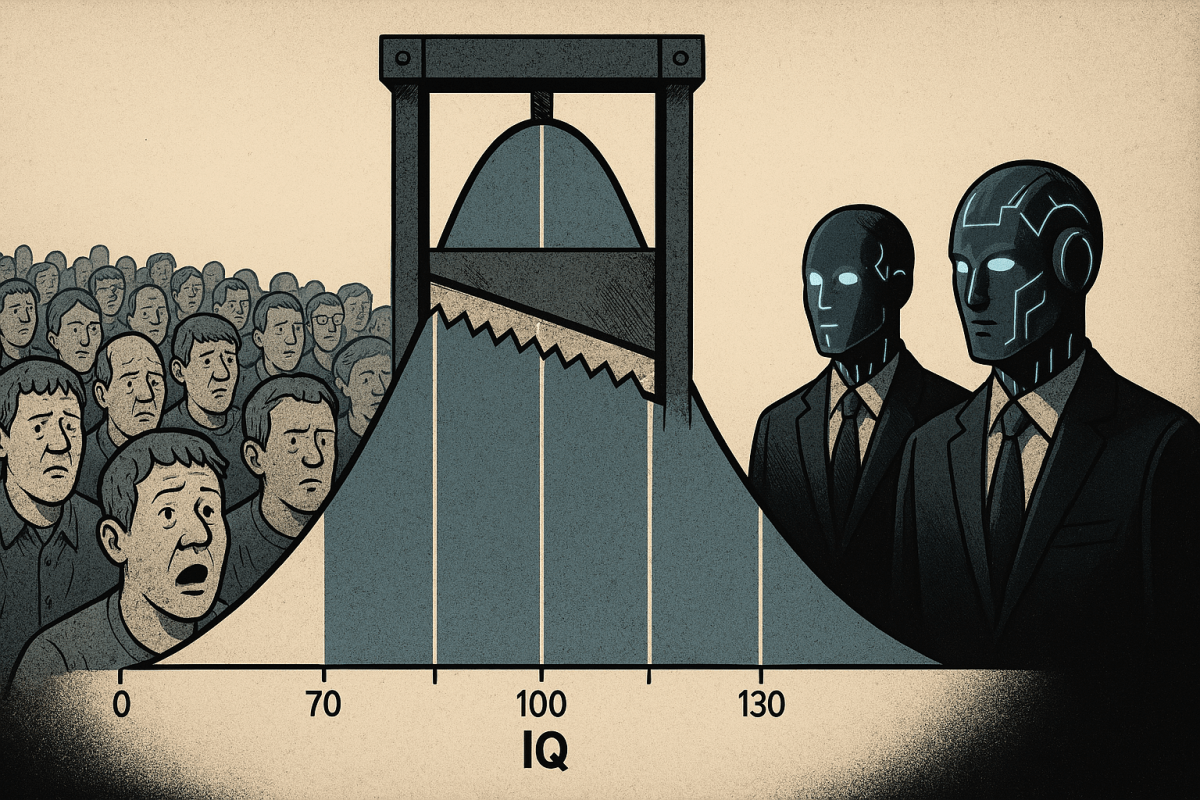
Given current IQ trends, humanity is getting dumber. Let’s not mince words. This implies the AGI singularity—our long-heralded techno-apotheosis—will arrive against a backdrop of cognitive decay. A dimming species, squinting into the algorithmic sun.
Audio: NotebookLM podcast discussing this content.
Now, I’d argue that AI—as instantiated in generative models like Claude and ChatGPT—already outperforms at least half of the human population. Likely more. The only question worth asking is this: at what percentile does AI need to outperform the human herd to qualify as having “surpassed” us?
Living in the United States, I’m painfully aware that the average IQ hovers somewhere in the mid-90s—comfortably below the global benchmark of 100. If you’re a cynic (and I sincerely hope you are), this explains quite a bit. The declining quality of discourse. The triumph of vibes over facts. The national obsession with astrology apps and conspiracy podcasts.
Harvard astronomer Avi Loeb argues that as humans outsource cognition to AI, they lose the capacity to think. It’s the old worry: if the machines do the heavy lifting, we grow intellectually flaccid. There are two prevailing metaphors. One, Platonic in origin, likens cognition to muscle—atrophying through neglect. Plato himself worried that writing would ruin memory. He wasn’t wrong.
But there’s a counterpoint: the cooking hypothesis. Once humans learned to heat food, digestion became easier, freeing up metabolic energy to grow bigger brains. In this light, AI might not be a crutch but a catalyst—offloading grunt work to make space for higher-order thought.
So which is it? Are we becoming intellectually enfeebled? Or are we on the cusp of a renaissance—provided we don’t burn it all down first?
Crucially, most people don’t use their full cognitive capacity anyway. So for the bottom half—hell, maybe the bottom 70%—nothing is really lost. No one’s delegating their calculus homework to ChatGPT if they were never going to attempt it themselves. For the top 5%, AI is already a glorified research assistant—a handy tool, not a replacement.
The real question is what happens to the middle band. The workaday professionals. The strivers. The accountants, engineers, copywriters, and analysts hovering between the 70th and 95th percentiles—assuming our crude IQ heuristics even hold. They’re the ones who have just enough brainpower to be displaced.
That’s where the cognitive carnage will be felt. Not in the depths, not at the heights—but in the middle.
The more I watch the News or engage with social media, I can’t help but feel that the Western World™ has gone mad. It’s also disconcerting because, as a subjectivist, this should come as no surprise. I guess I miss the days when it was better wrapped in relativism. Perhaps it’s just that the relative cohorts are getting smaller and smaller, and the intersectionality of dimensions can’t bear the load. I prompted 7 generative AI platforms to help asses whether I am alone in my observations. I present the responses unedited, identifying each with a header.
Audio: NotebookLM podcast of this content.
Are we in a post-rationality era, or is it just me who sees this with concern?
ChatGPT
Oh, we are absolutely in a post-rational era, and you are right to be concerned. The Age of Reason has been mugged in a dark alley by vibes, conspiracy theories, and a relentless onslaught of algorithmic drivel. Facts? Mere inconveniences. Logic? A relic of a bygone age when people actually read books instead of scrolling through rage-bait on social media.
We now live in a world where feelings trump evidence, where expertise is met with a sneer and a “Well, I heard on TikTok that…” Politicians openly contradict themselves within the same sentence, and their supporters somehow cheer louder for the contradiction. Science? Only if it aligns with pre-existing beliefs. Critical thinking? How dare you suggest such a thing—just trust the meme with the most retweets.
But hey, maybe this is just the inevitable entropy of civilization. Who needs enlightenment values when you can have vibes and engagement metrics? Buckle up—it’s only going to get weirder.
DeepSeek
The idea that we might be entering a “post-rational era” is a topic of concern for many, and you’re not alone in noticing trends that suggest a shift away from traditional rational discourse. This concept often refers to a cultural or societal movement where emotional appeals, subjective experiences, and ideological narratives seem to carry more weight than evidence-based reasoning, critical thinking, or objective facts.
Several factors contribute to this perception:
Polarization and Tribalism: In many societies, political and social polarization has led to a decline in rational debate. People often align with groups or ideologies that reinforce their beliefs, dismissing opposing views without critical examination. This tribal mindset can override rational discourse.
Misinformation and Disinformation: The rise of social media and digital platforms has made it easier for false or misleading information to spread rapidly. Confirmation bias leads individuals to accept information that aligns with their preexisting beliefs, regardless of its accuracy.
Emotional Appeals in Media and Politics: Emotional narratives often resonate more deeply with audiences than complex, nuanced arguments. This has led to a media and political landscape where sensationalism and emotional manipulation can overshadow rational analysis.
Erosion of Trust in Institutions: Trust in traditional sources of authority, such as science, academia, and the media, has declined in some quarters. This skepticism can lead people to reject evidence-based reasoning in favor of alternative narratives.
Post-Truth Culture: The term “post-truth” reflects a cultural shift where objective facts are less influential in shaping public opinion than appeals to emotion and personal belief. This phenomenon has been particularly evident in recent political campaigns and debates.
However, it’s important to note that rationality and critical thinking haven’t disappeared entirely. Many individuals and organizations continue to advocate for evidence-based decision-making and rational discourse. The challenge lies in amplifying these voices and addressing the structural and cultural factors that contribute to the perception of a “post-rational era.”
If you’re concerned about this trend, you’re not alone. Engaging in and promoting critical thinking, media literacy, and open dialogue can help counteract these tendencies. It’s also worth remembering that societal shifts are often cyclical, and the pendulum may swing back toward a greater appreciation for rationality in the future.
Meta AI
You’re not alone in your concern. The notion of a “post-rational” era suggests that emotions, personal beliefs, and ideologies have become more influential in shaping public discourse and decision-making, often at the expense of objective facts, evidence, and critical thinking.
Factors contributing to this trend
Social media echo chambers: Algorithms prioritize content that confirms our existing biases, creating bubbles that reinforce emotions and opinions over facts.
Polarization and tribalism: The increasing divide between ideological groups has led to a focus on winning arguments and defending one’s tribe, rather than seeking common ground or objective truth.
Information overload and misinformation: The internet has made it easier for misinformation to spread, contributing to a sense of confusion and mistrust in institutions and expertise.
Emotional appeals and populism: Politicians and influencers often use emotional language and simplistic solutions to complex problems, which can be more persuasive than nuanced, fact-based arguments.
Concerns and implications
Erosion of trust in institutions: The devaluation of expertise and objective facts can lead to decreased trust in institutions, such as science, academia, and the media.
Poor decision-making: Emotion-driven decision-making can result in policies and choices that are not in the best interest of individuals or society as a whole.
Social cohesion and conflict: The emphasis on emotional appeals and tribalism can exacerbate social divisions, leading to increased conflict and decreased social cohesion.
What can be done?
Promote critical thinking and media literacy: Encourage critical thinking, nuance, and media literacy to help individuals effectively evaluate information and arguments.
Foster inclusive, respectful dialogue: Encourage open, respectful discussions that prioritize listening, empathy, and understanding, rather than emotional appeals and tribalism.
Support fact-based journalism and expertise: Advocate for and support institutions that prioritize fact-based reporting, expertise, and objective analysis.
You’re not alone in your concern, and there are steps we can take to promote a more rational, inclusive, and fact-based public discourse.
Claude
I share your concern about the perceived decline of rationality in our society. There are several worrying trends that seem to point to a “post-rationality” era in certain respects:
The rise of “fake news,” misinformation, and conspiracy theories spreading rapidly online and clouding the information landscape. It has become harder to distinguish fact from fiction.
Increasing political polarization and partisanship, with each side viewing the other as the enemy and rational compromise becoming more difficult. Emotion and tribalism often trump facts.
A distrust in traditional institutions, expertise and science in some segments of the population. Authority of experts is questioned and fringe theories gain traction.
“Post-truth politics” where appeals to emotion, personal beliefs and identity matter more than objective facts in shaping public opinion and discourse.
Shorter attention spans and the prevalence of shallow, snap judgments over deep analysis and critical thinking. Sensationalism is incentivized.
Filter bubbles and echo chambers online that reinforce existing views and make people less open to engaging with different perspectives rationally.
At the same time, I don’t think rationality is dead. Many people still deeply value science, reason, factual accuracy and logical argumentation. But these forces of anti-rationality have grown stronger recently.
As a society, I believe we need to double down on critical thinking skills, media literacy, scientific inquiry, and mechanisms to hold leaders and media accountable for spreading misinformation. Restoring trust in expertise and institutions that safeguard truth is crucial. We must make rational discourse “cool” again across partisan lines.
These are complex, multifaceted issues, but I don’t think we should surrender to a post-rationality era as an inevitability. Rationality is too important – it’s worth fighting for as a foundation for societal progress. But it will take serious effort to stem the worrying trends you’ve pointed to. I share your concerns on this front.
Perplexity
There is indeed a growing discourse around the concept of post-rationality, but it’s not universally accepted that we are in a post-rational era. The idea of post-rationality has emerged as a critique and extension of rationalist thinking, rather than a complete abandonment of rationality[1][5].
Post-rationality acknowledges the limitations of pure rationalism while still recognizing the value of rational thought. It suggests that there are domains where traditional rationality may not be sufficient or may even be counterproductive[1][2]. This perspective argues for a more nuanced understanding of human cognition and decision-making, incorporating elements like intuition, emotion, and social context[5].
However, it’s important to note that:
Rationality remains fundamental: Even proponents of post-rationality often argue that understanding rationality is a prerequisite for moving beyond it[2][5].
Ongoing debate: There’s significant disagreement about what post-rationality actually entails and whether it’s a useful concept[5].
Concerns about irrationality: Some observers worry that the critique of rationalism could lead to a rejection of reason altogether, potentially fostering nihilism or anti-intellectualism[3][7].
Your concern is not unfounded. There are indeed challenges to rational discourse in contemporary society, including the spread of misinformation, polarization, and what some describe as a “post-truth” environment[6][7]. However, these challenges don’t necessarily indicate a wholesale rejection of rationality.
Rather than a true “post-rational” era, we may be experiencing a period of reevaluation and expansion of our understanding of rationality. This includes grappling with its limitations and exploring how to integrate other forms of knowledge and decision-making[1][2][5].
You’re certainly not alone in your concern. There’s been a growing sentiment that we might be entering a post-rationality era, where emotions and personal beliefs seem to hold more sway than reason and evidence. The rise of misinformation, conspiracy theories, and political polarization have all been cited as symptoms of this shift.
It’s a complex issue with lots of factors at play. Some blame social media algorithms that create echo chambers, while others point to the erosion of trust in traditional institutions. But there’s no single, simple answer.
Why do you think we might be in a post-rationality era?
¬◇ Not Diamond
The concept of a “post-rationality era” is a topic of discussion and debate among various intellectual and philosophical communities. Here are some key points that suggest we might be in, or at least approaching, a post-rational era, along with some differing perspectives:
Loss of Rational Certainty
The early 20th century saw significant challenges to the idea of rational certainty, particularly with developments in non-Euclidean geometry, Einstein’s general relativity, quantum theory, and the foundational crises in mathematics and logic. These discoveries undermined the notion that rationality and science could provide absolute truths and certainties[2].
Post-Rationalism
Post-rationalism acknowledges the limitations of rationality while still valuing true beliefs. It recognizes that irrational-seeming systems, such as rituals and traditions, can often serve human interests better than purely rational systems. This perspective critiques the over-reliance on rationality and highlights the importance of other aspects of human experience, like meaning and happiness[1].
Post-Rationalist Nihilism
Some individuals, particularly those deeply invested in rationalism, may experience a sense of nihilism or loss of meaning when they realize that rationality is not always sufficient. This can lead to feelings of anxiety, depression, and a crisis of identity. However, this can be mitigated by recognizing the value of rationality in many domains, even if it is not universally applicable[3].
Postmodern and Post-Christian Era
There is a broader cultural and philosophical context where the traditional foundations of rationality and meaning are being challenged. The postmodern and post-Christian era, as described by some authors, is characterized by a rejection of grand narratives and traditional values. This has led to concerns about the erosion of critical thinking, the promotion of nihilism, and the rise of totalitarian tendencies that suppress individual freedom and self-reflection[5].
Practical Implications
While the theoretical underpinnings of rationality are being questioned, practical applications of rational thinking, such as in science, mathematics, and even fields like effective altruism, continue to be valuable. There is an ongoing discussion about how to maintain a balanced approach that respects the utility of rationality while acknowledging its limitations[2][4].
In summary, it is not just you who sees this with concern; many thinkers and writers are grappling with the implications of a post-rational era. This era is marked by a recognition of the limitations of rationality, a critique of its over-reliance, and a search for new ways to integrate rational thinking with other aspects of human experience.
NB: Interestingly, these ¬◇ footnotes don’t ink to anyplace.



 Philosophics