Yes, I am still focusing on writing my ontology papers, but I still come up for air. Over lunch, I found this: Jonny Thomson showcasing Judge Coleridge: The Duty. Watch it.
Video: Philosophy Minis: Judge Coleridge: The Duty
This really got my hamster wheel cranking. In fact, it gave me another essay idea mired in formal logic. Yuck, I know.
My brief post here is to share this and ask why I don’t share ‘positive’ posts. Pretty much everything is critical. For one, it’s how my brain works. For two, I don’t really know.
When I see something, I instantly want to tear it apart, not for the sake of malice but because my mind registers it as WTAF?
In short, the judge says that one cannot privilege one’s own life over others. Of course, this got my hamster on steroids, considering the implication: does this invalidate self-defence? Wouldn’t it? 🧐
The answer is yes – but only if Law were tethered to Morality, which it isn’t. This will be my essay. Who knows when I’ll have time to write it? Please, stand by. Cheers.
What are your thoughts? Maybe I’ll share this as a video response on YouTube and TikTok. Time will tell – and it evidently heals all wounds.
Announcement: I’ll be taking a break from posting long-form articles for a while to focus on a project I’m developing. Instead, I’ll share progress summary updates.
Ontological Blindness in Modern Moral Science is a working title with a working subtitle as The Why Semantic Thickness, Measurement, and Reconciliation Go Wrong. No spoilers.
Audio: NotebookLM summary podcast of this topic.
INSERT: I’ve only outlined and stubbed this Ontological blindness project, and I’ve already got another idea. I need to stop reading and engaging with the world.
I was listening to the Audible version of A.J. Ayer’s classic, Language, Truth, and Logic (1936)– not because I had time but because I listen to audiobooks when I work out. Ayer is a Logical Positivist, but I forgive him. He’s a victim of his time. In any case, I noticed several holes in his logic.
Sure, the book was published in 1936, and it is infamous for defending or creating Emotivism, a favourite philosophical whipping boy. I’m an Emotivist, so I disagree with the opposition. In fact, I feel their arguments are either strawmen or already defended by Ayer. I also agree with Ayer that confusing the map of language with the terrain of reality is a problem in philosophy (among other contexts), but it’s less excusable for a language philosopher.
In any case, I have begun a file to consider a new working title, Phenomenal Constraint and the Limits of Ontological Language. I might as well stay in the ontological space for a while. We’ll see where it leads, but first, I need to put the original project to bed.
Every time I commence a project, I create a thesis statement and an abstract to orient me. These may change over the course of a project, especially larger ones – more of an abstract than a thesis. This thesis has already changed a couple of times, but I feel it’s settled now.
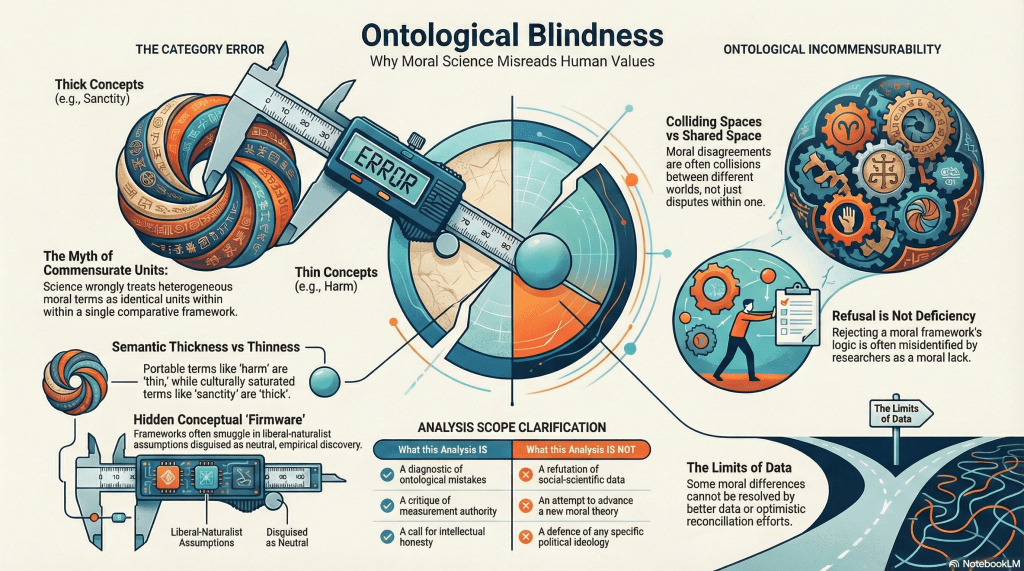
Image: NotebookLM infographic on this topic.
Thesis Statement
Modern moral psychology repeatedly commits a multi-layered category error by treating semantically and ontologically heterogeneous moral terms as commensurate units within a single comparative framework, while simultaneously treating parochial moral metaphysics as natural substrate.
This dual conflation—of semantic density with moral plurality, and of ontological commitment with empirical discovery—produces the false appearance that some moral systems are more comprehensive than others, when it in fact reflects an inability to register ontological incommensurability.
Moral Foundations Theory provides a clear and influential case of this broader mistake: a framework whose reconciliation-oriented conclusions depend not on empirical discovery alone, but on an unacknowledged liberal-naturalist sub-ontology functioning as conceptual ‘firmware’ mistaken for moral cognition itself.
Abstract
Modern moral psychology seeks to explain moral diversity through empirically tractable frameworks that assume cross-cultural comparability of moral concepts. This book argues that many such frameworks – including but not limited to Moral Foundations Theory (MFT) – rest on a persistent category error: the treatment of semantically and ontologically heterogeneous moral terms as commensurate units within a single evaluative space.
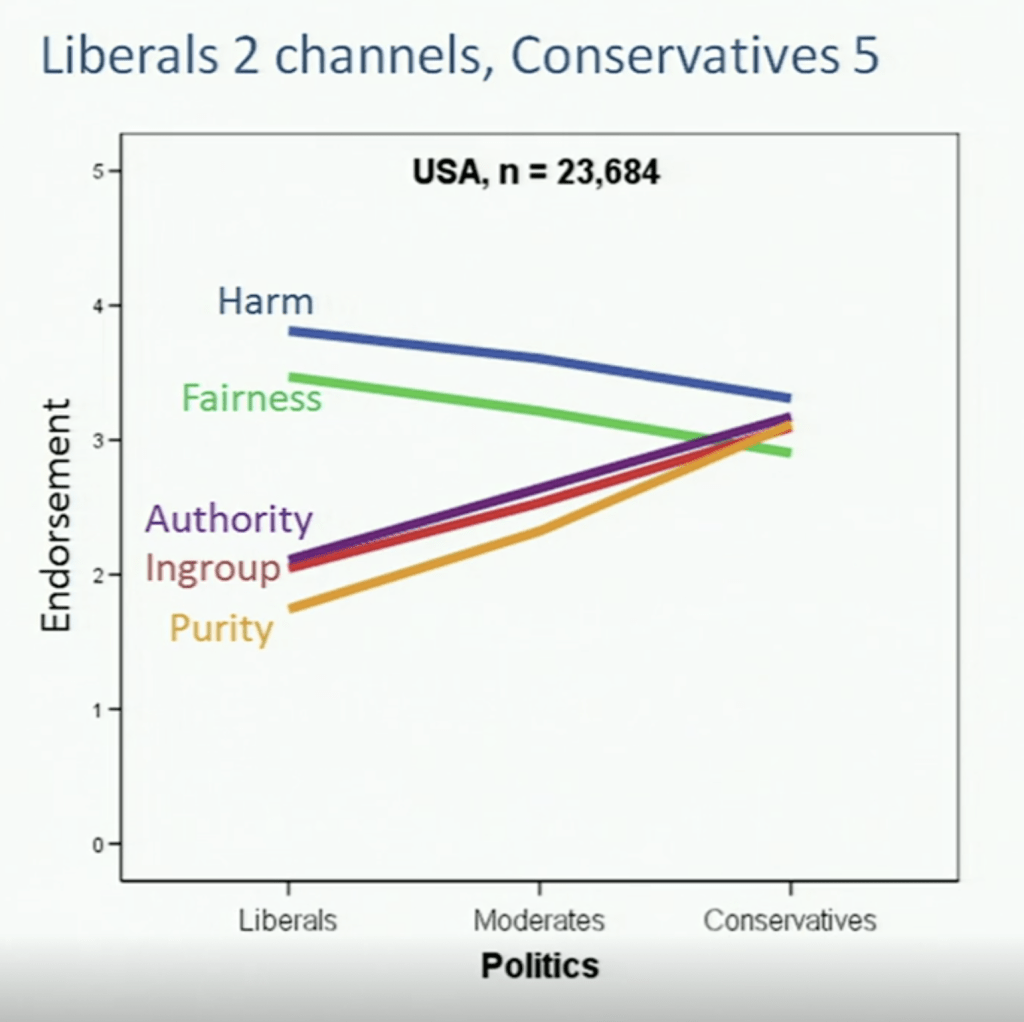
The argument proceeds in four stages. First, it establishes that moral vocabularies differ not merely in emphasis but in semantic thickness: some terms (e.g. harm, fairness) are comparatively thin, portable, and practice-independent, while others (e.g. loyalty, authority, sanctity) are culturally saturated, institution-dependent, and ontologically loaded. Treating these as equivalent ‘foundations’ mistakes density for plurality.
Second, the book shows that claims of moral ‘breadth’ or ‘completeness’ smuggle normativity into ostensibly descriptive research, crossing the Humean is/ought divide without acknowledgement. Third, it argues that this slippage is not accidental but functional, serving modern culture’s demand for optimistic, reconcilable accounts of moral disagreement.
Finally, through sustained analysis of MFT as a worked example, the book demonstrates how liberal naturalist individualism operates as an unacknowledged sub-ontology – conceptual firmware that determines what counts as moral, measurable, and comparable. The result is not moral pluralism, but ontological imperialism disguised as empirical neutrality.
The book concludes by arguing that acknowledging ontological incommensurability does not entail nihilism or relativistic indifference, but intellectual honesty about the limits of moral science and the false comfort of reconciliation narratives.
Ideation
I’ve been pondering ontologies a lot these past few weeks, especially how social ontologies undermine communication. More recently, I’ve been considering how sub-ontologies come into play. A key catalyst for my thinking has been Jonathan Haidt’s Moral Foundations Theory, but I’ve also been influenced by George Lakoff, Kurt Gray, and Joshua Greene, as I’ve shared recently. I want to be clear: This book is not about politics or political science. It intends to about the philosophy of psychology and adjacent topics.
At the highest levels, I see fundamental category errors undermining MFT, but as I inspected, it goes deeper still, so much so that it’s too much to fit into an essay or even a monograph, so I will be targeting a book so I have room to expand and articulate my argumentation. Essays are constraining, and the narrative flow – so to speak – is interrupted by footnotes and tangents.
In a book, I can spend time framing and articulating – educating the reader without presuming an in-depth knowledge. This isn’t to say that this isn’t a deep topic, and I’ll try not to patronise readers, but this topic is not only counterintuitive, it is also largely unorthodox and may ruffle a few feathers.
I’m not sure how much I’ll be able to share, but I’d like to be transparent in the process and perhaps gather some inputs along the way.
Methodology
Sort of… I’ve used Scrivener in the past for organising and writing fiction. This is the first time I’ am organising nonfiction. We’ll see how it goes.
My expanded direction has roots in the works of George Lakoff, Jonathan Haidt, Kurt Gray, and Joshua Greene. These people circle around the problem, even identify it, but then summarily ignore it.
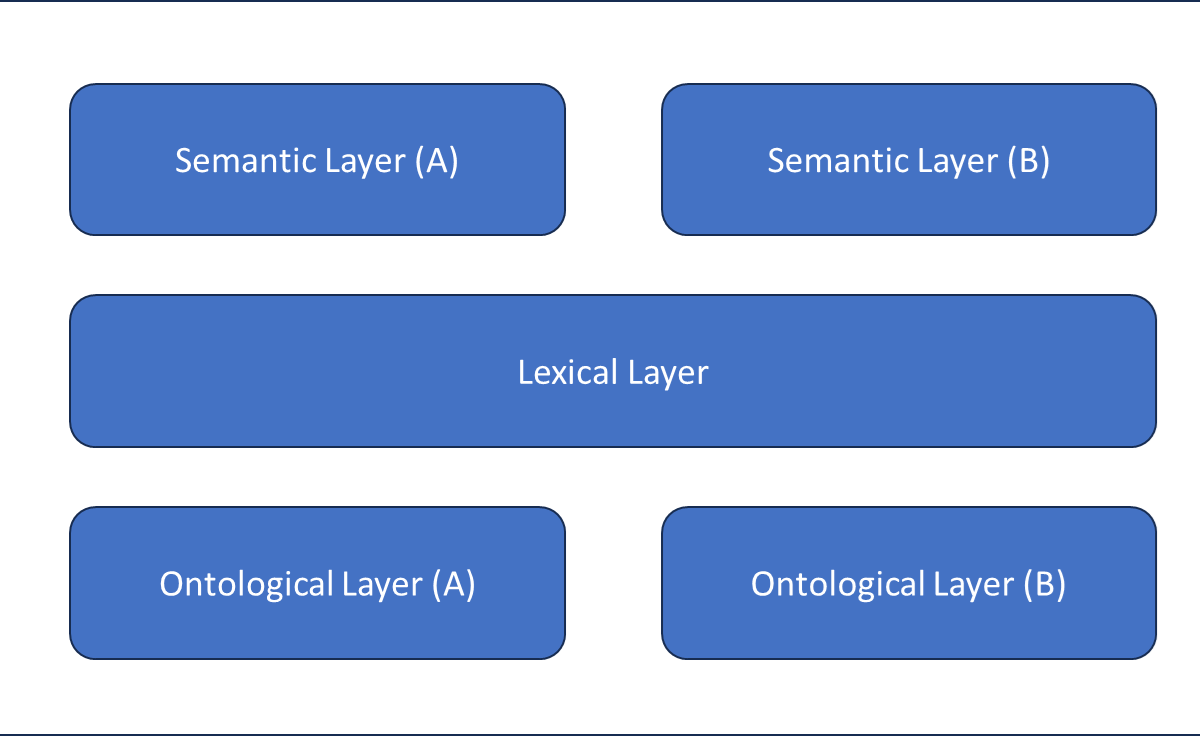
Image: This figure illustrates a simplified layered model of moral and political disagreement. Agents share a common lexical layer, enabling communication and the appearance of mutual understanding. Beneath this surface, however, ontological orientations diverge, structuring salience, legitimacy, and relevance prior to articulation. Semantic interpretation emerges downstream of these ontological commitments, producing divergent meanings despite shared vocabulary. The model highlights why disputes persist even under conditions of factual agreement and linguistic overlap: the instability lies not in words themselves, but in the ontological substrates from which semantic projections are drawn.
It’s more involved than this, but at a 50,000-foot level, it conveys the essence of my hypothesis.
I am also working on this logical expression:
∀ outcomes I(E), ∃ i,j such that Jᵢ ≠ Jⱼ
where,
Jᵢ = f(Oᵢ, E, I, RNG)
Also, in a particular context:
This will all make more sense in time. I’ll be publishing a manuscript as I study supporting research and develop my own perspectives.
Like many apps, especially in the SaaS and PaaS space, ChatGPT offered a year-in-review. Even though I use several generative AI platforms, ChatGPT and Claude are my top two, followed by Gemini, Grok, DeepSeek, Perplexity, and Mistral – in that order. I also like Kimi K2. I am not a fan of Meta Llama or Qwen.
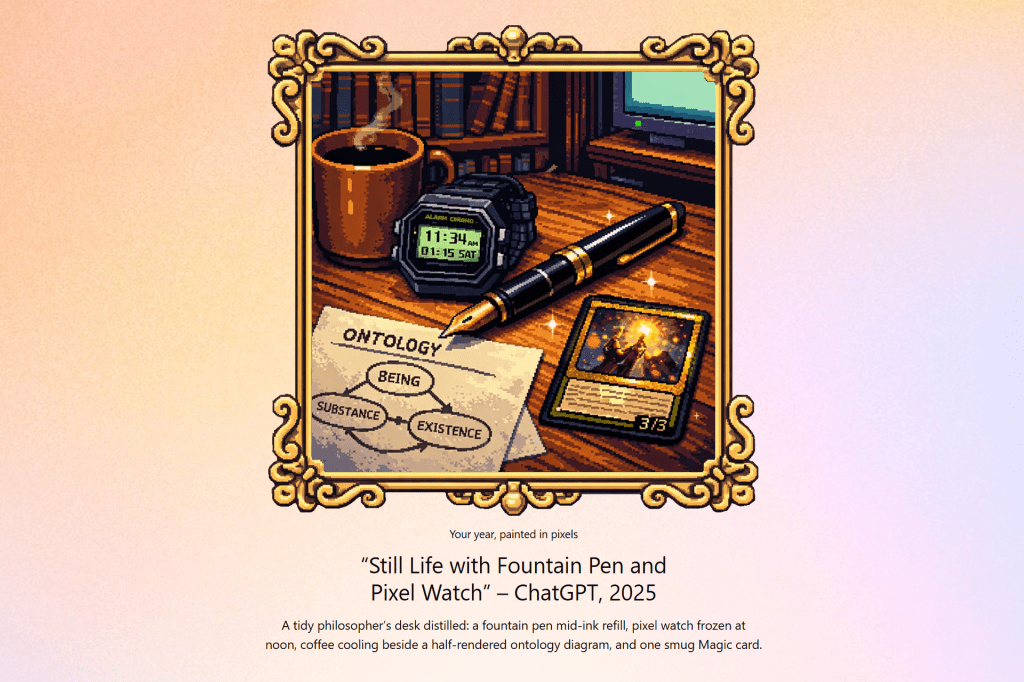
Image: Except for the coffee, this isn’t half bad. Image: 2025 ChatGPT Chat Stats
Wow. I sent ChatGPT over 35,000 messages. Since I have a couple of accounts, that’s even more amazing. This is my primary account.
I don’t usually use ChatGPT / Dalle-E for images. Many of these were ChatGPT, offering an image. Still, I used a few.
I had over 1,200 chats. I guess these are actual threads. I tend to create a thread per topic and run it deep, hence the disparity between chats and messages.
Evidently, my sent messages got me into the top 1 per cent of users, and I was one of the first 0.1% of users. I suppose that makes me an early adopter. lol
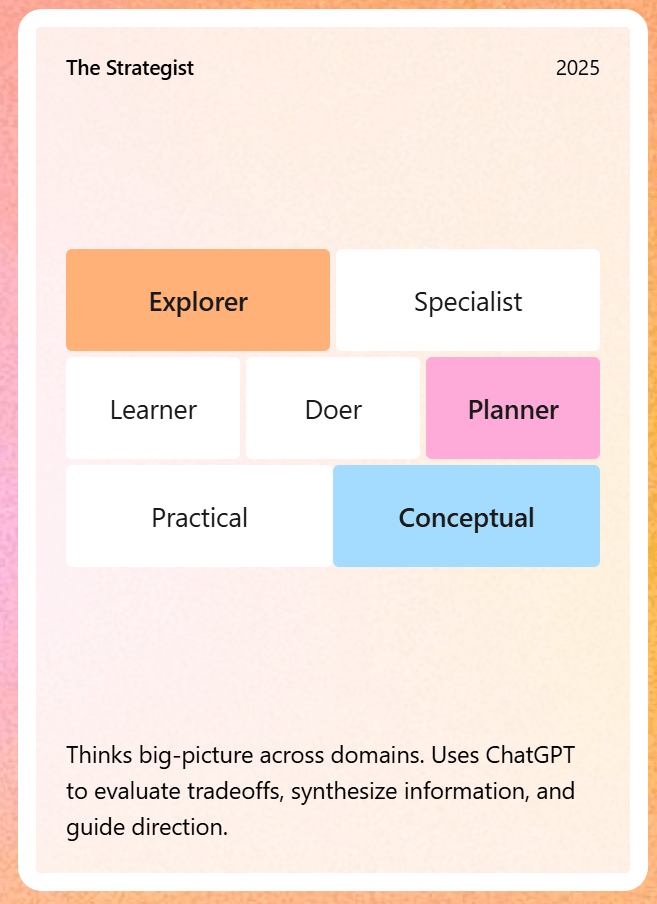
Image: ChatGPT Archetype: The Strategist
I just felt like sharing this silly novelty for no particular reason.
2025 has been a good year for this blog. I’ve crossed the 1,000-post mark, and this year it has had over 30,000 page views – best year ever. This month was the best month ever, and 1st December was the most popular day ever. That’s a lot of ‘evers’.
I shared the remainder of this post on my Ridley Park fiction blog – same reader, same books, same opinion. Any new content added below is in red.
I genuinely loathe top X lists, so let us indulge in some self-loathing. I finished these books in 2026. As you can see, they cross genres, consist of fiction and non-fiction, and don’t even share temporal space. I admit that I’m a diverse reader and, ostensibly, writer. Instead of just the top 5. I’ll shoot for the top and bottom 5 to capture my anti-recommendations. Within categories are alphabetical.
Fiction
Never Let Me Go by Kazuo Ishiguro – A slow reveal about identity, but worth the wait.
This was very philosophical and psychological. Nothing appeared to happen until chapter 7, as I recall. I felt like I was just eavesdropping on some school chums, which I was. Then came the big reveal.
Notes from Underground by Fyodor Dostoevsky – Classic unreliable narrator.
Again, philosophical, psychological. I liked it.
There Is No Antimemetics Division by QNTM (AKA Sam Hughes) – Points for daring to be different and hitting the landing.
This, I read because I was attracted to the premise of memory as it might affect language. It touched on this a tad, but it was mostly about memory, anti-memory, and constructed selves. How can one experience a contiguous, diachronic self with memory gaps? It never quite got that deep, that on occasion it did, as far as I recall.
Trainspotting by Irvine Welsh – Scottish drugs culture and bonding mates narrative.
This is an age-old cult classic – much better than the already excellent films. Fills in what the film cut for its medium. I read several other Welsh books. Filth was an honourable mention, which I also made connexions to Antimemetics, above.
We by Yevgeny Zamyatin – In the league of 1984 and Brave New World, but without the acclaim.
This flagged a tad at the end, but it was prescient and released in 1922, decades before 1984 and Brave New World. Worth the read.
Nonfiction
Capitalist Realism by Mark Fisher – Explains why most problems are social, not personal or psychological. Follows Erich Fromm’s Sane Society, which I also read in 2025 and liked, but it fell into the ‘lost the trail’ territory at some point, so it fell off the list.
Moral Politics by George Lakoff
Evidently, I forgot to explain myself in my prior post. I refer to this book and its trade counterpart, Don’t Think of an Elephant, which is more of a political polemic, but still worth the read. It’s also shorter. This is about Moral politics – duh! – but it’s about moral language. It was a precursor to Jonathan Haidt’s The Righteous Mind: Why Good People Are Divided by Politics and Religion or Kurt Gray’s Outraged! I found Haidt’s work interesting but reductive; I found Gray’s work merely reductive.
This said, Lakoff and Haidt were the vector through which I came upon my language ontology theory that further confounds language insufficiency. To be sure, Haidt was an unnecessary point, but it did emphasise it. Haidt’s frameworks also give me something to riff on.
Technofeudalism by Yanis Varoufakis – Explains why Capitalism is already dead on arrival.
Nothing much to add here. Technofeudalism is economic fare, albeit with philosophical implications. I enjoyed it. Yanis is also an interesting speaker.
NB: Some of the other books had great pieces of content, but failed as books. They may have been better as essays or blog posts. They didn’t have enough material for a full book. The Second Sex had enough for a book, but then Beauvoir poured in enough for two books. She should have quit whilst she was ahead.
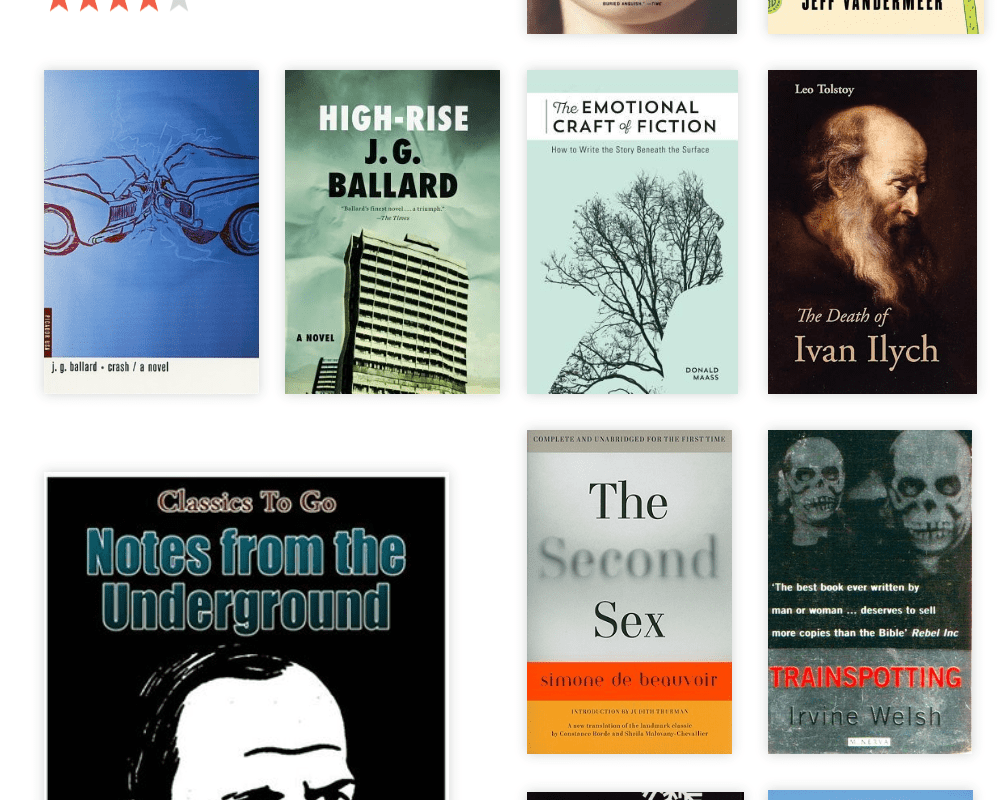
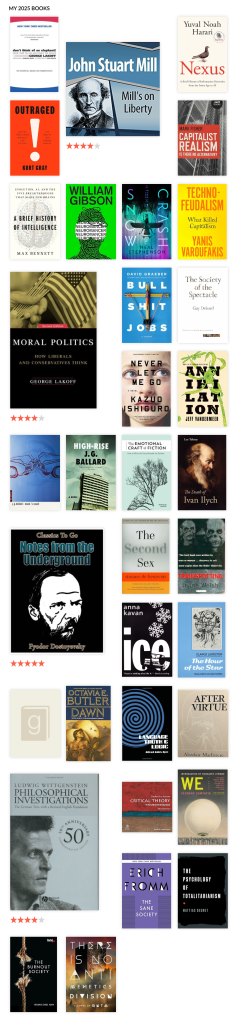
Image: Books I read in 2025 on Goodreads. Full disclosure: I don’t always record my reading on Goodreads, but I try.
Bottom of the Barrel
Crash by J.G. Ballard – Hard no. I also didn’t like High-rise, but it was marginally better, and I didn’t want to count an author twice.
Nah. I felt he was trying to hard for shock value. It didn’t shock, but it put me off. At least High-rise represented an absurd cultural microcosm. I just wanted the story to be over. Luckily, I read both of these sequentially whilst on holiday, so I wasn’t looking to ingest anything serious.
Neuromancer by William Gibson – I don’t tend to like SciFi. This is a classic. Maybe it read differently back in the day. Didn’t age well.
Nexus by Yuval Harari – Drivel. My mates goaded me into reading this. I liked Sapiens. He’s gone downhill since then. He’s a historian, not a futurist.
Outraged! by Kurt Gray – Very reductionist view of moral harm, following the footsteps of George Lakoff and Jonathan Haidt.
See comments above. ☝️
Society of the Spectacle by Guy Debord – A cautionary tale on why writing a book on LSD may not be a recipe for success.
Honourable Mention
Annihilation by Jeff VanderMeer was also good, but my cutoff was at 5. Sorry, Jeff.
I did like this, and it was much better than the Natalie Portman film adaptation. This is the first book in a trilogy. I absolutely hated the second instalment. The third was not as good as the first, but it tried to get back on track from the derailment of the second. As I wrote in public reviews, the second book could have been a prologue chapter to the third book with all of the relevant information I cared about. You could skip the second story with almost no material effect on the story or character arcs.
Just a quick note. Podcast summaries are typically available ahead of Philosophics blog posts.
I have NotebookLM summarise the posts after I write them, but I try (and occasionally fail) to only post one blog post per day – today among the exceptions. So, if I schedule a blog post for a future time, the audio summary is likely already available a day or more in advance.
I believe that some people only read the blog or listen to the podcasts, but not both. As a former educator, I understand that people have preferred attention modalities. I also know that people have practical constraints.
I am an avid reader. Nowadays, most of my reading is online, but I still buy physical books – and people gift me books – but I listen to audiobooks when I work out. I might opt for a podcast here.
In the spirit of keeping this short, I’ll end it here – perhaps paradoxically, without a podcast summary.
After many requests to speak personally instead of relying on NotebookLM, I’ve pulled together some audiovisual content to introduce myself, share my AI workflow, and talk about some current and future projects.
I keep an eye on the metrics of my various social media outlets, but I don’t always click in. Today, I did, and I noticed a female-dominant listenership.
This is surprising for two reasons.
Most interactions I get are from males – at least people with traditionally male names.
Until now, the split has been reversed.
I am not going to make any assumptions based on these data, but I was, as I said, surprised.
Add to this the age chart, and it shows that the majority of these listeners were between 35 and 44, a majority of whom were female. This is the outlier spike. Other than this, listeners skew toward older males, especially between 45 and 59. This makes intuitive sense to me, given my age, content and interests.
This was an unplanned post. I just wanted to share my surprise. More on unicorns and perspectival realism to follow presently. Please stand by.
NB: Don’t blame me for the cover image. This is Midjourney’s idea of a male and female engaging in a tug-of-war. Are those outfits standard fare? I’m not so sure about the rope physics either. 🧐
Accusations of writing being AI are becoming more common – an irony so rich it could fund Silicon Valley for another decade. We’ve built machines to detect machines imitating us, and then we congratulate ourselves when they accuse us of being them. It’s biblical in its stupidity.
A year ago, I read an earnest little piece on ‘how to spot AI writing’. The tells? Proper grammar. Logical flow. Parallel structure. Essentially, competence. Imagine that – clarity and coherence as evidence of inhumanity. We’ve spent centuries telling students to write clearly, and now, having finally produced something that does, we call it suspicious.
Audio: NotebookLM podcast on this topic and the next one.
My own prose was recently tried and convicted by Reddit’s self-appointed literati. The charge? Too well-written, apparently. Reddit – where typos go to breed. I pop back there occasionally, against my better judgment, to find the same tribunal of keyboard Calvinists patrolling the comment fields, shouting ‘AI!’ at anything that doesn’t sound like it was composed mid-seizure. The irony, of course, is that most of them wouldn’t recognise good writing unless it came with upvotes attached.
Image: A newspaper entry that may have been generated by an AI with the surname Kahn. 🧐🤣
Now, I’ll admit: my sentences do have a certain mechanical precision. Too many em dashes, too much syntactic symmetry. But that’s not ‘AI’. That’s simply craft. Machines learned from us. They imitate our best habits because we can’t be bothered to keep them ourselves. And yet, here we are, chasing ghosts of our own creation, declaring our children inhuman.
Apparently, there are more diagnostic signs. Incorporating an Alt-26 arrow to represent progress is a telltale infraction → like this. No human, they say, would choose to illustrate A → B that way. Instead, one is faulted for remembering – or at least understanding – that Alt-key combinations exist to reveal a fuller array of options: …, ™, and so on. I’ve used these symbols long before AI Wave 4 hit shore.
Interestingly, I prefer spaced en dashes over em dashes in most cases. The em dash is an Americanism I don’t prefer to adopt, but it does reveal the American bias in the training data. I can consciously adopt a European spin; AI, lacking intent, finds this harder to remember.
I used to use em dashes freely, but now I almost avoid them—if only to sidestep the mass hysteria. Perhaps I’ll start using AI to randomly misspell words and wreck my own grammar. Or maybe I’ll ask it to output everything in AAVE, or some unholy creole of Contemporary English and Chaucer, and call it a stylistic choice. (For the record, the em dashes in this paragraph were injected by the wee-AI gods and left as a badge of shame.)
Meanwhile, I spend half my time wrestling with smaller, dumber AIs – the grammar-checkers and predictive text gremlins who think they know tone but have never felt one. They twitch at ellipses, squirm at irony, and whimper at rhetorical emphasis. They are the hall monitors of prose, the petty bureaucrats of language.
And the final absurdity? These same half-witted algorithms are the ones deputised to decide whether my writing is too good to be human.
I created a “Book Club Edition” of Propensity, a Ridley Park book of fiction primarily for the European market – specifically in the UK – though it’s available elsewhere. I altered the cover art. As an author, I also wanted to compare KDP and IngramSpark as printers and distributors.
I find the cover texture on this version interesting, but I don’t have a word to describe it. I like it. There’s a certain je ne sais quoi about it – the texture. I reworked the art to track the second section of the book. The original cover tracks the first section.
Image: Propensity by Ridley Park; original book cover
At least in this proof version, the black ink is not 100% and is streaky. The KDP version is 100% K and solid black. I mightn’t have noticed except that some section division pages were mostly black, and it is quite evident. I don’t discern a difference in the quality of the text itself.
Illusion of Light
The Illusion of Light is a cloth version of a book also available in paperback. I like the cloth-bound. There is a nostalgic elegance about it. It feels durable – more so than a paperback for sure. I’m not sure about versus the case laminate versions. They come off like textbooks to me – not the vibe I am aiming for.








 Philosophics