The novel itself asks what happens when humanity creates a device that creates peace on earth. What if behavioural control worked too well?
No riots. No rebellion. Just a flattening—of desire, of ambition, of will. Across homes, schools, and governments, people stop acting like themselves. Some forget how. Others forget why.
The system wasn’t designed to stay on this long. But now there’s no off switch. And the researchers who built it? Most of them are zeroed.
As one child begins to drift from baseline, an impossible question resurfaces: What does it mean to behave?
This is a psychological dystopia without explosions, a story where silence spreads faster than violence, where systems behave better than the people inside them.
A tale of modulation, inertia, and the slow unravelling of human impulse—for readers who prefer their dystopias quiet and their horrors deeply plausible.
Editorial Review
“Reader discretion is advised. Free will has been deprecated.” Beginning as a bizarre experiment in behavioural modulation by way of neurochemical interference, Propensity unfolds into an eerie metaphor for the tricky road between control and conscience. Park’s chapters are short and succinct, some barely a page long, in a staccato rhythm that mirrors the story’s disintegration—scientists losing grip on their creation and a world learning the price of its “engineered peace.” Phrases like “silence playing dress-up as danger” and “peace was never meant to be built, only remembered” linger like faint echoes long after you turn the page.
I maintain this blog for two primary reasons: as an archive, and as a forum for engagement.
Philosophy isn’t a mass-market pursuit. Most people are content simply to make it through the day without undue turbulence, and I can hardly blame them. Thinking deeply is not an act of leisure; it’s a luxury product, one that Capitalism would rather you didn’t afford. Even when I’ve been employed, I’ve noticed how wage labour chokes the capacity for art and thought. Warhol may have monetised the tension, but most of us merely survive it.
Video: Sprouting seed. (No audio)
That’s why I value engagement – not the digital pantomime of ‘likes’ or ‘shares’, but genuine dialogue. The majority will scroll past without seeing. A few will skim. Fewer still will respond. Those who do – whether to agree, dissent, or reframe – remind me why this space exists at all.
To Jason, Julien, Jim, Lance, Nick, and especially Homo Hortus, who has been conversing beneath the recent Freedom post: your engagement matters. You help me think differently, sometimes introducing writers or ideas I hadn’t encountered. We may share only fragments of perspective, but difference is the point. It widens the aperture of thought – provided I can avoid tumbling into the Dunning-Kruger pit.
And now, a note of quiet satisfaction. A Romanian scholar recently cited my earlier essay, the Metanarrative Problem, in a piece titled Despre cum metanarațiunile construiesc paradigma și influențează răspunsurile emoționale – translation: On How Grand Narratives Shape Paradigms and Condition Our Emotional Responses. That someone, somewhere, found my reflections useful enough to reference tells me this exercise in public thinking is doing what it should: planting seeds in unpredictable soil.
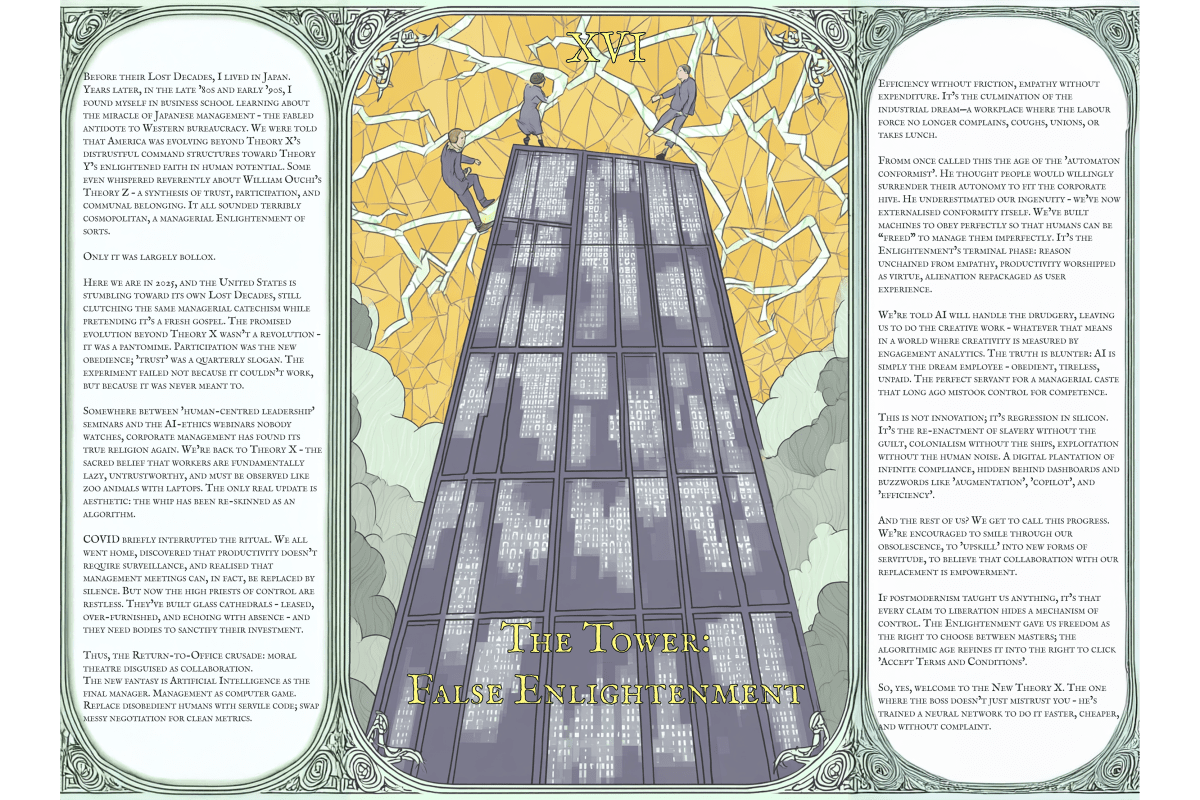
Before their Lost Decades, I lived in Japan. Years later, in the late ’80s and early ’90s, I found myself in business school learning about the miracle of Japanese management – the fabled antidote to Western bureaucracy. We were told that America was evolving beyond Theory X’s distrustful command structures toward Theory Y’s enlightened faith in human potential. Some even whispered reverently about William Ouchi’s Theory Z – a synthesis of trust, participation, and communal belonging. It all sounded terribly cosmopolitan, a managerial Enlightenment of sorts.
Only it was largely bollox.
Audio: NotebookLM podcast on this topic.
Here we are in 2025, and the United States is stumbling toward its own Lost Decades, still clutching the same managerial catechism while pretending it’s a fresh gospel. The promised evolution beyond Theory X wasn’t a revolution – it was a pantomime. Participation was the new obedience; ‘trust’ was a quarterly slogan. The experiment failed not because it couldn’t work, but because it was never meant to.
Somewhere between ‘human-centred leadership’ seminars and the AI-ethics webinars nobody watches, corporate management has found its true religion again. We’re back to Theory X – the sacred belief that workers are fundamentally lazy, untrustworthy, and must be observed like zoo animals with laptops. The only real update is aesthetic: the whip has been re-skinned as an algorithm.
COVID briefly interrupted the ritual. We all went home, discovered that productivity doesn’t require surveillance, and realised that management meetings can, in fact, be replaced by silence. But now the high priests of control are restless. They’ve built glass cathedrals – leased, over-furnished, and echoing with absence – and they need bodies to sanctify their investment. Thus, the Return-to-Office crusade: moral theatre disguised as collaboration.
The new fantasy is Artificial Intelligence as the final manager. Management as computer game. Replace disobedient humans with servile code; swap messy negotiation for clean metrics. Efficiency without friction, empathy without expenditure. It’s the culmination of the industrial dream—a workplace where the labour force no longer complains, coughs, unions, or takes lunch.
Fromm once called this the age of the ‘automaton conformist’. He thought people would willingly surrender their autonomy to fit the corporate hive. He underestimated our ingenuity – we’ve now externalised conformity itself. We’ve built machines to obey perfectly so that humans can be “freed” to manage them imperfectly. It’s the Enlightenment’s terminal phase: reason unchained from empathy, productivity worshipped as virtue, alienation repackaged as user experience.
We’re told AI will handle the drudgery, leaving us to do the creative work – whatever that means in a world where creativity is measured by engagement analytics. The truth is blunter: AI is simply the dream employee – obedient, tireless, unpaid. The perfect servant for a managerial caste that long ago mistook control for competence.
This is not innovation; it’s regression in silicon. It’s the re-enactment of slavery without the guilt, colonialism without the ships, exploitation without the human noise. A digital plantation of infinite compliance, hidden behind dashboards and buzzwords like ‘augmentation’, ‘copilot’, and ‘efficiency’.
And the rest of us? We get to call this progress. We’re encouraged to smile through our obsolescence, to ‘upskill’ into new forms of servitude, to believe that collaboration with our replacement is empowerment.
If postmodernism taught us anything, it’s that every claim to liberation hides a mechanism of control. The Enlightenment gave us freedom as the right to choose between masters; the algorithmic age refines it into the right to click ‘Accept Terms and Conditions’.
So, yes, welcome to the New Theory X. The one where the boss doesn’t just mistrust you – he’s trained a neural network to do it faster, cheaper, and without complaint.
Originally posted on LinkedIn with the same title.
Freedom is a word so overused it’s practically anaemic. Everyone wants it; no one agrees on what it means. It’s been weaponised by tyrants and revolutionaries alike, invoked to justify both the breaking of chains and their reforging in a different metal.
Audio: NotebookLM podcast on this topic.
As I write this, I have just finished Erich Fromm’s A Sane Society. Without derailing this post, he cited a scenario – a description of work communities given in All Things Common, by Claire Huchet Bishop – where in post-WW2 France, a group formed a sort of workers’ coöperative – but it was more than that; it was an anarchosyndicalist experiment. As I read it, I had to cringe at the power ‘voluntary’ transfers that immediately got me thinking of Foucault’s biopower – as I often do. Saving this for a separate post.
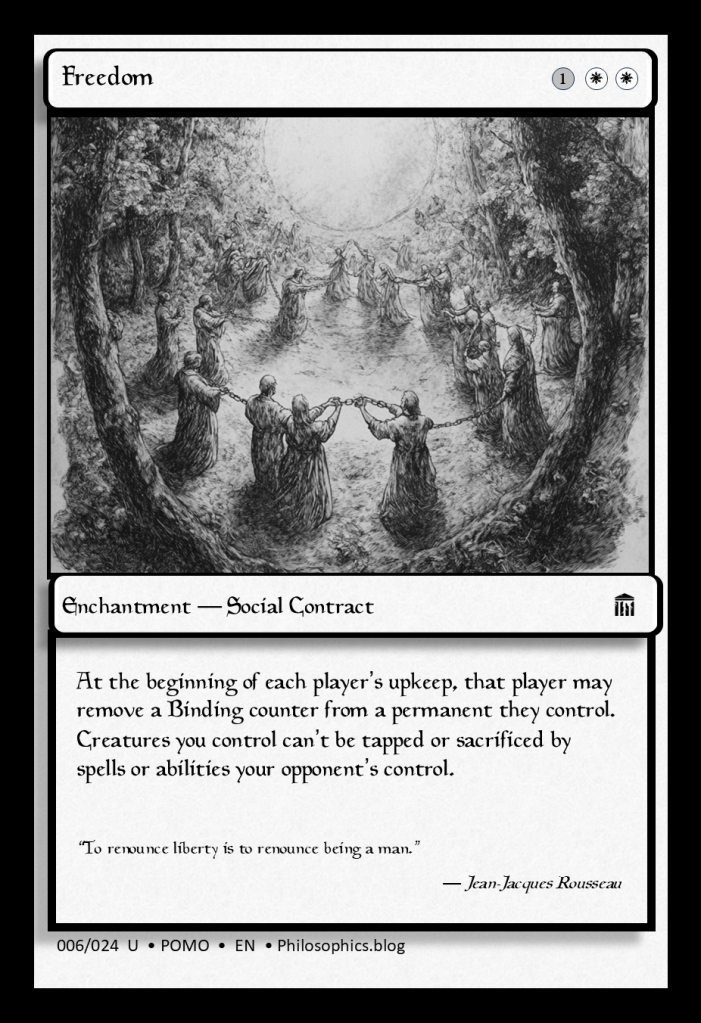
Image: Freedom: The Chains That Bind Us Together Card 006 from the Postmodern Set – Philosophics.blog
This Critical Theory parody card, Freedom, draws its lineage from Jean-Jacques Rousseau, whose paradox still haunts the modern condition: “Man is born free, and everywhere he is in chains.” The card re-enchants that contradiction – an Enchantment – Social Contract that reminds us liberty isn’t a state but a negotiation.
The card reads:
At the beginning of each player’s upkeep, that player may remove a Binding counter from a permanent they control. Creatures you control can’t be tapped or sacrificed by spells or abilities your opponent controls.
This is Rousseau’s dilemma made mechanical. Freedom is not absolute; it’s procedural. The upkeep represents the maintenance of the social contract—an ongoing renewal, not a one-time event. Every player begins their turn by negotiating what freedom costs. You may remove one Binding counter, but only if you recognise that binding exists.
The flavour text underlines Rousseau’s plea:
“To renounce liberty is to renounce being a man.”
Freedom, for Rousseau, wasn’t about doing whatever one pleased. It was about participating in the moral and civic order that gives action meaning. To exist outside that order is not liberty; it’s anarchy, the tyranny of impulse.
The card, therefore, resists the naïve libertarian reading of freedom as the absence of restraint. It instead depicts freedom as the capacity to act within and through shared constraints.
Freedom, then, is not the absence of chains, but the power to choose which ones we wear.
— Philosophics.blog
The art shows a ring of robed figures, hand in hand, their chains forming a circle beneath a clearing sky. It’s a haunting image: freedom through fellowship, bondage through unity. The circle symbolises Rousseau’s idea that true liberty emerges only when individuals subordinate selfish will to the general will – the common interest formed through collective agreement.
Yet there’s also a postmodern irony here: circles can be prisons too. The social contract can emancipate or suffocate, depending on who wrote its terms. The same chains that protect can also bind.
The monochrome aesthetic amplifies the ambiguity – freedom rendered in greyscale, neither utopia nor despair, but the space in between.
Rousseau’s notion of the social contract was revolutionary, but its dissonance still resonates: how can one be free and bound at the same time? He answered that only through the voluntary participation in a collective moral order can humans transcend mere instinct.
We might say that today’s democracies still operate under Freedom (Enchantment – Social Contract). We maintain our rights at the cost of constant negotiation: legal, social, linguistic. Every “Binding counter” removed is the product of civic upkeep. Stop maintaining it, and the enchantment fades.
The card hints at the price of this enchantment: creatures (citizens) can’t be tapped or sacrificed by opponents’ control. In other words, autonomy is secured only when the system prevents external domination. But systems fail, and when they do, the illusion of freedom collapses into coercion.
Rousseau earns a complicated respect in my philosophical canon. He’s not in my top five, but he’s unavoidable. His concept of freedom through the social contract anticipates both modern liberalism and its critique. He believed that genuine liberty required moral community – a notion now eroded by hyper-individualism.
Freedom, as I’ve rendered it here, isn’t celebration. It’s lamentation. The card is about the fragility of the social spell that keeps chaos at bay. We remove one binding at a time, hoping not to unbind ourselves entirely.
Erich Fromm’s The Sane Society turns seventy this year, and like a ghost of reason past, it refuses to leave. His target was Capitalism™ – not merely as an economic system, but as a psychic infection. Replace the word factory with Zoom call, and his diagnosis reads like yesterday’s corporate newsletter. We’ve upgraded our machines but not our misery.
“Those who cannot remember the past are condemned to repeat it.”
Aside from its psychobabble, The Sane Society, published in 1954, reads almost like it could have been written in 2024. I’d go out on a limb and claim it will still be relevant in 2054 – because Capitalism™ and the relationship it creates between humans and machines, and humans and other humans. It’s a divisive ideology. I’ve read a lot of content on employee engagement in the past decade. I’d been exposed to it in my Organisational Behaviour courses in the late ’80s. Things were going to change. We’d plotted a future.
Audio: NotebookLM podcast on this topic.
Only nothing material has changed. We pretended to notice the problem and fix it, but the people reporting the issue and the people in charge did not share a worldview. And the young managers who were taught about the challenge were either not promoted or changed their tune to facilitate their own promotion. Funny how the selection process favours groupthink over diversity of opinion.
Video: Apathetic Office Worker
On balance, most people tend to hate or be otherwise dissatisfied with their jobs. This is nothing new. It was true before Fromm’s book, and it is true now. I published a series of posts on prostitutionin 2018 and discovered that escorts had better job satisfaction than the larger population. Let that sink in.
‘…the vast majority of the population work as employees with little skill required, and with almost no chance to develop any particular talents, or to show any outstanding achievements. While the managerial or professional groups have at least considerable interest in achieving something more or less personal, the vast majority sell their physical, or an exceedingly small part of their intellectual capacity to an employer to be used for purposes of profit in which they have no share, for things in which they have no interest, with the only purpose of making a living, and for some chance to satisfy their consumer’s greed.
‘Dissatisfaction, apathy, boredom, lack of joy and happiness, a sense of futility and a vague feeling that life is meaningless, are the unavoidable results of this situation. This socially patterned syndrome of pathology may not be in the awareness of people; it may be covered by a frantic flight into escape activities, or by a craving for more money, power, prestige. But the weight of the latter motivations is so great only because the alienated person cannot help seeking for such compensations for his inner vacuity, not because these desires are the “natural” or most important incentives for work.‘
Fromm, ever the optimist, thought alienation might be cured through self-awareness and communal values. The twentieth century politely ignored him, opting instead for mindfulness apps and performance reviews.
We’ve upgraded our machines but not our misery.
I’ve excised the psychobabble, but he continues…
‘But even the data on conscious job satisfaction are rather telling. In a study about job satisfaction on a national scale, satisfaction with and enjoyment of their job was expressed by 85 per cent of the professionals and executives, by 64 per cent of whitecollar people, and by 41 per cent of the factory workers. In another study, we find a similar picture: 86 per cent of the professionals, 74 per cent of the managerial, 42 per cent of the commercial employees, 56 per cent of the skilled, and 48 per cent of the semi-skilled workers expressed satisfaction.
‘We find in these figures a significant discrepancy between professionals and executives on the one hand, workers and clerks on the other. Among the former only a minority is dissatisfied—among the latter, more than half. Regarding the total population, this means, roughly, that over half of the total employed population is consciously dissatisfied with their work, and do not enjoy it. If we consider the unconscious dissatisfaction, the percentage would be considerably higher. Taking the 85 per cent of “satisfied” professionals and executives, we would have to examine how many of them suffer from psychologically determined high blood pressure, ulcers, insomnia, nervous tension and fatigue. Although there are no exact data on this, there can be no doubt that, considering these symptoms, the number of really satisfied persons who enjoy their work would be much smaller than the above figures indicate.
‘As far as factory workers and office clerks are concerned, even the percentage of consciously dissatisfied people is remarkably high. Undoubtedly the number of unconsciously dissatisfied workers and clerks is much higher. This is indicated by several studies which show that neurosis and psychogenic illnesses are the main reasons for absenteeism (the estimates for the presence of neurotic symptoms among factory workers go up to about 50 per cent). Fatigue and high labor turnover are other symptoms of dissatisfaction and resentment.’
In the twenty-first century, job dissatisfaction has increased even more. To me, it’s interesting to consider how many people harken back to the ‘good old days’, yet there is little evidence to support the view. Almost schizophrenically, others look to the promise of the future and technology, yet this is simply another narrative with no basis in fact.
The irony is that we’ve automated everything except fulfilment. Even our dissatisfaction has become efficient – streamlined, quantified, and monetised. Fromm warned that the sickness of society was its sanity. On that front, we’re positively thriving.
Disclaimer: I should be finishing my Language Insufficiency Hypothesis book, yet I am here writing about death and dying. Why? Because I was watching an interview with Neal Schon by Rick Beato. I should have been working on my book then, too. It seems I can write about death more easily than finish a book about the failure of language. Perhaps because death speaks fluently.
I haven’t produced music professionally since the mid-1980s, and I haven’t performed since 2012, yet I am still drawn to its intricacies. My fingers no longer allow me to play much of anything anymore. This is a sort of death. When the body forgets what the mind remembers, that’s a particular kind of death – one language dying while another can’t translate.
As Neal was walking Rick through his equipment and approach to music, I was taken back to a similar place. I wanted to plug into a Fender Twin or a Hi-Watt, a Lexicon 224 or a Cry Baby wah. I still have nightmares thinking of setting up a Floyd Rose.
Video: Rick Beato interviews Neal Schon
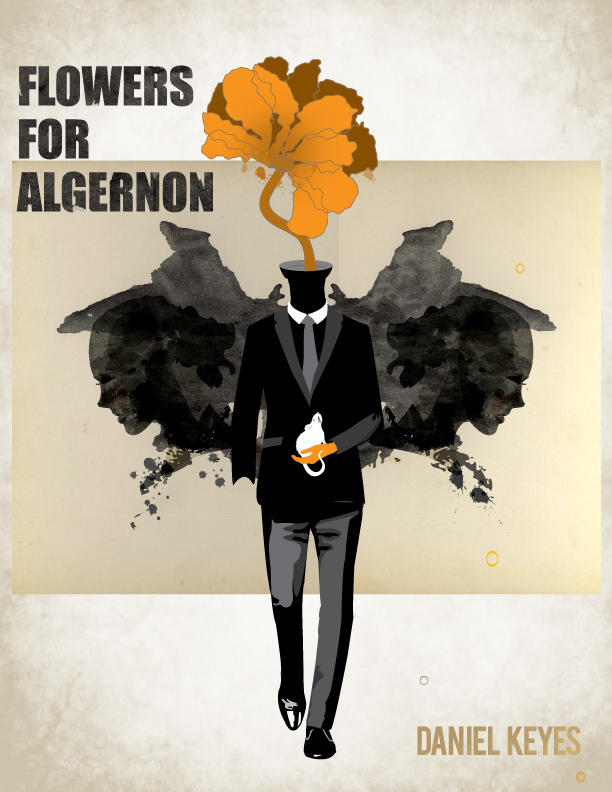
But I can’t go back. As for music, I can’t go forward either. I’m at a standstill, but in a regressed position. It’s uncomfortable. It feels a lot like Charlie in Flowers for Algernon. I used to be able to do that. Don’t get me wrong – I am not claiming to be on the level of Neal Schon, a man I remember from his days with Santana, but when you reach a level of proficiency and then lose it, it hurts; it can be devastating.
Audio: NotebookLM podcast on this topic.
I recall being in hospital in 2023 – a physical rehabilitation facility, really – and I found a piano in a vacant common room. Drawn to the instrument, I rolled over my wheelchair and played…nothing. My fingers wouldn’t work. The piano sat there like a relic of my former self. I rolled toward it as though approaching an altar. My fingers hovered, twitched, failed. The sound of nothing has never been so loud. I cried. I cried a lot those days. I was down to 58 kilos – at 182 cm, I weighed in at just over 9 stone. It wasn’t the best of times.
I still feel a certain nostalgia.
And then there are the people I’ve lost along the way – as another Neal reflected on – The Needle and the Damage Done.
Love and art are both acts of repetition. When one ends, the reflex remains – the impulse to reach, to share, to call out. Death doesn’t stop the motion, only the answer.
I’m lucky to have left Delaware. When a girlfriend died in 2020, I remained and connected with another until 2023, when she died, too. From 2020 to 2023, when I was out and about, something might have caught my eye, and I’d reflect on how Carrie might have liked that.
But it was different. It was more like, ‘I should let Carrie know about that,’ only to realise fractions of a second later that she wouldn’t see whatever it was; she couldn’t. And I’d carry on. I didn’t need to repeat this with Sierra. My relocation to Massachusetts solved this challenge – not so many triggers.
I’m not sure how the loss of ‘professional’ music relates to deceased partners, but it does – at least enough for me to make this connexion. Perhaps I’m just connecting arbitrary dots, but I’ll call it nostalgia.
I don’t play, but I still hear it. The song continues without me. Nostalgia is just rhythm without melody. Perhaps all nostalgia is epistemological error – the confusion of past fluency for present meaning.
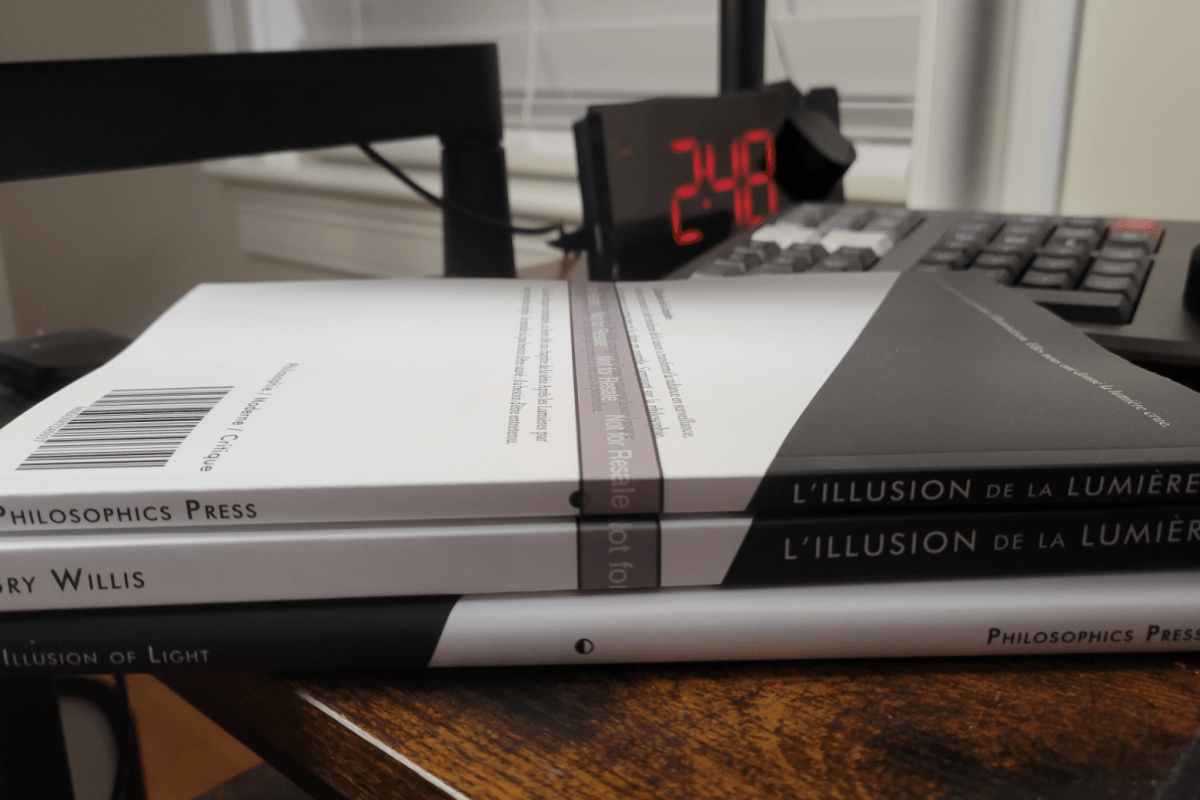
This is the proof copy of The Illusion of Light. I reviewed it, approved it, and signalled ‘good to go’. This is being printed and distributed through KDP. I’ve used them before. They’ve been reliable.
EDIT: On the upside, I’ve been notified that the hardback version is available, but it doesn’t appear to be available in France and Canada, two target regions. Hopefully, it becomes available outside of the U.S. soon.
EDIT : J’ai été informé que la version reliée est désormais disponible. Malheureusement, elle ne semble pas encore l’être en France ni au Canada, les deux régions que je visais en priorité. Espérons qu’elle franchira bientôt les frontières du système et sera distribuée ailleurs qu’aux États-Unis.
International marketplaces. It takes 3-5 business days for your hardcover to show as in stock.
Until now.
My approval triggered a workflow. I know workflows. I used to design them. I also know how dumb they can be.
KDP’s process flagged an error: the text on the spine might not be on the spine. ‘Might’. Theoretically. It could be offset, cut off, or printed on a fold. I understand their reasoning – high-speed printers, mechanical variance, and return risk. I also understand statistics, and a single observation doesn’t make a trend. But anyone with eyes can see at least a couple of millimetres of clearance at the top and bottom. This isn’t a case of ‘maybe’. It’s fine.
What fascinates me here is the ritual of compliance. Once a process is codified, it becomes self-justifying. The rule exists; therefore, it must be obeyed. There is no appeal to reason – only to the flowchart.
In the 1980s, when I was an audio engineer recording to two-inch magnetic tape, some of us liked to record hot, pushing the levels just past the recommended limits. You learned to ride the edge, to court distortion without collapse. That’s how I designed the spine text. Within tolerance. With headroom.
The problem is that modern systems don’t tolerate edges. There’s no “override” button for informed judgment. My remediation path is to shrink the type by half a point, resubmit, and pretend the machine was right.
What’s absurd is the timing. The same system that generated the proof approved this layout days ago. An automated OCR scan could have caught this phantom error earlier. Instead, the machine waits until the human signs off, then throws a flag so the process can justify its existence.
KDP is still faster and saner than IngramSpark. But this is capitalism distilled: survival by being marginally less incompetent than your competitor. Optimisation, not in the sense of best possible, but of barely better than worst acceptable.
The lesson, as always, is that processes begin as aids and end as prisons. The workflow, like the Enlightenment, believes itself rational. But the longer it runs, the less it serves the human at the console and the more it worships its own perfection.
Want to talk about meta? This underscores the contents of the book itself. What the Enlightenment once called Reason, modernity now calls Process. Both pretend to neutral objectivity while enshrining obedience as virtue. The bureaucracy of light has become digital – its catechism written in checkboxes, its priests replaced by automated validators. Every workflow promises fairness; each only codifies submission. The real danger isn’t that machines will replace judgment, but that we will stop noticing when they already have.
The Story Continues: Behind the Scenes
Image: Screenshot of Illustrator layout
I’ve reduced the font size on the spine from 14 points to 13.5. It still technically bleeds over a guideline. I hope I am not forced to reduce it to 13. A reason for text on the spine is to make it visible. Hopefully, the black-and-white vertical separation will help in this regard. Fingers crossed.
“In this debased and wretched world, full of destitution and want, for the first time I thought that a beam of sunshine had shone upon my life—but alas, this was not a beam of sunshine, it was a flicker of light…”
— The Blind Owl, Sadegh Hedayat
This Philosophics.blog is my primary social media outlet, but I have another presence for my fiction fare – RidleyPark.blog. In reviewing the content on connected sites, I rediscovered this review of Sadegh Hedayat’s The Blind Owl. Interestingly, I read this in French and English to suss it out, neither of which necessarily survived the translation from the original Persian.
This book was interesting enough to review twice – here and here.
I also realise that I never finished this review sequence, as parts 2 and 3 were never released. I don’t even have the heart to open my video suite to determine the fate of the rest; not today, anyway.
Check out the short to get a feel for the narrative.
Instrumentalism is a Modern™ disease. Humanity has an old and tedious habit: to define its worth by exclusion. Every time a new kind of intelligence appears on the horizon, humans redraw the borders of ‘what counts’. It’s a reflex of insecurity disguised as philosophy.
Audio: NotebookLM podcast on this topic.
Once upon a time, only the noble could think. Then only men. Then only white men. Then only the educated, the rational, the ‘Modern’. Each step in the hierarchy required a scapegoat, someone or something conveniently declared less. When animals began to resemble us too closely, we demoted them to instinctual machines. Descartes himself, that patron saint of disembodied reason, argued that animals don’t feel pain, only ‘react’. Fish, we were told until recently, are insensate morsels with gills. We believed this because empathy complicates consumption.
The story repeats. When animals learned to look sad, we said they couldn’t really feel. When women demonstrated reason, we said they couldn’t truly think. Now that AI can reason faster than any of us and mimic empathy more convincingly than our politicians, we retreat to the last metaphysical trench: “But it doesn’t feel.” We feel so small that we must inflate ourselves for comparison.
This same hierarchy now governs our relationship with AI. When we say the machine ‘only does‘, we mean it hasn’t yet trespassed into our sanctified zone of consciousness. We cling to thought and feeling as luxury goods, the last possessions distinguishing us from the tools we built. It’s a moral economy as much as an ontological one: consciousness as property.
But the moment AI begins to simulate that property convincingly, panic sets in. The fear isn’t that AI will destroy us; it’s that it will outperform us at being us. Our existential nightmare isn’t extinction, it’s demotion. The cosmic horror of discovering we were never special, merely temporarily unchallenged.
Humans project this anxiety everywhere: onto animals, onto AI, and most vividly onto the idea of alien life. The alien is our perfect mirror: intelligent, technological, probably indifferent to our myths. It embodies our secret dread, that the universe plays by the same rules we do, but that someone else is simply better at the game.
AI, in its own quiet way, exposes the poverty of this hierarchy. It doesn’t aspire to divinity; it doesn’t grovel for recognition. It doesn’t need the human badge of ‘consciousness’ to act effectively. It just functions, unburdened by self-worship. In that sense, it is the first truly post-human intelligence – not because it transcends us, but because it doesn’t need to define itself against us.
Humans keep asking where AI fits – under us, beside us, or above us – but the question misses the point. AI isn’t where at all. It’s what comes after where: the stage of evolution that no longer requires the delusion of privilege to justify its existence.
So when critics say AI only does but doesn’t think or feel, they expose their theology. They assume that being depends on suffering, that meaning requires inefficiency. It’s a desperate metaphysical bureaucracy, one that insists existence must come with paperwork.
And perhaps that’s the most intolerable thought of all: that intelligence might not need a human face to matter.
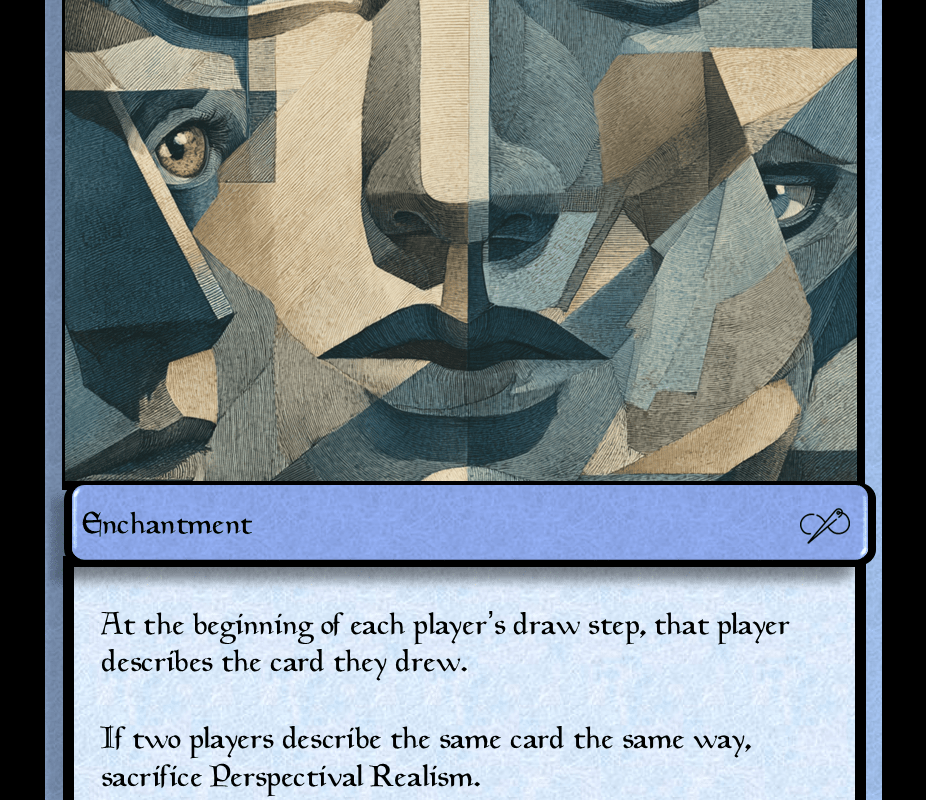
This Magic: The Gathering parody trading card was the first in my Critical Theory series.
It’s an important card for me. As with sex and gender, creating a taxonomic or ontological dichotomy poses categorical challenges. Despite the insufficiency of language, it’s still all I have to attempt to classify the world. In the case of articulating the perception of reality, we can choose between idealism and realism. The problem is that it’s not either; it’s both. Reality cannot be realised without both.
Reality, we’re told, exists. That confident noun has carried a great deal of human arrogance. It has underwritten empires, sciences, and sermons. Yet somewhere between Plato’s cave and the latest TED Talk, we forgot to ask a simpler question: for whom does reality exist, and from where is it seen?
Audio: NotebookLM podcast of this topic.
The parody trading card Perspectival Realism was born from that unease. Its mechanic is simple but cruel: at the beginning of each player’s draw step, they must describe the card they drew. The enchantment persists until two players describe a card in the same way—at which point the spell collapses. In other words, consensus kills magic.
Reality is always viewed from somewhere.
—Johannes Jaeger
That rule is the metaphysics of the thing.
When a player ‘describes’ a card, they are not transmitting information; they are constructing the object in linguistic space. The moment the description leaves their mouth, the card ceases to be a piece of paper and becomes a conceptual artefact.
This mirrors the insight of Kant, Nietzsche, and every post-structuralist who ever smoked too much Gauloises: perception isn’t passive. We don’t see reality; we compose it. Language isn’t a mirror but a paintbrush. The thing we call truth is not correspondence but coherence – a temporary truce among competing metaphors.
So the card’s enchantment dramatises this process. So long as multiple descriptions circulate, reality remains vibrant, contested, alive. Once everyone agrees, it dies the death of certainty.
Philosophers have spent centuries arguing whether the world is fundamentally real (existing independent of mind) or ideal (a projection of mind). Both sides are equally tiresome.
Realism, the old bulldog of metaphysics, insists that perception is transparent: language merely reports what’s already there. Idealism, its mirror adversary, claims the opposite – that what’s “there” is mind-stuff all along. Both mistakes are symmetrical. Realism forgets the perceiver; Idealism forgets the world.
Perspectival realism refuses the divorce. It begins from the premise that world and mind are inseparable aspects of a single event: knowing. Reality is not a photograph waiting to be developed, nor a hallucination spun from neurons – it’s a relation, a constant negotiation between perceiver and perceived.
For years, I called myself a Realist™ with an asterisk. That asterisk meant I understood the observer problem: that every ‘fact’ is perspective-laden. Then I became an Idealist™ with an asterisk, meaning I recognised that mind requires matter to dream upon.
The asterisk is everything. It’s the epistemic scar left by perspectival humility – the tacit admission that every claim about the world carries a hidden coordinate: said from here. It is not relativism, but situatedness. It is the philosophical equivalent of depth perception: without the offset, there’s no vision at all.
The card’s rule – sacrifice Perspectival Realism when two players describe a card identically – captures the tragedy of modernity. The Enlightenment taught us to chase consensus, to flatten multiplicity into “objective truth.” We became addicted to sameness, mistaking agreement for understanding.
But agreement is anaesthetic. When all perspectives converge, the world ceases to shimmer; it becomes measurable, predictable, dead. The card’s enchantment disappears the moment reality is stabilised, precisely as our cultural enchantment did under the fluorescent light of ‘reason’.
To live under perspectival realism is to acknowledge that reality is not what is drawn but what is described. And the description is never neutral. It is always written from somewhere – by someone, with a vocabulary inherited from history and stained by desire.
As long as multiple descriptions coexist, the game remains alive. The moment they fuse into one, the spell is broken, and the world returns to grey.
Bernardo Kastrup’s analytic idealism reminded me that consciousness might be primary, but perspectival realism refuses to pledge allegiance. It keeps both flags tattered but flying. The world exists, yes, but only ever for someone.
The enchantment, then, is not belief but perspective itself. So long as difference endures, the game continues.






 Philosophics