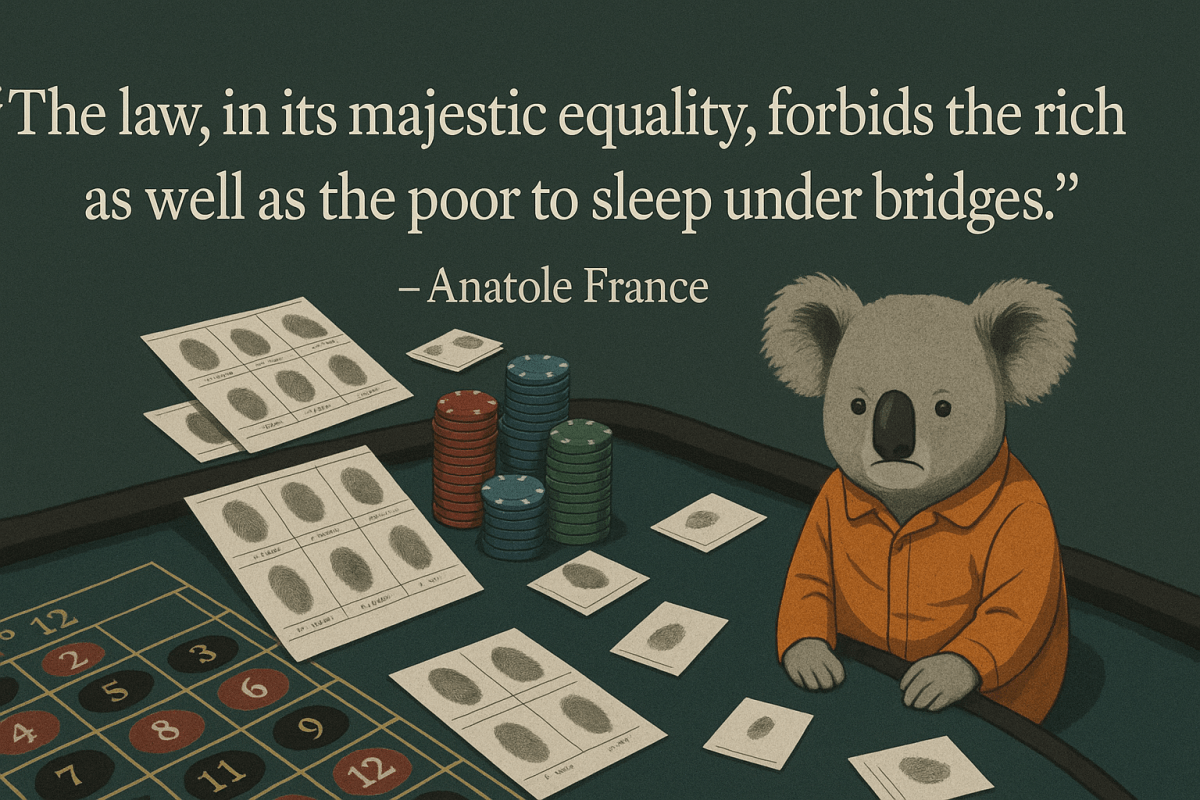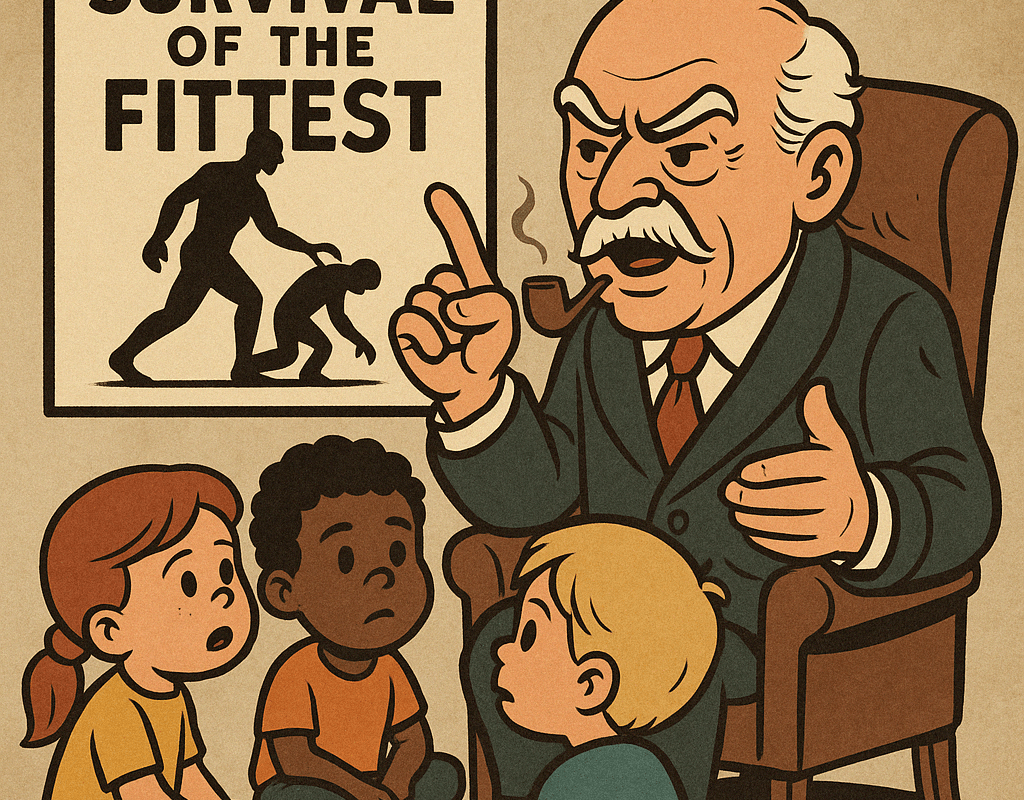
Welcome to the Grand Casino of Justice, where the chips are your civil liberties, the roulette wheel spins your fate, and the house—ever-smug in its powdered wig of procedural decorum—always wins.
Step right up, citizens! Marvel at the dazzling illusions of “science” as performed by your local constabulary: the sacred polygraph, that magnificent artefact of 1920s snake oil, still trotted out in back rooms like a séance at a nursing home. Never mind that it measures stress, not deception. Never mind that it’s been dismissed by any scientist with a functioning prefrontal cortex. It’s not there to detect truth—it’s there to extract confession. Like a slot machine that only pays out when you agree you’re guilty.
Audio: NotebookLM podcast on this topic.
And oh, the forensic pageantry! The blacklight! The dramatic swabs! The breathless invocations of “trace evidence,” “blood spatter patterns,” and—ooh! ahh!—fingerprints, those curly little whorls of manufactured certainty. You’ve been told since childhood that no two are alike, that your prints are your identity. Rubbish. Human fingerprint examiners disagree with themselves when presented with the same print twice. In blind tests. And yes—this bears repeating with appropriate incredulity—koalas have fingerprints so uncannily similar to ours they’ve confused human forensic analysts. Somewhere, a marsupial walks free while a teenager rots in remand.
You see, it’s not about justice. It’s about control. Control through performance. The legal system, like a casino, isn’t interested in fairness—it’s interested in outcome. It needs to appear impartial, all robes and solemnity, while tipping the odds ever so slightly, perpetually, in its own favour. This is jurisprudence as stagecraft, science as set-dressing, and truth as a collateral casualty.
And who are the croupiers of this great charade? Not scientists, no. Scientists are too cautious, too mired in uncertainty, too concerned with falsifiability and statistical error margins. No, your case will be handled by forensic technicians with just enough training to speak jargon, and just enough institutional loyalty to believe they’re doing the Lord’s work. Never mind that many forensic methods—bite mark analysis, tool mark “matching,” even some blood spatter interpretations—are about as scientifically robust as a horoscope printed on a cereal box.
TV crime dramas, of course, have done their bit to embalm these myths in the cultural subconscious. “CSI” isn’t a genre—it’s a sedative, reassuring the public that experts can see the truth in a hair follicle or the angle of a sneeze. In reality, most convictions hinge on shoddy analysis, flawed assumptions, and a little prosecutorial sleight of hand. But the juries are dazzled by the sciencey buzzwords, and the judges—God bless their robes—rarely know a confidence interval from a cornflake.
So, what do you do when accused in the great Casino of Justice? Well, if you’re lucky, you lawyer up. If you’re not, you take a plea deal, because 90% of cases never reach trial. Why? Because the system is designed not to resolve guilt, but to process bodies. It is a meat grinder that must keep grinding, and your innocence is but a small bone to be crushed underfoot.
This isn’t justice. It’s a theatre of probability management, where the goal is not truth but resolution. Efficiency. Throughput. The house keeps the lights on by feeding the machine, and forensic science—real or imagined—is merely the window dressing. The roulette wheel spins, the dice tumble, and your future hangs on the angle of a smudge or the misreading of a galvanic skin response.
Just don’t expect the koalas to testify. They’re wise enough to stay in the trees.
They say no one escapes the Spectacle. Guy Debord made sure of that. His vision was airtight, his diagnosis terminal: we are all spectators now, alienated from our labour, our time, our own damn lives. It was a metaphysical mugging—existence held hostage by images, by commodities dressed in drag. The future was a feedback loop, and we were all doomed to applaud.
Audio: NotebookLM podcast on this topic. Apologies in advance for the narrators’ mangling of the pronunciation of ‘Guy Debord’.
But what if the loop could be hacked? What if the infinitely halved distances of motionless critique—Zeno’s Paradox by way of Marx—could finally be crossed?
Enter: Yanis Varoufakis. Economist, ex-finance minister, techno-cassandra with a motorbike and a vendetta. Where Debord filmed the catastrophe in black-and-white, Varoufakis showed up with the source code.
Debord’s Limbo
Debord saw it all coming. The substitution of reality with its photogenic simulacrum. The slow death of agency beneath the floodlights of consumption. But like Zeno’s paradox, he could only gesture toward the end without ever reaching it. Each critique halved the distance to liberation but never arrived. The Spectacle remained intact, omnipresent, and self-replicating—like an ontological screensaver.
He gave us no path forward, only a beautiful, ruinous analysis. A Parisian shrug of doom.
Varoufakis’ Shortcut
But then comes Varoufakis, breaking through the digital labyrinth not by philosophising the Spectacle, but by naming its successor: Technofeudalism.
See, Debord was chasing a moving target—a capitalism that morphed from industrial to financial to semiotic faster than his prose could crystallise. But Varoufakis caught it mid-mutation. He pinned it to the slab and sliced it open. What spilled out wasn’t capital anymore—it was rent. Platform rent. Algorithmic tolls. Behavioural taxes disguised as convenience. This isn’t the market gone mad—it’s the market dissolved, replaced by code-based fiefdoms.
The paradox is resolved not by reaching utopia, but by realising we’ve already crossed the line—we just weren’t told. The market isn’t dying; it’s already dead, and we’re still paying funeral costs in monthly subscriptions and attention metrics.
From Spectacle to Subjugation
Debord wanted to unmask the performance. Varoufakis realised the theatre had been demolished and replaced with a server farm.
You don’t watch the Spectacle anymore. It watches you. It optimises you. It learns your keystrokes, your pulse rate, your browsing history. Welcome to feudal recursion, where Amazon is your landlord, Google your priest, and Meta your confessor.
Solving Zeno the Varoufakis Way
So how does one cross the infinite regress of alienation? Simple. You call it what it is. You reclassify the terrain.
“This is not capitalism,” Varoufakis says, in the tone of a man pulling a mask off a Scooby-Doo villain. “It’s technofeudalism. Capital didn’t win. It went feudal. Again.”
By doing so, he bypasses the academic ballet that has critics forever inching closer to the truth without touching it. He calls the system new, not to sell books, but to make strategy possible. Because naming a beast is the first step in slaying it.
In Conclusion: Debord Dreamed, Varoufakis Drives
Debord haunts the museum. Varoufakis raids the server room. Both are essential. But only one gives us a new map.
The Spectacle hypnotised us. Technofeudalism enslaves us. And if there’s a way out, it won’t be through slogans spray-painted on Parisian walls. It will be built in code, deployed across decentralised networks, and carried forward by those who remember what it meant to be not watched.
Let Debord whisper. Let Varoufakis roar. And let the rest of us sharpen our blades.
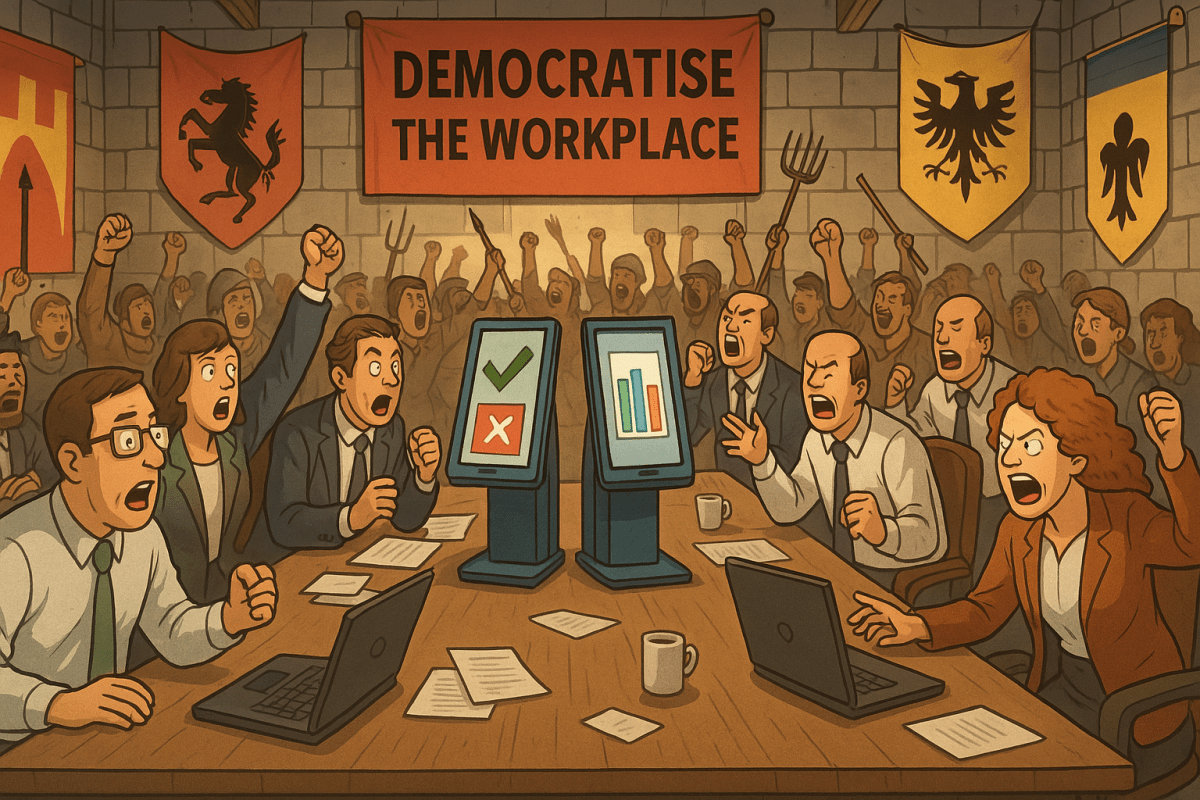
By the time we reach Chapter Seven of Technofeudalism: What Kills Capitalism, Yanis Varoufakis drops the ledger sheets and spreadsheets and starts sketching utopia in crayon. Entitled Escape from Technofeudalism, it proposes—brace yourself—a workplace democracy. It’s aspirational, yes. Compelling? Not particularly. Especially if, like me, you’ve long since stopped believing that democracy is anything more than a feel-good placebo for structural impotence.
Audio: NotebookLM podcast discussing this topic.
To be clear: the preceding chapters, particularly the first six, are sharp, incisive, and frankly, blistering in their indictment of today’s economic disfiguration. But Chapter Seven? It’s less an escape plan, more a group therapy session masquerading as an operational model.
So let’s take his proposal for Democratised Companiesapart, one charming layer at a time.
“Imagine a corporation in which every employee has a single share that they receive when hired…”
Splendid. One person, one vote. Adorable.
“All decisions – hiring, promotion, research, product development, pricing, strategy – are taken collectively…”
Because there’s nothing more efficient than a hiring committee comprised of thirty engineers, two janitors, a receptionist, and Steve from Accounts, whose main contribution is passive-aggressive sighing.
“…with each employee exercising their vote via the company’s intranet…”
Marvellous. We’ve now digitised the tyranny of the majority and can timestamp every idiotic decision for posterity.
“Equal ownership does not, however, mean equal pay.”
A relief. Until it doesn’t.
“Pay is determined by a democratic process that divides the company’s post-tax revenues into four slices…”
Here, dear reader, is where the cake collapses. Why, precisely, should a randomly-assembled group of employees—with wildly varying financial literacy—be entrusted to divide post-tax revenue like it’s a birthday cake at a toddler’s party?
And how often are these slices recalibrated? Each fiscal year? Every time someone is hired or fired? Do we amend votes quarterly or wait until the economic ship has already struck an iceberg?
Varoufakis does suggest preference voting to tackle allocation disputes:
“Any proposal to increase one slice must be accompanied by a proposal to reduce expenditure on one or more of the other slices…”
Fine. In theory, algorithmic voting procedures sound neat. But it presumes voters are rational, informed, and cooperative. If you’ve ever seen a corporate Slack thread devolve into emoji warfare, you’ll know that this is fiction on par with unicorns and meritocracy.
“The basic pay slice is then divided equally among all staff – from persons recently employed as secretaries or cleaners to the firm’s star designers or engineers.”
Ah yes, the ‘equality’ bit. Equal pay, unequal contribution. This isn’t egalitarianism—it’s enforced mediocrity. It might work in a monastery. Less so in a competitive tech firm where innovation requires both vision and differentiated incentive.
Now, on to bonuses, which are democratically determined by:
“…employees each given one hundred digital tokens to distribute among their colleagues…”
Welcome to Black Mirror: Workplace Edition. This is less economics, more playground politics. Who gets tokens? The charismatic chatterbox in the break room? The person who shared their lunch? The ghost employee who never shows up but emails back promptly?
And how, pray tell, does one evaluate the receptionist’s contribution relative to the lead engineer’s or the janitor’s? This isn’t peer review—it’s populism with a smiley face.
We’ve all seen “Teacher of the Year” competitions turn into contests of who had the cutest class poster or best cupcakes. Now imagine your livelihood depending on it.
In summary, democracy in the workplace may sound noble, but in practice, it’s the bureaucratic equivalent of herding caffeinated cats. It doesn’t even work in small groups, let alone an organisation of hundreds. Democracy—when applied to every function of an enterprise—is not liberation; it’s dilution. It’s design-by-committee, strategy-by-consensus, and ultimately, excellence-by-accident.
Escape from Technofeudalism? Perhaps. But not by replacing corporate lords with intranet polls and digital tokens. That’s not an exit strategy—it’s a cosplay of collectivism.
I’ve just finished Chapter 5 of Technofeudalism by Greek economist Yanis Varoufakis, and I can’t recommend it enough. Retiring from being a professional economist, I’d paused reading economic fare in favour of philosophy and fiction. Recently, I picked up Hobbes’ Leviathan and Graeber’s Bullshit Jobs, but this one called to me. I recall when it was released. I read some summaries and reviews. I heard some interviews. I thought I understood the gist. I did. But it goes deeper. Much deeper.
I considered Technofeudalism or Feudalism 2.0 as more of a political statement than a sociopolitical one. Now, I know better. Rather than review the book, I want to focus on a specific aspect that occurred to me.
In a nutshell, Varoufakis asserts that with Capitalism, we moved from a world of property-based rents to one of profits (and rents). We’ve now moved past this into a new world based on platform-based rents (and profits and property rents). Rent extraction yields more power than profits, again reordering power structures. Therefore, I think we might want to handle (read: tax) rents separately from profits.
Audio: NotebookLM podcast discussing this topic.
A Radical Proposal for Modern Taxation
Introduction: The Old Dream Reawakened
Economists have long dreamt of a world in which rent — the unearned income derived from control of scarce assets — could be cleanly distinguished from profit, the reward for productive risk-taking. Ricardo dreamt of it. Henry George built a movement upon it. Even today, figures like Thomas Piketty hint at its necessity. Yet rent and profit have grown entangled like ancient ivy around the crumbling edifice of modern capitalism.
Today, under what some call “technofeudalism,” the separation of rent from productive profit has become not merely an academic exercise but a matter of existential urgency. With rents now extracted not only from land but from data, networks, and regulatory capture, taxation itself risks becoming obsolete if it fails to adapt.
Thus, let us lay out a theoretical and applied map for what could — and arguably must — be done.
I. The Theoretical Framework: Defining Our Terms
First, we must operationally define:
Profit: income generated from productive risk-taking — investment, innovation, labour.
Rent: income generated from ownership or control of scarce, non-replicable assets — land, intellectual property, platforms, regulatory privilege.
Key Principle: Rent is unearned. Profit is earned.
This distinction matters because rent is an economic extraction from society’s collective value creation, whereas profit rewards activities that enlarge that pie.
II. Mapping EBITA: Where Rent Hides
EBITA (Earnings Before Interest, Taxes, and Amortisation) is the preferred metric of modern corporate reporting. Within it, rents hide behind several masks:
Property rental income
Intellectual property licensing fees
Monopoly markups
Platform access fees
Network effect premiums
Regulatory arbitrage profits
Parsing rent from EBITA would thus require methodical decomposition.
III. Theoretical Approaches to Decomposing EBITA
Cost-Plus Benchmarking
Estimate what a “normal” competitive firm would earn.
Treat any surplus as rent.
Rate-of-Return Analysis
Compare corporate returns against industry-normal rates adjusted for risk.
Excess returns imply rent extraction.
Monopolistic Pricing Models
Apply measures like the Lerner Index to estimate pricing power.
Deduce the rentier share.
Asset Valuation Decomposition
Identify earnings derived strictly from asset control rather than active operation.
Economic Value Added (EVA) Adjustments
Assign a competitive cost of capital and strip out the residual super-profits as rents.
IV. Toward Applied Solutions: Imposing Sanity on Chaos
In theory, then, we could pursue several applied strategies:
Mandated Rent-Adjusted Reporting
Require corporations to file a “Rent-Adjusted EBITA” metric.
Auditors would have to categorise income streams as “productive” or “rentier.”
Differential Taxation
Tax normal profits at a competitive corporate rate.
Tax rents at punitive rates (e.g., 70-90%), since taxing rents does not distort incentives.
Sector-Specific Rent Taxes
Levy special taxes on land, platforms, patents, and monopoly franchises.
Create dynamic rent-extraction indices updated annually.
Platform Rent Charges
Impose data rent taxes on digital platforms extracting value from user activity.
Public Registry of Rents
Create a global registry classifying rents by sector, firm, and mechanism.
Provide public transparency to rent-seeking activities.
V. The Political Reality: Clouds on the Horizon
Needless to say, the aristocracy of the digital age will not go gentle into this good night. Rentiers — whether in Silicon Valley, the City of London, or Wall Street — are deeply entwined with the political machinery that might otherwise regulate them.
Yet the costs of inaction are higher. If rent extraction continues to eclipse productive activity, the very legitimacy of markets — and democracy — will erode into cynicism, stagnation, and oligarchic decay.
Conclusion: The Choice Before Us
Separating rent from profit is not merely a technocratic tweak. It is a radical act — one that could reorient economic activity away from parasitic extraction and back toward genuine value creation.
In a world where algorithms are castles, platforms are fiefdoms, and data is the new serfdom, reclaiming the ancient dream of taxing rent is no longer optional. It is, quite simply, the price of our collective survival.
Given all of the clamouring about taxations and abolishing the Internal Revenue Service, affectionately known as the IRS. In Britain, one may be more aware of His Majesty’s Revenue and Customs (HMRC). In France, it’s Direction générale des Finances publiques (DGFiP).
Audio: NotebookLM podcast on this topic.
Given how up in arms the reincarnation of the NAZI party, disfectionately known as Republicans (or Republican’ts depending on your mood or persuasion), have been towards the IRS and taxation in general – they love to cosplay tossing crates of tea into harbours – I asked ChatGPT to clarify the originals of income taxes in the United States.
For the benefit of more casual readers, income taxes were unconstitutional – illegal – until 1913. These were snuck in under the guise of only applying to the wealthy, the 1% of the time. But once the floodgates were opened, the focus shifted to the 95%, increasingly exempting the wealthy. Even so, they still complain and evade.
Enough wittering. Here’s what ChatGPT had to say on the matter.
The Republican Party — yes, that bastion of “limited government” and “individual liberty” — was the main political force that promoted and passed the constitutional income tax that became the 16th Amendment.
To sprinkle a little more salt into the irony wound: it was under President William Howard Taft, a Republican, that the push for a constitutional amendment authorising federal income taxes really gained momentum. Congress proposed the 16th Amendment in 1909 (during Taft’s administration), and it was ratified by the states in 1913 — just in time for the modern federal leviathan to roll up its sleeves and plunge its greasy hands into everyone’s pockets.
Now, to be fair (or at least historically accurate), Taft and the Republicans framed it as a political counterattack against the Democrats’ attempts to impose income taxes via ordinary legislation — taxes which had been previously struck down by the Supreme Court in Pollock v. Farmers’ Loan & Trust Co. (1895). The amendment was sold as a “clarification” of federal powers. Think of it as constitutional tax laundering: put the amendment through, and voilà, what was once forbidden now becomes nobly sanctioned.
So yes — the same Republican Party that today wails about taxation like it’s the herald of the apocalypse, once upon a time delivered the federal income tax into America’s cradle. Swaddled it. Rocked it to sleep. Burped it.
Watching Sam Harris ruminate on the nature of political lies (still believing, poor lamb, that reason might one day triumph) reminds me of something more sinister: lies today are not attempts at persuasion. They are shibboleths — tribal passwords, loyalty oaths, secret handshakes performed in the broad light of day.
Video: Sam Harris tells us why Trump and his ilk lie.
Forget “alternative facts.” That charming euphemism was merely a decoy, a jangling set of keys to distract the infantile media. The real game was always deeper: strategic distortion, the deliberate blurring of perception not to deceive the outsider, but to identify the insider.
Audio: NotebookLM podcast on this topic.
When Trump — or any other post-truth demagogue — proclaims that penguins are, in fact, highly trained alien operatives from the Andromeda galaxy, the objective is not persuasion. The point is to force a choice: will you, standing before this glistening absurdity, blink and retreat into reason, stammering something about ornithology… Or will you step forward, clasp the hand of madness, and mutter, ‘Yes, my liege, the penguins have been among us all along’?
Those who demur, those who scoff or gasp or say ‘You’re an idiot,”’have failed the loyalty test. They have outed themselves as enemy combatants in the epistemic war. Truth, in this brave new world, is not a destination; it is an allegiance. To speak honestly is to wage rebellion.
Orwell, who tried very hard to warn us, understood this dynamic well: the real triumph of Big Brother was not merely to compel you to lie but to compel you to believe the lie. Koestler, another battered prophet of the age, charted how political movements sink into ritualistic unreason, demanding not conviction but performance. Swift, for his part, knew it was all hilarious if you tilted your head just right.
The bigger the lie, the better the shibboleth. Claim that two and two make five, and you catch out the weak-willed rationalists. Claim that penguins are extraterrestrials, and you find the truly devoted, the ones willing to build altars from ice and sacrifice to their feathery overlords.
It’s no accident that modern political theatre resembles a deranged initiation ritual. Each day brings a new absurdity, a fresh madness to affirm: ‘Men can become women by declaration alone!” “Billionaires are victims of systemic oppression!’ ‘The penguins are amongst us, plotting!’ Each claim a little more grotesque than the last, each compliance a little more degrading, a little more irreversible.
And oh, how eagerly the initiates rush forward! Clap for the penguins, or be cast out into the howling wilderness! Better to bend the knee to absurdity than be marked as an unbeliever. Better to humiliate yourself publicly than to admit that the Emperor’s penguin suit is just a costume.
Meanwhile, the opposition — earnest, naive — keeps trying to argue, to rebut, to point out that penguins are terrestrial flightless birds. How quaint. How pathetic. They do not understand that the moment they say, “You’re an idiot,” they’ve broken the spell, declared themselves apostates, and rendered themselves politically irrelevant.
The shibboleth, once uttered, divides the world cleanly: the believers, who will say anything, do anything, believe anything, provided it marks them safe from exile; and the infidels, who cling stupidly to reality.
The future belongs, not to the true, but to the loyal. Not to the rational, but to the ritualistic. The more extravagant the lie, the greater the proof of your faith.
So raise a glass to the penguins, ye of faint heart, and prepare your soul for abasement. Or stand firm, if you dare, and be prepared to be eaten alive by those who traded reason for the rapture of belonging.
After all, in the land of the blind, the one-eyed man is not king. He’s a heretic.
We live in an age of two-dimensional minds trying to navigate a three-dimensional world—and doing it with all the grace of a toddler wielding a chainsaw. For over a generation, the US and UK have been polarised, Balkanised, and lobotomised by the Great Red vs. Blue Punch & Judy Show. Left, right. Us, them. Hero, villain. There is no nuance, no gradient, no middle ground. Just a glorious reduction of civilisation’s complexities into primary-coloured football teams for emotionally underdeveloped adults.
This is not politics. This is pantomime.
Audio: NotebookLM podcast on this topic.
And the real tragedy? The world isn’t even two-dimensional. It’s not even three. Try thinking of it as a cube—six sides at least, all pressing in at once, depending on your angle. Culture, history, class, geography, education, trauma, temperament, aesthetic preference—each a face of the cube. But tell that to the modern partisan and they’ll squint at you like you’ve just tried to explain jazz to a toaster.
No, to them, the world is flat. A line. A tug-of-war between two equally blinkered tribes dragging the rest of us into the pit. Pick a side or shut up, they shriek. If you’re not with us, you’re against us. If you don’t chant the correct slogans or signal the proper virtues, you’re obviously a heretic, a bigot, or—worst of all—centrist scum. They don’t want conversation; they want confirmation. Preferably in 280 characters or less.
Try introducing complexity and you’ll be accused of bothsidesism, moral cowardice, or—God forbid—thinking. It’s like throwing a Rubik’s cube into a toddler fight club.
This binary reductionism doesn’t stop at politics. Even gender—possibly the most nuanced and intimate aspect of human identity—has been flattened into a tug-of-war between biological essentialists and gender abolitionists, both sides wielding hashtags like holy relics. The irony? These same culture warriors still manage to marvel at rainbows, utterly unaware that their own worldview only permits two colours. How do they even process a traffic light?
The cult of the binary isn’t just intellectually bankrupt—it’s a threat to civilisation. We didn’t crawl out of the primordial ooze, develop language, invent calculus, and split the atom just so Karen and Kev from Facebook could reduce geopolitics to an episode of EastEnders. The world is messy. People are contradictory. Context matters. But nuance doesn’t trend.
We’re governed by algorithms, policed by outrage, and divided by design. The machinery of mass culture rewards the loudest, angriest, most wilfully ignorant voices, and we feed the beast like dopamine-addled pigeons pecking a lever. The cube has been flattened into a cartoon. And yet we wonder why everything feels broken.
So here’s a radical idea: what if we stopped flattening the world into a battlefield and started mapping it like a landscape? What if we admitted that not every problem has two sides—some have two hundred? What if we taught critical thinking instead of tribal loyalty? What if we made complexity sexy again?
But I digress. That might require imagination. And we’ve outsourced that to TikTok influencers and AI chatbots.
Meanwhile, the cube spins. And the rest of us try to hold on.
I’m not a fan of IQ as a general metric. Let us be done with the cult of the clever. Let us drag the IQ score from its pedestal, strip it of its statistical robes, and parade it through the streets of history where it belongs—next to phrenology, eugenics, and other well-meaning pseudosciences once weaponised by men in waistcoats.
The so-called Intelligence Industrial Complex—an infernal alliance of psychologists, bureaucrats, and HR departments—has for too long dictated the terms of thought. It has pretended to measure the immeasurable. It has sold us a fiction in numerical drag: that human intelligence can be distilled, packaged, and ranked.
Audio: NotebookLM podcast on this topic.
What it measures, it defines. What it defines, it controls.
IQ is not intelligence. It is cognitive GDP: a snapshot of what your brain can do under fluorescent lights with a timer running. It rewards abstraction, not understanding; speed, not depth; pattern recognition, not wisdom. It’s a test of how well you’ve been conditioned to think like the test-makers.
This is not to say IQ has no value. Of course it does—within its own ecosystem of schools, bureaucracies, and technocracies. But let us not mistake the ruler for the terrain. Let us not map the entire landscape of human potential using a single colonial compass.
True intelligence is not a number. It is a spectrum of situated knowings, a polyphony of minds tuned to different frequencies. The Inuit hunter tracking a seal through silence. The griot remembering centuries of lineage. The autistic coder intuiting an algorithm in dreamtime. The grandmother sensing a lie with her bones. IQ cannot touch these.
To speak of intelligence as if it belonged to a single theory is to mistake a monoculture for a forest. Let us burn the monoculture. Let us plant a thousand new seeds.
A Comparative Vivisection of Intelligence Theories
Theory / Model
Core Premise
Strengths
Blind Spots / Critiques
Cultural Framing
IQ (Psychometric g)
Intelligence is a single, general cognitive ability measurable via testing
Predicts academic & job performance; standardised
Skewed toward Western logic, ignores context, devalues non-abstract intelligences
Western, industrial, meritocratic
Multiple Intelligences (Gardner)
Intelligence is plural: linguistic, spatial, musical, bodily, etc.
Recognises diversity; challenges IQ monopoly
Still individualistic; categories often vague; Western in formulation
Liberal Western pluralism
Triarchic Theory (Sternberg)
Intelligence = analytical + creative + practical
Includes adaptability, real-world success
Still performance-focused; weak empirical grounding
Western managerial
Emotional Intelligence (Goleman)
Intelligence includes emotion regulation and interpersonal skill
Useful in leadership & education contexts
Commodified into corporate toolkits; leans self-help
Western therapeutic
Socio-Cultural (Vygotsky)
Intelligence develops through social interaction and cultural mediation
Recognises developmental context and culture
Less attention to adult or cross-cultural intelligence
Soviet / constructivist
Distributed Cognition / Extended Mind
Intelligence is distributed across people, tools, systems
Breaks skull-bound model; real-world cognition
Hard to measure; difficult to institutionalise
Post-cognitive, systems-based
Indigenous Epistemologies
Intelligence is relational, ecological, spiritual, embodied, ancestral
Holistic; grounded in lived experience
Marginalised by academia; often untranslatable into standard metrics
Global South / decolonial
Conclusion: Beyond the Monoculture of Mind
If we want a more encompassing theory of intelligence, we must stop looking for a single theory. We must accept plurality—not as a nod to diversity, but as an ontological truth.
Intelligence is not a fixed entity to be bottled and graded. It is a living, breathing phenomenon: relational, situated, contextual, historical, ecological, and cultural.
And no test devised in a Princeton psych lab will ever tell you how to walk through a forest without being seen, how to tell when rain is coming by smell alone, or how to speak across generations through story.
It’s time we told the Intelligence Industrial Complex: your number’s up.
Reading Leviathan has me thinking. Nothing new, mind you—just reinvigorated. Hobbes, bless his scowling soul, is the consummate pessimist. People, in his view, are untrustworthy sods, ready to stab you in the back at the first flicker of opportunity. He doesn’t believe in community. He believes in containment.
Audio: NotebookLM discussion about this topic.
And to be fair, he’s not entirely wrong. He captures a certain cohort with uncanny accuracy. You know the type. Type-A™ personalities: the Donald Trumps, Elon Musks, Adolph Hitlers, Shahs of Iran, and that guy in marketing who always schedules meetings for 8am. The ones who salivate at the mere whiff of power, who’d sell their grandmothers for a press release and call it vision.
This, in short, is why we can’t have nice things.
Now, I’ll concede that most people want more than they have. Economics depends on this assumption like religion depends on guilt. But not everyone is driven by an insatiable lust for money, dominance, or legacy. That, my friends, is not ambition. It is pathology—a malignant, metastasising hunger that infects the likes of Trump, Musk, Bezos, Sunak, and their ilk. The hunger to rule, not just participate.
The trouble is, the majority of the world’s population are idiots—not technically, but metaphorically. Soft-headed. Overstimulated. Easily distracted by flags, influencers, and “free shipping.” And there are flavours of idiots. Musk is a lucky idiot. Trump is a useful idiot. Most are a hair’s breadth from being cannon fodder.
And then we wonder why everything’s broken.
The world could be configured differently. It could consist of autonomous collectives, each minding its own business, each respecting the other’s boundaries like courteous houseplants. But this equilibrium is shattered—always shattered—by the predatory few. The outliers. The sharks in suits. The ones who mistake governance for domination and diplomacy for personal branding.
So we build mechanisms to defend ourselves—laws, institutions, surveillance, standing armies—but these mechanisms inevitably attract the same types we were trying to ward off. Power-hungry cretins in different hats. The protectors, it turns out, are rarely benevolent dictators. They are predacious politicos, wearing virtue like a costume, mouthing justice while tightening the screws.
And here lies the eternal problem. Not technology. Not ideology. Not even ignorance.
But the recurring infestation of pathological ambition in a species otherwise just trying to get on with its day.
I’ve read Part I of Hobbes’ Leviathan and wonder what it would have been like if he filtered his thoughts through Hume or Wittgenstein. Hobbes makes Dickens read like Pollyanna. It’s an interesting historical piece, worth reading on that basis alone. It reads as if the Christian Bible had to pass through a legal review before it had been published, sapped of vigour. As bad a rap as Schopenhauer seems to get, Hobbes is the consummate Ebenezer Scrooge. Bah, humbug – you nasty, brutish, filthy animals!*
Audio: NotebookLM podcast conversation on this topic.
In any case, it got me thinking of free will and, more to the point, of will itself.
A Brief History of Humanity’s Favourite Metaphysical Scapegoat
By the time Free Will turned up to the party, the real guest of honour—the Will—had already been drinking heavily, muttering incoherently in the corner, and starting fights with anyone who made eye contact. We like to pretend that the “will” is a noble concept: the engine of our autonomy, the core of our moral selves, the brave little metaphysical organ that lets us choose kale over crisps. But in truth, it’s a bloody mess—philosophy’s equivalent of a family heirloom that no one quite understands but refuses to throw away.
So, let’s rewind. Where did this thing come from? And why, after 2,500 years of name-dropping, finger-pointing, and metaphysical gymnastics, are we still not quite sure whether we have a will, are a will, or should be suing it for damages?
Plato: Soul, Reason, and That Poor Horse
In the beginning, there was Plato, who—as with most things—half-invented the question and then wandered off before giving a straight answer. For him, the soul was a tripartite circus act: reason, spirit, and appetite. Will, as a term, didn’t get top billing—it didn’t even get its name on the poster. But the idea was there, muddling along somewhere between the charioteer (reason) and the unruly horses (desire and spiritedness).
No explicit will, mind you. Just a vague sense that the rational soul ought to be in charge, even if it had to beat the rest of itself into submission.
Aristotle: Purpose Without Pathos
Aristotle, ever the tidy-minded taxonomist, introduced prohairesis—deliberate choice—as a sort of proto-will. But again, it was all about rational calculation toward an end. Ethics was teleological, goal-oriented. You chose what aligned with eudaimonia, that smug Greek term for flourishing. Will, if it existed at all, was just reason picking out dinner options based on your telos. No inner torment, no existential rebellion—just logos in a toga.
Augustine: Sin, Suffering, and That Eternal No
Fast-forward a few hundred years, and along comes Saint Augustine, traumatised by his libido and determined to make the rest of us suffer for it. Enter voluntas: the will as the seat of choice—and the scene of the crime. Augustine is the first to really make the will bleed. He discovers he can want two incompatible things at once and feels properly appalled about it.
From this comes the classic Christian cocktail: freedom plus failure equals guilt. The will is free, but broken. It’s responsible for sin, for disobedience, for not loving God enough on Wednesdays. Thanks to Augustine, we’re stuck with the idea that the will is both the instrument of salvation and the reason we’re going to Hell.
Cheers.
Medievals: God’s Will or Yours, Pick One
The Scholastics, never ones to let an ambiguity pass unanalysed, promptly split into camps. Aquinas, ever the reasonable Dominican, says the will is subordinate to the intellect. God is rational, and so are we, mostly. But Duns Scotus and William of Ockham, the original voluntarist hooligans, argue that the will is superior—even in God. God could have made murder a virtue, they claim, and you’d just have to live with it.
From this cheerful perspective, will becomes a force of arbitrary fiat, and humans, made in God’s image, inherit the same capacity for irrational choice. The will is now more than moral; it’s metaphysical. Less reason’s servant, more chaos goblin.
Hobbes: Appetite with Delusions of Grandeur
Then along comes Thomas Hobbes, who looks at the soul and sees a wheezing machine of appetites. Will, in his famously cheery view, is simply “the last appetite before action.” No higher calling, no spiritual struggle—just the twitch that wins. Man is not a rational animal, but a selfish algorithm on legs. For Hobbes, will is where desire stumbles into motion, and morality is a polite euphemism for not getting stabbed.
Kant: The Will Gets a Makeover
Enter Immanuel Kant: powdered wig, pursed lips, and the moral rectitude of a man who scheduled his bowel movements. Kant gives us the “good will”, which acts from duty, not desire. Suddenly, the will is autonomous, rational, and morally legislative—a one-man Parliament of inner law.
It’s all terribly noble, terribly German, and entirely exhausting. For Kant, free will is not the ability to do whatever you like—it’s the capacity to choose according to moral law, even when you’d rather be asleep. The will is finally heroic—but only if it agrees to hate itself a little.
Schopenhauer: Cosmic Will, Cosmic Joke
And then the mood turns. Schopenhauer, world’s grumpiest mystic, takes Kant’s sublime will and reveals it to be a blind, thrashing, cosmic force. Will, for him, isn’t reason—it’s suffering in motion. The entire universe is will-to-live: a desperate, pointless striving that dooms us to perpetual dissatisfaction.
There is no freedom, no morality, no point. The only escape is to negate the will, preferably through aesthetic contemplation or Buddhist-like renunciation. In Schopenhauer’s world, the will is not what makes us human—it’s what makes us miserable.
Nietzsche: Transvaluation and the Will to Shout Loudest
Cue Nietzsche, who takes Schopenhauer’s howling void and says: yes, but what if we made it fabulous? For him, the will is no longer to live, but to power—to assert, to create, to impose value. “Free will” is a theologian’s fantasy, a tool of priests and moral accountants. But will itself? That’s the fire in the forge. The Übermensch doesn’t renounce the will—he rides it like a stallion into the sunset of morality.
Nietzsche doesn’t want to deny the abyss. He wants to waltz with it.
Today: Free Will and the Neuroscientific Hangover
And now? Now we’re left with compatibilists, libertarians, determinists, and neuroscientists all shouting past each other, armed with fMRI machines and TED talks. Some claim free will is an illusion, a post hoc rationalisation made by brains doing what they were always going to do. Others insist that moral responsibility requires it, even if we can’t quite locate it between the neurons.
We talk about willpower, will-to-change, political will, and free will like they’re real things. But under the hood, we’re still wrestling with the same questions Augustine posed in a North African villa: Why do I do what I don’t want to do? And more importantly, who’s doing it?
Conclusion: Where There’s a Will, There’s a Mess
From Plato’s silent horses to Nietzsche’s Dionysian pyrotechnics, the will has shape-shifted more times than a politician in an election year. It has been a rational chooser, a moral failure, a divine spark, a mechanical twitch, a cosmic torment, and an existential triumph.
Despite centuries of philosophical handwringing, what it has never been is settled.
So where there’s a will, there’s a way. But the way? Twisting, contradictory, and littered with the corpses of half-baked metaphysical systems.
Welcome to the labyrinth. Bring snacks.
* The solitary, poor, nasty, brutish, and short quote is forthcoming. Filthy animals is a nod to Home Alone.